ETP 2 kelcy warren
:{===
note tAG
SEE GREENPEACE SLAPP SUIT GIBSON CRUTCHER
ACTIVIST SUPPRESS DAPL? ECO-TERROR?
trump funder maga inc superpac dark monEy ZELDIN CHRIS WRIGHT ENDANGERMENT FUCKERY TERM 2? DEREG? TRUMP ASKED 1B$? PLUTO
PARDON?
HONDURAS PREZ COCAINE TRAFFICKER TRUMP PARDON ROGER
SEE MAIN FOR EARLIER
CORP BAD ACTOR
SEE RICK PERRY DOE CRONY
NO MERRI
congrats you evil feck, 1st non-state actor to do human rights violations, pvt sec honduras
see ETP
also etp tag
SLAPP
FAKE NEWSPAPERS TIMPONE
CONTINENTAL HAMM
activist and press supp bayou LA}:
renamed 2 917
BAK
---
---
---
-=-=
HEATED GMAIL 11 26
 |
An activist dressed as a fossil fuel executive pours fake gas over fake money outside Shell’s headquarters in May 2026. During the 2026 midterm elections, the U.S. fossil fuel industry lit actual money on fire trying to elect Republicans. Photo by James Willoughby/SOPA Images/LightRocket via Getty Images.
The U.S. oil and gas industry spent at least $182 million trying to elect Republicans in last night’s midterm elections¹.
It didn’t buy them very much.
Voters rejected fossil fuel allies and priorities across the country, not only stripping Republicans of control of both the House and Senate, but delivering stunning defeats in fossil-fueled governors’ races, state legislatures, regulatory commissions, and ballot measures.
Here are some notable examples.
- Republicans lost control of the House and Senate despite large oil industry donations. Chevron gave $8.2 million, Koch Inc. gave $6.8 million, and Energy Transfer gave $2 million to the Senate Leadership Fund and Congressional Leadership Fund, according to a Public Citizen analysis. The American Petroleum Institute gave at least another $8 million to the two super PACs, which work to elect Republican majorities in Congress. Republicans still lost both chambers.
- A Texas oil billionaire’s attempt to buy Michigan’s Senate race failed. Texas oil billionaire Tim Dunn gave $5 million to a super PAC backing Republican Mike Rogers in Michigan’s Senate race. It didn’t matter. Voters still elected Democrat Abdul El-Sayed, whose platform includes shutting down the Line 5 pipeline and transitioning to 100 percent renewable energy.
- In fact, pretty much everything Tim Dunn tried to do failed. The ultra-Christian oil billionaire gave more than $11 million to Texas Republican PACs, with almost all of it going to Texans United for a Conservative Majority. And what happened in Texas was the polar opposite of a conservative majority. Speaking of which:
- Chevron and fracking money couldn’t make Texans like Ken Paxton. Lone Star Liberty PAC, the group backing Republican Ken Paxton’s bid for U.S. Senate, received at least $2 million from oil and gas interests, including $200,000 from the Chevron Employees PAC and $250,000 from oil executive Russell Gordy. Fracking billionaire Farris Wilks gave another $250,000 to Paxton Victory. Voters still elected James Talarico, who campaigned on restoring federal support for renewable energy and strengthening clean air and water protections.
- Chevron couldn’t save Susan Collins, either. The oil company gave $200,000 to Pine Tree Results PAC, the super PAC backing Maine’s Republican senator. Voters still elected Democrat Troy Jackson, ending Collins’s nearly three decades in the Senate.
HEATED
- Two oil executives poured ~$6 million down the drain trying to save Greg Abbott. Midland Energy founder Javaid Anwar contributed about $4.37 million to the Texas Republican governor’s re-election campaign, and Energy Transfer’s Kelcy Warren also gave at least $1.5 million. Texans still elected Democrat Gina Hinojosa, who campaigned on making the energy industry pay its fair share and accused Abbott of letting gas companies profit at Texans’ expense during the deadly 2021 blackouts.
- Fossil fuel money couldn’t even save Texas’s fossil fuel regulator. In perhaps the most stunning blue flip in Texas, Democrat Jon Rosenthal won the race to oversee the Texas Railroad Commission, the agency that oversees the state’s massive oil and gas industry—and his did it despite his Republican opponent receiving $1.8 million from oil-linked donors. While Rosenthal hardly portrays himself as a climate champion, he’s campaigned on ending routine flaring and venting, requiring modern leak detection, and enforcing pollution rules.
- An oil heir wasted $18 million trying to buy the Texas attorney general’s office. Republican Mayes Middleton, president of his family’s Middleton Oil Company, contributed $18 million to his own campaign, but ultimately wound up losing to Nathan Johnson, who will become the first elected Democrat attorney general in Texas since 1994. This could have major implications for climate accountability, as state attorneys general have the power to investigate corporate deception and sue fossil fuel companies for misleading the public about climate change. (Middleton also received $100,000 donations from Energy Transfer vice chairman Kelcy Warren and Double Eagle co-founder Cody Campbell, to no avail.)
- Utility and coal money couldn’t keep Georgia’s energy regulators in Republican hands. For the first time in decades, Democrats gained control of Georgia Public Service Commission, which helps decide how much people pay for electricity and which power plants Georgia Power builds. They did this despite fossil fuel money flowing into the race: Republican candidate Fitz Johnson received nearly $200,000 from donors connected to companies the commission regulates, while Republican candidate Josh Tolbert received $63,200 from trusts linked to Alabama’s coal-rich Drummond family.
- Colorado voters will likely reject a Constitutional amendment establishing the right to buy methane gas. Amendment 82’s financial backers were largely unknown, but the ballot measure’s express purpose was to undermine state and local efforts to move buildings to electric appliances—so I’m just assuming it was a fossil fuel-backed measure. Nevertheless, it looks destined for defeat: With counting continuing, Amendment 82 had only about 46 percent support, well short of the 55 percent needed to pass.
- Bonus: Elon Musk flushed $445 million down the toilet. “But Elon Musk isn’t a fossil fuel billionaire,” you say. And sure, perhaps that’s technically true—but it’s getting less true by the day. Earlier this year, his company SpaceX acquired a literal fossil fuel company called APR Energy, in a deal valued at roughly $1 billion. APR operates mobile gas and diesel turbines to power AI data centers. Speaking of which, by June, Musk’s AI company xAI had installed at least 57 methane gas turbines at its Mississippi power plant, according to the NAACP and environmental groups—with enough generating capacity to power an estimated 738,000 to 950,000 homes. If that’s not a man in the fossil fuel business, please tell me what is.
Now, none of this is to say that oil money was entirely defeated in the 2026 midterms. Many fossil fuel-backed Republicans, including Texas Senator August Pfluger and U.S House Majority Leader Steve Scalise, handily won reelection.
Nor is it to say that the oil industry’s priorities will suddenly disappear from U.S. politics. Donald Trump is still the president, and *many* elected Democrats are out and proud champions of methane gas, one of the most climate-polluting fuels on the planet. (Perhaps now this is a good time to remind everyone that James Talarico championed ExxonMobil on the campaign trail).
But last night demonstrated something worth remembering, particularly for people who care about climate change but often doubt whether meaningful progress is possible, and as we head into two more difficult years of trying to achieve some kind of climate action under Donald Trump.
Fossil fuel money is one of the most powerful forces in American politics. It is the biggest obstacle we face in preserving a livable climate for everyone on Earth.
But it is not invincible.
Not even close.
-=-=
---
ref 2 brennan Fossil Fuel Industry Donors See Major Returns in Trump’s Policies
owen b
fossil fuel interests donated heavily to President Trump’s 2024 reelection bid. Months after his victory, oil and gas moguls have continued to pump money into his political coffers. Now, as promised by Trump during the campaign, his administration is embracing their policy agenda and governing in a way that is netting the industry billions.
Part of
Corruption in America**
More on
Trump asked oil and gas executives in 2024 to raise $1 billion for his campaign and told them he’d grant their policy wish list if he won. The investment, he said, would be a “deal” given the taxes and regulation they would avoid under his presidency. He also offered to help fast-track fossil fuel industry mergers and acquisitions if he won.
The industry responded by spending lavishly to elect Trump, giving at least $75 million to his campaign and affiliated PACs, thereby making them a top corporate backer of his reelection bid and a crucial source of funding.
Several oil tycoons gave millions on their own and hosted fundraisers with Trump and his associates. Some oil and gas executives who hadn’t given Trump money during previous cycles made major donations after attending fundraisers where he pledged to start acting on the industry’s policy priorities as soon as he retook the White House.
That’s just the spending we know about. The 2024 election saw record levels of “dark money” spending, where wealthy interests keep their role secret by funneling money through groups that do not disclose their donors. The fossil fuel industry has a history of deploying dark money tactics, and any such spending in 2024 would inherently be obscured.
Even after Trump’s victory in 2024, oil and gas interests have continued to pour money into his political operation. They gave $11.8 million to his inauguration fund, and even though Trump cannot run for a third term, his main super PAC has raked in millions more from the industry since he took office — including $25 million from oil producer Energy Transfer Partners and its CEO, Kelcy Warren.
As promised, Trump is rewarding the industry by adopting its policy agenda as his own. His signature legislative package — which one executive deemed “positive for us across all of our top priorities” — gives oil and gas firms $18 billion in tax incentives while rolling back incentives for clean energy alternatives. He’s placed fossil fuel allies in charge of the agencies that oversee the industry and fast-tracked drilling projects on public lands. In just his first 100 days back in office, Trump took at least 145 actions to undo environmental rules — more than he reversed during his entire first term as president. Before Trump even reentered the White House, the industry was reportedly pre-drafting executive orders for him to issue.
The profits are already rolling in for the industry. Take Warren and Energy Transfer Partners. Trump ended a Biden-era pause on liquefied natural gas exports and cleared the way for Energy Transfer Partners (which extracts liquefied natural gas) to extend a major project. Warren’s personal wealth grew nearly 10 percent after the administration greenlit the project as Energy Transfer Partners reported a boost in profits.
There’s also Occidental Petroleum, which donated $1 million to Trump’s inaugural committee, and whose CEO cohosted a major fundraiser for Trump in May 2024. Occidental is especially well positioned to see boosted profits from the sprawling array of favorable subsidies and tax incentives in his signature bill, passed into law this summer.
Now the Trump administration is taking its biggest swing yet for fossil fuel interests: repealing the “endangerment finding,” the federal government’s formal acknowledgement that global warming from greenhouse gases, produced by burning fossil fuels, endangers the public. The finding gives the government legal authority to set clean air rules, and it’s long been the subject of the fossil fuel lobby’s ire, surviving more than 100 challenges in court. Revoking the finding would erase scores of clean air rules that the industry opposes.
The fossil fuel industry is reaping major returns on its investment in the Trump administration. But what about the costs? Extreme weather events such as flooding, wildfires, and severe storms — which overwhelming scientific consensus has concluded are driven by global warming from fossil fuel usage — are becoming increasingly common, inflicting billions of dollars of damage on American communities and costing thousands of people their lives and livelihoods each year. Life-threatening summer heat affected more than 255 million Americans this year alone. It does not appear that these concerns are having any major impact on government policy, and instead, the administration fired hundreds of scientists tasked with tracking these issues.
Trump is far from the first president to use the office in ways that reward wealthy donors. Decades of harmful Supreme Court decisions, decaying anticorruption and campaign finance guardrails, and inadequate enforcement of existing rules around money in politics have enabled an unprecedented concentration of wealth and political power. So while Trump’s embrace of the fossil fuel industry’s agenda isn’t breaking entirely new ground, it offers yet another stark example of how wealthy interests are shaping policies that affect the lives of all Americans.
-=-=
---
August 4, 2025
Trump’s MAGA Inc. SuperPAC Donor List is Littered with Corporate and Billionaire Influence Buyers
WASHINGTON D.C. — President Trump’s MAGA Inc. SuperPAC received $1 million or more from 58 donors since January, according to the SuperPAC’s most recent campaign finance disclosure filed last week.
The million-dollar donor list includes numerous corporate and billionaire donors with interests in influencing the Trump administration, including two crypto companies that were facing SEC investigations that have since been dropped and a seller of “skin substitute” products that benefited from the delay of a Biden-era Medicare rule to limit spending on their products.
“The real question this mega-donor list raises is not ‘how much,’ but ‘who from?’” said Jon Golinger, democracy advocate for Public Citizen. “By taking contributions from wealthy individuals and industries who want something from government, Trump’s SuperPAC has used pay-to-play to raise big money from special interests like a legalized shakedown.”
Public Citizen analyzed the new MAGA Inc. SuperPAC filing with the Federal Election Commission, covering the period of January 1 – June 30, 2025, and found the following:
- Corporations gave $73.2 million
- Billionaires gave $49.2 million
- Cryptocurrency corporations, executives, and investors gave $41.7 million
- Fossil fuel corporations and executives gave $26.8 million
- Healthcare corporations and executives gave $12 million
- Donations of $1 million or more from corporations and billionaires included:
- $25 million (combined) from Energy Transfer LP and CEO Kelcy Warren. Energy Transfer is suing the Pipeline and Hazardous Materials Safety Administration, asking a judge to declare the agency’s in-house enforcement system unconstitutional.
- $16 million from Jeff Yass, a billionaire who owns a stake in TikTok’s parent company. TikTok is facing a Department of Justice lawsuit alleging violations of the Children’s Online Privacy Protection Act.
- $10 million in February 2025 from Foris Dax, Inc., which operates Crypto.com. Crypto.com was under investigation by the SEC over allegations of allegedly trading unregistered securities. The SEC investigation was reportedly dropped in March 2025.
- $5 million from the “skin substitute” company Extremity Care. In April 2025, the Trump Administration postponed implementation of a Biden-era rule that would limit Medicare spending on skin substitute products.
- $1 million (combined) in January 2025 from Gemini Trust Company (DBA Gemini) co-founders Cameron and Tyler Winklevoss. At that time, Gemini was under investigation by the SEC for allegedly trading unregistered securities. The SEC investigation was reportedly dropped in February 2025.
---
---
12:23
Which people told you to pardon him?
12:26
Because curiously, Hernandez had spent
12:28
years cozing up to the far right in the
12:30
US and made himself a lot of friends.
12:32
According to the Wall Street Journal, he
12:34
forged a partnership with Kelsey Warren,
12:36
a Texas energy billionaire and major
12:38
Trump donor who owns a utility company
12:40
in the country. Hernandez also helped
12:42
propel the privatized city of Prosper in
12:44
the country, a project in which Trump
12:46
donors Peter Teal, Mark Andre, Sam
12:48
Alman, and CEO of Coinbase Brian
12:50
Armstrong are all heavily invested.
12:53
Hernandez was their meal ticket. As Gil
12:56
Duran writes, he championed special
12:58
economic zones where investors could set
13:00
their own tax, labor, and regulatory
13:02
rules under long-term legal guarantees.
13:05
However, when Hernandez's successor,
13:07
Samara Castro, came into office, she
13:10
rolled back the special economic zones.
13:12
That made longtime Trump fixer Roger
13:14
Stone write in January on his Substack.
13:17
Yes, even cartoon villains are on
13:19
Substack that Trump should crush
13:22
socialism and save a freedom city known
13:24
as Prosper. And indeed, it was Stone
13:27
that met with Trump at Mara Lago and
13:29
lobbyed him to pardon Hernandez. So yes,
13:32
400 tons of cocaine are a-ok okay to
13:35
enter the US. I mean, how else is
13:38
Palanteer's Alexander Karp supposed to
13:40
sit through an entire interview?
13:42
Lot of decisions when we began talking
13:44
annoying each other 10 years ago.
13:46
Hopefully I'm annoying you as much as 10
13:47
years ago. Uh or more uh when when when
13:52
Sorry, did I say sit? I meant fly. Now,...
The Bitchuation Room (with Francesca Fiorentini)
---}:
ymail steve d 9 25
The Amsterdam case is now a major lifeline for Greenpeace after the group was hit in March with an outrageous $669 million damages verdict following a rigged trial in North Dakota. That case was financed by Warren.
What happens in Amsterdam literally could determine if Greenpeace lives or dies.
-----
tools lil sis
mapping-the-billionaire-winners-of-the-2024-election
December 12, 2024
Author(s): Derek Seidman
Issues: Billionaires, Money in Politics
This is the first in a new series of LittleSis posts mapping out billionaire power in current U.S. politics, including the new Trump administration. To see the latest posts in this LittleSis series, sign up for our newsletter and follow us on*X*,*Bluesky*,*Facebook*, and[Instagram
no charts
It’s nothing new that, in 2024, billionaires once again plowed massive amounts of cash into the presidential and congressional elections. Dozens upon dozens of billionaires backed Trump and Harris with huge donations. According to one study, billionaire families spent a mind-boggling $2 billionon the recents elections.
That said, the sheer amount of cash flowing from just a tiny handful of billionaire donors — with $994 million from the top ten contributors alone, measured beforefinal-quarter contributions of 2024 were even disclosed — is astronomical. Moreover, the crassness of Trump’s open embrace of the ultra-wealthy feels shocking even by the standards of U.S. billionaire rule. Trump’s transition is refusing to disclose donors, and Trump’s authoritarian style and total disdain for any ethics around conflicts of interests, will give billionaires even more unchecked power.
The extent of directbillionaire influence within the administration is seen in the very make-up of Trump’s transition team and top appointees, whose ranks include multiple billionaires. Two of those billionaires — Linda McMahon and Howard Lutnick — are co-chairing Trump’s transition team, and thus overseeing the set-up of his incoming administration. Trump has further nominated McMahon for Education secretary and Lutnick for Commerce Secretary. Meanwhile, billionaire Scott Bessent is set to become Treasury Secretary, meaning two billionaires — Lutnick and Bessant — will occupy core positions overseeing financial and economic policy.
Trump has also appointed two billionaires, Vivek Ramaswamy and Elon Musk, as co-chairs of the new Department of Government Efficiency, which is tasked with advising the administration on government cuts and austerity. Musk, of course, is the wealthiest person alive, and Musk, Lutnick, and McMahon are known to be especially close with Trump.
All told, according to a November 2024 Americans for Tax Fairness report, “the combined wealth of President-elect Trump’s wealthiest nominees and transition team officials,” amounts to $313 billion — and this number has since climbed well over $400 billion with Elon Musk’s net worth skyrocketing. As former labor secretary Robert Reich has said, Trump’s regime “will be a billionaires’ ball.”
This post looks at some of the billionaires and billionaire groups — Wall Street elites to crypto tycoons, fossil fuel barons to Elon Musk — that are set to benefit from the incoming Trump administration.
Wall Street Billionaires
A host of powerful Wall Street billionaires lined up behind Trump as major donors and fundraisers toward his reelection and as donors to his GOP allies.
These Wall Street billionaires, concentrated in private equity and hedge funds, included Stephen Schwarzman of Blackstone (worth $53.8 billion), Ken Griffin of Citadel (worth$47 billion), Paul Singer of Elliott Management (worth $6.2 billion), John Paulson of Paulson & Co. (worth $3.8 billion), and Nelson Peltz of Trian Partners (worth $1.7 billion).
Two Wall Street billionaires — Howard Lutnick and Scott Bessant — are also set to become Commerce Secretary and Treasury Secretary, respectively. Other financial billionaires, like JPMorgan CEO Jamie Dimon, have reportedly been serving as a “sounding board” for Trump.
All told, according to *Sludge*, “[d]onors from the securities and investment industry contributed a total of $193.8 million to the Trump campaign and outside spending groups supporting him, more than any other industry,” as of September 22, 2024.
Wall Street’s support for Trump has not been entirely smooth. Some billionaires like Schwarzman, Peltz, Griffin and others had previously disavowed Trump, especially after the January 6, 2021 capitol insurrection, before crawling back.
Moreover, there are tensions between Wall Street and Trump over issues like tariffs (which Wall Street opposes) and mass deportations (which Wall Street also opposes, but for purely economic reasons, not any humanitarian grounds). Overall, the financial industry is not a fan of the volatility and unpredictability that can come with a Trump regime.
But all this is rivalled — and indeed, for most Wall Street barons, outweighed — by the enormous potential to enrich themselves under Trump.
Trump has promised to reduce the corporate tax rate and to weaken regulatory bodies like the Securities and Exchange Commission (SEC) and Consumer Financial Protection Bureau (CFPB), and Wall Street is salivating over a potential mergers and acquisitions boom under Trump.
There’s also the potential for Wall Street to cash in on the privatization of public assets. For example, Trump backers John Paulson and Bill Ackman are big investors in the federal government’s housing finance companies, Freddie Mac and Fannie Mae, which, theNew York Times reports, could be privatized under Trump and deliver huge windfalls to investors.
One private equity executive, commenting before the election, summed up Wall Street’s perspective on Trump: “We’ll get richer if he wins.”
To be sure, many Wall Street barons, from Michael Bloomberg to Jonathan Gray, backed Kamala Harris. But they will not be hurting under the new Trump administration (Gray, in fact, is President and Chief Operating Officer of Blackstone, where he’s second-in-line to the Trump-backing Schwarzman).
*Crypto Billionaires
The 2024 election cycle signaled the clear emergence of the crypto elite as a major political player. Prominent crypto billionaires — such as Cameron and Tyler Winklevoss (worth $2.7 billion each), Coinbase’s Brian Armstrong (worth $13.7 billion), investor Marc Andreessen (worth $1.9 billion), Ripple Labs’ Brad Garlinghouse, and others — plowed millions towards pro-crypto PACs while crypto billionaires donated and fundraised for Trump.
All told, a triad of crypto-led PACs — Fairshake, Project Progress, and Defend American Jobs — spent more than $265.5 million dollars during the 2024 election cycle, according to the Lever,who declared that “the cryptocurrency industry is perhaps the biggest winner of the 2024 election cycle.”
The crypto industry has been volatile and faced fines, with growing calls, including from the Biden administration, for stronger regulation. Many crypto billionaires backed Trump, who courted the industry and said he’d be the first “crypto president,” betting that he’d stem these regulatory calls and also replace current SEC head Gary Gensler.
It appears the Trump-backing crypto barons will now get their wish, with top Trump cabinet appointees and power players who are very friendly to the industry. Howard Lutnick, the billionaire Trump ally who Trump nominated as Commerce Secretary, is deeply pro-crypto and personally tied to the industry. Trump also tapped pro-crypto billionaire Scott Bessent as Treasury Secretary, who one crypto executive called the “perfect pick” who will be “most pro-innovation, pro-crypto Treasury [secretary] we’ve ever seen.”
Many crypto leaders want the Commodity Futures Trading Commission (CFTC), rather than the more powerful SEC, to supervise the industry, and Trump has signaled support for this. Trump has also nominated the crypto-allied Paul Atkins to head the SEC, fulfilling the crypto billionaire bloc’s wish to ditch Gary Gensler, who it sees as an ardent foe.
The denizens of Trump World are adamantly pro-crypto, with numerous figures — JD Vance, Howard Lutnick, Elon Musk, Robert Kennedy Jr., Pete Hegseth, Tulsi Gabbard, and others — tied to or invested in the industry. Trump’s own media company, Trump Media and Technology Group, which operates Truth Social, and which Trump has a 53% stake in that he says he’ll retain, is in talks to buy Bakkt, a cryptocurrency trading venue, while the Trump family has a newly-created crypto project called World Liberty Financial. The former CEO of Bakkt is Kelly Loeffler, who Trump has nominated to head the Small Business Administration, and Loeffler’s husband still runs Bakkt’s parent company.
Crypto saw a major downturn in 2022, and one of its shining stars, Sam Bankman-Fried, was arrested on fraud charges and subsequently found guilty and sentenced to 25 years in prison. But the industry’s started to bounce back, with Bitcoin hitting record highs and surging more after Trump’s victory. The industry and its billionaires have also attained cultural cachet in the Trumpian conservative universe as edgy, rule-breaking, and futuristic.
Another tech and crypto billionaire investor, David Sacks, publicly flipped toward supporting Trump during the election and helped line up Silicon Valley donors behind him with a fundraiser Sacks’ personally hosted. Now, Trump has named Sacks his artificial intelligence and cryptocurrency czar.
All told, crypto’s massive backing of Trump is reaping major rewards for industry billionaires, who will have pro-crypto regulators and close access to the administration, and who are set to see their wealth bloom even higher.
The rise of an aggressive, anti-regulatory pro-Trump donor bloc deeply overlaps with a split in Silicon Valley that turned some tech billionaires toward Trump. The Guardianestimates that the tech industry spent at least $394.1 million on the election, with the bulk of that coming from Elon Musk.
Tech’s Trump backers are already getting one top demand from their wishlist: Trump is replacing Federal Trade Commission chair Lina Khan, a tough regulator of AI and corporate mergers, with a more industry-friendly chair.
But to be sure, Kamala Harris and the Democrats had their own massive bench of Silicon Valley billionaire donors, including Reid Hoffman, Eric Schmidt, Bill Gates, Sheryl Sandberg, Ben Horwitz, and Laurene Powell Jobs. And while they wanted Harris to win, as Hoffman made clear in a somewhat conciliatory post-election Financial Times op-ed, his ilk will try to find a way to do just fine under a Trump administration.
*Elon Musk
Among Trump’s billionaire backers, Elon Musk is in a class of his own. Musk is worth over $433 billion. He is, by far, the world’s richest person. He owns and runs a constellation of influential, omnipresent corporations, including X (formerly Twitter), Tesla, and SpaceX. Few people in the world are more famous — or more powerful and wealthy — than Elon Musk.
When Musk endorsed Trump and threw himself into Trump’s election, it represented more than a mere endorsement. Musk is fusing the vast business operation, influence machine, and popular following that runs through him with the MAGA movement and Trump himself. Through this, he stands to benefit financially, but also attain higher heights of influence for his reactionary conspiracy-peddling and hyper-libertarian ideology. In short, Musk is fomenting true oligarchic power.
Musk spent at least $264 million to reelect Trump, according to investigative news outlet *Sludge*. He plowed the money into his very own America PAC, which focused on new voter turnout for Trump in swing states. Musk oversaw the PAC’s day-to-day operations. He even offered a $1 million daily giveaway to voters (for this, he’s being sued for fraud) and workers for America PAC have complained of horrible treatment.
Musk has now emerged as a close confidant of Trump and his family. And with Trump’s reelection, Musk stands to benefit as much as anyone. Since Trump was elected, Musk’s net worth has skyrocketed by around $130 billion.
There are several ways that Musk stands to benefit from the Trump administration. Musk oversees a truly massive business empire of electric vehicles, space satellites and space rockets, social media, artificial intelligence, and more. All these business interests are deeply impacted by government regulations and government contracts.
Though Musk pushes a hard libertarian ideology, he benefits from vast government subsidies. “Mr. Musk’s rocket company, SpaceX, effectively dictates NASA’s rocket launch schedule,” notes the *New York Times*. “The Defense Department relies on him to get most of its satellites to orbit. His companies were promised $3 billion across nearly 100 different contracts last year with 17 federal agencies.”
The New York Timesalso notes Musk’s “numerous and adversarial” entanglements with federal regulators. “His companies have been targeted in at least 20 recent investigations or reviews, including over the safety of his Tesla cars and the environmental damage caused by his rockets,” they write.
As the premier Trump insider, Musk will now have direct influence within, and allies overseeing, the government agencies — from the Securities and Exchange Commission (SEC) and the Federal Communications Commission (FCC) to Office of Management and Budget (OMB) and the Consumer Financial Protection Bureau (CFPB, which Musk wants to “delete”) — that carry out regulation, oversee investigations, and reward government contracts.
All this, of course, poses enormous conflicts of interest, with Musk openly influencing the very government entities that impact his own business operations and wealth.
Musk’s influence and cultural cachet also stand to grow further. His social media platform, X, which Musk dominates as a user and content shaper, will likely deepen as basic communications and media infrastructure for the MAGA movement.
Moreover, Trump has appointed Musk to head up the new Department of Government Efficiency (DOGE) with billionaire Vivek Ramaswamy. It’s an advisory body, not an official government agency, and it remains to be seen how much power and influence DOGE will actually have. It could be a lever for implementing hyper-austerity, or it could be a plaything for two libertarian billionaire bros. But the precedent of awarding a huge donor, and the world’s wealthiest person, with their own “department,” is ominous.
It’s worth noting that while Musk also has discrete interests tied to specific companies, his vast business empire gives him a larger, generalized power and set of interests located at the very heart of U.S. capitalism and its future. Space technology, electric vehicles, AI, social media: this is all at the center of research and development and hardening geopolitical rivalries. Like Amazon and Jeff Bezos, Musk business operations dominate, and are even synonymous with, the very infrastructure that billions of people and governments worldwide depend on.
*Fossil Fuel Billionaires
Trump rode to reelection promising to “drill, baby drill” and achieve U.S. “energy dominance” in the world. He sought $1 billion from the fossil fuel industry in exchange for advancing its interests. While the $1 billion mark fell short, Trump was strongly backed by oil and gas billionaires, and the fossil fuel industry will benefit from an ultra-friendly administration.
The industry gave more than $75 million to Trump and his allies in 2024, with $15 million of this coming from three oil billionaires who own private companies: Harold Hamm (Continental Resources), Kelcy Warren (Energy Transfer) and Jeffery Hildebrand (Hilcorp Energy).
Other billionaire fossil fuel donors included George Bishop of GeoSouthern Energy and coal magnate Joseph Craft III, as well as fossil fuel-tied “mine operators, shipbuilders, engineering firms, hedge funds and little-known oil producers,” said theNew York Times.
Trump has promised to ramp up fossil fuel production in the U.S., reapprove the Keystone XL oil pipeline, pull the U.S. out of the Paris Agreement, reauthorize oil drilling in Alaska’s Arctic National Wildlife Refuge in Alaska, and weaken EPA regulations, among other things.
Trump has signaled his clear intention to follow through with these promises by making industry-friendly appointments tied to top energy and environment positions. These include fracking executive (and drinker of fracking fluid) Chris Wright as Energy Secretary, Lee Zeldin as Environmental Protection Agency head, and Doug Burgum as Interior Secretary.
Wright is a fossil fuel zealot who, as Energy Secretary, will run the department with huge influence over U.S. energy, environmental and nuclear policies. The American Petroleum Institute, the industry group for Big Oil, praised the appointment of Wright and congratulated Trump on his victory.
Lee Zeldin is a Chair of America First Policy Institute (AFPI), a policy group backed by Christian Nationalist oil baron Tim Dunn, a major Trump donor who has publicly stated he wants to end the classification of CO2 as a pollutant.
But Doug Burgum, who served as governor of the fracking powerhouse state of North Dakota and has deep ties to the fossil fuel industry, stands to be the major player directing Trump’s energy policy. As Interior Secretary, he’ll oversee hundreds of millions of acres of federal land that oil companies are itching to drill on. But even more, he’ll be coordinating the administration’s “energy dominance” agenda as Trump’s “energy czar,” heading up Trump’s National Energy Council and occupying a seat on the National Security Council.
All told, oil billionaires like Hamm stand to benefit greatly from a new Trump administration that promises to be a close ally of fossil fuel interests, even if this means intensifying the climate chaos that’s destabilizing the world and causing massive human dislocation and suffering.
*Potential Fractures in Billionaire Rule?
There are other billionaire and corporate blocs set to benefit from Trump’s rule, such as private prison and detention companies like CoreCivic and GEO (who Trump Attorney General nominee Pam Biondi lobbied for). And there are a slew of massive individual billionaire donors, from the railroad heir magnate Timothy Mellon to ultra-right shipping barrons Richard and Elizabeth Uihlein, who gave enormous sums to Trump and other Republicans.
While we face daunting challenges in a period of intensified direct billionaire rule, it’s also worth remembering that there is potential for fissures within the billionaire class. Trump’s cabinet contains blocs that are in tension with each other: neocons versus isolationists, austerity backers who also want vast government subsidies for corporate elites, and people who want to calm markets versus people who want to impose tariffs or just seek political revenge. Trump is notoriously capricious and volatile and is quick to turn on those who were once insiders.
And of course, there’s the fundamental conflict between Trump’s mere rhetoric of populism and his true agenda of billionaire rule that will further immiserate the working class. This will be a challenging period for progressive forces, but the left should seek to monitor and, to the extent possible, exploit divisions among billionaires.
Note: Maps in this post may be updated as new information comes along
This is the first in a new series of LittleSis posts mapping out billionaire power in current U.S. politics, including the new Trump administration. To see the latest posts in this LittleSis series, sign up for our newsletter and follow us on X, Bluesky, Facebook, and Instagram.
---
===
---
ymail 8 25
A pro-corporate judge scheduled a hearing on August 20th on Trump friend Kelcy Warren’s “emergency motion” to force Greenpeace to drop the lawsuit it filed against Warren in Dutch courts. Greenpeace is fighting for survival after it was hit with a crushing $669 million verdict in March after a rigged jury trial in a pro-Trump county in North Dakota.
Let’s be clear: Warren's latest motion is preposterous.
No US judge has the power to order a judge in a foreign country to withdraw a lawsuit.
So why is Judge James Gion even scheduling a hearing?
It’s simple. We believe the entire proceeding is corrupt. Warren’s law firm, Gibson Dunn, has repeatedly been called out by courts around the world for engaging in unethical practices. That's probably why Warren hired them.
The Montana Supreme Court once found the firm engaged in “legal thuggery” on behalf of its corporate clients. This is also the same law firm that locked up for almost three years in retaliation for helping Amazon communities win the landmark Ecuador pollution case.
Warren’s latest move is right out of the Trump playbook – declare a fake “emergency” to grab more power over not only Greenpeace but the entire client movement.
We are not going to take Warren’s bullying. But we need your help.
A donor has agreed to match all donations up to $10,000 from now until the end of the week so we can ensure Judge Gion understands that the world is watching his every move.
We also will use our trial monitoring report – which our attorneys are writing right now – to galvanize millions of people including hundreds of legal scholars to help protect Greenpeace.
---
---
ymail 6 25 donziger
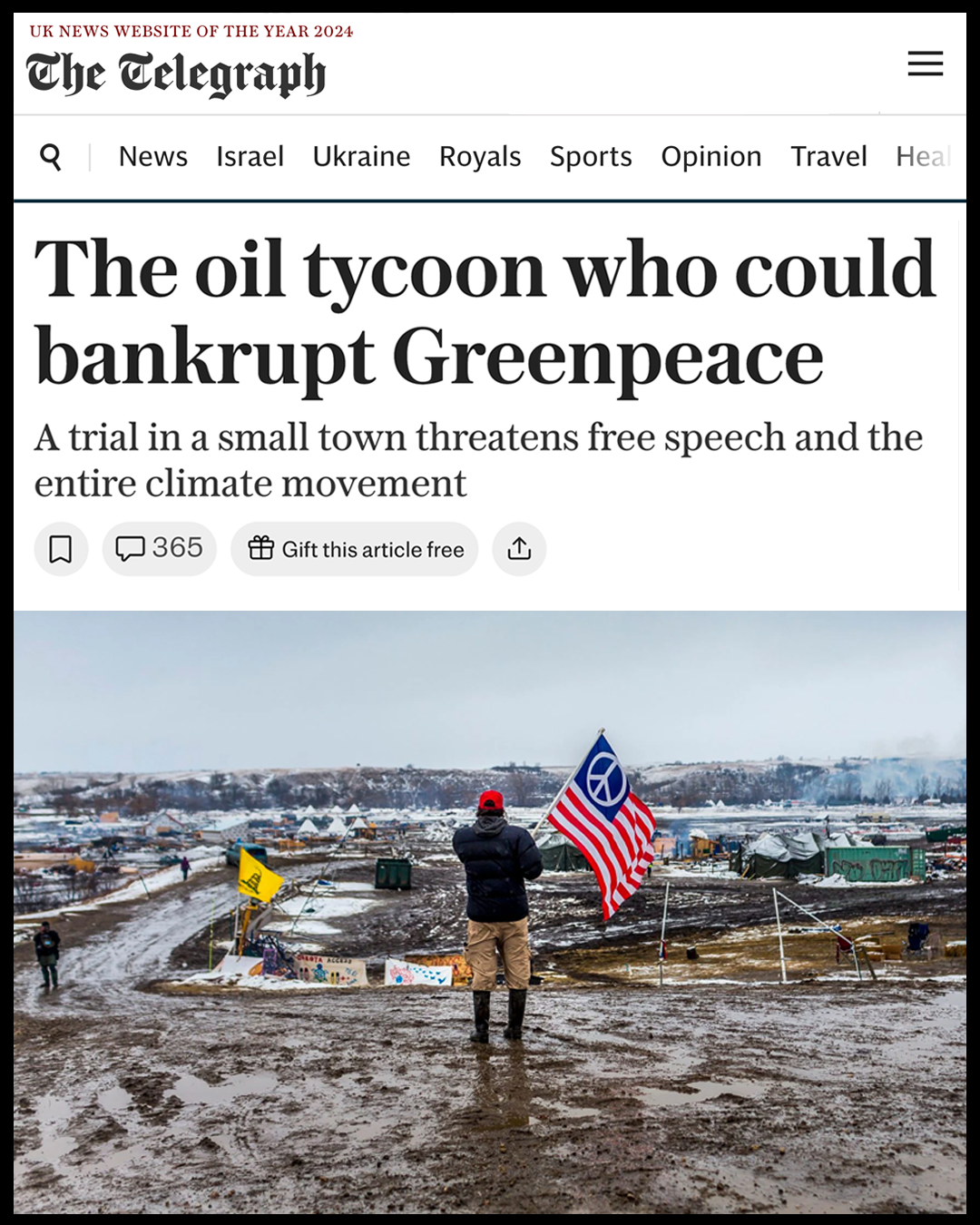
Greenpeace recently was hit with an outrageous $669 million court verdict in North Dakota. The trial – which I attended with several prominent attorneys – was widely condemned as a SLAPP harassment case designed to silence the environmental movement.
The verdict could be a financial death sentence against Greenpeace – unless we stop it.
That’s why I’m reaching out for help.
This is the deal: the targeting of Greenpeace was financed by one of the most notorious fossil fuel oligarchs in the world. This man, Kelcy Warren, amassed a net worth of $7 billion by building a network of planet-destroying pipelines in every region of our country.
Warren’s company, Energy Transfer, is so awful that it was convicted of multiple acts of criminality in Pennsylvania because a pipeline leaked toxic waste into waterways. Warren is so hateful he once said all climate activists “should be removed from the gene pool.”
Luckily, there’s a viable plan to stop Warren’s vile attacks.
Greenpeace recently filed an innovative claim in the courts of Amsterdam against Warren’s company. The claim uses a new anti-SLAPP law in the European Union that allows activists to sue the corporations that abuse them.
The case in Amsterdam can turn the tables on Warren and force him to pay damages to Greenpeace rather than the other way around.
This would be a huge victory for the climate movement.
Before I get to what we are going to do about it, I want to tell you about another dirty trick Warren has up his sleeve.
Warren is pressuring the trial judge in North Dakota to require Greenpeace to post a $75 million bond just to appealthe $669 million verdict. If granted, this enormous “bond” is likely to be a financial death sentence.
Warren went after Greenpeace after the group helped support the Indigenous-led protests at Standing Rock against the Dakota Access Pipeline.When 100,000 people turned up to block Warren from building his pipeline across Indigenous territory, he went ballistic.
Warren also personally donated at least $5 million to Trump for his two presidential campaigns. Trump then helped Warren get permits for his leaky pipeline.
The support of the public for this campaign is critical. Without it, we simply cannot do this work.
Our goal is to raise $20,000 before the end of the month. That means we have to raise approximately $12,000 in the next few days.
---
---
russel mok
greenpeace Goes to Trial in North Dakota to Defend Against Energy Transfer SLAPP Suit
:{By Editor Filed in Uncategorized February 13th, 2025
On February 24, 2025, Greenpeace USA is scheduled to go to trial in state court in Mandan, North Dakota. Greenpeace is being sued by Energy Transfer – the operator of the Dakota Access Pipeline – for nearly $300 million related to the 2016 protests at Standing Rock.
Deepa Padmanabha
The stakes are high, and not just for Greenpeace USA as an organization. This trial is testing out legal tactics that, if successful, could be widely applied against protesters, and indeed, anyone who speaks out or criticizes a deep-pocketed corporation.
The lawsuit filed against Greenpeace has been called a SLAPP suit – a Strategic Lawsuit Against Public Participation.
We rang up Deepa Padmanabha, a senior legal advisor to Greenpeace USA, to get some details on the lawsuit and upcoming trial.
What are the allegations of the lawsuit?
“Both sides have said this is likely the biggest case ever in the history of the North Dakota state courts,” Padmanabha toldCorporate Crime Reporterin an interview last week. “It’s three buckets of claims. The first bucket of claims are claims of defamation. Energy Transfer alleges that the Greenpeace entities made false statements. And those false statements caused damages. In the state case, we originally started out with over 80 statements that Energy Transfer alleged were defamatory. And now we are down to nine.”
“Those nine statements fall into three categories. The first category of statements are statements that we made that the Dakota Access Pipeline crosses Standing Rock Sioux tribal ancestral lands.”
“The second category are statements that Energy Transfer deliberately desecrated Standing Rock Sioux tribe cultural resources.”
“And the third category of statements are statements that we made that Energy Transfer and its contractors used excessive force against peaceful protestors.”
“The important thing to note here is that by the time Greenpeace entities made any of these statements that are at issue, these were statements that were already widely circulated in the public. Anybody familiar with the resistance at Standing Rock had heard these statements. These were not statements that Greenpeace invented.”
“Yet Energy Transfer is suing the Greenpeace entities for these statements.”
“That’s the first bucket of claims. The second bucket of claims are claims of tortious interference. They are related to defamation. Energy Transfer alleges that Greenpeace made these alleged false statements to financial institutions – institutions that were involved with financing the Dakota Access Pipeline. And the allegation is that based on those statements, the financial institutions took action that cost Energy Transfer hundreds of millions of dollars in damages – lost financing, financing costs from delays.”
“We know that many of these financial institutions had their own commitments. They did their own due diligence to understand what was happening with the Dakota Access Pipeline. In fact, no bank or financial institution made any decision based on a Greenpeace statement.”
“That’s the second bucket of claims. The third bucket of claims are on the ground claims such as trespass, conversion, and aiding and abetting. This is a bucket that is quite dangerous for the movement. These claims make it clear that Energy Transfer’s target is much bigger than Greenpeace. It really is an attack on our First Amendment rights.”
“What they are trying to do is create this idea of collective protest liability where if you have any involvement with, for example, training at a protest, you can be held accountable for anything that happens there by unknown people.”
“For example, if you are engaged in training in principles of non-violence, de-escalation, principles of safety, you can be held accountable for the actions of unknown protesters who, for example, destroy construction equipment. This idea is dangerous – that you can be held accountable for anything that happens by unknown people, especially at a time when we know that many protests are being infiltrated.”
“And you can imagine that this would have a serious chilling effect on anybody who wants to engage in protests. This idea that you can be held accountable for anything that happens is quite a dangerous one. It’s very clear that Energy Transfer – and the larger fossil fuel industry – is trying to send a message to everybody – watch out, you could be next.”
This lawsuit has been going on for eight years. Have there been any settlement talks?
“I can’t get into too much detail about that. But I will say that we are prepared to go to trial, and we are expecting to go to trial. It’s very important for us that no matter the outcome of this lawsuit, our decisions will be in line with our values and our principles and our commitments to our own indigenous peoples policies.”
There have been public reports about settlement talks in this lawsuit. And last year, Greenpeace settled with Shell Oil over another lawsuit. Did you work on that lawsuit?
“That was not Greenpeace USA. That was Greenpeace UK.”
Greenpeace UK agreed to pay something like $375,000 to settle that lawsuit. What are the odds this case will actually go to trial?
“As of now, we are fully prepared to go to trial. Trial is in three weeks. That’s where we are headed.”
Will you be in court at trial?
“Yes.”
You say this is a SLAPP suit. What is that?
“SLAPP stands for Strategic Lawsuit Against Public Participation. At their core, they are attacking First Amendment protected behavior. You look at the parties. It’s often activists, non-profit organizations, journalists, even concerned citizens who are speaking out about a matter of public concern.”
“In this instance, the concerns about the Dakota Access Pipeline, its routing and risks were absolutely a matter of public concern.”
“What is the nature of the activity targeted? Often the activity is First Amendment protected activity, such as free speech or non-violent protest. These lawsuits are often disguised as defamation lawsuits. That is very much the case here where many of the claims at issue are defamation claims.”
“The other issue is peaceful protest. Any involvement we had on the ground was 100 percent in line with our 50 plus year history of nonviolent direct action, bearing witness, and no property damage.”
“Another tell-tale sign of a SLAPP lawsuit is the power imbalance between the parties. To Energy Transfer, this lawsuit is just a drop in the bucket for them. But for Greenpeace, it represents a significant financial investment to put on this kind of defense.”
“Another tell-tale sign – the amount of damages. Energy Transfer is seeking $300 million. SLAPP suits have these huge damage claims to send a message. Even if they lack the evidence to support such a damage claim, which is absolutely the case here, just by making the allegation, it can have a chilling effect on anyone watching the case.”
“These corporations use the litigation process as punishment. This has been eight years. The first case was thrown out of federal court. But they kept the fight going.”
“When they filed the federal court action, they already had the green light to construct the Dakota Access Pipeline. It was constructed. So why would you still use the litigation process?”
“Because they know these kinds of lawsuits take years and years and years. You put a stress and burden on the powerful voice they are trying to shut down.”
“Even though it’s only the Greenpeace entities that have been served in this case, there have been a number of third party subpoenas. There have been wild attempts to draw in smaller groups and individuals into this lawsuit – not as named defendants, but to instill a sense of fear that they too are being watched.”
“As someone who has been involved in SLAPP lawsuits for a long time, this case hits every single aspect.”
The Wall Street Journal published an article last year titled – The Texas Billionaire Who Has Greenpeace USA on the Verge of Bankruptcy. That billionaire is Kelcy Warren. What did you make of that article?
“One of the most interesting points of that article was toward the end. The journalist wrote this: ‘The lawsuit poses its own risks for Warren. Some oil-and-gas investors expressed concerns about the claim, saying it makes the industry look vindictive and could result in a reinvigorated protest movement.’”
“Basically, some investors are concerned about a backlash. That is the truth. This lawsuit has galvanized the movement in a powerful way. Greenpeace is getting support from so many allies, allies we have never worked with before. They are now watching this case because they realize the implications this case could have.”
“There is what happens in court, but there is what happens outside the court. And corporations need to take the possible backlash into account. You could reinvigorate a movement. People have really come together to fight back against this kind of abuse of power.”
Were you able over the years to depose Energy Transfer executives, including the CEO Kelcy Warren?
“There were over 100 depositions in this case – Greenpeace employees, third parties, Energy Transfer contractors and Energy Transfer employees, including Kelcy Warren.”
Is the Kelcy Warren deposition public?
“I don’t know if that deposition is publicly available. There is quite a bit in this case that is subject to a protective order.”
Greenpeace wasn’t at the forefront of these protests. The native Americans groups were at the forefront of these protests.
“That is accurate. Greenpeace entities had limited involvement and that was intentional. This was not a Greenpeace campaign. This was a grassroots indigenous resistance. Greenpeace supported it by being an ally. Greenpeace supported the indigenous resistance in a very, very limited way.”
“Energy Transfer is trying to rewrite history. The first question I always get from people involved was – did Greenpeace have any involvement at Standing Rock? I had never heard about Greenpeace being involved. Greenpeace was really not involved.”
“Greenpeace was known for its big, bold campaigns. And that was not the case here.”
There were other major public interest groups who supported the resistance at Standing Rock. Why did Greenpeace get sued by Energy Transfer and not the other groups?
“Let’s go back to the first case that was dismissed, the RICO case. That was the second RICO case brought by the same law firm in back to back years. One of the lawyers made public statements and he was basically shopping this tactic around. There was this idea that civil RICO would be the new tactic used to go against advocacy groups.”
“Why Greenpeace? We are known for bearing witness, taking big, bold actions and not being intimidated. The idea was – if we can knock out Greenpeace, if we can scare them, then who else is going to step into their shoes? Who else will take on this level of risk?”
“We recognize that intention. And that also speaks to why we have been fighting the case the way we have been. We have been fighting this case for the movement. We know that the intent is to reach beyond the Greenpeace entities. And we take that fight seriously.”
---
1 15
e xxon resorts to “intimidation” in legal battle over plastics recycling
The oil giant is accusing its opponents of engaging in a “deliberate smear campaign” at the cost of Exxon’s reputation and business prospects.
Months after California Attorney General Rob Bonta and a group of nonprofits separately sued ExxonMobil for a “decades-long campaign of deception” about the viability of plastic recycling, Exxon is suing them back, accusing Bonta and the nonprofits of defaming the oil giant and intentionally harming its efforts to develop new “advanced” recycling technologies.
Bonta’s lawsuit argues that despite knowing that recycling couldn’t effectively handle significant amounts of plastic waste, Exxon marketed it to the public to assuage environmental concerns and delay limits on plastic production. Now that it’s clear traditional recycling methods are insufficient, California’s lawsuit says, Exxon is once again deliberately misleading the public to believe that “advanced” or chemical recycling technologies are a safe and effective solution to plastic waste. A group of environmental nonprofits — including Sierra Club, Surfrider, Heal the Bay, and Baykeeper — filed a similar lawsuit against Exxon on the same day in September.
Exxon’s new complaint says those cases and accompanying public statements amount to a conspiracy between Bonta, advocates, and “foreign interests” to falsely “attack and defame ExxonMobil’s integrity and reputation.” But others say Exxon’s case is a textbook SLAPP — or strategic lawsuit against public participation — intended to ensnare its opponents in lengthy legal battles and prevent them from speaking out.
“This is a classic lawfare and SLAPP suit,” said Pat Parenteau, an environmental law professor and senior fellow at Vermont Law School. “Intimidation is the whole point of lawsuits like this.”
Exxon’s chemical recycling claims have come under sharp scrutiny in recent years, with government and nonprofit reports and Exxon’s own internal documents obtained by California’s attorney general revealing a widening gap between the company’s promotion of chemical recycling and the technology’s capacity to work as promised, even in the future. Those reports also documented the harm caused by the process of chemical recycling, which involves releasing toxic and carcinogenic pollutants, in close proximity to people — and how these facilities have been most often sited in low-income communities and communities of color.
According to Exxon’s complaint, such criticism — and the legal actions that followed — have derailed Exxon’s existing and prospective business deals, and “further threaten to derail advanced recycling by preventing it from achieving the scale necessary to ensure effective and efficient recycling.” But advocates say that’s a diversion from the fact that chemical recycling doesn’t work to significantly reduce plastic waste, and would only perpetuate the increased production of plastic.
"There is consistent data showing that plastics recycling does not achieve a high level of recycling and that chemical recycling is not a real solution to the growing problem of plastic waste,” said Judith Enck, president of U.S. nonprofit Beyond Plastics and former EPA regional administrator. “It would be so much more productive if ExxonMobil simply told the truth and refrained from attempting to intimidate elected officials and advocates who are working to actually solve the problem."
In the complaint against Bonta, Exxon reports having recycled 70 million pounds of plastic waste to date — just 7% total of its goal of recycling one billion pounds per year via chemical recycling by year-end 2026, which appeared on its website as recently as October 31, 2024. Their website now says that goal will be reached by 2027.
A history of retaliation
The new lawsuit was filed Monday in a federal court in Texas, where Exxon’s chemical recycling operations are focused and where the company says defendants’ “disparaging and defamatory conduct” was targeted. According to law professor Parenteau, the venue was more likely seen as a friendlier court than where the original cases were filed, as “California has one of the strongest anti-SLAPP laws in the country to protect constitutional rights of free speech and access to justice.”
It isn’t the first time that Exxon has dragged its critics into a Texas court. In 2016, the company asked a federal court in Dallas to block investigations by New York and Massachusetts attorneys general into whether Exxon deceived investors and the public about climate change. That case was eventually transferred to New York, where it was dismissed.
After California municipalities sued Exxon for climate deception in 2017, the company requested that a Texas state court allow pre-suit depositions of municipal officials and lawyers involved in the case to determine whether they were aiming “to suppress the Texas energy sector’s Texas-based speech.” Their request was ultimately denied.
Since California brought its plastics suit against Exxon, the oil giant has been named in two separate class-action suits that focus on plastic recycling deception, one filed by Ford County, Kansas, and the other by four individuals in a federal court in Missouri. By Exxon’s own admission, the oil giant “is likely to become involved in additional legal matters bringing similar allegations against ExxonMobil in the near future.” To protect the company from facing “a multiplicity of suits in various forums throughout the country,” Exxon is asking the Texas court to issue a declaratory judgement making clear that the company has a legal right to “engage in and promote advanced recycling.”
That may be an unusual request. “Courts do not normally issue that kind of blanket declaration on an emerging technology with all kinds of technical, economic and environmental considerations that are better left to the legislative and executive branches,” said Parenteau.
The case could be part of a growing trend — by Exxon and other fossil fuel majors including Chevron, Italian oil giant Eni, and oil pipeline company Energy Transfer — to use SLAPPs, and defamation claims in particular, as a way to silence opposition and dodge accountability.
Rebecca Tushnet, a First Amendment professor at Harvard Law School, said Exxon’s lawsuit against Bonta and advocates should be considered a SLAPP. “Under current doctrine, the First Amendment strongly protects the speech at issue,” she said. “Even though we're in a period of rapid constitutional change, speech in connection with a lawsuit is really at the core of First Amendment protection, and this is pretty appalling (though perhaps not surprising).”
A matter of public concern
In its complaint, Exxon argues that chemical recycling is in fact “part of the solution to plastic waste,” and that the company “has not engaged in a decades-long secret mission to brainwash or deceive the public.” But the complaint hinges on another central point: that criticisms about chemical recycling have gotten in the way of Exxon’s business deals.
“As a result of Defendants’ false statements, major international brands have refused to jointly promote advanced recycling with ExxonMobil,” the complaint reads. “Potential customers have expressed concern and hesitancy to work with ExxonMobil and explicitly referenced statements by Bonta and the US Proxies as the cause of that concern. And, a number of companies have backed out of proposed transactions with ExxonMobil for advanced recycling.”
Exxon claims Attorney General Bonta worked in concert with U.S. nonprofits and Australian-based Intergenerational Environmental Justice Fund (IEJF) — a charity initiative of nonprofit group Minderoo, funded by Australian mining company Fortescue, a competitor of Exxon’s in the “low carbon solution” sector — to falsely malign Exxon’s chemical recycling business and file their lawsuits as “proxies.” Exxon also accuses IEJF of hiring the nonprofits’ law firm, Cotchett, Pitre, & McCarthy, LLP, to “recruit and enlist willing plaintiffs to stand in for the foreign interests’ agenda.” Bonta, IEJF, Minderoo, Fortescue, and the law firm have refuted Exxon’s descriptions of their connections and work
The company is now asking for an injunction requiring the named parties to “take down and retract defamatory statements and to cease interfering with existing and prospective business relationships.”
Michael Gerrard, director of the Sabin Center for Climate Change Law at Columbia University, suggested that the case could face challenges for its attempts to rein in public debate — even in Texas. “The anti-SLAPP laws adopted by almost every state, including Texas, are designed to protect citizens from defamation and similar claims over matters of public concern,” he said. “The viability of plastics recycling is certainly a matter of public concern.”
===
exxonknews gmail 12 24
Who’s funding this ‘newspaper’ mailed to potential jurors in Greenpeace’s trial?
A dark money trail linked to pipeline company Energy Transfer could be behind a mysterious mailer targeting North Dakota residents in the lead-up to its major trial with Greenpeace.
The following piece was co-published by DeSmog and ExxonKnews.
In early September, fossil fuel executive and Donald Trump megadonor Kelcy Warren quietly made a large donation to a political action committee few people have ever heard of. Warren is CEO of Energy Transfer, the company behind the infamous Dakota Access Pipeline, which in 2016 faced thousands of protesters including members of the Standing Rock Sioux Tribe and other opponents.
The timing is potentially significant because Warren made his $5 million donation to the super PAC called Turnout for America while his company pushed forward with a lawsuit against the nonprofit Greenpeace related to the Standing Rock protests.
Two weeks after receiving Warren’s contribution, Turnout for America paid $250,000 to Northern CB Corp. — an Illinois publishing and printing company — for “media services.”
One of the listed directors for Northern CB Corp. is Brian Timpone, a conservative businessman who owns Chicago-based company Metric Media, a Koch-linked network that runs more than 1,100 partisan websites masquerading as local news.
In October, residents in Morton County, where the Greenpeace trial is scheduled to take place, received a mailed publication called “Central ND News,” which featured articles decrying the Dakota Access protests and praising Energy Transfer. Central ND News is produced by Metric Media.
While news of this “weird” paper was first reported by Floodlight and the North Dakota News Cooperative, additional details related to Warren’s Super PAC donation are now being debated in the lawsuit itself.
Greenpeace is urging a North Dakota court to allow further investigation into who paid to send the publication attacking Dakota Access protestors to Morton County residents — and whether there was an attempt to exert “improper influence” over potential jurors in Energy Transfer’s favor.
“Given the importance of securing a fair and impartial jury … knowing who was directing these actions, to whom they directed the information, and why they did so are important issues to the fair administration of justice,” a Greenpeace brief shared with ExxonKnews and DeSmog reads.
A closely watched lawsuit
Energy Transfer’s $300 million lawsuit accuses the environmental group Greenpeace of unlawfully orchestrating protests against the Dakota Access pipeline in 2016 and 2017, during which time hundreds of protestors were arrested near the Standing Rock Sioux Indian Reservation — including climate activists and Indigenous water protectors.
Energy Transfer, which worked with law enforcement agencies to curtail the protests and used an international security firm to surveil and shift public opinion about the company’s opponents, claims that Greenpeace waged an “unlawful, malicious, and coordinated attack” to damage and defame the pipeline and the company itself.
**According to Greenpeace USA, Energy Transfer is suing the group because it “dared to uplift the Indigenous-led opposition movement at Standing Rock.”
The lawsuit could have implications for whether the fossil fuel industry is able to silence protesters as it embarks on major expansions, including the buildout of new gas and carbon dioxide pipelines, Gulf Coast LNG facilities, and petrochemical infrastructure. Experts and advocates say the case has all the hallmarks of a SLAPP, or strategic lawsuit against public participation — a larger legal tactic fossil fuel companies have been using to suppress dissent and drain their opposition of resources and time.
As the February 2025 trial draws near in the closely watched case, Greenpeace is now asking a state district court to grant an emergency motion to reopen discovery in the case, which would allow the environmental group to get more information about who funded the mailer to North Dakota residents.
In its new court filing, Greenpeace alleges that “there may have been improper influence over potential Morton County jurors through direct mailers containing negative reporting about Standing Rock protests that took place eight years ago, and benefits which Energy Transfer conferred on the local community six years ago.”
Greenpeace cites new details indicating that Kelcy Warren’s donation came around the same time as a surge of coverage from Central ND News targeting the Dakota Access protests. Central ND News began running a series on its website in August, called “On This Date in 2016.” The series contained six articles in August, three of which accused protestors of “unlawful” activities in their headlines. Subsequent articles in the series appeared a few times each month up until this week. There is no record of the paper covering those protests before this year.
The same day Turnout for America paid the Illinois publishing company, Central ND News published a story praising a donation that Energy Transfer made to a university in North Dakota six years ago. That story, written by C.D. Marsden (a name that Floodlight first found yields no results in a Google search), was featured in the October newspaper delivered to Morton County residents’ homes, juxtaposed with stories about Dakota Access pipeline protestors.
The 12-page paper included those stories in a section called “This Month in History: October 2016,” featuring one article titled “Area schools locked down as authorities respond to pipeline protests.” Another recounts the details of a felony arrest warrant accusing a pipeline protestor of charging a police officer on horseback.
“The purpose of that publication is quite clearly to remind people about what was happening eight years ago,” a lawyer for Greenpeace, Everett Jack, told the court at a December 9 hearing requesting the reopening of discovery. “We should be entitled to find out who made that decision.”
pix
One of Greenpeace’s lawyers — Derrick Braaten, who resides in Mandan, a city in Morton County — received the Central ND News at his home in October. The paper doesn’t appear to have any physical presence in North Dakota — it directed readers to the outlet’s website, and didn’t include any local advertisements, according to Greenpeace.*
Jack told Southwest Judicial District Court Judge James Gion that reopening discovery would allow Greenpeace’s attorneys to question the Texas-based printing company that sent the newspaper, FMC Printing. The group would seek to subpoena FMC Printing to determine whether the mailer was targeted only to Morton County residents, who directed that the mailer be sent there, and why. Depending on the results of that investigation, Greenpeace would consider requesting a change in venue for the trial.
“We’re filing this motion and seeking this discovery because I think this court would agree there’s nothing more sacred in the legal system than the right to a fair, impartial jury, and every lawyer knows that direct efforts to influenc[e] the jury pool are not okay,” Jack said.
‘Playing both sides’
Greenpeace has been fighting varying iterations of Energy Transfer’s case — which was originally filed under state and federal racketeering charges — for eight years, with individual Indigenous protestors and journalists also brought into the mix. This week, the Minnesota Supreme Court heard an appeal from Energy Transfer in its attempts to subpoena journalists who reported on the protests at Standing Rock, seeking to force them to produce confidential, unpublished material.
The Dakota Access pipeline began operating through North Dakota in 2017 after an executive action from then-President Trump. The pipeline, which protestors warned would threaten water supplies, sacred sites, and the climate, leaked 5 times in its first year of operation alone.
This fall, the day before the October mailing was sent, the Standing Rock Sioux Tribe filed a new lawsuit against the U.S. Army Corps of Engineers arguing that the pipeline is operating illegally and should be shut down. Energy Transfer CEO Warren gave $5 million in campaign donations to Trump, who recently promised “fully expedited approvals and permits” to companies who invest $1 billion in the U.S.
:{Energy Transfer’s case, originally filed by the firm Kasowitz Benson Torres (long-time lawyers for Donald Trump), was taken over in 2023 by Gibson Dunn, a law firm with a record of “playing both sides” of the First Amendment on behalf of its corporate clients. }:{:Gibson Dunn}: lawyer Trey Cox represented Energy Transfer in its opposition to Greenpeace’s motion this week, arguing that juror questionnaires are the appropriate method to ensure a fair trial — and that whether or not Morton County residents received or read the newspaper was irrelevant.
ND Central News, he said, was a local newspaper that existed before the mailer was sent, and was simply covering matters involving a high-profile trial. Cox accused Greenpeace of trying to delay the trial date (which Greenpeace denied), and said its motion did not have “any basis in law or in fact.”
Energy Transfer, Metric Media, and Trey Cox did not respond to requests for comment.
“We don’t have any evidence that this newspaper in any way prejudiced potential jurors,” Cox told the court.
---
an 11 23
to be honest, I didn't really care whether the Arizona Diamondbacks or the Texas Rangers won the World Series. Once my two favorite teams—the Dodgers and the Red Sox—were eliminated, I didn’t have a stake in the outcome of the World Series. I just wanted to watch to see first-rate baseball and see interesting games, and the Diamondbacks and Rangers didn't disappoint.
Most of the 30 MLB teams are owned by billionaires. But the owners of the Rangers and the Diamondbacks are particularly disgusting. Ken Kendrick, who owns the Diamondbacks, and Ray Davis—whose Rangers won the World Series in Game 5 on Wednesday night with a 5-0 shutout win—are both billionaires with a history of providing financial support for Republican candidates and right-wing causes.
:{:{According to Forbes magazine, Davis has a personal net worth of $2.9 billion. Before getting into the baseball business, Davis was CEO of two fossil fuel corporations—Energy Transfer Partners (ETP) and Energy Transfer Equity (ETE}:). ETP is a natural gas distributor and pipeline company. Davis stepped down as CEO in 2007 but still owns 2.4% of the company. In 2017, despite protests by the Standing Rock Sioux tribe, Energy Transfer finished building the $3.8 billion Dakota Access Pipeline.
The corporation operates over 125,000 miles of pipeline that move approximately 30% of America's oil and natural gas. Davis and a group of investors bought the Texas Rangers for about $600 million in 2010; it's now worth $1.5 billion. Since 2021, Davis has donated at least $225,000 to Texans for Greg Abbott, the state's right-wing Republican governor, according to state campaign finance records. He's also donated to other Republican candidates.}:
In 2003, the Chicago Cubs hosted the first Pride game to celebrate their LGBTQ fans. Since then, all but one of the 30 Major League teams have hosted an annual Pride Day or Pride Night event. The Texas Rangers are the only team without a Pride Night.
Ken Kendrick is only worth $1 billion, according to Forbes, but he's a much bigger donor to politicians and right-wing causes than Davis. He and his wife Randy have made large donations to conservative groups connected with the Koch brothers. According to FEC filings, he has donated to many Republican election deniers, including Arizona U.S. Congressman Paul Gosar and Andy Biggs as well as to conspiracy-theory nutjob Congresswoman Lauren Boebert of Colorado.
Kendrick founded a software company called Data Technology which merged in 1979 with another company called Datatel. General Motors bought the company in 1988 for $511 million, giving Kendrick a big boost in his personal wealth. He made more money by investing early in Woodforest National Bank, which now has more than $1.7 billion in assets. Woodforest National Bank is Walmart’s largest retail partner. Kendrick became part-owner of the Diamondbacks with the team's inception in 1995 and has been the managing general partner (the major owner) since 2004.
Kendrick is one of those Republicans who decry "big government," but he's perfectly happy receiving government subsidies for his business from Arizona taxpayers. The Diamondbacks built Bank One Ballpark (later renamed Chase Field), the first retractable roof stadium in MLB with a grass field, in 1995 with the help of $253 million dollars in public financing through an increase in sales tax in Maricopa County. This happened during a huge county budget deficit and lack of funding for other services. The County Supervisors approved the tax increase without asking for voters' approval. In 2016, Kendrick decided that the stadium needed about $65 million worth of repairs, and estimated that it would need a total of $187 million of upkeep costs over the final 12 years of its lease with Maricopa County. And of course, they wanted the taxpayers to pay for it. County officials refused. One of them, Andy Kunasek, described the Diamondbacks as “parasitic enterprise.” When the County wouldn't provide Kendrick with the subsidy, he sued the County in an attempt to get out of the Diamondback's lease, which expires in 2027. Kendrick has hinted that if the County doesn't pay for those improvements, he'd consider moving to the team and building another stadium.
Oh, and in case you're wondering, Kenrick is also a union-buster. In 2020, when the 30 major league owners locked the players out for three months (essentially, an owners' strike), Kendrick was one of the four most reactionary owners who voted against signing a new collective bargaining agreement with the players union.
So it was a win for the Rangers last night, and congrats to all the players. However, no matter which way this series may have gone, it would have been one right-wing billionaire or another holding the trophy in the end.
---
9 22 email
For nearly two years, The Intercept has been fighting an expensive legal battle to obtain 60,000 pages of public documents about pipeline giant Energy Transfer and TigerSwan, the private security firm that surveilled Indigenous-led activists who were brutally attacked protesting against the Dakota Access pipeline in 2017.
The law is on our side. We’ve won key rulings at the North Dakota Supreme Court. These documents should already be public.
But Energy Transfer continues to oppose the release of all the documents, and it’s hired one of the most famously combative law firms in the country: Kasowitz Benson Torres LLP.
The firm’s founder, Marc Kasowitz, has been described as the “toughest lawyer on Wall Street,” an “uberlitigator,” and “the Donald Trump of lawyering.”
In fact, according to public reports, Kasowitz and his firm represented Trump himself for over 15 years in countless legal fights from Atlantic City to the White House. Kasowitz has also represented the tobacco industry and corporate raider Carl Icahn. He even represented Bill O’Reilly after he was fired by Fox News for sexual harassment.
Now, with the nearly unlimited resources of an oil company behind it, Kasowitz Benson Torres is fighting our pipeline lawsuit tooth and nail.We won’t stop fighting for the truth, but we have to be prepared for whatever they throw at us — and as a nonprofit news outlet, we rely on reader donations as a key source of funding for our reporters and legal team
https://www.desmogblog.com/2020/05/03/keystone-xl-future-pipeline-permits
On April 15, Judge Brian Morris nullified water-crossing permits in Montana that were granted for the Keystone XL, a major setback for the long-embattled tar sands oil pipeline. The ruling came just days after Keystone XL owner TC Energy, formerly known as TransCanada, obtained billions of dollars in subsidies from the Alberta government as global oil prices plummeted.
The oil and gas industry has taken notice. Seemingly just a ruling on Keystone XL — the subject of opposition by the climate movement for the past decade — the ruling could have far broader implications for the future of building water-crossing pipelines and utility lines.
In his decision, Judge Morris cited a potential violation of the Endangered Species Act when he ordered the U.S. Army Corps of Engineers to do a deeper analysis of potential impacts to protected species. Morris required the Corps to demonstrate whether or not it could construct the pipeline without harming endangered species, such as the Pallid Sturgeon or the American burying beetle. Instead, the Army Corps “failed to consider relevant expert analysis and failed to articulate a rational connection between the facts it found and the choice it made,” Morris ruled, when the Corps gave Keystone XL the initial green light.
The original July 2019 complaintin that case — filed by Northern Plains Resource Council, Bold Alliance, Sierra Club, Natural Resources Defense Council, and Center for Biological Diversity — also argued that the Army Corps had violated the National Environmental Policy Act (NEPA) in using an obscure regulatory lever to fast-track the review process.
Known as Nationwide Permit 12, the permit only requires a short environmental analysis compared to the more robust environmental impact statement required under NEPA for other major infrastructure projects. But Morris also wrote that the decision applied not just to Keystone XL, but to all major federal projects aiming to utilize Nationwide Permit 12, calling for it to be “vacated pending completion of the consultation process and compliance with all environmental statutes and regulations.”
Just two days after this decision, Army Corps regulatory program Chief Jennifer Moyer wrote in an email obtained by the Associated Press that the agency should suspend the program indefinitely “out of an abundance of caution” until the issue is resolved legally.
The Trump administration has already requested a procedural halt on implementing Morris’ decision until its potential appeal weaves its way through the legal system.
“The Court has eliminated Nationwide Permit 12 for use by any utility line project anywhere in the country, which has extraordinary and immediate implications for numerous projects,” the U.S. Department of Justice attorneys wrote on behalf of the Army Corps.
The American Petroleum Institute (API), the lobbying and advocacy voice of the oil and gas industry, has also filed an affidavit in favor of putting a procedural halt to Morris’ ruling.
“The ability to provide reliable energy is even more important now during this sensitive and challenging time brought on by COVID-19,” Robin Rorick, Vice President of Midstream and Industry Operations for API, wrote in the affidavit. “The Court’s Order could threaten API’s members’ ability to continue numerous energy and infrastructure projects, affecting the health of numerous companies and job security in an already-strained economy.”
API also joined North America’s Building Trades Unions and Interstate Natural Gas Association of America in denouncing the ruling along similar lines.
'Single and Complete'
Nationwide Permit 12 historically was used for small “single and complete” projects crossing water parcels half an acre in size or smaller.
But in the aftermath of protests and civil disobedience actions taken against Keystone XL, the Obama administration began using that permitting process to split pipelines into hundreds or thousands of half-acre pieces. The process was a way around the more robust and democratic National Environmental Policy Act (NEPA) regulatory process, which involves both a public commenting and public hearing phase. Nationwide Permit 12 was also used to push through the Dakota Access pipeline, as well as the southern leg of the Keystone XL, both greenlighted by President Barack Obama.
During the Obama era, environmental groups decried this as a form of “segmentation” and a way out of complying with NEPA, which they routinely challeneged in court with some success—though not enough to undo the legal lever. The bedrock environmental law is now under further attack by President Donald Trump, with the administration trying to remove climate change contribution as a factor analyzed under the law for major projects and aiming to narrow the scope of and time it takes to complete these environmental impact reviews.
[vid]
Since March 2017, the Trump administration has utilized Nationwide Permit 12 over 37,000 times, the AP reported. As it stands today, the Army Corps’ decision to halt use of the Nationwide Permit 12 fast-track tool has put 360 permit applications on hold.
“The reason that matters is that the public and the communities and everybody that lives there has the chance to get involved in the process,” Eric Huber, Senior Managing Attorney with the Sierra Club's Environmental Law Program, told DeSmog. “Otherwise, these special permits just allow a pipeline company to go out and start construction without notice to anybody or to take private property and just proceed and blast this through regardless of how the local community thinks of it.”
External corporate attorneys, too, have taken notice and expressed their own concerns about the ruling.
“The decision puts in limbo thousands of infrastructure projects nationwide that rely on [Nationwide Permit] 12 for the construction, maintenance, or repair of utility lines and poses particularly acute problems for the oil and gas industry, which relies on the permit to facilitate projects ranging from large interstate pipelines to smaller gathering lines at exploration and production sites,” wrote attorneys fromBrownstein Hyatt Farber Schreck, a firm with close ties to the Trump administration, in one such reaction to the ruling.
Brownstein Hyatt Farber Schreck’s fossil fuel industry lobbying clients include the American Petroleum Institute, American Public Power Association, Freeport LNG, Talos Energy, Jordan Cove LNG, WPX Energy, and the New Mexico Oil and Gas Association.
Another firm heavily involved in fossil fuel industry litigation and lobbying,Steptoe & Johnson, also weighed in on the ruling and wrote that it could have the impact of “extending permitting time frames for these types of projects” going forward. The firm’s fossil fuel industry lobbying clients include American Gas Association, Gas Technology Institute, and Peabody Energy.
Permian Highway Pipeline in Texas
The legal precedent set in the Keystone XL case is already playing out in federal courts.
On April 30, the Sierra Club filed a lawsuitin the U.S. District Court for the Western District of Texas against the Army Corps of Engineers over another controversial pipeline. The complaint says the Army Corps did not comply with NEPA in issuing a Nationwide Permit 12 to the 428-mile Permian Highway gas pipeline. It also argues the agency is not currently in compliance with the order in the Keystone XL case because it has continued to allow pipeline construction under the contested Nationwide Permit 12 program.
“It is outrageous that the Corps approved this project without public notice or opportunity to comment on their permits,” Rebecca McCreary, a Sierra Club attorney, said of the Permian Highway pipeline in a press release. “Nationwide Permit 12 allows for no public hearings or participation by the local communities before the Corps permits construction to start, nor is there public notice or comment on the U.S. Fish and Wildlife Service permits allowing harm to the endangered species along the route. The Corps should stop this project immediately.”
Owned by Kinder Morgan, Permian Highway is a pipeline slated to carry gas obtained via hydraulic fracturing (“fracking”) in Texas’ Permian Basin east across the state. Kinder Morgan told DeSmog it was aware of the lawsuit, but declined to comment on it and the broader Nationwide Permit 12 issue.
Permian Highway has already seen issues with spills into water systems, with one late March incident spilling 36,000 gallons of drilling slurry — including a carcinogenic additive — into groundwater.
[twt]
Responding, the Hays County Commissioners Court voted on April 22 to rescind road permits given by the Texas county to allow Kinder Morgan to drill underneath county roads as it builds the pipeline. And Kinder Morgan, too, has suspended construction on this portion of the pipeline as it “determines the best path forward” in the aftermath of the spill, the company told Houston Chronicle.
The City of Austin, City of San Marcos, Hays County, Travis County, and others also filed their own Endangered Species Act lawsuit in February,arguing that the pipeline could threaten protected Golden Cheeked Warblers, two salamander species, and their habitats.
Keystone XL Decision Looms
In the Keystone XL case in Montana, Morris recently deniedthe Army Corps a procedural stay in the case. TC Energy, for its part, wants the decision struck down as it applies both to its own pipeline and for the permitting program at large.
“If TC Energy does not receive authorization from the Army Corps by early July, its construction plans will be significantly impacted,” Gary Salsman, a TC Energy vice president for the Keystone XL project, wrote in his April 29 affidavit. “Currently, TC Energy is evaluating potential options that would be available to it in that circumstance, each of which have significant adverse consequences.”
Those “potential options,” Salsman wrote, include a potential construction delay across Montana, South Dakota, and Nebraska; a change in construction plans this year to avoid the waters it is currently slated to cross that are impacted by the vacating of Nationwide Permit 12; or ending construction all together. He added that if construction does not begin in 2020, it could cost the company $750 million to $1.3 billion.
Morris could make a decision on how broadly his Nationwide Permit 12 decision applies as soon as May 8. Regardless of the outcome, Morris' next move will likely face an appeal from either side.
TAGS:
Brownstein Hyatt Farber Schreck
National Environmental Policy Act
==
hamm and kelcy etp in bakken (tho might want to bleed out wildcat indep smaller?)
cf antonia juhaz bakken bailout? oil -40$ bakken, 200b$ debt; in 2008 oil 150$, many poor cty could not afford, helped trigger Gt Recession?
==
==
220 search: Energy Transfer Partners bank kelcy warren capital invest dapl
https://yyy.theguardian.com/us-news/2016/oct/26/donald-trump-dakota-access-pipeline-investment-energy-transfer-partners
no lnx guk
dakota Access pipeline company and Donald Trump have close financial ties
This article is more than 3 years old
Trump’s financial disclosure forms show he invested in Energy Transfer Partners, operators of the controversial pipeline, and its CEO donated to his campaign
Support our fearless, independent journalism with a contribution or by becoming a member
Oliver Milman in New York
@olliemilman
Wed 26 Oct 2016 16.38 EDTFirst published on Wed 26 Oct 2016 06.00 EDT
Donald Trump’s close financial ties to Energy Transfer Partners, operators of the controversial Dakota Access oil pipeline, have been laid bare, with the presidential candidate invested in the company and receiving more than $100,000 in campaign contributions from its chief executive.
[Over 120 arrested at North Dakota pipeline protests, including journalists
Read more]
Trump’s financial disclosure forms show the Republican nominee has between $500,000 and $1m invested in Energy Transfer Partners, with a further $500,000 to $1m holding in Phillips 66, which will have a 25% stake in the Dakota Access project once completed. The information was disclosed in Trump’s monthly filings to the Federal Election Commission, which requires candidates to disclose their campaign finance information on a regular basis.
The financial relationship runs both ways. Kelcy Warren, chief executive of Energy Transfer Partners, has given $103,000 to elect Trump and handed over a further $66,800 to the Republican National Committee since the property developer secured the GOP’s presidential nomination.
On 29 June, Warren made $3,000 in donations to Trump’s presidential campaign. The limit for individual contributions to a candidate is $2,700 per election and it’s unclear whether Trump returned $300 to Warren. Trump’s campaign was contacted for comment.
Warren made a further $100,000 donation to the Trump Victory Fund, a joint fundraising committee among Trump’s campaign, the RNC and 11 state parties, on 29 June. A day earlier, the Energy Transfer Partners chief executive doled out $66,800 in two separate donations to the RNC.
Play vid]
Raw footage of mass arrests at North Dakota pipeline protest – video
Trump is therefore indirectly linked to Dakota Access, a $3.8bn pipeline development that will funnel oil from North Dakota to Illinois. The 1,170-mile pipeline has caused uproar among Native American tribes as it runs close to the Standing Rock Sioux reservation in North Dakota. A protest camp, set up over fears the pipeline will poison water and destroy cultural heritage, has been the scene of repeated clashes between protesters and Energy Transfer Partners security staff.
A court challenge has allowed the project to go ahead but the federal government, which initially approved the project, is now reassessing its decision following an outcry by tribes and has placed a temporary halt to construction on federal land.
Trump has signaled his opposition to any restrictions on the development of oil, coal or gas, telling a crowd in Gettysburg, Pennsylvania, last week that he would “lift the Obama-Clinton roadblocks to allow these vital energy infrastructure projects to go ahead”.
“We have roadblocks like you’ve never, ever seen – environmental blocks, structural blocks,” he said. “We are going to allow the Keystone pipeline and so many other things to move forwards. Tremendous numbers of jobs and good for our country.”
Jesse Coleman, a researcher at Greenpeace, said Trump seems to know “very little” about energy policies other than to side with wealthy fossil fuel interests.
“Trump likes to say he’s an outsider candidate but he’s very close to fossil fuel tycoons and accepts campaign donations from them,” he said. “Warren wants powerful people to be sympathetic to his business plans and donating to them is his MO.”
Warren has worked in the energy industry for the past 25 years and has a net worth of $3.8bn, according to Forbes. The Texas-based businessman has said concerns over the Dakota Access pipeline are “unfounded” and insisted there are no Native American artifacts at risk from its construction. He vowed that Energy Transfer Partners will press ahead with the project.
Warren has been an enthusiastic backer of Republican politicians, contributing the maximum allowable amount to the campaigns of the House speaker, Paul Ryan, and Fred Upson, chairman of the energy and commerce committee.He also contributed $6m to a committee backing an unsuccessful presidential bid by the former Texas governor Rick Perry.
Greg Abbott, the current Texas governor, received $555,000 from Warren during the 2014 election cycle and subsequently appointed the businessman, and his wife Amy, to state boards. Energy Transfer Partners has teamed up with Mexican billionaire Carlos Slim to build an 148-mile natural gas pipeline through west Texas to the Mexican border – a plan that has been opposed by affected ranchers and environmentalists.
Dakota Access has sparked the most vociferous protests, however, with the Standing Rock Sioux tribe escalating its grievances to the UN and, most recently, the US justice department. On Tuesday, the tribe requested that the US attorney general, Loretta Lynch, investigate alleged strip searches, dog attacks and pepper-spraying by police and security personnel against Native American protesters.
“Peaceful protests are being met with military vehicles and heavily armed law enforcement personnel in riot gear,” the tribe’s letter states. “To many people, the military tactics being used in North Dakota are reminiscent of the tactics used against protestors during the civil rights movement some 50 years ago.”
Energy Transfer Partners refused to comment on the donations.
==
Rick Perry Resigns From Boards of Dakota Access Pipeline ...
www.thestreet.com › politics › rick-perry-resigns-from-boards-of-dak.....q=cache:EGgYdQ_BFE8J:https://www.thestreet.com/politics/rick-perry-resigns-from-boards-of-dakota-access-pipeline-companies-13945434+&cd=16&hl=en&ct=clnk&gl=us" ping="/url?sa=t&source=web&rct=j&url=https://webcache.googleusercontent.com/search%3Fq%3Dcache:EGgYdQ_BFE8J:https://www.thestreet.com/politics/rick-perry-resigns-from-boards-of-dakota-access-pipeline-companies-13945434%2B%26cd%3D16%26hl%3Den%26ct%3Dclnk%26gl%3Dus&ved=2ahUKEwiEmIu3uOjnAhUDbq0KHdgYAPcQIDAPegQIBxAG" style="text-decoration-line: none; cursor: pointer; display: block; padding: 7px 18px; outline: 0px;">
:{pension plan:(style="background-color:#ff9900;"):}: / crony capitaLISM ukraine scandal an ASSET?!
Rick Perry Rejoins Pipeline Company Energy Transfer’s Board of Directors
Former U.S. Energy Secretary Rick Perry has rejoined the board of the company that oversees Energy Transfer Partners, one of the biggest pipeline operators in the United States. The company, owned by billionaire Kelcy Warren, is best known for its Dakota Access crude oil pipeline, the construction of which drew months of massive resistance led by the Standing Rock Sioux and other Native American nations. Perry had previously served as a director of Energy Transfer Partners before stepping down in 2016 as the corporation faced backlash over the Dakota Access pipeline
==
https://www.greenpeace.org/usa/reports/too-far-too-often/
6/18 ***
see daplgrnpeace18
==
aha 519: is it a criminal enterprise? activ suppress, honduras?
see suncor , tar sands,
see kelcy warren CRONY CAPITALISM
5/17 etp tag then saw redumbdent b/c xl tag
seetigerswan
https://theintercept.com/2019/12/08/energy-transfer-tigerswan-bribery-conspiracy-charges/
pIPELINE GIANT ENERGY TRANSFER AND ITS PRIVATE SECURITY CONTRACTORS FACE BRIBERY CHARGES IN PENNSYLVANIA
Alleen Brown
December 8 2019, 10:25 a.m.
SECURITY PERSONNEL WORKING for Energy Transfer, one of the largest and most controversial oil and gas pipeline companies in the U.S., have been charged with bribery and criminal conspiracy for allegedly recruiting, hiring, and hiding payments to Pennsylvania state constables.
According to a complaint filed December 3 by Chester County District Attorney Tom Hogan, Energy Transfer illegally hired 19 constables to guard the Mariner East 2 natural gas pipeline, which has faced opposition from residents over the project’s ecological impact, explosion risks, and violations of their property rights. The constables were encouraged to wear their uniforms and badges and carry their guns, in what Hogan described as an intimidation tactic.
While it is not uncommon for companies to hire uniformed off-duty police officers to provide security services, in Pennsylvania, constables are elected officials barred from private security work. Furthermore, they are required to report outside income of more than $1,300. None of the seven who met that threshold did, according to the complaint. And in what appeared to be an attempt to hide the illegal activity, Energy Transfer paid the constables via a series of subcontractors, in many instances using handwritten checks that were not claimed for tax purposes.
Hogan charged an Energy Transfer security manager, two contractors for the security firm TigerSwan, and two former state troopers for involvement in what his office called a “buy-a-badge scheme.”
“We do not believe these charges have any merit,” Energy Transfer spokesperson Amanda Gorgueiro told The Intercept in an emailed statement. “The Pennsylvania constables in question were hired by an independent, Pennsylvania-based security firm to help maintain the safety of our worksites. Local law enforcement never expressed any objection to this security plan when it was discussed and implemented.”
TigerSwan did not reply to requests for comment.
The case is an example of the myriad ways that corporations behind some of the country’s most controversial fossil fuel projects are using local law enforcement to overcome opposition. And it’s only the latest scandal involving Energy Transfer’s security personnel. The state security boards of Louisiana and North Dakota have each confronted TigerSwan for attempting to circumvent local licensing laws.
In North Dakota, where Energy Transfer hired TigerSwan to guard the Dakota Access pipeline, the security firm faced scrutiny after The Intercept published leaked documents detailing its invasive surveillance practices, which involved infiltrators, aerial monitoring, and a close collaboration with local law enforcement to thwart massive protests near the Standing Rock reservation. The documents reveal that both of the TigerSwan contractors charged in Pennsylvania previously worked on the Dakota Access pipeline.
Until now, Energy Transfer has successfully distanced itself from the deeds of its contractors. Hogan’s case offers a rare glimpse of the pipeline company’s hand in questionable security activities.
The Mariner East 2 pipeline carries volatile propane, butane, and ethane from western Pennsylvania and Ohio’s shale fields to a terminal near Philadelphia. The natural gas liquids are mostly destined to become ingredients for plastics manufacturing in Europe. Sunoco, the Energy Transfer subsidiary in charge of Mariner East 2, repeatedly spilled drilling mud during construction, contaminating drinking water wells, and the construction has opened sinkholes on properties along the pipeline’s route.
...
long no lnx
==
lake charles LNG export
Kelcy Warren's next frontier? Energy Transfer opens first office ...
https://www.dallasnews.com › business › energy › 2019/04/02 › kelcy-war...
1.
https://www.colorado.edu/program/fpw/2019/04/19/bigger-problem-how-energy-transfer-partners-and-other-pipeline-companies-do-business
==
OMFG
may 2017
Ruth Hopkins, Indian Country Today Media Network
https://truthout.org/articles/footing-the-15-million-bill-for-the-dakota-access-pipeline-s-private-army/
Last fall, the eyes of the world were fixated on Standing Rock.
Among the images burned into the brains of so many abroad were those of Morton County sheriff’s department, joined by law enforcement officers from across the country, bedecked in military gear and armed to the teeth, brutalizing defenseless water protectors for expressing their first amendment rights and freedom of religion. Eyes were opened when mercs sicced vicious attack dogs on women and children guarding sacred burial grounds with their lives. Folks thousands of miles away watched in horror as they witnessed concussion grenades being thrown into crowds and elders being maced in the midst of sweat lodge raids. People will never forget live stream video picked up by mainstream media, showing hundreds of civilians being shot with water cannons in subzero temperatures by a corporate police state army.Some photos of injuries were judged too graphic to post by social media, as they revealed a young woman with a near severed limb and another who’d been blinded in one eye.
This was not Iraq or Afghanistan. There was no foreign enemy invading our shores. These events occurred in the middle of the United States, on Lakota treaty lands; and the only thing these innocent people had done was dare to stand in the way of the Dakota Access Pipeline, the same one Bismarck, North Dakota residents rejected due to fears it would contaminate their water supply. This war zone created by Dakota Access and Morton County was meant to subdue Standing Rock residents and water protectors and force them to accept an unwarranted risk to their fresh water and the desecration of ancestral graves, under the barrel of a gun.
Here in the states, hundreds of Native Nations and the American public sided with Standing Rock. Scores came to camp along the shores of the Mni Sosa (Missouri River). Others rallied in the local cities, signed petitions, and called the White House. Millions were outraged by the injustice.
Yet who is paying for the corporate police state brutality I just mentioned? You are.
Senator John Hoeven (R-ND), who accepted money from Energy Transfer Partners (the company behind the Dakota Access Pipeline) and has been vocal in his support of both the Dakota Access Pipeline as well as the Keystone XL pipeline, has announced that North Dakota will receive $15 million in federal funds to reimburse the state for costs incurred as a result of militarizing Barney Fife and company while they pushed the pipeline through for ETP and engaged in the violent, forced removal of water protectors. Hoeven slid said monies into the Department of Justice’s budget as part of Fiscal 2017 funding legislation.
By the way, Hoeven sits on the Senate Appropriations Committee and is now the chairman of the Senate Committee on Indian Affairs.Welcome to Custer’s wet dream.
The distinguished Senator from North Dakota would have us believe his state was alone in its mission to extinguish #NoDAPL. Nothing could be further from the truth.
When Morton County requested backup, law enforcement officials from across the nation came to North Dakota via the Emergency Management Assistance Compact (EMAC). The Sheriff’s Association also showed up in full force.
New York Daily News writer Shaun King obtained audio where Energy Transfer Partners freely admitted that they worked closely with the Sheriff’s Association, and wow, did they ever. They became one and the same.
Water protectors who lived at camp can attest to ETP and law enforcement’s collusion and fraternization, but the record speaks for itself.
The Sheriffs’ Association has a $3.46 million budget, according to tax forms. Some of this funding comes from corporate sources, like TigerSwan. TigerSwan maintains offices in Iraq and Afghanistan. TigerSwan’s CEO is a former adviser to the multinational private security firm, Blackwater. Blackwater was founded by Erik Prince, a Trump campaign donor and the brother of Betsy DeVos, the US Secretary of Education. Besides funding the Sheriff’s Association, TigerSwan is in charge of Dakota Access intelligence and supervising overall security for the company. Tigerswan works for Dakota Access, while funding and partnering with the Sheriffs’ Association.
The Sheriff’s Association purchased military gear from the US Department’s Defense Logistics Agency thanks to the Defense Department’s 1033 program.Think corporate welfare for the defense industry.
Wait, there’s more. Energy Transfer Partners CEO Kelcy Warren offered to reimburse North Dakota and Morton County for costs due to defending the Dakota Access Pipeline.
So why are US taxpayers forking over $15 million to North Dakota?
Despite the fossil fuel industry’s wishes, America is not an oil company with an army. We should not be bankrolling our own oppression.
Incidentally, the Dakota Access Pipeline is not even operational yet, and it’s already sprung a leak in South Dakota, just southwest of the Lake Traverse Reservation. End this foolishness.
==
==
https://www.motherjones.com/environment/2017/02/ceo-kelcy-warren-dakota-access-pipeline-energy-transfer-partners-country-music/
==
http://polluterwatch.org/kelcy-warren
Texan businessman Mr. Kelcy L. Warren is the current chairman and Chief Executive Officer of energy pipeline company Energy Transfer Partners, the company behind the Dakota Access Pipeline. In 1995 Warren and Ray C. Davis cofounded Energy Transfer Equity, a master limited partnership that owns the general partner and 100% of the incentive distribution rights (IDRs) of Energy Transfer Partners, L.P. (NYSE:ETP) and Sunoco LP (NYSE:SUN).
The Wall Street Journal - Kelcy Warren:{:(style="background:url("):}:
Energy Transfer Equity - Company Overview:{:(style="background:url("):}:
After obtaining a bachelor’s degree in Civil Engineering from the University of Texas at Arlington in 1978, Warren started his career in energy industry. Also he serves as a Member of Development Board at University Of Texas At Arlington.
UT Arlington University Gifts - Kelcy Warren:{:(style="background:url("):}:
Professional History:
- Chief Executive Officer at PennTex Midstream Partners, LLC and Penntex Midstream GP LLC since November 01, 2016
- Chief Executive Officer of Panhandle Eastern Pipe Line Co LP.
- Chairman and Chief Executive Officer of Energy Transfer Partners, L.P.
- Co-chief Executive Officer of the general partner of ETC OLP and as Co-chief Executive Officer and Co-Chairman of the Board of the general partner of La Grange Energy since 2002
- Chief Executive Officer at LE GP, LLC since August 15, 2007
- Chairman and Chief Executive Officer of Energy Transfer Partners, L.L.C. since August 15, 2007
- Co-Chief Executive Officer and Co-Chairman of the Board of Energy Transfer Partners, L.L.C. since January 2004
- President of the general partner of ET Company I, Ltd., since 1996 (Prior to the combination of the operations of ETC OLP and HOLP)
- Co-Chief Executive Officer and Co-Chairman of Energy Transfer Partners LP and U S Propane LLC since January 2004
- Co-Chief Executive Officer of OEC Compression Corp. since September 1999
- President and Chief Operating Officer of Cornerstone Natural Gas Inc. from June 1993 to 1996 and its Executive Vice President from 1989 to 1990
Prior to forming Energy Transfer Company, he was employed by Endevco Inc., a natural gas pipeline and processing company and predecessor of Cornerstone Natural Gas Inc., from 1981 to 1992. At Endevco, he served in many capacities, including President and Chief Operating Officer. Prior to Endevco, he started his career working at Lone Star Gas Company.
Bloomberg - Energy Transfer Partners LP (ETP: New York) - People:{:(style="background:url("):}:
In addition to his private island in Honduras, Warren keeps a 23,000 foot mansion in the exclusive Preston Harlow neighborhood of Dallas and manages a record label, Music Road Records. His wife, Amy Warren, manages an affiliated music festival called Cherokee Road which takes place each Summer on the Warren’s 8,000 acre Los Valles Ranch in Cherokee, TX.
QUOTES:
“Concerns about the pipeline's impact on the local water supply are unfounded.”
- Energy Transfer Partners Letter in Response to #NoDAPL Protests
Dallas News:{:(style="background:url("):}:
"I just don't think it's going to happen. This is state of the art."
-Kelcy Warren was asked by the host of Valley News about what is he doing with Dakota Access Pipeline to make sure there are no oil leaks and environmental impacts on November 21, 2016
Valley News:{:(style="background:url("):}:
"This action is motivated purely by politics at the expense of a company that has done nothing but play by the rules it was given … To propose, as the Corps now does, to further delay this pipeline and to engage in what can only be described as a sham process sends a frightening message about the rule of law.”
- Kelcy Warren on the US Army Corps of Engineers Decision Not to Proceed Until Warren Talked to Native Leaders
Dallas News:{:(style="background:url("):}:
EVIDENCE:
PRWatch lists Energy Transfer Partners as a Trustee Level sponsor of a 2014 ALEC:{:(style="background-image:url("):}: conference.
MONEY IN POLITICS AND BANKROLLING CLIMATE DENIERS
Warren and his company intervene in local and national politics, and bankroll organizations and people that deny climate change science.
Rick Perry, the former Governor of Texas and the current Secretary of the Department of Energy, took a position on the corporate board of Energy Transfer Partners only two weeks after ending his term as governor. Kelcy Warren has been a major backer of Perry's political career, contribut:{:(style="background-image:url("):}:ing$6 Million to Perry:{:(style="background-image:url("):}:'s 2016 campaign for president. This made Warren the 6th largest politcal donor in the US at the time.
When Rick Perry was the governor of Texas his appointees at the state’s environmental agency interfered and censored references of climate change and sea-level rise in Galveston Bay in an environmental report, and unsurprisingly sparked revolt among scientists who contributed to this report.
Kevin Brady, a representative of the state’s 8th District and chairman of the House Ways and Means Committee, received $15,000 from the Energy Transfer Partners PAC. Republican Representative Brady voted YES on “opening Outer Continental Shelf to oil drilling” and “barring EPA from regulating greenhouse gases” in 2011, and voted NO on “enforcing limits on CO2 global warming pollution” in 2009 and “tax credits for renewable electricity, with PAYGO offsets” in 2008.
Kevin Brady on Energy & Oil:{:(style="background:url("):}:
Pete Olson, a representative of the state’s 22nd District and a member of the House Committee on Energy and Commerce, received $12,000 in donations from Energy Transfer Partners. Olson is a vocal opponent of controls on emissions of greenhouse gases:{:(style="background:url("):}: and the Paris climate treaty. He voted YES on “opening Outer Continental Shelf to oil drilling” and “barring EPA from regulating greenhouse gases” in 2011, and voted NO on “enforcing limits on CO2 global warming pollution” in 2009.
Pete Olson on Energy & Oil:{:(style="background:url("):}:
In 2016 election cycle, Energy Transfer Partners raised $634,400 and spent $366,300. Total Contributions from this PAC to federal candidates is $130,500, and 3% of the contributions goes to Democrats and 97% goes to Republicans. In 2014 election cycle, the Dallas-based energy giant raised $598,219and spent $581,317. Total Contributions from this PAC to federal candidates is $320,999, and 21% of the contributions goes to Democrats and 79% goes to Republicans.
In 2016 election cycle, all recipients at the House: Open Secrets - Energy Transfer Partners:{:(style="background:url("):}:
ENVIRONMENTAL VIOLATIONS AND POLLUTION
After co-founded Energy Transfer Partners with Ray Davis in 2005, the company quickly became one of the most prominent American natural gas and pipeline companies, as well as one of the nation’s top 20 polluters. ETP has reportedly accrued over $22 million in penalties for environmental violations since 2010 alone.Sunoco Logistics (SXL.N:{:(style="background-image:url("):}:), the company merged with Energy Transfer Partners and the future operator of the Dakota Access Pipeline, has an unmatchable records of oil spills. According to EPA’s records, Sunoco has 31 records of environmental violation merely since 2010.
Bloomberg - Kelcy Warren:{:(style="background:url("):}:
Political Economy Research Institute - Energy Transfer Partners:{:(style="background:url("):}:
Violation Tracker - Energy Partner:{:(style="background:url("):}:
EPA - SUNOCO:{:(style="background:url("):}:
Sunoco Company Website:{:(style="background:url("):}:
Kelcy Warren:{:(style="background:url("):}: has been called “shady” by the Motley Fool after a failed merger with Williams, Co in 2015, and the publication listed ETP as one of two dividends stocks to never buy.
When ETPs CFO Jamie Welch stepped down in early 2016, Welch suedEnergy Transfer Equity :{:(style="background:url("):}:for breach of contract.
CLOSE FINANCIAL TIES WITH DONALD TRUMP
Warren:{:(style="background-image:url("):}: has been a noted Trump supporter and has close financial ties with Trump. According to campaign finance disclosure records, Warren donated $3000 to Trump’s campaign directly, and another $100,000 to the Trump Victory Fund, a joint fundraising committee that includes the Trump campaign, the Republican National Committee, the Republican Party of Arkansas and the Connecticut Republican Party.
Warren has also donated $66,800 to the Republican National Committee after Trump secured the nomination.
Trump is also directly invested in Kelcy Warren’s company, Energy Transfer Partners. This year, Trump:{:(style="background-image:url("):}: disclosed between $1,500 and $50,000 :{:(style="background-image:url("):}:in investments in the primary builder of the pipeline, Texas-based Energy Transfer Partners. This figure is down from the $500,000 to $1 million in investments he disclosed in 2015.
He also disclosed between $100,000 and $250,000 in investments inPhillips 66,which would own one-quarter of the Dakota Access Pipeline once completed.
ACCUSATIONS OF ENVIRONMENTAL RACISM
Energy Transfer Partner’s Dakota Access Pipeline remains highly controversial, especially in its methods of land acquisition. Their landowner FAQ page indicates that both land surveying and contracts between ETP and landowners are voluntary, but if a mutual agreement to have one’s rightfully owned land cannot be made, then ETP clarifies that they will pursue action through the courts to move forward with land surveying, and the landowner will pick up the tab.
Dakota Access Pipeline Landowner Facts:{:(style="background-image:url("):}:
Opponents of the pipeline point out that though the project was re-routed for public safety when authorities originally deemed it topose a hazard to the drinking water:{:(style="background-image:url("):}: in the majority-white city of Bismarck, the new route takes the pipeline (DAPL) through another populated area -- a Sioux reservation.
Haunting video shows protesters of all ages being shot with rubber bullets:{:(style="background-image:url("):}: and water cannons. Young and old have been grievously injured by police:{:(style="background-image:url("):}: responding to DAPL protest.
The violent response to peaceful water protectors have led many to ask whether the government has violated constitutional law and treaties, and international human rights standards for treatment of protesters. Energy Transfer Partners have made no effort to intervene even in the face of brutalities such as the release of police attack dogs on indigenous children.
In Texas, protesters are also calling for Warren to be arrested.
On January 24, 2017, President Trump signed a Presidential Memoranda:{:(style="background:url("):}: to urge “the relevant Federal agencies (including the Army Corps of Engineers) to expedite reviews and approvals for the remaining portions of the Dakota Access Pipeline:{:(style="background:url("):}:”
FOOL ME ONCE: A DEADLY PATTERN OF EXPLOITING COMMUNITIES OF COLOR FOR PROFIT
Kelcy Warren:{:(style="background-image:url("):}: spent the majority of 2016 in conflict with the mayor and community members of Roatan, Bay Islands, Honduras regarding another construction project he initiated without approval from local authorities, and nine years ago his private security forces were responsible for the death of three teenage ladino islanders and serious injury of eleven others.
The Roatan Electric Company (RECO) is the primary energy provider to Roatan, which serves as capitol city to thewealthy Honduran department of the Bay Islands. The departments of Honduras are somewhat analogous to states or provinces. RECO was originally founded by residents as a user-owned utility cooperative, but was declared insolvent in 2007 and put under emergency management. It was then bought out by Kelcy Warren in 2008 through a public private partnership with ENEE, a nationally-owned power company of Honduras. Warren went on to abandon the cooperative structure, privatizing the company and by extension its profits, a transition which abruptly limited the power of Roatan’s energy consumers. RECO is simply no longer accountable to the public in the way it was when its public users actually owned the company.
RECO Company Website:{:(style="background:url("):}:
Energy & Infrastructure - RECO:{:(style="background:url("):}:
WARREN’S PRIVATE SECURITY TEAM KILLS 3 LOCAL TEENS ON HIS PRIVATE ISLAND, INJURE 11 MORE
As of 2005, Kelcy Warren owns the majority of Barbareta, which has essentially become his private island east of Roatan. Residents have expressed concern about changes in ownership of the island leading to suppression of the cultural enjoyment of the environment.
Oscar Mejia, congressman with the left-leaning Democratic Unification Party expressed deep concern over the practice of selling islands to foreigners. Mejia used Kelcy Warren’s purchase of Barbareta as an example of how such sales not only compromised the Honduran constitution, but also posed potentially deadly consequences for locals.
Boat Rams Another, Killing Three, Bay Island Voice:{:(style="background:url("):}:
Congreso investigara venta de islas a extranjeros, Laprensa:{:(style="background:url("):}:
According to the Bay Islands Voice, Warren’s private security guards killed and critically injured 14 young islanders of ladino ethnicity who were fishing near his estate on the island of Barbaret in 2007. Relatives of the deceased publicly considered charging Warren with the deaths, and apparently had garnered enough public support for this campaign that elected officials began openly espousing discomfort of the implications on foreign relations that would come with charging a wealthy American businessman with such a crime.
Barbaret’s falling out, Bay Island Voice:{:(style="background:url("):}:
The liability was ultimately pinned solely on the security employees, and not the man paying them to “guard” the island. Media reports offer absolutely no indication of any threat of violence from the fishermen which could have inspired the attack. Warren’s private security:{:(style="background-image:url("):}: killed 3 teen boys, putting one in a coma, causing another to lose an eye, and injuring 9 others--all for fishing. Police statements to the press indicate that, by their analysis at that time, the act was premeditated.
Prior to becoming a private island, locals had regularly enjoyed the coral reefs and lush fishing areas of Barbaret.
Waren’s RECO holds an effective monopoly over Roatan’s energy supply, a claim which by itself has raised concerns from local government. First, RECO insists :{:(style="background:url("):}:that it is “the only company that can distribute and generate electricity on the island of Roatan,” though Mayor Ebanks stated thatRECO must abandon:{:(style="background:url("):}: its scheme to monopolize Roatan’s energy grid and prepare to compete with other providers. Secondly, the diesel powered energy supplied by RECO is dirty.
Residents have long been protesting against outmoded diesel fuel storage tanks kept in their residential areas. The local government has asked RECO to move the tanks.
yay rare win? FAIL
https://www.desmogblog.com/2019/02/14/energy-transfer-racketeering-claims-greenpeace-dakota-access-pipeline-dismissed
A North Dakota federal judge dismissed Energy Transfer’s racketeering lawsuit against Greenpeace and all its co-defendants in a sharply worded ruling issued today, finding that the pipeline builder’s allegations fell “far short of what is necessary to establish a [racketeering] claim.”
In August 2017, Energy Transfer filed a Racketeer Influenced and Corrupt Organization (RICO) Act civil complaint against Greenpeace and other environmental groups who had opposed the company’s Dakota Access pipeline, claiming that the protests had caused $300 million in damages (and requesting three times that amount from the defendants).
Today’s ruling flatly rejected Energy Transfer’s claims.
“Donating to people whose cause you support does not create a RICO enterprise,” District Judge Billy Roy Wilson wrote in a terse 12-page opinion dismissing all state and federal claims in the suit. “Posting articles written by people with similar beliefs does not create a RICO enterprise.”
The company labeled opponents “eco-terrorists” in its 187-page complaint, DeSmog reported at the time; Greenpeace responded that the lawsuit should be considered a Strategic Lawsuit Against Public Participation (a so-called SLAPP suit) and was nothing more than an attempt to deter legitimate organizing work.
Other civil society organizations agreed with Greenpeace’s stance.
“Defendants employed time-honored, lawful means to advance their views, protected by core constitutional rights of free speech and association,” the American Civil Liberties Union (ACLU) wrote in a friend-of-the-court brief objecting to Energy Transfer's (then Energy Transfer Partners, or ETP) claims of racketeering, defamation, and conspiracy. “Under ETP’s theories, ordinary political speech that runs counter to a corporation’s business interests could expose the speaker to enormous, unwarranted liability.”
Judge Wilson ruled today that Energy Transfer’s lawsuit could not go forward, dismissing all of the federal claims with prejudice (so that they cannot be re-filed), writing that “any additional amendments [by the plaintiff] would be futile.” He also dismissed the state claims, though without prejudice.
Energy Transfer said it planned to pursue futher action in state court, given that the federal judge had declined to hear their state law claims. “We are disappointed, but because the judge dismissed the state claims without deciding their merits, we intend to quickly pursue those in the appropriate venue,” Lisa Dillinger, an Energy Transfer spokesperson, said in a Friday email to DeSmog.
The federal judge dismissed Energy Transfer’s allegations of “wire fraud and mail fraud” in a single sentence. “There appear to be problems with both causation and the fact that most (if not all) of the alleged ‘false and sensational’ claims are either subject to debate, matters of opinion, or inconsequential.”
The judge’s Valentines Day 2019 ruling describes the case’s history, observing that claims against two of Greenpeace’s co-defendants were dismissed in July. Plaintiffs then added individual defendants, named in today’s ruling as “Greenpeace’s employee Charles Brown, and alleged protesters Cody Hall, Krystal Two Bulls, Jessica Reznicek and Ruby Montoya.”
“This is a huge victory not just for Greenpeace but for anyone and everyone who has ever stood up against powerful corporate interests,” Greenpeace USA General Counsel Tom Wetterer said in a statement.
“Today’s decision to dismiss Energy Transfer's baseless lawsuit against Greenpeace and others sends a clear message to companies trying to muzzle civil society that corporate overreach will not be tolerated,” he said. “It is also a check on corporate efforts to silence dissent.”
The ruling comes just one month after RICO claims against Greenpeace by Resolute Forest Products –- a case also filed by attorneys from Kasowitz Benson Torres (a law firm used by President Donald Trump) – were similarly dismissed in January.
Greenpeace hailed the federal court decision as showing that, in their words, “[j]ustice has been served.”
“We must and will continue to hold Energy Transfer accountable for its corporate behavior on current risky pipeline projects like Bayou Bridge,” Wetterer said, referring to the Energy Transfer oil pipeline being built in Louisiana, “where the company is continuing to use private security to intimidate protestors and has aggressively used eminent domain laws to secure land.”
==
==
racketeering suit ~ GP!?
https://www.santacruzsentinel.com/2018/09/20/dakota-access-pipeline-developer-defends-racketeering-claims/
no lnx
Dakota Access pipeline developer defends racketeering claims
By ASSOCIATED PRESS and BLAKE NICHOLSON |
PUBLISHED: September 20, 2018 at 3:47 pm | UPDATED: September 25, 2018 at 11:26 am
BISMARCK, N.D. (AP) — The company that built the Dakota Access oil pipeline says environmental group Greenpeace should be held legally accountable for violating federal racketeering laws.
Texas-based Energy Transfer Partners sued Greenpeace and two other groups for up to $1 billion last year, arguing they worked to undermine the $3.8 billion pipeline that’s now shipping oil from North Dakota to Illinois. Greenpeace recently asked to be dismissed from the case, after a federal judge dismissed the other two groups. But the company argued this week that there was plentiful evidence of “malicious criminal conduct” by Greenpeace.
:{
}:
In court documents filed Tuesday, company attorneys allege that Greenpeace knowingly disseminated false information about the pipeline to obtain donations and incite unrest, including to company lenders and investors to hurt ETP financially. The company also alleges the environmental group organized and funded a violent protest faction in violation of the Racketeer Influenced and Corrupt Organizations Act.
“Defendants’ RICO enterprise comprised three related components,”ETP attorney Jennifer Recine wrote in the court filing, arguing that Greenpeace was employing similar tactics against ETP pipeline projects in Pennsylvania and Louisiana.
Greenpeace argued in its dismissal request this month that ETP’s claims were “generalized and implausible.”
ETP filed the lawsuit last year against Earth First, BankTrack and three Greenpeace groups — Greenpeace, Greenpeace International and Greenpeace Fund.
The groups argued the lawsuit was an attack on free speech.
But in the documents filed Tuesday, Recine argued that ETP wasn’t trying “to limit anyone’s exercise of any legally protected conduct.” Rather, the company is seeking “to vindicate its own legal rights in the face of the Greenpeace defendants’ malicious criminal conduct.”
U.S. District Judge Billy Roy Wilson dismissed BankTrack and Earth First as defendants in the case this summer. He said ETP failed to make a case that Earth First is an entity that can be sued. The judge said BankTrack’s actions in imploring banks not to fund the pipeline did not amount to radical ecoterrorism.
In July, Wilson denied a motion by Greenpeace to be dismissed. But he also ordered ETP to revise the lawsuit, which the judge said contained vague claims. Company lawyers did so last month.
Groups and American Indian tribes who feared environmental harm from the pipeline staged large protests that resulted in 761 arrests in southern North Dakota over a six-month span beginning in late 2016.
Follow Blake Nicholson on Twitter:
==
https://www.desmogblog.com/2018/10/24/greenpeace-energy-transfer-oil-spills-pipeline-protesters-violence
Battles over new shale gas and oil pipelines involving Energy Transfer, formerly known as Energy Transfer Partners, have heated up in recent weeks — an escalation that carries a tilt, as one side stands accused of acts of violence.
Energy Transfer (ET) security contractors have been accused of physically assaulting pipeline opponents on multiple occasions, including incidents in which security allegedly pointed a gun at one pipeline opponent, struck another with the butt of a shotgun, and overturned two boats carrying a television film crew and pipeline opponents into a Louisiana swamp, according to a new report published by Greenpeace USA on October 18.
Pipeline opponents also ratcheted up their protests, as three women from communities impacted by ET projects interrupted an ET shareholder meeting and activists carrying signs locked themselves to gates outside the company CEO’s residence.
New Name, Same Risks?
Energy Transfer Partners, or ETP, is the company behind controversial oil and gas pipeline projects like the Dakota Access pipeline (DAPL), the Bayou Bridge pipeline, and Mariner East. Last week, ETP finished a business deal that left the company with a new corporate name and a new stock symbol. The new firm,Energy Transfer Equity,trades under the stock symbol ET.
The Greenpeace report, published the same day as that business deal, calls attention to ET’s continuing record of what the report called “concerning corporate behavior” — not only spills and accidents, but also efforts to silence or criminalize critics.
“Despite this new business model, Energy Transfer continues to display behavior that indicates a lack of significant changes with regards to the company’s approach to civilian opposition to its pipeline projects,” Greenpeace wrote.
What’s behind that opposition? Greenpeace describes Energy Transfer's record of spills and mishaps, writing “Energy Transfer and subsidiaries have reported 15 hazardous liquids incidents so far in 2018.”
“These 15 incidents led to the release of 1,282 barrels of hazardous liquids (of which 609 barrels were recovered),” the report adds, “and caused a reported $8.4 million in property damage.”
Energy Transfer and the Courts
The report also highlights ET’s use of the court system to jail critics like Ellen Gerhart, a Pennsylvania landowner sentenced this summer to two to six months incarceration after ET claimed she had violated a court order.
And it provides an update on aracketeering complaint filed by ET against Greenpeace and other pipeline opponents in August 2017, which described an alleged $300 million in damages done by the defendants and asked the court for three times that amount. ET’s complaint alleged that the DAPL protests involved “a network of putative not-for-profits and rogue eco-terrorist groups who employ patterns of criminal activity and campaigns of misinformation to target legitimate companies and industries with fabricated environmental claims and other purported misconduct, inflicting billions of dollars in damage.”
In an August 2018 order, U.S. District Judge Billy Roy Wilson ordered ET to revise its complaint. “Energy Transfer has failed to state plausible RICO [Racketeer Influenced and Corrupt Organizations] claims against Greenpeace,” Judge Wilson wrote. “It has also failed to comply with basic rules of pleading.”
Noting that ET’s court filings offered lots of insinuation but few identifiable facts, Judge Wilson continued, “This Circuit consistently requires pro se parties [people who have no lawyer and represent themselves] to plead with more clarity, and less irrelevant hyperbole, than present here.”
In its October update, Greenpeace writes that ET used that amendment to expand its original complaint by naming five individuals as defendants, including “a recently hired Greenpeace USA employee.”
The Greenpeace report, titled “Still Too Far,” also calls attention to so-called “critical infrastructure” bills that are under consideration in Pennsylvania and Ohio and just went into effect in Louisiana, which would turn many criminal charges at pipeline protests into felonies carrying prison sentences of over a year. It notes that ET has ongoing pipeline construction projects in all three states (other states are also considering similar laws, which appear to be based on a model ALEC bill).
“From leaky pipelines and reckless actions against peaceful demonstrators to a clear disdain for the First Amendment, Energy Transfer hasn’t shown any signs of engaging in meaningful change,” said Greenpeace USA Global Finance Pipeline Lead Diana Best. “The company’s decision to continue with its controversial business as usual should raise an alarm for any remaining financial institutions with ties to the company.”
The report, which includes photographs taken by Julie Dermansky, comes shortly after the NN Group, an investment fund managing $275 billion, announced that it would withdraw investments in ET and a group of tar sands oil companies and pipeline builders, citing not only pollution and climate change worries, but also human rights concerns.
During an October 18 shareholder meeting, three prominent opponents to ET pipeline projects — Ellen Gerhart, a Pennsylvania landowner who lives along the route of Mariner East; Cherri Foytlin, an activist who bought land on the Bayou Bridge pipeline’s route in 2016; and Waniya Locke, a water protector from the Standing Rock Sioux Reservation — interrupted discussions.
A Facebook live video of the event posted by Cherri Foytlin has over 42,000 views. Protesters also gathered outside the shareholder meeting in Dallas, Texas, and locked themselves to the gates of the Dallas home of Kelcy Warren, ET’s CEO
...
energy Transfer recently found itself facing allegations of endangering the safety of pipeline opponents after an ET security boat allegedly caused two other boats carrying a group of members of the press (including a Comedy Central film crew) and protesters with L’eau Est La Vie Camp to overturninto a Louisiana swamp through which the pipeline is being constructed.
DeSmog has previously reported on ET’s use of a private security firm called TigerSwan, which was denied a license to operate in Louisiana earlier this year over continuing lawsuits against the firm from its role on behalf of Energy Transfer in the battles over the Dakota Access pipeline. Greenpeace previously alleged that TigerSwan “deployed excessive force and military style counterterrorism tactics against Water Protectors while operating without a license in North Dakota.”
Energy Transfer rejected the allegations in the Greenpeace report. “Our priority is the safe construction and operation of our assets,” a company spokesperson wrote in an email to DeSmog. “We value the local communities and environments in which we work, which is why our employees and contractors spend years designing and constructing these projects. To claim anything different is incorrect. “
==
https://www.ecowatch.com/energy-transfer-pipeline-explodes-pennsylvania-2604024050.html
==
Karen Savage, an award-winning investigative reporter, did not expect to be arrested as she covered Energy Transfer Partners’ controversial construction of the Bayou Bridge pipeline through Louisiana's Atchafalaya Basin, a river swamp bigger than the Florida Everglades.
“We were on land that the pipeline company doesn’t even claim to have,” she said, adding that she had permission in writing from the property owner to be there. “I didn’t think there was really any risk at all.”
Savage, a freelance reporter who teaches at the City University of New York’s graduate school of journalism, has previously covered the BP oil spill and environmental justice issues. Truthout describes her as “embedded” with L’eau Est La Vie protest camp, which opposes the pipeline.
She now faces “critical infrastructure” trespass charges, as do over half a dozen others recently arrested near Bayou Bridge construction. These felony charges come under a newly minted Louisiana law modeled after “critical infrastructure” laws in other states, which have been criticized as efforts to criminalize oil and gas pipeline protests.
Louisiana’s first felony trespass arrests came on August 9, when three people kayaking through waters adjoining Bayou Bridge construction were charged under the new law, according to pipeline opponents who said the kayakers were paddling in public waterways. And three more people were arrested the same day as Savage, according to Truthout.
Early Monday morning, a Bayou Bridge activist who identifies as a “water protector” was tased and arrested after being forced from a “skypod,” a device similar to the tripods sometimes used in civil disobedience campaigns. That person was charged and held on $10,000 bail, according to a statement put out by local activists.
Like many who opposed Energy Transfer Partners’ Dakota Access pipeline in North Dakota, Bayou Bridge opponents identify themselves as water protectors. Some of those opposed to Bayou Bridge have engaged in tree-sits as a form of civil disobedience.
Trespassing Near 'Critical Infrastructure'
Traditionally, trespass charges are relatively low-level crimes often punishable by little more than a fine.
The law turning trespassing — if it’s near “critical infrastructure” or construction sites for critical infrastructure — into a felony carrying a sentence of up to five years went into effect on August 1. It specifically amended the Louisiana criminal code to include oil and gas pipelines under the definition of “critical infrastructure,” and included “conspiracy” charges to enter or damage these sites with harsh penalties both in terms of prison time and fines.
Energy Transfer Partners, the company building the Bayou Bridge pipeline, supported the bill elevating “critical infrastructure” trespassing to a felony, a local ABC News affiliate reported in April.
Another ALEC Bill Now Law
The Louisiana law is similar to a bill pushed nationwide by the American Legislative Exchange Council (ALEC), a corporate-funded bill mill whose members include oil and gas companies like Chesapeake Energy and Continental Resources. Energy Transfer Partners has twice supported ALEC’s annual conferences, according to Sourcewatch.
Part of the reason that trespass charges are rarely serious is that it can be a complex legal issue to sift out who exactly owns a piece of land, especially if ownership is disputed. The owners of land where Bayou Bridge construction is currently underway have said that the company never obtained an easement or seized their property through eminent domain, meaning that they believe the construction is illegal.
Bayou Bridge opponents predicted that the bill would be used to target their campaigns — particularly if there’s a risk of being arrested for a felony even when you reasonably believe you are not trespassing.
“Clearly the purpose is to chill lawful dissent,” New Orleans-based environmental activist Meg Logue told The Advocatein April.
Other reports of police misconduct and the blurring of the lines between public officials and private security at Bayou Bridge sites drew a warning from lawyers from three prominent civil liberties organizations in late July.
Police stood by while company “[c]onstruction workers [used] chainsaws on the very trees these individuals are sitting in,” William P. Quigley, law professor and director of the Loyola Law Clinic; Pam Spees, senior staff attorney at Center for Constitutional Rights; and Lauren Regan of the Civil Liberties Defense Center wrote in a July 28 letter to Louisiana’s governor. “We also have reports that various state employees from the Department of Public Safety, Corrections, and Probation and Parole are working as private security in this matter.”
DeSmog has previously reported that legislatures in at least three other states have begun considering laws similar to ALEC’s model bill. So far this year, “critical infrastructure” bills have passed either the state House or Senate in Iowa, Pennsylvania, Oklahoma, and Wyoming. Similar bills have also been introduced in states including Virginia, New York, Ohio, and Minnesota, and Colorado and Washington state have also considered related measures.
==
==
wotus pipelines?
https://www.ecowatch.com/bayou-bridge-pipeline-louisiana-2566981602.html
Louisiana State Court Declares Bayou Bridge Pipeline Permit Illegal
A Louisiana judge recently ruled that the state regulators violated guidelines when it issued Energy Transfer Partners' controversial Bayou Bridge pipeline a coastal use permit.
The permit was issued for the last 18-mile stretch of the fracked oil pipeline that would have run through the riverside town of St. James Parish, where dozens of refineries and industrial facilities are already fueling a public health crisis in the mostly African-American community.
The proposed 162-mile Bayou Bridge pipeline would connect the contentious Dakota Access Pipeline to the Gulf of Mexico.
As noted by the Bridge the Gulf Project, the judge ruled that the permit granted by the state's Department of Natural Resources (DNR) was illegal because it did not take into consideration the impacts the project would have on the town.
In his April 30 decision, made public on Monday, 23rd Judicial District Court Judge Alvin Turner Jr. held, "Once constructed, this pipeline has the potential to impact some of Louisiana's most coveted and ecologically sensitive areas such as the Atchafalaya Basin, as well as other wetlands through Louisiana."
He also wrote, "the permit application does not include an emergency response plan nor does it address potential spills that may occur after construction once the pipeline is operational."
Among other decisions, the court ordered DNR to require the pipeline builders "to develop effective environmental protection and emergency or contingency plans relative to evacuations in the event of a spill or other disaster."
The plaintiffs include St. James residents, H.E.L.P. association, the Gulf Restoration Network, the Atchafalaya Basinkeeper and Bold Louisiana. They were represented by the Tulane Environmental Law Clinic.
"Here in St. James, we are in desperate need for an evacuation plan that will allow us to get out fast when something spills or explodes," said Genevieve Butler, resident of St. James and petitioner in the lawsuit, in a statement received by EcoWatch.
"More facilities keep coming, and each one puts us at more risk, but none of them want to do anything about our situation. Well, now Bayou Bridge has to step up. I hope all the others see this ruling as a sign that they have to give our community the protection we deserve."
Pastor Harry Joseph of Mt. Triumph Baptist Church and another petitioner added, "It seems like the state agency didn't think too much about the people who live here when it was giving Bayou Bridge this permit, and neither did Bayou Bridge. So we went to court, to somebody who we felt would listen to us, and he did."
...
==
https://www.desmogblog.com/2018/04/17/energy-transfer-partners-pipelines-leaked-once-every-11-days-greenpeace-report
:{
}:
5,475 days, 527 pipeline spills: that's the math presented in a new report from environmental groups Greenpeace USA and the Waterkeeper Alliance examining pipelines involving Dakota Access builder Energy Transfer Partners (ETP). It's based on public data from 2002 to 2017.
All told, those leaks released 3.6 million gallons of hazardous liquids, including 2.8 million gallons of crude oil, according to data collected from the federal Pipeline and Hazardous Materials Safety Administration (PHMSA).
That doesn't include an additional 2.4 million gallons of “drilling fluids, sediment, and industrial waste” leaked during ETP's construction of two pipelines in West Virginia, Pennsylvania, Ohio, and Michigan. Also left out: air pollution and leaks from natural gas pipelines, which were beyond the scope of the new report but which play a significant role in climate change and can cause explosions.
Across the entire industry, hazardous liquid pipelines spilled a total of 34.7 million gallons during the past decade, directly causing 16 deaths and $2.7 billion worth of damage. More than one in ten of those gallons came from ETP.
“That’s a red flag for a company that has an extensive network across the country and is building even more pipelines as we speak in Louisiana, Pennsylvania, and other states,” said Greenpeace USA research lead Tim Donaghy, PhD. “ETP and Sunoco's track record of spills, including several striking examples of big spills, are indicators of a constant threat to communities and water. This could happen again to communities along the pipeline routes.”
A Long List of Spills and Accidents
ETP spilled crude oil over 400 times, “refined petroleum products” such as gasoline 92 times, and other flammable or toxic fluids 27 times, the researchers found. And many of the spills involved large amounts of oil — roughly one in four of ETP's pipeline oil spills involved 2,100 or more gallons of oil.
In one 2005 incident, 436,000 gallons of crude oil spewed from a tank farm into a Delaware River tributary outside Philadelphia. That same year, a pipeline built in the 1950s dumped enough oil into the Kentucky and Ohio river to leave a 17-mile oil slick. And in 2009, a Texas pipeline caught fire and leaked over 140,000 gallons near Colorado City, Texas.
Cleaning up those sorts of spills is no easy job. Out of 3.6 million gallons ETP spilled, almost half — a total of more than 1.5 million gallons — was never mopped up, the report found. In addition, the company caused $115 million in property damage, according to federal tallies.
Sunoco, which merged with ETP, is included in the report's analysis. In 2012, ETP first merged with Sunoco, formally absorbing pipeline-wing Sunoco Logistics Partners in 2017. The combined companies operate over 70,000 miles of U.S.pipes. That's “nearly long enough to encircle the earth three times,” the report notes.
The new report finds that ETP's pipelines have a somewhat higher-than-average rate of problems. Twelve percent of ETP's spills polluted water sources, finds the report, titled “Oil and Water: ETP and Sunoco's History of Pipeline Spills.” That's compared against a 10 percent national average. And three out of eight incidents nationwide where PHMSA specifically noted harm to drinking water supplies involved ETP pipelines.
The pipeline industry's record has grown worse over time, the report notes, reaching a peak of 454 spills in 2015 before dropping “slightly” to 404 in 2017.
Bayou Bridge Pipeline
The company's controversial pipeline construction projects across the U.S. include the Bayou Bridge pipeline that would tie in to the Dakota Access pipeline and carry oil from North Dakota's Bakken shale down to the Gulf of Mexico, the Mariner East 2 pipeline that will carry the plastic precursor ethane across Ohio and Pennsylvania to the Atlantic coast, and the 713-mile Rover pipeline, that will transport natural gas through Michigan, Ohio, West Virginia, and Pennsylvania, where millions of gallons of drilling fluid have spilled during construction.
The Bayou Bridge pipeline's route through wetlands and drinking water supplies for over 300,000 people has community and environmental advocates particularly concerned.
“Construction of the Bayou Bridge pipeline represents a high risk to hundreds of waterways across the entire state of Louisiana,” said Waterkeeper Alliance Clean and Safe Energy Campaign Manager Donna Lisenby.
The new report warns that if ETP's track record remains unchanged, the Bayou Bridge pipeline will experience multiple spills of 2,100 gallons or more of hazardous materials after it's built. “Assuming the U.S. system-wide rate for significant crude oil spills of 0.001 per year per mile, we estimate that the Bayou Bridge Pipeline would suffer eight significant spills during a 50-year nominal lifetime,” the report concludes. Photographs of Bayou Bridge construction taken by photojournalist Julie Dermansky, who has reported on Bayou Bridge for DeSmog, are included in Greenpeace's report.
“We're not happy with Bayou Bridge because we know that Energy Transfer Partners is accident prone,” said Harry Joseph, a pastor from St. James, Louisiana, where the Bayou Bridge pipeline will terminate. “We fear that something will happen in St. James — it's just a matter of time because of ETP’s history. The company has had problems.”
Sinkholes, Spills, and Suing
Those fears will sound familiar to some Pennsylvanians living near the Mariner East 1 and 2 pipelines, where the new report tallied over a hundred “inadvertent releases” and accidents, some of which contaminated locals' water wells, polluted local trout streams, or even caused massive sinkholes to open up. One of those sinkholes erupted just 300 feet from railroad tracks where Amtrak trains and local commuter rail operates, prompting the state to issue an emergency shutdown.
Many living near Mariner East's path are concerned about the risk of more accidents. “This is an organic farm,” West Cornwall farmer Phil Stober told ABC News, “and if it damages our groundwater, what recourse do we have?”
The company's most notoriously controversial project was, of course, the Dakota Access pipeline (DAPL), where an encampment by people calling themselves “water protectors” in Standing Rock, North Dakota, drew national attention as law enforcement used attack dogs, tear gas, and high-pressure water cannons in subzero temperatures against Indigenous peoples and allies who opposed DAPL construction.
“We all recall the Dakota Access pipeline construction process because of the inspiring resistance from Indigenous communities that wanted to protect their water,” said Greenpeace's Donaghy. “Those Water Protectors were right; that pipeline alone leaked four times in 2017.”
An additional three incidents along the full stretch of the Dakota Access-Energy Transfers Crude Oil pipeline were also reported to federal authorities, including a roughly 5,000 gallon oil spill in Tennessee.
Other ETP pipeline construction projects that have had a lower national profile also caused major spills. The Permian IIExpress pipeline dumped 361,200 gallons of crude near Sweetwater, Texas, in the largest pipeline leak of 2016.
Last August, ETP sued Greenpeace, BankTrack, and Earth First!,claiming that anti-pipeline advocates were engaged in racketeering against the firm and demanding $900 million in damages. Greenpeace is currently defending against those charges in court and argues that the case is what's known as a Strategic Lawsuit Against Public Participation, or SLAPP suit, aimed at silencing discussion of harms caused by ETP. (This month, a federal judge effectively dropped Earth First! from that lawsuit, following arguments that Earth First! is a philosophy and not actually an organization. ETP had attempted to hold a magazine called Earth First! Journal liable as representing Earth First!) The lawsuit against Greenpeace is still ongoing.
==
https://www.democracynow.org/2018/3/13/critics_of_bayou_bridge_pipeline_in
inLouisiana, newly disclosed documents reveal a state intelligence agency regularly spied on activists opposing construction of the Bayou Bridge pipeline, which would carry nearly a half-million barrels of oil per day across Louisiana’s wetlands. The documents show the Louisiana Governor’s Office of Homeland Security and Emergency Preparedness regularly drafted intelligence memos on anti-pipeline activists, including a gathering of indigenous-led water protectors who’ve set up a protest encampment along the pipeline’s route. Other newly revealed documents show close coordination between Louisiana regulators and the company building the pipeline, Energy Transfer Partners.
:{
}:
This comes just one week after a U.S. district judge in Baton Rouge ordered a temporary injunction against construction of the Bayou Bridge pipeline in order to “prevent further irreparable harm” to the region’s delicate ecosystems, while court challenges proceed. For more, we speak with Pastor Harry Joseph of the Mount Triumph Baptist Church. We also speak with Pamela Spees of the Center for Constitutional Rights and Anne Rolfes, founding director of the Louisiana Bucket Brigad
==
https://www.alternet.org/environment/former-senator-exposed-major-conflict-interest-over-pipeline-approval
From Dakota Access to Keystone to Atlantic Coast, there has been no shortage of controversies over major proposed oil and gas pipelines in recent years. We can add the Bayou Bridge Pipeline to this list.
Energy Transfer Partners and Phillips 66’s Bayou Bridge Pipeline is a proposed connection to ETP’s Bakken Pipeline network that will ship between 280,000 and 480,000 barrels of crude oil per day through southern Louisiana’s bayous and wetlands to petroleum refineries in Lake Charles.
The pipeline is facing committed resistance, both from environmental activists concerned about climate change and the impact of inevitable pipeline leaks and accidents on theenvironmentally sensitive Atchafalaya Basin,as well as from the communities of people whose homes and ways of life are threatened by the project.
On the other side are the oil and gas corporations that stand to profit from building the pipeline, the banks seeking interest payments on loans to oil and gas companies, and the politicians and academics dependent on oil and gas industry largesse for their careers.
PAI’s latest report, "The Power Behind the Pipelines: Bayou Bridge Pipeline," examines the interests pushing Bayou Bridge despite the substantial public opposition.
Former Senator Mary Landrieu working for ETP and key environmental regulator
The most shocking find in our investigation was that Mary Landrieu, the former Democratic senator from Louisiana, has been working as a consultant for Energy Transfer Partners touting the pipeline in public testimony and in print media at the same time as she is registered as a lobbyist for the Louisiana Coastal Protection and Restoration Authority, which needed to approve Bayou Bridge before the project could move forward.
It is not entirely clear whether Landrieu is being paid by Energy Transfer Partners, and if so, how much. She is not registered to lobby on behalf of ETP at the state or federal level, however, the former senator identified herself as a consultant for the firm in an article endorsing the pipeline and reportedly told protesters that “she would support the project even if she wasn’t working for the company.”
At the same time, Landrieu is registered to represent the Louisiana Coastal Protection and Restoration Authority, one of the final remaining regulatory agencies to approve of Bayou Bridge, to the federal government.
These dual roles—working both for an environmental regulator and an energy company with a project that must be approved by the regulator—pose an extraordinary conflict of interest.
Landrieu is a powerful politician who served in the US Senate for 18 years and whose family is heavily involved in Louisiana politics. During her time there, she received more than $1.7 million from the oil and gas industry, including $41,400 from Energy Transfer Partners. Her formidable connections and conflicting positions raise questions of whether she may be influencing CPRA on behalf of ETP.
map]
Our other most notable finding was that two banks—US Bank and DNB Capital—that had pledged they would stop financing ETP’s Dakota Access Pipeline after public pressure on them to do so were lending to the companies behind Bayou Bridge.
In the case of US Bank, after Food & Water Watch’s Hugh MacMillan revealed the banks financing Dakota Access spurred a pressure campaign that included a banner drop at a Minnesota Vikings game at US Bank Stadium, the bank announced to great accolades that it would cease “project financing for the construction of oil or natural gas pipelines.”
Crucially, US Bank did not pledge to stop lending to the companies building pipelines but merely pledged to stop financing individual projects. This distinction is academic, however, since corporate debt is, in fact, financing pipeline construction. In its most recent annual report, Energy Transfer Equity, ETP’s parent company, said that ETP’s credit facility would provide “temporary financing for growth projects,” which includes Bayou Bridge.
In December 2017, eight months after their announcement US Bank joined other banks in two new agreements to lend up to $5 billion to Energy Transfer Partners, the main company behind Dakota Access and the majority owner of Bayou Bridge. US Bank is also party to credit agreements to lend up to $5.75 billion to Phillips 66.
DNB Capital, a Norwegian bankwhich had been a member of credit agreements with Energy Transfer Equity and both Energy Transfer Partners and Sunoco Logistics Partners before their merger, announced that it would sell off its loans to Energy Transfer Partners “to signal how important it is that the affected indigenous population is involved and that their opinions are heard in these types of projects.”
However, DNB Capital remains party to credit agreements with Phillips 66, which is a 25 percent owner of Dakota Access and a 40 owner of Bayou Bridge.
The banks’ announcements about pulling financing from Dakota Access show that public pressure campaigns like Mazaska Talks have had an impact, however, the fact they are still finding ways to finance pipeline construction that threatens the environment and the sovereignty of indigenous people shows that the promise of oil profits still has major allure.
map of banks
...
For more information on the power behind Bayou Bridge Pipeline—including other politicians backing the pipeline, the major investors like Blackstone and Berkshire Hathaway invested in the companies behind it, and the significant conflicts of interest at Louisiana State University which published a report touting the pipeline—see the full report, available at the Public Accountability Initiative website.
https://www.ecowatch.com/rover-pipeline-spill-2526282302.html
Rover Pipeline Spills Another 150,000 Gallons of Drilling Fluid Into Ohio Wetlands
Energy Transfer Partners' troubled $4.2 billion Rover pipeline has spilled nearly 150,000 gallons of drilling fluidinto wetlands near the Tuscarawas River in Stark County, Ohio—the same site where it released 2 million gallons in April.
The 713-mile pipeline, which will carry fracked gas across Pennsylvania, West Virginia, Ohio and Michigan and Canada, is currently under construction by the same Dallas-based company that built the controversial Dakota Access pipeline.
Horizontal directional drilling work to lay the pipe beneath highways and rivers was temporarily halted in the wake of the major April spill, but work was allowed to resume in December. Energy Transfer Partners said it is continuing to follow a plan approved by the federal government and the state EPA, WOSU reported.
According to Kallanish Energy, the Ohio Environmental Protection Agency inspected the horizontal directional drilling site on Jan. 10 and reported 146,000 gallons of drilling fluids "lost down the hole," referring to the pilot hole installation under the Tuscarawas River. Three attempts to seal the hole have failed, the state agency said. No inadvertent returns have been detected.
...
https://www.ecowatch.com/us-bank-dapl-2519145269.html
U.S. Bank Quietly Joins $4B Deal With Dakota Access Owner After Declaring End to Oil and Gas Pipeline Loans
By Sharon Kelly
At a shareholder meeting this past spring, U.S. Bank announced it would be the first large American bank to completely stop issuing loans for oil and gas pipeline construction projects.
Environmental groups, indigenous activists and divestment advocates hailed U.S. Bank's announcement as a triumph.
Yet that triumph—and the bank's commitment—seems less sure with the news that U.S. Bank has entered into a new $4 billion loan deal with the company behind the contentious Dakota Access pipeline (DAPL).
For months, the bank had been under fire for financing the Dakota Access pipeline by providing over a quarter billion dollars worth of funding to its builder, Energy Transfer Partners (ETP). Environmentalists famously dropped a banner calling on U.S. Bank to divest from DAPL at the New Years 2017 Minnesota Vikings and Chicago Bears football game.
The language of the bank's new policy seemed blunt.
"The company does not provide project financing for the construction of oil or natural gas pipelines," U.S. Bancorp, parent company of U.S. Bank, wrote in its April 2017 Environmental Responsibility Policy.
Divestment advocates cheered. "We applaud this progressive decision from U.S. Bank," an Honor the Earth representative said in a statement, as the bank's new policy made headlines.
Some advocates remained skeptical, however, pointing out that the line of credit extended to Energy Transfer Partners wouldn't be covered by that language, because it could be considered a loan for the company as a whole, not the more specific "project financing." And U.S. Bank's CEO told shareholders that his bank wouldn't end its existing Energy Transfer Partners deal, saying that instead it would "fulfill that contract and commitment."
"We know there are always loopholes through which banks will try to pass off responsibility," Rachel Heaton of Mazaska Talks and a Muckleshoot Tribe member told Yes Magazine, "but we will continue to resist until these banks completely divest from all pipeline and fossil fuel corporations and incorporate the Free, Prior, and Informed Consent of Indigenous peoples into their corporate lending structures."
Even if that specific contract wasn't going to be torn up, environmental groups hoped that in the future, the bank would limit its funding of fossil fuel projects.
CEO Andy Cecere "strongly implied that the bank would pull back from pipelines and ETP in particular—aside from its obligations under its 'contract with ETP' (i.e. its existing credit facility)," Brant Olson, Program Director at ClimateTruth.org, told DeSmog.
U.S. Bank's new environmental policy added that any new deals the bank did with companies in the oil and gas pipeline industry would have to undergo additional scrutiny, including a look at their environmental record.
"We want to confirm that a firm's policies and processes are sound and effective as they relate to the environment and the community in which it operates," the policy adds. "In accordance with our environmental responsibility commitment, we prohibit relationships with customers who participate in any illegal activities."
Transferring More Money to Energy Transfer Partners
That's why it was so striking when Energy Transfer Partners quietly announced in a Dec. 1 Securities and Exchange Commission (SEC) filing thatU.S. Bank was part of ETP's new $4 billion credit deal.
ETP's projects include numerous controversial fossil fuel pipelines nationwide, including not only Dakota Access, but also Mariner East 2, Rover, Bayou Bridge, and the Energy Transfer Crude Oil pipeline.
Asked whether Energy Transfer Partners had passed muster during the additional due diligence in U.S. Bank's much-lauded environmental review policy, U.S. Bank's spokesperson Cheryl Leamon declined to comment. "As a matter of policy, we do not discuss customer relationships," she told DeSmog in an email.
Environmentalists hoped that this was a chance for U.S. Bank to end its dealings with ETP. StopETP.org, a coalition of national and local environmental and indigenous rights groups, wrote a letter to the bank in November, urging it to use the chance to cut ties with ETP, which was seeking to renew its $4 billion credit line in a deal involving numerous major banks.
But U.S. Bank has apparently refused, said Food and Water Watch senior researcher Dr. Hugh MacMillan, "after having scored praise back in May for its new pipeline finance policy."
U.S. Bank did not respond when asked about the types of law-breaking that might cross the line and cause a borrower to fail the bank's new due diligence requirements.
Illegal Activities
The bank's professed wariness of fossil fuel companies had drawn an angry response from the Energy Equipment and Infrastructure Alliance, which had fired off a letter to U.S. Bank protesting the new policy. "This creates the presumption that firms and people involved in these areas, including those providing construction, equipment, materials, services or other support to these operations, are more likely than all others to be 'bad actors'," the trade group wrote, "thus requiring a higher level of scrutiny."
That additional environmental record review was widely expected to be particularly bad news for Energy Transfer Partners, which has an environmental record that includes more than 300 pipeline incidents in the past decade, causing over $67 million dollars in property damage, according to data from the federal Pipeline and Hazardous Materials Safety Administration.
"From January 2010 through June 2017, ETP spilled hazardous liquids near water crossings more than twice as frequently as any other pipeline company in the United States this decade [and w]as responsible for almost 20 percent of all hazardous liquid spills near water crossings," a recently published report by the Waterkeeper Alliance noted.
In November, one of Energy Transfer Partners' pipeline projects was was sued by Ohio's Environmental Protection Agency over 13 violations of the state's environmental laws, including spewing millions of gallons of drilling fluid into the state's wetlands.
"Among other things, ETP has caused seven industrial spills during the construction of the $4.2 billion natural gas pipeline through Ohio, Pennsylvania, West Virginia and Michigan," Reps. Frank Pallone, Jr. and Maria Cantwell, ranking members of the House Committee on Energy and Commerce and Energy and Natural Resources, respectively, wrote in a July 27, 2017 letter to federal regulators decrying ETP's track record on complying with environmental laws.
The company's spill record has even drawn concern from investors, with The Street reporting, "'Energy Transfer seems to have an approach where they stick to the minimum requirements instead of exceeding them,' Genscape natural gas analyst Colette Breshears said."
Sunoco Logistics, which merged into ETP last year, had the worst oil spill record of any company in the industry, a 2016 Reuters investigative report found.
==
https://www.alternet.org/environment/energy-transfer-partners-company-behind-dakota-access-pipeline-strong-armed-landowners
Four Pennsylvania residents filed a federal lawsuit this week against Texas-based pipeline company Energy Transfer Partners (ETP), claiming the Fortune 500 company and its subsidiaries violated their constitutional rights by engaging in illegal surveillance and harassment against landowners and pipeline protestersand caused emotional distress and other harm.
The suit, which seeks compensatory damages, also names ETP's private security provider, North Carolina-based TigerSwan, as well as local law enforcement officers who arrested pipeline opponents on charges that ultimately were not prosecuted. It claims that energy companies like ETP are increasingly relying on de facto public-private partnerships with government to "strong-arm" opponents into silence with false arrests and malicious prosecution.
"Since May of 2015, every day of my life has been affected by the plans to build this pipeline, and the lengths that Energy Transfer Partners will go to in the pursuit of profit," said plaintiff Elise Gerhart, who lives on property that will be crossed by the pipeline. "We've been needlessly harassed by agencies and violently threatened by individuals who've been intentionally incited and mobilized."
The lawsuit centers on ETP's Mariner East 2 pipeline project that would carry fracked gas from the Marcellus and Utica shale regions of West Virginia, Ohio and western Pennsylvania to refineries near Philadelphia, with much of the product to be exported overseas for making plastics. ETP is also behind several other controversial petro pipeline projects including the Bayou Bridge pipeline in Louisiana, the Trans-Pecos in Texas and the Dakota Access in North Dakota, the target of massive demonstrations last year in which Native American protesters and their supporters faced attack dogs, rubber bullets, mace and water cannons. Pipelines are a growing concern across the South: Of the 56 interstate pipeline projects that have sought permits from federal regulators since 2013, 31 run at least partly through Southern states.
Elise Gerhart's mother, Ellen Gerhart, also a plaintiff in the lawsuit, has owned a 27-acre property in central Pennsylvania's rural Huntingdon County with her husband, Stephen, since 1983 and has cared for it according to the principles of the state's forest stewardship program, which encourages private landowners "to implement sound forest management practices." In 2015, Sunoco, which has since merged with ETP, filed a declaration of taking in county court in order to gain access to a wooded part of the property to begin clearing trees for the planned pipeline. The court granted the company's request in March 2016, establishing an easement on the property and barring the Gerharts from interfering with access. There's currently a lawsuit working its way through the state courts over whether the taking was legal; it comes at a time of growing controversy over how pipeline companies are gaining access to private lands.
At the time the court granted Sunoco/ETP access rights to the Gerhart property, the Mariner East 2 project had neither the necessary state permits for construction nor what's known as "possessory interest" in the easement, which wasn't granted by the county court until April 2017. The lawsuit claims that, without possessory interest, the company had no legal right to exclude anyone from the easement — but that's not what happened.
Arrest to silence?
In late March 2016, shortly after the court granted the easement, the Philadelphia-based environmental advocacy group Clean Air Council posted a public event to Facebook encouraging people to oppose the tree-cutting planned for the Gerhart property. On March 29, 2016, dozens of protesters arrived and set up an encampment, with some sitting in trees to block their removal.
Agents of ETP/Sunoco bearing chainsaws also arrived on the land, escorted by state police and officers from the local sheriff's department. They were eager to begin work as U.S. Fish and Wildlife Service regulations prohibit cutting trees on the Gerhart property after March 31 to protect migratory birds and an endangered bat.
Three of the plaintiffs in the lawsuit were arrested that day:
- Protester Alex Lotorto of Milford, Pennsylvania, claims he was using a walkie-talkie to let other protesters know where the tree cutters were but law enforcement officers accused him of using it to disrupt work at the site. Arrested and charged with disorderly conduct and criminal contempt, he was held on a $200,000 bond he could not afford to pay and stayed in jail for three days. Once the tree-cutting stopped on April 1, his bond was reduced to $5,000 unsecured and he was released.
- Protester Elizabeth Glunt of Altoona, Pennsylvania, entered the easement only briefly to warn tree cutters that they were getting too close to tree-sitting protesters, according to the lawsuit. She was charged with disorderly conduct and criminal contempt. Held in jail until her family raised the money to pay her $100,000 bond, Glunt was strip-searched and claims she suffered emotional distress as a result.
- The lawsuit states that Ellen Gerhart approached but did not enter the easement area to warn tree cutters that they were too close to tree sitters. She was arrested and charged with disorderly conduct and indirect criminal contempt and released on a $5,000 unsecured bond.
Just over a week later, on April 7, 2016, Ellen Gerhart was arrested again on the same charges when tree cutters returned to her property unannounced and she approached them to warn that they were violating federal wildlife regulations. Elise Gerhart was also arrested for climbing a tree and charged with disorderly conduct.
Smears of Russian ties
All of the charges against the plaintiffs were ultimately dismissed.The lawsuit says that's because the arrests weren't part of a legitimate pursuit of justice but rather an effort to "arbitrarily and maliciously send a message to the Gerhart family and their supporters to discourage their opposition to the pipeline and its construction and thereby chill their First Amendment rights."
The lawsuit also takes aim at TigerSwan, ETP's private security provider, based in the town of Apex near Raleigh, North Carolina. The company was founded in 2008 by retired U.S. Army lieutenant colonel and Delta Force operator James Reese.
According to company documents obtained by The Intercept, an investigative news outlet whose reporting is cited in the lawsuit, TigerSwan's tactics against pipeline protesters in five states — North Dakota, South Dakota, Iowa, Illinois, and Texas — included military-style counterterrorism measures such as aerial surveillance, radio eavesdropping, and infiltration of camps and activist circles.
The plaintiffs in the lawsuit say similar tactics are being deployed against Mariner pipeline opponents, who cite helicopters and drones flying low over the Gerhart property outside of the easement, and unmarked vehicles parking nearby and shining high-beam lights onto the land. TigerSwan has been operating in Pennsylvania at least since April 2017.
The suit further charges that ETP and TigerSwan have repeatedly sent an agent to the Gerhart property to attempt to infiltrate the protest encampment. While there, the lawsuit says, the agent took photos that were later posted to the Facebook page of a shadowy group called PA Progress to identify Ellen and Elise Gerhart. Other PA Progress posts called Elise Gerhart an "anarchist" and falsely accused her of sabotage. The lawsuit suggests that the page, which has since been taken down, was connected to TigerSwan.
The campaign against the protesters also deployed misleading propaganda in other ways. For example, the chair of TigerSwan's advisory board, retired Army Major General James "Spider" Marks, had an op-ed published on the news website PennLive.com in May warning that Mariner pipeline opponents would engage in violence and cause environmental damage. However, he did not identify his connection to TigerSwan and its interest in the pipeline project. The website has since added a note to the op-ed disclosing his position and stating that Marks' work will not appear there again.
The lawsuit further claims that the Gerharts were the targets of misinformation spread online, which it also connects to TigerSwan. For example, it points to posts atBlack Badger Report — a pseudonymously written website that claims to be concerned about the proliferation of "fake news" but whose front page features just six stories since June, all of them critical of pipeline protesters except for one condemning The Intercept of Communist ties — falsely accused Elise Gerhart and other protesters of being fronts for Russian government attempts to disrupt U.S. energy markets. The lawsuit ties the online attacks to TigerSwan through a web of internet connections involving TigerSwan Vice President Derek Borror.
The inaccurate posts not only caused "reputational harm," the lawsuit says, but "have incited commenters to threaten to injure or kill Elise Gerhart and her supporters," which in turn have caused her "mental anguish and emotional distress."
The plaintiffs are asking for a jury trial. Neither ETP nor TigerSwan responded to a request for comment.
Sue Sturgis
==
$250K inaugural
==
- Kelcy Warren, the main force behind the Dakota Access Pipeline, founder of Energy Transfer Partners, is worth USD 7.3 billion, according to Bloomberg, Dakota Access Pipeline quietly purchased 6,000 acres last week of private ranch land near to Camp of the Sacred Stone – the historic Cannon Ball Ranch, which begs the question of how the purchase was made possible.Energy Transfer Partners donated USD $304,200 in 2016 and USD 581,300 in 2014 to political campaigns. [in ND?]
http://hpr1.com/index.php/feature/news/gray-eminence-the-power-behind-dakota-access/
==
oct 2016
HOUSTON/WASHINGTON (Reuters) - The top executive at the company behind the embattled Dakota Access Pipeline has donated more than $100,000 to Republican presidential candidate Donald Trump since June, according to campaign finance disclosure records.
The donations by Kelcy Warren, chairman and chief executive officer at pipeline operator Energy Transfer Partners, support the candidate seen by many as more likely to promote the U.S. oil and gas industry than his opponent, Democrat Hillary Clinton.
Warren donated $300 to the Trump campaign during the primaries, and $2,700 to Trump during the general election phase of the campaign, for the maximum contribution allowed by a single individual during an election.
He also gave $100,000 to the Trump Victory Fund, a joint fundraising committee that includes the Trump campaign, the Republican National Committee, the Republican Party of Arkansas and the Connecticut Republican Party.
The donations, first reported by the British newspaper The Guardian, were made before the U.S. government halted construction on a segment of Energy Transfer Partners' 1,100-mile (1,770-km) Dakota Access Pipeline in early September following protests by Native American and environmental groups.
The project, which would move oil from the highly productive Bakken shale formation to the Midwest and Gulf Coast, sparked violent clashes between security officers near the construction site and Native American tribe members and other protesters. Opponents have said the project will damage burial sites considered sacred to the Standing Rock Sioux tribe and pollute the area's drinking water.
Warren has also given $66,800 to the Republication National Committee since Trump secured the nomination for the Nov. 8 election, The Guardian reported.
==
==
https://www.opensecrets.org/pacs/lookup2.php?strID=C00438754&cycle=2016
$500K plus 2014, 2016
| Total Receipts | $634,373 |
|---|---|
| Total Spent | $366,259 |
| Begin Cash on Hand | $126,423 |
| End Cash on Hand | $394,537 |
| Debts | $0 |
| Date of last report | December 31, 2016 |
2016 PAC Contribution Data
Contributions from this PAC to federal candidates (list recipients) (3% to Democrats, 97% to Republicans) | $130,500 |
|---|---|
| Contributions to this PAC from individual donors of $200 or more( list donors) | $490,153 |
Official PAC Name:
ENERGY TRANSFER EMPLOYEE MANAGEMENT COMPANY PAC (ENERGY TRANSFER PAC)
Location: AUSTIN, TX 78701
Industry: Oil & Gas; Natural Gas transmission & distribution
Treasurer: RUCKEL, KENDALL G
FEC Committee ID: C00438754
(Look up actual documents filed at the FEC)
Total Contributions from this PAC to federal candidates (3% to Democrats, 97% to Republicans) | $130,500 |
House
Total to Democrats: $2,500
:{
Total to Republicans: $95,500
| Recipient | Total |}:
| Angelle, Scott (R-LA) | $5,000 |
|---|---|
| Brady, Kevin (R-TX) | $10,000 |
| Costello, Ryan (R-PA) | $2,500 |
| Cramer, Kevin (R-ND) | $5,000 |
| Curbelo, Carlos (R-FL) | $1,000 |
| Denham, Jeff (R-CA) | $2,500 |
| Fitzpatrick, Brian (R-PA) | $2,000 |
| Flores, Bill (R-TX) | $2,500 |
| Graves, Garret (R-LA) | $5,000 |
| Johnson, Bill (R-OH) | $5,000 |
| LaHood, Darin (R-IL) | $2,500 |
| Latta, Robert E (R-OH) | $0 |
| Loebsack, David (D-IA) | $2,500 |
| Marchant, Kenny (R-TX) | $2,500 |
| Meehan, Patrick (R-PA) | $5,000 |
| Mullin, Markwayne (R-OK) | $4,500 |
| Olson, Pete (R-TX) | $7,000 |
| Petri, Scott (R-PA) | $2,000 |
| Pitts, Joe (R-PA) | $1,500 |
| Ryan, Paul (R-WI) | $5,000 |
| Scalise, Steve (R-LA) | $5,000 |
| Shimkus, John M (R-IL) | $5,000 |
| Shuster, Bill (R-PA) | $5,000 |
| Upton, Fred (R-MI) | $7,500 |
| Young, David (R-IA) | $2,500 |
Senate
Total to Democrats: $1,000
Total to Republicans: $31,500| Recipient | Total |
| Boozman, John (R-AR) | $3,000 |
|---|---|
| Boustany, Charles Jr (R-LA) | $2,500 |
| Coons, Chris (D-DE) | $1,000 |
| Grassley, Chuck (R-IA) | $2,500 |
| Hoeven, John (R-ND) | $5,000 |
| Kennedy, John (R-LA) | $5,000 |
| Lankford, James (R-OK) | $5,000 |
| Murkowski, Lisa (R-AK) | $5,000 |
| Portman, Rob (R-OH) | $1,000 |
| Toomey, Pat (R-PA) | $2,500 |
Based on data released by the FEC on February 08, 2017
https://www.opensecrets.org/news/2016/12/pipelines-of-funds-support-allies-of-dapl/
When the Army Corp of Engineers announced Sunday it would block construction of an essential part of theDakota Access Pipeline Projectand study alternative routes, thousands of protestors at the site — members of the Standing Rock Sioux tribe, environmentalists, veterans and others — joined hands in jubilation.
Concern about potential damage to the tribe’s sacred lands and leaks that could poison the water supply led to the outcry; a semi-permanent encampment of RVs, teepees and tents sprang up in recent months as the ranks of the objectors grew.
But they’re not breaking camp just yet. The forces behind the $3.8 billion pipeline, which is expected to carry Bakken Shale oil from northwest North Dakota through South Dakota and Iowa to connect to an oil reserve in Illinois, have a lot of sway with President-elect Donald Trump, who could order the Corps to reverse course, and those around him.Trump indicated his support for the pipeline, including the segment that has triggered the controversy, on Monday.
North Dakota Sen. Heidi Heitkamp (D), who has been mentioned as a possible Interior secretary under Trump,has avoided taking a position of the pipeline per se, but encouraged the protestors to go home: “When you look at it, we know one thing for sure: When the administration changes, the easement is going to be approved,” Heitkamp said Monday. “I understand the frustration of the protesters, I just think that this fight is not winnable.”
A member of the Senate Indian Affairs Committee, Heitkamp and her leadership PAC have raised $8.7 million since 2011, with $277,879 from the oil and gas industry. That includes $1,500 from the political action committee of Energy Transfer Partners, which owns Dakota Access, LLC, the key player in the project.
Fellow North Dakota Sen. John Hoeven (R), who recently came out supporting the pipeline, also received $5,000 from the PAC during his re-election campaign this cycle. With seats on the Energy and Natural Resources and Indian Affairs committees, Hoeven’s single biggest financial supporter throughout his senatorial career has been the oil and gas industry, which has given his campaign $673,030 since 2011.
In total, Energy Transfer Partners’ PAC donated $128,000 to federal candidates this in the 2016 cycle.
Trump’s interest in the pipeline has been more than just tangential: His 2015 financial disclosure report showed he owned Energy Transfer Partners stock valued at between $500,000 and $1 million. Trump’s latest financial report, filed in May 2016, shows he reduced his investment to somewhere between $15,000 and $50,000, but also revealed an investment in Phillips 66 of between $100,000 and $250,000. Phillips 66 owns about 25 percent of the pipeline, making it the biggest partner in the project after ETP. Trump sold all his shares in companies in June, including the investment in ETP, according to his spokesperson, though no documentary evidence of that has been shared.
Energy Transfer Partners CEO Kelcy Warren showed his strong support for Trump in late June by donating $100,000 to his joint fundraising committee, $3,000 of which went straight to his campaign.
Like many big donors this cycle, Warren flirted with other presidential prospects first, most notably former Texas Gov. Rick Perry. The pro-Perry super PAC Opportunity & Freedom I got a $5 million donation from Warren soon after Perry announced his bid last year — but Warren received a refund after Perry dropped out of the race a few months later. Perry, it turns out, is on the board of Energy Transfer Partners. National Republican party committees also received $203,400 from Warren this election cycle.
:{At the state level, Warren donated [$250,000](http://followthemoney.org/show-me?f-fc=2%2C3&d-eid=11563260&f-eid=11281947&d-cci=33#[{1|gro=y) to Texas Gov. Gregg Abbott (R) in this election cycle and [$10,400](http://followthemoney.org/show-me?f-fc=2%2C3&d-eid=11563260&s=LA&f-eid=16072644&d-cci=33#{1|gro=y,f-eid) to Louisiana Public Service Commissioner Scott Angelle, who oversees public utilities in the state. Angelle, the onetime head of the Louisiana Department of Natural Resources, is a board member of Sunoco Logistics Partners, a subsidiary of Energy Transfer :(style="background-color:#ffff66;"):}:and one of the smaller owners of the pipeline project. Angelle faces a run-off election for Louisiana’s [3rd Congressional District seat on Saturday, and his single biggest supporter has been the oil and gas industry, which has contributed $103,150 so far.
Warren doesn’t skimp: He has donated over $2.4 million to candidates, parties and committees at the federal level since 2007 and [$1.7 million](http://followthemoney.org/show-me?f-fc=2,3&d-eid=11563260#[{1|gro=f-eid,d-cci,s) at the state and local level in the last decade.
Energetic support
Heitkamp is only the latest addition to the list of oil executives and pro-development politicians being considered to run the Interior Department, overseeing the nation’s wildlife and natural resources.
Trump’s key energy advisor and Continental Resources CEO Harold G. Hamm, in particular, has been the mastermind of the energy policies of the president-elect.
Hamm and his wife Sue Ann Hamm have donated nearly $1.9 million to federal candidates and committees over the years. This election cycle, individuals (including the chief executive) and the political action committee of Continental Resources donated $15,226 to Trump as well as $10,300 and $10,200 to Heitkamp and Hoeven, respectively. The oil billionaire who was at the forefront of the fracking boom in North Dakota was also considered a leading contender for the top job at the Department of Energy, but recently denied any plans to join Trump’s cabinet.
In a Wall Street Journal column published Monday, another key energy adviser to the Trump campaign, Rep. Kevin Cramer (R-N.D.) — who also received $7,400 from Continental Resources this year — censured the protesters. He, too, counts the energy and natural resources sector as his biggest source of financial support, especially the oil and gas industry: The sector has given his campaign and his leadership PAC $932,925 throughout his congressional career, including his unsuccessful 1996 campaign. Oasis Petroleum, whose well leaked more than 67,000 gallons of crude oil last year, endangering a tributary around the Missouri River, topped Cramer’s donors, giving $68,500. North Dakota-based Armstrong Corp and Koch Industries also have given Kramer $32,800 and $33,000, respectively.
While members of Congress have voiced their views on the high-profile project, the permitting process has mostly been in the purview of the states. Both the Iowa Utility Boardand the North Dakota Public Service Commission have been key here.
Unlike IUB members, who were all appointed by Iowa Gov. Terry Branstad, the three North Dakota public service commissioners — Julie Fedorchak, Randy Christmann and Brian Kalk — were elected to their six-year terms and boasted strong financial support from the energy and natural resources sector. Combined, they brought in a total of $117,550 from those interests. The North Dakota Petroleum Council forked over a total of $15,900 to the three. Hamm, of Continental Resources, gave them $1,000 each.
And energy and natural resources donors have been crucial to Branstad, too, accounting for over $1 million out of $1.8 million total contributions to the governor since 2010.
Unfortunately for protesters, the Dakota Access Pipeline is not the only pipeline plan that could be revived by the new administration.
Cramer — formerly a North Dakota Public Service Commissioner who helped approve the original Keystone Pipeline in 2010 — has been a leading voice in reviving the fourth phase of the Keystone project, which would add North Dakota and Montana to its route.
Called the Keystone XL, the pipeline proposal was a top election issue in 2014. The Obama administration rejected it last year, but Trump says he backs it to free America from dependence on foreign oil. Beneficiaries of the pipeline would be American oil moguls operating in the region, like Hamm and the Koch brothers.
Keystone XL’s biggest owner, TransCanada, appears to be stepping up its political game. Contributions from the company’s employees and PAC jumped from $4,600 in the 2014 cycle to $243,226 this time around. Ohio Gov. John Kasich received $11,000, while Cramer and Trump received $5,000 and $4,136 each. Even Hillary Clinton, who publicly opposed the extended pipeline, received contributions totaling $1,639.
Categories: Campaign finance Congress Congressional Committees Environment Oil & gas Politicians & Elections
Tags: b3, Continental Resources, Dakota Access Pipeline, energy transfer partners, harold hamm, Heidi Heitkamp, John Hoeven, Kelcy Warren, Keven Cramer, Keystone Pipeline, north dakota, Rick Perry, Scott Angelle, soorin kim, transcanada
==
==
...Trump has not spoken about the DAPL but holds stocks that are directly funding the Dakota Access Pipeline. According to Trump's financial disclosure forms, The Guardian reported that he has invested between $500,000 and $1 million in Energy Transfer Partners.
The ardent supporter of fossil fuels wants to bring back the Keystone XL and announced plans to undo President Obama's climate change and environmental policies.
Warren said he has "never met" Trump but has donated $103,000 to his presidential campaign. He believes the DAPL will result in cheaper oil and more jobs.
Warren, however, brushed off any leak concerns: “I'm not gonna win that argument with you because pipelines do leak. It's rare. I think the chances of this pipeline leaking is extremely remote."
The Texas businessman went on to say that the protestors "will not stop our project, that's naive."...
==
fac so:
Over the Labor Day weekend, security guards for a petro pipeline company used attack dogs and pepper sprayagainst Native Americans resisting construction of a$3.8 billion pipeline through North Dakota, a project they say is desecrating land sacred to the Standing Rock Sioux and putting critical water supplies at risk of contamination.
:{
If completed, the Dakota Access Pipeline would carry crude from the nearby Bakken oilfields to Illinois, where it would meet an existing pipeline that would transport the oil to Texas. That's the home state of the billionaire and major Republican political donor behind the project:Kelcy Warren, chair of Energy Transfer Equity of Dallas, a company that's No. 65 on this year's Fortune 500 list.
The controversy around the Dakota Access Pipeline made a personal visit to Warren last week, as about 200 protesters, many of them Native Americans, showed up outside his company's Dallas offices for a demonstration. Organizer Yolanda Bluehorse of the American Indian Movement of Central Texas told the Dallas Morning News that the protestors "hope the big billionaires and higher ups can see us."
So who is Kelcy Warren?
A native of East Texas and graduate of the University of Texas at Arlington with a degree in civil engineering, Warren worked in the natural gas industry and became co-chair of Energy Transfer Equity in 2007. With business partner Ray Davis, co-owner of the Texas Rangers baseball team, Warren built Energy Transfer Equity into one of the nation's largest pipeline companies, which now owns about 71,000 miles of pipelines carrying natural gas, natural gas liquids, refined products and crude oil. The company's holdings include Sunoco, Southern Union and Regency Energy Partners.
Forbes estimates the 60-year-old Warren's personal wealth at $4 billion. Bloomberg described him as "among America's new shale tycoons" — but rather than building a fortune by drilling he "takes the stuff others pull from underground and moves it from one place to another, chilling, boiling, pressurizing, and processing it until it's worth more than when it burst from the wellhead."
Warren lives in a 27,200-square-foot castlein the Preston Hollow neighborhood of north Dallas, a community that had restrictive covenants in place until 2000 limiting it to white people only (except for domestic servants). The neighborhood is also home to former President George W. Bush.
Warren owns the Lajitas Golf Resort along the Rio Grande near the Mexican border as well as Music Road Records, a roots label that operates recording studios in Austin and Cherokee, Texas. Warren's musical modelis singer-songwriter Jackson Browne, who this week put out a statement opposing the Dakota Access Pipeline and announcing that he'll donate all proceeds from a tribute album of his songs released by Music Road Records to tribes fighting the pipeline:}:
I did not know anything about Kelcy Warren's other business as the production of this album went forward. Although as a music publisher there is no legal way to deny permission to a record company to cover a song that has been previously published, I could have dissuaded the artists from appearing on this record had I known. I routinely vet the companies who ask me to perform for them. I do not play for oil interests. I do not play for companies who defile nature, or companies who attack demonstrators with trained attack dogs and pepper spray. The list of companies I have denied the use of my music is long. I certainly would not have allowed my songs to be recorded by a record company whose owner's other business does what Energy Transfer Partners is allegedly doing — threatening the water supply and the sacred sites of indigenous people.
:{:{Warren has also used his massive wealth to support conservative politicians. So far in the 2015-2016 election cycle, he has contributed over $743,000 to Republican candidates and organizations, according to the Center for Responsive Politics' OpenSecrets.org database. That includes over $500,000 to the Opportunity and Freedom PAC supporting former Texas governor and Republican presidential candidate Rick Perry, $97,000 to the Republican National Committee, $79,500 to the Republican National Congressional Committee, and $25,000 to the Congressional Leadership Fund, which supports GOP candidates.
In addition, Warren has contributed the maximum amount to the campaigns of House Speaker Paul Ryan (R-Wisconsin), House Energy and Commerce Committee Chair Fred Upton (R-Michigan), House Majority Leader Kevin McCarthy (R-California) and Senate Energy and Natural Resources Chair Lisa Murkowski (R-Alaska).}:
Meanwhile, Energy Transfer Partners — part of Energy Transfer Equity's complex business structure — has a PAC that's also a major political contributor, donating over $288,000 so far this election cycle to 23 House campaigns and nine Senate campaigns, according to OpenSecrets.org. Of that amount, only $3,500 went to a total of two Democrats.
The company's PAC is also a major contributor to state politics, having invested over $178,000 in state-level candidates in the last election cycle and over $98,000 so far this election cycle, according to the National Institute on Money in State Politics' FollowTheMoney.org database. While the bulk of those contributions have been made to GOP candidates in the company's home state of Texas, it's also donated to politicians in the Dakotas among other states. Warren himself is also [a major state-level donor](http://followthemoney.org/show-me?f-core=1&f-fc=2&d-eid=11563260#[{1|gro=y), contributing over $950,000 in the last election cycle alone, with most of that going to Republican candidates in Texas.
Whether Warren's political investments will pay off for the Dakota Access Pipeline remains uncertain. Leading the opposition to the project are the Standing Rock Sioux, whose reservation is near where the pipeline crosses from North Dakota into South Dakota and who use water from the Missouri River, which the pipeline will pass under, for irrigation and drinking. They have the support of 60 American Indian tribes as well as environmentalists, human rights advocates and farmers.
This week a federal judge ordered a temporary halt to some of the construction. He said he expects to rule by the end of Friday on the Standing Rock Sioux's challenge of federal regulators' decision to grant permits for the project.
}: