ACSH 2
this is main 23 TAGS 6 26
NO MERRI
See also Am Councilduplicate
see also Wheelan, acsh tag
KOCH GMU CEI DONORS HOOVER OLIN SINGER FRED STOSSEL
KID KILLERS
MONSANTO BAYER SYNGENTA DOW GLYPHO UNION CARBIDE ASBESTOS MERCURY NEO-NICS
DENIAL
EXXON CHEVRON API
TOBACCO ETS ALTRIA PM BAT RJR
DENIAL API EXXON SHELL PAT FUCKING MICHAELS
TESTIMONY
DEREG?
STANLEY YOUNG SADISTICS AIEA ENSTROM ENTINE
DR OZ?
DDT
COORS
capt 10/17
bak 819
---
see alex b covid fail
---
-=-=-
-=-=
Corporations, Too, Can Be Slandered: The Roundup Story
Barbara Pfeffer Billauer JD MA (Occ. Health) PhD — Sep 30, 2025
Related content:
Science Finally Winning the Day in Glyphosate Cases
Modern Salem-Witch-Trials 2: Rounding on Roundup
The Witch-Trials Return: Rematch On Roundup
Kabashing the Roundup Litigation
Stare decisis is the legal principle assuring that courts follow established precedents (prior decisions) when ruling on similar cases. Its purpose is to promote consistency, predictability, and integrity in the legal system. The principle works when cases are brought within the same jurisdiction. Still, courts are not bound by rulings from other states, and state courts are not bound by many federal court rulings, contributing to a hodgepodge of conflicting verdicts.
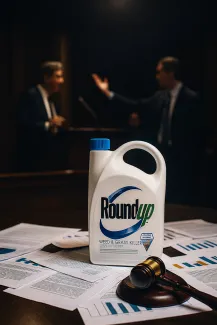
Image: ACSH
This inconsistency disrupts corporations’ handling of toxic tort lawsuits, which arise in federal courts and multiple state courts simultaneously, impacting reserves, SEC disclosures, and corporate planning. When courts conflict, only Congressional action can provide some measure of consistency. However, when attempts to standardize the regulation of pesticides through legislation were introduced, pesticide manufacturers – especially Bayer/Monsanto, the manufacturer of Roundup experienced a barrage of attacks, including false characterizations of the proposed legislation.
Before tackling the mischaracterization of the proposed law as a reckless attempt to thwart litigation and protect manufacturers, it is worth examining how we got here in the first place: That derives from a schism in the way some states and the federal courts address admissibility of scientific evidence to assure junk science stays out of the courtroom, resulting in conflicting findings in the RoundUp litigation.
State of the Cases
As of May, 61,000 Roundup cases against Monsanto/Bayer remained. These are mostly pending in a few state courts at the trial level, with 4,000 cases pending in a federal MultiDistrict Litigation in California; the results will undoubtedly be inconsistent. The divergence often hinges on the differing standards of admissibility employed by various courts.
Frye v. Daubert
Most state and federal courts follow the Daubert requisites. Under Daubert, the judge is designated as the “gatekeeper” of scientific evidence: i.e., before any evidence reaches the jury, the judge must first decide whether that evidence is reliable, relevant, and “fit”. When Daubert speaks of “reliable,” it really covers two scientific concepts:
- Validity – the method or science fits the purpose for which it is being used.
- Repeatability – the results can be reproduced.
The latter “Joiner” decision adds the requirement that experts may provide opinions based on the evidence, but those opinions must be logically tied to that evidence. Experts can no longer offer “ipse dixit” (“because I say so”) testimony.
In December 2023, the amended Federal Rules of Evidence (FRE) 702 and 203 reinforced the judge’s role as gatekeeper. These updates remind judges that they, not the jury, must decide whether the offered evidence and expert testimony rest on sound and relevant science. Judges can no longer delegate that responsibility to jurors, as they are charged with making an initial determination of whether the proffered evidence is reliable, relevant, and admissible.
The amendment was needed because, as the Fourth Circuit noted,
“some courts had abdicate[d] that duty by opening the gate indiscriminately to any proffered expert witness” and “exposing jurors to ‘dubious scientific testimony’ that [could] ultimately ‘sway’ their verdict.”
This admonition, however, did not prevent one state court judge, charged with following the Daubert standard, from doing precisely this in the Zantac litigation. In the spring of 2024, abdicating her responsibility as gatekeeper, Judge Vivian Medinilla presented all the scientific evidence to the jury, adopting a “let them decide” philosophy.
Her decision would have allowed experts to testify with junk science. Not surprisingly, shortly after this decision, 92 Roundup cases were filed in Delaware. Subsequently, Judge Medinilla’s ruling was overruled by the State’s highest court, ruling that all expert testimony was inadmissible as “junk science.” However, the court left open the question of threshold dose. Perhaps, as a result, the plaintiffs’ bar has tightened its eligibility requirements for Roundup plaintiffs it will represent, insisting on a high level of exposure for new clients (although it has apparently recently reversed this position).
“In recent years, we tightened our Roundup case criteria. That meant turning away many potential clients who did not meet strict thresholds for pesticide exposure or who fell outside the statute of limitations. We required a clear and consistent history of Roundup use over several years…”
(Plaintiff’s) Lawsuit Information Center
California Rejects Roundup as Causal
Stay curious. Stay informed. Free, independent writing delivered weekly
— no ads, no sponsored fluff.
In a recent 9th Circuit case, Engilis v. Monsanto, under the Daubert standard, the appellate court affirmed a summary judgment in favor of Monsanto, striking an expert witness on specific causation, i.e., finding that Roundup did not cause the particular plaintiff’s cancer.
Going further, a week ago in Bulone v. Monsanto, again under the Daubert, the 9th Circuit affirmed the trial court’s rejection of expert testimony on the issue of general causation, meaning the case could not proceed against Monsanto since there was no sound scientific evidence establishing that Roundup is even capable of causing cancer.
State Courts Using Frye
The same outcome would not be expected under the Frye standard, where the general consensus of scientific opinion drives admissibility. Judges are only involved in deciding what that consensus is, allowing the jury to assess the strength of the evidence, often after being bombarded with irrelevant and slanderous information about the manufacturers and further swayed by the horribly injured plaintiff before them.
Most states where the Round Up cases are pending rely on Frye, and it’s not accidental. Under Frye, one important, albeit deeply flawed, consensus report from the International Agency for Research on Cancer (IARC) released in 2015, can and has been admitted. That this report has since been debunked appears to carry little weight.
Indeed, the blatant partisanship, conflict of interest, and junk science embodied by the IARCreport would render it inadmissible under Daubert. For example, the head of the committee, Christian Portier, a statistician, had reportedly signed a lucrative contract to act as a litigation consultant for two law firms preparing to sue manufacturers, claiming their clients suffered cancer as a result of glyphosate exposure.
Poitier played a key role in the IARC decision, resulting in a conclusion that glyphosate was “probably carcinogenic”. The designation is modified by the phrase “although based on limited evidence, namely animal and cell studies”, but this caveat is glossed over when plaintiffs’ attorneys describe (malign) the product. Additionally, the report is based on “cherry-picked results, emphasizing those studies favoring the plaintiffs’ claim and ignoring negative studies”, a cardinal rubric upon which judges following the amended 702 reject testimony and dismiss cases. The results rendered in the study are also unreliable, further disqualifying them from admissibility under Daubert.
“According to a 2016 commentary entitled in the European Journal of Cancer Prevention, Robert Tarone, a statistician who spent most of his career at the National Cancer Institute, re-examined the animal studies cited by IARC. The results could not be replicated.”
“What Tarone found is that the IARC panel highlighted certain positive results from the rodent studies … and, glaringly, ignored contradictory negative results from the same studies. He also found that an inappropriate statistical test was used, making the data look more impressive than they actually were…” - Forbes
Another exposé by Reuters confirmed findings that the glyphosate document underwent significant editing to remove null results and to strengthen positive conclusions. In 10 significant instances, “a negative conclusion about glyphosate leading to tumors was either deleted or replaced with a neutral or positive one,” noting that “the original draft found little animal evidence that glyphosate was a carcinogen.” Reuters concluded:
“It is crucial to repeat that the classification of glyphosate as probably carcinogenic to humans relied entirely upon the conclusion that there was sufficient evidence of animal carcinogenicity because the epidemiologic evidence was not strong.” [emphasis in original]
If there remains any doubt about the lack of evidence tethering Roundup to cancer, the impartial and astoundingly thorough review by Judge Michael Lee of Australia, dismissing the class action case against Monsanto, should be dispositive. After reviewing thousands of pages of epidemiological, animal, cellular, and genetic evidence, the judge concluded there simply was not enough evidence to demonstrate, more probably than not, that Roundup caused cancer. While noting there were isolated studies that did show an association, he relied on the largest epidemiological study, which conclusively showed no connection.
Notwithstanding, the plaintiffs continue to tout diversionary studies, such as the June study published by Environmental Health. This one ostensibly showed a relationship between glyphosate exposure and leukemia in baby rats to support the (now debunked) IARC report. There are several significant problems with the study, including exposures beginning during gestation, and the excess incidence found was of lymphoblastic leukemia. Lawsuits against Monsanto focus on glyphosate’s alleged causal relationship with Non-Hodgkin Lymphoma (NHL). The two are distinctly different diseases with different mechanisms of causation. Lymphomas start in the lymphatic system, while leukemia begins in the bone marrow and primarily affects blood and bone marrow cells.
The persistence of the plaintiffs’ bar despite repeated sound scientific evidence establishing no connection between glyphosate and NHL requires a solution. Bayer/Monsanto is attempting to establish a nationwide uniform system of pesticide regulation, relying on the EPA’s determination of safety, which aligns with the WHO and the European Food Safety Authority. This approach is similar to the one used for pharmaceuticals, where lawsuits are limited once the FDA has established safety.
Let’s hope they prevail.
Tags:
- Roundup cancer lawsuits
- Bayer Monsanto litigation
- glyphosate scientific evidence
- Daubert vs Frye standard
- junk science in courts
- pesticide regulation debate
- IARC glyphosate report
- federal vs state court rulings
Category
---
ACSH
Energy drinks under attack for supposed mislabeling | American Council on Science and Health
Energy drinks under attack for supposed mislabeling
Posted on August 29, 2012 by admin
...
:{Currently, New York attorney general Eric T. Schneiderman is investigating whether the companies have violated federal law by promoting these drinks as dietary supplements rather than as foods, given that supplements are much more loosely regulated.
Health advocates have expressed concern largely about the effect of the caffeine on those (typically college students) who drink these beverages along with alcohol. One concern is that caffeine can mask the effects of alcohol. Another concern is that regular consumption of these beverages may produce caffeine-induced cardiovascular complications. The caffeine content in these beverages ranges from 80 to 500 milligrams. Given that a 12-ounce soda has about 50 mg, and a 5-ounce coffee has about 100 mg, those who regularly down these energy drinks should probably be aware of the relative amounts of caffeine they contain, ACSH’s Dr. Ruth Kava notes.
But whether the labeling is a legal violation is dubious, saysACSH advisor Dr. Henry Manne.“Outright deception in advertising can usually be dealt with quickly and almost surgically by state law enforcement officials,” notes Dr. Manne, who is an emeritus dean at the George Mason University School of Law. “But if the campaign comes out of the blue without prior widespread complaints from the public and it has the earmarks of hype and publicity hounding, there probably is a hidden agenda.” In such instances, he says, “the general rule is ‘look for the competitors.’ Those are the ones most likely to complain about the new product’s danger for the community’s safety, welfare, or morality.” ...
RANDOM 2026
Podcast: 'It's Just Hokum': Ultra-Processed Food Doesn't Cause Behavioral Issues in Kids
Podcast: Pesticides Killing Bees? Busting Chemical Myths With Dr. Liza Lockwood
Podcast: Fight Drug Abuse With Safe Injection Sites? Dr. Lynn Webster
Podcast: Religion and Science—Friends, Enemies or Total Strangers?
Podcast: Fighting Schizophrenia—With Bacon? How Ketosis May (Or May Not) Help Treat Psychosis
Coffee Doesn't Taste Like Caffeine. Here's Why
World Blood Donor Day: The Science, Courage, and Legacy
Aspartame: Not the Devil Incarnate but Not A Godsend Either
The Chemical Legacy of Louis Pasteur
No, You Did Not Get a Cortisone Shot
whelan ross e cig NY testimony 2013? enstrom on ltrhead
https://www.nysenate.gov/sites/default/files/American%20Council%20on%20Science%20and%20Health%20testimony%20e-cigarette.pdf
wow actually ack sea level rise and even ej but hints no gubmint bailout? comment sez tuvalu sp getting bigger
dinerstein
https://www.acsh.org/news/2021/11/12/great-climate-migration-15932
https://www.acsh.org/news/2016/09/02/pacific-standard-has-low-science-standards-9978
didn't slate do a deal with lomborg?
6/2016
i have been a long-time reader ofPacific Standard (once called Miller-McCune), a publication that tries to be the West Coast equivalent of The Atlantic.That is a fine mission because, as a Seattleite, I am keenly aware that there aren't many West Coast media outlets that capture the attention of the rest of the nation.
When I was still editor of RealClearScience(RCS), I frequently linked to Pacific Standard's content, particularly articles produced by Tom Jacobs, who was and continues to be a fine social science writer. However, in recent months, the magazine as a whole has become nearly unreadable. As its political cheerleading becomes more and more blatant, its standards for science journalism have fallen. I don't think that is a coincidence.
A few years ago, something similar happened at *Slate*. At one time, Slate was producing so much good science content that RCS would link to them several times per week. But when its science page became an extension of its political coverage (thanks largely to Phil Plait), RCS took them far less seriously. Despite the fact that we had a politically diverse editorial team, RCS was turned off by the one-sided politicization of science.
The latest exhibit on "how not to do science writing" comes once again from Pacific Standard, which covered a new paper from Science Advances on pesticide use among farmers who adopted GMOs. The article begins, "There is at least one potentially good thing about genetically modified crops."
Right off the bat, the author, Nathan Collins, is admitting his anti-GMO bias. If he believes that there is merely "one potentially good thing" about GMOs, then he has chosen to ignore the scientific consensus on GMOs, as well as the entire field of biotechnology -- which has done everything from creating specialized animal models for researchers and insulin for diabetics. But that journalistic tip-of-the-hand is forgivable; what he does next is not.
The gist of Mr. Collins' article is that pesticide use has increased and herbicide (glyphosate) resistance is spreading. The article's summary states, "In theory, Roundup Ready soybeans and the like should have reduced pesticide use. They haven't." But, that's highly misleading. Mr. Collins largely ignores other conclusions made by the researchers and uses the vague word pesticide when he should be making a crucial distinction between herbicides and insecticides.
As a general rule, herbicides and insecticides are much safer than they were in the past. Decreasing their application just for the sake of using fewer pesticides isn't necessarily a worthwhile goal. Still, it is worth differentiating between herbicides and insecticides, as each plays different roles in the ecosystem.
The authors of the paper indeed concluded that farmers who use glyphosate-resistant crops "used increasingly more herbicides relative to nonadopters" and that the spread of glyphosate-resistant weeds appears to be to blame. The upward trend in both glyphosate use and resistance is concerning and must be addressed. But they also clearly wrote in their abstract:
When pesticides are weighted by the environmental impact quotient, however, we find that (relative to nonadopters) GE [genetically engineered] adopters used about the same amount of soybean herbicides, 9.8% less of maize herbicides, and 10.4% less of maize insecticides.
In other words, when one factors in how damaging a particular pesticide is to the environment, GMOs have a pretty good record over the study period (1998-2011). That is because glyphosate is less toxic than many other herbicides and is even less toxic than caffeine. (To his credit, Mr. Collins acknowledges this.) Crucially, GMOs have caused a 10% drop in insecticide use.
However, Mr. Collins' article entirely ignores that. Instead, he focuses almost exclusively on the increasing trend of glyphosate use and resistance. Mr. Collins quotes the authors: "[T]he most striking trend has been an increase in the use of glyphosate." This is certainly true, especially for farmers who use genetically modified soybeans. These farmers have applied more herbicide than those who do not use genetically modified soybeans since 2003. But he left out the very previous sentence: "The rate of use of insecticides applied to maize fell from 0.2 kg/ha in 1998 to about 0.05 kg/ha in 2011, a 75% decrease."
That is a telling omission. It is difficult to come to any other conclusion than that it was purposeful.
In the Discussion, the authors once again clearly state:
Over the period 1998–2011, our results show that GE [genetically engineered] variety adoption reduced both herbicide and insecticide use in maize, while increasing herbicide use in soybeans. However, weighting pesticides by the EIQ lowers the difference in herbicide use by GT soybean adopters (such that the estimated average impact over the study period is statistically indistinguishable from zero). Adoption of Bt maize, on the other hand, is associated with a clearer decline in insecticide use.
And:
We find clear evidence of increasing herbicide use by GT [glyphosate-tolerant] variety adopters over time for both soybeans and maize, a finding that we attribute in part to the emergence of glyphosate weed resistance.
These conclusions add nothing substantive to the literature. While the authors' methods are new (and perhaps more accurate), there are no new takeaways. Both the overuse of glyphosate (and the subsequent resistance in weeds) and the drop in insecticide use have been documented before. Honestly, this isn't an article worthy of press attention... unless a writer is trying to politicize it.
There seems to be a greater lesson here for media outlets: Partisanship and science quality are inversely related.
bad code
Tags:
science journalismGMOPesticidesherbicidesinsecticidesgenetically modified crop
11 21 grab acsh
Health Scares Vs Health Threats
Thank You,Trial Lawyers, For Protecting Us from the Scourge of Baby Powder
Scientists say that talcum baby powder doesn't cause cancer. Trial lawyers say it does. As usual, the lawyers win. Scientists, common sense, and Americans lose.
Read more
Coronavirus: Fear of a Pandemic, or a Pandemic of Fear?
We must eliminate both. Here's one group's plan to do that.
Read more
95% of Baby Food Tainted with Toxic Metals? Don't Panic
The Centers for Disease Control says that the “American food supply is among the safest in the world.” But a read of some recent news reports about toxic metals in baby food may have you feeling somewhat concerned. So what's really the state of the supermarket aisle? Let's take a closer look.
Read more
Everything Goes to Pot: Myths Are Driving FDA, CDC Vaping Policy
While an investigation is underway into the exact nature of the problem, so far the likeliest explanation is that improper use of vaping devices has led to illness, or the death, of some users. But that sort of nuance isn't governing the thinking of the FDA or CDC officials, both of which are allowing myths and fearmongering to drive their policies and public statements.
Read more
Precautionary Principle:We Must Ban Driving to Whole Foods
Better safe than sorry. That's a great lesson for a child when a parent explains why she should wear a helmet when riding her bicycle. But that refrain makes for terrible public health policy.
Read more
CDC Misleads by Calling E-Cigarettes a 'Tobacco Product'
The CDC says "tobacco use by youth is rising." If that were to be true, it'd be horrible -- but it's not. Cigarette use is down. The only reason the CDC can make this claim is because the agency considers e-cigarettes and vaping devices -- which only contain nicotine -- to be tobacco products. This is misleading and undermines public health.
Read more
AAAS Runs Dishonest Glyphosate Story, Then Deletes It. Is Politics to Blame?
The American Association for the Advancement of Science is one of the foremost pro-science organizations in the world. Not only does it advocate for good science and science policy, it publishes Science, the prestigious journal read globally by millions. Unfortunately, AAAS has gotten a bit weird in recent months.
Read more
UK Parliament Endorses E-Cigarettes to Help Smokers. Will U.S. Follow?
U.S. public health agencies struggle to endorse an obvious solution to a true public health menace. Hopefully, the UK Parliament will provide a much-needed boost to the forces of common sense.
Read more
Glyphosateand Pesticides: Et Tu, Live Science?
Normally a reliable source of information, Live Science published an article that is a dream for anti-pesticide and anti-chemical fearmongers.
Read more
CNN's Christiane Amanpour Misleads on Flint Water Crisis [recall BSS elsewhere on pb]
The recent reporting on Flint's water crisis by CNN's Christiane Amanpour has a tenuous grasp of the data and the reality.
Read more
New Study Refutes the 'Wine Will Kill You' Nonsense
A few weeks ago, a paper claimed that an extra glass of wine will shorten your life. The story circled the globe in minutes. A new paper, with better methodology, concluded what we all knew: Moderate alcohol consumption can be integrated into a healthy lifestyle. It, however, won't receive nearly as much attention as the sensationalist report. Such is the power of the academic PR hype machine combined with a gullible, sensationalist press.
Read more
Diarrhea Outbreaks: A Glimpse into Anti-Vaxxer Utopia
Despite the reality of measles, rotavirus, and a plethora of other infectious diseases, there's yet another anti-vaccine movement afoot in California. And its aim is to turn the clock back to the 10th Century.
Read more
11 21 desmog
Meet the Climate Science Deniers Who Downplayed COVID-19 ...
DeSmog › 2020/03/16 › climate-science-deniers-downplayed-co...
January 30, 2020, the World Health Organization (WHO) declared that the outbreak of novel coronavirus 2019, which causes the disease COVID-19, was officially a “public health emergency of international concern.” At the time, there were cases confirmed in 19 countries and deaths in China had reached 170.
The very next day, the American Council on Science and Health (ACSH) published an article titled, “Coronavirus in the U.S.: How Bad Will It Be?”
“Is coronavirus worse than the flu?” it began. “No, not even close.”
“It already has spread from person-to-person in the U.S., but it probably won’t go far,” ACSH added. “And the American healthcare system is excellent at dealing with this sort of problem.”
ACSH is one of several organizations promoting climate science denial that are now spreading misinformation on the coronavirus, with potentially deadly consequences.
American Council on Science and Health?
The ACSH presents itself to the public as a proponent of “peer-reviewed mainstream science,” in the words of the organization’s mission. Their experts have frequently been quoted in mainstream newspapers and magazines, and they pen columns criticizing journalists who write critically about companies like Monsanto. The group has received funding from oil giants including ExxonMobil, as well as from the agribusiness, chemical and tobacco industries to name a few.
When it comes to climate change, ACSH has published a steady stream of articles downplaying climate science and criticizing efforts to slow carbon emissions — even in the face of a mountain of peer-reviewed research on the climate crisis.
ACSH slammed the medical journal The Lancet as “an ideologically driven outlet with a very clear political agenda where being sensationalist and culturally woke trumps evidence and reasonability” (after the Lancet published an article titled “The carbon footprint”).The purported “pro-science” advocacy group has labeled Greta Thunberg’s activism “doomsday prophesying.” It has (falsely) suggested that climate change is less of a concern because “more people die in winter than in summer” (they don’t).
And that’s all just in the past nine months. The ACSH’s stance against climate action dates back to at least 1997.
When it comes to coronavirus, now a global pandemic, ACSH’s authors rushed to judgment. They assured readers that there was little to worry about, and put some of the same faulty thinking that underlies their stance on climate change on display.
aCSH isn’t alone. Other organizations that have also engaged in climate science denial made similar missteps on COVID-19, including prominent organizations that fanned the flames of conspiracy theories or confidently promoted complacency when circumstances required rapid action.
To be clear: No one should be faulted for failing to foresee precisely how severe of a problem COVID-19 would prove to be. None of us has a crystal ball and few, if any, expected this situation to unfold in this particular way.
But these organizations published positions that not only wound up being laden with false reassurances, but they did so based on claims that they made confidently at the time that now appear to have been false or misleading...Defending Conspiracy Theorists... “Was coronavirus a bioweapon? We don’t know, but history shows we can’t trust China.”...[twt]
the article defended Sen. Tom Cotton of Arkansas for his Fox News interview , an AEI visiting scholar, also penned a January 29 piece headlined, “The media is driving the overreaction to the coronavirus....The piece argues against action on COVID-19, without citing any evidence about the virus itself, but instead based on characterizations and generalizations. “I’ve seen several news reports essentially implying that, even if quarantining travelers or imposing travel bans to China are overreactions to the risk of the coronavirus, this is ok because it’s better to be safe than sorry,” he wrote. “Companies are so fearful of negative press that they seem to base much of their own rhetoric on what the media and liberal elites demand. While some of this is arguably harmless — note much of the hot air at Davos about climate change — when it becomes corporate policy and is echoed by government policy, it then has real consequences.”
“A contagion will happen at some point, and it’s important we recognize it and react,” he added.
“Unless the coronavirus mutates into something far more dangerous,” he concluded, “this isn’t it.”
To be sure, there was not a visible consensus on those views within AEI. That same day, another AEI fellow published an article calling the coronavirus a “big economic deal,” citing its impact on China’s economy. And a three-paragraph AEI post later labeled claims that COVID-19 is a bioweapon “fake news.”
Those other pieces, however, do not undo any impacts from AEI publishing claims that proved to be baseless.
Reading Comprehension
Other times, articles downplaying the risks from COVID-19, penned by organizations that have adopted climate-science denying stances, present arguments laced with logical fallacies.
In some cases, it’s not clear whether the authors understood the comments they were critiquing.
Take, for instance, the Cato Institute’s March 4, 2020 column on “COVID-19 Deaths and Incredible WHO Estimates.” That piece attacks a statement by the WHO’s director general, Dr. Tedros Adhanom Ghebreyesus, who was quoted in The New York Times as saying, “Globally, about 3.4 percent of reported :{COVID:(style="box-sizing:border-box"):}:‐19 cases have died.”
Cato’s column labeled that statistic “sensationalist nonsense.” The number doesn’t take into account the fact that mild cases are more likely to go unreported, Cato’s Alan Reynolds wrote.
Because most #CoronaVirus cases are mild and aren’t reported, the WHO’s alleged 3.4% #Covid19 mortality rate is nothing more than sensationalist nonsense. The actual death rate among infected people outside China may be as low as 0.5%. https://t.co/:{CQ:(style="box-sizing:border-box"):}:mNYEkXsE #CatoHealth pic.twitter.com/nnyUH0DqXe
— Cato Institute (@CatoInstitute) March 8, 2020
That, of course, is exactly why Dr. Adhanom included the word “reported” in his description of the statistic. There’s no ball being hidden here. And in case readers missed that word and its importance, The Times’ report included an explanation of that precise context. (“But the figure came loaded with caveats,” The Times wrote. “Experts, including those at the WHO, say that when more is known about the epidemic, the death rate will be considerably lower.”)
One day later, President Trump took a similar tack to Cato’s, calling the 3.4 precent statistic “really a false number.”
“Now, this is just a hunch, but based on a lot of conversations with a lot of people that do this,” Trump added.
It’s not clear where exactly Trump picked up his impression — but then of course, Trump has his own well-known stance on climate science.
‘Not Even Close’
The author of the ACSH piece claiming that coronavirus is “not even close” to as bad as the flu was Dr. Alex Berezow — a PhD in microbiology, according to his bio, not a medical doctor. Berezow has been interviewed about coronavirus precautions by the Wall Street Journal, New York magazine, Insider, and Yahoo News.
Berezow doubled down on his claim that the flu is a worse threat than coronavirus in a February 18 article. “Influenza is far deadlier than the Wuhan coronavirus, but few people worry about it,” that article begins, referring to the virus with the Chinese city initially at the center of the outbreak (a practice that’s since been viewed as stigmatizing and racist, amid a growing number of cases of stigma-motivated racial violence).
A few weeks later, Berezow changed his tune, offering readers assurances that even if COVID-19 was far more deadly than the flu, there was still little reason for alarm in an article calling media reports “unreliable” and “sensationalism.”
“Even though the Wuhan coronavirus is currently thought to have a case-fatality rate of 2 percent (which would make it 20 times deadlier [than influenza]),” he wrote, “it’s unlikely that it will rack up a similar annual death toll because — at least for the time being — it is not going to infect hundreds of millions of people.”
A week later, on February 27, Berezow admitted he had changed his mind, saying that the facts had changed and writing: “When COVID-19, aka the Wuhan coronavirus, first emerged, it seemed most likely that the virus would fizzle out. But as the disease continues to spread, that outcome now appears nearly impossible.”
But by mid-March, Berezow was back to arguing that, as he wrote on March 11, “[f]or now, influenza remains the far bigger global public health threat.”
In contrast, public health organizations like the WHO have sought to offer information in ways that are both careful and candid. The Centers for Disease Control’s (neglected) guidelines for public health communication call for messaging that’s consistent, accurate, and doesn’t withhold important information.
There’s an enormous amount of uncertainty about what the coming days will bring when it comes to this pandemic. But if we’re all going to make the best decisions possible today, we’d be well-served to pay close attention to medical science.
And when so much of the message that there’s nothing to worry about on climate change comes from think tanks like Cato, AEI, and ACSH that made unsupported and flawed calls on COVID-19, it’s worth taking a moment to pause and think about that as well.
Because as monumental as the impacts of this pandemic are now, the science tells us that if we fail to dramatically cut carbon and methane emissions, the impacts of climate change may be even more profound over the long run.
https://www.climatedocket.com/2019/06/26/exxon-climate-denial-american-council-science-health/
exxonMobil is funding a little-known nonprofit that calls itself a “pro-science advocacy organization,” but whose scientific advisory board includes several renowned climate deniers and has worked for decades to sow doubt about the health impacts of climate change.
Records show the ExxonMobil Foundation provided grants of at least $60,000 in both 2017 and 2018 to the American Council on Science and Health (ACSH), a group that says its mission is to “publicly support evidence-based science and medicine.”
Members of the ACSH scientific advisory board, however, include a who’s who of climate deniers, includingPatrick J. Michaels, who has worked for more than 30 years on behalf of the fossil fuel industry;S. Fred Singer,who last year wrote an article for the Wall Street Journal falsely claiming that sea level rise is not caused by climate change; andWilliam Happer, a current member of President Trump’s National Security Council who as recently as 2016 argued that carbon dioxide is not a pollutant.
Documents recently revealed in an investigation by The Guardian guk show ExxonMobil’s current funding of the ACSH began prior to 1999, when Exxon and Mobil merged to become Exxon Mobil Corporation, one of the largest oil companies in the world.
“ACSH is a front group for libertarian billionaires, fossil fuel companies, and basically every other industry selling dangerous products,” said Geoffrey Supran, a Harvard University researcher who in 2017 published a study that showed how Exxon’s internal memos take the climate issue seriously while its public communications emphasize doubt about the science.
ACSH has also defended fracking as safe for the environment, denied the dangers of bisphenol-A (BPA) and opposed efforts to limit sugar in sodas, among other pro-industry stances.
Corporations fund nonprofits, think tanks and trade groups, many of which are “dark money” organizations that do not disclose their donors to the public, to further their interests without directly being tied to the groups’ work.
“This is just one more example of how these large corporations use third-party organizations to convey their message without being directly connected to them,” said Drexel University environmental sociologist Robert Brulle, who is now a visiting professor of environment and society at Brown University.
“It fits exactly with the kind of stuff ExxonMobil has done for years and years—this is exactly their strategy,” said Brulle, who has studied the funding patterns of organizations connected to climate denial. “The question is what is still going on and why does Exxon still have its connection to this group after all these years?”
In addition to its questionable science advisory board, the ACSH board of trustees includes Fred L. Smith, founder of the conservative think tank Competitive Enterprise Institute (CEI) and current director of CEI’s Center for Advancing Capitalism.
In a bit of irony, Exxon said in 2006 it would stop funding CEI (which it had given nearly $2 million between 1998-2005) because of its work denying climate change, but it continued to fund ACSH at least through 2018, the last year for which data is available.
ExxonMobil’s current funding of ACSH is a continuation of a relationship that goes back decades.
Prior to merging in 1999, Exxon and Mobilboth funded the ACSH, according to internal Mobil Foundation documents, which include a list of potential grant recipients as well as Mobil’s justification for the funding decision. They reveal that the Mobil Foundation provided at least $125,000 in grants to the ACSH between 1981-93 and funding was expected to continue into 1994.
The Mobil Foundation recommended continuing to provide funding to the ACSH in part because “the Council has achieved high credibility and recognition in the media and scientific community, as evidenced by wide publication of their positions in the press and scientific journals.”
It’s unclear what the most recent ExxonMobil Foundation grants were used for, but Alex Berezow, vice president of scientific affairs for ACSH, said they weren’t designated for any specific research or project.
“Our policy for the past several years precludes us from doing specific research in exchange for corporate grants,” Berezow said.
Since its founding in 1978, the ACSH has worked to promotecorporatepositions on science, most often taking theposition that chemicals are not a threat to humans or the environment.
“It’s a quintessential anti-science astroturf in the fossil fuel industry’s web of denial and delay—this is an organization founded by money from libertarian ideologues like the Scaifes, Olins, and Kochs,” Supran said. “Unsurprisingly therefore, ACSH’s rhetoric on the climate crisis since the 1990’s has masterfully complemented the talking points of itsfossil fuel funders, including Exxon, Mobil, ExxonMobil, Chevron, Shell, and the American Petroleum Institute.”
Exxon, Mobil and “The Great Defender of Petrochemical Companies”
ACSH was founded in 1978 by Elizabeth Whelan, a public health scientist with postgraduate degrees from Yale and Harvard, who died in 2014. She wanted to counteract the work of environmental and consumer advocacy groups, which she said were not using sound science about the dangers of products to the environment and public health. “We help policymakers see past scaremongers and activist groups who have targeted GMOs, vaccines, conventional agriculture, nuclear power, natural gas, and ‘chemicals,’ while peddling health scares and fad diets,” the ACSH website says.
It’s unknown whether Exxon and Mobil’s funding was used for a specific project or research, but the ACSH grant was recommended by Mobil’s public relations department, which said Whelan’s work was a major benefit to the company.
Whelan’s description of the ACSH was much more candid. In a 1992 memo, she referred to the organization as “the great defender of petrochemical companies.”
In a 1998 article titled, *Global Warming Not Health Threat*, Whelan wrote that climate science is “is rife with uncertainty as are the allegations for the health effects” and climate change models are “far from perfect.”
“As for the hypothetical health effects that are based on the alleged global warming, these predictions are even more dubious,” wrote Whelan, adding that limiting greenhouse gas emissions could worsen human health in developing countries.
Supran said ACSH vociferously promoted Mobil’s position that addressing climate change would result in severe adverse economic impacts and increase poverty.
“ACSH was and is a talking head, amplifying the fossil fuel industry’s narrative while maintaining the false pretense of an “independent” voice,” Supran said. “Their rhetoric faithfully echoed Mobil’s key themes of doubt: that global warming is not real and human-caused, not serious, and not solvable.”
ExxonMobil did not respond to a request for comment.
Wanted: Studies to “Put Climate Change Health Hazards in Perspective”
It was at the urging of Mobil that the Global Climate Coalition (GCC), a fossil fuel industry-backed group that worked from 1989 to 2002 to strategically undermine international climate negotiations, looked to the ACSH for help downplaying the potential health effects of climate change.
By the mid-1990’s, the GCC and its fossil fuel members, including many ACSH funders, had become concerned about the growing body of research suggesting climate change could cause serious health impacts.
Exxon scientists Dennis Devlin and Barry Friedlander presented a summary of published literature on the health impacts of climate change during a September 1996 meeting of the Global Climate Coalition’s Science and Technology Assessment Committee. The presentation emphasized “key knowledge gaps” and “advocated critical evaluation of models and ongoing studies to put climate change health hazards in perspective.”
After the presentation, the GCC meeting attendees discussed the findings and brainstormed “ways of encouraging a more balanced scientific evaluation of this concern.”
To provide that “balance,” Lenny Bernstein of Mobil suggested Whelan and the ACSH.
Bernstein told the group that Whelan was considering an “independent assessment on the climate change and health issue.” He also noted that many of the Global Climate Coalition’s member companies financially support the ACSH and urged them to contact her to suggest she write an assessment.
“The health issue is increasing in importance with the climate change issue, as with other environmental issues,” wrote the Global Climate Coalition in meeting minutes from January 1997. “The GCC has got to be prepared to respond to the issue this year.”
Disregarding the growing body of research indicating otherwise, the GCC in early 1997 wrote in a position paper that “attempting to link global climate change and adverse health impacts requires a long and very tenuous stretch.” The group downplayed the work of a 1995 report by the Intergovernmental Panel on Climate Change (IPCC)—an intergovernmental body of the United Nations that includes the world’s leading climate scientists—writing “concerns that climate change might be the cause of various health problems rests on a number of unproved assumptions.”
The Global Climate Coalition also provided the ACSH with a two-part grant to study the health effects of climate change.
The study, however, would be anything but independent.
By early summer 1997, the GCC had reviewed a draft of the report and suggested edits. The ACSH then began working on a rewritten draft to be reviewed by GCC committee members.
It’s unclear if that report was ever published, but later that year the ACSH published “Global climate change and human health.”
As the GCC had hoped, the report downplayed the views of mainstream science and said “implementation of current proposals for mitigation measures—measures to stabilize the concentration of greenhouse gases in the atmosphere—would be both costly and ineffective.”
Brulle said corporations and industry groups like the GCC use organizations like the ACSH to add a “veneer of legitimacy.”
“This really fits directly into this whole strategy of third party spokespersons, taking your point, but not attributing it to you, it’s attributed to an ‘independent’ organization,” Brulle said.
The ACSH report did not disclose its funders, but concluded that “policymakers can safely take several decades to plan a response, and scientists will have enough time to develop cost-effective anti-climate-change strategies.”
When asked if the published report was funded by the Global Climate Coalition or if another report was published, Berezow said he did not know.
“Anyone who would know the answer to that question is either deceased or retired,” he said.
ACSH Benefits to ExxonMobil: Denial and Delay
After years of scrutiny, ExxonMobil has stopped funding some of the more vocal climate deniers and organizations. In addition to dropping CEI, the oil giant has ended its membership in the American Legislative Exchange Council and has said it no longer funds the Cato Institute, the Heartland Institute and the Institute for Energy Research, all organizations that are heavily industry-influenced and have worked for years to deny climate change and delay the regulation of greenhouse gas emissions.
But ExxonMobil continues to fund the ACSHdespite the organization’s position that “climate change is a slow-moving threat whose consequences are in the medium- to long-term future, not the near-term.”
“We typically only talk about climate change tangentially. For instance, we support Generation IV nuclear power because, among many other things, it helps reduce carbon emissions,” Berezow said, adding that the organization’s main focus is on biomedical science and public health.
Brulle said while using third-party spokespeople and groups like the ACSH isn’t new, ExxonMobil’s continued relationship is notable.
“I do find it a little surprising that ExxonMobil would be cozy enough to be directly connected to this group,” Brulle said.
Supran said ACSH continues to be an excellent investment for ExxonMobil.
“In a 2016 ACSH article promoting the authority of discredited and debunked climate deniers and delayers, for instance, ExxonMobil’s funding fingerprints are nowhere to be found,” Supran said, referring to Meet the Scientific Outcasts and Mavericks,which was authored by Berezow.
In *Are The ‘Green 20’ Suppressing Scientific Dissent?*, posted in 2017, then-ACSH presidentHank Campbell, critiqued the New York attorney general’s office for its investigation of ExxonMobil for possibly deceiving its investors on the risks of climate change.
In another, *Al Gore: Still Demented After All These Years*, Berezow said in 2017 that the world’s biggest health problem is poverty, not climate change. “When it comes to human disease, climate change is mostly a distraction. Eliminating poverty will do far more to save people’s lives than lowering the temperature a notch,” Berezow said.
Nowhere on the ACSH website is ExxonMobil’s funding acknowledged.
“As it’s grown more publicly untenable for companies themselves to publicly deny basic science, front groups like ACSH help do their dirty work,” said Supran, adding that the ACSH is a prime example of how ExxonMobil’s denial and delay continue through increasingly veiled initiatives.
“ACSH’s faux-scientific calls for ’evidence-based science’ and its fixation on false dichotomies between meaningful climate action on the one hand, and poverty reduction and economic growth on the other, align with, extend, and amplify ExxonMobil’s own talking points,” he said. “The rhetoric has shifted an inch, but it’s just a rose by any other name—the goal is the same: inaction.”
https://www.desmogblog.com/2020/03/16/climate-science-deniers-downplayed-covid-19-cato-acsh-aei
Meet the Climate Science Deniers Who Downplayed COVID-19 Risks
By Sharon Kelly • Monday, March 16, 2020 - 15:25
no lnx many
On January 30, 2020, the World Health Organization (WHO) declared that the outbreak of novel coronavirus 2019, which causes the disease COVID-19, was officially a “public health emergency of international concern.” At the time, there were cases confirmed in 19 countries and deaths in China had reached 170.
The very next day, the American Council on Science and Health (ACSH) published an article titled, “Coronavirus in the U.S.: How Bad Will It Be?”
“Is coronavirus worse than the flu?” it began. “No, not even close.”
“It already has spread from person-to-person in the U.S., but it probably won't go far,” ACSH added. “And the American healthcare system is excellent at dealing with this sort of problem.”
ACSH is one of several organizations promoting climate science denial that are now spreading misinformation on the coronavirus, with potentially deadly consequences.
American Council on Science and Health?
The ACSH presents itself to the public as a proponent of “peer-reviewed mainstream science,” in the words of the organization’s mission. Their experts have frequently been quoted in mainstream newspapers and magazines, and they pen columns criticizing journalists who write critically about companies like Monsanto. The group has received funding from oil giants including ExxonMobil, as well as from the agribusiness, chemical and tobacco industries to name a few.
When it comes to climate change, ACSH has published a steady stream of articles downplaying climate science and criticizing efforts to slow carbon emissions — even in the face of a mountain of peer-reviewed research on the climate crisis.
ACSH slammed the medical journal The Lancet as “an ideologically driven outlet with a very clear political agenda where being sensationalist and culturally woke trumps evidence and reasonability” (after the Lancet published an article titled “The carbon footprint”). The purported “pro-science” advocacy group has labeledGreta Thunberg’s activism “doomsday prophesying.” It has (falsely) suggested that climate change is less of a concern because “more people die in winter than in summer” (they don’t).
And that’s all just in the past nine months. The ACSH’s stance against climate action dates back to at least 1997.
When it comes to coronavirus, now a global pandemic, ACSH’s authors rushed to judgment. They assured readers that there was little to worry about, and put some of the same faulty thinking that underlies their stance on climate change on display.
ACSH isn’t alone. Other organizations that have also engaged in climate science denial made similar missteps on COVID-19, including prominent organizations that fanned the flames of conspiracy theories or confidently promoted complacency when circumstances required rapid action.
To be clear: No one should be faulted for failing to foresee precisely how severe of a problem COVID-19 would prove to be. None of us has a crystal ball and few, if any, expected this situation to unfold in this particular way.
But these organizations published positions that not only wound up being laden with false reassurances, but they did so based on claims that they made confidently at the time that now appear to have been false or misleading.
Defending Conspiracy Theorists
Take for example, the American Enterprise Institute’s (AEI) publications on COVID-19.
AEI fanned the flames of a conspiracy theory that claims COVID-19 was developed for biological warfare.
AEI resident scholar Michael Rubin published a piece titled, “Was coronavirus a bioweapon? We don’t know, but history shows we can’t trust China.”...The article defended Sen. Tom Cotton of Arkansas for his Fox News interview circulating the theory.
Roger Bate, an AEI visiting scholar, also penned a January 29 piece headlined, “The media is driving the overreaction to the coronavirus.”
The piece argues against action on COVID-19, without citing any evidence about the virus itself, but instead based on characterizations and generalizations. “I’ve seen several news reports essentially implying that, even if quarantining travelers or imposing travel bans to China are overreactions to the risk of the coronavirus, this is ok because it’s better to be safe than sorry,” he wrote. “Companies are so fearful of negative press that they seem to base much of their own rhetoric on what the media and liberal elites demand. While some of this is arguably harmless — note much of the hot air at Davos about climate change — when it becomes corporate policy and is echoed by government policy, it then has real consequences.”
“A contagion will happen at some point, and it’s important we recognize it and react,” he added.
“Unless the coronavirus mutates into something far more dangerous,” he concluded, “this isn’t it.”
To be sure, there was not a visible consensus on those views within AEI. That same day, another AEI fellow published an article calling the coronavirus a “big economic deal,” citing its impact on China’s economy. And a three-paragraph AEI post later labeled claims that COVID-19 is a bioweapon “fake news.”
Those other pieces, however, do not undo any impacts from AEI publishing claims that proved to be baseless.
Reading Comprehension
Other times, articles downplaying the risks from COVID-19, penned by organizations that have adopted climate-science denying stances, present arguments laced with logical fallacies.
In some cases, it’s not clear whether the authors understood the comments they were critiquing.
Take, for instance, the Cato Institute’s March 4, 2020 column on “COVID-19 Deaths and Incredible WHO Estimates.” That piece attacks a statement by the WHO’s director general, Dr. Tedros Adhanom Ghebreyesus, who was quoted in The New York Times as saying, “Globally, about 3.4 percent of reported COVID-?19 cases have died.”
Cato’s column labeled that statistic “sensationalist nonsense.” The number doesn’t take into account the fact that mild cases are more likely to go unreported, Cato’s Alan Reynolds wrote.
That, of course, is exactly why Dr. Adhanom included the word “reported” in his description of the statistic. There’s no ball being hidden here. And in case readers missed that word and its importance, The Times’ report included an explanation of that precise context. (“But the figure came loaded with caveats,” The Times wrote. “Experts, including those at the WHO, say that when more is known about the epidemic, the death rate will be considerably lower.”)
One day later, President Trump took a similar tack to Cato’s, calling the 3.4 precent statistic “really a false number.”
“Now, this is just a hunch, but based on a lot of conversations with a lot of people that do this,” Trump added.
It’s not clear where exactly Trump picked up his impression — but then of course, Trump has his own well-known stance on climate science.
'Not Even Close'
The author of the ACSH piece claiming that coronavirus is “not even close” to as bad as the flu was Dr. Alex Berezow — a PhD in microbiology, according to his bio, not a medical doctor. Berezow has been interviewed about coronavirus precautions by the Wall Street Journal, New York magazine, Insider, and Yahoo News.
Berezow doubled down on his claim that the flu is a worse threat than coronavirus in a February 18 article. “Influenza is far deadlier than the Wuhan coronavirus, but few people worry about it,” that article begins, referring to the virus with the Chinese city initially at the center of the outbreak (a practice that's since been viewed as stigmatizing and racist, amid a growing number of cases of stigma-motivated racial violence).
A few weeks later, Berezow changed his tune, offering readers assurances that even if COVID-19 was far more deadly than the flu, there was still little reason for alarm in an article calling media reports “unreliable” and “sensationalism.”
“Even though the Wuhan coronavirus is currently thought to have a case-fatality rate of 2 percent (which would make it 20 times deadlier [than influenza]),” he wrote, “it’s unlikely that it will rack up a similar annual death toll because — at least for the time being — it is not going to infect hundreds of millions of people.”
A week later, on February 27, Berezow admitted he had changed his mind, saying that the facts had changed and writing: “When COVID-19, aka the Wuhan coronavirus, first emerged, it seemed most likely that the virus would fizzle out. But as the disease continues to spread, that outcome now appears nearly impossible.”
But by mid-March, Berezow was back to arguing that, as he wrote on March 11, “[f]or now, influenza remains the far bigger global public health threat.”
In contrast, public health organizations like the WHO have sought to offer information in ways that are both careful and candid. The Centers for Disease Control’s (neglected) guidelines for public health communication call for messaging that’s consistent, accurate, and doesn’t withhold important information.
There’s an enormous amount of uncertainty about what the coming days will bring when it comes to this pandemic. But if we’re all going to make the best decisions possible today, we’d be well-served to pay close attention to medical science.
And when so much of the message that there’s nothing to worry about on climate change comes from think tanks like Cato, AEI, and ACSH that made unsupported and flawed calls on COVID-19, it’s worth taking a moment to pause and think about that as well.
Because as monumental as the impacts of this pandemic are now, the science tells us that if we fail to dramatically cut carbon and methane emissions, the impacts of climate change may be even more profound over the long run.
==
hank c link kind of clever, filters but current content?
"U.S. Right To Know" source:acsh.org
..
"U.S. Right To Know" source:acsh.org
35 results (0.26 seconds)
Search Results
American Council on Science and Health
On Glyphosate, Who Do You Trust: UCSF or Everybody Else?
Mr. Ruskin operates an organization called U.S. Right to Know, whose primary benefactor is the Organic Consumers Association, a group that, ...
2 weeks ago
American Council on Science and Health
Anti-Science, Anti-Semitic Website 'CounterPunch' Attacks ACSH
Note that Borowski cites U.S. Right to Know (USRTK), a group of anti-biotech, pro-Kremlin activists to back up his accusation. Also note that ...
Mar 11, 2019
American Council on Science and Health
Do Physicians Have a 'Right to Be Forgotten'?
When we all lived in villages, knowing individual merchants allowed you to identify and avoid the cheats. As we urbanized brand names ...
Feb 7, 2019
American Council on Science and Health
"Unreasonable": Superior Court Judge Signals She's Going To Gut ...
... the bulk of the funding behind Baum Hedlund allies U.S. Right To Know, is prominently egging on the jurors may be a concern for the judge.
Oct 19, 2018
American Council on Science and Health
What's Worse? Kidney Stones ... Or a Chemistry Lesson About Them?
Conflict of Interest Statement: No matter what I write, the mutants over at US Right To Know (Nothing) will call me a shill and the mouthpiece of ...
May 13, 2019
American Council on Science and Health
How Organic Consumers Association Colludes with Russian Trolls
And Gary Ruskin, who heads the anti-GMO group U.S. Right to Know (which is funded primarily by the Organic Consumers Association), ...
Feb 14, 2019
American Council on Science and Health
Dear Gary Ruskin and Anti-GMOers, Stop Being Puppets for Putin
Gary Ruskin heads an organization, called U.S. Right to Know (USRTK), that -- despite opposition from America's best doctors and scientists ...
May 2, 2017
American Council on Science and Health
Retraction Watch Begins For Gary Ruskin Conspiracy Claims In ...
Gary Ruskin, the chief junkyard dog of US Right To Know, an industry front group created by Organic Consumers Association to harass and ...
Sep 27, 2017
American Council on Science and Health
On Glyphosate, Carey Gillam Keeps Lying Early and Often
But there's yet another reason: Gillam works for an organization, U.S. Right to Know, that receives the majority of its funding from the Organic ...
May 1, 2018
American Council on Science and Health
If John Oliver Wants To Be Funny About Science Non-Profits, I Can ...
As I noted, he is British, and the U.K. came up with both the anti-vaccine and anti-GMO movements, both of which U.S. Right To Know help, but I ...
Aug 13, 2018
American Council on Science and Health
UCSF Publishes Anti-Biotech Propaganda, Refuses to Answer ...
But instead of providing evidence, their only "proof" is thousands of documents hand-picked for them by U.S. Right to Know (USRTK), a trade ...
Jun 20, 2018
American Council on Science and Health
Postmodernism Weaponized: Russia's Assault on American Science
Furthermore, RT is colluding with anti-GMO activists in America, such as Gary Ruskin, who runs U.S. Right to Know. In these areas -- energy ...
Aug 27, 2018
American Council on Science and Health
UCSF: An Academic Home for Conspiracy Theorists, Anti-Vaxxers
U.S. Right to Know (USRTK) is an anti-GMO organization funded almost exclusively by the organic food industry. To its credit, USRTK doesn't ...
Sep 15, 2018
American Council on Science and Health
Neil Tyson And Geoffrey Kabat Lumped Into A Conspiracy Tale, And ...
... such as Organic Consumers Association and its vassal sites like Sourcewatch and US Right To Know, mobilize its bloggers for their clients.
Aug 14, 2017
American Council on Science and Health
Anti-Science Groups Demand Media Give Them Equal Time Or Ban ...
U.S. Right To Know is a small marketing group devoted primarily to endorsing the organic food process and undermining conventional ...
Feb 27, 2017
American Council on Science and Health
We're On History Channel, NYU Journalism Goes Anti-Vaccine, and ...
I am not giving US Right To Know a link, because they are unethical trade group muckspouts who feed off attention. They were literally created ...
Sep 3, 2018
American Council on Science and Health
Netflix Is The Last Place You'll Find A Pro-Science Documentary
(1) Such as Organic Consumers Association and their vassal sites, like US Right To Know, a corporate front group they created. Center for ...
Aug 18, 2017
American Council on Science and Health
'Undark' Joins the Dark Side on GMOs
Now, she works for an avowedly anti-biotechnology organization called U.S. Right to Know, whose mission is to label GMOs with the ultimate ...
Nov 29, 2017
American Council on Science and Health
IARC: Chris Portier Denies Being Paid By EDF Is A Conflict Of Interest ...
... who practically prints press releases written by Organic Consumers Association industry front group US Right To Know in his columns, would ...
Jul 12, 2018
American Council on Science and Health
Organic Activists' New Conspiracy: Pesticides Cause School Shootings
OCA is also behind U.S. Right to Know, the organization that lies about GMOs and endorses mandatory labels. They have engaged in smear ...
Apr 17, 2018
American Council on Science and Health
IARC Activism Begins To Unravel- Congress May Be About To Pull ...
... the rest of us, US Right To Know, an organic industry trade group, was delivering them to Russia Today, the propaganda arm of the Kremlin, ...
Nov 2, 2017
American Council on Science and Health
With Bayer Buying Monsanto, Non-GMO Project Is Puzzled About Who ...
Bayer does not care what Non-GMO Project or any of the groups paid for by Organic Consumers Association, like U.S. Right To Know, think for ...
Sep 15, 2016
American Council on Science and Health
NYT 'Greenmails' Ben & Jerry's, Teaches the Controversy on Glyphosate
... organic food lobbyists working for organizations such as the Organic Consumers Association and the anti-GMO group U.S. Right to Know.
Jul 31, 2017
American Council on Science and Health
Gary Ruskin, GMO Labeling Movement Funded by Anti-Vaxxers
The Organic Consumers Association has made a friend in Gary Ruskin, an anti-GMO activist who operates the website U.S. Right to Know.
May 8, 2017
American Council on Science and Health
Urine, Glyphosate and JAMA: Conflicts Of Interest Bordering On Fraud ...
And it had only 2000 views, which means industry-funded groups like Organic Consumers Association and their poodles at US Right To Know ...
Apr 5, 2018
American Council on Science and Health
Organic Consumers Association Wants Conventional Farming Gone
Organic Consumers Association, the notable militant trade rep group famous for creating anti-science Deniers For Hire like U.S. Right To Know ...
Sep 13, 2016
American Council on Science and Health
New York University Journalism Academics, Stop Libeling Scientists ...
A few weeks ago I noted an effort by one organic marketing group, US Right To Know, to try and get our scientists and doctors banned from ...
Mar 24, 2017
American Council on Science and Health
Nutrition Activists Go After American Diabetes Association, CDC And ...
Some shills can be funded - U.S. Right To Know is 97 percent funded by organic food corporations who pay them to scaremonger genetically ...
Oct 12, 2016
American Council on Science and Health
Easter Candy: A Meta-Analysis
... concerns about a choking hazard and demands for regulatory oversight by US Right To Know, perhaps the group's most urgent mission ever.
Mar 27, 2018
American Council on Science and Health
If ACSH Is a Corporate Shill, We're Really Bad At It
... group" by the usual anti-science suspects: Dr. Oz, Greenpeace, Mother Jones, NRDC, U.S. Right to Know, and SourceWatch, among others.
Jul 27, 2016
American Council on Science and Health
WikiLeaks Reveals Hillary Clinton Campaign Manager John Podesta ...
... the campaign receiving advice from Michael Hansen, who works for the thoroughly discredited anti-GMO organization U.S. Right to Know.
Oct 12, 2016
American Council on Science and Health
If You Correct Michael Pollan's Flawed Understanding Of Science ...
And their money flows to scaremongers like US Right To Know and groups who pay Michael Pollan to consult or give talks. (4) Even magazines ...
Oct 5, 2016
American Council on Science and Health
SourceWatch: A Website for Conspiracy Theorists Run by Lawyer Lisa ...
... Consumers Association, which provides the corporate funding for the US Right To Know anti-GMO group that promotes Sourcewatch as well, ...
Apr 6, 2017
American Council on Science and Health
Miles McEvoy: Organic Marketing Is Losing A Key Government Advocate
It's odd that an employee of Beyond Pesticides, who also is on the Board of US Right To Know, an industry front group, could be on a ...
Sep 12, 2017
American Council on Science and Health
Another Organic Farm Has Killed Someone - This Time with Raw Milk
They promote the same sort of nonsense that all organic marketing does (and pays Deniers For Hire like U.S. Right To Know and SourceWatch ...
Mar 29, 2016
==
The first director of IARC (the International Agency for Research on Cancer), Dr. John Higginson, was also a scientific advisor to the American Council on Science and Health Those were the glory days of IARC, which was founded for the purpose of identifying human carcinogens for further study and to guide health policy.
Unfortunately, much has changed since 1965. Fifty-two years after its inception, IARC has become a fringe group, seemingly more interested in scaring people than identifying actual health threats. Any organization that declares bacon to be as dangerous as plutonium has entirely lost its way.
Things started to unravel for IARC over a popular herbicide called glyphosate, which it considers a "probable human carcinogen." Every major science and regulatory body disagrees, including the U.S. EPA and the European Food Safety Authority (EFSA). Even the World Health Organization, which is the parent of IARC, believes that glyphosate doesn't cause cancer. What is going on?
We now have an answer. Thanks largely to the investigative work of David Zaruk on Science 2.0, *The Times* reports that Christopher Portier, a key IARC advisor who lobbied to have glyphosate listed as a carcinogen, accepted $160,000 from trial lawyers representing cancer patients who stood to profit handsomely by suing glyphosate manufacturers. Mr. Portier's failure to disclose such an obvious conflict of interest has exploded into a textbook case of scientific fraud.
Glyphosate-gate: A Case of Scientific Fraud
It gets worse. Reuters reports that evidence that glyphosate was harmless was intentionally edited out of an IARC monograph. The monograph also distorted other studies it cited, for instance, by concluding that the research found a link between glyphosate and cancer when the opposite was true. Furthermore, Reuters writes that "the agency won't say who made the changes or why." Sixteen scientists contacted by Reuters refused to answer any questions about the edits. That's not how science operates; that's how Fight Club operates.
Truly, it is difficult to overstate the seriousness of what IARC and Mr. Portier have done. As Dr. Zaruk writes for his Risk-Monger site, such behavior undermines not only the World Health Organization but the scientific enterprise itself. How can people trust health advice when the regulators who dispense it can be bought off by trial lawyers?
Sometimes, Money Matters
At ACSH, we believe that good science is good regardless of who pays for it -- be it academia, the government, non-profits, or industry. Scientific research must be judged on its merits alone. That's why people who cry, "Corporate shill!" are little more than conspiracy theorists.
However, bad science is another issue entirely. The vast majority of the time, bad science is promulgated by researchers or journalists who aren't good at their jobs or don't know any better. Occasionally, bad science is promoted by people who are being bought off. This is one of those times.
IARC has severely and perhaps irreparably damaged the reputation of the World Health Organization. Besides, given the sheer number of regulatory bureaucrats who already exist in the U.S., Europe, and elsewhere, IARC's role is redundant and only serves to add confusion rather than clarity.
It ought to be defunded and disbanded and we are recommending the U.S. government do just that.
Tags:
==
cites usatoday at acsh guy berezow
https://www.usatoday.com/story/opinion/2016/08/10/hot-beverages-world-health-cancer-coffee-column/88511276/
If nanny state critics want a fine example of regulation gone wild, they should look to the World Health Organization. The group’s International Agency for Research on Cancer has given us a reason to fire up our espresso machines by declaring that coffee does not cause cancer. But don't celebrate too hard. The IARC also says that any very hot drink probably causes cancer, including hot water.
You’re definitely not alone if that doesn’t make a lot of sense to you. The agency’s own evaluation, published in The Lancet Oncology, even admitted that there was “limited evidence” for this conclusion. So why make it?
Unfortunately, IARC’s actions have long appeared to be influenced by factors other than sound science. For example, even though both the U.S. Environmental Protection Agency and the United Nations have declared that glyphosate (an herbicide commonly used with genetically modified crops) is unlikely to pose a health risk, IARC still considers it to be “probably carcinogenic to humans.”
Do you like processed meat and alcohol? Indeed, consuming too much is linked to bowel cancer or liver cancer, respectively, but IARC goes several steps further and lists both as “Group 1” carcinogens, alongside tobacco, asbestos, and plutonium. Putting bacon and beer in the same risk category as a radioactive metal demonstrates a lack of common sense and a striking inability to handle scientific nuance.
Demanding political change for black lives: Voices
And despite the fact that it is not physically possible for cell phone radiation to cause cancer (because the microwave photons associated with it do not carry enough energy to break chemical bonds), IARC believes that radiofrequency electromagnetic radiation is “possibly carcinogenic” to humans.
If you look hard enough, you will find that pretty much anything on Earth has been linked to cancer by some research group. Apparently, that is sufficient to make IARC’s naughty list.
Part of the problem is IARC’s methodology. Their study was&... America and based on case studies that show an increased risk of esophageal cancer if people consumed very hot drinks. However, the data is so weak that they include&...“Although the mechanistic and other relevant evidence for very hot beverages is scant, biological plausibility exists for an association between very hot beverages and cell injury and the sequelae that might lead to cancer.”
In other words, IARC admits there is little to no evidence for their claim that hot water causes cancer, but because it is biologically plausible, they feel justified in alarming the public. Not only is that scientifically dubious as it undermines the rigorous methodology applied by scientists in their pursuit of knowledge, it is socially irresponsible.
Put another way, just because something is biologically plausible does not make it probable. It is also biologically plausible that if we exercise more, we can all look like Chris Hemsworth and Gigi Hadid. But it’s certainly not probable.
Furthermore, if hot drinks are dangerous, then why should IARC stop there? Maybe that chicken soup or burrito that you left in the microwave for too long is slowly killing you. And don’t even get us started on that piping hot pizza.<...Undoubtedly, IARC’s stated mission is an admirable one: “Cancer research for cancer prevention.” When it comes to recommendations on what causes cancer, only the best, evidence-based advice should be made available to the public.
But all too often, IARC seems more interested in promoting a particular lifestyle — one that does not include GMOs, cell phones or even hot drinks — than it does about promoting sensible health decisions. That’s a shame because IARC is abusing the good name and reputation of the ...http://acsh.org/about-acsh/meet-the-team/alex-berezow/" ...Alex Berezow, senior fellow of biomedical science at the American Council on Science and Health and founding editor of RealClearScience, holds a Ph.D. in microbiology and is a member of USA TODAY's Board of Contributors. Julianna LeMieux is senior fellow of molecular biology at ACSH and holds a Ph.D. in molecular biology and microbiology. Follow them on Twitter: @AlexBerezow and @julemieux1
In addition to its own editorials, USA TODAY publishes diverse opinions from outside writers, including our Board of Contributors. To read more columns, go to the Opinion front page and follow us on Twitter @USATOpinion.
==
IARC hit
Glyphosate-gate: IARC's Scientific Fraud | American Council on ...
https://www.acsh.org › news › 2017/10/24 › glyphosate-gate-iarcs-scientifi...
1.
IARC's Game of Chicken with Congress | American Council on ...
https://www.acsh.org › news › 2017/11/08 › iarcs-game-chicken-congress-...
1.
https://www.acsh.org/news/2017/11/08/iarcs-game-chicken-congress-12107
World Health Organization group International Agency for Research on Cancer (IARC) is suffering through a period of critical upheaval. Thanks to investigative work spearheaded by independent blogger David Zaruk, Ph.D., the ethical breaches of IARC environmental activist Chris Portier, Ph.D., who massaged Working Group criteria to exclude experts with any industry experience while exempting his paychecks from Environmental Defense Fund, have been exposed. That Portier signed a lucrative contract with attorneys looking to sue Monsanto before Monograph 112, which declared the herbicide glyphosate a "probable" human carcinogen, was even released has sadly become expected for the group. It is now obvious that the attorneys knew what the result of the Monograph would be before WHO or the public did, because Portier was looking to cash in on his efforts.
It was later discovered that in making their finding about glyphosate, the IARC Working Group weirdly branded studies concluding that the compound was not a carcinogen as being evidence for carcinogenicity, they blocked other studies that would have invalidated their conclusion as being too weak to include. Scientists who were on the Working Group have overwhelmingly refused calls for transparency, the only ones who have bothered to respond cloaked themselves in United Nations immunity.
But Congress is not going to be stonewalled so easily. If IARC were an American agency, it probably would never have gotten to this point. If IARC were an American company, Portier and IARC's leader, Chris Wild, Ph.D., would be facing the prospect of jail time. Instead, Wild was seemingly removed from his position before WHO repositioned it as being a very, very, very early announcement that he would not be continuing after his term expires. The U.S. Congressional Committee On Science, Space, And Technology is still not appeased. Last week, Chairman Lamar Smith called on IARC to respond to allegations about their manipulation of the Working Group findings. IARC is trying to buy time, claiming Congress did not go through their proper procedures...which means they are trying to formulate answers that won't call into question their cancer claims about bacon, hot water, diesel emissions and plenty of other findings. The group says they will only answer if the U.S. State Department goes through American representatives sitting on IARC's governing council.
That sort of posturing may play well at the U.N. but it is a sure way to get their funding pulled by a US Congress. And really, IARC doesn't need American funding. I know plenty of activists who can cherry-pick studies and make junk science claims, and they will do it for free since, like with Portier, activists and sue-and-settle attorneys are behind the scenes bankrolling their efforts.
Related articles
Glyphosate-gate: IARC's Scientific Fraud
IARC: Chris Portier Denies Being Paid By EDF Is A Conflict Of Interest For IARC Members
IARC Activism Begins To Unravel - Congress May Be About To Pull Their Plug
A $289M Hit Job on Science in Jackpot Verdict on Monsanto's Glyphosate
California Pulls The Plug On Trial Lawyers Hoping To Get Rich Off Glyphosate Lawsuits
==
https://www.alternet.org/2019/08/documents-reveal-monsanto-surveilled-journalists-activists-even-musician-neil-young/
cf DN
Explosive new documents reveal the U.S. agribusiness giant Monsanto ran a “fusion center” to surveil and discredit journalists and activists who criticized or wrote damning reports about Monsanto, as well as legendary singer-songwriter Neil Young, who released an album in 2015 called “The Monsanto Years.” Monsanto monitored Young’s Twitter activity and even analyzed the lyrics of his album. The fusion center also surveilled journalist Carey Gillam, who has done extensive research and writing about Monsanto and its popular pesticide Roundup, which has been linked to cancer. The corporation also targeted the nonprofit research group U.S. Right to Know, which submitted Freedom of Information Act requests about the company. From Kansas City, Missouri, we speak to Carey Gillam, a veteran investigative journalist and author of “Whitewash: The Story of a Weed Killer, Cancer, and the Corruption of Science,” and from Berkeley, California, Gary Ruskin, co-founder of U.S. Right to Know
==
https://www.democracynow.org/2019/8/9/monsanto_fusion_center_surveillance_of_critics
GOODMAN: “Monsanto Years” by Neil Young and Promise of the Real. This is Democracy Now! I’m Amy Goodman. An explosive new report shows documents — in an explosive new report, documents reviewed by The Guardian reveal that the U.S. agribusiness giant Monsanto ran a “fusion center” to surveil and discredit journalists and activists who criticized or wrote damning reports about Monsanto, as well as legendary singer-songwriter Neil Young, who released an album in 2015 called The Monsanto Years. Monsanto monitored Young’s Twitter activity and even analyzed the lyrics of his album.
The so-called fusion center also surveilled journalist Carey Gillam. She was a Reuters reporter who was reporting extensively on Monsanto and its popular pesticide Roundup, which has been linked to cancer. Documents show Monsanto made plans to harass Gillam online, contact her editors at Reuters in the hopes of having her taken off reporting on Monsanto. The corporation also targeted the nonprofit research group U.S. Right to Know, which submitted a Freedom of Information Act request about the company.
For more, we’re joined in Kansas City, Missouri, by Carey Gillam, a veteran investigative journalist and author of Whitewash: The Story of a Weed Killer, Cancer, and the Corruption of Science. And in Berkeley, California, Gary Ruskin is with us, co-founder of U.S. Right to Know — both Monsanto targets.
Carey Gillam, let’s begin with you in Kansas City. Can you explain what happened when you released your book, Whitewash?
CAREY GILLAM: Yeah, I mean, even before Whitewash came out, we know now from the documents that Monsanto was preparing to discredit the book, to discredit me. What we see from the documents that have come out is that the company had a strategic plan, a project action plan, with 20-some different line items and a consulting company in Washington, D.C., and numerous individuals engaged in, you know, covert and secretive strategies to make it look like third parties, for instance, were writing negative book reviews about me. Independent individuals were giving talking points to discredit me and to smear the book. We know from the documents that Monsanto talked about purchasing Google blog postings, search engine optimization, so that if people searched for my name and the book, they would get a host of negative, slanderous information about me. And all of this was done to look like it didn’t come from Monsanto, to look like it was coming from independent third parties — farmers or scientists or others. And we saw that play out. I saw that play out on Amazon, on one weekend, after the book was released, when a whole host of negative book reviews, all at once, with similar talking points, sounding like they came from one person almost, just poured onto Amazon to try to take the book down.
AMY GOODMAN: Democracy Now! invited Monsanto to join us on the show. They declined our request but sent us a statement to read on the air: quote, “None of the documents cherry-picked by plaintiffs’ lawyers and their surrogates contradict the findings of the extensive body of science and conclusions of leading health regulators that glyphosate-based herbicides are safe when used as directed and that glyphosate is not carcinogenic. Instead, they show that Monsanto’s activities were intended to ensure there was a fair, accurate and science-based dialogue about the company and its products in response to significant misinformation, including steps to respond to the publication of a book written by an individual who is a frequent critic of pesticides and GMOs. We take the safety of our products and our reputation very seriously and work to ensure that everyone — from regulators to customers to other stakeholders — has accurate and balanced information to make decisions about our products.” Carey Gillam, if you could respond?
CAREY GILLAM: Sure. I mean, first of all, you know, a frequent critic of GMOs and pesticides, you know, is not really an accurate representation. I’m a journalist. I report accurate information about the risks, as well as the rewards, as well as the benefits. But my book, you know, did lay out a lot of information that Monsanto had wanted to keep hidden. It was based very heavily on documents that I obtained from EPA, USDA and FDA, as well as some internal Monsanto documents. So, you know, the book is very heavily documented and data-driven. Monsanto has not been able to come up with anything that’s inaccurate in the book.
And what Monsanto is actually saying there, you know, they want to talk about fairness and truthfulness and transparency, but what they were doing was actually trying to deceive the public by coming out and engineering all of these secretive things that would look like they were coming from outside the company. You know, if the company has complaints, if the company wants to make a statement about something, they should do it in a truthful way, so that people know it’s coming from Monsanto, and not engage in these secretive strategies.
And what I talk about with this is, it’s not so important, you know, what they were trying to do to me or what they were trying to do to a book. I’m one person. I’m one journalist. But what we know, from a larger trove of documents, is that this is par for the course. You know, this is what they do. They have engaged in smear campaigns against numerous scientists, numerous journalists around the world, and they do it through this third-party strategy so that it looks like it’s coming from a more authentic, more valid, independent source.
AMY GOODMAN: In Oakland, California, Monsanto, in May, was ordered to pay its highest damages yet in the third lawsuit over the popular weed killer Roundup. A jury has ordered Monsanto, which is owned by German pharmaceutical giant Bayer, to pay more than $2 billion in punitive damages to Alva and Alberta Pilliod, a couple who were both diagnosed with non-Hodgkin’s lymphoma cancer after using Roundup on their properties for over 30 years.
Gary Ruskin, that’s Oakland, California. You’re right now in Berkeley. You’re the founder of U.S. Right to Know. Your group was also targeted by Monsanto. Can you respond to what you have been trying to find out, what you understand from these documents, how they targeted you, and why you’re concerned so much about Roundup, why you’ve been raising issues?
GARY RUSKIN: Sure. So, in 2015, we began an investigation of the Monsanto Company and its business practices and its public relations practices. And so I filed a number of Freedom of Information Act requests and tried to understand how they do their business and how they deploy their public relations strategies, and quickly found explosive documents that became a front-page New York Times story about how Monsanto uses and deploys academics in its public relations strategies and how it pays them secretively and there are secret ties. But, essentially, Monsanto creates a choir, by which it deploys its messaging about, that its products are safe.
And so, as these stories got replicated in outlets both in the United States and across the world, apparently Monsanto became very alarmed by them. And so, we now have documents that show they had this elaborate plan, 30 pages long, 11 Monsanto staff, you know, public relations firm, trade groups, all helping out, trying to respond to our little tiny investigation. You know, I run a very small nonprofit. We only have four staff, including Carey Gillam. And yet Monsanto was so threatened by our small effort to conduct an investigation into their public relations work that they generated this elaborate plan to — they said that our investigative effort had the potential to be extremely damaging, that it would impact the entire industry. And so, not too long after that, up springs lots of really kind of — you know, lots of slime and smears about me and about Carey, that spring up all over the internet, as well. And we also found out that there is this Monsanto fusion center, an internal corporate intelligence center, that is tracking, has been tracking our work in some way. We don’t really know very much about its operations. So, that’s what we know from the documents.
AMY GOODMAN: We began this segment with a song of Neil Young from his album The Monsanto Years. Talk about what the documents show about Neil Young, how they were going after him.
GARY RUSKIN: Well, it’s very limited, what we have. We know that the Monsanto intelligence center, the fusion center, was analyzing his social media and his work talking about and singing about Monsanto. It’s pretty sparse. That’s all we know. I mean, really, the documents raise many more questions than they answer about: What exactly is the Monsanto fusion center? What does it do? What practices does it carry out? Who really works for it? You know, what tactics and strategies do we use? There’s a New York Times story about corporate intelligence centers from last year that talk about the use of military-style tactics. The word “fusion center” really comes from a Department of Homeland Security term, “fusion centers.” You know, it’s well known that some of these fusion centers are staffed by former intelligence people. So, what actually happens at the Monsanto fusion center, we don’t really know.
AMY GOODMAN: The website American Council on Science and Health, or [ACSH], has posted articles attempting to discredit our guests, Carey Gillam and Gary Ruskin. One article is titled “Dear Gary Ruskin and Anti-GMOers, Stop Being Puppets for Putin.” Internal Monsanto documents show the company funds the [ACSH]. One document says, in all caps, “You WILL NOT GET A BETTER VALUE FOR YOURDOLLAR than [ACSH].” Carey Gillam, if you could respond to this? And also, according to The Guardian, Monsanto paid Google — and you talked about this — to promote search results for “Monsanto Glyphosate Carey Gillam” that criticized your work. Explain how this works, how they can pay Google to increase the chance that when I look for your name, I’m going to see something negative.
CAREY GILLAM: Well, I cannot pretend to understand how the algorithms of Google work. But what we do know and what we have seen is that when there is information that Monsanto really wants to promote, or others in the agrochemical industry, you can see this play out on Google search engines. Sometimes it will say, you know, a Google ad off to the left of it. But there are ways to optimize this sort of search engine so that information does rise to the top. And certainly Monsanto has had the resources, the information to do that. And we know that they talk about doing that.
Now, in terms of the other payments, this ACSH group, that I’ve talked about and you mentioned, the American Council on Science and Health, this is one, what we call, front group, one group that we have been able to establish that Monsanto has helped fund, sends money to, secretly. The group is supposed to look like it’s independent and authoritative. They post op-eds all in USA Today, and they have — their people write in Forbes magazine. And what they’re doing is really — you know, they’re paid hit men for Monsanto. And we see that in these internal emails. And it’s really, you know, ingenious on the part of corporations like Monsanto, but what it does is it fools consumers. It’s designed to fool scientists, consumers, lawmakers, anyone who’s really looking for authoritative information and doesn’t understand that this is being funded by special corporate interests.
AMY GOODMAN: Gary Ruskin, you’re calling for the release of all records on this subject. You believe that these documents are just the tip of the iceberg. Are you continuing to be monitored, harassed, targeted?
GARY RUSKIN: Well, we don’t really know, except that we do know that if you search for my name or Carey’s name on the internet, you see a fantastic amount of smears and slime and things that aren’t true. And so, why is that? Where does that come from? You know, the documents that were just released do suggest that Monsanto was carrying out some kind of a campaign to discredit us and to discredit our organization and Carey’s book. And so, the documents are what we know.
AMY GOODMAN: Carey Gillam, will you be suing?
CAREY GILLAM: You know, no. I mean, I have made some inquiries and talked to some legal counsel, and we’ve talked about this. I mean, the publisher of the book would be very concerned, is very concerned, about what Monsanto has done to try to interfere with sales of the book.
AMY GOODMAN: We’re going to have to leave it there, but I thank you both very much for being with us, Carey Gillam, a veteran journalist, author of Whitewash, and Gary Ruskin of U.S. Right to Know. I’m Amy Goodman. This is Democracy Now!Thanks so much for joining us.
Up Next
How Monsanto Plants Stories, Suppresses Science & Silences Dissent to Sell a Cancer-Linked Chemical
==
2013
wow
acsh 2013
bodman
api
tirad fdn fracking
bristol myers, safwe cog 3x?
bayercropsci
syngnta
3m
mcD's
altria
am chem c
previous am bev, pepsi, pharma
monsanto
FM kirby brit am tobacco
dow agro'
exxon
lorrilard, pfizer
reynolds am PM
direct mial
long list of active leads bradly basf
dezenhall
conoco
pharma
https://assets.documentcloud.org/documents/809483/acsh-financial-summary.pdf
==
https://www.acsh.org/news/2017/10/24/glyphosate-gate-iarcs-scientific-fraud-12014
BS berezow
he first director of IARC (the International Agency for Research on Cancer), Dr. John Higginson, was also a scientific advisor to the American Council on Science and Health Those were the glory days of IARC, which was founded for the purpose of identifying human carcinogens for further study and to guide health policy.
Unfortunately, much has changed since 1965. Fifty-two years after its inception, IARC has become a fringe group, seemingly more interested in scaring people than identifying actual health threats. Any organization that declares bacon to be as dangerous as plutonium has entirely lost its way.
Things started to unravel for IARC over a popular herbicide called glyphosate, which it considers a "probable human carcinogen." Every major science and regulatory body disagrees, including the U.S. EPA and the European Food Safety Authority (EFSA). Even the World Health Organization, which is the parent of IARC, believes that glyphosate doesn't cause cancer. What is going on?
We now have an answer. Thanks largely to the investigative work of David Zaruk on Science 2.0, *The Times* reports that Christopher Portier, a key IARC advisor who lobbied to have glyphosate listed as a carcinogen, accepted $160,000 from trial lawyers representing cancer patients who stood to profit handsomely by suing glyphosate manufacturers. Mr. Portier's failure to disclose such an obvious conflict of interest has exploded into a textbook case of scientific fraud.
Glyphosate-gate: A Case of Scientific Fraud
It gets worse. Reuters reports that evidence that glyphosate was harmless was intentionally edited out of an IARC monograph. The monograph also distorted other studies it cited, for instance, by concluding that the research found a link between glyphosate and cancer when the opposite was true. Furthermore, Reuters writes that "the agency won't say who made the changes or why." Sixteen scientists contacted by Reuters refused to answer any questions about the edits. That's not how science operates; that's how Fight Club operates.
Truly, it is difficult to overstate the seriousness of what IARC and Mr. Portier have done. As Dr. Zaruk writes for his Risk-Monger site, such behavior undermines not only the World Health Organization but the scientific enterprise itself. How can people trust health advice when the regulators who dispense it can be bought off by trial lawyers?
Sometimes, Money Matters
At ACSH, we believe that good science is good regardless of who pays for it -- be it academia, the government, non-profits, or industry. Scientific research must be judged on its merits alone. That's why people who cry, "Corporate shill!" are little more than conspiracy theorists.
However, bad science is another issue entirely. The vast majority of the time, bad science is promulgated by researchers or journalists who aren't good at their jobs or don't know any better. Occasionally, bad science is promoted by people who are being bought off. This is one of those times.
IARC has severely and perhaps irreparably damaged the reputation of the World Health Organization. Besides, given the sheer number of regulatory bureaucrats who already exist in the U.S., Europe, and elsewhere, IARC's role is redundant and only serves to add confusion rather than clarity.
It ought to be defunded and disbanded and we are recommending the U.S. government do just that.
==
food evol doc
campbell
acsh preZ ny premier
https://geneticliteracyproject.org/2017/06/27/food-evolution-new-york-city-premiere-proof-science-reason-win-gmo-skeptics/
==
==
http://www.bloomberg.com/news/articles/2016-06-28/coca-cola-may-pull-products-from-vermont-to-comply-with-gmo-law
-Cola Co., the world’s largest soft-drink company, expects to pull some of its beverages from Vermont stores as the state imposes a GMO-labeling law this week.
All products made with genetically modified organisms must have warning labels in order to stay on sale in Vermont -- the nation’s second-least-populous state -- starting July 1. While the Atlanta-based company’s top beverages will stay on shelves, including Coca-Cola, Diet Coke and Coke Zero, some smaller brands or configurations may disappear for now, according to spokesman Ben Sheidler.
“To avoid multiple labeling changes, some lower-volume brands and packages we offer within our broad portfolio could be temporarily unavailable in Vermont,” he told Bloomberg BNA.
Products made with GMOs are a hot-button topic in the food and agriculture industry, and the U.S. Senate is discussing its own bill that would supersede Vermont’s labeling law. Consumers are increasingly wary of scientifically altered ingredients, but food companies say the scientific consensus is that GMOs are safe.
Kellogg Co., Campbell Soup Co. and Mars Inc. previously announced that they would bow to the Vermont law and begin labeling their products for GMOs.
Senate Bill
But the industry is still seeking a national solution, saying a patchwork of state laws isn’t practical. Republicans and Democrats on the U.S. Senate Agriculture Committee have struck a deal that would create national GMO-labeling protocol, pre-empting the Vermont law.
For beverage companies such as Coca-Cola, the GMO debate adds to bigger problems. Per-person soda consumption in the U.S. fell to a 30-year low last year, according to Beverage Digest. And sales have continued to tumble in 2016.
PepsiCo Inc. announced that it was revamping its diet-cola line this week after slow sales.
hank campbell
https://www.geneticliteracyproject.org/2016/06/29/coca-cola-reportedly-pulling-products-from-vt-over-gmo-labeling-law/
Coca-Cola reportedly pulling products from VT over GMO labeling law
==
http://www.motherjones.com/politics/2013/10/american-council-science-health-leaked-documents-fundraising
usrtk
Why You Can’t Trust the American Council on Science and Health
The American Council on Science and Health is a front group for the tobacco, agrichemical, fossil fuel, pharmaceutical and other industries.
Personnel
- ACSH’s “Medical/Executive Director” is Dr. Gilbert Ross.[[2]](http://usrtk.org/hall-of-shame/why-you-cant-trust-the-american-council-on-science-and-health/#_ftn2) In 1993, according to United Press International, Dr. Ross was “convicted of racketeering, mail fraud and conspiracy,” and was “sentenced to 47 months in jail, $40,000 in forfeiture and restitution of $612,855” in a scheme to defraud the Medicaid system.[[3]](http://usrtk.org/hall-of-shame/why-you-cant-trust-the-american-council-on-science-and-health/#_ftn3)
- ACSH’s Dr. Ross was found to be a “highly untrustworthy individual” by a judge who sustained the exclusion of Dr. Ross from Medicaid for ten years.[[4]](http://usrtk.org/hall-of-shame/why-you-cant-trust-the-american-council-on-science-and-health/#_ftn4)
Funding
ACSH has often billed itself as an “independent” group, and has been referred to as “independent” in the press. However, according to internal ACSH financial documents obtained by Mother Jones:
- “ACSH planned to receive a total of $338,200 from tobaccocompanies between July 2012 and June 2013. Reynolds American and Phillip Morris International were each listed as expected to give $100,000 in 2013, which would make them the two largest individual donations listed in the ACSH documents.”[[5]](http://usrtk.org/hall-of-shame/why-you-cant-trust-the-american-council-on-science-and-health/#_ftn5)
- “ACSH donors in the second half of 2012 included Chevron ($18,500), Coca-Cola ($50,000), the Bristol Myers Squibb Foundation ($15,000), Dr. Pepper/Snapple ($5,000), Bayer Cropscience ($30,000), Procter and Gamble ($6,000), agribusiness giantSyngenta($22,500), 3M ($30,000), McDonald’s ($30,000), and tobacco conglomerate Altria ($25,000). Among the corporations and foundations that ACSH has pursued for financial support since July 2012 are Pepsi,Monsanto, British American Tobacco, DowAgro, ExxonMobil Foundation, Philip Morris International, Reynolds American, the Koch family-controlled Claude R. Lambe Foundation, the Dow-linked Gerstacker Foundation, the Bradley Foundation, and the Searle Freedom Trust.”[[6]](http://usrtk.org/hall-of-shame/why-you-cant-trust-the-american-council-on-science-and-health/#_ftn6)
- ACSH has received $155,000 in contributions from Koch foundations from 2005-2011, according to Greenpeace.[[7]](http://usrtk.org/hall-of-shame/why-you-cant-trust-the-american-council-on-science-and-health/#_ftn7)
Indefensible and incorrect statements on science
ACSH has:
- Claimed that “There is no evidence that exposure to secondhand smoke involves heart attacks or cardiac arrest.”[[8]](http://usrtk.org/hall-of-shame/why-you-cant-trust-the-american-council-on-science-and-health/#_ftn8)
- Argued that “there is no scientific consensus concerning global warming. The climate change predictions are based on computer models that have not been validated and are far from perfect.”[[9]](http://usrtk.org/hall-of-shame/why-you-cant-trust-the-american-council-on-science-and-health/#_ftn9)
- Argued that fracking “doesn’t pollute water or air.”[10]
- Claimed that “The scientific evidence is clear. There has never been a case of ill health linked to the regulated, approved use of pesticides in this country.”[[11]](http://usrtk.org/hall-of-shame/why-you-cant-trust-the-american-council-on-science-and-health/#_ftn11)
- Declared that “There is no evidence that BPA [bisphenol A] in consumer products of any type, including cash register receipts, are harmful to health.”[[12]](http://usrtk.org/hall-of-shame/why-you-cant-trust-the-american-council-on-science-and-health/#_ftn12)
- Argued that the exposure to mercury, a potent neurotoxin, “in conventional seafood causes no harm in humans.”[[13]](http://usrtk.org/hall-of-shame/why-you-cant-trust-the-american-council-on-science-and-health/#_ftn13)
offit paul good on vaccine, but ...?
useful tool in ~ alternative medicine?
http://acsh.org/tag/dr-paul-offit/
===
Hank Campbell, founder of the groundbreaking movement known as Science 2.0 as well as the heavily-visited website which bears its name, has been chosen as the new president of the American Council on Science and Health.
“Since its inception in 1978, ACSH has been a trusted guide for the public on complex issues, and today that mission is more vital than ever,” said Campbell. “I look forward to guiding this outstanding organization to even greater heights.”
In 2006, Campbell began using web-based technology and his prescient site to deliver sound, science-based health information directly to the public.
While he will bring his energetic and innovative approach to his new position, Campbell, 49, will also continue the course charted by the late Dr. Elizabeth Whelan, the Council’s longtime president, trailblazer and co-founder, who passed away in Sept. 2014 at the age of 70.
“In many ways,” Campbell continued, “Science 2.0 was inspired by the Council. Scientists have always known that anti-science groups use clever public relations to drive a wedge between the public and their work. So, in turn, they’ve smartly embraced the ability to communicate research directly to the consumer. ACSH provides them with a world-class opportunity to increase public understanding of science and health even more.”“Dr. Whelan was a giant on the public health scene, and her body of work advocating evidence-based decision-making – as well as her opposition to efforts promoting fear and doubt that undermine science – are part of our cultural DNA,” said Campbell. “Her energy and enthusiasm lives on with our core of experts. Putting people’s health needs first is the primary ideal for the panel of scientists and doctors we rely on, who help to ensure the public has a place to go for impartial, fact-based guidance.
Hank Campbell’s Bio
Founder of Science 2.0, the largest independent science writing site in the U.S., with more than 15 million annual visitors
Prominent executive at Optimal Corp. & Ansoft Corp., two physics software companies
Co-author of Science Left Behind, an Amazon #1 Bestseller among environmental policy books
Former U.S. Army officer (1987-95), commissioned as Second Lieutenant
Duquesne University graduate (1987)
Pennsylvania native; married, father of two
==
milloy flurry of posts on:(by john1282 anaon ?)
many posts of epa holocaust bs; "secret sci" meme fail so far
also many posts on:
Hank Campbell picks up the issue on research funding and the NIH
Posted on :{August 21, 2015:(style="border:0px;font-style:inherit;font-weight:inherit;margin:0px;outline:0px;padding:0px;vertical-align:baseline"):}: by john1282 | 6 Comments
As you might know the new exec at American Council on Science and Health (ASCH) is Hank Campbell, who started up Science 2.0
Here below I pasted what I think is a thoughtful and informative essay on the research funding issue we mentioned in the last 2 days. I have a couple of comments that are critical of Hank’s analysis but we agree on the big point that big jumps in research funding are not necessarily going to be efficient or productive. Hank agrees but says more that needs to be said.
Freeing Up Money For Science, Without Funding Waste
Posted on August 20, 2015 by Hank Campbell
Congress has decided to boost funding for the National Institutes of Health by $9.3 billion over five years, and that is welcome news to researchers. But there are two ways we could have prevented life sciences researchers from feeling like they were being disrespected by the current White House administration.
The first is to recognize that the previous administration, and his same-party Congress, loved science a little too much and reset expectations somewhat. When NIH funding was basically doubled in a short period of time, it meant the creation of many new buildings for Johns Hopkins University and a whole raft of new R01 grants and hiring of post-docs to do research. However, science actually doesn’t get done that way. It is mostly a slow, measured process. If it was really possible to just spend more and get a result, we could throw $50 billion at cancer and solar power and the issues would be solved.
Instead of boosting science output, it created an artificial bubble. The current administration wanted to focus on solar panels, not biology, and academia was producing 600 percent more PhDs than were ever going to get faculty positions, which meant a glut of post-docs, and suddenly, the average age for getting a first grant became 40-plus.
So while it was wonderful that the White House and Congress in the early 2000s were so pro-science, it didn’t help science to be over-funded in such a short period of time.
The second obstacle has been a lingering one: waste and duplication. Former Senator Tom Coburn, one of the few fiscals hawks in either House of Congress, used to issue an annual report of such waste in transportation, and the military, and in science. But scientists reacted no differently than any of those other special interest groups when their funding was critiqued. They cried foul and claimed they were being unfairly targeted. Yet they should have embraced it. He was telling them that they could easily have more funding if the government started spending the money already allocated in ways it was supposed to be spend — not to fund things that were not science (i.e. how people build relationships in Farmville, why political candidates make vague statements) and to prevent funding from becoming bureaucratic waste.
More recently, a third issue has cropped up: Concern that even studies that are science may not be very good.
I have written in the Wall Street Journal about reproducibility issues, and Adam Marcus and Ivan Oransky touch on it again today. A recent paper determined that half of examined papers could not be reproduced, and implied therefore they were flawed. But they are being too simplistic — reproducibility is actually a false metric in a lot of cases, so perhaps they mean replication, and erroneously use the terms interchangeably in their article.
Yet definitions aside, the real issue is a modern Big Science culture that makes publishing things in a hurry so important in the chase for government money.
Sixty percent of American basic research, and almost 100 percent of applied research, is corporate — and America produces the best science in the world, with five percent of the population generating over 30 percent of total output. By instead promoting government Science, Technology, Engineering and Math (STEM) initiatives across multiple government departments at a cost of billions of dollars, we have created a belief in universities that only academic science is “real” science and everything else is basically some flavor of evil Big Pharma.
---
==
==
Why You Can’t Trust the American Council on Science and Health
The American Council on Science and Health is a front group for the tobacco, agrichemical, fossil fuel, pharmaceutical and other industries.
Personnel
- ACSH’s “Medical/Executive Director” is Dr. Gilbert Ross.[[2]](http://usrtk.org/hall-of-shame/why-you-cant-trust-the-american-council-on-science-and-health/#_ftn2) In 1993, according to United Press International, Dr. Ross was “convicted of racketeering, mail fraud and conspiracy,” and was “sentenced to 47 months in jail, $40,000 in forfeiture and restitution of $612,855” in a scheme to defraud the Medicaid system.[[3]](http://usrtk.org/hall-of-shame/why-you-cant-trust-the-american-council-on-science-and-health/#_ftn3)
- ACSH’s Dr. Ross was found to be a “highly untrustworthy individual” by a judge who sustained the exclusion of Dr. Ross from Medicaid for ten years.[[4]](http://usrtk.org/hall-of-shame/why-you-cant-trust-the-american-council-on-science-and-health/#_ftn4)
Funding
ACSH has often billed itself as an “independent” group, and has been referred to as “independent” in the press. However, according to internal ACSH financial documents obtained by Mother Jones:
- “ACSH planned to receive a total of $338,200 from tobacco companies between July 2012 and June 2013. Reynolds American and Phillip Morris International were each listed as expected to give $100,000 in 2013, which would make them the two largest individual donations listed in the ACSH documents.”[[5]](http://usrtk.org/hall-of-shame/why-you-cant-trust-the-american-council-on-science-and-health/#_ftn5)
- “ACSH donors in the second half of 2012 included Chevron ($18,500), Coca-Cola ($50,000), the Bristol Myers Squibb Foundation ($15,000), Dr. Pepper/Snapple ($5,000), Bayer Cropscience ($30,000), Procter and Gamble ($6,000), agribusiness giant Syngenta ($22,500), 3M ($30,000), McDonald’s ($30,000), and tobacco conglomerate Altria ($25,000). Among the corporations and foundations that ACSH has pursued for financial support since July 2012 are Pepsi, Monsanto, British American Tobacco, DowAgro, ExxonMobil Foundation, Philip Morris International, Reynolds American, the Koch family-controlled Claude R. Lambe Foundation, the Dow-linked Gerstacker Foundation, the Bradley Foundation, and the Searle Freedom Trust.”[[6]](http://usrtk.org/hall-of-shame/why-you-cant-trust-the-american-council-on-science-and-health/#_ftn6)
- ACSH has received $155,000 in contributions from Koch foundations from 2005-2011, according to Greenpeace.[[7]](http://usrtk.org/hall-of-shame/why-you-cant-trust-the-american-council-on-science-and-health/#_ftn7)
Indefensible and incorrect statements on science
ACSH has:
- Claimed that “There is no evidence that exposure to secondhand smoke involves heart attacks or cardiac arrest.”[[8]](http://usrtk.org/hall-of-shame/why-you-cant-trust-the-american-council-on-science-and-health/#_ftn8)
- Argued that “there is no scientific consensus concerning global warming. The climate change predictions are based on computer models that have not been validated and are far from perfect.”[[9]](http://usrtk.org/hall-of-shame/why-you-cant-trust-the-american-council-on-science-and-health/#_ftn9)
- Argued that fracking “doesn’t pollute water or air.”[10]
- Claimed that “The scientific evidence is clear. There has never been a case of ill health linked to the regulated, approved use of pesticides in this country.”[[11]](http://usrtk.org/hall-of-shame/why-you-cant-trust-the-american-council-on-science-and-health/#_ftn11)
- Declared that “There is no evidence that BPA [bisphenol A] in consumer products of any type, including cash register receipts, are harmful to health.”[[12]](http://usrtk.org/hall-of-shame/why-you-cant-trust-the-american-council-on-science-and-health/#_ftn12)
- Argued that the exposure to mercury, a potent neurotoxin, “in conventional seafood causes no harm in humans.”[[13]](http://usrtk.org/hall-of-shame/why-you-cant-trust-the-american-council-on-science-and-health/#_ftn13)
Footnotes
[[2]](http://usrtk.org/hall-of-shame/why-you-cant-trust-the-american-council-on-science-and-health/#_ftnref2) “Meet the ACSH Team,” American Council on Science and Health website.
[[3]](http://usrtk.org/hall-of-shame/why-you-cant-trust-the-american-council-on-science-and-health/#_ftnref3) “Seven Sentenced for Medicaid Fraud.” United Press International, December 6, 1993. See also correspondence from Tyrone T. Butler, Director, Bureau of Adjudication, State of New York Department of Health to Claudia Morales Bloch, Gilbert Ross and Vivian Shevitz, “RE: In the Matter of Gilbert Ross, M.D.” March 1, 1995. Bill Hogan, “Paging Dr. Ross.” Mother Jones, November 2005. Martin Donohoe MD FACP, “Corporate Front Groups and the Abuse of Science: The American Council on Science and Health (ACSH).”Spinwatch, June 25, 2010.
[[4]](http://usrtk.org/hall-of-shame/why-you-cant-trust-the-american-council-on-science-and-health/#_ftnref4) Department of Health and Human Services, Departmental Appeals Board, Civil Remedies Division, In the Cases of Gilbert Ross, M.D. and Deborah Williams M.D., Petitioners, v. The Inspector General. June 16, 1997. Docket Nos. C-94-368 and C-94-369. Decision No. CR478.
[[5]](http://usrtk.org/hall-of-shame/why-you-cant-trust-the-american-council-on-science-and-health/#_ftnref5) Andy Kroll and Jeremy Schulman, “Leaked Documents Reveal the Secret Finances of a Pro-Industry Science Group.” Mother Jones, October 28, 2013. “American Council on Science and Health Financial Report, FY 2013 Financial Update.” Mother Jones, October 28, 2013.
[[6]](http://usrtk.org/hall-of-shame/why-you-cant-trust-the-american-council-on-science-and-health/#_ftnref6) Andy Kroll and Jeremy Schulman, “Leaked Documents Reveal the Secret Finances of a Pro-Industry Science Group.” Mother Jones, October 28, 2013. “American Council on Science and Health Financial Report, FY 2013 Financial Update.” Mother Jones, October 28, 2013.
[[7]](http://usrtk.org/hall-of-shame/why-you-cant-trust-the-american-council-on-science-and-health/#_ftnref7) “Koch Industries Climate Denial Front Group: American Council on Science and Health (ACSH).” Greenpeace. See also Rebekah Wilce, “Kochs and Corps Have Bankrolled American Council on Science and Health.” PR Watch, July 23, 2014.
[[8]](http://usrtk.org/hall-of-shame/why-you-cant-trust-the-american-council-on-science-and-health/#_ftnref8) Richard Craver, “The Effects of the Smoking Ban.” Winston-Salem Journal, December 12, 2012.
[[9]](http://usrtk.org/hall-of-shame/why-you-cant-trust-the-american-council-on-science-and-health/#_ftnref9) Elizabeth Whelan, “’Global Warming’ Not Health Threat.” PRI (Population Research Institute) Review, January 1, 1998.
[[10]](http://usrtk.org/hall-of-shame/why-you-cant-trust-the-american-council-on-science-and-health/#_ftnref10) Elizabeth Whelan, “Fracking Doesn’t Pose Health Risks.” The Daily Caller, April 29, 2013.
[[11]](http://usrtk.org/hall-of-shame/why-you-cant-trust-the-american-council-on-science-and-health/#_ftnref11) “TASSC: The Advancement of Sound Science Coalition,” p. 9. Legacy Tobacco Documents Library, University of California, San Francisco. November 21, 2001. Bates No. 2048294227-2048294237.
[[12]](http://usrtk.org/hall-of-shame/why-you-cant-trust-the-american-council-on-science-and-health/#_ftnref12) “The Top 10 Unfounded Health Scares of 2012.” American Council on Science and Health, February 22, 2013.
[[13]](http://usrtk.org/hall-of-shame/why-you-cant-trust-the-american-council-on-science-and-health/#_ftnref13) “The Biggest Unfounded Health Scares of 2010.” American Council on Science and Health, December 30, 2010.
Food For Thought, Hall of Shame
==
The American Council on Science and Health (ACSH) poses as an independent science-based organization devoted to outing "junk science," but consumer advocates have called it "a consumer front organization for its business backers" that "glove[s] the hand that feeds it."
The majority of ACSH's funds have come from corporations and major foundations, but a new review of its funding sources by The Progressive Inc.'s Center for Media and Democracy (CMD) reveals that some of the hands that feed the group that bashes people concerned about genetically modified organisms (GMOs) and chemicals used in factory farming, for example, are those of the Koch brothers, Charles and David Koch, through the Koch family fortune. Koch Industries profits from petroleum products like ammonia fertilizers and other agribusiness-related operations.
ACSH Spins GMOs, Fracking, E-Cigarettes, and More
In the last year, ACSH has published reports calling fracking "a safe and efficient path to energy independence," despite the hazardous chemical cocktail used in hydraulic fracturing, which spoils millions of gallons of fresh drinking water each year. ACSH's spin also ignores the growing amount of "natural gas" fracked in the U.S. that is exported to foreign countries -- as CMD began documenting in 2010 (and has been at the forefront of exposing the PR deception of national security claims like ACSH's). Now, the *New York Times* and other outlets are writing about the strong push by energy companies like Exxon for large quantities of liquid natural gas from fracking to be exported to Russia and elsewhere rather than kept for domestic use.
ACSH has also published claims about GMOs that make outrageous statements like "opposition to agricultural progress . . . causes blindness and death worldwide." ACSH has also made patently false and easily disprovable claims such as, "[T]here are no alternative technologies available to plant breeders with which new improved varieties can be created to overcome the current limitations of global agriculture to produce sufficient food, feed, fuel, and fiber on available land."
Traditional plant breeding continues to develop crop varieties that are better adjusted to local conditions, produce more, and have other beneficial traits. Take, for example, the work done by the Organic Seed Partnership, a collaborative effort of Oregon State University, the University of Wisconsin, the U.S. Department of Agriculture's Agricultural Research Service, Cornell University, and the Organic Seed Alliance.
Tobacco was the rare consumer health hazard about which ACSH had publicly expressed concern. As a result, some of its funding from the food industry dried up after those companies were acquired by Philip Morris (now the global tobacco company Altria), which took umbrage at ACSH's position against tobacco. "ACSH's warnings about cigarette smoking resulted in the loss of substantial contributions from food manufacturers that had been acquired by tobacco companies," ACSH once stated on its website.
But ACSH has sinced received funding from Altria and at least one manufacturer of electronic cigarette maker called "The Safe Cig."
With the rise of e-cigarettes -- and ACSH's receipt of funding from companies selling them -- ACSH has reversed course. It now advocates that "electronic cigarettes should be made as accessible as cigarettes. Electronic cigarettes should be sold widely and lightly regulated..." In another publication, it expresses the hope that the Food and Drug Administration will continue to "allow... millions of desperate addicted smokers continued access to this lifesaving technology."
E-cig companies have been making the rounds at groups like ACSH as well as the American Legislative Exchange Council (ALEC) and the State Policy Network (SPN) in search of third parties to help promote its product and derail regulation.
Kochs, DonorsTrust, Bradley, Searle, and Others Fund ACSH
In addition to such corporate and trade group funders as ExxonMobil, Chevron, the American Petroleum Institute, Syngenta, Bayer CropScience, CropLife America, Procter and Gamble, the Personal Care Products Council, Coca-Cola, Dr. Pepper/Snapple, and McDonald's, ACSH funders have also included the Koch brothers' David H. Koch Foundation and Claude R. Lambe Foundation (which closed in early 2013), the Sarah Scaife Foundation, and the Bradley Foundation. In this partial list of funders (ACSH stopped disclosing its donors early in the 1990s), the second-largest funder is DonorsTrust, which is known for its "murky money maze" of anonymous right-wing funding connected to the Kochs.
ACSH's funding stream overlaps significantly with the web of right-wing think tanks called the State Policy Network (SPN), which CMD has dubbed "stink tanks." For example, the Bodman Foundation, endowed by the investment banking fortune of the late George Bodman, has funded SPN members including New Jersey's Common Sense Institute and the Empire Center for New York State Policy as well as associate members the American Enterprise Institute, the Acton Institute, the Empire Center's parent group the Manhattan Institute for Policy Research, and the National Center for Policy Analysis. Altria (the global tobacco company), the Armstrong Foundation, the Bradley Foundation, Donors Capital Fund, DonorsTrust, the JM Foundation, the Claude R. Lambe Foundation, the Olin Foundation, and Searle Freedom Trust have all funded both ACSH and SPN.
Many of ACSH's funders also have ties to the controversial ALEC, which CMD has called a "corporate bill mill." Special interests such as 3M, Altria, the American Petroleum Institute, Bayer CropScience, the Bradley Foundation, Bristol-Myers Squibb, Chevron, Coca-Cola, CropLife America, Donors Capital Fund, DonorsTrust, Dr. Pepper/Snapple, ExxonMobil, the JM Foundation, the Claude R. Lambe Foundation, McDonald's, the Olin Foundation, PhRMA, Procter and Gamble, the Randolph Foundation, and Searle Freedom Trust have all funded both ACSH and ALEC.
See CMD's full review of ACSH's known financial underwriters below:
| Funder | Amount Donated | Funding source | Years |
|---|---|---|---|
| 3M | $30,000 | 2012[21] | |
| Bodman Foundation | $90,000 | investment banking | 2007-2012[22][23][24][25][21] |
| Altria | $25,000 | 2012[21] | |
| American Petroleum Institute | $37,500 | petroleum industry | 2012[21][8] |
| Amvac Chemical Corporation | $5,000 | 2012[21] | |
| Armstrong Foundation | $15,000 | 2003-2012[8] | |
| Bayer CropScience | $30,000 | 2012[21] | |
| Bradley Foundation, Lynde and Harry | $270,000 | factory automation equipment manufacturer Allen-Bradley | 2004-2012[8] |
| Bristol-Myers Squibb Foundation | $300,000 | 2002-2012[26][27][28][29][30][31][32][33][21] | |
| Chevron | $18,500 | oil | 2012[21] |
| Coca-Cola | $50,000 | 2012[21] | |
| CropLife America | $25,000 | pesticide industry | 2004[34] |
| Distilled Spirits Council of the United States | $30,000 | 2008-2012[35][36][37] | |
| Dodge Jones Foundation | $25,500 | railroad and minerals | 2003,[38] 2010[39] |
| Donors Capital Fund | $89,500 | anonymous "donor directed" fund | 2008-2011[40][8] |
| DonorsTrust | $534,574.62 | anonymous "donor directed" fund | 2005-2011[40][8] |
| Dr. Pepper/Snapple | $5,000 | 2012[21] | |
| Earhart Foundation | $212,000 | 2002-2009[8] | |
| Ethox Chemicals | $2,000 | 2012[21] | |
| ExxonMobil | $240,000 | petroleum | 2000-2012[8][21][41] |
| Fragrance Materials Association of the United States, Inc. | $20,000 | 2011[42] | |
| Friedmann, Philip M. Family Charitable Trust | $11,900 | Recycled Paper Greetings company | 2003-2012[43][44][45][46][47][48][49][50][51] |
| GE Foundation | $396,000 | General Electric (including a small amount of donations matching employees') | 2003-2012[52][53][54][55][56][57][58][59] |
| Gilder Foundation | $5,000 | stockbroker Richard Gilder | 2005[8] |
| International Formula Council | $10,000 | 2012[21] | |
| JM Foundation | $15,000 | Borden Milk Company | 1997[8] |
| Kayser Family Foundation | $2,500 | 2006-2009[60][61][62][63] | |
| Kirby, F.M. Foundation | $307,000 | Woolworth and Alleghany Companies | 1998-2012[8] |
| Koch, David H. Foundation | $6,000 | Koch Industries | 1986-1987[8][64] |
| Olin Foundation, John M. | $915,500 | Olin Corporation chemical | 1985-2004 (foundation closed in 2005)[8] |
| Lambe, Claude R. Foundation | $95,000 | Koch Industries | 2005-2008 (also contributed $30,000 in 2006 that was returned to the foundation in 2009)[65][66][67][68][69][8][64] |
| McDonald's | $30,000 | 2012[21] | |
| Nolan, David P. Foundation | $250 | 2010[70] | |
| Opportunity Foundation | $2,000 | 2009-2012[8] | |
| Personal Care Products Council | $20,000 | personal care products (cosmetics, toiletries, fragrances, etc.) industry | 2011-2002[71][72][21] |
| PhRMA | $160,000 | pharmaceutical industry | 2008-2010[8] |
| Procter and Gamble | $6,000 | 2012[21] | |
| Randolph Foundation | $73,920 | Vicks chemical company | 2006[8] |
| Samuel Roberts Noble Foundation | $27,500 | oil | 1998-2001[8] |
| Sarah Scaife Foundation | $205,000 | Mellon industrial, oil, aluminum and banking | 1985-1991[8] |
| Searle Freedom Trust | $100,000 | pharmaceuticals | 2007[8] |
| Stare Fund | $7,500 | 2012[21] | |
| Syngenta | $22,500 | 2012[21] | |
| Tepper Family Foundation | $500 | 2013[73][8] | |
| Texmark Chemicals (David Smith) | $5,000 | 2012[21] | |
| The Safe Cig | $4,100 | electronic cigarette manufacturer | 2012[21] |
| Tober, Barbara and Donald Foundation | $23,500 | 2007-2012[74][75][76][77][78][79] | |
| Triad Foundation | $35,000 ("Gen/fracking") | foundation endowed by media businessman Roy H. Park, formed in 2003 as a spin-off of the Park Foundation | 2012[21] |
Section:
Topics:
- See more at: http://www.progressive.org/news/2014/07/187795/kochs-and-corps-have-bankrolled-american-council-science-and-health#sthash.1xaii0KG.dpuf
srcwtch (updated?)
The American Council on Science and Health (ACSH) describes itself as "a consumer education consortium concerned with issues related to food, nutrition, chemicals, pharmaceuticals, lifestyle, the environment and health." At one time the web site stated, "ACSH is an independent, nonprofit, tax-exempt organization. The nucleus of ACSH is a board of 350 physicians, scientists and policy advisors - experts in a wide variety of fields - who review the Council's reports and participate in ACSH seminars, press conferences, media communications and other educational activities." Currently that statement is changed to read, "ACSH is a national, non-profit, tax-exempt 501(c)(3) consumer health education and advocacy organization based in New York City." Note that the word "independent" no longer appears in the description.[1]
To its credit, it has taken a strong public position against the dangers of tobacco, one of the leading preventable causes of death in today's society. However, it takes a generally apologetic stance regarding virtually every other health and environmental hazard produced by modern industry, accepting corporate funding from Coca-Cola, Kellogg, General Mills, Pepsico, and the American Beverage Association, among others.
Contents[hide] |
History
The website states that "ACSH was founded...by a group of scientists who had become concerned that many important public policies related to health and the environment did not have a sound scientific basis. These scientists created the organization to add reason and balance to debates about public health issues and bring common sense views to the public." [1]
ACSH director**Elizabeth Whelan** explains that the concept of ACSH emerged following being commissioned by Pfizer to produce a background paper on the 'Delaney Clause' in the 1958 Food Additive Amendment, which restricted the use of cancer causing chemicals in foods. Subsequently Whelan wrote Panic in the Pantry, a "book on the history of food scares", which was published in 1976.
ACSH was founded by Whelan and Dr. Frederick Stare in March 1978, with the assistance of her father and husband as legal advisers."With assistance from former Secretary of the Treasury William Simon, ACSH was introduced to the Scaife Foundations and John M. Olin Foundation which provided ACSH with its first financial support," Whelan explained in a retrospective on the organization's 25th anniversary. [2]
Independence
A revealing reference regarding ACSH's origins appears in the March 1978 minutes of a meeting of the board of directors of the Manufacturing Chemists' Association (later renamed the Chemical Manufacturers Association, and known today as the American Chemistry Council). The minutes record an appeal by MCA director William J. Driver, who noted that Whelan had founded "a tax-exempt organization composed of scientists whose viewpoints are more similar to those of business than dissimilar. . . . ACSH is being pinched for funds, but in the interest of independence and credibility will not accept support from any chemical company or any company which could even remotely be concerned with the aims of the council." [3]
Notwithstanding this desire to make ACSH appear independent, Driver added that "Dr. Whelan would be happy to hear from" MCA members who "are interested in the work of the council and know of possible sources of funds."
Media coverage
WaPo 2010: McCaughey and death panels
The Washington Post identified ACSH as "an industry-friendly group whose board member Betsy McCaughey helped set off the "death panels" frenzy" in the 2009 health care reform debate.[2]
Coverage of ACSH Ties
The conflict between ACSH's hidden sponsors and the views espoused occasionally rates a mention in media coverage too. Writing in the Columbia Journalism Review, Gloria Cooper wryly commented that the Today Show deserved a "dart" for "failing to meet truth-in-labeling standards." Cooper noted that in a June 12 2003 segment on the Today Show, Whelan had dismissed the suggestion of the New York Assemblyman Felix Ortiz that a 1 percent tax be placed on junk foods. "There is room in life for potato chips and Twinkies and all these other maligned foods if you don't eat huge amounts of them," Whelan said.
"Point well taken", Cooper wrote, "But one that viewers might well have taken with a mindful grain of salt, had they been given at least a clue to the organization that Whelan represents." [4]
Case studies
Alar and apples
"It was the great Alar scare of 1989 that boosted Whelan into the media stratosphere," Washington Post media reporter Howard Kurtz wrote in a 1990 article in the Columbia Journalism Review. ACSH and Whelan were fixtures on the anti-environmental scene long before the Alar issue emerged, downplaying risks from DDT, dioxin, asbestos, and a host of other polluting chemicals, but Whelan's prominent role in the Alar counter-publicity campaign helped make ACSH a common source for journalists seeking commentary on public health issues.
See Alar and apples
Benzene in Soft Drinks
C. Everett Koop and ACSH
Panic Attack
See Panic Attack: ACSH Fears Nothing but Fear Itself
ACSH and Tobacco
In December, 1980 ACSH co-founder Stare wrote to tobacco giant Philip Morris seeking financial support. "We are a voice of scientific reason in a sea of pseudo science, exaggeration and misnformation. We believe it would be to your benefit to help ACSH," he wrote. Stare explained that the "basic" ACSH corporate benefactor membership was $3,000 "but we hope you will contribute $10,000 or more."[3]
Whelan&ACSH oppostion to tobacco
Despite Stare's 1980 solicitation of funds from PM, Whelan was an early advocate against the tobacco industry. In December 1981 she wrote to Henry Waxman explaining that while they opposed government labelling restrictions on food additives such as saccharin and nitrites - "because there is no adequate data to support the hypothesis that these substances pose a risk to human health" - cigarettes was another matter altogether.
"In the case of cigarette smoking, however, the evidence is overwhelming. I believe it is the correct role of government to provide educational information on the health risks to consumers, and let the consumers make their own decisions," she wrote.[5]
When a new cigarette brand called "Satin" appeared with the slogan "Spoil yourself with Satin," the ACHS commended this in a newsletter as the first truthful cigarette ad because "our dictionary defines 'spoil' as 'to damage seriously; to ruin; to impair the quality or effect of.' What better way to describe a product which harms the lungs, heart and other organs, stains the teeth and fingers, promotes wrinkles, fouls the breath, and leaves an unpleasant odor on hair and clothing. Certainly the more than 300,000 Americans who died last year of smoking related diseases were 'spoiled' by cigarettes."(L. White, Merchants of Death, 1988)
In 1982 and 1986, ACSH conducted a survey of magazines to determine how well they covered the hazards of smoking and to explore the role that cigarette advertising might play in editorial policy. The studies clearly showed that the best coverage of smoking and health was presented in magazines that did not accept cigarette advertising.(L. White, Merchants of Death, 1988).
Tobacco industry reaction
The tobacco industry, tired of Whelan's criticism of their products, considered exploiting concern over her advocacy for the interests of funders. In 1983 the lobby shop Shook, Hardy and Bacon drafted a briefing note just in case Tobacco Institute representatives were quizzed on why they hadn't responded to letters from Whelan. "It is interesting that Dr. Whelan continues to make unequivocal assertions about cigarette smoking at the same time that she categorically rejects similar charges about other possible health hazards, such as chemicals and food additives," they wrote. [6]
"It suggests that Dr. Whelan may be using different scientific standards to judge claims about cigarettes smoking than about products manufactured by companies that would appear to have a vested interest in furthering views such as those expressed by Dr. Whelan. As you may be aware, it has been suggested in the press and elsewhere that her views about certain products are open to question because of the sources of funding for her organization," the briefing note stated.
Sound Science Award
ACSH awarded author Michael Crichton its 2005 Sound Science Prize for "his defense of sound scientific principles and critiques of junk science" in his novel State of Fear.[4], although ACSH reportedly takes no stand on climate change. The ACSH has not awarded this prize before or since.[5]
Funding
Original
"ACSH did not accept funding -- even general operating funding -- from any corporation or trade association for the first two years of operation," Whelan explained in 2003. ACSH's policy, she said, was to only accept funding only from foundations was soon relaxed. "For two years we tried that, but the media still regularly implied that ACSH had industry support … The ACSH Board of Directors concluded that what critics objected to was not ACSH's funding but ACSH's views -- and that in avoiding corporate donations we were limiting ACSH's fundraising potential to no avail," she wrote insisting that corporate funding must be "no strings attached".
Shortly after its founding, ACSH abandoned even the appearance of independent funding. In a 1997 interview, Whelan explained that she was already being called a "paid liar for industry," so she figured she might as well go ahead and take industry money without restrictions.
2003 shortfall
In its IRS Form 990 for its fiscal year ending June 30, 2003, ACSH reported revenues totalling $1,332,214 but ran a deficit that year just over $402,000. (In comparison, its total revenue for the year to June 30 1999 was $2,566,557). See ACSH financial data
Faced with a budget shortfall, ACSH suspended the production of its newsletter, ACSH News, for eighteen months. [7] While ACSH's income has nosedived, salaries for the top three staff have climbed. In 2002-2003, the three highest paid staff - Whelan, Stier and Ross - accounted for $638,186 between them.
In a year that the organisation ran a substantial deficit, the salaries of the top three accounted for 48% of the revenue for the year and over a third of the organisations total expenditure. While Stier and Ross took a pay cut of approximately 4.5% each in 2002-2003, Whelan's salary rose by over 11%.
Proportions
In a speech marking the 25th anniversary of ACSH Whelan explained that about 40% of ACSH funding comes from private foundations, "about 40% from corporations, and the rest of the sale of ACSH publications", she wrote. "The important thing, though, is not the source of your funding but the accuracy of the points you make, and ACSH's scientific advisors and use of peer review keep us honest". [[8]
Funders
During its first 15 years of operation, ACSH published the names of its institutional funders, but it has stopped doing this in recent years, making it harder to identify where all of its money comes from. In the latest years for which information is available, some 40 percent of ACSH's budget was supplied directly by industry, including a long list of food, drug and chemical companies that have a vested interest in supporting Whelan's message.
1984 Funders
In its 1984 Annual report ACSH provided an extensive list of its corporate and foundations. [9] ACSH funders have included the following:
- ALCOA Foundation
- Allied Signals Foundation, Inc.
- American Cyanamid Company
- American Meat Institute
- Amoco Foundation, Inc.
- Anheuser-Busch Foundation
- Archer Daniels Midland Company
- Ashland Oil Foundation
- Boise Cascade Corporation
- Bristol-Myers Fund, Inc.
- Burger King Corporation
- Campbell Soup Company
- Carnation Company
- Chevron Environmental Health Center
- Ciba-Geigy Corporation
- Coca-Cola Company
- Consolidated Edison
- Cooper Industries Foundation
- Adolph Coors Foundation
- Crystal Trust
- Shelby Cullum Davis Foundation
- Dow Chemical Canada, Inc.
- Dow Corning Corporation
- E.I. Du Pont de Nemours & Company
- Ethyl Corporation
- Exxon Corporation
- FMC Foundation
- Ford Motor Company Fund
- Frito-Lay
- General Electric Foundation
- General Mills, Inc.
- General Motors Foundation
- Gerber Products Company
- Rollin M. Gerstacker Foundation
- Hershey Foods Corporation Fund
- Heublein, Inc.
- ICI Americas Inc.
- Johnson & Johnson
- Johnson's Wax Fund, Inc.
- Kellogg Company
- Ester A. and Joseph Klingenstein Fund, Inc.
- David H. Koch Charitable Foundation
- Kraft Foundation
- Kraft General Foods (now part of Altria Group)
- Licensed Beverage Information Council
- Thomas J. Lipton Foundation, Inc.
- M&M Mars
- Merck Company Foundation
- Mobil Foundation, Inc.
- Monsanto Fund
- National Agricultural Chemicals Association
- National Dairy Council
- National Soft Drink Association
- National Starch and Chemical Foundation
- Nestlé
- Samuel Roberts Nobel Foundation, Inc.
- Northwood Institute
- NutraSweet Company
- John M. Olin Foundation Inc.
- Oscar Mayer Foods
- Pepsico Foundation Inc. (Pepsi-Cola)
- Pfizer Inc.
- Pillsbury Company
- PPG Industries Foundation
- Procter & Gamble Fund
- Ralston Purina
- Rohm & Haas Company
- Salt Institute
- Sarah Scaife Foundation, Inc.
- Schultz Foundation
- G.D. Searle Charitable Trust
- Joseph E. Seagrams & Sons, Inc.
- Shell Oil Company Foundation
- Stare Fund
- Starr Foundation
- Sterling Drug, Inc.
- Stouffer Company
- Stroh Brewery Company
- Sugar Association, Inc.
- Sun Company, Inc.
- Syntex Corporation
- Union Carbide Corporation
- Uniroyal Chemical Co.
- USX Corp.
- Warner-Lambert Foundation
- Wine Growers of California
Funders who withdrew
According to ACSH, some of its funding from the food industry dried up after those companies were acquired by Philip Morris, which does not like the position that ACSH has taken against tobacco. "ACSH's warnings about cigarette smoking resulted in the loss of substantial contributions from food manufacturers that had been acquired by tobacco companies. A metal pipe manufacturer withdrew its support after ACSH defended the safety of the proper use of plastic pipes," ACSH states on its website. [10]
Supporters
While ACSH has never been far from controversy, it can draw on well-connected supporters. ABC News' John Stossel was the master of ceremonies at ACSH's 25th anniversary dinner on December 4, 2000.[11] (Stossel penned a commentary column - "The Anti-Junk Scientists" - lauding ACSH for that that days edition of the for the New York Post.) [12] Also attending was conservative humourist Christopher Buckley.
Personnel
ACSH has been headed by Elizabeth Whelan since its inception. Whelan makes no bones about her political leanings, describing herself as a lifelong conservative who is "more libertarian than Republican." According to media commentator Howard Kurtz, "Television producers like Whelan because she's colorful and succinct, skewering her adversaries with such phrases as 'toxic terrorists' and referring to their research as 'voodoo statistics.' Newspaper reporters often dial her number because she is an easily accessible spokesperson for the 'other' sideof many controversies."
Board of Trustees
December 2009
The ACSH board of Trustees, as of December 2009[6], is composed of:
- Nigel M. Bark, M.D., Albert Einstein College of Medicine
- Elissa P. Benedek, M.D., University of Michigan Medical School
- James E. Enstrom, Ph.D., M.P.H., University of California, Los Angeles
- Robert Fauber, M.B.A., Moody's Corporation
- Hon. Bruce S. Gelb, New York, NY
- Elizabeth McCaughey, Ph.D., Committee to Reduce Infection Deaths
- Henry I. Miller, M.D., The Hoover Institution
- Rodney W. Nichols, The New York Academy of Sciences, President Emeritus
- George F. Ohrstrom, The Ohrstrom Foundation
- Kenneth M. Prager, M.D., Columbia University Medical Center
- Elizabeth Rose, Aim High Productons
- Lee M. Silver, Ph.D., Princeton University
- Thomas P. Stossel, M.D., Harvard Medical School
- Harold D. Stratton, Jr., J.D., Brownstein Hyatt Faber Schreck LLP
- Glenn Swogger, JR., M.D. The Menninger Clinic (ret.)
July 2004
The ACSH board of Trustees, as of July 2004, was composed of:
- John H. Moore Chairman of the Board, ACSH Grove City College
- Elissa P. Benedek, M.D. University of Michigan
- Norman E. Borlaug, Ph.D. Texas A&M University
- Michael B. Bracken, Ph.D., M.P.H. Yale University School of Medicine
- Christine M. Bruhn, Ph.D. University of California
- Taiwo K. Danmola, C.P.A. Ernst & Young
- James E. Enstrom,
- Thomas R. DeGregori, Ph.D. University of Houston
- Henry Miller, M.D. Hoover Institution
- A. Alan Moghissi, Ph.D. Institute for Regulatory Science
- Albert Nickel Lyons Lavey Nickel Swift, Inc.
- Kenneth M. Prager, M.D. Columbia College of Physicians and Surgeons
- Stephen S. Sternberg, M.D. Memorial Sloan-Kettering Cancer Center
- Mark C. Taylor, M.D. Physicians for a Smoke-Free Canada
- Lorraine Thelian from the PR company, Ketchum
- Kimberly Thompson, Sc.D. Harvard School of Public Health
- Elizabeth Whelan, Sc.D., M.P.H. American Council on Science and Health
- Robert J. White, M.D., Ph.D. Metrohealth Medical Center, OH
Founders Circle
In December 2009 the ACSH listed the following individuals in its Founders Circle[6]:
- Christine M. Bruhn, Ph.D. University of California, Davis
- Taiwo K. Danmola, C.P.A., Ernst & Young
- Thomas R. DeGregori, Ph.D., University of Houston
- A. Alan Moghissi, Ph.D., Institute for Regulatory Science
- Albert G. Nickel, LyonHeart (ret.)
- Stephen S. Sternberg, M.D., Memorial Sloan-Kettering Cancer Center
- Lorraine Thelian, Ketchum
- Kimberly M. Thompson, Sc.D., Harvard School of Public Health
- Robert J. White, M.D., Ph.D., Case Western Reserve University
Scientific Advisors
As of December 2009, ACSH lists over 300 advisors; see ACSH Scientific advisors
Staff
Staff, including the salaries and benefits to its top five employees were reported in ACSH's 2003 IRS return as follows:
- Elizabeth Whelan President $326,612
- Jeff Steir, Associate Director, $155,577
- Gilbert Ross, Medical Director, $155,997
- Ruth Kava, Director of Nutrition, $67,639
- Cheryl Martin, Associate Director, Internal Affairs $60,777
- Judy D'Agostino Administrative Assistant
- Patricia A. Keenan Executive Assistant to the President
- A Marcial C. Lapena Accountant
- Yelena Ponirovskaya Art Director
- Todd Seavey Director of Publications $51,224
- Tiffany Dovey Research Intern
(Between the 1999 financial year to 2003, Whelan's salary climbed from $223,570 to $326,612; Stiers from $110,185 to $155,577 and Gilbert Ross's from $87,325 to 155,997). (See ACSH staff salaries).
Former staff
Nicolas Martin was ACSH's administrative director during parts of 1988 and 1989. He dubbed ACSH's President, Elizabeth Whelan, the "junk food queen" for her defense of companies who make products with low nutritional value.
Martin says that during his tenure with ACSH he saw or was informed of instances when funders were intimately involved in ACSH projects. Before Martin's arrival at the organization, ACSH published a booklet on sugar and health. He says that he was told by ACSH's then vice-president, Edward Remmers, that the booklet was printed in-house by The Hershey Company. Martin says that during his tenure ACSH was producing a booklet on alcohol and health that the Stroh Brewery Company participated in editing. Neither booklet included an acknowledgement of funder participation.
Martin claims that in 1999 The Professional Lawn Care Association of America (PLCAA) asked ACSH to publish a booklet defending chemicals used for lawn care. He says that Dr. Whelan insisted that ACSH would only produce such a defense if the PLCAA made a donation to fund it.This is the sort of quid pro quo Dr. Whelan has always claimed that ACSH has never permitted.[13] Martin says that he notified ACSH board members of these apparent violations of ACSH policy, but that no public acknowledgement or correction resulted.
Martin disputes Dr. Whelan's claim to be a libertarian, noting that she has long supported government limits on the sale of food supplements, and controls over tobacco sale and use by adults. He notes that Dr. Whelan attended a fundraiser to support the Supreme Court nomination of Robert Bork, whose constitutional views are anathema to most libertarians.
From 1989 to the present, Martin has been executive director of the Consumer Health Education Council.
Contact Information
American Council on Science and Health
1995 Broadway
New York, NY 10023-5860
phone: (212) 362-7044
http://www.acsh.org
Related SourceWatch Resources
External links
- Donohoe MT, Corporate front groups and the abuse of science: the saga of the American Council on Science and Health Z Magazine, 2007 (October):42-6. Published version available at http://zmagsite.zmag.org/Oct2007/donohoe_print.html.
Referenced version available at web address above. This article discusses the threats to science and society posed by anti-science groups, focusing on American Council on Science and Health, and provides background on Elizabeth Whelan and Gilbert Ross. An open access powerpoint is available at Confronting pseudoscience and threats from a corporate front group - the American Council on Science and Health. No password necessary.
Articles by ACSH Staff
- Elizabeth Whelan, "Where Did ACSH Come From?", Editorial, December 4, 2003.
- Elizabeth Whelan, "letter to Henry :{Waxman:(style="background-color:#ffff66;"):}:", Bates Number: 03741494, December 1981.
ACSH Annual Reports
- "Second Annual Report," American Council on Science and Health, 1979
- "Seventh Annual Report," American Council on Science and Health, 1984
General Articles
- Norman Borlaug the Poster Boy for Bogus Science, [14]
- Interactive Network of Connections for ACSH [[15]](http://www.politicalfriendster.com/showPerson.php?id=3412&name=American-Council-on-Science-and-Health-%28ACSH%29 "http://www.politicalfriendster.com/showPerson.php?id=3412&name=American-Council-on-Science-and-Health-(ACSH)")
- Center for Science in the Public Interest, ""Consumer Group" labeled front for industry", News Release, February 14, 1982.
- Peter Harnik, "Voodoo Science, Twisted Consumerism: the golden assurances of the American Council on Science and Health", Bates No 521021383, Center for Science in the Public Interest, January 1982.
- John Stauber and Sheldon Rampton, "The Junkyard Dogs of Science", PR Watch, Volume 5, No. 4, 4th Quarter 1998.
- "Integrity Ain't Cheap", PR Watch, Volume 5, No. 4, 4th Quarter 1998.
- "Flying the Koop: A Surgeon General's Reputation On the Line", PR Watch, Volume 5, No. 4, 4th Quarter 1998.
- "Panic Attack: ACSH Fears Nothing but Fear Itself", PR Watch, Volume 5, No. 4, 4th Quarter 1998.
- "ACSH vs. Ashes: Tobacco's Worst Enemy, or a Smoke Screen?", PR Watch, Volume 5, No. 4, 4th Quarter 1998.
- Wade Frazier , "Julian Simon, Whaling, and the 'Good News'". This essay looks primarily at the work of now-deceased conservative economist Julian Simon, but also includes commentary based on Frazier's close reading of several books authored by Elizabeth Whelan. It also provides details about Whelan's relationship with her mentor and ACSH co-founder Frederick Stare, a nutritional "expert" who specialized in the defense of sugar and fatty foods.
- Republican Doctors to Gingrich: Shun Tobacco Industry. This story provides an example of Whelan's rather unusual approach to anti-tobacco activism. (She is critical of tobacco, yet opposes requiring cigarettes to carry the U.S. Surgeon General's warning label.)
- Frederick Stare, "ACSH letter to Dr H R.R. Wakeham, Vice President, Science & Technology, Philip Morris", Bates Number: 1000283163/3165, December 5, 1980.
- Howard Kurtz, "Dr. Whelan's Media Operation," Columbia Journalism Review, Vol. 8, No. 6 (March 1990), pp. 43-47.
- "The ACSH: Forefront of Science, or Just a Front?", Consumer Reports, May 1994, p. 319.
- Gloria Cooper, "Darts & Laurels", Columbia Journalism Review, Issue 5, September/October 2003.
- W. Shinn (Shook Hardy & Bacon), "For Congressional hearings or more formal inquiries: Why no response to Elizabeth Whelan?", Bates No TIMN0140124/0126, 1983 (approx).
- John Stossel, "The Anti-Junk Scientists", New York Post, November 4, 2003.
- Roger P. Maickel, Ph.D. "ACSH Defended", PR Watch, Volume 6, No. 2, Second Quarter 1999. (A response by PR Watch follows this letter to the editor).
- Bill Hogan "Paging Dr. Ross: A doctor who defends corporations from "inconvenient" science has a secret of his own, Mother Jones, November/December 2005.
- John Stauber, Food Flack Nation Attacks Journalist Eric Schlosser, PRWatch.org, May 11, 2006.
References
- ↑ American Council on Science and Health About, organizational web page, accessed January 24, 2012
- ↑ Dan Eggen How interest groups behind health-care legislation are financed is often unclear Washington Post, January 7, 2010, Page A1
- ↑ Stare, FJ 3-page Letter, Bates No.1000283163/3165, Philip Morris document collection, December 5, 1980
- ↑ Author unknown (2005-11-08). Michael Crichton Accepts Award from ACSH. ACSH. Retrieved on 2010-11-17. “New York, NY -- November 8, 2005. The American Council on Science and Health (ACSH) presented Dr. Michael Crichton with the 2005 Sound Science Award for his defense of sound scientific principles and critiques of junk science...at the Union League Club in Manhattan on Friday, November 4th...drew an impressive crowd and featured remarks from such prominent individuals as ABC News's John Stossel and former White House Chief Counsel, the Honorable C. Boyden Gray, in addition to the guest of honor.”
- ↑ Whelan, Nov. 2010, pers. comm.
- ↑ ^6.0^ ^6.1^ ACSH Trustees and Founders Circle. American Council on Science and Health. Retrieved on 2009-12-24.
This article may include information from Tobacco Documents Online.
| Search the Documents Archives of the Tobacco Industry | Search the Documents Archives of the Tobacco Industry | Search the Documents Archives of the Tobacco Industry | Search the Documents Archives of the Tobacco Industry |
|---|---|---|---|
| Legacy Tobacco Documents Library: |
Categories: Tobaccowiki | Front groups portal | Tobacco documents organizations | Advertisement | Cigarettes | Diseases | Health | United States | Environment | Front groups
http://www.sourcewatch.org/index.php?title=American_Council_on_Science_and_Health
John Stauber and Sheldon Rampton, "**The Junkyard Dogs of Science**",PR Watch, Volume 5, No. 4, 4th Quarter 1998.
http://www.prwatch.org/prwissues/1998Q4/dogs.html
For the American Council on Science and Health (ACSH), the "phthalate issue" (pronounced "THAL ate") is just another "scare as usual"--another media fire needing to be extinguished.
 The issue has been simmering for several years, but it reached a flash point in the United States in November 1998 when the environmental group Greenpeace issued a report showing that soft vinyl children's toys contain significant levels of toxic chemicals--up to 41 percent by weight. Greenpeace warned that children may ingest the chemicals, known as phthalates, if they put the toys in their mouths. "When children suck and chew on soft vinyl toys, it is similar to squeezing a sponge. Water comes out of a sponge, just as these toxic softeners can leach out of a toy," explained Joe Di Gangi, the author of the Greenpeace report.
Greenpeace was not alone on the issue. Health authorities in several other countries, including Austria, Denmark and Sweden, had already issued regulations banning phthalates. Similar measures were under consideration, along with warning advisories to parents and requests for retailers to voluntarily recall vinyl toys, in half a dozen other European countries and Canada.
ACSH responded to the "scare" the way it has responded on many similar past occasions, by announcing that it was forming a committee to study the question, headed by former U.S. Surgeon-General Dr. C. Everett Koop.
"Dr. Koop will oversee the blue ribbon committee's work and ensure that the most qualified scientists are recruited to look at the science on phthalates," said ACSH president Elizabeth Whelan. "We know that people want to hear from independent scientists and physicians on important safety issues. The committee's report will provide an authoritative point of view on the safety of phthalates in vinyl products."
Most people who read the news probably concluded that ACSH--described in numerous stories as a "health advocacy group"--was some sort of impartial consumer organization that could be expected to look seriously at the issue. Some reports noted vaguely that ACSH "gets some funding from industry." Overall, however, the media did such a thorough job of obscuring ACSH's identity as an industry front group that Plastics News,an industry trade publication, mistakenly credited ACSH for beginning the "barrage" against the plastics industry over the phthalate issue.
In fact, ACSH is anything buta critic of industry.Since its founding in 1978, it has actively courted industry support, offering itself as an off-the-shelf, available-on-demand source of "sound scientific expertise" in defense of virtually every form and type of industrial pollution known to the 20th century.
Following the Money
For public consumption, ACSH calls itself "a science-based, public health group that is directed by a board of 300 leading physicians and scientists . . . providing mainstream, peer reviewed scientific information to American consumers."
When appealing to industry, ACSH uses a different pitch. A revealing reference crops up, for example, in the minutes of a March 16, 1978 meeting of the board of directors of the Manufacturing Chemists' Association (today known as the Chemical Manufacturers Association).
Written in the same month that ACSH began operating, the minutes record an appeal by MCA director William J. Driver, who noted that Whelan had founded "a tax-exempt organization composed of scientists whose viewpoints are more similar to those of business than dissimilar. . . . ACSH is being pinched for funds, but in the interest of independence and credibility will not accept support from any chemical company or any company which could even remotely be concerned with the aims of the council."
Notwithstanding this desire to make ACSH appearindependent, Driver added that "Dr. Whelan would be happy to hear from" MCA members who "are interested in the work of the council and know of possible sources of funds."
Shortly after its founding, ACSH abandoned even the appearance of independent funding. In a 1997 interview, Whelan explained that she was already being called a "paid liar for industry," so she figured she might as well go ahead and take industry money without restrictions.
Today, some 40 percent of ACSH's $1.5 million annual budget is supplied directly by industry, including a long list of food, drug and chemical companies that have a vested interest in supporting Whelan's message.
Stacking the Deck
ACSH claims to be an "independent, nonprofit, tax-exempt organization" that adds "reason and balance to debates about public health issues." Whatever "balance" means, however, it definitely doesn't mean ideological neutrality. ACSH is unabashedly right-wing and pro-industry. Whelan makes no bones about her political leanings, describing herself as a lifelong conservative who is "more libertarian than Republican." ACSH's board of directors is also heavily stacked with right-wing ideologues.
Take, for example, ACSH board chairman A. Alan Moghissi. A former official with the U.S. Environmental Protection Agency, Moghissi characterizes environmentalism as a belief that "members of endangered species deserve protection and that, because there are billions of humans, humanity does not qualify for protection."
As an "expert on risk assessment," Moghissi appears regularly on rosters of industry-supported "expert panels" that work to undermine environmental regulations. He serves on the advisory board of numerous anti-environmental organizations and right-wing "think tanks," including the American Policy Center's "EPA Watch," the Committee for a Constructive Tomorrow, the Advancement of Sound Science Coalition, and the National Wilderness Institute, a "wise use" anti-environmental organization that calls for abolition of the Endangered Species Act.
In 1990, Moghissi served on a panel created by the far-right Competitive Enterprise Institute, in league with Consumer Alert and the National Consumer Coalition to challenge the EPA's policy requiring asbestos removal from schools and other public buildings.
Moghissi also chairs the Science Advisory Committee of the Environmental Issues Council (EIC), which was established in 1993 by industry trade associations including the Association of American Farm Bureaus, the Association of General Contractors, the National Cattleman's Association, the American Pulpwood Association, the Natural Gas Supply Association, the United States Business and Industrial Council, the Mountain States Legal Foundation (MSLF), as well as the Independent Petroleum Association of America (IPAA).
The purpose of the EIC was to serve as a "new ally against ill-conceived environmental regulation" according to Petroleum Independent,an IPAA trade publication. "The industries represented face common problems," it explained."The spotted owl might seem to be an active threat only to the timber industry but is in actuality a direct threat to agriculture, mining and virtually any land user. In addition to the Endangered Species Act, all industries are seriously threatened by federal policies regarding wetlands, hazardous waste, and a multitude of other environmental issues."
Other members of the ACSH board of directors include:
- Attorney Jerald Hill, a former long-time president of the Landmark Legal Foundation, which appears in the Heritage Foundation's list of conservative "resource organizations." A recipient of funding from right-wing gazillionaire Richard Mellon Scaife, Landmark has a $1 million annual budget and a reputation as a "conservative's American Civil Liberties Union." It has filed lawsuits against labor unions and school desegregation and has fought for legislation that would allow parents to direct public education funding toward their children's private schools. (Whitewater special investigator Kenneth Starr also has ties to Landmark, which has focused heavily in recent years on hyping the Clintongate scandals.)
- Fredric Steinberg of Mainstreet Health Care, a private HMO in Atlanta, Georgia, who regards Canada's single-payer healthcare system as "the socialized road to medical oblivion."
- Henry Miller, a former FDA official now at the Hoover Institution, who regularly grinds an ax against what he considers the FDA's "extraordinarily burdensome regulations" regarding genetically engineered foods and new drugs. In 1996, Miller also editorialized against the FDA's proposal to regulate tobacco. "The FDA's anti-tobacco initiative . . . has not been without its own costs to American consumers and taxpayers," he stated, describing FDA commissioner David Kessler as "personally consumed by this single issue."
In addition to the board of directors, ACSH also has a 300-member "board of scientific and policy members." As journalist Beatrice Trum Hunter observes, however, "Many of the advisory board members from academia serve in departments of food science and technology, mainly supported by the generosity of commercial food interests."
Other advisors include familiar names from the list of "usual suspects" who appear regularly as scientific experts in a variety of anti-environmental, pro-industry forums:Dennis Avery, Michael Gough, Patrick J. Michaels, Stephen Safe, and S. Fred Singer,to name a few. Several, including Floy Lilley and J. Gordon Edwards, as well as Moghissi, have written articles for 21st Century and Technology, a publication affiliated with lunatic-fringe conspiracy theorist Lyndon LaRouche.
PR Connections
The 17-member ACSH board of directors also includes representatives from two PR and advertising firms: Albert Nickel of Lyons Lavey Nickel Swift (their motto: "We change perceptions"), and Lorraine Thelian ofKetchumCommunications.
Some 40 percent of ACSH's
$1.5 million annual budget
is supplied directly by industry,
including a long list of food, drug
and chemical companies that
have a vested interest in
supporting Whelan's message.
Thelian is a Ketchum senior partner and director of its Washington, DC office, which handles the bulk of the firm's "environmental PR work" on behalf of clients includingDowChemical, the Aspirin Foundation of America, Bristol Myers Squibb, the American Automobile Manufacturers Association, the Consumer Aerosol Products Council, the National PharmaceuticalCouncil, the North American Insulation Manufacturers Association, and the American Industrial Health Council,another industry-funded group that lobbies against what it considers "excessive" regulation of carcinogens. Ketchum boasts that the D.C. office "has dealt with issues ranging from regulation oftoxins, global climate change, electricity deregulation, nuclear energy, product and chemical contamination, and agricultural chemicals and Superfund sites,to name but a few."
In 1994, for example, Ketchum's DC office worked on behalf of Dow and the Chlorine Chemistry Council to round up scientists who would challenge the U.S. Environmental Protection Agency's 1994 report on the health effects ofdioxin. Even before the report was released, Ketchum swung into action with a 30-city PR blitz designed to undercut press coverage for the EPA report. "We identified a number of independent scientists and took them on the road" to meet with journalists, academics, political leaders and local health officials, Mark Schannon, an associate director of Ketchum's Washington office, said. "Basically what we're trying to do is assure that industry's voice is heard by people who make policy decisions both here and around the country," Schannon said.
Published in PR Watch, Fourth Quarter 1998, Volume 5, No. 4
- Previous story: Flack Attack
- Next story: Integrity Ain't Cheap
| Non-Profit Organizations Receiving Corporate Funding |
| Index of Non-Profit Organizations Receiving Corporate Funding | Index of Non-Profit Organizations Receiving Corporate Funding | Index of Non-Profit Organizations Receiving Corporate Funding | Index of Non-Profit Organizations Receiving Corporate Funding | Index of Non-Profit Organizations Receiving Corporate Funding | Index of Non-Profit Organizations Receiving Corporate Funding | Index of Non-Profit Organizations Receiving Corporate Funding | Index of Non-Profit Organizations Receiving Corporate Funding | Index of Non-Profit Organizations Receiving Corporate Funding | Index of Non-Profit Organizations Receiving Corporate Funding | Index of Non-Profit Organizations Receiving Corporate Funding | Index of Non-Profit Organizations Receiving Corporate Funding | Index of Non-Profit Organizations Receiving Corporate Funding | Index of Non-Profit Organizations Receiving Corporate Funding | Index of Non-Profit Organizations Receiving Corporate Funding | Index of Non-Profit Organizations Receiving Corporate Funding | Index of Non-Profit Organizations Receiving Corporate Funding | Index of Non-Profit Organizations Receiving Corporate Funding | Index of Non-Profit Organizations Receiving Corporate Funding | Index of Non-Profit Organizations Receiving Corporate Funding | Index of Non-Profit Organizations Receiving Corporate Funding | Index of Non-Profit Organizations Receiving Corporate Funding | Index of Non-Profit Organizations Receiving Corporate Funding | Index of Non-Profit Organizations Receiving Corporate Funding | Index of Non-Profit Organizations Receiving Corporate Funding | Index of Non-Profit Organizations Receiving Corporate Funding | Index of Non-Profit Organizations Receiving Corporate Funding | Index of Non-Profit Organizations Receiving Corporate Funding | Index of Non-Profit Organizations Receiving Corporate Funding | Index of Non-Profit Organizations Receiving Corporate Funding | Index of Non-Profit Organizations Receiving Corporate Funding | Index of Non-Profit Organizations Receiving Corporate Funding | Index of Non-Profit Organizations Receiving Corporate Funding | Index of Non-Profit Organizations Receiving Corporate Funding | Index of Non-Profit Organizations Receiving Corporate Funding | Index of Non-Profit Organizations Receiving Corporate Funding | Index of Non-Profit Organizations Receiving Corporate Funding |
|---|---|---|---|---|---|---|---|---|---|---|---|---|---|---|---|---|---|---|---|---|---|---|---|---|---|---|---|---|---|---|---|---|---|---|---|---|
| AMERICAN COUNCIL ON SCIENCE AND HEALTH | AMERICAN COUNCIL ON SCIENCE AND HEALTH | AMERICAN COUNCIL ON SCIENCE AND HEALTH | AMERICAN COUNCIL ON SCIENCE AND HEALTH | AMERICAN COUNCIL ON SCIENCE AND HEALTH | AMERICAN COUNCIL ON SCIENCE AND HEALTH | AMERICAN COUNCIL ON SCIENCE AND HEALTH | AMERICAN COUNCIL ON SCIENCE AND HEALTH | AMERICAN COUNCIL ON SCIENCE AND HEALTH | AMERICAN COUNCIL ON SCIENCE AND HEALTH | AMERICAN COUNCIL ON SCIENCE AND HEALTH | AMERICAN COUNCIL ON SCIENCE AND HEALTH | AMERICAN COUNCIL ON SCIENCE AND HEALTH | AMERICAN COUNCIL ON SCIENCE AND HEALTH | AMERICAN COUNCIL ON SCIENCE AND HEALTH | AMERICAN COUNCIL ON SCIENCE AND HEALTH | AMERICAN COUNCIL ON SCIENCE AND HEALTH | AMERICAN COUNCIL ON SCIENCE AND HEALTH | AMERICAN COUNCIL ON SCIENCE AND HEALTH | AMERICAN COUNCIL ON SCIENCE AND HEALTH | AMERICAN COUNCIL ON SCIENCE AND HEALTH | AMERICAN COUNCIL ON SCIENCE AND HEALTH | AMERICAN COUNCIL ON SCIENCE AND HEALTH | AMERICAN COUNCIL ON SCIENCE AND HEALTH | AMERICAN COUNCIL ON SCIENCE AND HEALTH | AMERICAN COUNCIL ON SCIENCE AND HEALTH | AMERICAN COUNCIL ON SCIENCE AND HEALTH | AMERICAN COUNCIL ON SCIENCE AND HEALTH | AMERICAN COUNCIL ON SCIENCE AND HEALTH | AMERICAN COUNCIL ON SCIENCE AND HEALTH | AMERICAN COUNCIL ON SCIENCE AND HEALTH | AMERICAN COUNCIL ON SCIENCE AND HEALTH | AMERICAN COUNCIL ON SCIENCE AND HEALTH | AMERICAN COUNCIL ON SCIENCE AND HEALTH | AMERICAN COUNCIL ON SCIENCE AND HEALTH | AMERICAN COUNCIL ON SCIENCE AND HEALTH | AMERICAN COUNCIL ON SCIENCE AND HEALTH |
The following groups contributed to ACSH, according to ACSH’s 1991 annual report. ACSH stopped disclosing corporate donors in the early 1990s. **$25,000 and above**
**$15,000 to $24,000**
**$10,000 to $14,999**
**$5,000 to $9,999**
**$1,000 to $4,999**
(*ACSH Annual Report*, 1991; on file at CSPI) **ACSH Corporate Donors 1997:** | Abbott Laboratories | $13,000 | American International Group | $150,000 | Bristol-Myers Squibb | $17,500 | ConAgra | $15,000 | Eaton | $1,000 | Exxon Mobil | $15,000 | General Electric | $25,000 | PepsiCo | $20,000 | Procter & Gamble | $12,500 | Texaco | $10,000 | Union Carbide | $20,000 | Total | $299,000 | (Yablonski, Christopher. *Patterns of Corporate Philanthropy: A Mandate for Reform,*Capital Research Center 2001, page 123: available athttp://www.capitalresearch.org/pubs/pdf/x3760651772.pdf; accessed 8/5/03) **ACSH EXECUTIVE STAFF**
**ACSH BOARD OF DIRECTORS**
Chairman of the Board, ACSH Grove City College
University of Michigan
Texas A&M University
Yale University School of Medicine
University of California
Ernst & Young
University of Houston
Hoover Institution
Institute for Regulatory Science
Lyons Lavey Nickel Swift, Inc.
Columbia College of Physicians and Surgeons
Memorial Sloan-Kettering Cancer Center
Physicians for a Smoke-Free Canada
Ketchum Public Relations
Harvard School of Public Health
American Council on Science and Health
Metrohealth Medical Center, OH (http://www.acsh.org/about/; accessed 6/13/03) |
=
pdf of how industry does good studies
CHAIRMAN VICE CHAIRMAN Henry G. Grabowski, Ph.D.
Duke University
James Ian Gray, Ph.D.
Michigan State University
William W. Greaves, M.D., M.S.P.H.
Medical College of Wisconsin
Kenneth Green, D.Env.
American Interprise Institute
Laura C. Green, Ph.D., D.A.B.T.
Cambridge Environmental, Inc.
Richard A. Greenberg, Ph.D.
Hinsdale, IL
Sander Greenland, Dr.P.H., M.S., M.A.
UCLA School of Public Health
Gordon W. Gribble, Ph.D.
Dartmouth College
William Grierson, Ph.D.
University of Florida
Lester Grinspoon, M.D.
Harvard Medical School
F. Peter Guengerich, Ph.D.
Vanderbilt University School of Medicine
Caryl J. Guth, M.D.
Advance, NC
Philip S. Guzelian, M.D.
University of Colorado
Terryl J. Hartman, Ph.D., M.P.H., R.D.
The Pennsylvania State University
Clare M. Hasler, Ph.D.
The Robert Mondavi Institute of Wine and
Food Science, University of California, Davis
Virgil W. Hays, Ph.D.
University of Kentucky
Cheryl G. Healton, Dr.PH.
Mailman School of Public Health of
Columbia University
Clark W. Heath, Jr., M.D.
American Cancer Society
Dwight B. Heath, Ph.D.
Brown University
Robert Heimer, Ph.D.
Yale School of Public Health
Robert B. Helms, Ph.D.
American Enterprise Institute
Zane R. Helsel, Ph.D.
Rutgers University, Cook College
James D. Herbert, Ph.D.
Drexel University
Gene M. Heyman, Ph.D.
McLean Hospital/Harvard Medical School
Richard M. Hoar,Ph.D.
Williamstown, MA
Theodore R. Holford, Ph.D.
Yale University School of Medicine
Robert M. Hollingworth, Ph.D.
Michigan State University
Edward S. Horton, M.D.
Joslin Diabetes Center/Harvard Medical
School
Joseph H. Hotchkiss, Ph.D.
Cornell University
Steve E. Hrudey, Ph.D.
University of Alberta
Peter Barton Hutt, Esq.
Covington & Burling, LLP
Susanne L. Huttner, Ph.D.
University of California, Berkeley
Lucien R. Jacobs, M.D.
University of California, Los Angeles
Alejandro R. Jadad, M.D., D.Phil., F.R.C.P.C.
University of Toronto
Rudolph J. Jaeger, Ph.D.
Environmental Medicine, Inc.
William T. Jarvis, Ph.D.
Loma Linda University
Elizabeth H. Jeffery,Ph.D.
University of Illinois, Urbana
Michael Kamrin, Ph.D.
Michigan State University
John B. Kaneene, D.V.M., M.P.H., Ph.D.
Michigan State University
P. Andrew Karam, Ph.D., CHP
MJW Corporation
Philip G. Keeney, Ph.D.
Pennsylvania State University
Kathryn E. Kelly, Dr.P.H.
Delta Toxicology
George R. Kerr, M.D.
University of Texas, Houston
George A. Keyworth II, Ph.D.
The Progress & Freedom Foundation
F. Scott Kieff, J.D.
Washington University School of Law
Michael Kirsch, M.D.
Highland Heights, OH
John C. Kirschman, Ph.D.
Allentown, PA
Ronald E. Kleinman, M.D.
Massachusetts General Hospital/
Harvard Medical School
Leslie M. Klevay, M.D., S.D. in Hyg.
University of North Dakota School of
Medicine and Health Sciences
David M. Klurfeld, Ph.D.
U.S. Department of Agriculture
Kathryn M. Kolasa, Ph.D., R.D.
East Carolina University
James S. Koopman, M.D, M.P.H.
University of Michigan School of Public
Health
Alan R. Kristal, Dr.P.H.
Fred Hutchinson Cancer Research Center
Stephen B. Kritchevsky, Ph.D.
Wake Forest University Baptist Medical
Center
Mitzi R. Krockover, M.D.
SSB Solutions
Manfred Kroger, Ph.D.
Pennsylvania State University
Laurence J. Kulp, Ph.D.
Puyallup, WA
Sandford F. Kuvin, M.D.
University of Miami School of Medicine/
Hebrew University of Jerusalem
Carolyn J. Lackey, Ph.D., R.D.
North Carolina State University
J. Clayburn LaForce, Ph.D.
University of California, Los Angeles
Robert G. Lahita, M.D., Ph.D.
Mount Sinai School of Medicine
James C. Lamb, IV, Ph.D., J.D., D.A.B.T.
The Weinberg Group
Lawrence E. Lamb, M.D.
San Antonio, TX
William E. M. Lands, Ph.D.
College Park, MD
Lillian Langseth, Dr.P.H.
Lyda Associates, Inc.
Brian A.Larkins, Ph.D.
University of Arizona
Larry Laudan, Ph.D.
National Autonomous University of Mexico
Tom B. Leamon, Ph.D.
Liberty Mutual Insurance Company
Jay H. Lehr, Ph.D.
Environmental Education Enterprises, Inc.
Brian C. Lentle, M.D., FRCPC, DMRD
University of British Columbia
Floy Lilley, J.D.
Fernandina Beach, FL
Paul J. Lioy, Ph.D.
UMDNJ-Robert Wood Johnson Medical
School
William M. London, Ed.D., M.P.H.
California State University, Los Angeles
Frank C. Lu, M.D., BCFE
Miami, FL
William M. Lunch, Ph.D.
Oregon State University
Howard D. Maccabee, Ph.D., M.D.
Alamo, CA
Janet E. Macheledt, M.D., M.S., M.P.H.
Houston, TX
Henry G. Manne, J.S.D.
George Mason University Law School
Karl Maramorosch, Ph.D.
Rutgers University, Cook College
Judith A. Marlett, Ph.D., R.D.
University of Wisconsin, Madison
Lawrence J. Marnett, Ph.D.
Vanderbilt University
James R. Marshall, Ph.D.
Roswell Park Cancer Institute
Roger O. McClellan, D.V.M., M.M.S., DABT, DABVT, FATS
Toxicology and Risk Analysis
Mary H. McGrath, M.D., M.P.H.
University of California, San Francisco
Alan G. McHughen, D.Phil.
University of California, Riverside
James D. McKean, D.V.M., J.D.
Iowa State University
Joseph P. McMenamin, M.D., J.D.
McGuireWoods, LLP
Patrick J. Michaels, Ph.D.
University of Virginia
Thomas H. Milby, M.D., M.P.H.
Walnut Creek, CA
Joseph M. Miller, M.D., M.P.H.
Durham, NH
Richard K. Miller, Ph.D.
University of Rochester
William J. Miller,Ph.D.
University of Georgia
Dade W. Moeller, Ph.D.
Harvard University
Grace P. Monaco, J.D.
Medical Care Ombudsman Program
Brian E. Mondell, M.D.
Baltimore Headache Institute
John W. Morgan, Dr.P.H.
California Cancer Registry
Stephen J. Moss, D.D.S., M.S.
New York University College of Dentistry/
Health Education Enterprises, Inc.
Brooke T. Mossman, Ph.D.
University of Vermont College of Medicine
Allison A. Muller, Pharm.D
The Children’s Hospital of Philadelphia
Ian C. Munro, F.A.T.S., Ph.D., FRCPath
Cantox Health Sciences International
Anthony W. Myres, Ph.D.
Health Canada
Harris M. Nagler, M.D.
Beth Israel Medical Center/ Albert Einstein
College of Medicine
Daniel J. Ncayiyana, M.D.
Durban Institute of Technology
Philip E. Nelson, Ph.D.
Purdue University
Joyce A. Nettleton, D.Sc., R.D.
Denver, CO
John S. Neuberger, Dr.P.H.
University of Kansas School of Medicine
Gordon W. Newell, Ph.D., M.S., F.-A.T.S.
Cupertino, CA
Thomas J. Nicholson, Ph.D., M.P.H.
Western Kentucky University
Robert J. Nicolosi, Ph.D.
University of Massachusetts, Lowell
Steven P. Novella, M.D.
Yale University School of Medicine
James L. Oblinger, Ph.D.
North Carolina State University
Paul A. Offit, M.D.
The Children’s Hospital of Philadelphia
John Patrick O’Grady, M.D.
Tufts University School of Medicine
James E. Oldfield, Ph.D.
Oregon State University
Stanley T. Omaye, Ph.D., F.-A.T.S., F.ACN, C.N.S.
University of Nevada, Reno
Michael T. Osterholm, Ph.D., M.P.H.
University of Minnesota
Michael W.Pariza, Ph.D.
University of Wisconsin, Madison
Stuart Patton, Ph.D.
Pennsylvania State University
James Marc Perrin, M.D.
Mass General Hospital for Children
Timothy Dukes Phillips, Ph.D.
Texas A&M University
MaryFrances Picciano, Ph.D.
National Institutes of Health
David R. Pike, Ph.D.
University of Illinois, Urbana-Champaign
Thomas T. Poleman, Ph.D.
Cornell University
GaryP.Posner, M.D.
Tampa, FL
John J. Powers, Ph.D.
University of Georgia
William D. Powrie, Ph.D.
University of British Columbia
C.S. Prakash, Ph.D.
Tuskegee University
Marvin P. Pritts, Ph.D.
Cornell University
Daniel J. Raiten, Ph.D.
National Institute of Health
David W. Ramey, D.V.M.
Ramey Equine Group
R.T. Ravenholt, M.D., M.P.H.
Population Health Imperatives
Russel J. Reiter, Ph.D.
University of Texas, San Antonio
William O. Robertson, M.D.
University of Washington School of Medicine
J. D. Robinson, M.D.
Georgetown University School of Medicine
Brad Rodu, D.D.S.
University of Louisville
Bill D. Roebuck, Ph.D., D.A.B.T.
Dartmouth Medical School
David B. Roll, Ph.D.
The United States Pharmacopeia
Dale R. Romsos, Ph.D.
Michigan State University
Joseph D. Rosen, Ph.D.
Cook College, Rutgers University
Steven T. Rosen, M.D.
Northwestern University Medical School
Stanley Rothman, Ph.D.
Smith College
Stephen H. Safe, D.Phil.
Texas A&M University
Wallace I. Sampson, M.D.
Stanford University School of Medicine
Harold H. Sandstead, M.D.
University of Texas Medical Branch
Charles R. Santerre, Ph.D.
Purdue University
Sally L. Satel, M.D.
American Enterprise Institute
Lowell D. Satterlee, Ph.D.
Vergas, MN
Mark V. Sauer, M.D.
Columbia University
Jeffrey W. Savell
Texas A&M University
Marvin J. Schissel, D.D.S.
Roslyn Heights, NY
Edgar J. Schoen, M.D.
Kaiser Permanente Medical Center
David Schottenfeld, M.D., M.Sc.
University of Michigan
Joel M. Schwartz, M.S.
American Enterprise Institute
David E. Seidemann, Ph.D.
Brooklyn College
Patrick J. Shea, Ph.D.
University of Nebraska, Lincoln
Michael B. Shermer, Ph.D.
Skeptic Magazine
SidneyShindell, M.D., LL.B.
Medical College of Wisconsin
Sarah Short, Ph.D., Ed.D., R.D.
Syracuse University
A. J. Siedler, Ph.D.
University of Illinois, Urbana-Champaign
Marc K. Siegel, M.D.
New York University School of Medicine
Michael S. Simon, M.D., M.P.H.
Wayne State University
S. Fred Singer, Ph.D.
Science & Environmental Policy Project
Robert B. Sklaroff, M.D.
Elkins Park, PA
Anne M. Smith, Ph.D., R.D., L.D.
Ohio State University
GaryC. Smith, Ph.D.
Colorado State University
John N.Sofos, Ph.D.
Colorado State University
Roy F. Spalding, Ph.D.
University of Nebraska, Lincoln
Leonard T. Sperry, M.D., Ph.D.
Florida Atlantic University
Robert A. Squire, D.V.M., Ph.D.
Johns Hopkins University
Ronald T. Stanko, M.D.
University of Pittsburgh Medical Center
James H. Steele, D.V.M., M.P.H.
University of Texas, Houston
Robert D. Steele, Ph.D.
Pennsylvania State University
Judith S. Stern, Sc.D., R.D.
University of California, Davis
Ronald D. Stewart, O.C., M.D., FRCPC
Dalhousie University
Martha Barnes Stone, Ph.D.
Colorado State University
Jon A. Story, Ph.D.
Purdue University
Michael M. Sveda, Ph.D.
Gaithersburg, MD
Glenn Swogger, Jr., M.D.
Topeka, KS
Sita R. Tatini, Ph.D.
University of Minnesota
DickTaverne
House of Lords, UK
Steve L. Taylor, Ph.D.
University of Nebraska, Lincoln
Andrea D. Tiglio, Ph.D., J.D.
Townsend and Townsend and Crew, LLP
James W. Tillotson, Ph.D., M.B.A.
Tufts University
Dimitrios Trichopoulos, M.D.
Harvard School of Public Health
Murray M. Tuckerman, Ph.D.
Winchendon, MA
Robert P. Upchurch, Ph.D.
University of Arizona
MarkJ. Utell, M.D.
University of Rochester Medical CenterShashi B. Verma, Ph.D.
University of Nebraska, Lincoln
Willard J. Visek, M.D., Ph.D.
University of Illinois College of Medicine
Lynn Waishwell, Ph.D., C.H.E.S.
University of Medicine and Dentistry of New
Jersey, School of Public Health
Brian Wansink, Ph.D.
Cornell University
Miles Weinberger, M.D.
University of Iowa Hospitals and Clinics
John Weisburger, M.D., Ph.D.
New York Medical College
Janet S. Weiss, M.D.
The ToxDoc
Simon Wessley, M.D., FRCP
King’s College London and Institute of
Psychiatry
Steven D. Wexner, M.D.
Cleveland Clinic Florida
Joel Elliot White, M.D., F.A.C.R.
Danville, CA
John S. White, Ph.D.
White Technical Research
Carol Whitlock, Ph.D., R.D.
Rochester Institute of Technology
Christopher F. Wilkinson, Ph.D.
Wilmington, NC
Mark L. Willenbring, M.D., Ph.D.
National Institute on Alcohol Abuse and
Alcoholism
Carl K. Winter, Ph.D.
University of California, Davis
James J. Worman, Ph.D.
Rochester Institute of Technology
Russell S. Worrall, O.D.
University of California, Berkeley
S. Stanley Young, Ph.D.
University of Iowa
Steven H. Zeisel, M.D., Ph.D.
University of North Carolina
Michael B. Zemel, Ph.D.
Nutrition Institute, University of Tennessee
Ekhard E. Ziegler, M.D.
University of Iowa
The opinions expressed in ACSH publications do not necessarily represent the views of all members of the ACSH Board of Trustees, Founders Circle and Board of Scientific and Policy Advisors, who all serve without compensation.
ACSH STAFF
EUN HYE CHOI
ART DIRECTOR
JUDITH A. D’AGOSTINO
EXECUTIVE ASSISTANT TO THE PRESIDENT
CORRIE DRIEBUSCH
RESEARCH ASSOCIATE
RUTH KAVA, PH.D., R.D.
DIRECTOR OF NUTRITION
A. MARCIAL C. LAPEÑA
ACCOUNTANT
CHERYL E. MARTIN
ASSOCIATE DIRECTOR
KELLY MCCLUNG
DEVELOPMENT ASSISTANT
GILBERT L. ROSS, M.D.
EXECUTIVE AND MEDICAL DIRECTOR
TODD SEAVEY
DIRECTOR OF PUBLICATIONS
JEFF STIER, ESQ.
ASSOCIATE DIRECTOR
KRYSTAL WILSON
RESEARCH ASSOCIATE
==
As of January 2010, the Scientific Advisors of the American Council on Science and Health were:[1]
Scientific advisors in January 2010
- Ernest L. Abel, Ph.D., C.S. Mott Center
- Gary R. Acuff, Ph.D., Texas A&M University
- Casimir C. Akoh, Ph.D., University of Georgia
- Peter C. Albertsen, Ph.D., University of Connecticut
- Julie A. Albrecht, Ph.D., University of Nebraska, Lincoln
- Philip Alcabes, Ph.D., Hunter College, CUNY
- James E. Alcock, Ph.D., Glendon College, York University
- Thomas S. Allems, M.D., M.P.H., San Francisco, CA
- Richard G. Allison, Ph.D., Federation of American Societies for Experimental Biology
- John B. Allred, Ph.D., Ohio State University
- Philip R. Alper, M.D., University of California, San Francisco
- Karl E. Anderson, M.D., University of Texas Medical Branch, Galveston
- Jerome C Arnett, Jr., M.D., Elkins, WV
- Dennis T. Avery, Hudson Institute
- Ronald P. Bachman, M.D., Kaiser-Permanente Medical Center
- Heejung Bang, Ph.D., Weill Medical College of Cornell University
- Robert S. Baratz, D.D.S., Ph.D., M.D., International Medical Consultation Services
- Stephen Barrett, M.D., Pittsboro, NC
- Thomas G. Baumgartner, Pharm.D., M.Ed., University of Florida
- W. Lawrence Beeson, Dr.P.H., Loma Linda University
- Sir Colin Berry, D.Sc., Ph.D., M.D., Institute of Pathology, Royal London Hospital
- William S. Bickel, Ph.D., University of Arizona
- Steven Black, M.D., Kaiser-Permanente Vaccine Study Center
- Blaine L. Blad, Ph.D., Kanosh, UT
- Hinrich L. Bohn, Ph.D., University of Arizona
- Ben W. Bolch, Ph.D., Rhodes College
- Joseph F. Borzelleca, Ph.D., Medical College of Virginia
- Michael K. Botts, Esq., Alexandria, VA
- George A. Bray, M.D., Pennington Biomedical Research Center
- Ronald W. Brecher, Ph.D., C.Chem., DABT, GlobalTox International Consultants, Inc.,
- Robert L. Brent, M.D., Ph.D., Thomas Jefferson University / A. l. duPont Hospital for Children
- Allan Brett, M.D., University of South Carolina
- Kenneth G. Brown, Ph.D., KBinc
- Gale A. Buchanan, Ph.D., Adel, GA
- Patricia A. Buffler, Ph.D., M.P.H., University of California Berkley
- George M. Burditt, J.D., Bell, Boyd & Lloyd LLC
- Edward E. Burns, Ph.D., Texas A&M University
- Francis F. Busta, Ph.D., University of Minnesota
- Elwood F. Caldwell, Ph.D., M.B.A., University of Minnesota
- Zerle L. Carpenter, Ph.D., Texas A&M University
- Robert G. Cassens, Ph.D., University of Wisconsin, Madison
- Ercole L. Cavalieri, D.Sc., University of Nebraska
- Russell N. A. Cecil, M.D., Ph.D., Albany Medical College
- Rino Cerio, M.D., Barts and The London Hospital Institute of Pathology
- Morris E. Chafetz, M.D., Health Education Foundation
- Sam K. C. Chang, Ph.D., North Dakota State University
- Bruce M. Chassy, Ph.D., University of Illinois, Urbana-Champaign
- David A. Christopher, Ph.D., University of Hawaii
- Martha A. Churchill, Esq., Milan, MI
- Emil William Chynn, M.D., FACS., M.B.A., New York Eye & Ear Infirmary
- Dean O. Cliver, Ph.D., University of California, Davis
- F. M. Clydesdale, Ph.D., University of Massachusetts
- Donald G. Cochran, Ph.D., Virginia Polytechnic Institute and State University
- W. Ronnie Coffman, Ph.D., Cornell University
- Bernard L. Cohen, D.Sc., University of Pittsburgh
- John J. Cohrssen, Esq., Arlington, VA
- Gerald F. Combs, Jr., Ph.D., USDA Grand Forks Human Nutrition Center
- Gregory Conko, J.D., Competitive Enterprise Institute
- Michael D. Corbett, Ph.D., Omaha, NE
- Morton Corn, Ph.D., Johns Hopkins University
- Nancy Cotugna, Dr.Ph., R.D., C.D.N., University of Delaware
- H. Russell Cross, Ph.D., Texas A&M University
- William J. Crowley, Jr., M.D., M.B.A., Spicewood, TX
- James W. Curran, M.D., M.P.H., Rollins School of Public Health, Emory University
- Charles R. Curtis, Ph.D., Ohio State University
- Ilene R. Danse, M.D., Bolinas, CA
- Sherrill Davison, V.M.D., M.S., M.B.A., University of Pennsylvania
- Elvira De Mejia, Ph.D., University of Illinois, Urbana-Champaign
- Peter C. Dedon, M.D., Ph.D., Massachusetts Institute of Technology
- Robert M. Devlin, Ph.D., University of Massachusetts
- Merle L. Diamond, M.D., Diamond Headache Clinic
- Seymour Diamond, M.D., Diamond Headache Clinic
- Donald C. Dickson, M.S.E.E., Gilbert, AZ
- Ralph Dittman, M.D., M.P.H., Houston, TX
- John E. Dodes, D.D.S., National Council Against Health Fraud
- John Doull, M.D., Ph.D., University of Kansas
- Theron W. Downes, Ph.D., Okemos, MI
- Michael P. Doyle, Ph.D., University of Georgia
- Adam Drewnowski, Ph.D., University of Washington
- Michael A. Dubick, Ph.D., U.S. Army Institute of Surgical Research
- Greg Dubord, M.D., M.P.H., Toronto Center for Cognitive Therapy
- Edward R. Duffie, Jr., M.D., Savannah, GA
- Leonard J. Duhl, M.D., University of California, Berkeley
- David F. Duncan, Dr.P.H., Duncan & Associates
- James R. Dunn, Ph.D., Averill Park, NY
- John Dale Dunn, M.D., J.D., Carl R. Darnall Hospital, Fort Hood, TX
- Herbert L. DuPont, M.D., St. Luke's Episcopal Hospital
- Robert L. DuPont, M.D., Institute for Behavior and Health
- Henry A. Dymsza, Ph.D., University of Rhode Island
- Michael W. Easley, D.D.S., M.P.H., Florida Department of Health
- George E. Ehrlich, M.D., M.B., Philadelphia, PA
- Michael P. Elston, M.D., M.S., Western Health
- William N. Elwood, Ph.D., NIH/Center for Scientific Review
- Edward A. Emken, Ph.D., Midwest Research Consultants
- Nicki J. Engeseth, Ph.D., University of Illinois
- NO ENTINE
- Stephen K. Epstein, M.D., M.P.P., FACEP, Beth Israel Deaconess Medical Center
- Myron E. Essex, D.V.M., Ph.D., Harvard School of Public Health
- Terry D. Etherton, Ph.D., Pennsylvania State University
- R. Gregory Evans, Ph.D., M.P.H., St. Louis University Center for the Study of Bioterrorism and Emerging Infections
- William Evans, Ph.D., University of Alabama
- Daniel F. Farkas, Ph.D., M.S., P.E., Oregon State University
- Richard S. Fawcett, Ph.D., Huxley, IA
- Owen R. Fennema, Ph.D., University of Wisconsin, Madison
- Frederick L. Ferris, III, M.D., National Eye Institute
- David N. Ferro, Ph.D., University of Massachusetts
- Madelon L. Finkel, Ph.D., Weill Medical College of Cornell University
- Kenneth D. Fisher, Ph.D., Office of Dietary Supplements
- Leonard T. Flynn, Ph.D., M.B.A., Morganville, NJ
- William H. Foege, M.D., M.P.H., Seattle, WA
- Ralph W. Fogleman, D.V.M., Savannah, GA
- Christopher H. Foreman, Jr., Ph.D., University of Maryland
- Glenn W. Froning, Ph.D., University of Nebraska, Lincoln
- Vincent A. Fulginiti, M.D., Tucson, AZ
- Robert S. Gable, Ed.D., Ph.D., J.D., Claremont Graduate University
- Shayne C. Gad, Ph.D., D.A.B.T., A.T.S., Gad Consulting Service
- William G. Gaines, Jr., M.D., M.P.H., College Station, TX
- Charles O. Gallina, Ph.D., Professional Nuclear Associates
- Raymond Gambino, M.D., Quest Diagnostics Incorporated
- J. Bernard L. Gee, M.D., Yale University School of Medicine
- K. H. Ginzel, M.D., University of Arkansas for Medical Science
- William Paul Glezen, M.D., Baylor College of Medicine
- Jay A. Gold, M.D., J.D., M.P.H., Medical College of Wisconsin
- Roger E. Gold, Ph.D., Texas A&M University
- Reneé M. Goodrich, Ph.D., University of Florida
- Frederick K. Goodwin, M.D., The George Washington University Medical Center
- Timothy N. Gorski, M.D., F.A.C.O.G., University of North Texas
- Ronald E. Gots, M.D., Ph.D., International Center for Toxicology and Medicine
- Henry G. Grabowski, Ph.D., Duke University
- James Ian Gray, Ph.D., Michigan State University
- William W. Greaves, M.D., M.S.P.H., Medical College of Wisconsin
- Kenneth Green, D.Env., American Interprise Institute
- Laura C. Green, Ph.D., D.A.B.T., Cambridge Environmental, Inc.,
- Richard A. Greenberg, Ph.D., Hinsdale, IL
- Sander Greenland, Dr.P.H., M.S., M.A., UCLA School of Public Health
- Gordon W. Gribble, Ph.D., Dartmouth College
- William Grierson, Ph.D., University of Florida
- F. Peter Guengerich, Ph.D., Vanderbilt University School of Medicine
- Caryl J. Guth, M.D., Advance, NC
- Philip S. Guzelian, M.D., University of Colorado
- Terryl J. Hartman, Ph.D., M.P.H., R.D., The Pennsylvania State University
- Clare M. Hasler, Ph.D., The Robert Mondavi Institute of Wine and Food Science, University of California
- Davis Virgil W. Hays, Ph.D., University of Kentucky
- Cheryl G. Healton, Dr.PH., Mailman School of Public Health of Columbia University
- Clark W. Heath, Jr., M.D., American Cancer Society
- Dwight B. Heath, Ph.D., Brown University
- Robert Heimer, Ph.D., Yale School of Public Health
- Robert B. Helms, Ph.D., American Enterprise Institute
- Zane R. Helsel, Ph.D., Rutgers University, Cook College
- James D. Herbert, Ph.D., Drexel University
- Richard M. Hoar, Ph.D., Williamstown, MA
- Theodore R. Holford, Ph.D., Yale University School of Medicine
- Robert M. Hollingworth, Ph.D., Michigan State University
- Edward S. Horton, M.D., Joslin Diabetes Center/Harvard Medical School
- Joseph H. Hotchkiss, Ph.D., Cornell University
- Clifford A. Hudis, M.D., Memorial Sloan-Kettering Cancer Center
- Peter Barton Hutt, Esq., Covington & Burling, LLP
- Susanne L. Huttner, Ph.D., University of California Berkely
- Lucien R. Jacobs, M.D., University of California, Los Angeles
- Alejandro R. Jadad, M.D., D.Phil., F.R.C.P.C., University of Toronto
- Rudolph J. Jaeger, Ph.D., Environmental Medicine, Inc.,
- William T. Jarvis, Ph.D., Loma Linda, CA
- Elizabeth H. Jeffery, Ph.D., University of Illinois, Urbana
- Geoffrey C. Kabat, Ph.D., M.S., Albert Einstein College of Medicine
- Michael Kamrin, Ph.D., Michigan State University
- John B. Kaneene, D.V.M., M.P.H., Ph.D., Michigan State University
- P. Andrew Karam, Ph.D., CHP, MJW Corporation
- Kathryn E. Kelly, Dr.P.H., Delta Toxicology
- George R. Kerr, M.D., University of Texas, Houston
- George A. Keyworth II, Ph.D., The Progress & Freedom Foundation
- F. Scott Kieff, J.D., Washington University School of Law
- Michael Kirsch, M.D., Highland Heights, OH
- John C. Kirschman, Ph.D., Allentown, PA
- William M. P. Klein, Ph.D., University of Pittsburg
- Ronald E. Kleinman, M.D., Massachusetts General Hospital/Harvard Medical School
- Leslie M. Klevay, M.D., S.D. in Hyg., University of North Dakota School of Medicine and Health Sciences
- David M. Klurfeld, Ph.D., U.S. Department of Agriculture
- Kathryn M. Kolasa, Ph.D., R.D., East Carolina University
- James S. Koopman, M.D, M.P.H., University of Michigan School of Public Health
- Alan R. Kristal, Dr.P.H., Fred Hutchinson Cancer Research Center
- Stephen B. Kritchevsky, Ph.D., Wake Forest University Baptist Medical Center
- Mitzi R. Krockover, M.D., SSB Solutions
- Manfred Kroger, Ph.D., Pennsylvania State University
- Sandford F. Kuvin, M.D., University of Miami School of Medicine/Hebrew University of Jerusalem
- Carolyn J. Lackey, Ph.D., R.D., North Carolina State University
- J. Clayburn LaForce, Ph.D., University of California, Los Angeles
- Robert G. Lahita, M.D., Ph.D., Mount Sinai School of Medicine
- James C. Lamb, IV, Ph.D., J.D., D.A.B.T., The Weinberg Group
- Lawrence E. Lamb, M.D., San Antonio, TX
- William E. M. Lands, Ph.D., College Park, MD
- Lillian Langseth, Dr.P.H., Lyda Associates, Inc.,
- Brian A. Larkins, Ph.D., University of Arizona
- Larry Laudan, Ph.D., National Autonomous University of Mexico
- Tom B. Leamon, Ph.D., Liberty Mutual Insurance Company
- Jay H. Lehr, Ph.D., Environmental Education Enterprises, Inc.,
- Brian C. Lentle, M.D., FRCPC, DMRD, University of British Columbia
- Scott O. Lilienfeld, Ph.D., Emory University
- Floy Lilley, J.D., Fernandina Beach, FL
- Paul J. Lioy, Ph.D., UMDNJ-Robert Wood Johnson Medical School
- William M. London, Ed.D., M.P.H., California State University, Los Angeles
- Frank C. Lu, M.D., BCFE, Miami, FL
- William M. Lunch, Ph.D., Oregon State University
- Daryl B. Lund, Ph.D., University of Wisconsin-Madison
- John R. Lupien, M.Sc., University of Massachusetts
- Howard D. Maccabee, Ph.D., M.D., Alamo, CA
- Janet E. Macheledt, M.D., M.S., M.P.H., Houston, TX
- Henry G. Manne, J.S.D., George Mason University Law School
- Karl Maramorosch, Ph.D., Rutgers University, Cook College
- Judith A. Marlett, Ph.D., R.D., University of Wisconsin, Madison
- Lawrence J. Marnett, Ph.D., Vanderbilt University
- James R. Marshall, Ph.D., Roswell Park Cancer Institute
- Roger O. McClellan, D.V.M., M.M.S., DABT, DABVT, FATS, Toxicology and Risk Analysis
- Mary H. McGrath, M.D., M.P.H., University of California, San Francisco
- Alan G. McHughen, D.Phil., University of California, Riverside
- James D. McKean, D.V.M., J.D., Iowa State University
- Joseph P. McMenamin, M.D., J.D., McGuireWoods, LLP
- Patrick J. Michaels, Ph.D., University of Virginia
- Thomas H. Milby, M.D., M.P.H., Walnut Creek, CA
- Joseph M. Miller, M.D., M.P.H., Durham, NH
- Richard A. Miller, Ph.D., Pharmacyclics, Inc
- Richard K. Miller, Ph.D., University of Rochester
- William J. Miller, Ph.D., University of Georgia
- Grace P. Monaco, J.D., Medical Care Ombudsman Program
- Brian E. Mondell, M.D., Baltimore Headache Institute
- John W. Morgan, Dr.P.H., California Cancer Registry
- Stephen J. Moss, D.D.S., M.S., New York University College of Dentistry/Health Education Enterprises, Inc.,
- Brooke T. Mossman, Ph.D., University of Vermont College of Medicine
- Allison A. Muller, Pharm.D, The Children’s Hospital of Philadelphia
- Ian C. Munro, F.A.T.S., Ph.D.,FRCPath, Cantox Health Sciences International
- Harris M. Nagler, M.D., Beth Israel Medical Center/ Albert Einstein College of Medicine
- Daniel J. Ncayiyana, M.D., Benguela Health
- Philip E. Nelson, Ph.D., Purdue University
- Joyce A. Nettleton, D.Sc., R.D., Denver, CO
- John S. Neuberger, Dr.P.H., University of Kansas School of Medicine
- Gordon W. Newell, Ph.D., M.S., F.-A.T.S., Cupertino, CA
- Thomas J. Nicholson, Ph.D., M.P.H., Western Kentucky University
- Robert J. Nicolosi, Ph.D., University of Massachusetts, Lowell
- Steven P. Novella, M.D., Yale University School of Medicine
- James L. Oblinger, Ph.D., North Carolina State University
- Paul A. Offit, M.D., The Children’s Hospital of Philadelphia
- John Patrick O’Grady, M.D., Tufts University School of Medicine
- James E. Oldfield, Ph.D., Oregon State University
- Stanley T. Omaye, Ph.D., F.-A.T.S., F.ACN, C.N.S., University of Nevada, Reno
- Michael T. Osterholm, Ph.D., M.P.H., University of Minnesota
- Michael W. Pariza, Ph.D., University of Wisconsin, Madison
- Stuart Patton, Ph.D., Pennsylvania State University
- James Marc Perrin, M.D., Mass General Hospital for Children
- Jay Phelan, M.D., Wyle Intergrated Science and Engineering Group
- Timothy Dukes Phillips, Ph.D., Texas A&M University
- Mary Frances Picciano, Ph.D., National Institutes of Health
- David R. Pike, Ph.D., University of Illinois, Urbana-Champaign
- Steven Pinker, Ph.D., Harvard University
- Henry C. Pitot, M.D., Ph.D., University Wisconsin-Madison
- Thomas T. Poleman, Ph.D., Cornell University
- Gary P. Posner, M.D., Tampa, FL
- John J. Powers, Ph.D., University of Georgia
- William D. Powrie, Ph.D., University of British Columbia
- C.S. Prakash, Ph.D., Tuskegee University
- Marvin P. Pritts, Ph.D., Cornell University
- Daniel J. Raiten, Ph.D., National Institute of Health
- David W. Ramey, D.V.M., Ramey Equine Group
- R.T. Ravenholt, M.D., M.P.H., Population Health Imperatives
- Russel J. Reiter, Ph.D., University of Texas, San Antonio
- William O. Robertson, M.D., University of Washington School of Medicine
- J. D. Robinson, M.D., Georgetown University School of Medicine
- Brad Rodu, D.D.S., University of Louisville
- Bill D. Roebuck, Ph.D., D.A.B.T., Dartmouth Medical School
- David B. Roll, Ph.D., The United States Pharmacopeia
- Dale R. Romsos, Ph.D., Michigan State University
- Joseph D. Rosen, Ph.D., Cook College, Rutgers University
- Steven T. Rosen, M.D., Northwestern University Medical School
- Stanley Rothman, Ph.D., Smith College
- Stephen H. Safe, D.Phil., Texas A&M University
- Wallace I. Sampson, M.D., Stanford University School of Medicine
- Harold H. Sandstead, M.D., University of Texas Medical Branch
- Charles R. Santerre, Ph.D., Purdue University
- Sally L. Satel, M.D., American Enterprise Institute
- Lowell D. Satterlee, Ph.D., Vergas, MN
- Mark V. Sauer, M.D., Columbia University
- Jeffrey W. Savell, Texas A&M University
- Marvin J. Schissel, D.D.S., Roslyn Heights, NY
- Edgar J. Schoen, M.D., Kaiser Permanente Medical Center
- David Schottenfeld, M.D., M.Sc., University of Michigan
- Joel M. Schwartz, M.S., American Enterprise Institute
- David E. Seidemann, Ph.D., Brooklyn College
- David A. Shaywitz, M.D., Ph.D., The Boston Consulting Group
- Patrick J. Shea, Ph.D., University of Nebraska, Lincoln
- Michael B. Shermer, Ph.D., Skeptic Magazine
- Sidney Shindell, M.D., LL.B., Medical College of Wisconsin
- Sarah Short, Ph.D., Ed.D., R.D., Syracuse University
- A. J. Siedler, Ph.D., University of Illinois, Urbana-Champaign
- Marc K. Siegel, M.D., New York University School of Medicine
- Michael Siegel, M.D., M.P.H., Boston University School of Public Health
- Michael S. Simon, M.D., M.P.H., Wayne State University
- S. Fred Singer, Ph.D., Science and Environmental Policy Project
- Robert B. Sklaroff, M.D., Philadelphia, PA
- Anne M. Smith, Ph.D., R.D., L.D., Ohio State University
- Gary C. Smith, Ph.D., Colorado State University
- John N. Sofos, Ph.D., Colorado State University
- Laszlo P. Somogyi, Ph.D., SRI International (ret.)
- Roy F. Spalding, Ph.D., University of Nebraska, Lincoln
- Leonard T. Sperry, M.D., Ph.D., Florida Atlantic University
- Robert A. Squire, D.V.M., Ph.D., Johns Hopkins University
- Ronald T. Stanko, M.D., University of Pittsburgh Medical Center
- James H. Steele, D.V.M., M.P.H., University of Texas, Houston
- Robert D. Steele, Ph.D., Pennsylvania State University
- Daniel T. Stein, M.D., Albert Einstein College of Medicine
- Judith S. Stern, Sc.D., R.D., University of California, Davis
- Ronald D. Stewart, O.C., M.D., FRCPC, Dalhousie University
- Martha Barnes Stone, Ph.D., Colorado State University
- Jon A. Story, Ph.D., Purdue University
- Sita R. Tatini, Ph.D., University of Minnesota
- Dick Taverne, House of Lords, UK
- Steve L. Taylor, Ph.D., University of Nebraska, Lincoln
- Andrea D. Tiglio, Ph.D., J.D., Townsend and Townsend and Crew, LLP
- James W. Tillotson, Ph.D., M.B.A., Tufts University
- Dimitrios Trichopoulos, M.D., Harvard School of Public Health
- Murray M. Tuckerman, Ph.D., Winchendon, MA
- Robert P. Upchurch, Ph.D., University of Arizona
- Mark J. Utell, M.D., University of Rochester Medical Center
- Shashi B. Verma, Ph.D., University of Nebraska, Lincoln
- Willard J. Visek, M.D., Ph.D., University of Illinois College of Medicine
- Lynn Waishwell, Ph.D., C.H.E.S., University of Medicine and Dentistry of New Jersey, School of Public Health
- Brian Wansink, Ph.D., Cornell University
- Miles Weinberger, M.D., University of Iowa Hospitals and Clinics
- John Weisburger, M.D., Ph.D., New York Medical College
- Janet S. Weiss, M.D., The ToxDoc
- Simon Wessley, M.D., FRCP, King’s College London and Institute of Psychiatry
- Steven D. Wexner, M.D., Cleveland Clinic Florida
- Joel Elliot White, M.D., F.A.C.R., Danville, CA
- John S. White, Ph.D., White Technical Research
- Kenneth L. White, Ph.D., University [sic]
- Carol Whitlock, Ph.D., R.D., Rochester Institute of Technology
- Christopher F. Wilkinson, Ph.D., Wilmington, NC
- Mark L. Willenbring, M.D., Ph.D., National Institute on Alcohol Abuse and Alcoholism
- Carl K. Winter, Ph.D., University of California, Davis
- James J. Worman, Ph.D., Rochester Institute of Technology
- Russell S. Worrall, O.D., University of California, Berkeley
- S. Stanley Young, Ph.D., National Institute of Statistical Sciences
- Steven H. Zeisel, M.D., Ph.D., University of North Carolina
- Michael B. Zemel, Ph.D., Nutrition Institute, University of Tennessee
- Ekhard E. Ziegler, M.D., University of Iowa
Notes
- ↑ ACSH Scientific Advisors retrieved from the Internet Archive of 10 January 2010 on 17 September 2013.