COURTS 2
1/17
age of trump
see legal / judiciary and related tags
see hope, holding actions
see ct judicial capt takeover 819 mcconn
Our Children's Trust (lives as of 11/18)
bak 1019
consistently saving our ass thus mod
see state scotus, 1/20 1-1 on voter suppress WI v fla
aha hmmn, does djt hijack of law = evil perversion? also pseudo-populism by billionaire to line own pocket and corrupt cronies?
see roy cohn for full txt
https://www.alternet.org/2020/04/sadism-crime-and-a-love-of-lies-what-3500-lawsuits-reveal-about-trumps-true-nature/
no lnx
Sadism, crime and a love of lies: What 3,500 lawsuits reveal about Trump’s true nature
Written by History News Network April 11, 2020
American presidents before Donald Trump had some record of public achievement in politics, government or the military before they were elected. Donald Trump lacked any of those credentials, but brought his astounding history of involvement in thousands of lawsuits to the nation’s highest office. This trove of cases from more than 45 years reflects Trump’s contempt for ethical standards and for the US Constitution and the rule of law, the foundation of American democracy.
As a perennial litigant, Trump weaponized the law to devastate perceived enemies, to consolidate power, to frustrate opposing parties, as former federal prosecutor and acclaimed author James D. Zirin illuminates in his compelling and disturbing history of Trump’s use and abuse of the law, Plaintiff in Chief: A Portrait of Trump in 3,500 Lawsuits (All Points Books)....
an 220
A federal judge on Sunday ruled President Donald Trump illegally
hope/ win
https://www.alternet.org/2020/02/this-gruesome-logic-is-profoundly-disturbing-judge-reverses-convictions-of-border-humanitarians/
==
FAIL
https://www.ecowatch.com/juliana-v-united-states-tossed-2644863188.html
An appeals court tossed out the landmark youth climate lawsuit *Juliana v. United States* Friday, arguing that the courts are not the place to resolve the climate crisis.
The three-judge panel on the Ninth Circuit Court of Appeals agreed with the 21 young plaintiffs that the U.S. government had actively contributed to climate change by supporting a fossil-fuel based economy and that the young people had been injured by its actions, The Guardian explained. However, the majority ruled that the courts did not have the power to order a plan for government action to address the crisis, as the 12-to-23-year-old plaintiffs had requested.
"Reluctantly, we conclude that such relief is beyond our constitutional power," Judge Andrew D. Hurwitz wrote in the court's opinion. "Rather, the plaintiffs' impressive case for redress must be presented to the political branches of government."
[twt]
The decision raises the question of where young people can turn to ensure their futures are protected.
"The idea that their only recourse is to go to the very branches of government that are violating their rights when half of them can't even vote is a preposterous notion," the young people's lead lawyer Julia Olson told The New York Times.
In her dissent, Judge Josephine L. Staton agreed, criticizing her colleagues for "throw[ing] up their hands."
"Where is the hope in today's decision?" she wrote. "Plaintiffs' claims are based on science, specifically, an impending point of no return. If plaintiffs' fears, backed by the government's own studies, prove true, history will not judge us kindly. When the seas envelop our coastal cities, fires and droughts haunt our interiors, and storms ravage everything between, those remaining will ask: Why did so many do so little?"
The lawsuit was filed in 2015 by the 21 plaintiffs with the support of the nonprofit Our Children's Trust, according to Climate Liability News. It argues that by supporting a fossil-fuel based economy despite evidence it was contributing to climate change, the federal government violated the public trust and the young plaintiffs' constitutional rights to life, liberty and property.
For example, plaintiff Levi Draheim, 12, has had to repeatedly evacuate his home in Satellite Beach, Florida because of more extreme storms, according to The Guardian. Jaime Butler, 19, has been separated from her home and relatives in Navajo Nation because of water insecurity.
The federal government has tried to dismiss the case several times since it was filed, according to Climate Liability News. And Assistant Attorney General Jeffrey Bossert Clark told The New York Times that the government was "pleased with the outcome" of Friday's decision.
However, Our Children's Trust and the plaintiffs have vowed to keep fighting and to ask the full Ninth Circuit to review the decision, the group announced in a press release.
"We will continue this case because only the courts can help us," Draheim said. "We brought this lawsuit to secure our liberties and protect our lives and our homes. Much like the civil rights cases, we firmly believe the courts can vindicate our constitutional rights and we will not stop until we get a decision that says so."
If the full Ninth Circle refuses to hear the case, the group would then have to appeal to the Supreme Court, Climate Liability News explained.
- U.S. appeals court tosses children's climate lawsuit | Science | AAAS ›
- Landmark Youth Climate Change Case Tossed - Rolling Stone ›
==
==
? Wisconsin: A trio of rulings from three separate Wisconsin courts on Monday and Tuesday has resulted, for now, in a halt to a conservative group’s effort to require the state to remove 209,000 voter registrations from the rolls.
On Monday, a lower court judge, who had previously ordered the purge to go forward, held Democratic election officials in contempt for not proceeding with the removal. These officials, who’d asked the judge, Daniel Malloy, to issue a stay while they appeal, pointed out that Malloy’s order had not specified a deadline by which they were obligated to act.
Later that same day, the state Supreme Court declined to expedite an appeal requested by the plaintiff, a conservative organization called the Wisconsin Institute for Law and Liberty. WILL had hoped that the Supreme Court, which is dominated by right-wing jurists, would give it a friendly reception, one but conservative justice who’s up for re-election this year recused himself and another sided with the court’s two liberals in declining to fast-track the case. That resulted in a 3-3 tie, meaning the plaintiff’s request was rejected.
Finally, on Tuesday, the state’s intermediate Court of Appeals stayed Malloy’s decisions: both his order directing the purge to proceed and his contempt ruling. That amounted to a victory for voting rights advocates, who, if they cannot halt the purge, at least want to delay it until after November’s elections.
The win is only temporary, though: The state Supreme Court’s refusal to expedite the case does not guarantee that the court will stop the purge if the case eventually reaches them. A separate federal lawsuit opposing the purge remains ongoing.
https://www.alternet.org/2020/01/federal-judge-blocks-ncs-voter-id-law-cites-states-sordid-history-of-racist-voter-suppression/
==
Ruling allows California to start enforcing efficiency standards ...
https://www.sfchronicle.com › news › article › Ruling-allows-California-to...
1.
California defies Trump Administration on lightbulb efficiency ...
https://www.utilitydive.com › news › california-defies-trump-administratio...
1.
great
**Jim Hightower: Can ‘powerless nobodies’ fight the corporate powers?**
Written by Jim Hightower December 21, 2019
House committee sues AG Barr in wake of judge’s ruling that declared ‘presidents are not kings’
Written by David Badash / The New Civil Rights Movement November 26, 2019
The House Oversight Committee wasted no time in filing a lawsuit against Attorney General Bill Barr and Commerce Secretary Wilbur Ross, suing both Trump appointees for failure to respond to subpoenas demanding documents.
Declaring “President Trump and his aides are not above the law,” Oversight Chairwoman Carolyn Maloney on Tuesday announced, “I am filing this enforcement action today because the Trump Administration’s brazen obstruction of Congress must not stand.”
Politico reports Maloney is seeking documents related to the 2020 Census, and the Trump administration’s attempts to add a citizenship question to the constitutionally-mandate survey.
That question was the brainchild of a Republican strategist, now deceased, who wrote it would depress participation in the Census by minorities, effectively granting Republicans greater representation in the House and other areas – including where $675 billion in federal funds are spent.
One federal judge declared if the citizenship question made it onto the census, “hundreds of thousands — if not millions — of people will go uncounted.”
The Trump administration has ignored many subpoenas from House Democrats. On Monday a federal judge ruled former White House Counsel Don McGahn could not ignore a subpoena and must testify before Congress.
“Stated simply, the primary takeaway from the past 250 years of recorded American history is that Presidents are not kings,” Judge Ketanji Brown Jackson wrote in her 118-page ruling Monday.
https://insideclimatenews.org/news/17112019/oil-gas-leases-suspended-climate-impact-federal-nepa-assessment-blm-utah-colorado-wyoming
Trump administration's relentless push to expand fossil fuel production on federal lands is hitting a new snag: its own refusal to consider the climate impacts of development.
The federal Bureau of Land Management's Utah office in September voluntarily suspended 130 oil and gas leases after advocacy groups sued, arguing that BLM hadn't adequately assessed the greenhouse gas emissions associated with drilling and extraction on those leases as required by law.
The move was unusual because BLM suspended the leases on its own, without waiting for a court to rule.
Some environmental advocates say it could indicate a larger problem for the bureau.
"It is potentially a BLM-wide issue," said Jayni Hein, natural resources director at the Institute for Policy Integrity at NYU School of Law, which has been involved in similar litigation in other states. "It could have the effect of suspending even more leases across the West, and not just for oil and gas, for coal as well."
Officials in Utah had already pulled back several other lease sales earlier this year. In effect, BLM appears to be trying to get ahead of potential court rulings, advocates say.
A series of court rulings have established that BLM must conduct a thorough analysis of the climate impacts of drilling before it allows development in order to comply with the National Environmental Policy Act (NEPA).
In the latest ruling, a federal district court in Washington, D.C., in March ordered the bureau to redo its environmental analysis for a slate of leases in Wyoming to better assess climate impacts. In response, BLM suspended the Wyoming leases, as well as leases in Utah and Colorado that were included in the lawsuit but not directly addressed by the ruling.
The new Utah suspensions cover a different set of leases, including many sold last year. In letters sent in September to energy companies that had bought the leases, BLM said it was suspending them "based on the parallels" between the lawsuit over them and the case that resulted in the March ruling in Washington, D.C.
All told, nearly 1 million acres may now be suspended across the West,said Rebecca Fischer, an attorney with WildEarth Guardians, which filed the lawsuit in the Washington, D.C., circuit, including more than 460,000 acres covered by that lawsuit and some 300,000 acres that Utah's BLM office has suspended since the March ruling.
...
==
==
routinely rule to hand over docs to impeach, convict roger stone
=
Attempt to ‘criminalize basic human kindness’ fails as activist Scott Warren found not guilty on all charges
==
‘Enormous victory’: US judge rules suspicionless searches of travelers’ electronic devices unconstitutionalJessica Corbett / Common Dreams
==
==
https://www.alternet.org/2019/11/how-a-historic-ruling-in-alaska-could-provide-a-roadmap-to-defeating-citizens-united/
Eoin Higgins / Common DreamsNovember 5, 2019
A ruling in a court in Alaska Monday could open the door to imposing more restrictions on super PACs and possibly reversing the infamous 2012 Citizens United by the U.S. Supreme Court that in 2012 upended the nation’s campaign finance laws.
Anchorage Superior Court Judge William F. Morse ordered the state to impose limits on donations to political groups in Alaska, saying in the ruling (pdf) that the Alaska Public Offices Commission (APOC), which handles election enforcement, “should reinstate enforcement of the contribution limits at issue.” The decision is expected to head to the Alaska Supreme Court.
In a statement, election reform group Equal Citizens founder Lawrence Lessig said that the decision in favor of three Alaskan citizens contesting the unlimited donations was “historic.”
“This decision gives Alaskans and all Americans a chance to revisit those destructive decisions,” said Lessig, who helped develop the legal strategy for the case. “And it will allow us to continue to make our case that the Framers did not wish to see super PACs. Just the opposite: they would have despised the kind of corruption we have seen recently, and the Constitution gives states the power to eliminate it.”
==
Federal court blocks Florida Republicans’ modern-day poll tax 1019 Stephen Wolf / Daily Ko
icn 1019
Court Rules Trump's EPA Can’t Erase Interstate Smog Rules
==
djt loses like 5 cases in one day?
udge Neomi Rao, who was appointed by President Donald Trump to the United States District Court for the District of Columbia, dissented from her colleagues when she ruled that the president’s accounting firm should not have to comply with a subpoena of his financial records.
In a case involving a Congressional Oversight Committee subpoena of the president’s financial records, the court’s majority affirmed a lower court ruling that denied Trump attorneys’ request for a permanent injunction against a the subpoena.
Judge Rao, however, wrote a dissenting opinion that Slate legal writer Mark Joseph Stern is describing as “deeply embarrassing,” as he believes it shows the entire goal of her ruling is to protect the president.
“The thrust of Rao’s dissent is that the House has to invoke its *impeachment power* to investigate the president,” Stern writes on Twitter. “It cannot investigate him pursuant to its legislative authority. Which is just not true! Congress passes legislation governing the executive branch all the time!”
He then goes on to argue that the ramifications of Rao’s ruling would be to essentially render presidents almost completely unaccountable to any authority.
“If taken seriously, Rao’s argument would insulate the president from congressional investigations into his illegal conduct *unless* (1) the House invoked impeachment and (2) the courts found the allegations to be within ‘the scope of impeachable offenses,'” he writes. “What?!”
Read the whole thread below.
==
icn 1019
Courts Question Pipeline Builders’ Use of Eminent Domain to Take Land
BY: PHIL MCKENNA
Advocates argue the rush of natural gas pipelines isn’t what eminent domain was meant for. One ruling gives states a way to challenge the plan
==
1019
federal judge rules Harvard can continue to use race as one of its factors in admissions decisions
Vinay Harpalani, The Conversation
https://www.alternet.org/2019/09/here-are-the-most-extreme-far-right-judges-pushed-through-by-the-trump-administration/
==
LOSS
819 ew
A Nebraska court has granted a victory to the owner of the Keystone XL pipeline, removing one of the last major challenges in the project's way.
The state's Supreme Court on Friday ruled unanimously that the state's Public Service Commission had acted in the public interest in approving an alternate route for the pipeline in November 2017. Challengers to the project say that the approval of an alternate route did not include appropriate input from landowners and tribes, who filed a motion with environmental groups to intervene.
"The Nebraska decision to approve the KXL route is not a surprise, but we had hoped they would be courageous to protect the earth, water, and wishes of the indigenous people and our allies," Yankton Sioux member Faith Spotted Eagle said in a statement released by 350.
...
==
==
imperial prez need ctr-bal by congress and increasingly courts?
see Courts 2 on saving our asses, and trump almost always losing eg Muslim ban, also on environment?
But Rove went after state level courts hard, staring in Texas, and recently big fights/losses in state scotus, eg WI, that affect gerry and voting.
Now McConnell on jihad with window closing? it's the only action he can take, but also in wake of SCOTUS wins on gorsuch and brett k, placed there seemingly as abortion culture warriors, but will deliver big for true patrons oligarch/corps.
ag firing scandal? back in the day, but also djt preet B?
https://www.alternet.org/2019/08/grave-warnings-as-mitch-mcconnell-accelerates-right-wing-takeover-of-us-court
no lnx
Grave warnings as Mitch McConnell accelerates right-wing takeover of US courts
Written by Jake Johnson / Common Dreams August 1, 2019
The Republican-controlled Senate confirmed 13 of President Donald Trump’s lifetime judicial nominees this week, a major victory in Senate Majority Leader Mitch McConnell’s years-long effort to reshape the nation’s courts and drag them further to the right for decades to come.
The breakneck speed with which McConnell has ushered young—and often unqualified—right-wing judges through the Senate confirmation process “should send shockwaves across the nation,” the Leadership Conference on Civil and Human Rights tweeted Wednesday.
But the rapid confirmation of Trump’s judicial picks this week has largely flown under the radar as America’s cable networks and newspapers have been dominated by coverage of the 2020 Democratic presidential debates.
Kristine Lucius, executive vice president for policy and government affairs at the Leadership Conference, issued a statement singling out Texas district court nominees Jeffrey Brown and Brantley Starr, who she said are “hostile to voting rights, LGBTQ equality, reproductive rights, and immigrant rights.”
“Additionally, neither one would even state that the bedrock civil rights decision Brown v. Board of Education was correctly decided,” said Lucius, referring to the 1954 Supreme Court decision that ruled racial segregation of public schools unconstitutional.
Brown and Starr were just two of seven Trump judicial picks confirmed by the Senate on Wednesday.
“Senate Republicans will stop at nothing to stack the courts with partisan judges who will push their radical agenda through at any cost,” Lucius said. “In doing so, they are not only degrading our courts, but also endangering our democracy.”
It is unclear whether McConnell will succeed in pushing through all 19 of the judges he set out to confirm before the Senate breaks for recess at the end of the week, but progressives said the Kentucky Republican nevertheless did a lot of damage in just a few days—without much resistance from the Democratic Party.
Christopher Kang
@cdkang76
Yesterday, the Senate confirmed one of these lifetime judicial picks who wouldn't say #BrownvBoard was correctly decided 87-1. (Thanks @SenBlumenthal!)
Today, Democrats let another be confirmed by voice vote--not even bothering to insist on a roll-call vote.
Where is the floor? https://twitter.com/NAACP_LDF/status/1156307354608111617 …
Legal Defense Fund
?
@NAACP_LDF
Replying to @NAACP_LDF
Disturbingly, 11 of the nominees being advanced failed to acknowledge the landmark Brown v. Board Supreme Court decision. Read our letter: http://bit.ly/2K6wO8Y
Marge Baker, executive vice president of progressive advocacy group People for the American Way, said in a statement Thursday that the “judges confirmed by the Senate this week include a number of alarming, narrow-minded elitists—including but not limited to nine nominees who would not say that they agreed with the Supreme Court’s ruling in Brown v. Board of Education.”
“Republicans are counting on these judges to dismantle reproductive rights, marriage equality, and the separation of church and state,” said Baker, “and also to shred the New Deal and regulations that protect people from corporate power.”
McConnell and Trump’s ongoing transformation of the nation’s judiciary received very little attention during the two Democratic presidential debates this week.
In an interview on MSNBC Thursday, Washington Gov. Jay Inslee, who was on the debate stage in Detroit Wednesday night, accused Senate Democrats of not doing everything in their power to stop Trump’s judicial picks because they want to leave town for August recess.
“They’ve approved his judge selections so they can go on recess,” said Inslee.
“These are lifetime appointments,” Inslee added. “Stopping Mitch McConnell and Donald Trump from putting these conservative judges on the bench is more important than their vacation, frankly.”
Demand Justice
@WeDemandJustice
Gov. Inslee hits Senate Dems for supporting Trump judges: "We have to stop giving him a pass. They've approved his judge selections so they can go on recess. These are lifetime appointments ... It's more important than their vacation, frankly."
Embedded video
==
==
https://www.alternet.org/2019/07/neo-nazi-troll-andrew-anglins-celebratory-mood-crushed-by-14-million-judgment-against-him/
david n kos
Over the weekend, Andrew Anglin was in a celebratory mood, thanks to Donald Trump’s racist tweets telling congresswomen of color to go back to their native countries.
Then, on Monday, the hammer fell on the notorious neo-Nazi troll and publisher of The Daily Stormer. A judge in **Montana**, ruling in a lawsuit brought by a Jewish woman from Whitefish and the Southern Poverty Law Center, determined that Anglin owed the woman $14 million in damages for the “troll storm” he unleashed on her in early 2017.
Magistrate Judge Jeremiah Lynch found Anglin had acted with “actual malice,” declaring his conduct was “egregious and reprehensible,” and recommended that real estate agent Tanya Gersh be awarded the maximum in punitive damages under Montana law ($10 million) and more than $4 million in compensatory damages. The findings now await final approval from a federal judge.
==
Federal judge blocks Ohio ‘heartbeat’ bill from taking effect
https://www.motherjones.com/environment/2019/06/a-scientist-took-climate-change-deniers-to-court-and-wrested-an-apology-from-them/
ENVIRONMENT
JUNE 16, 2019
A Scientist Took Climate Change Deniers to Court and Wrested an Apology From Them
In the fight against climate disinformation, experts like him are turning to new arenas.
EMMA MCINTOSH
Scientist Michael Mann attends the New York screening of the HBO documentary, "How To Let Go Of The World And All The Things Climate Can't Change" in New York City.Slaven Vlasic/Getty/HBO
This story was originally published by National Observer and is shared here as part of the Climate Desk collaboration.
In 2011, renowned scientist Michael E. Mann sued a Canadian think tank that published an interview suggesting his work on climate change was fraud.
Eight years later, the Winnipeg-based Frontier Centre for Public Policy—which often promotes climate change denial—apologized Friday and wiped the inflammatory interview from its website.
“(The apology) gives me faith in our legal system that truth can still win out, even in an era of ‘fake news’ and ‘alternative facts,'” Mann said in an email to National Observer.
In the fight against climate disinformation, experts like Mann, an atmospheric scientist at Pennsylvania State University, are turning to new arenas.
Mann is best known as the lead researcher on a landmark 1998 paper on climate change. He and three colleagues reconstructed global temperatures going back about 500 years, producing a now-infamous sideways-hockey-stick-like graph of global temperatures that showed a sharp upswing beginning in the 1900s.
Mann has spent the two decades since the paper’s publication defending it and his reputation against climate change deniers—sometimes in court. He settled with the Frontier Centre on Friday, but a related case in British Columbia and a similar one in the United States are ongoing.
In a message posted to its website, the Frontier Centre apologized for publishing “untrue and disparaging” comments about Mann.
“Although the Frontier Centre for Public Policy still does not see eye to eye with Mr. Mann on the subject of global warming and climate change, we now accept that it was wrong to publish allegations by others that Mr. Mann did not comply with ethical standards…” the think tank wrote in part.
@MichaelEMann
I've settled my claims in BC Supreme Court against The Frontier Centre for Public Policy Inc. on a basis which includes the following retraction & apology.I have not settled my claims against Tim Ball, who remains a defendant in that lawsuit: https://fcpp.org/retraction-and-apology-to-michael-mann/ …
1,173
12:29 PM - Jun 7, 2019...
==
https://insideclimatenews.org/news/06062019/tar-sands-oil-pipeline-court-ruling-spill-risk-minnesota-michigan-enbridge-canada-climate-change
2 More Tar Sands Oil Pipelines Run Into Trouble in the Midwest
A court in Minnesota and officials in Michigan are raising concerns about the Enbridge pipelines’ safety and risk of oil spills in or near the Great Lakes.
Republican-controlled Senate confirmed Daniel Collins to a lifetime seat on the 9th Circuit Court of Appeals Tuesday. Collins has defended Big Oil companies like Shell and Occidental Petroleum against communities impacted by fossil fuel extraction and the effects of climate change. He has also refused to say whether the landmark Brown v. Board of Education ruling was correctly decided, and has filed briefs supporting the restriction of access to contraceptives through health insurance.
dn 519
==
https://www.alternet.org/2019/05/us-senate-poised-to-confirm-3-trump-judicial-nominees-who-wont-say-if-they-support-landmark-scotus-civil-rights-case/
The Republican-majority Senate this week is poised to confirm three Trump judicial nominees who refuse to say they support a landmark U.S. Supreme Court case on which critical modern-day civil rights are based.
The case: 1954’s Brown v. Board of Education, which essentially codified that “separate but equal” is not equal. Brown strengthened the 14th Amendment, allowing it to become a key tool for civil rights advocates.
Brown v. Board of Education led to the end of legal segregation, or, as the NAACP’s Sherrilyn Ifill in The Washington Post writes, “legal apartheid in this country.”
(Meanwhile, on Friday, Vox reported: “65 years after Brown v. Board of Education, school segregation is getting worse.)
Another landmark Supreme Court ruling, 2015’s Obergefell v. Hodges, which found that same-sex couples have the same rights and responsibilities to marriage as different-sex couples, is based in part of the 14th Amendment, strengthened by Brown v Board of Education.
==
ref wapo no lnx
Opinions
If judicial nominees don’t support ‘Brown v. Board,’ they don’t support the rule of law
Neomi Rao appears before the Senate Judiciary Committee in February. (J. Scott Applewhite/AP)
By Sherrilyn Ifill May 12 at 4:21 PM
Sherrilyn Ifill is president and director-counsel of the NAACP Legal Defense and Educational Fund.
Since April 2018, more than two dozen executive and judicial nominees have declined to endorse the Supreme Court’s unanimous decision in Brown v. Board of Education. This week — one that marks the 65th anniversary of the landmark ruling that struck down legal apartheid in this country — the Senate is poised to confirm three of those judicial nominees to lifetime seats on the federal bench.
That is simply unacceptable.
Few of us — no matter our race, color or creed — would recognize our democracy or legal system without the changes touched off by this momentous civil rights case. For nearly 65 years, the legal consensus around Brown was unequivocal. With its transformational opinion eviscerating segregation and codifying the modern contours of equal justice, Brown remained above partisanship, ideology and everything else.
Even the most conservative judges affirmed its centrality to our nation’s democratic character. At his 2005 confirmation hearing, Chief Justice John G. Roberts Jr. repeatedly affirmed his agreement with Brown. That same year, Justice Samuel A. Alito Jr. explained that Brown “vindicated what the equal protection clause of the 14th Amendment was supposed to mean, which was to guarantee equal rights to people of all races.” Just last year, Justice Brett M. Kavanaugh described Brown as the “single greatest moment in Supreme Court history.”
But in April 2018, Trump judicial nominee Wendy Vitterbucked more than a half-century of unanimity by failing to offer support for the Brown decision. In response to Sen. Richard Blumenthal’s (D-Conn.) request for her position, Vitter said, “I don’t mean to be coy, but I think I get into a difficult area when I start commenting on Supreme Court decisions, which are correctly decided and which I may disagree with.”Judicial nominees such as Andrew Oldham, Neomi Rao and Michael Park followed Vitter’s lead.
This response simply doesn’t pass muster. The reluctance to speak about Brown cannot be explained by the rationale frequently offered by nominees who refuse to answer questions about Citizens United, for instance, namely that the case is one that might come back before the court. But no serious legal analyst thinks the issue of segregation will be relitigated ever again. In 2005, Roberts deemed Brown as unlikely to come back before the court as Marbury v. Madison, the 1803 case that established the principle of Supreme Court judicial review.
More recently, and more perplexingly, President Trump’s nominee for deputy attorney general also refused to answer the question. This is unprecedented territory for a Justice Department nominee during the Trump administration, and it appears to be new ground for a Justice Department nominee in any administration since the watershed decision. Jeffrey Rosen said he could not be expected to go through “thousands of Supreme Court opinions and say which ones are right and which ones are wrong.” But the deputy attorney general oversees the Justice Department’s Civil Rights Division, whose mandate is to enforce the nation’s civil rights laws and precedent, including Brown. We do, in fact, have a right to know his position.
So, what’s the real reason these executive and judicial nominees are suddenly demurring on Brown? The ugly truth is that declining to offer approval of Brown signals a willingness to question the project of democracy that Brown created — one in which African Americans and other marginalized groups compelled the federal courts to honor the spirit of equal justice embodied in the words of the 14th Amendment. And this isn’t just deeply troubling; it’s also downright dangerous.
Once positioned near the center of the canon of Supreme Court jurisprudence, it’s hard not to conclude that a move is afoot to move Brown to the margins. If distancing oneself from Brown becomes an accepted marker of conservative legal bona fides, something monumental will have shifted in American legal thinking and values.
But there has been little public outrage about this clearly orchestrated response by Trump nominees. That is a colossal mistake. Perhaps we have blown past so many norms and guardrails over the past two years that we have become numb to the onslaught. But we must awaken from this paralysis. This year, when so much is at stake, we must reclaim Brown. We must demand that all nominees to the federal bench offer their support of this central feature of the rule of law in the United States.
If we are to pass down to our children a system that will protect their rights for decades to come, we must reject nominees who reduce Brown to merely one among “thousands of Supreme Court opinions” rather than as a seminal case that anchors our very conception of modern American democracy.
Support for Brown should be regarded as a low bar to clear for any judicial or Justice Department nominee. That scores of Trump nominees have been confirmed despite a refusal to even approach this simple question is a shameful reminder of how far we have moved away from principles that once enjoyed broad consensus in this “new normal.” Nominees either support Brown, the rule of law and equality under the law, or they do not. And if they do not, they put our very democracy at risk.
==
Kansas Supreme Court Rules That Abortion Is Protected by State Constitution
==
.
Federal judge slaps down Trump’s giveaway to the coal industry
- by Daily KosApril 24, 2019
Thank God for Team Trump’s hard-right incompetence, because it’s difficult to imagine how much damage they could do if they weren’t stumblebums. A federal judge has ruled that ex-Interior Secretary…
- https://www.alternet.org/2019/04/federal-judge-slaps-down-trumps-giveaway-to-the-coal-industry/
==
https://www.alternet.org/2019/04/landmark-victory-for-first-amendment-as-court-strikes-down-texas-anti-bds-law/
==
https://www.alternet.org/2019/04/federal-judge-issues-latest-rebuke-of-trumps-attack-on-public-lands/
no lnx twit
Green groups on Saturday celebrated the latest federal ruling aimed at preventing President Donald Trump from rolling back environmental regulations that were put in place by his predecessor.
Judge Brian Morris issued a ruling late Friday stating that the Interior Department broke federal law when it lifted former President Barack Obama’s moratorium on coal mining in public lands.
Former Interior Secretary Ryan Zinke, who resigned last December due to multiple ethics scandals, did not order adequate studies of the environmental impact of coal, Morris said. The Trump administration had claimed the plan was “a mere policy shift” in order to avoid having to order such reviews.
Morris refuted this claim, saying Trump had initiated a “major federal action” without taking the necessary precautions required by the National Environmental Policy Act of 1970.
The judge said he would hand down another ruling in the coming months on whether to reinstate Obama’s 2016 moratorium.
“This is a victory for communities whose land, water, and way of life is threatened by new coal mining,” said Jenny Harbine, an attorney with Earthjustice, who argued the case on behalf of the Northern Cheyenne Tribe and several climate action groups. “It’s time we put their health and safety ahead of coal industry interests.”
Earthjustice
?
@Earthjustice
ICYMI: Major victory last night! This is a win for our climate, our health, and our public lands. https://ejus.tc/2Doi3dV
97
10:29 AM - Apr 20, 2019
Twitter Ads info and privacy
Mining operations near Douglas, Wyo. A judge on Friday delivered a setback to a Trump policy to encourage coal mining on federal land.
Judge Delivers Major Setback to Trump Policy to Increase Coal Mining on Federal Land
The Interior Department acted illegally when it sought to lift an Obama-era moratorium on coal mining on public lands, a court found.
nytimes.com
53 people are talking about this
Jamie Henn
@Agent350
The courts just declared Trump’s coal mining on public lands illegal! Keep up the fight! https://www.nytimes.com/2019/04/19/climate/court-trump-coal-mining-setback.html?smid=nytcore-ios-share …
43
8:16 AM - Apr 20, 2019
Twitter Ads info and privacy
Mining operations near Douglas, Wyo. A judge on Friday delivered a setback to a Trump policy to encourage coal mining on federal land.
Judge Delivers Major Setback to Trump Policy to Increase Coal Mining on Federal Land
The Interior Department acted illegally when it sought to lift an Obama-era moratorium on coal mining on public lands, a court found.
nytimes.com
24 people are talking about this
The decision is just the latest defeat of Trump’s efforts to roll back his predecessor’s attempts to curb emissions from the coal industry and other fossil fuel businesses, ignoring public opinion and scientists who agree that fossil fuel extraction is contributing to the rapid warming of the planet.
About 40 rulings have now denied Trump the authority to follow through on his key energy plans, including his plan to sell fracking leases on public lands and his lifting of Obama’s ban on oil and gas extraction in the Arctic and Atlantic Oceans.
“The court held clearly that the Trump administration needs to rationally consider the consequences of its decision,” said Harbine in a statement. “Those include dire impacts to clean water, public health and our climate.”
==
Court Blocks Gold Mining in Yellowstone National Park
Canadian company cannot carry out exploratory drilling for gold mining on land just north of Yellowstone National Park, a Montana district court ruled Monday.
Protecting the public lands around Yellowstone has been a bipartisan effort, as Earthjustice, which argued the case against the Canadian company, pointed out in a press release. Former Interior Sec. Ryan Zinke banned mining on public lands near Yellowstone for 20 years in October 2018, and this was made permanent in March when President Donald Trump signed a massive, bi-partisan public lands bill. But Lucky Minerals Inc. had sought permission to mine on private land in Emigrant Gulch.
"The court's ruling is a critical piece in protecting Yellowstone's Gateway from the menace of gold mining," Greater Yellowstone Coalition (GYC) Executive Director Caroline Byrd said in the press release. "The Trump administration, the Obama administration, Congress, the Forest Service, the Park County Commission, thousands of citizens and more than 420 Montana businesses all agree, Yellowstone is more valuable than gold."
The Greater Yellowstone Coalition joined with the Park County Environmental Council to challenge Lucky Minerals. Park County District Judge Brenda Gilbert ruled in their favor, invalidating the Montana Department of Environmental Quality's (DEQ) permit for the project,The Associated Press reported.
Gilbert had already ruled in May 2018 that the DEQ permit did not consider the drilling's impact on water quality and wildlife, according to GYC and Earthjustice. However, a provision of the Montana Environmental Policy Act prohibits judges from blocking projects because of inadequate environmental analyses, The Associated Press reported....
==
'Huge Victory': French Court Finds Monsanto Guilty of Poisoning Farmer
https://www.commondreams.org/news/2019/04/12/huge-victory-french-court-finds-monsanto-guilty-poisoning-farmer
Monsanto was ordered to pay restitution to a French farmer who developed a neurological disease after using its weedkiller—the latest victory for the chemical giant's former customers who want to hold the company accountable for selling poisonous pesticides.
A court in Lyon, France,ordered Monsanto Thursday to immediately pay Paul François €50,000 ($56,000) for the legal fees he incurred as he fought the company, and said the full amount it would be required to pay him would be announced in an upcoming ruling. François is seeking €1 million ($860,000).
François expressed relief at the news of his victory, which came 15 years after he first became ill and 12 years after he took action against Monsanto.
"It's a huge sigh of relief. It's been a 12-year battle," François told reporters. "Twelve years where my life had to be put on hold and my family had to suffer because they were subjected to this battle."
....
https://www.alternet.org/2019/04/heres-why-mitch-mcconnells-mark-on-the-federal-judiciary-could-last-for-generations/
In either January 2021 or January 2025—depending on whether he serves one or two terms—Donald Trump’s presidency will become a memory. But his mark on the federal judiciary could last for generations. The Republican who is doing the most to help Trump achieve that is Senate Majority Leader Mitch McConnell, and in an April 10 report for the Daily Beast, journalist Eleanor Clift explains why the Kentucky senator has been so helpful to Trump when it comes to moving the federal judiciary to the far right.
Clift opens her piece by observing, “What Mitch McConnell lacks in charisma, he more than makes up for with steely discipline”—and McConnell, to be sure, has been amazingly disciplined since becoming Senate majority leader in January 2015.
Clift outlines how much McConnell has done to advance the Republican agenda, writing, “McConnell’s goal is not fairness. He envisions a federal bench firmly on the right to steer the country for generations to come.His record so far: two Supreme Court judges, 37 Court of Appeals judges, and 57 District Court judges, including two confirmed Tuesday.”
The journalist elaborates, “He took extraordinary means to deny President Obama’s Supreme Court pick, Merrick Garland. And in the last two years, he’s taken numerous actions to override the Senate’s role of advise and consent.”
Clift notes that just last week, McConnell “pushed through a change in Senate rules…. to reduce the time for debate on certain judicial nominees and executive branch appointees from 30 hours to just two hours.” And she points to Patrick Wyrick, a 38-year-old District Court nominee from Oklahoma, as a beneficiary: under the new rules, Wyrick was confirmed by the Senate in a 53-47 vote on Tuesday, April 9. The far-right Wyrick is an ally of Scott Pruitt, Trump’s former administrator for the Environmental Protection Agency.
Wyrick, Clift points out, “has only been on the Oklahoma Supreme Court for two years—and now, he’s on his way to a lifetime federal appointment. No wonder McConnell didn’t want anybody talking about Wyrick for 30 hours.”
Clift goes on to explain, “Republicans are now putting nominees forward in groups of four, which restricts senators in their ability to probe any one nominee. Wyrick was part of such a panel, which meant that each senator had just five minutes for questioning.”
McConnell (who was first elected to the U.S. Senate in 1984) is up for reelection in 2020. And given how much of a red state Kentucky is, his chances of winning another term and staying on as Senate majority leader are quite good.
Clift concludes her report by stressing that McConnell has made it more difficult for Democrats in the Senate to vet GOP judicial nominees.
“Progressives need government to work to enact their agenda—Republicans not so much,” Clift observes. “They’ve kept their eye on the prize: the federal judiciary. And with McConnell in place, it’s paid off.”
==
https://www.alternet.org/2019/04/federal-judge-says-flint-water-lawsuit-actually-can-target-the-former-governor-meaning-he-may-finally-be-held-accountable/
A federal judge on Monday—who agreed that allegations of “conscience shocking” conduct claimed by plaintiffs were “plausible”—reinstated Michigan’s former Governor Rick Snyder as a defendant in a class action lawsuit by the victims of the water crisis in the city of Flintthat first captured national headlines in 2014.
After earlier removing Snyder from the suit, brought by city residents harmed by the poisoning of the municipal water supply, U.S.District Court Judge Judith Levy reversed that decision as she noted the plaintiffs had shown the allegations against Snyder and his fellow co-defendants “plausibly describe ‘conscience shocking’ conduct” as thepeople of Flint were stripped of 14th Amendment protections from bodily harm or injury.
The plaintiffs in the suit, Levy wrote in her ruling,
"plausibly state that the Governor acted indifferently to the risk of harm they faced, demonstrating a callous disregard for their right to bodily integrity. This indifference manifested itself in two ways.Initially, the Governor was indifferent because instead of mitigating the risk of harm caused by the contaminated water, he covered it up. In private, he worried about the need to return Flint to DWSD water and the political implications of the crisis. But in public, he denied all knowledge, despite being aware of the developing crisis.”
As a result, plaintiffs were lured into a false sense of security. They could have taken protective measures, if only they had known what the Governor knew. Instead, the Governor misled them into assuming that nothing was wrong. Governor Snyder’s administration even encouraged them to continue to drink and bathe in the water."
The legal team representing the plaintiffs welcome the judge’s determination....
==
ew 4/19
Judge Says Trump’s Plan to Allow Drilling in Arctic Ocean Is ‘Unlawful and Invalid’
==
https://www.alternet.org/2019/04/mitch-mcconnell-moving-toward-nuclear-option-to-approve-trumps-judges-even-faster-another-step-in-his-effort-to-cede-authority-to-the-administration/
Senate Republicans are threatening to use the “nuclear option’ in order to speed through President Donald Trump’s judicial and executive nominees 15 times faster.
Senate Majority Leader Mitch McConnell is pushing a resolution that would change the Senate rules to speed through more of Trump’s District Court nominees and sub-cabinet nominees. But Republicans would likely need to drastically change the filibuster rules to get it approved.
McConnell’s push comes after the Senate Rules Committee in February voted to limit debate time for Trump’s sub-cabinet and District Court nominees to two hours after procedural votes, The Hill reported. The current debate time is 30 hours.
In a Senate floor speech Thursday, McConnell claimed that the move was necessary because of “unprecedented obstruction” by Democrats. The speech came after Trump insisted to McConnell in a closed-door meeting Tuesday that he wanted his nominees approved faster, Politico reported.
“A minority of senators have used Senate procedure to systematically prevent the president of the United States from putting a full team in place,” McConnell said Thursday. “The American people deserve the government they elected.”
The majority leader claimed that the rule change would also benefit Democrats because the current rules would subject future Democratic administrations to “the same paralysis.”
After his speech, McConnell likened his resolution to former Democratic leader Harry Reid’s order that sped up the process for approving President Obama’s District Court judges and sub-cabinet nominees. Reid effectively eliminated most filibusters for these nominees but left in place the 30-hour post-cloture debate rule.
“A number of members on the other side have said they’d be more than happy to support it provided it took effect two years from now, so they know it’s not an unreasonable proposal,” McConnell told Politico.
But the resolution needs 60 votes to pass and Democrats are far from eager to go along with a plan that would let Trump speed through the 128 District Court and sub-cabinet nominees currently pending in the Senate.
Senate Republicans say that they are ready to invoke the nuclear option to scrap the filibuster and rewrite the Senate rules with a simple majority vote, The Hill reported.
Minority Leader Chuck Schumer blasted the move, accusing McConnell of trampling longstanding Senate rules to appease the Trump administration.
“Sen. McConnell’s approach has always been to manipulate Senate rules when it helps him and then change Senate rules when the tables turn,” the New York Democrat said in a statement. “This is just another step in his effort to limit the rights of the minority and cede authority to the administration.”
McConnell’s complaints are especially rich given that Reid only changed the rules to get around the obstruction led by McConnell. McConnell slowed judicial confirmations down to the slowest level in 60 years, Politico reported at the time. The Senate confirmed just 20 district and circuit court judges in Obama’s last two years in office despite dozens of unfilled positions, while the Democratic-led Senate in the final two years of the George W. Bush administration confirmed 68 federal judges. And after stopping Obama from filling the many vacant seats, McConnell denied any hearing whatever for Obama’s Supreme Court nominee, Merrick Garland.
==
wow hope?
Controversy
Schuette was working to strike down a ballot initiative to eliminate partisan gerrymandering, which has gained enough signatures to be on the Michigan ballot in the November 2018 election.[42] The issue went on to the state supreme court, where "Five of the seven justices were nominated or appointed by Republicans, and two of those have received financial backing from the Michigan Chamber of Commerce, which also happens to be one of the main funders of the opposition campaign. Both justices have refused to recuse themselves from the case."[42] The court upheld the inclusion of the initiative on the ballot which was approved by voters.[43]
==
==
===
trump trying to kill aca in ct w/ team red, also
https://www.alternet.org/2019/03/a-federal-judge-just-struck-a-blow-to-the-trump-administrations-cruel-plot-to-gut-medicaid/
On Wednesday, a federal judge dealt a massive blow to one of the Trump administration’s pet projects.
Washington, D.C. District Court judge James Boasberg struck down work requirements in Kentucky and Arkansas, ruling that the waivers granted by Health and Human Services Secretary Alex Azar were not valid because work requirements do not further the Medicaid Act’s mission of improving public health...
https://www.alternet.org/2019/03/trumps-judicial-confirmations-arent-changing-the-balance-of-the-courts-as-much-as-he-hoped-heres-why/
good news on trump packing noms:
Trump is not very productive on policy, but one note of solace for conservatives — and horror for liberals — is that he has been very good at getting judicial nominees through the Senate.
With the help of Senate Majority Leader Mitch McConnell (R-KY), who left numerous seats vacant under President Barack Obama and blocked qualified nominees in the hope of getting a Republican president to fill them instead, Trump has put two judges on the Supreme Court — one of whom weathered accusations of sexual assault — and flooded the appellate and district courts with new judges.
But even Trump’s judicial confirmations haven’t produced the dramatic conservative shift in the courts that Republicans had hoped. As the Huffington Post notes, one of the reasons is that most of the vacancies Trump is filling were already held by Republican-appointed judges anyway:
Russell Wheeler, a visiting fellow in the Brookings Institution’s Governance Studies Program, crunched the numbers on this in December and found that 19 of Trump’s 29 circuit judges were replacing judges selected by other Republican presidents. HuffPost updated his numbers:24 of the 36 circuit judges Trump has confirmed so far have replaced Republican picks.
What about the circuit court vacancies that Trump could still fill in his first term? Wheeler found in December that nine of 16 current and announced future vacancies were filled by Republican-chosen judges. HuffPost updated his numbers: Five of 10 current and future vacancies were or are still filled by Republican-chosen judges.
The lower court judges Trump are appointing will be the final deciders in the majority of federal cases, as the Supreme Court only takes 100 to 150 appeals from the roughly 7,000 annual cases before the 13 circuit courts.
These new judges are overwhelmingly young, anti-choice, anti-voting-rights conservative activists, often alumni of the hard-right Federalist Society — and many of them are flamboyant characters. John Bush, whom Trump seated on the Sixth Circuit, compared abortion to slavery. James Ho, on the Fifth Circuit, has suggested the wealthy should have the right to bribe regulators and accused judges who don’t agree with his hardline anti-abortion position of hating Christians. Don Willett, also on the Fifth Circuit, wants to bring back the Lochner doctrine, an extreme-right early 20th century judicial philosophy that holds that “contract rights” nullify virtually all laws regulating labor and businesses. Some of Trump’s judicial picks are so extreme and unqualified that even Senate Republicans rejected them, like Brett Talley, who defended the Ku Klux Klan in college writings.
While Trump’s ideological impact of the courts has advanced slowly so far, it is not as if there has been zero change — this month, the Third Circuit officially flipped to having a Republican majority.And while no other Democratic-majority appeals courts have enough vacancies for Trump to flip them yet, that could change if he wins a second term, and some of the older Democratic judges could retire or assume senior status. Then, of course, there’s the matter of Ruth Bader Ginsburg.
If the 2016 elections were a pivotal moment for the federal courts, the 2020 elections could be infinitely more so.
==
ref
yikes Lochner reboot!
https://thinkprogress.org/trumps-most-radical-nominee-since-neil-gorsuch-02d1bcabc8e0/
Justice Don Willett is charming.
Best known outside legal circles for his Twitter feed, @JusticeWillett, the Texas Supreme Court justice — and now a Trump nominee to a federal appeals court — tweets largely apolitical commentary about Calvin and Hobbes, his children, and Oxford commas. Many of his tweets are genuinely hilarious, and Willett is equally disarming in person. When I met him a couple years ago at a gathering of the conservative Federalist Society, he was genial, thoughtful, and surprisingly familiar with my work. The man knows how to endear himself to people.
This would all be well and good, if not for one other factor. This charming, intelligent, knowledgeable man also wants to dismantle much of the last 80 years of American law.
In a 2015 opinion laden with libertarian tropes and selective history, Willett called upon his court to revive a defunct doctrine once used to strike down minimum wage laws and gut workers’ right to organize. It’s a doctrine that that three of the Supreme Court of the United States’ most conservative members recently called out as “discredited” and “unprincipled.”
The “Lochner Era'
There are a handful of past Supreme Court decisions that belong to the constitutional “anti-canon” — the pro-slavery decision in Dred Scott, the Court’s pro-segregation decision in Plessy v. Ferguson, a 1918 decision striking down child labor laws. These are the sort of cases that law students are taught never to cite favorably in a brief. When they do come up in litigation, it is typically because one party accuses the other of make an argument reminiscent of an anti-canonical case.
Until recently, Lochner v. New York—which struck down a New York law providing that bakery workers could not work more than 60 hours a week — was viewed as part of the anti-canon by all but a fringe group of lawyers with little influence. Even Robert Bork, the Reagan Supreme Court nominee denied a place on the Court due to fears he was too rigidly conservative, labeled Lochner an “abomination” that “lives in the law as the symbol, indeed the quintessence of judicial usurpation of power.”
Lochner provided the basis for a host of decisions preventing progressive regulation of the workplace. Indeed, the four decade period in the late nineteenth and early twentieth century, when the Supreme Court effectively read a laissez-faireorthodoxy into several provisions of the Constitution, is known as the “Lochner Era” among legal scholars due to this case’s defining role in shaping the decisions of the day.
How Conservatives Abandoned Judicial Restraint, Took Over The Courts And Radically Transformed America]
One decision applying Lochnerheld that the law may not to used to compel “any person in the course of his business and against his will to accept or retain the personal services of another, or to compel any person, against his will, to perform personal services for another” — a rule that, had it still been in effect in the 1960s, would have required courts to strike down the Civil Rights Act of 1964’s bans on employment discrimination and whites-only lunch counters.
In recent years, however, a group of mostly libertarian legal scholars have sought to pull Lochnerout of the anti-canon (one of the seminal texts of this movement is named “Rehabilitating *Lochner*“). Combining a mixture of true facts of dubious relevance, ad hominem attacks on Lochner‘s opponents, and doubtful historiography, these scholars seek to restore Lochner to the legitimate pantheon of legal decisions — and even to revive its doctrines.
Which brings us to Justice Willett’s opinion in Patel v. Texas Department of Licensing and Regulation. Willett’s concurring opinion in Patelis deeply steeped in the scholarship seeking to revive cases like Lochner. It quotes the Pope, Fredrick Douglass, Shakespeare, James Madison, Adam Smith, and Davy Crockett. And it buys wholeheartedly into libertarian ideas that would dismantle much of American government.
“Don’t Thread on Me”
Patel is a tribute to the increasing sophistication of lawyers fighting to restore cases like Lochner. It involves both an exceptionally dumb law and a bevy of sympathetic plaintiffs. It’s the sort of case where you very much want the plaintiffs, who were represented by a law firm that specializes in Trojan Horse lawsuits seeking to launder radical legal doctrines through cases involving real injustice, to prevail even if they don’t have any good legal arguments. It’s the sort of case that tugs at the heart, and that shuts down the part of the brain that makes judges think through the implications of what they are signing onto.
Texas law required eyebrow threaders — a practice where stray hairs are removed by cotton or polyester thread — to undergo a 750-hour training course that included a great deal of material unrelated to threading. It was an extraordinarily dumb law. Any sensible legislator would vote to repeal it.
But the fact that a law is ill-advised does not make it unconstitutional. And it does not mean judges should revive long-discredited doctrines in order to take it out.
The issue with Lochner was that it read dubious “rights,” such as a right to enter into labor contracts that called for very long hours and very low pay, into the Constitution itself. Chastened by this experience, the justices who rejected Lochner many decades ago decided that they should not be trusted with such a freewheeling power to invent new doctrines with hardly any connection to the text of the Constitution. Thus, the Court held that nearly all laws should be treated as presumptively constitutional, with exceptions for laws that violate an explicit provision of the Constitution, that single out certain minorities for inferior treatment, or that harm the democratic process itself.
This presumption of constitutionality ushered in a golden age of American democracy, where courts got out of the business of making economic policy and left these matters to leaders like Franklin Roosevelt or Lyndon Johnson. It also coincided with the massive expansion of American wealth and power that took place in the later two-thirds of the twentieth century.
Yet, for libertarian scholars, this golden age was an age of perdition, and the original sin was the presumption of constitutionality intended to ward of decisions like Lochner.
The leading scholar arguing this viewpoint is probably Randy Barnett, a Georgetown law professor who believes that most of the twentieth century is unconstitutional. Barnett has explicitly praised the *Lochner* decision. He’s even claimed that Social Security is unconstitutional.
Barnett’s core claim is that the presumption of constitutionality should be replaced by a presumption of unconstitutionality — courts should presume that most laws are unconstitutional, in Barnett’s view. Yet, being a skilled advocate, Barnett gives his presumption a much more appealing name. He calls it the “presumption of liberty.”
Which brings us to this excerpt from Justice Willett’s Patel opinion, where the judge rejects the post-Lochner consensus and restates Barnett’s philosophy:
In today’s age of staggering civic illiteracy—when 35 percent of Americans cannot correctly name a single branch of government—it is unsurprising that people mistake majority rule as America’s defining value. But our federal and state charters are not, contrary to popular belief, about “democracy”—a word that appears in neither document, nor in the Declaration of Independence. Our enlightened 18th and 19th-century Founders, both federal and state, aimed higher, upended things, and brilliantly divided power to enshrine a promise (liberty), not merely a process (democracy). . . . This case concerns the timeless struggle between personal freedom and government power. Do Texans live under a presumption of liberty or a presumption of restraint?
Nor is this passage Willett’s only shoutout to the writers seeking to revive cases like Lochner. Willett also explicitly rejects the argument, made by one of his colleagues in a dissenting opinion, that Lochnerism is something to be feared. “A wealth of contemporary legal scholarship is reexamining Lochner, its history and correctness as a matter of constitutional law, and its place within broader originalist thought,” he writes.
Willett notes that Justice Oliver Wendell Holmes, the justice who wrote the strongest dissent in the original Lochner case, also penned an odious opinion in Buck v. Bellholding that the state can sterilize individuals against their will. It’s an ad hominemargument that pro-Lochner scholars often repeat — if Holmes was so wrong in Buck, how could his opinion in Lochnerbe right! — but it’s also not a particularly strong argument. Buckwas an 8-1 decision, joined by many of the Court’s staunchest defenders of Lochner. The biggest lesson to be drawn from Buck is that the Supreme Court as a whole was full of terrible people in 1927.
Willett also favorably cites fringe libertarian thinkers such as Timothy Sandefur, a litigator for the conservative Goldwater Institute who has claimed that courts are required to follow decisions like Lochner even if the Constitution is amended to explicitly reject this view.
Willett’s opinion, in other words, is the picture of a man eager to roll back nearly a century of American law. It is the picture of a judge who believes he has far to little power — and that the people who are actually elected to make laws have too much ability to act. And it is the picture of a judge eager to seize more power and use it to implement doctrines that took America to a very dark place the first time around.
The Fox News of judges
If all of this discussion of legal scholarship and books written by largely unknown lawyers sounds obscure and arcane, that’s because it is. Most lawyers — indeed, most legal scholars and judges — are not familiar with neo-Lochnerite scholarship, much less the most cutting edge rebuttals to its claims. People like Barnett and Sandefur are influential in Federalist Society circles, but few people outside of the conservative legal community know who they are.
But that does not mean that they can be safely ignored. Much as conservative media outlets like Fox News and Breitbart have created an alternative universe of facts for their consumers, libertarian scholars have constructed an alternative history of the Constitution — some of it based in reality, much of it based in half-truths or outright misrepresentations.
If mainstream lawyers and judges are not familiar with these alternative facts, they will be poorly equipped to rebut them when judges like Willett write them into opinions like Patel. The age of the anti-canon, when judges could safely assume that decisions like Lochner were dead, buried, and incapable of resurrection, is coming to a close.
Justice Willett is many things. He is radical and deeply conservative. But he is also intelligent, charismatic, and skilled in the arts of persuasion. And he will probably soon be a federal appellate judge. His views can no longer be safely ignored.
==
Lawyers Ramp Up Challenges to Trump’s Oil Drilling Push, Citing Climate Impact
In Wyoming, a judge put oil leases on hold over a failure to consider the climate risks of greenhouse gases. More challenges are planned in the Arctic.
:{
}:
:{
}:
2 big ct loss --> settle 5 bill?$
4 key epa sci oppose current legal status, one ed imp peer jrl
kpfa 3/12 jess roland rev dr to chem gp; dessicant on wht and oats 9kids food, ~ ca bill)
Whitewash Bk USRTK Terry Gillam
40 mil lbs? to 300 m now, in rain
==
==
https://earthjustice.org/news/press/2019/gray-wolves-will-keep-california-endangered-species-protection
GRAY WOLVES WILL KEEP CALIFORNIA ENDANGERED SPECIES PROTECTION
==
https://www.facingsouth.org/2019/01/court-packing-coal-country
==
https://www.ecowatch.com/canada-supreme-court-fossil-fuel-companies-2627712275.html
Green energy campaigners in Canada applauded a precedent-settiing Supreme Court rulingon Thursday which ordered the bankrupt Alberta-based oil and gas company Redwater Energy to clean up its failed wells instead of leaving the task to the public.
Observing the "polluter pays principle," the 5-2 ruling overturned two earlier decisions by lower courts which had sided with a federal law stating that insolvent companies could prioritize paying back their creditors over fulfilling their environmental obligations.
"Bankruptcy is not a license to ignore rules," Chief Justice Richard Wagner wrote in the ruling, which was celebrated as one that would set a new precedent for the entire country.
...
RICO!
https://insideclimatenews.org/news/22012019/greenpeace-racketeering-lawsuit-rico-claims-dismissed-federal-court-resolute-forest
U.S. judge on Tuesday dismissed the most serious claims in a lawsuit brought by a Canadian logging company that accused Greenpeace and another advocacy group of running a criminal enterprise to damage the company.
The case, and a similar one filed later by the developer of the Dakota Access oil pipeline, had gained the attention of civil liberties and environmental advocacy organizations who warned it could set a dangerous precedent if it were allowed to proceed.
These groups argued that the lawsuit, filed by Resolute Forest Products, aimed to silence legitimate advocacy by characterizing the basic elements of activists' campaign work as a criminal conspiracy.
By invoking the Racketeer Influenced and Corrupt Organizations Act, or RICO, a federal conspiracy law that was devised to ensnare mobsters, the lawsuit threatened the defendants with a lengthy and complex legal battle and potentially hundreds of millions of dollars in damages. "
"The judge's decision to throw out the abusive racketeering charges is a positive development and a win for advocacy," said Tom Wetterer, general counsel for Greenpeace USA, in a statement. "From day one, it was clear Resolute intended to bully legitimate advocacy organizations and forest defenders by abusing laws designed to curtail the mafia."
While U.S. District Judge Jon S. Tigar dismissed the racketeering claims, he also ruled that defamation and unfair competition claims against Greenpeace could continue. All of the claims again the other organization, Stand.earth, were dropped.
This was the second time Tigar has ruled in the case. In 2017, he dismissed the entire lawsuit but allowed Resolute to refile the allegations in a more focused complaint.
The environmental groups had been campaigning against Resolute for years, arguing that its logging practices were particularly damaging. The lawsuit grew out of statements Greenpeace made in which it erroneously said Resolute was logging in a particular protected forest. Greenpeace later retracted the statements. The judge ruled the defamation case over this question could proceed.
Michael Bowe, a lawyer representing Resolute, welcomed that development.
"We are pleased that the Court has correctly held that Resolute has properly alleged defamation and unfair competition claims and we will be proceeding aggressively through discovery to trial," Bowe said.
In the Dakota Access case, a federal judge in North Dakota dismissed the racketeering case against some defendants, but the charges against Greenpeace are still pending. Wetterer said he's optimistic that Tuesday's ruling in federal court in California will deal a blow to those claims.
PUBLISHED UNDER:
==
==
==
https://insideclimatenews.org/news/04012019/climate-change-lawsuits-2018-year-review-exxon-fossil-fuel-companies-human-rights-children-government
ct loss
1/19
https://www.ecowatch.com/colorado-youth-fracking-case-2626070704.html
==
https://www.ecowatch.com/epa-wheeler-emails-polluting-industries-2625417216.html
many lnx
Court Rules EPA Must Release 20,000 Emails Between Wheeler, Other Top Officials and Polluting Industries
A federal court has ordered that top officials at the Environmental Protection Agency (EPA)—including Acting Administrator Andrew Wheeler—must release about 20,000 emails exchanged with industry groups, The Washington Post reported Monday.
The December 26 decision by the U.S. District Court for the Northern District of California was the result of a lawsuit brought by the Sierra Club after the EPA missed its deadline in responding to a Freedom of Information Act (FOIA) request. The environmental group had sought the emails to see how industry contacts might be influencing decisions by officials like Wheeler, a former coal lobbyist, to roll back Obama-era regulations on climate-change causing emissions and other pollutants.
"The law is clear: the EPA must produce these documents, it must do so quickly, and if necessary it must re-allocate staff to speed things up and lift the curtain on the toxic relationship between Trump's appointees and the polluters they are supposed to be protecting us from," Senior Sierra Club Attorney Elena Saxonhouse, who helped argue the case, said in a press release.
The court mandated a 10 month timeline for the release of the documents, which will begin as soon as the federal government fully reopens pending the end of the ongoing shutdown. The FOIA request targeted 25 Trump administration officials at the EPA including Wheeler, Office of Air and Radiation head and former corporate lawyer Bill Wehrum, top Office of Chemical Safety and Pollution Prevention official and former chemical industry lobbyist Nancy Beck and Albert "Kell" Kelly, who was formerly in charge of a task force on improving the way the EPA cleans toxic sites and has a lifetime ban from working in banking, The Washington Post reported.
The EPA had said it was so inundated with FOIA requests that it needed until 2022 to release the documents, but the Sierra Club argued successfully that the release could not wait that long, in part because President Donald Trump has indicated he will nominate Wheeler to officially replace former Administrator Scott Pruitt, who resigned in part because of scandals revealed through previous Sierra Club FOIA requests.
"The Senate should not act on Wheeler's expected nomination until we know exactly what he is up to behind the scenes. The revelations which FOIA'd emails uncovered about Scott Pruitt were unprecedented, shocking, and helped bring about his rapid downfall," Sierra Club Executive Director Michael Brune said in the press release. "Now, we await tens of thousands of emails between Andrew Wheeler, his industry-conflicted deputies, and the polluters they are supposed to be protecting us from. Given Wheeler and Wherum's history of exclusively protecting polluter profits, we can only imagine what abuses these documents are likely to uncover."
RELATED ARTICLES AROUND THE WEB
EPA: Wheeler's calendar sheds light on industry meetings -- Monday ... ›
In Andrew Wheeler, Trump Gets a Cannier E.P.A. Chief | The New ... ›
These conflicts of interest make Wheeler wrong for EPA ... ›
EPA Cuts Science Panel That Reviewed Deadly Air Pollutants ›
==
no lnx cnbc
UPDATE 2-U.S. top court rejects Exxon in climate change document dispute
Nate Raymond
Jan 7 (Reuters) -The U.S. Supreme Court on Monday cleared the way for the attorney general of Massachusetts to obtain records from Exxon Mobil Corp to probe whether the oil company for decades concealed its knowledge of the role fossil fuels play in climate change.
The justices declined to hear Exxon's appeal of a ruling by the top court in Massachusetts holding that state Attorney General Maura Healey, a Democrat, had jurisdiction to seek records to probe whether the company misled consumers and investors.
The high court's action marked the latest setback for Exxon in its efforts to halt the Massachusetts investigation and a similar one by New York's attorney general, who in October filed a lawsuit against the company.
:{
}:
New York's lawsuit accused Exxon of engaging in a systematic scheme to deceive investors about the impact that future climate change regulations could have on its business. Exxon has called the claims "meritless."
The Massachusetts and New York investigations were launched following 2015 news reports that Exxon's own scientists had determined that fossil fuel combustion must be reduced to mitigate the impact of climate change.
Those news reports, by InsideClimate News and the Los Angeles Times, were based on documents from the 1970s and 1980s. Exxon said the documents were not inconsistent with its public positions.
Healey in 2016 issued a civil investigative demand to Exxon seeking documents to investigate whether it had violated the state's consumer-protection law through its marketing and sale of fossil fuel products.
Exxon said that because it is incorporated in Texas and New Jersey, Healey had no basis to seek documents to conduct a Massachusetts-based investigation.
The Massachusetts Supreme Judicial Court in April held that jurisdiction existed because of Exxon's control over advertising conducted for about 300 franchise gas stations operating under the Exxon and Mobil brands in Massachusetts.
Exxon has called the Massachusetts and New York investigations politically motivated.
(Reporting by Nate Raymond and Lawrence Hurley; Editing by Will Dunham)
==
==
http://www.pfaw.org/blog-posts/a-troubling-milestone-in-the-trump-mcconnell-effort-to-remake-the-federal-courts/
Although the campaign by President Trump and Senate Majority Leader McConnell to remake the federal courts has already had much troubling success, with 84 lifetime judgesadded to the federal courts so far, there is one important objective that they have not yet achieved. Even though they have added a record number of 29 judges to lifetime posts on the powerful federal circuit courts of appeal, one level below the Supreme Court, they have yet to “flip” a circuit court – to appoint enough judges who replace Democratic appointees so that the majority of active judges on a circuit will have been appointed by Republican presidents instead of Democratic. But very soon, they will have their chance to do just that on at least one circuit court.
Specifically, Thomas Vanaskie, an Obama appointee to the U.S. Court of Appeals for theThird Circuit,is reportedly taking semi-retired senior status today, as of November 30, 2018, which allows Trump to nominate a replacement. Trump has already placed two nominees (Stephanos Bibas and David Porter) on the Third Circuit, and a third nominee (Paul Matey) had a hearing before the Senate Judiciary Committee in mid-November. Assuming Matey is approved by the Republican-controlled Senate, the court will consist of seven Republican and six Democratic appointees, successfully “flipping” the first circuit court under Trump. A replacement for Vanaskie next year will make it 8-6 Republican. Although noting that “the party affiliation of the appointing president is an imperfect proxy for judicial philosophy,” right-wing conservatives have already begun to “celebrate,” particularly since there will then be five out of 12 circuits around the country with a majority of judges appointed by Trump, George W. Bush, or other Republican presidents.
The effects of this flip could be quite significant in the Third Circuit, which handles all federal appeals in Pennsylvania, New Jersey, and Delaware. Federal courts of appeals often consider whether to hear important cases en banc, with all active judges participating. In one recent case, Trump appointee Bibas joined a dissent from a decision not to rehear en banc a three-judge panel ruling that upheld a school district policy that protected the rights of transgender students to use facilities that correspond to their gender identity. The dissenters complained that it was “unsupportable” to suggest that federal law prohibited a policy that did not allow such use, contrary to rulings by other courts. If that issue comes up in another appeal, which appears likely, the addition of three more Trump judges would allow the dissenters’ view to become law in the Third Circuit, harming the rights of transgender students.
Other important cases are already pending in the Third Circuit that could be significantly influenced by a “flip” next year. For example, the Third Circuit is now considering an appeal of a lower court decision that ruled against a Trump administration policy that allows most employers to refuse to provide required contraceptive coverage to their employees under the Affordable Care Act. Earlier in November, a three-judge panel on the Third Circuit heard oral argument in a challenge to a decision that upheld a Philadelphia policy that ended referrals concerning foster children to Catholic Social Services because of the agency’s refusal to place them with same-sex couples.
In addition to the Third Circuit, several other federal appellate courts are one or two Trump appointments away from “flipping” as well. Confirming additional Trump judges to the appellate courts, moreover, will likely become “easier” in 2019 with 53 Republican Senators, as Trump recently exulted.
Much will depend, of course, on who Trump nominates to fill Vanaskie’s seat. Trump’s past performance is not encouraging, since unlike President Obama and previous presidents, he did not consult home state senators in filling many seats during his first two years, and Porter was confirmed to the Third Circuit despite the vigorous objections of home state Senator Bob Casey.
The consequences of Trump’s confirmed judges have already been devastating to Americans across the country, as shown by a recent PFAW report, and will no doubt become worse in the future. Despite the enhanced Republican Senate majority, PFAW will continue to oppose the worst of Trump’s nominees in cooperation with our members and allies. It is crucial that Republican Senators be held to account for their votes to confirm such Trump nominees, and that all Americans consider the important issue of judicial appointments in the presidential and Senate elections in 2020.
Tags:
Protecting Lower CourtsThird Circuit Court of Appeals
==
loss
http://www.pfaw.org/blog-posts/confirmed-judges-confirmed-fears-trump-circuit-judge-tries-to-strike-down-lobbyist-registration-and-disclosure-law-as-applied-to-unpaid-lobbyist-on-free-speech-grounds/?utm_medium=email&utm_source=nl&utm_campaign=december2018
"Confirmed Judges, Confirmed Fears” is a blog series documenting the harmful impact of President Trump’s judges on Americans’ rights and liberties.
Trump Eighth Circuit Judge David Stras dissented from an opinion by two other Republican-appointed judges in late November and argued that Missouri’s lobbyist registration and disclosure law violated the First Amendment as applied to an unpaid conservative lobbyist. The majority strongly disagreed with Stras’ attempt to expand the reach of decisions like Citizens Unitedand explained that the state’s interest in transparency and public disclosure of who is trying to influence legislation clearly warranted the minimal burdens imposed by the law.
Ronald Calzone is the president, director, and unpaid lobbyist for Missouri First, a conservative nonprofit organization that regularly lobbies members of the state legislature. He filed a First Amendment challenge to the Missouri lobbying registration and disclosure law. The law simply requires filling out a form and paying a $10 fee once each year, as well as filing additional reports concerning lobbying-related expenditures. The district court rejected his claim that the law was unconstitutional as applied to him as an unpaid lobbyist, and he appealed.
In Calzone v. Summers,Judges Steven Colloton and Bobby Shepherd, both appointed by President George W. Bush, affirmed the lower court decision, but Judge Stras dissented. The majority explained that it was improper to consider Calzone’s additional argument that he makes no lobbying-related expenditures, as Judge Stras did in dissent, because that argument had not been raised below or even in the court of appeals until oral argument, noting that Stras’ view to the contrary was “unfair” to the lower court and to the state. All three judges agreed that Citizens Unitedrequired “exacting scrutiny” of the law as applied to Calzone, but Stras claimed that the state’s interest in “transparency” was not enough.
The majority strongly disagreed, explaining that based on precedent, there was a strong interest in disclosure of who is “pressuring and attempting to influence legislators.” They also noted that even unpaid lobbyists could offer “things of value” to legislators, raising the state interest in “avoiding the fact or appearance of public corruption.” The burden of complying with the law was “minimal,” they stated, particularly if Calzone did not make lobbying-related expenditures as he claimed in the court of appeals.
Overall, the majority concluded, the state system was “precisely that which we have previously held would satisfy” the requirement that such a disclosure law have a “substantial relationship” to the state’s interests. Stras’ dissent, on the other hand, would have further extended efforts in Citizens United and similar cases to misuse the First Amendment to undermine important public disclosure laws.
Tags:
Confirmed Judges Confirmed FearsDavid StrasFighting Big Money in Politicslobbyingmoney in politics
==
11/18
A federal judge in Montana has temporarily halted the construction of the controversial Keystone XL pipeline Thursday. The Keystone XL pipeline would carry oil from Canada’s tar sands region in Alberta to refineries as far away as the Gulf of Mexico. The court’s decision will require the Trump administration to review more thoroughly the potential negative impacts of the pipeline on the surrounding environment and climate change. President Obama halted the construction of the pipeline in 2015, following mass public protests, but Trump reversed the order shortly after he came into office. Environmental and indigenous groups hailed the decision Thursday. Sierra Club attorney Doug Hayes said in a statement, “The Trump administration tried to force this dirty pipeline project on the American people, but they can’t ignore the threats it would pose to our clean water, our climate, and our communities.” It’s unclear whether the Trump administration will appeal the decision. Click here for our complete coverage on the Keystone XL pipeline.
https://www.democracynow.org/2018/11/9/headlines/judge_halts_construction_of_keystone_xl_pipeline
https://insideclimatenews.org/news/26102018/children-climate-change-lawsuit-trial-delayed-supreme-court-kavanaugh
A federal judge in Oregon has delayed a lawsuit brought by 21 children and young adults to force government action on climate change, pending a decision by the Supreme Court on whether to dismiss the case before trial. Opening arguments had been set for Monday.
The government has repeatedly tried to halt the case. Last week, the Supreme Court agreed to a temporary stay while it considers the Justice Department's argument that a trial would cause the government "irreparable harm." The decision to delay the case at this early stage was highly unusual.
The plaintiffs and their lawyers say the government is trying to deprive them of their right to a fair hearing.
"Since the early days of the Republic, our judiciary has grown to be the last line of defense against governance that threatens the public good and destroys the lives of our people," Julia Olson, co-counsel for the plaintiffs, said in a statement. "These young people deserve that chance to present their case against those who govern and let the light fall where it may."
If successful, the lawsuit could result in a court order that the federal government develop and implement a plan to cut greenhouse gas emissions. If the plaintiffs ultimately lose, a trial would still present a public forum on climate change and the grave risks it poses to the nation. A trial could also force the Trump administration into the embarrassing position of publicly admitting the facts about climate change while arguing that it need not address the problem.
The government's lawyers haven't contested the children's central claims—that climate change is real and is causing them harm. Instead, the lawyers have argued that the federal government is not responsible and that the court has no place ordering political branches what to do.
The Supreme Court is now considering those questions. In July, the court denied an earlier attempt by government lawyers to halt the case. It's unclear why the court changed its position now.
David Bookbinder, chief counsel for the libertarian Niskanen Center, which filed a brief supporting the youths' case, said the only thing that has changed is the replacement of Justice Anthony Kennedy, who retired, with Justice Brett Kavanaugh, President Donald Trump's controversial pick whose record as a federal judge includes ruling against some environmental regulations.
"They're willing to step in and look at this earlier than the court normally would because it's a climate case," he said. One of the few other cases in which justices have issued such a ruling at this stage, he said, was when they halted implementation of President Barack Obama's proposal to limit emissions from the electricity sector. "Climate is just different."
Like Brown v. Board of Education with school integration or Obergefell v. Hodges, which established a right to marriage for same-sex couples, the case is pushing a novel claim for constitutional rights, legal experts say. It will also test core questions about the separations of powers. The plaintiffs argue that, as in Brown, the Constitution's checks and balances require the courts to step in because the political branches are failing citizens, in this case by neglecting to protect them from climate harm. The government has argued that existing laws and environmental regulations take precedence and any action by the court would overstep its authority.
"For three years, my co-plaintiffs and I have been waiting for our voices to be heard in court," Hazel V., a 14-year-old plaintiff in the case, said in a statement. "But the U.S. government is doing everything it can to silence us, all while we watch it continue to make the climate crisis worse.
==
==
https://www.desmogblog.com/2018/10/24/greenpeace-energy-transfer-oil-spills-pipeline-protesters-violence
Battles over new shale gas and oil pipelines involving Energy Transfer, formerly known as Energy Transfer Partners, have heated up in recent weeks — an escalation that carries a tilt, as one side stands accused of acts of violence.
Energy Transfer (ET) security contractors have been accused of physically assaulting pipeline opponents on multiple occasions, including incidents in which security allegedly pointed a gun at one pipeline opponent, struck another with the butt of a shotgun, and overturned two boats carrying a television film crew and pipeline opponents into a Louisiana swamp, according to a new report published by Greenpeace USA on October 18.
Pipeline opponents also ratcheted up their protests, as three women from communities impacted by ET projects interrupted an ET shareholder meeting and activists carrying signs locked themselves to gates outside the company CEO’s residence.
New Name, Same Risks?
Energy Transfer Partners, or ETP, is the company behind controversial oil and gas pipeline projects like the Dakota Access pipeline (DAPL), the Bayou Bridge pipeline, and Mariner East. Last week, ETP finished a business deal that left the company with a new corporate name and a new stock symbol. The new firm, Energy Transfer Equity, trades under the stock symbol ET.
The Greenpeace report, published the same day as that business deal, calls attention to ET’s continuing record of what the report called “concerning corporate behavior” — not only spills and accidents, but also efforts to silence or criminalize critics.
“Despite this new business model, Energy Transfer continues to display behavior that indicates a lack of significant changes with regards to the company’s approach to civilian opposition to its pipeline projects,” Greenpeace wrote.
What’s behind that opposition? Greenpeace describes Energy Transfer's record of spills and mishaps, writing “Energy Transfer and subsidiaries have reported 15 hazardous liquids incidents so far in 2018.”
“These 15 incidents led to the release of 1,282 barrels of hazardous liquids (of which 609 barrels were recovered),” the report adds, “and caused a reported $8.4 million in property damage.”
Energy Transfer and the Courts
The report also highlights ET’s use of the court system to jail critics like Ellen Gerhart, a Pennsylvania landowner sentenced this summer to two to six months incarceration after ET claimed she had violated a court order.
And it provides an update on aracketeering complaint filed by ET against Greenpeace and other pipeline opponents in August 2017, which described an alleged $300 million in damages done by the defendants and asked the court for three times that amount. ET’s complaint alleged that the DAPL protests involved “a network of putative not-for-profits and rogue eco-terrorist groups who employ patterns of criminal activity and campaigns of misinformation to target legitimate companies and industries with fabricated environmental claims and other purported misconduct, inflicting billions of dollars in damage.”
In an August 2018 order, U.S. District Judge Billy Roy Wilson ordered ET to revise its complaint. “Energy Transfer has failed to state plausible RICO [Racketeer Influenced and Corrupt Organizations] claims against Greenpeace,” Judge Wilson wrote. “It has also failed to comply with basic rules of pleading.”
Noting that ET’s court filings offered lots of insinuation but few identifiable facts, Judge Wilson continued, “This Circuit consistently requires pro se parties [people who have no lawyer and represent themselves] to plead with more clarity, and less irrelevant hyperbole, than present here.”
In its October update, Greenpeace writes that ET used that amendment to expand its original complaint by naming five individuals as defendants, including “a recently hired Greenpeace USA employee.”
The Greenpeace report, titled “Still Too Far,” also calls attention to so-called “critical infrastructure” bills that are under consideration in Pennsylvania and Ohio and just went into effect in Louisiana, which would turn many criminal charges at pipeline protests into felonies carrying prison sentences of over a year. It notes that ET has ongoing pipeline construction projects in all three states (other states are also considering similar laws, which appear to be based on a model ALEC bill).
“From leaky pipelines and reckless actions against peaceful demonstrators to a clear disdain for the First Amendment, Energy Transfer hasn’t shown any signs of engaging in meaningful change,” said Greenpeace USA Global Finance Pipeline Lead Diana Best. “The company’s decision to continue with its controversial business as usual should raise an alarm for any remaining financial institutions with ties to the company.”
The report, which includes photographs taken by Julie Dermansky, comes shortly after the NN Group, an investment fund managing $275 billion, announced that it would withdraw investments in ET and a group of tar sands oil companies and pipeline builders, citing not only pollution and climate change worries, but also human rights concerns.
During an October 18 shareholder meeting, three prominent opponents to ET pipeline projects — Ellen Gerhart, a Pennsylvania landowner who lives along the route of Mariner East; Cherri Foytlin, an activist who bought land on the Bayou Bridge pipeline’s route in 2016; and Waniya Locke, a water protector from the Standing Rock Sioux Reservation — interrupted discussions.
A Facebook live video of the event posted by Cherri Foytlin has over 42,000 views. Protesters also gathered outside the shareholder meeting in Dallas, Texas, and locked themselves to the gates of the Dallas home of Kelcy Warren, ET’s CEO
...
energy Transfer recently found itself facing allegations of endangering the safety of pipeline opponents after an ET security boat allegedly caused two other boats carrying a group of members of the press (including a Comedy Central film crew) and protesters with L’eau Est La Vie Camp to overturn into a Louisiana swamp through which the pipeline is being constructed.
DeSmog has previously reported on ET’s use of a private security firm called TigerSwan, which was denied a license to operate in Louisiana earlier this year over continuing lawsuits against the firm from its role on behalf of Energy Transfer in the battles over the Dakota Access pipeline. Greenpeace previously alleged that TigerSwan “deployed excessive force and military style counterterrorism tactics against Water Protectors while operating without a license in North Dakota.”
Energy Transfer rejected the allegations in the Greenpeace report. “Our priority is the safe construction and operation of our assets,” a company spokesperson wrote in an email to DeSmog. “We value the local communities and environments in which we work, which is why our employees and contractors spend years designing and constructing these projects. To claim anything different is incorrect. “
==
Historic Climate Ruling Upheld by Dutch Appeals Court
https://www.ecowatch.com/netherlands-climate-change-lawsuit-2611132561.html
A Dutch appeals court upheld a historic climate liability ruling Tuesday, affirming that the Dutch government has to reduce greenhouse gas emissions by 25 percent by 2020 compared with 1990 levels, The Associated Press reported.
The original ruling, decided in June 2015, was the first time a court found that governments had a legal obligation to their citizens to protect them from agw..
==
https://www.ecowatch.com/mountain-valley-pipeline-construction-2609999282.html
Communities along the 300-mile proposed route for the Mountain Valley Pipeline (MVP) heard some good news this week. On Tuesday, the Fourth Circuit Court of Appeals unanimously voted to vacate a permit required by the Clean Water Act, which was previously issued by the U.S. Army Corps of Engineers. The ruling stated the Army Corps lacked the authority to substitute one type of construction for another for the natural gas pipeline, which would crisscross rivers and other sensitive aquatic ecosystems hundreds of times between northern West Virginia and southern Virginia. The case—brought by the Sierra Club, the West Virginia Rivers Coalition, and other citizen organizations—does not kill the project outright, but it is a significant roadblock.
MVP is one of two pipelines (the other is the Atlantic Coast Pipeline) that have drummed up fierce public backlash across the region. Concerned residents have been peacefully protesting the projects for months, sometimes among the trees they would be helping to save.
...
2 Courts Upheld State Nuclear Subsidies. Here's Why That's a Big Deal for Renewable Energy, Too.
:{BY: DAN GEARINO
A defeat in federal court likely would have been used to challenge state policies around the country that promote renewable energy, environmental law experts say. Read more}:
==
https://www.alternet.org/election-03918/red-state-victory-voting-rights-federal-court-protects-hundreds-thousands-new-voter
Voting rights advocates won a major victory in Missouri late on Friday, when a federal district court ordered the state’s Driver License Bureau to promptly forward address change information for an estimated 200,000 people who recently moved to election officials to update voter rolls before the midterm election.
This technical snafu—where one state agency has not been sharing its latest information with another; in this case, the driver bureau not sharing the latest address information with statewide election officials—is not simply bureaucratic bungling.
It is willfully turning what should be a simple matter—transferring data—into a potential voter suppression tactic. That’s because it could complicate the process for hundreds of thousands of people in states with close races, starting with U.S. Senate contests.
Slightly different variations of this problem have surfaced in Missouri and Arizona.
In Arizona, civil rights groups have been frustrated by its state Motor Vehicle Division refusal to forwarded address changes for an estimated 384,000 people to election offices. That number comes from people who did not check a box on a form agreeing to forward the change of address information, a Secretary of State spokesman said Friday, adding officials were going to fix that problem after the November 2018 election.
Unlike Missouri, voting rights activists in Arizona did not win a court order after suing. As a result, the affected individuals could face a more arduous task of casting a ballot that would be counted—as their voter information on file will not be accurate—unless they take proactive steps between now and the state’s close of voter registration. But, of course, these individuals are probably not aware there’s even a potential problem.
At issue in Missouri, where Democratic U.S. Sen. Claire McCaskill faces a tough re-election bid, is whether or not a sizeable number of the estimated 580,000 voters who move within the state every year will have their voting credentials updated as part of getting news driver’s licenses. A 1993 federal law, the National Voter Registration Act, called the motor voter law, requires state agencies to offer voter registration services.
“Specifically, the lawsuit alleges that DOR [Missouri Department of Revenue that oversees driver’s licenses] is failing to provide Missouri residents with the opportunity to register and update their registration information during various license and identification card transactions,” the voting rights attorneys saidthis spring.
“Over 580,000 Missourians move within the state each year—approximately 200,000 of who move to a new electoral jurisdiction,” they explained. “When a voter’s registration information does not reflect their current address no matter whether they have moved within the county or not, the voter must cast a provisional ballot; and, if a voter has moved to a different election jurisdiction, their vote is discarded entirely.”
Late on Friday, U.S. District Court Judge Brian C. Wimes ordered the driver agency to fulfill the NVRA’s voter registration obligations, and ordered the state to send voter applications to people who got a new license in the past year.
“There is no dispute among the parties that ‘ensuring qualified voters exercise their right to vote is always in the public interest,’” the court held. “While the Court is cognizant of the extreme nature of preliminary injunctive relief, the circumstances of this case suggest the public’s interests in the right to vote, and ensuring that state processes follow federal law, outweigh the public costs for Defendants to comply with a preliminary injunction.”
The court ordered the state to act quickly, citing an October 10 voter registration deadline in Missouri for the November 6 election. In contrast, in Arizona, organizations like Mi Familia Vota will be scrambling to urge people to check and possibly update their voter registration information before that state’s October 9 close of registration.
==
yay but why do the right thing? what was circuit ct?
https://www.alternet.org/stunning-supreme-court-decision-dark-money-were-about-know-lot-more-about-who-funding-our-elections
In a win for increased transparency and those demanding an end to the so-called "dark money" eating away at U.S. democracy, the Supreme Court on Tuesday lifted a previous stay on a lower court ruling by rejecting the argument by right-wing advocacy groups who said they should not have to reveal the identity of big-dollar donors who fund their issue-based campaign ads.
:{
}:
Crucially, the ruling means that groups that in the past have been able to hide the source of their funding before, during, and after campaigns will have now have to make that information available before voters go to the polls—in this case, that means before the upcoming mid-term elections. Effective immediately, any group or individual making more than $250 in express advocacy ads — ads that tell viewers who to vote for or against — must now disclose the identities of all contributors who gave more than $200 in a year.
As the Huffington Post reports:
The decision came about after Citizens for Responsibility and Ethics in Washington, a liberal watchdog group, fought for the past six years to get the Federal Election Commission to enforce campaign finance laws against Crossroads GPS, a conservative nonprofit group founded by Karl Rove, a senior adviser to George W. Bush when he was president. CREW finally won its battle on Tuesday.
As of Sept. 18, any group that runs an independent expenditure ― election ads that expressly call for the election or defeat of a candidate― in excess of $250 will have to disclose all political donors above $200.
Norm Eisen, the chairperson of CREW, celebrated the decision on Twitter: "We are about to drive a lot of dark money donors into the light—it's gonna look like the climax of a Harry Potter movie where the creatures shrivel in the sun."
Writing for the Center for Public Integrity, Dave Levinthal and Sarah Kleiner report that "secret money in politics will soon be a lot less secret."
And while Levinthal and Kleiner quoted Federal Election Commission Vice Chairwoman Ellen Weintraub, who said it won't be surprising to see some groups "come up with clever ways of getting around the rules," champions of disclosure said the ruling is a major crack in the armor of the forces of those using shadowing groups and their vast fortunes to undermine democracy.
"This is a great day for transparency and democracy," said Noah Bookbinder, CREW's executive director. "Three courts, including the Supreme Court, have now rejected Crossroads' arguments for a stay, meaning we're about to know a lot more about who is funding our elections."
==
Major Victory': Landowner's Legal Challenge Halts Construction of Bayou Bridge Pipeline in Louisiana
By Jessica Corbett
In a "major victory" for local landowners and pipeline activists who are fighting to block the Bayou Bridge Pipeline in Louisiana, the company behind the project agreed to halt construction on a patch of private property just ahead of a court hearing that was scheduled for Monday morning.
==
coc beat!
const local regs maine
https://insideclimatenews.org/news/28082018/tar-sands-pipeline-court-ruling-south-portland-ban-public-health-constitutional-big-oil-maine
A federal judge has ruled that the coastal city of South Portland, Maine, did not violate the U.S. Constitution when it passed an ordinance that blocked a local pipeline company from bringing tar sands oil through its port.
For the city of 25,000, the ruling was a surprise victory after years of fighting what felt like an impossible battle against some of the world's biggest oil companies, which lined up to support the Portland Pipe Line Corporation (PPLC).
Provided the ruling survives an appeal, it slams the door on a significant plan to ship Canadian tar sands oil, one of the most carbon-intensive fuels on the planet, to the East Coast for export to international markets, and it could offer a guide for other communities hoping to block energy projects.
"For other communities looking at opposing fossil fuel infrastructure, this case is a blueprint for how you should do it," said Patrick Parenteau, an environmental law professor at the Vermont Law School. "It's a strong opinion, and it could result in a really significant precedent for local control on petroleum-based industries." The pipeline company's plan involved a 70-year-old pipeline system that currently carries conventional crude oil in the opposite direction, from a tanker facility in South Portland to refineries in Montreal. After Canada's tar sands oil boom crippled the market for oil travelling from Maine to Montreal, PPLC saw its business dwindle.
A plan to reverse the flow and provide a route for tar sands oil to reach global markets through the port at South Portland represented a golden egg for the company—a way to redefine its business model, provide jobs and become a linchpin for oil exports.
But it also would have come at a steep price, the grassroots group Protect South Portland argued.
The plan called for the construction of a pair of 70-foot-high smokestacks next to a beloved waterfront park to burn off volatile compounds from the tar sands oil before it could be loaded into tankers. Concerns about emissions from those smokestacks led to the creation of the so-called Clear Skies Ordinance, which banned the bulk loading of crude oil onto tankers.
When the City Council passed the ordinance in 2014, it sought to protect South Portland citizens from air pollution. The ordinance's foundation lay in Maine's "home rule authority," a stipulation of thestate Constitution that allows municipalities to create regulations that go beyond state rules to protect public health and welfare.
[map]
The pipeline company filed its lawsuit in 2015, and a lengthy, expensive legal battle ensued. Late last year, a federal district court judge threw out all but one of the industry's claims against the city, but left open the key question of whether the ordinance violated the Constitution.
In his 92-page decision issued on Friday, Judge John A Woodcock, Jr., found it did not.
The decision "gives communities a powerful tool," said Ken Rumelt, a Vermont Law School professor who led students at its environmental law clinic in advising groups involved in the case. "It says that a community, assuming there isno state law preempting what they're trying to do, can say no, we don't want to suffer these impacts."
A Tale of Two Portlands
The Maine decision echoes one issued earlier this month in the other Portland—Oregon.
There, a group of industry and business groups had sued over a 2016 ordinance that banned the construction of new fossil fuel infrastructure. As in Maine, the petitioners argued that the ordinance violated the Commerce Clause of the Constitution, which regulates commerce with foreign nations, among states and with Native American tribes.
After years of volleying through the courts, the Oregon Supreme Court opted not to hear a challenge to the ordinance.
"The two Portlands are setting the stage for lots of other communities in between the two coasts," said Sean Mahoney of the Conservation Law Foundation, who has advised South Portland. "The lesson is that communities have the right and the obligation to protect the public health of the people who live in them, whether that is from air pollution or water pollution or lead in drinking water or housing."
As Goes Maine?
In the Maine case, the local pipeline company enlisted powerful allies as it opposed the ordinance. The American Petroleum Institute, whose members include most major oil and gas companies, spent hundreds of thousands of dollars to defeat a 2013 ballot measure that would have blocked the project. After the ordinance was passed, API and the U.S. Chamber of Commerce both supported PPLC in its lawsuit.
Josh Axelrod, a policy analyst with Natural Resources Defense Council, said that support laid bare just how much the industry wanted to use the PPLC pipelines to gain access to the East Coast for exporting tar sands. "This is a huge win to stop that from happening," he said.
One by one, viable options to export the tar sands via pipeline have run into challenges. TransCanada abandoned its plans for the Energy East Pipeline in 2017, announcing it was uneconomical. Earlier this month, a federal judge ordered a new environmental review of the Keystone XL project. And later this week, a Canadian court will ruleon whether First Nations groups were adequately consulted in the plans for the Trans Mountain pipeline—a decision that could delay or cancel the plans for that pipeline.
These challenges "put some upper limit on where the industry would like to go," Axelrod said. "Back almost 10 years ago, they would talk about growing to 9 million barrels of oil per day of [tar sands] production. Their most optimistic projections now are less than 4.5 million barrels of oil per day."
And that's premised on the construction of at least two new pipelines, Axelrod said—a prospect that's seeming less likely given the opposition and court rulings.
'Committed Citizens Can Change the World'
The South Portland case will most likely be appealed. But for now, the decision is being met with surprise, and relief.
Mayor Linda Cohen praised the ruling in a written statement, saying, "Faced with the prospect of hundreds of thousands of barrels of crude oil being loaded onto marine tank vessels in the City and threatening the health of the residents and preventing redevelopment of the waterfront, the City Council prohibited this new activity. We are pleased that the Court upheld the ordinance."
Rachel Burger, the co-founder and president of Protect South Portland, said she was overjoyed. "I didn't count on this happening, necessarily. I thought the ruling was more likely to be negative," she said. "I'm just amazed that a group of people can do something like this."
Thinking back on years of canvassing, fundraisers, marches and grassroots organizing, Burger said she keeps coming back to a Margaret Mead quote: "Never doubt that a small group of thoughtful, committed citizens can change the world; indeed, it's the only thing that ever has."
PUBLISHED UNDER:
==
==
Massachusetts' highest court on Tuesday resoundingly upheld the state's power to impose limits on carbon emissions from power plants.
It's the latest example of states establishing their authority to fill the regulatory void the Trump administration is creating as it moves to roll back the Clean Power Plan and other federal climate regulations.
The Massachusetts Department of Environmental Protection finalized rules last year to require power plants within the state's borders to reduce their emissions annually, amounting to a 7 percent reduction in greenhouse gas emissions from current levels by 2020 and an 80 percent reduction by 2050. It is one of a suite of clean energy and pollution control policies state officials have put into place under the Global Warming Solutions Act, signed into law by then-Gov. Deval Patrick in 2008. The law's "name bespeaks its ambitions," Justice Scott Kafker wrote for the unanimous seven-member Massachusetts Supreme Judicial Court. It "was passed to address the grave threats that climate change poses to the health, economy, and natural resources of the Commonwealth."
"The act is designed to make Massachusetts a national, and even international, leader in the efforts to reduce the greenhouse gas emissions that cause climate change," he wrote. Since the electric power sector is one of the largest sources of greenhouse gas emissions within the state, Kafker, who was appointed last year by Republican Gov. Charlie Baker, said, it would make "little to no sense" for the Legislature to have excluded it from the requirements of the law.
The court dismissed the arguments of the electric power industry (represented by the New England Power Generators Association and GenOn Energy) that the sector is subject to other state regulations and therefore can't be subject to the carbon emissions rules. Kafker said the environmental regulations don't conflict, but complement each other.
He also brushed aside the industry's contention that the new rules could have the unintended consequence of increasing carbon emissions if Massachusetts seeks additional power from out of state that ends up being dirtier. Kafker noted that the state has a renewable energy standard in place that is designed to force power providers to rely on an increasing amount of clean energy.
"Far from causing increased greenhouse gas emissions from out-of-State generators," Kafker wrote, state environmental officials had provided convincing evidence that "the two regulations together will send a market signal that Massachusetts' neighbors should invest in clean energy development in order to satisfy the Commonwealth's increasing demand for renewable energy."
Massachusetts' Push Away from Fossil Fuels
The decision comes at pivotal moment for Massachusetts, as it transitions to cleaner energy.
The state's last coal plant, Brayton Point in Somerset, closed last year, and the state has been investing in the infrastructure to support an offshore wind industry. The Vineyard Wind project, an 800 megawatt offshore wind farm planned off the coast of Martha's Vineyard, is expected to soon start the state toward its goal of having 1,600 megawatts of offshore wind energy by 2027.
"It spells the end of fossil fuel electricity in Massachusetts," said David Ismay, an attorney with the Boston-based Conservation Law Foundation, arguing the standards will mean a gradual phase-down in the natural gas generation, which dominates the state's electricity mix.
"It solidifies the shift to clean energy."
States Leading the Way Toward Cleaner Energy
The Massachusetts plan to reduce carbon emissions from power plants is just one example of states seizing the initiative to force reductions in greenhouse gases over the past year as President Donald Trump has made clear his intention to abandon the U.S. commitment to reduce emissions. California lawmakers last week voted to require that state's utilities to use 100 percent carbon-free power by 2050. Hawaii has a similar requirement. Other states have increased their renewable portfolio standards for clean energy.
Massachusetts is also part of the nine-state Regional Greenhouse Gas Initiative, which last year updated its cap-and-trade program to achieve a 30 percent reduction in carbon pollution from the region's power plants by 2030. (In 2016, the Massachusetts high court said that state officials could not rely on RGGI alone to achieve the goals of the state's Global Warming Solutions Act, since it did not guarantee Massachusetts-based emissions reductions. The rules upheld on Tuesday were written in response to that ruling.)
Governors of a dozen states have committed to reduce emissions in line with the U.S. goals under the Paris Agreement even though Trump has announced his intention to withdraw. The climate action commitments made by states, cities and businesses will be the focus of a Global Climate Action Summit scheduled for next week in San Francisco.
Ismay said he believed the Massachusetts court decision will resonate beyond the state.
"We can't solve it alone," he said. "But we can have an impact by pointing a way forward, and passing strong laws that are upheld."
PUBLISHED UNDER:
8/28/18
In a major victory for voting rights, a federal court has once again struck down North Carolina’s gerrymandered congressional district voting map, saying it was unfairly drawn to help Republican candidates. In 2016, Republicans won 77 percent of the state’s House districts despite receiving just 53 percent of the statewide vote. A redrawn map could put more seats into play for Democrats in November, but the case may first go back to the Supreme Court.
==
==
kroll mojo 10th wave of fedsoc
https://www.rollingstone.com/politics/politics-features/trumps-judicial-takeover-711200/
no lnx
One evening last November, Don McGahn, the top lawyer in the Trump White House, walked onstage in an opulent ballroom at the Mayflower Hotel in Washington, D.C. He looked out at the audience of several hundred judges, lawyers, clerks and law students seated under a pair of glittering chandeliers that hung from a ceiling accented in gold. McGahn, who rarely gives interviews or speeches, had come to speak at the annual conference of the Federalist Society, the powerful network of conservative lawyers, and the occasion felt like a homecoming and a victory lap.
Over the past two decades — including five years serving on the Federal Election Commission — McGahn has become an ideological warrior battling what he sees as the tyranny of the federal government. He parlayed his campaign-finance expertise into a job as Donald Trump’s lawyer. After the election, Trump rewarded McGahn with the job of White House counsel, a perch from which McGahn has spearheaded the administration’s unprecedented campaign to reshape the American judicial system, filling courts with judges who share Trump’s goals of dismantling environmental protection, rolling back civil and reproductive rights, and gutting labor laws — in other words, destroying the so-called administrative state. “These efforts to reform the regulatory state begin with Congress and the executive branch,” McGahn said in his speech, “but they ultimately depend on courts.”
On the campaign trail, Trump told evangelicals and other wavering Republicans they had no choice but to vote for him: “You know why? Supreme Court judges, Supreme Court judges.” He talked about judges nonstop and even released a list of 21 potential Supreme Court picks that he had gathered with the help of the Federalist Society and the archconservative Heritage Foundation. He would enter office with the most judicial vacancies since Bill Clinton — largely thanks to Republican filibustering of Obama’s nominees — and his administration has filled those vacancies as fast as possible.
As of this writing, Trump has put 26 new judges onto the appellate courts, more than any other chief executive at this point in the presidency. He has also nominated over 100 district-court judges and gotten 26 of those picks confirmed. These judges are overwhelmingly young, ideological and now set to serve lifetime appointments. And then, of course, there’s Justice Neil Gorsuch, Trump’s first pick for the Supreme Court, and Judge Brett Kavanaugh, the president’s second Supreme Court nominee, who stands a strong chance of confirmation. “Whatever anyone wants to say about President Trump, he was very explicit about which judges he wanted, and he’s gone about appointing them,” says Michael Gerhardt, a law professor at the University of North Carolina-Chapel Hill. “He made a promise and they’re keeping it.”
[RELATED
Jamil Smith: Lessons From a Botched Voter Suppression Scheme
Taibbi: Why Did John McCain Continue to Support War?]
What unites these judges is the radical legal doctrine of originalism— that the text of the Constitution should be understood only as it was intended when written more than 230 years ago. Originalism was long seen as a fringe philosophy; taken to its logical extreme, an originalist reading of the Constitution could mean a country without same-sex marriage, federal child-labor laws or the Americans With Disabilities Act. Today, however, originalism is the dominant legal philosophy on the right and the litmus test for any judge appointed by President Trump.
That’s in large part due to the influence of Leonard Leo, who sat in the front row for McGahn’s speech. An owlish 52-year-old lawyer and operative, Leo is the executive vice president of the Federalist Society, where he has played a pivotal role grooming a generation of conservative lawyers and supplying dozens of names to the White House for judicial vacancies. (He has advised on the past three successful Republican picks for the Supreme Court.) “Our opponents of judicial nominees frequently claim the president has outsourced his selection of judges,” McGahn said. “That is completely false. I’ve been a member of the Federalist Society since law school, still am, so frankly it seems like it’s been in-sourced.”
Leonard Leo, executive VP of the Federalist Society, has helped the White House appoint an unprecedented number of federal judges. Photo: Mark Peterson/Redux
Behind all the chaos and upheaval of the Trump administration, McGahn, Leo and Republican leaders including Senate Majority Leader Mitch McConnell have steadily filled the courts with future Clarence Thomases and Antonin Scalias. In Donald Trump, they have found the perfect vehicle for executing a judicial takeover. “We’re now looking at the possibility of as many as three Supreme Court vacancies and more than 200 lower-court seats to fill just in these next few years,” Leo said last year. “We are at this unique point in history.”
In the process of filling the empty seats, McGahn and Co. have shown a willingness to look past extreme and inflammatory comments made by judicial nominees. Damien Schiff, a Trump pick for the U.S. Court of Federal Claims, blogged in 2007 that Justice Anthony Kennedy was a “judicial prostitute” because of his frequent swing votes. John Bush, an appointee to the Sixth Circuit, likened Roe v. Wade to the 1857 Dred Scott decision, which denied citizenship to black people. Using an anonymous byline, Bush also promoted birther conspiracies about President Obama.
Not surprisingly, many of Trump’s picks have championed hard-line conservative positions on LGBTQ equality, civil rights, environmental regulation, consumer protection and more. These are the kinds of judges who hesitate to say that Brown v. Board of Education was correctly decided, or rule that campaign-finance laws are unconstitutional. They would almost certainly overturn Roe if given the chance. “These nominees appear to have been chosen because they check ideological boxes, rather than because they represent the best and the brightest,” says Sen. Dianne Feinstein, the ranking Democrat on the Judiciary Committee. “This is a clear strategy to stack our courts for generations.”
It has taken brute force and legislative cunning to engineer an overhaul of the courts. During the Obama years, Senate Republicans — led by McConnell — filibustered so many picks for the bench that then-Senate Majority Leader Harry Reid used the “nuclear option” to abolish the 60-vote threshold for lower-court nominees. Reid said McConnell’s tactics had left him a choice: “Continue like we are or have democracy?” Obama rushed through a slew of confirmations, but Republicans won back the Senate in 2014. McConnell, a master tactician and consummate cynic, was running the show. He not only denied Obama the chance to fill a Supreme Court seat after Scalia’s death, but the Senate confirmed just 22 judicial nominees in Obama’s final two years, reportedly the lowest number since the end of Harry Truman’s second term, leaving 112 vacancies for Trump.
A week after Trump’s victory, McConnell gave McGahn a call to say the new president had a chance to make history. “The impact that this administration could have on the courts,” McConnell later told Time, “is the most long-lasting impact we could have.”
McConnell and Senate Republicans have tossed out one norm after another to whisk Trump’s nominees through the confirmation process. They eliminated the filibuster for Supreme Court picks, paving the way for Gorsuch’s confirmation. They’ve held confirmation hearings for two nominees at the same time, limiting how long each senator can question them. They have disregarded the blue-slip tradition of seeking the approval of both home-state senators before confirming a nominee. And with the exception of George W. Bush, Trump is the only president to dismiss the role of the American Bar Association, which interviews and rates the quality of judicial picks. The ABA rated four of Trump’s nominees “not qualified,” two of them by a unanimous decision. (That represented 25 percent of all “not qualified” ratings for the past five presidencies.)
Trump has also suffered some setbacks. One pick for the U.S. District Court of D.C., Matthew Petersen, withdrew his nomination after failing at his confirmation hearing to answer questions a first-year law student should know. Another nominee for appellate court, Ryan Bounds, went up in smoke when Sen. Tim Scott, R-S.C., vowed to oppose him due to past writings that were widely seen as racist. And then there was Brett Talley. A 36-year-old lawyer, horror novelist and ghost hunter with scant courtroom experience, Talley joined the Trump administration in early 2017 working in the Justice Department office that selects and vets judicial nominees. Trump nominated him later that year for a district-court opening in Alabama, but journalists soon discovered that Talley had written comments on a sports-fan message board trashing Muslims, making light of statutory rape and defending the first grand wizard of the Ku Klux Klan. Talley withdrew his nomination — only to land a plush job as an assistant U.S. attorney in northern Virginia.
But at the appellate-court level — the “de facto Supreme Court to the vast majority” of Americans, as Feinstein once put it — Trump appointed more judges in his first year than any previous president since the appeals courts were created in 1891.Appellate courts hear 59,000 cases a year, compared with just 70 or 80 for the Supreme Court. Trump is on pace to flip three of the 13 appellate courts from liberal to conservative in his first term alone. “These are the judges that have the greatest influence,” says John Malcolm of the Heritage Foundation. “The buck stops at the courts of appeals.”
It is too soon to say how influential Trump’s dozens of judicial picks will be, but the early returns are what you’d expect. Judge Amul Thapar, a Trump appointee on the Sixth Circuit, helped uphold Ohio’s controversial lethal-injection program and a Michigan county’s tradition of beginning government meetings with Christian prayer. Recently appointed Judge James Ho on the Fifth Circuit issued fiery opinions in two Texas cases, about campaign-finance limits and a law concerning the burial of fetal remains. Ho’s opinion on the latter case — at one point he refers to the “moral tragedy of abortion” — left no doubt about his opposition to Roe. “It is hard to imagine,” he wrote, “a better example of how far we have strayed from the text and original understanding of the Constitution than this case.”
If Republicans retain control of the Senate this fall — to say nothing of Trump in 2020 — McGahn and Leo and McConnell could have as much as 20 percent of the American judicial system to fill. As Heritage’s Malcolm puts it, “This is the president’s legacy.”
https://kpfa.org/episode/talkies-august-28-2018/
==
https://www.motherjones.com/politics/2018/08/unions-just-scored-a-win-against-the-trump-administration/
yay, appeal expected
Unions just scored a victory against the Trump administration, which has steadily been working to weaken the power of organized labor. A federal judge in Washington on Friday struck down most provisions of three executive orders that made it easier for government agencies to fire workers and restricted the ability of their unions to negotiate with managers.
US District Court Judge Ketanji Brown Jackson ruled that the executive orders, signed by President Donald Trump in May,conflicted with Congress’ opinion that good-faith union negotiations are vital to the public interest.While “the president has the authority to issue executive orders that carry the force of law with respect to federal labor relations, it is undisputed that no such orders can operate to eviscerate the right to bargain collectively as envisioned in the [statute],” Jackson wrote.
The executive orders told federal agencies to give underperforming employees less time to improve their work before firing them—just three months, as opposed to 120 days previously. The orders also made it more difficult for federal workers to appeal their performance evaluations; greatly reduced the amount of time federal employees could devote to union business during regular work hours; and told agencies not to negotiate over important workplace issues, including the number of employees assigned to particular projects.
More than a dozen federal employee unions sued to block the orders. “Employees are really frightened,” Loni Schultz, a union official representing employees in the Social Security Administration, told the *New York Times*. “They’re frightened about losing jobs. They have house payments, car payments, child care.”
Judge Jackson’s decision does leave a few provisions of the executive orders in place, including one that allows federal agencies to unilaterally implement changes to a union agreement if members are found to be bargaining in bad faith.
The Federal Workers Alliance, a coalition of 13 federal employee unions, applauded the judge’s ruling. “We are very pleased that the court agreed that the president far exceeded his authority, and that the apolitical career federal work force shall be protected from these illegal, politically motivated executive orders,” Sarah Suszczyk, co-chair of the group, said in a statement. “It is a wonderful day to be a federal employee and a union member!” the :{American Federation of Government Employees,the country’s largest federal employee union, tweeted.
}:
Friday’s ruling comes just weeks after a Supreme Court decision weakenedpublic-sector unions by barring them from requiring fees for representation from both union and non-union members, overturning years of precedent. (Federal employees were already exempt from paying dues or fees unless they wanted to.)
“[T]he entire labor movement will not be pushed around,” tweeted Richard Trumka, president of the AFL-CIO. “Together, we’re fighting back and winning.”
==
nice to get a big win. A circuit court just ordered the Environmental Protection Agency (EPA) to stop delaying and implement the Chemical Disaster Rule, which will help prevent chemical disasters around the country.
https://insideclimatenews.org/news/15082018/youth-climate-change-lawsuit-dismissed-washington-state-greenhouse-gas-emissions
bumma, wa state 8/18
A group of young climate advocates who sued the state of Washington to force it to reduce greenhouse gas emissions lost their case on Tuesday when a judge sided with the state and agreed to dismiss it.
The judge urged them to pursue their cause through other channels.
King County Superior Court Judge Michael Scottwrote that the issues at the heart of the case are political and should be considered by the state's legislative and executive branches, not settled by its courts.
The Washington lawsuit is one of nine state-level cases involving youth advocates supported by Our Children's Trust, the group leading a federal youth lawsuitthat heads to trial in a U.S. District Court in Oregon this October. Like the federal suit, known as Juliana v. U.S., the state lawsuits accuse the government of failing to protect the children from the dangers of climate change and pushing policies that favor fossil fuel use.
The U.S. Supreme Court recently rejected a plea by the Trump administration to halt the federal trial, but in doing so, it also cautioned the lower court to tread cautiously before expanding judicial powers. In his ruling on Tuesday, Scott made clear from the first sentence that "anthropogenic climate change caused by increased greenhouse gas emissions poses severe threats to our environment and requires urgent governmental action." However, he said that the state's constitution doesn't include a right to a clean environment, as the plaintiffs had argued.
It's unclear what influence, if any, the Washington decision might have in other states or at the federal level.
"The decision in this case was based on the Washington state constitution, with the judge finding that it does not confer a specific right to a stable climate system. Other state courts could reach a different conclusion with respect to their own state constitutions," explained Romany Webb, a fellow at the Sabin Center for Climate Change Law at Columbia University....
==
Judge Orders Full Environmental Review of Keystone XL in Nebraska
TransCanada's long-gestating Keystone XL (KXL) tar sands pipeline was dealt another setback after a federal judge in Montana ruled Wednesday that the Trump State Department must conduct a robust environmental review of the alternative pipelineroute through Nebraska.
U.S. District Court Judge Brian Morris sided with environmentalists, landowners and tribal plaintiffs in their challenge to the Trump administration. Pipeline opponents argued that the State Department's approval of the KXL was based on an outdated Environmental Impact Statement from 2014 of the original route, and accused the administration of trying to short-cut the permitting process.
...
Victory for Clean Water: Court Reinstates Obama WOTUS Rule for 26 States
A federal judge invalidated the Trump administration's suspension of the Clean Water Rule, effectively reinstating the Obama-era regulation in 26 states.
The 2015 rule, also known as Waters of the United States (WOTUS) defines which waters can be protected from pollution and destruction under the Clean Water Act. It protects large water bodies such as lakes and rivers, as well as small streams and wetlands.
....
==
==
immigr judge turn the plane around, sessions contempt/jail?!
==
https://www.alternet.org/news-amp-politics/monsanto-ordered-pay-massive-financial-damages-groundskeeper-who-said-roundup-gave
NEWS & POLITICS
Monsanto Ordered to Pay Massive Financial Damages to Groundskeeper Who Said Roundup Gave Him Deadly Cancer
A jury sided with the groundskeeper over the massive agriculture giant.
cody f
Monsanto has been ordered by a San Francisco juryto pay Dewayne Johnson a total of nearly $329 million in damages after he claimed in court that the company's product, Roundup, gave him cancer, NBC News reported.
Johnson, 42, worked as a groundskeeper and used Roundup, an herbicide, along with Ranger Pro, another Monsanto product, according to the report. He now has lymphoma, which many believe is caused by exposure to Roundup.
Monsanto has denied the Roundup causes cancer, but the jury, it seems, disagreed.
NBC News notes that this particular ruling does not have any direct effect on the other Roundup cases making their way through the courts.
“Today the jury confirmed what we have known since our investigation began — that Monsanto knew Roundup contained cancer-causing ingredients and failed to take this product off the shelf and protect consumers," said Micah Dortch of the Potts Law Firm, according to *USA Today*. "The company chose corporate profit and greed above humanity.”
Dortch was not directly involved in the case decided Friday, but his law firm represents more than a 100 client making related claims.
==
==
https://www.ecowatch.com/chlorpyrifos-epa-ban-2594491287.html
Court Rebukes EPA, Orders Ban on Pesticide That Harms Kids’ Brains
In a scathing opinion, a federal court on Thursday ordered the U.S. Environmental Protection Agency (EPA) to ban chlorpyrifos, a toxic pesticide linked to brain damage in children.
The ruling by the Ninth Circuit Court of Appeals nullified the decision last year by then-EPA Administrator Scott Pruitt to cancel the agency's proposal to ban chlorpyrifos—an insecticide that in small doses can harm children's brains and nervous systems—from use on food crops.
Pruitt's reversal of the proposed ban came a few weeks after he met with the CEO of Dow Chemical Company, the world's largest manufacturer of chlorpyrifos, according to The Associated Press.
In the Ninth Circuit's opinion, released Thursday morning, District Judge Jed Rakoff blasted the EPA's actions, stating that there "remains no justification for the EPA's 'continued failure to respond to the pressing health concerns presented by chlorpyrifos,' which has now placed the agency in direct contravention" of federal laws regulating food and pesticides.
"Today's court decision is a huge victory for public health, especially that of children," said Melanie Benesh, legislative attorney for the Environmental Working Group. "By requiring the EPA to finally ban chlorpyrifos, the Ninth Circuit is ensuring that the agency puts children's health, strong science and the letter of the law above corporate interests."
The Ninth Circuit decision orders the EPA to revoke all tolerances and cancel all registrations for chlorpyrifos within 60 days....
==
https://www.ecowatch.com/supreme-court-youth-climate-case-2591440617.html
Supreme Court Rules Trump Administration Can’t Stop Youth Climate Case
In a glimmer of hope for climate change litigation, the Supreme Court ruled against the Trump administration's attempt to block a ground-breaking lawsuit brought by 21 young people against the U.S. government for crafting policies that support climate-changing fossil fuels, The Huffington Post reported.
The high court ruled that the administration's motion to dismiss the case was "premature."
"This decision should give young people courage and hope that their third branch of government, all the way up to the Supreme Court, has given them the greenlight to go to trial in this critical case on their inalienable rights," Our Children's Trust Executive Director and Chief Legal Counsel Julia Olsen said in a statement reported by The Huffington Post.
Our Children's Trust is the non-profit that helped the young people behind the case file the suit.
The ruling comes as historic cases around the country are determining what role the courts can play in responding to the climate crisis.
In the past two months, federal judges in New York and San Francisco have dismissed cases brought by cities suing oil companies for the cost of adapting to climate change.
In dismissing the cities' cases, the judges argued that the executive and legislative branches should determine climate policy, not the courts.
The children's lawsuit, *Juliana v. United States*, is different from the cities' suits in that it targets the government, not oil companies, for creating policies that encouraged climate change....
pathos:
term cancer
"I would never have sprayed the product around school grounds or around people if I thought it would cause them harm," the 46-year-old Dewayne "Lee" Johnson told the San Francisco Superior Court jury, as quoted by the San Francisco Chronicle. "They deserve better."
*Dewayne Johnson v. Monsanto Company* is considered a "bellwether" case. If Johnson is successful, it could open the door for roughly 4,000 other similar lawsuits against Monsanto. Conversely, if he loses, it could discourage the other cases.
The plaintiffs claim that exposure to Monsanto's glyphosate-based herbicide caused them or their loved ones to develop non-Hodgkin lymphoma (NHL). The lawsuits also allege that the company suppressed scientific evidence related to the health risks of its weedkillers.
https://www.ecowatch.com/monsanto-roundup-cancer-lawsuit-2589521100.html
==
==
https://www.ecowatch.com/climate-liability-lawsuit-new-york-2588447153.html
Big Apple Loses to Big Oil as Judge Dismisses Climate Liability Suit
A federal judge ruled on Thursday in favor of a motion by five big oil companies to dismiss a lawsuit brought against them by New York City, which demanded they pay the costs of adapting the city's infrastructure to climate change, The New York Times reported.
The ruling comes nearly a month after a federal judge in San Francisco dismissed a similar case brought by the cities of Oakland and San Francisco.
In his decision Thursday, Judge John F. Keenan of United States District Court for the Southern District of New York echoed the reasoning of Federal Judge William Alsup when he dismissed the San Francisco and Oakland case.
While both judges acknowledged the reality of climate change, they thought that crafting policy around it was too large an issue for the courts to settle.
"Global warming and solutions thereto must be addressed by the two other branches of government," Keenan wrote in his decision.
But environmentalists pointed out that fossil fuel companies like the defendants had done everything in their power to stop the other branches of government from acting.
"There is a grave irony here. The fossil fuel company defendants claimed in court—and the judge apparently agreed—that it is entirely up to Congress and the President to address climate change. But these same defendants and their trade groups have fought successfully against even modest laws and regulations to cut the carbon pollution from burning fossil fuels that causes global warming," Union of Concerned Scientists President Ken Kimmel said in a statement reported by Climate Liability News.
Like San Francisco, New York City spokesperson Seth Stein said the city would appeal the decision.
"The mayor believes big polluters must be held accountable for their contributions to climate change and the damage it will cause New York City. We intend to appeal this decision and to keep fighting for New Yorkers who will bear the brunt of climate change," he told The New York Times.
The city had argued that the defendants―Chevron, ConocoPhillips, ExxonMobil, BP and Royal Dutch Shell―had known about the risks posed by burning fossil fuels since the 1950s and had "engaged in an overt public relations campaign intended to cast doubt on climate science," an argument Keenan acknowledged in his decision.
The cases brought by New York, San Francisco, Oakland and other municipalities attempt to sue oil companies using state public nuisance law that allows courts to find defendants liable for interfering with the use of property, according to The New York Times.
Attempts to sue oil companies over climate change under federal nuisance law led to a Supreme Court decision in 2011 ruling that the Clean Air Act displaced nuisance law on the federal level and put the U.S. Environmental Protection Agency (EPA) in charge of dealing with the issue.
The new batch of lawsuits argues state nuisance law still applies, but Keenan rejected the idea that state law would apply to the city's lawsuit, saying climate change was an area of "federal concern," The New York Times reported.
However, environmental law experts said judges trying similar cases in state courts might rule differently.
"The cases that are either filed in federal court or—as with the San Francisco and Oakland cases—removed to federal court are decided under federal law," University of California Los Angeles environmental law professor Ann Carlson told Climate Liability News. "Federal nuisance law is much less favorable for the cities and counties than state law is. The state courts are where we are likely to see interesting and perhaps surprising rulings."
There are currently similar cases pending in courts in California, Washington, Colorado and Rhode Island, Climate Liability News reported.
https://www.ecowatch.com/glyphosate-cancer-lawsuits-2585689479.html
More Than 400 Glyphosate Cancer Lawsuits Can Go to Trial, Judge Rules
A federal judge presiding over more than 400 lawsuits claiming that glyphosate—the active ingredient in Monsanto's Roundup weed killer—causes cancer ruled Tuesday that the plaintiffs could present their evidence in court, ABC reported.
U.S. District Judge Vince Chhabria said the evidence presented by experts in March hearings linking glyphosate to a type of cancer called non-Hodgkin's lymphoma were"not junk science"and could be heard by a jury. However he also said the evidence was "rather weak" and that lawyers faced a "daunting challenge" in convincing him to let the jury hear evidence linking individual cancer cases to glyphosate.
...
GLC excerpt
eturning to the witness stand, a scientist on Wednesday [April 4] defended her opinion that Monsanto’s popular weed killer Roundup causes cancer.
UCLA epidemiologist Dr. Beate Ritz was invited back to court after she and other scientists spent a week testifying in March about whether glyphosate, the active ingredient in the world’s most popular weed killer, causes Non-Hodgkin’s Lymphoma in humans.
Ritz’ testimony could advance more than 300 lawsuits filed against Monsanto and consolidated in a multidistrict case in San Francisco. The suits were filed by farmers and landscapers who say exposure to Roundup’s active ingredient caused them to develop cancer of the lymph nodes, organs crucial for a properly functioning immune system.
U.S. District Judge Vince Chhabria must decide whether there is adequate scientific evidence to support the plaintiffs’ claims against Monsanto.
Dismissing arguments that she failed to consider exposure to other pesticides in her analysis, Ritz told Chhabria ... that “over-adjusting” the numbers can bias the results.
...
Ritz was responding to criticism from Monsanto and Chhabria, who last month dismissed some of her opinions as “junk science” because she failed to account for exposure to carcinogenic pesticides in her analysis.
Read full, original post: Scientist Defends Opinion That Roundup Causes Cancer
'Junk science'? Judge and UCLA scientist square off in glyphosate ...
https://geneticliteracyproject.org/.../junk-science-monsanto-and-ucla-scientist-square-o...
1.
Inside Monsanto's day in court: Scientists weigh in on glyphosate's ...
https://www.pri.org/.../inside-monsanto-s-day-court-scientists-weigh-glyphosate-s-can...
1.
Cancer Agency Labels Glyphosate Carcinogenic: Junk Science ...
https://www.nationalreview.com/.../cancer-agency-labels-glyphosate-carcinogenic-jun...
1.
Monsanto, RoundUp and Junk Science | HuffPost
https://www.huffingtonpost.com/.../monsanto-roundup-and-junk-science_b_7473736....
1.
**M**onsanto has calledthe IARC findings “junk science,” as the findings differ from the assessment of regulatory agencies in the U.S. and EU. However, IARC, unlike the regulatory agencies, looks at all the available studies in the scientific literature and does not ignore or downplay studies performed on the formulated product and/or which do not follow narrow testing protocols.====
The Department of Justice (DOJ) dropped charges against 38 people who were among the 234 arrested on January 20, 2017 at a protest against President Donald Trump's inauguration. Some of the charges had carried sentences of more than 60 years in prison. The government initially charged the protesters with felony rioting, but wereable to secure only one guilty plea to the charge. Twenty pleaded guilty to misdemeanor charges.
The protesters have been tried in groups, with six defendants acquitted late last year after prosecutors failed to convince a jury that the protesters were responsible for the property damage they were accused of committing.
Prosecutors also came under scrutiny for relying on videos shot by the right-wing group Project Veritas to build their case—leading to a judge's ruling in the trial of 10 protesters in May, that the government had withheld evidence.
"I do think it's a serious violation," Wasington D.C. Superior Court Chief Judge Robert Morin said of the prosecution's failure to disclose the entirely of Project Veritas's undercover video of a meeting about the protests.
The protesters and
AN
==
==
Rhode Island sues
CAFO PORK
https://www.ecowatch.com/factory-farming-air-pollution-lawsuits-2583239804.html
Rural Americans Breathe Life Into the Fight Against Factory Farm Polluters
By Sacoby Wilson
As U.S. livestock farming becomes more industrial, it is changing rural life. Many people now live nearConcentrated Animal Feeding Operations (CAFOs)—large facilities that can house thousands of animals in close quarters. Neighbors have to contend with noxious odors, toxic emissions and swarms of insects, and have had little success in obtaining relief—but this could be changing.
On April 26, Murphy Brown LLC, a division of Smithfield Foods, was required to pay $75,000 in compensatory damages and $50 million in punitive damages in a nuisance lawsuit filed by ten residents of Bladen County, North Carolina over impacts from a nearby hog farm. On June 29, another North Carolina jury awarded $25 million to a couple in Duplin County in a similar lawsuit against Smithfield Foods. Other cases are pending in North Carolina and Iowa.
==
https://insideclimatenews.org/news/27062018/hfcs-global-warming-climate-pollution-lawsuit-trump-epa-regulations-kigali-amendment
Eleven states and the District of Columbia sued the Trump administration on Wednesday, demanding enforcement of regulations on super-polluting greenhouse gases in air conditioners and refrigerators.
A similar lawsuit was filed by environmentalists on Tuesday. Both challenge an attempt by Environmental Protection Agency Administrator Scott Pruitt to roll back federal regulations on the class of chemicals known as hydrofluorocarbons, or HFCs.
The HFC lawsuits are the latest in a string of legal challenges to the Trump administration's far-reaching agenda of rolling back environmental regulations, especially those relating to climate change. Instead of launching a new formal rulemaking procedure to rescind or replace the HFCs rule, Pruitt announced in Aprilthat the agency would no longer enforce the Obama-era rule, which a federal court had partially struck down in a case brought by two foreign HFCs manufacturers.
The court had struck down only part of the HFCs rule, leaving some elements in place, yet Pruitt's move essentially eliminated the rule entirely. By using "guidance" to do that rather than going through the formal rulemaking process, Pruitt violated administrative law, the NRDC's Lissa Lynch wrote in a blog post explaining her group's lawsuit over the move.
"Throwing out these commonsense restrictions on this potent pollutant is contrary to the law and science, and it is disruptive to the manufacturers that have invested in alternatives," Massachusetts Attorney General Maura Healey said in announcing the states' lawsuit. "We are suing to protect the health of our residents and the planet."
An EPA spokesperson, asked about the lawsuits, said the agency does not comment on pending litigation.
Thousands of Times More Potent Than CO2
HFCs have become the world's fastest growing greenhouse gases as use of refrigeration and cooling spreads in a warming and more populous world. In the short term, they are thousands of times more potent as global warming gases than carbon dioxide, and while they don't last as long in the atmosphere, the short-lived climate pollutants have a rapid global impact.
The Obama administration finalized a rule in 2015 to phase out the chemicals. By then, U.S. manufacturers were already producing less damaging alternatives, and many companies supported the phase-down.
An analysis by Lawrence Berkeley National Laboratory estimated the rule would have provided about 4 percent of the cuts in greenhouse gas emissions the U.S. needed to meet its obligations under the Paris climate agreement.
What About the Kigali Amendment?
Another move to phase out HFCs has been developing at theinternational level, and the Trump administration at one point indicated it supported it.
In 2016, nations agreed to an update to the Montreal Protocol called the Kigali Amendment that requires all countries to slash production and consumption of HFCs by at least 80 percent over the next 30 years. It has the backing of a wide array of U.S. businesses, many of which manufacture safer alternatives to HFCs. But the Trump administration has yet to send it to the Senate for ratification.
Thirteen Republican senators, led by John Kennedy of Louisiana and Susan Collins of Maine, have urged the White House to move forward with the treaty, saying the amendment would help domestic companies by leveling the playing field worldwide and giving them long-term certainty on what chemicals to use going forward.
In the meantime, Pruitt's deregulatory moves, if they survive court challenges, would undercut U.S. progress toward meeting the Kigali goals.
Connections to an Ethics Scandal
HFCs have come up in the ethics allegations swirling around Pruitt, as well, the Washington Post reportedthis week. Emails obtained by the Sierra Club under the Freedom of Information Act show that J. Steven Hart, a lobbyist whose wife rented Pruitt a condo on Capitol Hill last year, had contacted Pruitt's chief of staff in 2017 seeking to discuss the HFCs rule and issues it might cause for companies. The agency has maintained that Hart did not lobby the agency on environmental issues. The matter is under investigation by both the EPA's inspector general and the House oversight committee.
The attorneys general who sued over HFCs represent New York, California, Delaware, Illinois, Minnesota, New Jersey, Oregon, Vermont, Washington and the District of Columbia, and they were joined by the Pennsylvania Department of Environmental Protection. Earlier this year, Californiaregulators adopted their own state prohibition on HFCs in new air-conditioning and refrigeration.
"The Trump EPA is seeking to gut critical climate protection rules through the backdoor—once again endangering New Yorkers while thumbing their nose at the law," New York Attorney General Barbara Underwood said.
PUBLISHED UNDER:
SHORT-LIVED CLIMATE POLLUTANTS
==
https://insideclimatenews.org/news/26062018/california-cities-climate-change-lawsuits-dismissed-fossil-fuels-industry-rising-sea-levels
not over
federal judge in California has dismissed lawsuits by San Francisco and Oakland that sought to hold the fossil fuel industry financially responsible for the global warming damages related to rising sea levels.
Even though he called the dangers of climate change "very real" and noted that fossil fuel companies did not dispute that the burning of their products causes it, U.S. District Court Judge William Alsup said the issue should be handled by Congress and by treaty, not in a federal liability lawsuit.
"The problem deserves a solution on a more vast scale than can be supplied by a district judge or jury in a public nuisance case," Alsup wrote in a 16-page opinion issued Monday.
While the ruling gave the fossil fuel companies what they wanted in this case, it's just one of several similar lawsuits brought by U.S. cities and counties. Alsup's ruling put the other cases in the spotlight, especially those before California state courts, where the law is friendlier to municipal plaintiffs. Environmental lawyers who argued before Alsup said they were disappointed by his decision. But they said they were also encouraged because, after hearing testimony on the scientific consensus on climate change in an unusual tutorial, he got the industry to endorse the robustness of the science in a court of law.
He heard the case only because he ruled that it belonged in his court rather than in a state court, where the plaintiffs brought it.
In contrast, U.S. District Court Judge Vincent Chhabriaruled earlier this year that similar cases brought by Marin and San Mateo counties and the city of Imperial Beach could be best adjudicated under California law. That ruling on venue is being appealed by the industry.
Alsup's ruling on the merits shouldn't have much bearing on the other California cases, especially those that have survived attempts by the industry to have them moved to federal court, said Ann Carlson, an environmental law professor at the University of California at Los Angeles School of Law.
"The judge in those cases rejected the motion to remove and remanded the cases back to state court," Carlson said. "State law will govern those cases, not federal law. And state law is much more favorable for the plaintiffs than federal law is."
A Setback, But Cities Aren't Giving Up
San Francisco and Oakland sued Chevron, Exxon, ConocoPhillips, Royal Dutch Shell and British Petroleum last year, claiming the companies knew the climate risks their products were creating yet engaged in widespread campaigns to downplay the dangers.
In a case that saw theTrump Administration weigh in on the side of the industry, the two cities were fighting to force the companies to pay what could have totaled billions of dollars for the coastal infrastructure to protect property and neighborhoods against sea level rise.
Alsup ruled that the solution is not a legal matter but rather a policy matter.
"While it remains true that our federal courts have authority to fashion common law remedies for claims based on global warming, courts must also respect and defer to the other co-equal branches of government when the problem at hand clearly deserves a solution best addressed by those branches," the judge wrote.
Reaction from Oakland and San Francisco officials predictably reflected both disappointment and resolve to continuing the fight though appeals.
"This is obviously not the ruling we wanted, but this doesn't mean the case is over," said John Coté, communications director for San Francisco City Attorney Dennis Herrera.
Although Alsup's ruling was a setback, Coté said the case forced a public airing of climate science conclusive of the industry role in climate change. "Our belief remains that these companies are liable for the harm they've caused," he said.
Oakland City Attorney Barbara Parker also expressed disappointment.
"We believe our lawsuit presents valid claims and these defendants must be held accountable for misleading the American people about the catastrophic risks to human beings and all forms of life on this planet caused by fossil fuel-driven global warming and sea level rise," she said in a prepared statement.
Balancing Fossil Fuel Harms and Benefits
The Oakland and San Francisco lawsuits mirror those filed in the last nine months by six other California cities and counties, as well as by New York City and in Colorado and Washington state. Some of those lawsuits seek financial compensation to fight the climate risks that go beyond sea-level rise and include wildfire and drought.
The industry has challenged each of the California cases, saying they belong in federal court because federal statues under the Clean Air Act govern emissions and take precedence over state laws.
San Francisco and Oakland have faced an uphill battle ever since the cases landed in Alsup's court earlier this year. Unusual requests by Alsup for aclimate tutorial and legal essays addressing the question of how to hold fossil fuel companies responsible without losing the benefit of fossil fuels focused added attention on the cases.
It appears Alsup wrestled with that question.
"With respect to balancing the social utility against the gravity of the anticipated harm, it is true that carbon dioxide released from fossil fuels has caused (and will continue to cause) global warming," the judge wrote.
"But against that negative, we must weigh this positive: our industrial revolution and the development of our modern world has literally been fueled by oil and coal. Without those fuels, virtually all of our monumental progress would have been impossible."
Ultimately he deferred responsibility for balancing the pluses and minuses of fossil use to the "expertise of our environmental agencies, our diplomats, our Executive, and at least the Senate."
The judge also brushed aside the cities' nuanced arguments that federal pollution laws were not binding in this case because they were suing the companies for producing the fossil fuel not for creating the emissions, said William Ruskin, a lawyer who has spent his career defending corporate giants against tort, environmental and liability claims.
Ruskin said the cities were themselves responsible for their crumbling infrastructure.
"The failure to protect against rising sea levels are just one piece of this larger phenomenon," he said. "There is a failure on the part of our municipal, state and local governments to raise taxes or issue bonds to address these longstanding problems."
The Difference in State Courts
Pat Parenteau, a professor of environmental law at the Vermont Law School who has advised some of the municipal plaintiffs, said Alsup's ruling fails to address the central question of whether the cities have valid common law claims.
"This is a pollution case, this is what it is," Parenteau said. By citing preemption and blaming the victims, Alsup "invokes these various doctrines but they don't have any relevance to carbon pollution."
Parenteau said he thinks that Alsup will be overturned on appeal.
The lawsuits, as initially filed in California state courts, rested on the state's strong public nuisance statutes. The cities claimed that the oil and gas companies knowingly created a public nuisance from the heat-trapping greenhouse gases generated by burning fossil fuels, which were responsible for sea level rise that threatens to overwhelm their communities.
If a city prevails in such a case, it would break new legal ground, but would build on existing precedents. An analogous case instigated by California cities and counties against three paint manufacturers rested on the public nuisance theory that lead paint in old homes constituted a danger. After years of litigation, the companies lost in court and were ordered to pay more than $1 billion in damages. The companies continue to fightthe ruling via legislation or ballot referendum.
==
==
https://www.propublica.org/article/kris-kobach-voter-fraud-kansas-trial
In the end, the decision seemed inevitable. After a seven-day trial in Kansas City federal court in March, in which Kansas Secretary of State Kris Kobach needed to be tutored on basic trial procedure by the judge and was found in contempt for his “willful failure” to obey a ruling, even he knew his chances were slim. Kobach told The Kansas City Star at the time that he expected the judge would rule against him (though he expressed optimism in his chances on appeal).
Sure enough, yesterday federal Judge Julie Robinson overturned the law that Kobach was defending as lead counsel for the state, dealing him an unalloyed defeat. The statute, championed by Kobach and signed into law in 2013, required Kansans to present proof of citizenship in order to register to vote. The American Civil Liberties Union sued, contending that the law violated the National Voter Registration Act (AKA the “motor voter” law), which was designed to make it easy to register.
The trial had a significance that extends far beyond the Jayhawk state. One of the fundamental questions in the debate over alleged voter fraud — whether a substantial number of non-citizens are in fact registering to vote — was one of two issues to be determined in the Kansas proceedings. (The second was whether there was a less burdensome solution than what Kansas had adopted.) That made the trial a telling opportunity to remove the voter fraud claims from the charged, and largely proof-free, realms of political campaigns and cable news shoutfests and examine them under the exacting strictures of the rules of evidence.
That’s precisely what occurred and according to Robinson, an appointee of George W. Bush, the proof that voter fraud is widespread was utterly lacking. As the judge put it, “the court finds no credible evidence that a substantial number of noncitizens registered to vote” even under the previous law, which Kobach had claimed was weak.
Read More
Trump’s Voter Fraud Commission Is Gone, But Scrutiny Will Continue
The president dissolved the commission and indicated that the Department of Homeland Security will continue its mission. Experts say DHS won’t achieve the results he wants — and critics won’t back down.
A Short History of the Brief and Bumpy Life of the Voting Fraud Commission
It never made it to its third meeting, but the friction — and the lawsuits — live on.
For Kobach, the trial should’ve been a moment of glory. He’s been arguing for a decade that voter fraud is a national calamity. Much of his career has been built on this issue, along with his fervent opposition to illegal immigration. (His claim is that unlawful immigrants are precisely the ones voting illegally.) Kobach, who also co-chaired the Trump administration’s short-lived commission on voter fraud, is perhaps the individual most identified with the cause of sniffing out and eradicating phony voter registration. He’s got a gilded resume, with degrees from Harvard University, Yale Law School and the University of Oxford, and is seen as both the intellect behind the cause and its prime advocate. Kobach has written voter laws in other jurisdictions and defended them in court. If anybody ever had time to marshal facts and arguments before a trial, it was Kobach.
But things didn’t go well for him in the Kansas City courtroom, as Robinson’s opinion made clear. Kobach’s strongest evidence of non-citizen registration was anemic at best: Over a 20-year period, fewer than 40 non-citizens had attempted to register in one Kansas county that had 130,000 voters. Most of those 40 improper registrations were the result of mistakes or confusion rather than intentional attempts to mislead, and only five of the 40 managed to cast a vote.
One of Kobach’s own experts even rebutted arguments made by both Kobach and President Donald Trump. The expert testified that a handful of improper registrations could not be extrapolated to conclude that 2.8 million fraudulent votes — roughly, the gap between Hillary Clinton and Trump in the popular vote tally — had been cast in the 2016 presidential election. Testimony from a second key expert for Kobach also fizzled.
As the judge’s opinion noted, Kobach insisted the meager instances of cheating revealed at trial are just “the tip of the iceberg.” As she explained, “This trial was his opportunity to produce credible evidence of that iceberg, but he failed to do so.” Dismissing the testimony by Kobach’s witnesses as unpersuasive, Robinson drew what she called “the more obvious conclusion that there is no iceberg; only an icicle largely created by confusion and administrative error.”
By the time the trial was over, Kobach, a charismatic 52-year-old whose broad shoulders and imposing height make him resemble an aging quarterback, seemed to have shrunk inside his chair at the defense table.
But despite his defeat, Kobach’s causes — restricting immigration and tightening voting requirements — seem to be enjoying favorable tides elsewhere. Recent press accounts noted Kobach’s role in restoring a question about citizenship, abandoned since 1950, to U.S. Census forms for 2020. And the Supreme Court ruled on June 11 that the state of Ohio can purge voters from its rolls when they fail to vote even a single time and don’t return a mailing verifying their address, a provision that means more voters will need to re-register and prove their eligibility again.
For his own part, Kobach is now a candidate for governor of Kansas, running neck and neck with the incumbent in polls for the Republican primary on Aug. 7.It’s not clear whether the verdict will affect his chances — or whether it will lead him and others to quietly retreat from claims of voter fraud. But the judge’s opinion and expert interviews reveal that Kobach effectively put the concept of mass voter fraud to the test — and the evidence crumbled.
Perhaps it was an omen. Before Kobach could enter the courtroom inside the Robert J. Dole U.S. Courthouse each day, he had to pass through a hallway whose walls featured a celebratory display entitled “Americans by Choice: The Story of Immigration and Citizenship in Kansas.” Photographs of people who’d been sworn in as citizens in that very courthouse were superimposed on the translucent window shades.
Public interest in the trial was high. The seating area quickly filled to capacity on the first day of trial on the frigid morning of March 6. The jury box was opened to spectators; it wouldn’t be needed, as this was a bench trial. Those who couldn’t squeeze in were sent to a lower floor, where a live feed had been prepared in a spillover room.
From the moment the trial opened, Kobach and his co-counsels in the Kansas secretary of state’s office, Sue Becker and Garrett Roe, stumbled over the most basic trial procedures. Their mistakes antagonized the judge. “Evidence 101,” Robinson snapped, only minutes into the day, after Kobach’s team attempted to improperly introduce evidence. “I’m not going to do it.”
Matters didn’t improve for Kobach from there.
Throughout the trial, his team’s repeated mishaps and botched cross examinations cost hours of the court’s time. Robinson was repeatedly forced to step into the role of law professor, guiding Kobach, Becker and Roe through courtroom procedure. “Do you know how to do the next step, if that’s what you’re going to do?” the judge asked Becker at one point, as she helped her through the steps of impeaching a witness. “We’re going to follow the rules of evidence here.”
Becker often seemed nervous. She took her bright red glasses off and on. At times she burst into nervous chuckles after a misstep. She laughed at witnesses, skirmished with the judge and even taunted the lawyers for the ACLU. “I can’t wait to ask my questions on Monday!” she shouted at the end of the first week, jabbing a finger in the direction of Dale Ho, the lead attorney for the plaintiffs. Ho rolled his eyes.
Roe was gentler — deferential, even. He often admitted he didn’t know what step came next, asking the judge for help. “I don’t — I don’t know if this one is objectionable. I hope it’s not,” he offered at one point, as he prepared to ask a question following a torrent of sustained objections. “I’ll let you know,” an attorney for the plaintiffs responded, to a wave of giggles in the courtroom. On the final day of trial, as Becker engaged in yet another dispute with the judge, Roe slapped a binder to his forehead and audibly whispered, “Stop talking. Stop talking.”
Kobach’s cross examinations were smoother and better organized, but he regularly attempted to introduce exhibits — for example, updated state statistics that he had failed to provide the ACLU in advance to vet — that Robinson ruled were inadmissible. As the trial wore on, she became increasingly irritated. She implored Kobach to “please read” the rules on which she based her rulings, saying his team had repeated these errors “ad nauseum.”
Kobach seemed unruffled. Instead of heeding her advice, he’d proffer the evidence for the record, a practice that allows the evidence to be preserved for appeal even if the trial judge refuses to admit it. Over the course of the trial, Kobach and his team would do this nearly a dozen times.
Eventually, Robinson got fed up. She asked Kobach to justify his use of proffers. Kobach, seemingly alarmed, grabbed a copy of the Federal Rules of Civil Procedure — to which he had attached a growing number of Post-it notes — and quickly flipped through it, trying to find the relevant rule.
The judge tried to help. “It’s Rule 26, of course, that’s been the basis for my rulings,” she told Kobach. “I think it would be helpful if you would just articulate under what provision of Rule 26 you think this is permissible.” Kobach seemed to play for time, asking clarifying questions rather than articulating a rationale. Finally, the judge offered mercy: a 15-minute break. Kobach’s team rushed from the courtroom.
...
It wasn’t enough to save him. In her opinion, Robinson described “a pattern and practice by Defendant [Kobach] of flaunting disclosure and discovery rules.” As she put it, “it is not clear to the Court whether Defendant repeatedly failed to meet his disclosure obligations intentionally or due to his unfamiliarity with the federal rules.” She ordered Kobach to attend the equivalent of after-school tutoring: six hours of extra legal education on the rules of civil procedure or the rules of evidence (and to present the court with a certificate of completion).
It’s always a bad idea for a lawyer to try the patience of a judge — and that’s doubly true during a bench trial, when the judge will decide not only the law, but also the facts. Kobach repeatedly annoyed Robinson with his procedural mistakes. But that was nothing next to what the judge viewed as Kobach’s intentional bad faith.
This view emerged in writing right after the trial — that’s when Robinson issued her ruling finding Kobach in contempt — but before the verdict. And the conduct that inspired the contempt finding had persisted over several years. Robinson concluded that Kobach had intentionally failed to follow a ruling she issued in 2016 that ordered him to restore the privileges of 17,000 suspended Kansas voters.
In her contempt ruling, the judge cited Kobach’s “history of noncompliance” with the order and characterized his explanations for not abiding by it as “nonsensical” and “disingenuous.” She wrote that she was “troubled” by Kobach’s “failure to take responsibility for violating this Court’s orders, and for failing to ensure compliance over an issue that he explicitly represented to the Court had been accomplished.” Robinson ordered Kobach to pay the ACLU’s legal fees for the contempt proceeding.
That contempt ruling was actually the second time Kobach was singled out for punishment in the case. Before the trial, a federal magistrate judge deputized to oversee the discovery portion of the suit fined him $1,000 for making “patently misleading representations” about a voting fraud document Kobach had prepared for Trump. Kobachpaid the fine with a state credit card.
More than any procedural bumbling, the collapse of Kobach’s case traced back to the disintegration of a single witness.
The witness was Jesse Richman, a political scientist from Old Dominion University, who has written studies on voter fraud. For this trial, Richman was paid $5,000 by the taxpayers of Kansas to measure non-citizen registration in the state. Richman was the man who had to deliver the goods for Kobach.
With his gray-flecked beard and mustache, Richman looked the part of an academic, albeit one who seemed a bit too tall for his suit and who showed his discomfort in a series of awkward, sudden movements on the witness stand. At moments, Richman’s testimony turned combative, devolving into something resembling an episode of The Jerry Springer Show. By the time he left the stand, Richman had testified for more than five punishing hours. He’d bickered with the ACLU’s lawyer, raised his voice as he defended his studies and repeatedly sparred with the judge.
“Wait, wait, wait!” shouted Robinson at one point, silencing a verbal free-for-all that had erupted among Richman, the ACLU’s Ho, and Kobach, who were all speaking at the same time. “Especially you,” she said, turning her stare to Richman. “You are not here to be an advocate. You are not here to trash the plaintiff. And you are not here to argue with me.”
Richman had played a small but significant part in the 2016 presidential campaign. Trump and others had cited his work to claim that illegal votes had robbed Trump of the popular vote. At an October 2016 rally in Wisconsin, the candidate cited Richman’s work to bolster his predictions that the election would be rigged. “You don’t read about this, right?” Trump told the crowd, before reading from an op-ed Richman had written for The Washington Post: “‘We find that this participation was large enough to plausibly account for Democratic victories in various close elections.’ Okay? All right?”
Richman’s 2014 study of non-citizen registration used data from the Cooperative Congressional Election Study — an online survey of more than 32,000 people. Of those, fewer than 40 individuals indicated they were non-citizens registered to vote. Based on that sample, Richman concluded that up to 2.8 million illegal votes had been cast in 2008 by non-citizens. In fact, he put the illegal votes at somewhere between 38,000 and 2.8 million — a preposterously large range — and then Trump and others simply used the highest figure.
Academics pilloried Richman’s conclusions. Two hundred political scientists signed an open letter criticizing the study, saying it should “not be cited or used in any debate over fraudulent voting.” Harvard’s Stephen Ansolabehere, who administered the CCES, published his own peer-reviewed paper lambasting Richman’s work. Indeed, by the time Trump read Richman’s article onstage in 2016, The Washington Post had already appended a note to the op-ed linking to three rebuttals and a peer-reviewed study debunking the research.
None of that discouraged Kobach or Trump from repeating Richman’s conclusions. They then went a few steps further. They took the top end of the range for the 2008 election, assumed that it applied to the 2016 election, too, and further assumed that all of the fraudulent ballots had been cast for Clinton.
Some of those statements found their way into the courtroom, when Ho pressed play on a video shot by The Kansas City Star on Nov. 30, 2016. Kobach had met with Trump 10 days earlier and had brought with him a paper decrying non-citizen registration and voter fraud. Two days later, Trump tweeted that he would have won the popular vote if not for “millions of people who voted illegally.”
...
no lnx
On the courtroom’s televisions, Kobach appeared, saying Trump’s tweet was “absolutely correct.” Without naming Richman, Kobach referred to his study: The number of non-citizens who said they’d voted in 2008 was far larger than the popular vote margin, Kobach said on the video. The same number likely voted again in 2016.
In the courtroom, Ho asked Richman if he believed his research supported such a claim. Richman stammered. He repeatedly looked at Kobach, seemingly searching for a way out. Ho persisted and finally, Richman gave his answer: “I do not believe my study provides strong support for that notion.”
To estimate the number of non-citizens voting in Kansas, Richman had used the same methodology he employed in his much-criticized 2014 study. Using samples as small as a single voter, he’d produced surveys with wildly different estimates of non-citizen registration in the state. The multiple iterations confused everyone in the courtroom.
“For the record, how many different data sources have you provided?” Robinson interjected in the middle of one Richman answer. “You provide a range of, like, zero to 18,000 or more.”
“I sense the frustration,” Richman responded, before offering a winding explanation of the multiple data sources and surveys he’d used to arrive at a half-dozen different estimates. Robinson cut him off. “Maybe we need to stop here,” she said.
“Your honor, let me finish answering your question,” he said.
“No, no. I’m done,” she responded, as he continued to protest. “No. Dr. Richman, I’m done.”
To refute Richman’s numbers, the ACLU called on Harvard’s Ansolabehere, whose data Richman had relied on in the past. Ansolabehere testified that Richman’s sample sizes were so small that it was just as possible that there were no non-citizens registered to vote in Kansas as 18,000. “There’s just a great deal of uncertainty with these estimates,” he said.
Ho asked if it would be accurate to say that Richman’s data “shows a rate of non-citizen registration in Kansas that is not statistically distinct from zero?”
“Correct.”
The judge was harsher than Ansolabehere in her description of Richman’s testimony. In her opinion, Robinson unloaded a fusillade of dismissive adjectives, calling Richman’s conclusions “confusing, inconsistent and methodologically flawed,” and adding that they were “credibly dismantled” by Ansolabehere. She labeled elements of Richman’s testimony “disingenuous” and “misleading,” and stated that she gave his research “no weight” in her decision.
One of the paradoxes of Kobach is that he has become a star in circles that focus on illegal immigration and voting fraud despite poor results in the courtroom. By ProPublica’s count, Kobach chalked up a 2–6 won-lost record in federal cases in which he was played a major role, and which reached a final disposition before the Kansas case.
Those results occurred when Kobach was an attorney for the legal arm of the Federation for American Immigration Reform from 2004 to 2011, when he became secretary of state in Kansas. In his FAIR role (in which he continued to moonlight till about 2014), Kobach traveled to places like Fremont, Nebraska, Hazleton, Pennsylvania, Farmers Branch, Texas, and Valley Park, Missouri, to help local governments write laws that attempted to hamper illegal immigration, and then defend them in court. Kobach won in Nebraska, but lost in Texas and Pennsylvania, and only a watered down version of the law remains in Missouri.
The best-known law that Kobach helped shape before joining the Kansas government in 2011 was Arizona’s “show me your papers” law. That statute allowed police to demand citizenship documents for any reason from anyone they thought might be in the country illegally. After it passed, the state paid Kobach $300 an hour to train law enforcement on how to legally arrest suspected illegal immigrants. The Supreme Court gutted key provisions of the law in 2012.
Kobach also struggled in two forays into political campaigning. In 2004, he lost a race for Congress. He also drew criticism for his stint as an informal adviser to Mitt Romney’s 2012 presidential campaign. Kobach was the man responsible for Romney’s much-maligned proposal that illegal immigrants “self-deport,” one reason Romney attracted little support among Latinos. Romney disavowed Kobach even before the campaign was over, telling media outlets that he was a “supporter,” not an adviser.
Trump’s election meant Kobach’s positions on immigration would be welcome in the White House. Kobach lobbied for, but didn’t receive, an appointment as Secretary of Homeland Security. He was, however, placed in charge of the voter fraud commission, a pet project of Trump’s. Facing a raft of lawsuits and bad publicity, the commission was disbanded little more than six months after it formally launched.
Back at home, Kobach expanded his power as secretary of state. Boasting of his experience as a law professor and scholar, Kobach convinced the state legislature to give him the authority to prosecute election crimes himself, a power wielded by no other secretary of state. In that role, he has obtained nine guilty pleas against individuals for election-related misdemeanors. Only one of those who pleaded guilty, as it happens, was a non-citizen.
Kansas Gov. Sam Brownback signs a bill granting prosecuting power to the secretary of state for cases of voter fraud in Topeka, Kansas, on June 8, 2015, as Kris Kobach, back center, looks on. (Chris Neal/The Topeka Capital-Journal via AP)
He also persuaded Kansas’ attorney general to allow Kobach to represent the state in the trial of Kansas’ voting law. Kobach argued it was a bargain. As he told The Wichita Eagle at the time, “The advantage is the state gets an experienced appellate litigator who is a specialist in this field and in constitutional law for the cost the state is already paying, which is my salary.”
Kobach fared no better in the second main area of the Kansas City trial than he had in the first. This part explored whether there is a less burdensome way of identifying non-citizens than forcing everyone to show proof of citizenship upon registration. Judge Robinson would conclude that there were many alternatives that were less intrusive.
In his opening, Ho of the ACLU spotlighted a potentially less intrusive approach. Why not use the Department of Homeland Security’s Systematic Alien Verification for Entitlements System list, and compare the names on it to the Kansas voter rolls? That, Ho argued, could efficiently suss out illegal registrations.
Kobach told the judge that simply wasn’t feasible. The list, he explained, doesn’t contain all non-citizens in the country illegally — it contains only non-citizens legally present and those here illegally who register in some way with the federal government. Plus, he told Robinson, in order to really match the SAVE list against a voter roll, both datasets would have to contain alien registration numbers, the identifier given to non-citizens living in the U.S. “Those are things that a voter registration system doesn’t have,” he said. “So, the SAVE system does not work.”
But Kobach had made the opposite argument when he headed the voter fraud commission. There, he’d repeatedly advocated the use of the SAVE database. Appearing on Fox News in May 2017, shortly after the commission was established, Kobach said, “The Department of Homeland Security knows of the millions of aliens who are in the United States legally and that data that’s never been bounced against the state’s voter rolls to see whether these people are registered.” He said the federal databases “can be very valuable.”
A month later, as chief of the voting fraud commission, Kobach took steps to compare state information to the SAVE database. He sent a letter to all 50 secretaries of state requesting their voter rolls. Bipartisan outrage ensued. Democrats feared he would use the rolls to encourage states to purge legitimately registered voters. Republicans labelled the request federal overreach.
At trial, Kobach’s main expert on this point was Hans von Spakovsky, another member of the voter fraud commission. He, too, had been eager in commission meetings to match state voter rolls to the SAVE database.
But like Kobach, von Spakovsky took a different tack at trial. He testified that this database was unusable by elections offices. “In your experience and expertise as an election administrator and one who studies elections,” Kobach asked, “is [the alien registration number] a practical or even possible thing for a state to do in its voter registration database?” Von Spakovsky answered, “No, it is not.”
Von Spakovsky and Kobach have been friends for more than a decade. They worked together at the Department of Justice under George W. Bush. Kobach focused on immigration issues — helping create a database to register visitors to the U.S. from countries associated with terrorism — while von Spakovsky specialized in voting issues; he had opposed the renewal of the Voting Rights Act.
Hans von Spakovsky, a member of the voter fraud commission (Douglas Graham/Roll Call/Getty Images)
Von Spakovsky’s history as a local elections administrator in Fairfax County, Va., qualified him as an expert on voting fraud. Between 2010 and 2012, while serving as vice chairman of the county’s three-member electoral board, he’d examined the voter rolls and found what he said were 300 registered non-citizens. He’d pressed for action against them, but none came. Von Spakovsky later joined the Heritage Foundation, where he remains today, generating research that underpins the arguments of those who claim mass voter fraud.
Like Richman, von Spakovsky seemed nervous on the stand, albeit not combative. He wore wire-rimmed glasses and a severe, immovable expression. Immigration is a not-so-distant feature of his family history: His parents — Russian and German immigrants — met in a refugee camp in American-occupied Germany after World War II before moving to the U.S.
Von Spakovsky had the task of testifying about what was intended to be a key piece of evidence for Kobach’s case: a spreadsheet of 38 non-citizens who had registered to vote, or attempted to register, in a 20-year period in Sedgwick County, Kansas.
But the 38 non-citizens turned out to be something less than an electoral crime wave. For starters, some of the 38 had informed Sedgwick County that they were non-citizens. One woman had sent her registration postcard back to the county with an explanation that it was a “mistake” and that she was not a citizen. Another listed an alien registration number — which tellingly begins with an “A” — instead of a Social Security number on the voter registration form. The county registered her anyway.
When von Spakovsky took the stand, he had to contend with questions that suggested he had cherry-picked his data. (The judge would find he had.) In his expert report, von Spakovsky had referenced a 2005 report by the Government Accountability Office that polled federal courts to see how many non-citizens had been excused from jury duty for being non-citizens — a sign of fraud, because jurors are selected from voter rolls. The GAO report mentioned eight courts. Only one said it had a meaningful number of jury candidates who claimed to be non-citizens: “between 1 and 3 percent” had been dismissed on these grounds. This was the only court von Spakovsky mentioned in his expert report.
His report also cited a 2012 TV news segment from an NBC station in Fort Myers, Fla. Reporters claimed to have discovered more than 100 non-citizens on the local voter roll.
“Now, you know, Mr. von Spakovsky, don’t you, that after this NBC report there was a follow-up by the same NBC station that determined that at least 35 of those 100 individuals had documentation to prove they were, in fact, United States citizens. Correct?” Ho asked. “I am aware of that now, yes,” von Spakovsky replied.
That correction had been online since 2012 and Ho had asked von Spakovsky the same question almost two years before in a deposition before the trial. But von Spakovsky never corrected his expert report.
Under Ho’s questioning, von Spakovsky also acknowledged a false assertion he made in 2011. In a nationally syndicated column for McClatchy, von Spakovsky claimed a tight race in Missouri had been decided by the illegal votes of 50 Somali nationals. A month before the column was published, a Missouri state judge ruled that no such thing had happened.
On the stand, von Spakovsky claimed he had no knowledge of the ruling when he published the piece. He conceded that he never retracted the assertion.
Kobach, who watched the exchange without objection, had repeatedly made the same claim — even after the judge ruled it was false. In 2011, Kobach wrote a series of columns using the example as proof of the need for voter ID, publishing them in outlets ranging from the Topeka Capital-Journal to the Wall Street Journal and the Washington Post. In 2012, he made the claim in an article published in the Syracuse Law Review. In 2013, he wrote an op-ed for the Kansas City Star with the same example: “The election was stolen when Rizzo received about 50 votes illegally cast by citizens of Somalia.” None of those articles have ever been corrected.
Ultimately, Robinson would lacerate von Spakovsky’s testimony, much as she had Richman’s. Von Spakovsky’s statements, the judge wrote, were “premised on several misleading and unsupported examples” and included “false assertions.” As she put it, “His generalized opinions about the rates of noncitizen registration were likewise based on misleading evidence, and largely based on his preconceived beliefs about this issue, which has led to his aggressive public advocacy of stricter proof of citizenship laws.”
There was one other wobbly leg holding up the argument that voter fraud is rampant: the very meaning of the word “fraud.”
Kobach’s case, and the broader claim, rely on an extremely generous definition. Legal definitions of fraud require a person to knowingly be deceptive. But both Kobach and von Spakovsky characterized illegal ballots as “fraud” regardless of the intention of the voter.
Indeed, the nine convictions Kobach has obtained in Kansas are almost entirely made up of individuals who didn’t realize they were doing something wrong. For example, there were older voters who didn’t understand the restrictions and voted in multiple places they owned property. There was also a college student who’d forgotten she’d filled out an absentee ballot in her home state before voting months later in Kansas. (She voted for Trump both times.)
Late in the trial, the ACLU presented Lorraine Minnite, a professor at Rutgers who has written extensively about voter fraud, as a rebuttal witness. Her book, “The Myth of Voter Fraud,” concluded that almost all instances of illegal votes can be chalked up to misunderstandings and administrative error.
Kobach sent his co-counsel, Garrett Roe, to cross-examine her. “It’s your view that what matters is the voter’s knowledge that his or her action is unlawful?” Roe asked. “In a definition of fraud, yes,” said Minnite. Roe pressed her about this for several questions, seemingly surprised that she wouldn’t refer to all illegal voting as fraud.
Minnite stopped him. “The word ‘fraud’ has meaning, and that meaning is that there’s intent behind it. And that’s actually what Kansas laws are with respect to illegal voting,” she said. “You keep saying my definition” she said, putting finger quotes around “my.” “But, you know, it’s not like it’s a freak definition.”
Kobach had explored a similar line of inquiry with von Spakovsky, asking him if the list of 38 non-citizens he’d reviewed could be absolved of “fraud” because they may have lacked intent.
“No,” von Spakovsky replied, “I think any time a non-citizen registers, any time a non-citizen votes, they are — whether intentionally or by accident, I mean — they are defrauding legitimate citizens from a fair election.”
After Kobach concluded his questions, the judge began her own examination of von Spakovsky.
“I think it’s fair to say there’s a pretty good distinction in terms of how the two of you define fraud,” the judge said, explaining that Minnite focused on intent, while she understood von Spakovsky’s definition to include any time someone who wasn’t supposed to vote did so, regardless of reason. “Would that be a fair characterization?” she asked.
“Yes ma’am,” von Spakovsky replied.
The judge asked whether a greater number of legitimate voters would be barred from casting ballots under the law than fraudulent votes prevented. In that scenario, she asked, “Would that not also be defrauding the electoral process?” Von Spakovsky danced around the answer, asserting that one would need to answer that question in the context of the registration requirements, which he deemed reasonable.
The judge cut him off. “Well that doesn’t really answer my question,” she said, saying that she found it contradictory that he wanted to consider context when examining the burden of registration requirements, but not when examining the circumstances in which fraud was committed.
“When you’re talking about … non-citizen voting, you don’t want to consider that in context of whether that person made a mistake, whether a DMV person convinced them they should vote,” she said. Von Spakovsky allowed that not every improper voter should be prosecuted, but insisted that “each ballot they cast takes away the vote of and dilutes the vote of actual citizens who are voting. And that’s —”
The judge interrupted again. “So, the thousands of actual citizens that should be able to vote but who are not because of the system, because of this law, that’s not diluting the vote and that’s not impairing the integrity of the electoral process, I take it?” she said.
Von Spakovsky didn’t engage with the hypothetical. He simply didn’t believe it was happening. “I don’t believe that this requirement prevents individuals who are eligible to register and vote from doing so.” Later, on the stand, he’d tell Ho he couldn’t think of a single law in the country that he felt negatively impacted anyone’s ability to register or vote.
Robinson, in the end, strongly disagreed. As she wrote in her opinion, “the Court finds that the burden imposed on Kansans by this law outweighs the state’s interest in preventing noncitizen voter fraud, keeping accurate voter rolls, and maintaining confidence in elections. The burden is not just on a ‘few voters,’ but on tens of thousands of voters, many of whom were disenfranchised” by Kobach’s law. The law, she concluded, was a bigger problem than the one it set out to solve, acting as a “deterrent to registration and voting for substantially more eligible Kansans than it has prevented ineligible voters from registering to vote.”
==
==
618 ca
https://www.ecowatch.com/landmark-glyphosate-case-2571385642.html
https://www.ecowatch.com/climate-litigation-california-big-oil-2571971191.html
Climate Litigation Against Big Oil Heats Up
By Jason Mark
Can any one group of actors be held responsible for the damages caused by global climate change?
That was the central question argued in federal court on Thursday as attorneys representing San Francisco and Oakland tried to beat back efforts by ExxonMobil, BP, Chevron, ConocoPhillips and Royal Dutch Shell to have a judge throw out a potentially groundbreaking climate change related lawsuit.
The nearly three-hour hearing was the latest round in a burgeoning effort by cities and counties nationwide to hold major fossil fuel producers accountable for climate change-related damages. Last year, seven California cities and counties sued the oil majors, claiming that their production and sale of fossil fuels—even as they were aware of the risks of CO2 emissions—constitute a public nuisance. Since then, similar suits have been filed by New York City; Boulder and two Colorado counties; and King County, Washington, home to the city of Seattle. (For more, see SIERRA's May/June cover story, "The Case for Climate Reparations.")
Thursday's hearing represented the first major test of such lawsuits as Judge William Alsup considered whether the Oakland and San Francisco complaint should move forward. The defendants challenged the lawsuit on a broad range of grounds, forcing Judge Alsup, a Clinton-appointee known for being an idiosyncratic jurist, to say at one point, "There are a lot of arguments here. As soon as I focus on one, you run off to another one."
The defendants' arguments for dismissing the suit centered on two main questions: whether the Federal District Court for Northern California is an appropriate jurisdiction to decide the case, and, of larger concern, whether the lawsuits might be displaced by existing federal laws and policies.
Arguments hinged on a welter of legal terms such as "general jurisdiction" versus "personal jurisdiction" versus "specific jurisdiction," while also touching on the distinctions between a holding company and an operating company. (Lawyers for Royal Dutch Shell maintained that the Netherlands-based multinational corporation is a holding company, and therefore has no agents in California.) In the course of the arguments it became clear that the very scale of the contested issue—global climate change—further complicates the questions of jurisdiction. The defendants argued that it's hard, if not impossible, to establish direct causation for a specific harm when the source of that harm is billions of people burning fossil fuels worldwide.
"[The plaintiffs] have decided that they do not want to and cannot disaggregate the conduct that leads to their harm," Jaren Janghorbani, an attorney representing ExxonMobil, said. "They cannot attribute any of the harm they are alleging to the company's activities in California."
Jonathan Hughes, a lawyer representing BP, echoed that point. "The amount [of CO2 emissions from its California operations] that could be attributed to BP would be a fraction of a fraction of a fraction of a percent. And under the but-for argument, if BP hadn't produced any fossil fuels, would they have still suffered an injury? The answer is yes. We are talking about a speck in the ocean."
In response, Benjamin Krass, a lawyer representing San Francisco and Oakland, said the oil company attorneys were "muddying up" the but-for argument—the principle of tort law that establishes liability. "The end result of the defendants' argument is that a company that does business everywhere should be held accountable nowhere."
In the end, Judge Alsup said he didn't have enough information to make a decision on the jurisdiction question. He gave both sides at least 60 days for a discovery process and depositions to establish whether each of the defendants has sufficient business operations in California for the two California cities to claim injury.
That left Chevron, the only defendant headquartered in California, to argue for dismissal based on the merits of the case. Chevron attorney Theodore Boutrous, Jr. began by saying that the cities' claims stretch federal common law and that "the plaintiffs are asking this court to throw caution to the wind." Boutrous went on to argue that a complex issue like climate change "should be committed to those who write the laws rather than those who interpret them." And Congress, Boutrous argued, has again and again passed laws in favor of fossil fuel production. "Congress has made clear that energy production is not a public nuisance; it is a public necessity."
As a rebuttal, Steve Berman, the lead counsel for the two cities, argued that the cities' complaints are not nearly as novel as the defendants make it seem—but instead merely the application of ancient laws to contemporary circumstances. "The law of nuisance has been around forever, and it has responded to changes in mankind. What we are doing is applying hundreds of years of law to a new situation." Berman later said, "We allege that this was a deliberate nuisance, based on phony science."
The San Francisco and Oakland case has generated a great deal of attention among legal scholars and climate change activists. In March, Judge Alsup held an unusual "climate science tutorial" as a preliminary step in the case—an event that attracted so big a crowd, the court had to reserve an overflow room. The case has also become a proxy battle of sorts. Fifteen states with Republican attorneys general—including Indiana, Colorado, Kansas and Louisiana—filed an amicus brief in support of the oil corporations' position. Meanwhile, California, New Jersey and Washington filed their own brief backing the cities' arguments.
The federal government has also weighed in. Two weeks ago the U.S. Department of Justice filed a brief supporting the five oil companies, and on Thursday, Eric Grant, a deputy assistant attorney general, was given time to express the federal government's opposition to the San Francisco and Oakland suits."It is upon Congress, not the courts, to prescribe policy in areas of special interest," Grant said. "As this court knows, in respect to domestic emissions, the kind of national policy-making sought by plaintiffs is inappropriate … [Climate change] is a complex issue involving trade-offs affecting a nation of more than 300 million people. Individual federal district courts lack the competence to undertake that task."
The federal government's arguments appeared to give Judge Alsup pause, even as he continued to express exasperation with the legal maneuverings of some of the defendants. "There is no court in the history of the universe that has extended this [federal common law] to global warming," the judge said. "The United States is pointing to Supreme Court language that judges like me have to move slowly … There's no doubt there will be some sea rise. But will it be in 75 years or 25 years? We don't know."
To which Berman, the plaintiff's attorney, responded, "That's what the trial is for. Today we're talking about a motion to dismiss."
Whether the case will ever make it to a trial is, of course, now in the hands of Judge Alsup....
https://insideclimatenews.org/news/18052018/atlantic-coast-pipeline-natural-gas-civil-rights-environmental-justice-epa
Afederal court has invalidated a key permit for the Atlantic Coast pipeline project, a step that could give civil rights advocates more time to build their environmental justice case against the $6 billion project to carry natural gas from West Virginia to North Carolina.
Opponents of the Atlantic Coast pipeline allege the Dominion Energy-led project would have a disproportionate impact on people of color living along its route.
A group of community and statewide advocacy groups in North Carolina, along with the national Friends of the Earth, filed a complaint with the U.S. Environmental Protection Agency's External Civil Rights Compliance Office on Tuesday asking the agency to overturn North Carolina state permits for the pipeline and for a new environmental justice analysis of it.
On the same day, a three-judge panel in the 4th U.S. Circuit Court of Appeals invalidated a U.S. Fish and Wildlife Service permit for the pipeline, known as an "incidental take limit." The judges ruled that that permit, designed to limit the number of threatened or endangered species that could be harmed or killed during the pipeline's construction and operation, was too vague and could not be enforced.
...
==
yikes, b/c gop slow-walked BO noms, trump has 2x slots 60 vs 120ish, evnaglicals/bopp pushing
no lix map
https://www.exposedbycmd.org/2018/05/09/christian-right-groups-wage-crusade-capture-courts/?eType=EmailBlastContent&eId=5c5ed87e-0075-4ed8-aad0-19dc7ba0c82b
big-budget religious-right organizations are waging a sustained crusade to advance their controversial social agenda by rigging the rules in state courts, according to a new report released by the Center for Media and Democracy (CMD).
Ten of the largest groups with a combined annual budget of more than $220 million have spent millions over the past decade to mount a relentless attack on traditional safeguards designed to insulate judges from politics, including merit selection, campaign finance laws, and judicial codes of conduct that limit what judges can say about legal issues likely to come before their courts.
The Christian right groups oppose same-sex marriage and adoption rights, promote gay conversion therapy, oppose reproductive rights, and fight for broad religious exemptions. Some have been classified as hate groups by the Southern Poverty Law Center.
Emboldened by the successful ousting of three state Supreme Court justices in Iowa in 2010, as retaliation for the Court’s unanimous decision overturning a ban on same-sex marriage, those conservative religious groups have used legal challenges, legislation, and dark-money election spending in more than a dozen states to politicize state courts.
Religious Right Assaults on Judicial Indipendence
“All courts are under attack by conservative warriors,” said Arn Pearson, CMD’s executive director and the report’s author. “But since Iowa, those most at risk are in the states.”
“The organized Christian right thinks judges should be accountable to ‘values’ voters, and does not believe in the separation of church and state,” Pearson said.
While the religious right has not been able to replicate its Iowa rout, it has successfully teamed up with corporate and partisan players to abolish merit selection in Tennessee, win a conservative majority on Wisconsin’s Supreme Court, and mount a major 2016 challenge against four Kansas Supreme Court justices based on their rulings on abortion, the death penalty, and school funding.
Those efforts have been bolstered by the U.S. Supreme Court’s controversial ruling in Citizens United v. FEC, which allowed corporations–including nonprofits–to pour money into judicial elections for the first time in more than a century.
“The influence of big money–already pervasive in federal and state elections–increasingly casts a shadow over how state judges handle controversial cases concerning equal marriage or privacy rights,” Pearson said. “Million-dollar-plus campaigns against sitting judges have become the new normal and can intimidate judges, who are supposed to be neutral arbiters of the law, even when unsuccessful.”
Outside spending on state supreme court elections has more than tripled since 2010, reaching a record $28 million in the 2015-16 judicial elections.
Outside Spending in Supreme Court
Citizens United and many of the state attacks on judicial independence have been masterminded by James Bopp, an Indiana attorney and GOP insider who has represented groups like Focus on the Family, the Christian Coalition, National Organization for Marriage, and National Right to Life.
Focus on the Family and its advocacy partner, the Family Policy Alliance, have been major players in that effort. The groups spent a combined $93 million in 2016 and funneled nearly $7 million to a network of local partners in 38 states between 2012 and 2015.
Focus on the Family recently declared itself a church and announced that it will no longer file informational tax returns with the IRS.
“The religious right wants to win ‘Christ-centered’ courts that reflect their extreme religious views, and they will continue to wage a series of small battles until they get there,” Pearson said. “Ensuring that courts will protect the constitutional and civil rights of all Americans, regardless of their religious views, will take an equal commitment from supporters of an independent judiciary.”
Read the report: Conquering the Courts
https://www.ecowatch.com/bayou-bridge-pipeline-louisiana-2566981602.html
Louisiana State Court Declares Bayou Bridge Pipeline Permit Illegal
A Louisiana judge recently ruled that the state regulators violated guidelines when it issued Energy Transfer Partners' controversial Bayou Bridge pipeline a coastal use permit.
The permit was issued for the last 18-mile stretch of the fracked oil pipeline that would have run through the riverside town of St. James Parish, where dozens of refineries and industrial facilities are already fueling a public health crisis in the mostly African-American community.
The proposed 162-mile Bayou Bridge pipeline would connect the contentious Dakota Access Pipeline to the Gulf of Mexico.
As noted by the Bridge the Gulf Project, the judge ruled that the permit granted by the state's Department of Natural Resources (DNR) was illegal because it did not take into consideration the impacts the project would have on the town.
In his April 30 decision, made public on Monday, 23rd Judicial District Court Judge Alvin Turner Jr. held, "Once constructed, this pipeline has the potential to impact some of Louisiana's most coveted and ecologically sensitive areas such as the Atchafalaya Basin, as well as other wetlands through Louisiana."
He also wrote, "the permit application does not include an emergency response plan nor does it address potential spills that may occur after construction once the pipeline is operational."
Among other decisions, the court ordered DNR to require the pipeline builders "to develop effective environmental protection and emergency or contingency plans relative to evacuations in the event of a spill or other disaster."
The plaintiffs include St. James residents, H.E.L.P. association, the Gulf Restoration Network, the Atchafalaya Basinkeeper and Bold Louisiana. They were represented by the Tulane Environmental Law Clinic.
"Here in St. James, we are in desperate need for an evacuation plan that will allow us to get out fast when something spills or explodes," said Genevieve Butler, resident of St. James and petitioner in the lawsuit, in a statement received by EcoWatch.
"More facilities keep coming, and each one puts us at more risk, but none of them want to do anything about our situation. Well, now Bayou Bridge has to step up. I hope all the others see this ruling as a sign that they have to give our community the protection we deserve."
Pastor Harry Joseph of Mt. Triumph Baptist Church and another petitioner added, "It seems like the state agency didn't think too much about the people who live here when it was giving Bayou Bridge this permit, and neither did Bayou Bridge. So we went to court, to somebody who we felt would listen to us, and he did."
...
https://www.ecowatch.com/new-york-constitution-pipeline-2564902494.html
The U.S. Supreme Court on Monday rejected a petition filed by Constitution Pipeline to challenge New York state's denial of a water quality certification for the natural gas project.
Natural Gas Intelligence reported: "The petition was distributed for conference, or discussion, on Friday, but the justices simply denied it."
The ruling leaves in place the August 2017 judgment of the New York-based 2nd U.S. Circuit Court of Appeals, which sided with the state. This is a big win for the attorney general's office and the state's authority to protect its waters and natural resources.
...
==
==
3/18 9th circuit judge passed
==
https://www.ecowatch.com/colorado-sues-exxonmobil-2560966559.html
Colorado Communities Sue ExxonMobil and Suncor for Climate Damages
By Elliott Negin
Two Colorado counties and the city of Boulder are suing ExxonMobil and Suncor Energy, Canada's largest oil company, to hold them responsible for climate change-related damage to their communities.
The lawsuit, filed Tuesday in a state district court by Boulder, Boulder County and San Miguel County, is seeking compensation for damage and adaptation costs resulting from extreme weather events.
New York City and eight coastal California cities and counties, including San Francisco and Oakland, have filed similar lawsuits against ExxonMobil and other oil and gas companies, charging that they have injured their communities under common law. The Colorado suit is the first by an inland county or municipality.
"Climate change is not just about sea level rise. It affects all of us in the middle of the country as well," said Boulder County Commissioner Elise Jones. "In fact, Colorado is one of the fastest warming states in the nation."
Oil Industry Knew About Threat 50 Years Ago
The 1,300-square-mile San Miguel County sits in the southwest corner of the state on the Utah border. About a third of the county's 8,000 residents live in Telluride, a well-known ski resort town. Boulder, 25 miles northwest of Denver, is the county seat of the 740-square-mile Boulder County and home to nearly a third of the county's 319,000 residents. The three communities have been ravaged by costly climate-related extreme weather events, including wildfires and flash floods, according to the 100-page complaint. Likewise, each community has launched initiatives to curb carbon emissions and adapt to a changing climate.
The Colorado communities contend that ExxonMobil and Suncor were aware that their products caused global warming as early as 1968, when a report commissioned by the American Petroleum Institute (API), the U.S oil and gas industry's premier trade association, warned of the threat burning fossil fuels posed to the climate. Subsequent reports and memos prepared for API and its member companies came to similar conclusions. Regardless, ExxonMobil and Suncor not only continued to produce and market fossil fuel products without disclosing their risks, the complaint charges, they also engaged in a decades-long disinformation campaign to manufacture public doubt and confusion about the reality and seriousness of climate change.
The plaintiffs want the two oil giants to "pay their share of the damage" caused by their "intentional, reckless and negligent conduct." That share could amount to tens of millions, if not billions, of dollars to help cover the cost of more heat waves, wildfires, droughts, intense precipitation, and floods.
==
==
chevron 4/18
https://www.ecowatch.com/us-bank-pipelines-financing-policy-2559289565.html
==
3/18 update
https://insideclimatenews.org/news/04042018/climate-change-fossil-fuel-company-lawsuits-timeline-exxon-children-california-cities-attorney-general
...
Cities Sue Over Sea Level Rise
Faced with the possibility of devastating consequences brought by rising sea levels, six cities and three counties in California, along with New York City, filed civil lawsuits against several oil and gas companies.
The lawsuits make a public nuisance claim and, in some cases, allege negligence. Essentially the lawsuits say the oil and gas companies have known for decades that burning fossil fuels is one of the biggest contributors to global warming. Instead of acting to reduce harm, the cities charge, companies attempted to undermine climate science and mislead the public by downplaying the risk posed by fossil fuels.
The lawsuits seek billions of dollars to pay for mitigation measures such as sea walls to protect coastal property. The oil and gas companies responded by seeking to move the cases to federal courts, where nuisance claims are less likely to succeed. That jurisdictional battle rages on, with the cases divided between state and federal courts.
Key Events:
July 17, 2017: San Mateo County, Marin County and Imperial Beach file separate lawsuits in California Superior Court seeking damages from 37 fossil fuel companies over sea level rise.
Sept. 19, 2017: San Francisco and Oakland file lawsuits in California Superior Court seeking damages from five fossil fuel companies over sea level rise.
Dec. 20, 2017: Santa Cruz and Santa Cruz County file lawsuits in California Superior Court against 29 fossil fuel companies, seeking compensation for climate change-related damage.
Jan. 8, 2018: Exxon asks a Texas court to grant a discovery order allowing the company to question officials in counties and cities suing.
Jan. 9, 2018: New York City files suit in federal court against five fossil fuel companies over climate change-related costs.
Jan. 22, 2018: City of Richmond files lawsuit in California Superior Court against 29 fossil fuel companies.
March 16, 2018: Federal judge rules some of the cases should be tried in state court, creating a conflict with another judge who ruled similar cases belong in federal court.
March 21, 2018: Federal judge overseeing the San Francisco and Oakland cases hosts a climate change tutorial for the court.
https://insideclimatenews.org/news/05042018/shell-knew-scientists-climate-change-risks-fossil-fuels-global-warming-company-documents-netherlands-lawsuits
Internal company documents uncovered by a Dutch news organization show that the oil giant Shell had a deep understanding, dating at least to the 1980s, of the science and risks of global warming caused by fossil fuel emissions.
:{
}:
They show that as the company pondered its responsibility to act, Shell's scientists urged it to heed the early warnings, even if, as they said, it might take until the 2000s for the mounting evidence to prove greenhouse gases in the atmosphere were causing unnatural climate change.
"With the very long time scales involved, it would be tempting for society to wait until then before doing anything," company researchers wrote in a 1988 report based on studies completed in 1986. "The potential implications for the world are, however, so large that policy options need to be considered much earlier. And the energy industry needs to consider how it should play its part."
Otherwise, a team of Shell experts said, "it could be too late to take effective countermeasures to reduce the effects or even to stabilize the situation."
For the next decade—as the emerging science was becoming increasingly robust, and as international efforts to curb heat-trapping emissions gained steam and calls for action grew more urgent—the company persisted in emphasizing the lingering uncertainties of climate science and the costs of ambitious policies, the documents show.
Shell's own "review of the scientific uncertainty and the evolution of energy systems indicates that policies to curb greenhouse gases beyond 'no regrets' measures could be premature, divert economic resources from more pressing needs and further distort markets," a February 1995 management brief advised.
The documents were unearthed by the journalist Jelmer Mommers of De Correspondent, whose investigative article was published on Thursday in Dutch. Many of the documents, along with explanatory notes, were released on the Climate Files website, where researcher and climate advocate Kert Davies maintains extensive archives. To get their work before a broader audience, they shared embargoed copies of the documents.
What Shell Knew & What It Means for Lawsuits
Just like researchers at other oil and gas companies, notably Exxon, Shell's scientists and managers understood, before the general public, that uncontrolled greenhouse gas emissions could eventually put its core businesses at risk—and alter ecosystems and put much of the world's population in peril.
The accretion of evidence complicates the industry's position as Big Oil defends itself in a broadening array of climate-related litigation.
On Wednesday, Dutch environmentalists said they plan to sue Royal Dutch Shell to force it to cut its oil and gas investments and production. Donald Pols, director of Friends of the Earth Netherlands/Milieudefensie, said the company "should take its responsibility to stop wrecking the climate."
Responding to the litigation, Shell said that it has long embraced climate change science and strongly supports the Paris climate agreement aimed at limiting global warming to 2 degrees Celsius or less. But it said that meeting that target is a complex social challenge, that energy is important to the global quality of life, and that the issues should not be tackled in court. Rather, it called for sound government policy and a cultural shift toward green energy.
Shell is already a defendant in other court cases.
==
https://www.ecowatch.com/exxon-climate-lawsuit-2554739359.html
Court Tosses Exxon's 'Implausible' Lawsuit Seeking to Stop Climate Probe
A federal judge on Thursday threw out Exxon Mobil's lawsuit that sought to derail New York and Massachusetts' probe into whether the oil giant misled investors and the public about its knowledge of climate change.
Exxon tried to convince U.S. District Court Judge Valerie A. Caproni that New York Attorney General Eric Schneiderman and Massachusetts Attorney General Maura Healey were infringing on the company's free speech rights and the AGs were pursuing politically motivated investigations.
But in a searing ruling, Caproni called the company's claims "implausible" and "a wild stretch of logic."
"The relief requested by Exxon in this case is extraordinary: Exxon has asked two federal courts—first in Texas, now in New York—to stop state officials from conducting duly-authorized investigations into potential fraud," she wrote. "It has done so on the basis of extremely thin allegations and speculative inferences."
Exxon's allegations rested on statements made at the AGs' United for Clean Power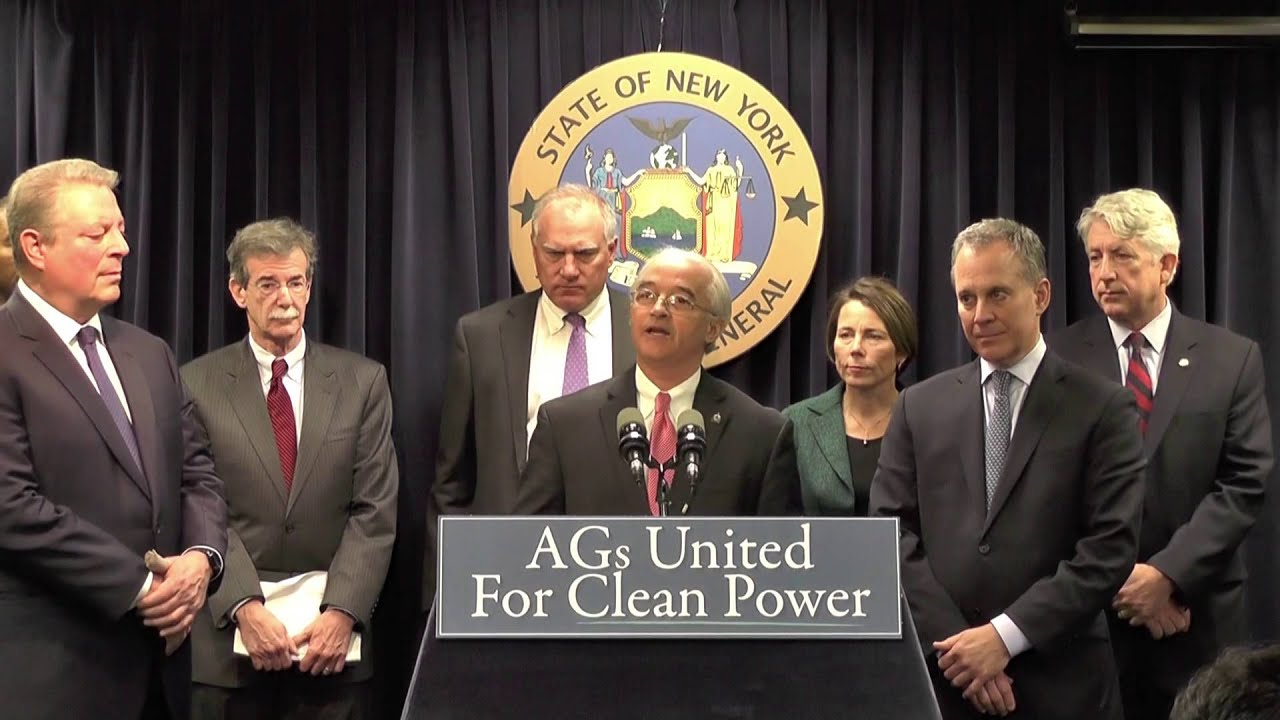 in March 2016. The company tried to paint Schneiderman and Healey's participation in the event as a evidence of their political bias against the company.
However, Caproni dismissed that argument, which she considered a result of "cherry-picking snippets from the transcript of the press conference."
"Some statements made at the press conference were perhaps hyperbolic, but nothing that was said can fairly be read to constitute declaration of a political vendetta against Exxon," she wrote.
The company's claims that the AGs "are pursuing bad faith investigations in order to violate Exxon's constitutional rights are implausible," the judge continued. She called it a "a wild stretch of logic" for Exxon to contend that the AGs' comments about public confusion relative to climate change showed any intent to "chill dissenting speech."
Caproni dismissed the lawsuit with prejudice, meaning Exxon cannot file it again.
Schneiderman and Healey celebrated the ruling.
"I am pleased with the court's decision to dismiss Exxon's frivolous, nonsensical lawsuit that wrongfully attempted to thwart a serious state law enforcement investigation into the company," Schneiderman said.
...
==
https://theintercept.com/2018/03/21/pipeline-protest-necessity-defense-tar-sands/
AN ACTIVIST IN Montana was sentenced on Tuesday in a case that has become both a touchstone for industry-friendly legislators pushing to increase penalties for pipeline protest and a measure of the U.S. legal system’s ability to recognize the emergency presented by climate change.
On October 11, 2016, while the Dakota Access pipeline protests were in full force, climate activists approached above-ground valve sites on five tar sands pipelines in Minnesota, Montana, North Dakota, and Washington state. After calling the pipeline companies to give warning, they turned the valve wheels in a coordinated attempt to stop the flow of tar sands oil.
Tuesday’s sentencing hearing tested a Montana court’s willingness to apply the severe penalties already available for use against pipeline protesters. For halting the flow of oil through Enbridge’s Express pipeline for several hours,Leonard Higgins, a 66-year-old retired information technology manager for the state of Oregon, faced a maximum sentence of 10 years in prison and a $50,000 fine for charges of misdemeanor trespass and felony criminal mischief. Higgins was sentenced to three years’ probation and $3,755 in restitution to the pipeline company.
“I’m relieved and actually a bit bewildered. It’s unexpected to me. I came very much prepared and expecting to do some jail time at least,” Higgins told The Intercept. “This is a case where both in terms of the severity of the charges and the large amount of claimed damages, I think they were using it to chill the possibility that others might do similar protest.”
Enbridge had initially claimed more than $200,000 in losses, a figure later reduced to $25,630, including $16,000 worth of replacement chains to secure valves along the pipeline against future tampering.
“The courts and the juries are not hammering individuals in the way these corporations would like to see, so they attempt to use the restitution process to grossly inflate their damage numbers with hope that threatening the citizen with $200,000 might chill others from committing similar acts,” said Lauren Regan, Higgins’s attorney.
“Enbridge respects the court’s decision,” said company spokesperson Michael Barnes. “It is our intention to donate any court-ordered payment in this case to local area first responders. … We believe it’s important to support the people who every day focus on the safety and wellbeing of the community and the environment.”
Although the sentence is lenient in light of the possible penalties Higgins faced, it does not represent a full win for the activists. Higgins’s legal team had hoped Judge Daniel Boucher would allow them to argue that, given the severity of the climate threat, he had no choice but to act — a strategy known as anecessity defense. But Boucher said that since Higgins appeared to fear harm to his children and grandchildren, rather than an imminent threat to his own life, the defense could not apply. In his denial, Boucher wrote, “The energy policy of the United States is not on trial, nor will this court allow Higgins to attempt to put it on trial.”
...
==
https://www.ecowatch.com/chevron-lawsuit-california-climate-science-2551250987.html
Chevron Presents on Climate Science While Oil Companies Move to Dismiss Landmark Case
This was a big week for the suit brought by San Francisco and Oakland against the five largest investor-owned fossil fuel companies for the costs associated with adapting to climate change.
First, the five companies in question—Chevron, ConocoPhillips, ExxonMobil, BP and Royal Dutch Shell—filed a motion Tuesday to dismiss the case, arguing that the U.S. Supreme Court and the U.S. Court of Appeals for the Ninth Circuit had dismissed similar cases in the past because the U.S. Environmental Protection Agency, not private companies, is responsible for setting and enforcing carbon dioxide levels, Forbes reported.
But they didn't file in time to avoid participating in Wednesday's historic climate science tutorial. U.S. District Court Judge William Alsup, who is currently hearing the case, ordered both sides to answer a series of questions about climate science in a two-hour presentation each.
Chevron was the only company whose lawyer actually presented at the tutorial. The other companies did not present as a show of their opposition to the court's jurisdiction, Alyssa Johl, an attorney and the founder of Climate Rights Collective, reported in a live tweet of the tutorial.
Alsup, however, did not let the other companies off the hook, but gave their lawyers two weeks to file statements detailing any differences they had with the testimony of Chevron's lawyer.
...
https://www.ecowatch.com/climate-change-lawsuit-2547843097.html
Two Major Climate Change Lawsuits Move Forward
By Ken Kimmell
A major front in the climate change debate has moved to the courtroom, as I've previously discussed. Last week, plaintiffs in two separate cases won significant procedural victories—one against major fossil fuel companies, and a second against the Trump administration. Here are the latest developments and their implications.
Bay Area vs. Big Oil
In this suit, The People of the State of California v. BP et al.,the cities of San Francisco and Oakland sued five major oil companies (BP, ExxonMobil, Chevron, Conoco Phillips and Shell), charging that these companies created a public nuisance by extracting and selling oil, coal and gas while misleading the public about the harms that these products cause.
The two cities filed in state court and under state law. This was an important strategic choice, as the U.S. Supreme Court and the Ninth Circuit Court of Appeals (which covers California) had dismissed prior cases brought in federal court, holding that congress enacted the Clean Air Act to comprehensively address the emission of greenhouse gases, and that therefore there was no role for federal lawsuits of this kind.
Citing the precedent of these earlier rulings, the defendant oil companies transferred the cities' cases to federal court, and argued that the cities' claims were preempted by federal law. In response, the cities claimed that they had a right to file in state court and that their claims under state law were not preempted by federal law, and they asked the judge to send the cases back to state court.
A federal district court judge issued a decision that neither side argued for. The court decided in the oil companies' favor that the case was properly in federal court, reasoning—with some logic—that climate change is an international problem, that state courts might apply inconsistent standards if allowed to adjudicate these cases, and that only the federal court could apply a uniform standard.
But, the court went on to find that the two earlier cases which had dismissed federal court suits did not apply to this case. The court found that while the Clean Air Act addresses the emissions from fossil fuel combustion, the San Francisco/Oakland case was not about emissions of pollutants, but rather an alleged scheme to sell a product through deception. The court reasoned—again with some logic—that the Clean Air Act offered no remedy for that conduct, and therefore did not preempt this lawsuit.
This part of the ruling was a major win for the plaintiffs, as it seems to take away the key defense of preemption that the oil companies seemed to be counting on.
On top of this, the court also ordered the parties to participate in a five-hour "climate science" tutorial for the court, to be held on Mar. 21. The judge ordered the parties to "trace the history of scientific study of climate change, beginning with scientific inquiry into the formation and melting of the ice ages, periods of historic cooling and warming, smog, ozone, nuclear winter, volcanoes and global warming." And further, to inform the court of "the best science now available on global warming, glacier melt, sea rise and coastal flooding."
This is fascinating and highly unusual. As anyone who has seen a trial on television or in the movies knows, courts don't conduct tutorials; they oversee trials, in which lawyers present the testimony of witnesses under oath and each side gets to examine and cross examine. The sheer novelty of this procedure is a good sign for the plaintiffs. Why would the judge invest time and energy to learn about climate science unless he thought the plaintiffs' legal claims might rest on a durable foundation? Also, the fact that the court asked for a climate science timeline suggests the court is honing in on some key questions: what did the fossil fuel companies know about climate change, when did they know it, and how did their public statements square with the scientific consensus at the time?
All eyes will be on this climate science tutorial, which will presumably be open to the public. To my knowledge, this is the first time climate science will be presented to a court in this fashion, and it offers an excellent opportunity to highlight the longstanding and well-supported scientific consensus.
It is too early to confidently predict what lies ahead but, on the basis of the judge's initial opinion, one can say this: the courtroom door is open now on these issues as it never has been before.
Kids sue to protect themselves and future generations.
In this case, *Juliana v. the United States*, a group of kids are suing the Trump administration for failing to protect them against the harms of climate change. I wrote about the novelty of this case last fall, and its early success when a federal district court judge in Oregon ordered the case to trial, rejecting all the Trump administration's procedural defenses.
Since that time, the Trump administration asked the Ninth Circuit Court of Appeal to dismiss the case. This was an unusual move because, ordinarily, a party to a lawsuit cannot appeal until the trial court has issued a final judgment. In this case, however, the district court had not done so. Predictably, the court of appeals ruled that the appeal was therefore premature, and sent the case back to the district court.
(Full disclosure: UCS joined a friend of the court brief on this issue, ably authored by Earthjustice attorneys).
The case was originally set for trial in February, 2018, but the Trump administration's appeal delayed that. Presumably, the next step will be for the court to set another trial date.
This is not good news for the Trump administration. At a minimum, a trial on this will be a public relations nightmare in which an appealing group of kids, represented by experienced attorneys, will have the opportunity to question Trump administration officials in open court. They will no doubt ask questions that the administration will find extremely difficult to answer, such as: Why has the Trump administration sought to withdraw from the Paris agreement, rolled back regulations to lower greenhouse gas emissions, and promoted subsidies for coal? Does the Trump administration not accept climate science? Does it not care about the harm of runaway climate change?
Further down the line, if the plaintiffs are successful in district court and if the court of appeals or the supreme court affirms the ruling (all very big "ifs," of course), the Trump administration faces the prospect of being forced under court order to develop and implement a plan to address climate change.
Chickens coming home to roost.
These lawsuits and the apparent judicial receptiveness to them—at least so far—are not accidental. Courts are heavily influenced by historic context, and judges are no doubt well aware of the pressing urgency of climate change and the failure of the federal government to address it. With no solution in sight, it is not surprising that courts are increasingly willing to hear cases urging a strong judicial role.
Is it ideal that courts, rather than our elected representatives, would decide these issues? Of course not. Maybe it is time for those who have opposed having our elected leaders take action on climate to consider this question–would they prefer the courts to do that job?
Ken Kimmell is president of the Union of Concerned Scientists and has more than 30 years of experience in government, environmental policy, and advocacy.
RELATED ARTICLES AROUND THE WEB
- Our Children's Trust ›
- Four climate change lawsuits to watch in 2018 | Environment| All ... ›
- ExxonMobil says government climate change lawsuits are a ... ›
win
3/18
https://www.desmogblog.com/2018/03/08/see-you-court-kids-climate-lawsuit-moves-forward-after-judge-denies-trump
==
https://www.ecowatch.com/keystone-xl-approval-2538558599.html
Inside the Trump Admin's Fight to Keep the Keystone XL Approval Process Secret
By Steve Horn
At a Feb. 21 hearing, a U.S. District Court judge ruled that the Trump administration must either fork over documents showing how the U.S. Department of State reversed an earlier decision and ultimately came to approve the Keystone XL pipeline, or else provide a substantial legal reason for continuing to withhold them. The federal government has an order to deliver the goods, one way or the other, by March 21.
DeSmog has reviewed the court evidence from the environmental groups bringing the case, records which help illuminate their argument that the government is, in fact, withholding such documents. The judge will decide if those documents, legally, should be made public.
The case, which began in March 2017, pits the Indigenous Environmental Network and the North Coast River Alliance against the State Department, U.S. Fish and Wildlife Service, the U.S. Department of interior and TransCanada, the owner of Keystone XL. During his first week in office, Donald Trump signed a memorandumcalling for the State Department to perform an expedited 60-day permit review of the pipeline. Two months later, the State Department gave Keystone XL the permit it needed to cross the U.S.-Canada border.
Under the Obama administration, the Keystone XL pipeline, which would carry oil from Alberta's tar sands, underwent a years-long environmental review process which culminated in President Barack Obama nixing it in November 2015. For the better part of the past decade, the pipeline has served as a central mobilizing force for the environmental movement.
Dispute Over Records
At the center of this case is a dispute over the administrative records of federal agencies, which in other lawsuits are routinely made public as part of the pre-trial process.
Generally, releasing such documents gives a snapshot of the full deliberative process behind federal agencies' decisions. DeSmog, in fact, published a story on such documents in 2015 related to a different tar sands pipeline project, which involved Enbridge's Alberta Clipper (also known as Line 67), part of a broader pipeline system DeSmog calls the "Keystone XLClone."
In the TransCanada case, the State Department has argued for keeping these pre-trial records sealed while the plaintiffs, the environmental groups, have argued they should be made public. These documents, which might include emails and memos, would offer the plaintiffs and the general public an idea of how the Trump administration decided to approve the Keystone XL.
The plaintiffs say that not all of those records have been turned over.
"Federal Defendants have wrongly omitted an unknown number of emails and other internal communications considered by the agencies during their review of the Keystone XL pipeline," the plaintiffs in the case argued in court documents on Jan. 8.
In an affidavit exhibited as part of that filing, Cecilia Segal, an attorney for one of the plaintiffs, cited a Dec. 19 phone call she had with the federal defendants, in which they said that agency emails and other records do not need to be disclosed as part of the case.
Another letter exhibited as part of the Jan. 8 filing, written on Nov. 30 by attorneys for the Center for Biological Diversity, further complained that the documents already handed over were not adequately comprehensive or organized in a manner useful for the case. And many documents, they allege, seem to be missing entirely and without explanation.
"We are concerned that both the State Department and Service have withheld records as privileged without identifying and certifying them on a privilege log," wrote the attorneys.
==
Court Orders Trump Administration to Enforce Obama-Era Methane Rule
A federal judge reinstated a widely supported methane waste rule that President Trump's administration has repeatedly tried to stop.
Judge William Orrick of the U.S. District Court for Northern California ruled Thursday that Bureau of Land Management's (BLM) decision to suspend core provisions of the 2016 Methane and Waste Prevention Rule was "untethered to evidence."
In a major blow to President Trump’s anti-immigration agenda, a U.S. judge in San Francisco has temporarily stopped the Trump administration from ending the DACAprogram—that’s Deferred Action for Childhood Arrivals. The Obama-era program gave nearly 800,000 young undocumented people legal permission to live and work in the United States. President Trump announced he was ending the program late last year. On Tuesday, U.S. District Judge William Alsup ruled the DACA program must remain in place, amid multiple lawsuits over Trump’s decision to rescind the program.
https://www.nytimes.com/2018/01/09/us/north-carolina-gerrymander.html
A panel of federal judges struck down North Carolina’s congressional map on Tuesday, condemning it as unconstitutional because Republicans had drawn the map seeking a political advantage. The ruling was the first time that a federal court had blocked a congressional map because of a partisan gerrymander, and it instantly endangered Republican seats in the coming elections.
Judge James A. Wynn Jr., in a biting 191-page opinion, said that Republicans in North Carolina’s Legislature had been “motivated by invidious partisan intent” as they carried out their obligation in 2016 to divide the state into 13 congressional districts, 10 of which are held by Republicans. The result, Judge Wynn wrote, violated the 14th Amendment’s guarantee of equal protection.
The ruling and its chief demand — that the Republican-dominated Legislature create a new landscape of congressional districts by Jan. 24 — infused new turmoil into the political chaos that has in recent years enveloped North Carolina. President Trump carried North Carolina in 2016, but the state elected a Democrat as its governor on the same day and in 2008 supported President Barack Obama.
The unusually blunt decision by the panel could lend momentum to two other challenges on gerrymandering that are already before the Supreme Court — and that the North Carolina case could join if Republicans make good on their vow to appeal Tuesday’s ruling.
Continue reading the main story
RELATED COVERAGE
Justices Reject 2 Gerrymandered North Carolina Districts, Citing Racial Bias MAY 22, 2017
Pennsylvania Lawsuit Says House Redistricting Is Partisan Gerrymander JUNE 15, 2017
In October, the court heard an appeal of another three-judge panel’s ruling that Republicans had unconstitutionally gerrymandered Wisconsin’s State Assembly in an attempt to relegate Democrats to a permanent minority. In the second case, the justices will hear arguments by Maryland Republicans that the Democratic-controlled Legislature redrew House districts to flip a Republican-held seat to Democratic control.
The Supreme Court has struggled without success for decades to develop a legal standard for determining when a partisan gerrymander crosses constitutional lines. The court once came close to ruling that such cases were political matters beyond its jurisdiction. But the rise of extreme partisan gerrymanders in the last decade, powered by a growing ideological divide and powerful map-drawing software, has brought the question back to the justices with new urgency. A Supreme Court ruling outlawing at least some such gerrymanders could reshape the political landscape.
Fights over voting rights and election procedures have often taken center stage in Raleigh, North Carolina’s capital, and Tuesday’s ruling noted that “partisan advantage” had been a criterion lawmakers used when mulling how to map the state.
Republican officials in the General Assembly said Tuesday evening that they intended to appeal the ruling, which many elected officials and political strategists were still scrambling to digest. Dallas Woodhouse, the executive director of the North Carolina Republican Party, criticized Judge Wynn and accused him of “waging a personal, partisan war on North Carolina Republicans.”
In a separate post on Twitter, Mr. Woodhouse argued that Judge Wynn had concluded that North Carolina’s Republicans “should not be allowed to draw election districts under any circumstances under any set of rules,” an effort he called “a hostile takeover” of the General Assembly and legislatures nationwide. Republicans could ask the Supreme Court to stay the decision and allow the disputed map to be used this year.
But critics of the congressional map welcomed a decision that was notable for its tartness and urgency.
“Clearly, the courts have realized that they do need to step in and police extreme partisan gerrymanders, and the court recognized that North Carolina’s gerrymander was one of the most extreme in history,” said Ruth Greenwood, senior legal counsel at the Campaign Legal Center and a lawyer representing some of the map’s challengers.
The chairman of the North Carolina Democratic Party, Wayne Goodwin, said the decision was “a major victory for North Carolina and people across the state whose voices were silenced by Republicans’ unconstitutional attempts to rig the system to their partisan advantage.”
The judges issued their decision fewer than 24 hours before the General Assembly was to convene in Raleigh for a special session. The ruling unmistakably placed lawmakers on the clock, giving them two weeks to present a “remedial plan” and declaring that the court would institute its own map if it finds the new district lines unsatisfactory.
“Politically, this gives hope to Democrats,” said J. Michael Bitzer, a professor of political science at Catawba College, which is near Charlotte. “I can imagine the Republicans being furious, but they have to see political reality, and it’s not just in the next two weeks: It’s come November.”
Professor Bitzer, though, cautioned that the ultimate political fallout would not become clearer until the courts settled what could be a cascade of appeals and injunctions.
The ruling left little doubt about how the judges assessed the Legislature’s most recent map. Judge Wynn, who sits on the United States Court of Appeals for the Fourth Circuit and was a member of a special panel considering the congressional map, said that “a wealth of evidence proves the General Assembly’s intent to ‘subordinate’ the interests of non-Republican voters and ‘entrench’ Republican domination of the state’s congressional delegation.”
Most federal lawsuits are first heard by a district court, and later — if needed — by an appeals court and the Supreme Court. But under federal law, constitutional challenges to the apportionment of House districts or statewide legislative bodies are automatically heard by three-judge panels, and appeals are taken directly to the Supreme Court.
In addition to Judge Wynn, an appointee of Mr. Obama’s, Senior Judge W. Earl Britt of the Federal District Court in Raleigh joined the opinion. Judge Britt was appointed by President Jimmy Carter.
Judge William L. Osteen Jr., who was appointed by President George W. Bush and sits on the federal bench in Greensboro, said he agreed that the existing map violated the 14th Amendment, but he disputed other parts of Judge Wynn’s opinion, including the decision to appoint an independent expert to begin preparing an alternative map.
yikes, longterm damage:
https://www.alternet.org/right-wing/senate-republicans-want-speed-approval-trumps-nutty-nominees
It's one of those stories that might be a minor issue in a normal presidential administration but takes on alarming implications in the era of Donald Trump: The Hill reports that Senate Republicans under Majority Leader Mitch McConnell are considering changing the rules for confirming appointees to both federal agencies and the district courts, drastically reducing the amount of time that senators get to question the people Trump wants to entrust with these powerful positions.
Republicans are considering shrinking debate for non-Cabinet federal nominees down from 30 hours to just eight, and limiting debate on district judges to two hours apiece.
To be clear, it's not that unusual to shorten debate time on nominations, and Senate Democrats made a similar rule change in 2013 — though only for that session of Congress. The current proposal, offered by Sen. James Lankford, R-Okla., would be a more permanent change so that rubber-stamping Trump nominees could be the practice not just this year but for as long as Trump holds office. But the larger concern is not just that this would be a long-term rules change being proposed, but who, exactly, would benefit: A president who has been quite clear that incompetence is no obstacle to nomination -- and that being opposed to the mission of the office you wish to run is a bonus.
"What we need is not less time, but more time, based on what we’ve seen over and over," Sasha Buchert, a staff attorney at Lambda Legal, told Salon. "The judicial nominees we’ve seen are so bad, and every day there’s something new that’s revealed. It’s a similar issue with the executive nominations, unfortunately."
With Senate Republicans eager to simply vote in everyone Trump tosses their way, the only way to stop at least some of the worst nominees is to make the confirmation process a public spectacle that forces withdrawal from sheer embarrassment. Buchert pointed to cases like that of Matthew Petersen, who withdrew his nomination to be a district judge after the confirmation hearing exposed that he was incapable of answering basic questions most first-year law students could handle.
Buchert also flagged the case of Eric Dreiband, a lawyer who spent his career defending employers in discrimination cases, whom Trump nominated to be the head of the Justice Department's civil rights division. The longer confirmation process gave human rights groups time to raise the alarm and so far, Dreiband's confirmation seems stalled. But shortening debate might make it easier for troublesome nominees to slide through.
Drew McConville, a senior managing director at The Wilderness Society, linked the proposal to limit debate to the Trump administration's largerhostility toward any kind of public accountability.
"Time after time, we’re seeing the administration look to undermine opportunities for public input," McConville said. “Unfortunately, the administration has shown itself in the first year to put special interests above the public interest.”
McConville noted that over the past year, environmental activists have documented a downturn in public comment opportunities, the disbanding of advisory committees, and an apparent decision to ignore public opinion on issues like protecting national monuments — in favor of doing whatever oil and gas companies want. Instead, a cult of secrecy has become ingrained in the Trump administration, particularly at the Interior Department and the EPA, and the public is being shut out of important decisions that affect it directly.
"The fact that the GOP Senate conference is reacting to Trump's comically unqualified nominees by streamlining the process really should end 'When will Republicans start standing up to Trump?' discussions," said Scott Lemieux, a political science lecturer at the University of Washington.
He added that "getting conservative judges and executive branch nominees is the main thing Republicans -- both legislators and voters -- are getting from Trump," saying this attempt to fast-track the process "was probably overdetermined."
Republicans argue that the change is necessary because Trump is lagging behind his predecessors when it comes to getting appointees confirmed, at least to the federal agencies.(He's getting his judicial nominees confirmed at breakneck speed already.)
"As of Thursday, the Trump administration has had 300 nominations confirmed by the Senate, with an additional 177 currently working their way through the upper chamber's pipeline," The Hill reports. "That lags behind former President Obama who had 418 nominations confirmed by the Senate at the same time, while former President George W. Bush had 493 and former President Clinton had 471."
But while Republicans want to blame Democrats for this, the reality is far more complicated. As NPR reports, the Trump administration has failed to file paperwork quickly and completely, which is hanging up a lot of nominees. Also, as The Washington Post tracker indicates, a huge part of the problem is that the administration isn't too hasty with its nominations, either. By this point in his presidency, Obama had sent 640 nominations to the Senate. George W. Bush had sent 616. Trump has only sent 477 so far.
Still, the larger issue is competence. Trump has an unmistakable tendency to pick appointees who oppose the mission of the agency they are slated to manage. In many cases, these picks have been laughably unqualified. Sam Clovis, Trump's initial pick to be chief scientist at the USDA (now withdrawn), is not a scientist of any kind and had no experience with agriculture whatsoever. His pick to head NASA, Jim Bridenstine, has no background in science or engineering. That Trump isn't nominating people quickly is probably a good thing on the whole, since so many of the people he does pick clearly have no idea what they're doing.
“These positions matter," McConville said. "We’re talking about public officials who are entrusted with stewarding our public lands, protecting the air we breathe, the water we drink and so much more.”
But as with the tax reform bill, it's clear that congressional Republicans are less interested in doing something well than in cramming through a right-wing agenda at breakneck speed. It's almost as if they don't think they will get a full four-year term to enact the Trump agenda and are making this a rush job, which may not be an unreasonable assumption when the headlines are dominated by the slowly unfolding Russia scandal and Trump's dubious mental state.
==
==
yikes
https://www.alternet.org/news-amp-politics/trump-packing-courts-unqualified-conservatives
Many of Trump’s appointees have drawn scrutiny, including Leonard Grasz, who was the Senate—who the Senate confirmed earlier this month to the 8th Circuit Court of Appeals despite a “not qualified” rating from the American Bar Association. Grasz is one of at least four Trump nominees the ABA deemed “not qualified.” Meanwhile, Trump’s nominee to a lifetime appointment on the U.S. District Court in Washington withdrew from consideration, after widely circulated video showed he was unable to answer basic questions about the law and had never tried a case in court. This is Louisiana Republican John Kennedy questioning Matthew Petersen at a Senate Judiciary Committee confirmation hearing earlier this month.
=-
https://www.ecowatch.com/fracking-waste-gulf-of-mexico-2515883905.html
Lawsuit Launched Against Trump EPA for Approving Fracking Waste Dumping Into Gulf of Mexico
The Center for Biological Diversity filed on Thursday a formal notice of intent to sue the Trump administration for allowing oil companies to dump waste from fracking and drilling into the Gulf of Mexico without evaluating the dangers to sea turtles, whales or other imperiled marine life.
In September the U.S. Environmental Protection Agency (EPA) finalized a Clean Water Act permit for new and existing offshore oil and gas platforms operating in federal waters off the coasts of Texas, Louisiana and Mississippi. The permit allows oil companies to dump unlimited amounts of waste fluid, including chemicals involved in fracking, into the Gulf of Mexico.
"The Trump administration is letting the oil industry turn our oceans into toxic-waste dumps. The EPA's supposed to protect water quality, not help pollute the Gulf," said Kristen Monsell, a senior attorney at the Center for Biological Diversity. "It's time for the courts to remind this agency that its mission is to safeguard the environment and public health."
Thursday's notice letter highlighted the fact that the agency's approval of the permit without studying risks to imperiled species in the Gulf of Mexico is a violation of the federal Endangered Species Act.
Fracking chemicals and other contaminants in produced water raise grave ecological concerns because the Gulf of Mexico provides important habitat for whales, sea turtles and fish—as well as being federally designated critical habitat for imperiled loggerhead sea turtles. Dolphins and other species in the Gulf are still suffering the lingering destructive effects of the 2010 Deepwater Horizon oil spill.
Federal waters off Texas, Louisiana and Mississippi host the largest concentration of offshore oil and gas drilling activities in the country. Previous records requests revealed that oil companies dumped more than 75 billion gallons of wastewater into these waters in 2014 alone. Records also show that fracking has been on the rise in the Gulf of Mexico, and the EPA has failed to conduct any meaningful review of the environmental impacts of dumping fracking waste into the water.
In October the Trump administration announced plans to auction off more than 76 million acres of Gulf of Mexico waters to oil companies. That lease sale, which is scheduled for March 2018, will be the largest oil sale in U.S. history. It includes federal waters off the coasts of Texas, Louisiana, Mississippi, Alabama and Florida and could vastly expand drilling and fracking in the Gulf.
"Only the courts can stop Trump's assault on our oceans," Monsell said. "Oil-industry pollution was already a problem in the Gulf, but this administration isn't even trying to protect wildlife from fracking chemicals. We need to fight back on behalf of marine wildlife."
At least 10 fracking chemicals routinely used in offshore fracking could kill or harm a broad variety of marine species, including marine mammals and fish, Center for Biological Diversity scientists have found. The California Council on Science and Technology has identified some common fracking chemicals to be among the most toxic in the world to marine animals.
Today's 60-day notice of intent to sue is required before a lawsuit can be filed to compel the federal government to comply with the Endangered Species Act.
==
==
muslim ban win temp? 3 rounds?
===
loss:
https://www.ecowatch.com/climate-activist-leonard-higgins-guilty-2512148096.html
Blocked From Discussing Climate Change, Valve-Turner Faces 10 Years in Prison After Felony Conviction
By Julia Conley
After a judge refused to allow him to share his reasons for shutting off a tar sands pipeline valve in a protest of fossil fuel mining, 65-year-old climate activist Leonard Higgins was found guilty of criminal mischief—a felony—and misdemeanor criminal trespass. Higgins faces up to 10 years in jail and as much as $50,000 in fines.
"I'm happy for the opportunity to share why I had to shut down this pipeline, and I really appreciate the time and dedication of the jury and the judge," Higgins said. "I was disappointed and surprised by the verdict, but even more disappointed that I was not allowed a 'necessity defense,' and that I wasn't allowed to talk about climate change as it related to my state of mind. When I tried to talk about why I did what I did I was silenced. I'm looking forward to an appeal."
Supporters spoke out on social media after the verdict was handed down in a Montana court room, following a trial that lasted less than two days...
==
https://www.alternet.org/news-amp-politics/trump-judges-aim-end-progressive-state
:{
}:
...federal courts that struck down his “Muslim travel ban” on three separate occasions, that blocked his ban on trans people in the military and that did the same to his attempt to defund so-called sanctuary cities.
But the makeup of America’s judges is quietly becoming the site of one of Trump’s most unequivocal successes: nominating and installing judges who reflect his own worldview at a speed and volume unseen in recent memory. Trump could conceivably have handpicked more than 30% of the nation’s federal judges before the end of his first term, his advisers have suggested, and independent observers agree.
“The president himself has said that he expects this to be one of his major legacies. He is going to reshape the bench for generations to come,” said Douglas Keith, counsel with the fair courts arm of the Brennan Center for Justice.
“I do think this deserves more attention given the consequence, the significance of what will eventually be a wholesale change among the federal judiciary,” he continued.
Much has been made of Trump’s failure to get legislation through Congress and received wisdom suggests that he has little to show for his first 10 months in power. However, the lasting impact that court picks have on the lives of Americans means that Trump’s choices – and the sheer numbers involved – will help reshape America for the next half-century.
Until recently little attention has been paid to Trump’s judicial appointments. But Senator Chris Coons, a Democrat from Delaware and a member of the Senate judiciary committee, identified the importance of these appointments early on. In June he said: “This will be the single most important legacy of the Trump administration. They will quickly be able to put judges on circuit courts all over the country, district courts all over the country, that will, given their youth and conservatism, have a significant impact on the shape and trajectory of American law for decades.
The lack of diversity in Trump’s picks was highlighted by the Associated Press. They ran the numbers on the 58 people nominated by the Trump administration to lifetime positions on appeal courts, district courts, and the supreme court. Of those, 53 are white, three are Asian American, one is Hispanic and one is African American.
Forty seven are men and 11 are women.
...
erhaps the most brazen of Trump’s early picks is Brett Talley, an Alabama attorney just three years out of law school who has yet to try a case. The American Bar Association gave Talley a unanimous rating of “unqualified” for the post but that did not stop him from breezing through a confirmation hearing in the Senate judiciary committee. Neither did the fact that Talley appears to have blogged favorably about the KKK and statutory rape on message boards and failed to disclose in his questionnaire that his wife is a staffer in the White House.
Trump is “appointing hacks and cronies which I think is either intentionally or just has the effect of signaling contempt for legal process”, Azmy said.
Some of the other stand-out Trump picks include Jeff Mateer, a Texas attorney who has openly admitted that he discriminates against LGBT people, and Thomas Farr, who has spearheaded multiple legal efforts to suppress the black vote in his home state of North Carolina.
“It is no exaggeration to say that had the White House deliberately sought to identify an attorney in North Carolina with a more hostile record on African-American voting rights and workers’ rights than Thomas Farr, it could hardly have done so,” wrote the Congressional Black Caucus in a letter to Trump urging him to withdraw the nomination.
One thing Mateer, Talley and Farr all have in common, like a startling 74% of Trump’s nominees, is that they are all white men. According to the Associated Press, if Trump continues on this trend through his first term, he will be the first Republican since Herbert Hoover to name fewer women and minorities to the court than his GOP predecessor.
“This is a striking move in the direction away from diversity that is not just attributable to them wanting to appoint more conservative judges,” who will tend to be whiter and more male than the general population, said Douglas Keith.
And the impact that can have for generations is hard to overstate. “Federal courts shape laws, they shape the constitution, they affect people’s rights, and at core they impact how our democracy functions,” Keith said. “Conservatives have understood the importance of these courts, they’ve been organizing around them for decades, and have been able to move their supporters in ways that the left hasn’t.”
That has involved, first and foremost, building a pipeline of potential conservative candidates, Keith said. Conservative groups like the Federalist Society and the Heritage Foundation have become de facto clearing houses for Republican presidents and they absolutely have Trump’s ear.
According to the Hill, of the 13 judicial nominees confirmed since President Trump took office, 10 are either current or formerFederalist Society members or regular speakers at its events.
The organization describes itself as “a group of conservatives and libertarians interested in the current state of the legal order”, and operates on the premise that “law schools and the legal profession are currently strongly dominated by a form of orthodox liberal ideology”. Clarence Thomas, Jeff Sessions and the late Antonin Scalia are among the society’s more well-known alumni.
The non-partisan American Bar Association, which for decades had offered the White House its opinion on the qualifications of nominees was removed from the process by Trump in favor of Federalist Society influence. So far they have rated four of Trump’s nominees unqualified, four more than they ever did under the previous administration.
Thus far the Republican-controlled Senate judiciary committee has been little more than a rubber stamp for Trump’s nominees, having advanced all of his picks through hearings so far. This drew scorn from Democratic committee member Sheldon Whitehouse who earlier this month called the hearings “a joke” and complained that candidates had been studiously coached on “how to withstand all of five minutes of questioning by senators”.
Trump also inherited a massive cache of over 100 judicial openings when he came into office, more than twice that of his predecessor Obama in 2009. That’s because, even as Trump has routinely lambasted Democrats as the party of obstruction, it was Republicans for most of Barack Obama’s term who slowed the confirmation of judicial nominees to a slow crawl. Since his inauguration the number of openings has grown to more than 160 – that’s about half the 323 regional federal judges Obama nominated and had confirmed during his full eight years in office, and Trump has only been in office for 10 months.
It is true that, even as Republicans have picked up the pace of confirmations, Trump cannot fill all those 160 openings overnight. But after sweeping Democratic election wins in races earlier this month, anxious conservatives are going to start pushing Trump to get as many nominees as possible through before the 2018 midterms.
“Obviously, who gets nominated and the pace of confirmations … changes dramatically if the Senate were to flip back to the Democrats,” said John Malcolm, a former justice department lawyer and now an analyst at the Heritage Foundation in Washington. Republicans “should be paying particular attention to pushing through as many nominees as they can”.
win
https://insideclimatenews.org/news/16102017/climate-change-activists-arrest-pipeline-shutdown-necessity-defense
A judge in Minnesota has cleared the way for an unusual and potentially groundbreaking defense, allowing climate activists to use the "necessity" of confronting the climate crisis as justification for temporarily shutting down two crude oil pipelines last year.
Robert Tiffany, a district court judge in Clearwater County, Minnesota, ruled on Oct. 11 that three activists who were arrested and charged with felonies last year can argue that they violated the law in order to protect citizens from the impacts of global warming and that they had no legal alternative.
"It is extremely unusual for a court to allow presentation of the necessity defense by environmental protesters," said Michael Gerrard, director of the Sabin Center for Climate Change Law at Columbia University. "It will be fascinating to see how this trial goes and how much evidence the court allows."
The ruling is the third recent case in which a judge in the United States has allowed for such a defense in a climate case in a jury trial. A case in Massachusetts in 2014 did not go to trial afterthe prosecutor dropped the charges. A judge allowed the necessity defense in a Washington State case in 2016 but then instructed jurors theycould not acquit on necessity. There was also a recent non-jury case in which a county judge in Slate Hill, New York, allowed a necessity defense for climate activists charged with misdemeanor trespassing, but he issued a guilty verdict in June, stating the defense failed to prove "imminence", or immediate harm posed by climate change.
In the Minnesota case, Emily Johnston, Annette Klapstein and Benjamin Joldersma are charged with felonies over the shutdown of two pipelines there on Oct. 11, 2016. A fourth defendant, Steven Liptay, who filmed the pipeline shutdowns, is charged with two gross misdemeanors.
Enbridge Inc., the Canadian company that owns and operates the two pipelines, said at the time of the shutdowns that the actions were "reckless and dangerous" and that the company would "support the prosecution of all those involved," according to news reports.
An Unusual Legal Tactic for Protesters
Use of a necessity defense is typically used not for protests but for more clear cut cases of individuals intentionally committing a crime to prevent imminent danger, such as breaking into a house where someone is being held hostage, Gerrard said.
Political activists have, however, used the necessity defense in the past in opposition to issues including the Vietnam War, nuclear weapons and abortion.
The defense tactic is widely seen as an attempt to focus attention on controversial government policies by forcing jurors to pass judgment on the morality of such policies and of individuals' resistance to them.
The pipeline shutdowns in Minnesota were part of a multi-state protest by the group Climate Direct Action to protest the flow of tar sands crude into the U.S., and to show solidarity with the Dakota Access pipeline protests in North Dakota.
A Greater Risk than Climate Change?
"I think it's a sensible ruling that will allow the jurors to take into consideration all of the information that they really need to rule on this case properly," Marla Marcum, director of the Climate Disobedience Center, said.
Marcum's group is collaborating with the defendants in the Minnesota case and other "valve turner" cases on trial strategy.
Ken Ward, who shut down a pipeline in Washington state, was convicted of second-degree burglary in June and received30 days of community service. Activists who shut down a pipeline in North Dakota were convicted on felony charges earlier this month and are awaiting sentencing. Activists in Montana are still awaiting trial for a similar act.
The case in Minnesota may center around whether the actions taken by the protestors—shutting down valves on an active pipeline—presented an equal or greater risk than that posed by climate change.
"You are getting close to threats to public health, welfare, safety, when you start actually damaging the infrastructure itself," Patrick Parenteau, an environmental law professor at Vermont Law School said.
"The equation here is, did the defendants take action appropriate to draw attention to the problem, or does the balance tip against them and in favor of protecting public health and safety. The prosecutor will probably put people on the stand who will say, this is dangerous," Parenteau said.
Soon after the pipeline shutdowns last fall, Carl Weimer of the Pipeline Safety Trust, an industry watchdog, characterized the activity as a "dangerous stunt" according to news reports. Marcum said that in each case, pipeline operators were notified of the valve closures several minutes before they occurred so the companies could shut down the compressors that pump the oil through the pipes to safely shut the pipelines down.
Courts Are Considering Climate Risk
In his ruling, Judge Tiffany stated that Minnesota's standard for the necessity defense is high: "To successfully assert the defense, a criminal defendant must show that the harm that would have resulted from obeying the law would have significantly exceeded the harm actually caused by breaking the law, there was no legal alternative to breaking the law, the defendant was in danger of imminent physical harm, and there was a direct causal connection between breaking the law and preventing the harm."
Gerrard said the decision to allow a necessity defense may be part of a growing awareness in the courts of the risks of climate change, including recent rulings on coal leases and natural gas pipelines, that went in favor of closer scrutiny of environmental considerations.
"What we are seeing in some courts is there is such frustration at the failure of the executive and legislative branches to act on climate change that some courts are becoming willing to step in," he said.
PUBLISHED UNDER:
==
==
ICN portal
https://insideclimatenews.org/content/choke-hold
This yearlong investigation explores the ways the fossil fuel industry has fought to protect its central role in providing America's energy. Each Choke Hold article examines one particular front in the industry's battle to block stronger environmental regulation and action on climate change—its litigation fights, campaign contributions, public relations, control over science and more. Together these articles tell the story of the fossil fuel industry's inordinate influence across society.
eg 10/17
https://insideclimatenews.org/news/05062017/exxon-climate-change-fraud-investigation-eric-schneiderman-rex-tillerson-exxonmobil
==
https://www.ecowatch.com/earthjustice-roadless-rule-2490941377.html
Battle to Protect 50 Million Forest Acres May Finally Be Won After 16 Years
By Jessica A. Knoblauch
A decades-long fight over a landmark rule protecting wild forests nationwide took another successful–and possibly final–turn last week after a U.S. district court threw out a last-ditch attack by the state of Alaska against the Roadless Rule.
Adopted in the closing days of the Clinton administration, the Roadless Rule prohibits most logging and road construction in roadless areas of national forests. These lands, today equaling about 50 million acres or about the size of Nebraska, are some of the wildest places left in America.
Upon its passage, the rule was overwhelmingly popular with the American people, including those who like to hike, camp, fish and recreate among the trees in wild, unmarred areas. The Forest Service also liked the rule, since, at the time, the agency had a multibillion-dollar backlog on maintenance for more than 400,000 miles of existing roads, and it wasn't eager to add even more to its workload.
Yet, despite its popularity, state political leaders with ties to the logging and timber industries hated the new rule. Even before President Clinton left office, they began their attack. The Bush administration, which took office just eight days later, failed to come to the rule's defense.
"It created this vacuum," said Earthjustice attorney Tom Waldo, one of the legal architects of the organization's Roadless Rule strategy. "So Earthjustice stepped in."
...
:{
}:
==
court win ca
https://www.centerforfoodsafety.org/press-releases/5065/victory-court-of-appeal-rejects-californias-approval-of-bee-killing-pesticides
Ends State’s Practice of Rubber-Stamping New Uses for Neonicotinoids
San Francisco, CA — The First District California Court of Appeal issued an opinion Tuesday in a lawsuit challenging a California Department of Pesticide Regulation (DPR) decision to approve additional uses for two bee-killing pesticides without disclosing the impact on honeybees.
Pesticide Action Network, Center for Food Safety, and Beyond Pesticides, represented by Earthjustice, filed the underlying lawsuit in 2014, seeking to halt DPR’s practice of approving ever more uses for neonicotinoid pesticides pending completion of the agency’s languishing scientific review of the evidence linking agricultural use of neonicotinoids to a global honeybee die-off. DPR began its scientific review in early 2009 after it received evidence that neonicotinoids are killing bees, but DPR has yet to complete its review or take meaningful action to protect bees. Instead, DPR has continued to allow increased use of neonicotinoids in California.
“DPR acknowledged almost 10 years ago that neonicotinoids are killing bees, yet the agency has approved more and more uses for these toxic pesticides every year since,” said Earthjustice attorney Greg Loarie, who represented the groups. “It’s time for DPR to do its job and protect honeybees and the multi-billion dollar agricultural economy that bees make possible in this State.”
...
==
sci supp
On September 14, the Arizona Court of Appeals ruled that a trial court decision to release two University of Arizona climate scientists’ emails had improperly ignored an Arizona statutory protection for university records.
We filed a brief in the case in July, asking the court to protect the researchers from the Energy & Environment Legal Institute, which seeks to obtain a 13-year span of emails belonging to Malcolm Hughes and Jonathan Overpeck. In the brief, we argued that the trial court decision forcing the release of scientists’ emails should be reversed because it set a dangerous precedent and would harm the scientific endeavor.
The case has been through the trial court twice and now returns for a third round. We’re optimistic that the trial court will follow the existing statute, and protect scientific research in this case. We’ll let you know the outcome of the proceedings; in the meantime, learn more about the case on our blog and in this *Ars Technica* article.
Science is increasingly under attack, but this is the second time in one month that a court has ruled in favor of climate scientists. We’re encouraged by these decisions and grateful to everyone who makes our work possible, especially those who donated to help us meet — and exceed — our ambitious $55,000 matching challenge this summer.
You’re invited! On Thursday, October 19 we’ll honor two defenders of science, attorneys Peter Fontaine and Michael Gerrard, ...
==
AN 917
Yet another example this week showed that the GOP is willing to rewrite the rules when it comes to the democratic process, if that’s what it takes for them to win. Senate Majority Leader Mitch McConnell said he wants to end a process where home-state senators must approve any federal judicial nominee in their state. Blue state senators have been opposing Trump’s nomination of right-wingers to lifetime appointments.
McConnell blocked President Obama’s final U.S. Supreme Court nomination, and stalled Senate action on federal appeals and district court seats—hoping a Republican victory last November would result in a federal judiciary turning toward the right for decades. Currently, there are 144 federal court vacancies. In this case, McConnell is trying to press the Senate Judiciary Committee Chairman, Iowa’s Charles Grassley, to end the so-called “blue slip” practice, where home state senators can veto nominations. Yet again, the GOP is willing to put party before country to win and exercise power.
Will New Scientific Breakthroughs Pave the Way for More Climate-Related Lawsuits?
https://www.ecowatch.com/scientific-breakthroughs-climate-lawsuits-2482945732.html
By Elliott Negin
What can you do when the president of the U.S. says climate change is a hoax and Congress is gridlocked by fossil fuel industry-funded climate science deniers?
Look to the courts for redress—with a major assist from science.
Using sophisticated computer analyses, scientists can now determine what percentage of an extreme weatherevent can be attributed to climate change. This emerging field of "climate attribution" science offers courts a powerful new tool for apportioning responsibility in cases brought by victims of extreme weather events—Hurricane Harveycomes to mind—or other climate-induced damages, such as sea level rise, against municipalities and private real estate developers for failing to protect them from foreseeable damages.
Likewise, companies responsible for producing and marketing fossil fuels—BP, Chevron, ExxonMobil and the like—may find themselves in legal crosshairs thanks to a first-of-its-kind study definitively linking global climate changes to carbon emissions directly associated with them.
Published Thursday in the journal Climatic Change, the study calculated the amount of sea level rise and global temperature increase resulting from carbon dioxide and methane emissions from products marketed by the largest coal, gas and oil producers and cement manufacturers as well as their extraction and production processes.
"We've known for a long time that fossil fuels are the largest contributor to climate change," said Brenda Ekwurzel, lead author and climate science director at the Union of Concerned Scientists (UCS). "What's new here is that we've verified just how much specific companies' products have caused the Earth to warm and the seas to rise."
Ekwurzel's study builds on a groundbreaking study one of her co-authors, geographer Richard Heede, published in Climatic Change in 2014. Closely tracking the oil, gas and coal extracted since the Industrial Revolution, Heede found that just 90 private and state-owned companies are responsible for two-thirds of human-caused carbon emissions since then. What's more, Heede's research showed that more than half of these carbon emissions occurred since 1988, when NASA scientist James Hansen sounded the alarm about climate change in well-publicized congressional testimony.
https://link.springer.com/journal/10584
Ekwurzel et al.'s study quantified climate change impacts of each company's carbon and methane emissions during two time periods: from 1880 to 2010 and from 1980 to 2010, because internal industry documents show fossil fuel companies were well aware of the threat posed by global warming at least 25 years ago.
According to the new study, emissions traced to the 90 largest carbon producers contributed approximately 57 percent of the upsurge in atmospheric carbon dioxide, nearly 50 percent of the increase in global average temperatures, and about 30 percent of global sea level rise since 1880. Meanwhile, emissions attributed to just the 50 investor-owned carbon producers, including BP, Chevron, ConocoPhillips, ExxonMobil, Peabody and Shell, were responsible for roughly 16 percent of the global average temperature increase and around 11 percent of the global sea level rise from 1880 to 2010. Between 1980 and 2010, the same 50 companies contributed approximately 10 percent of the global average temperature increase and about 4 percent of the sea level rise.
State-owned companies also have played a significant role. Emissions linked to 31 majority state-owned companies, including Coal India, Russia's Gazprom, Kuwait Petroleum, Mexico's Pemex, Petroleos de Venezuela, National Iranian Oil Company and Saudi Aramco, were responsible for about 15 percent of the global temperature increase and approximately 7 percent of sea level rise from 1880 to 2010.
"Until a decade or two ago, no corporation could be held accountable for the consequences of their products' emissions because we simply didn't know enough about what their impacts were," explained Myles Allen, a study co-author and professor of geosystem science at the University of Oxford in England. "Our study provides a framework for linking fossil fuel companies' product-related emissions to a range of impacts, including increases in ocean acidification and deaths caused by heat waves, wildfires, and other extreme weather-related events. We hope the results of this study will inform the debate over how best to hold major carbon producers accountable for their contributions to the problem."
As climate change impacts worsen and become more expensive to address, the question of financial responsibility will become more urgent. In New York City alone, local officials estimate that it will cost more than $19 billion to adapt to climate change. Globally, adaptation cost projections are equally astronomical. The U.N. Environment Programme calculates that developing countries will require $140 billion to $300 billion per year in 2030 and a whopping $280 billion to $500 billion per year by 2050.
"Fossil fuel companies could have taken any number of steps to address climate change, such as investing in clean energy or carbon capture and storage," said Peter Frumhoff, a study co-author and director of science and policy at UCS. "Instead, many of them spent millions of dollars to try to deceive the public about climate science and block sensible limits on carbon emissions. Taxpayers alone, especially those living in vulnerable coastal communities, shouldn't have to bear all the costs of these companies' irresponsible decisions."
Pending lawsuits by three California coastal communities could benefit immediately from Ekwurzel et al.'s findings. San Mateo and Marin counties and Imperial Beach, a city in San Diego County, filed complaints in July against 37 major coal, oil and gas companies, including BP, Chevron, ExxonMobil and Shell, claiming higher sea levels triggered by their products is putting billions of dollars of property at risk. The study also may embolden other municipalities and states to take similar legal action in the absence of leadership from the Trump administration and Congress. It then will be up to the courts to do what too many of our elected officials have so far failed to do: acknowledge scientific reality.
Elliott Negin is a senior writer at the Union of Concerned Scientists.
==
===
https://insideclimatenews.org/news/22082017/court-rejects-ferc-pipeline-approval-orders-climate-environment-impact-review-sabal-gas
2nd ct win
===
==
LOSS
ExxonMobil has won a major court case over its role in a 2013 pipeline spill in Arkansas when more than 200,000 gallons of tar sands oil flowed through a residential neighborhood of Mayflower, Arkansas, and nearby waterways. U.S. pipeline regulators had fined Exxon $2.6 million and ordered the company to revise its pipeline safety procedures. But now a federal appeals court has sided with Exxon, overturning much of the regulator’s decision.
==
==
trump moves fast on fed jud nominees:
https://en.wikipedia.org/wiki/Stephen_S._Schwartz 34 yo
damien schiff blogger justice kennedy judicial prostitute
sonali 8/18 830 afj.org alliance for justice
Allison Eid
On June 7, 2017, President Donald Trump nominated Colorado Supreme Court Justice Allison Hartwell Eid for the seat on the U.S. Court of Appeals for the Tenth Circuit vacated by U.S. Supreme Court Justice Neil Gorsuch. Eid’s nomination defies the recommendation of the Judicial Conference of the United States, which creates guidelines for the administration of the federal courts, that the vacancy on the Tenth Circuit not be filled due to lack of caseload.
August 14, 2017 |Pending
Early Look: Allison Eid
Colorado Supreme Court Justice Allison Eid has been nominated by President Trump for a seat on the Court of Appeals for the Tenth Circuit. Alliance for Justice is examining Eid’s record and has identified several red flags.
August 8, 2017 |Pending
Ralph Erickson
On June 7, 2017, President Trump nominated Judge Ralph Erickson of the Federal District Court of North Dakota to fill a vacancy on the Eighth Circuit Court of Appeals. Judge Erickson’s nomination comes after the seat was denied to President Obama’s nominee, as is the case for numerous judicial positions currently being filled by the Trump Administration.
July 24, 2017 |Pending
Stephen Schwartz
On June 7, 2017, President Trump nominated Stephen S. Schwartz to serve as a judge on the United States Court of Federal Claims, the same court to which Damien Schiff has been nominated. Schwartz’s brief legal career has been as an advocate for ultraconservative causes, opposing critical legal protections for women, transgender youth, immigrants, and people of color. Alliance for Justice opposes Schwartz’s nomination to the CFC.
July 21, 2017 |Pending
Amy Coney Barrett
On February 18, 2015, Judge John Tinder of Indiana took senior status from the U.S. Court of Appeals for the Seventh Circuit. After Senator Daniel Coats did not return the blue slip for President Obama’s nominee to the court, Myra Selby, on May 8, 2017, President Trump nominated Amy Coney Barrett, a professor at the Notre Dame Law School, to fill the vacancy. Alliance for Justice opposes Barrett’s nomination.
July 19, 2017 |Pending
Joan Larsen
On May 8, 2017, President Trump nominated Joan Larsen, a justice on the Michigan Supreme Court, to the Court of Appeals for the Sixth Circuit. Larsen is the third of the President’s nominees to that court (Amul Thapar and John Bush, both from Kentucky, were the other two.)
July 18, 2017 |Pending
Kevin Newsom
On May 8, 2017, President Trump nominated Kevin Newsom to the Court of Appeals for the Eleventh Circuit. Newsom’s nomination was only possible because Senators Jeff Sessions and Richard Shelby refused to return their blue slips for Abdul Kallon, currently a federal district court judge in Alabama, whom President Obama nominated in February 2016. Judge Kallon would have been the first African American to sit on the Court of Appeals from Alabama, yet did not even receive a hearing because the Judiciary Committee followed custom and did not act without the blue slips.
June 12, 2017 |Pending
Damien M. Schiff
Damien Schiff—who has called Justice Anthony Kennedy a “judicial prostitute” —has been nominated by President Trump to be a judge on the U.S. Court of Federal Claims (“CFC”). As this report demonstrates, rarely has there been a nominee who is so sorely unfit to serve as a judge.
June 8, 2017 |Pending
David Stras
Like other Trump nominees, Stras fits the mold of an ultra-right-wing conservative who will be a good friend to big corporations, the wealthy and the powerful, at the expense of everyday Americans.
May 12, 2017 |Pending
==
https://www.afj.org/our-work/nominees?nominee_type=pending
Damien Schiff—who has called Justice Anthony Kennedy a “judicial prostitute”—has been nominated by President Trump to be a judge on the U.S. Court of Federal Claims (“CFC”). As this report demonstrates, rarely has there been a nominee who is so sorely unfit to serve as a judge.
Remarkably, attacking the integrity of a Supreme Court justice is just one example of Schiff’s character. He also has repeatedly disparaged environmentalists, LGBTQ advocates, union organizers, and legal scholars, among others.
He unquestionably lacks the temperament to be a fair and unbiased judge anywhere, let alone on the CFC, where he could serve several terms, potentially remaining for decades. The court has been called the “keeper of the nation’s conscience”2 and “the People’s Court”3 and hears monetary claims against the U.S. Government deriving from the Constitution, federal statutes, executive regulations, and civilian or military contracts. Moreover, judges on this court have been elevated to federal courts of appeals in the past.
Besides his disqualifying temperament, Schiff himself has emphasized that he would not be a neutral jurist. He sees the role of the judge not to apply facts to law, but to advance an agenda. He has called for a “reinvigorated constitutional jurisprudence, emanating from the judiciary” which “could well be the catalyst to real reform, as opposed to that reform coming from other branches.” He has written that the “the President is hampered by the modern administrative state” and “Congress, as a collective body of 535 persons, cannot act effectively.” But, “the Supreme Court, with just five votes, can overturn precedents upon which many of the unconstitutional excrescences of the New Deal and Great Society eras depend.”
Schiff is a member of The Federalist Society and is a lawyer for the Pacific Legal Foundation (PLF), a group whose goal, PLF’s Vice President of Litigation admitted, is to “get rid of the regulatory state established by F.D.R.’s New Deal.” PLF brings sweeping challenges to fundamental protections for the environment, workers, and victims of discrimination, and Schiff’s practice has been devoted to weakening environmental laws and other legal protections.
Indeed, as this report demonstrates, Schiff holds extremist views regarding property rights and the ability of government to protect the health and safety of the American people. He has dedicated his career to undermining protections for clean air, clean water, and wildlife. He believes that federal land should be sold, including Yosemite National Park to Walt Disney. And, he believes persons who don’t use public schools should not have to pay for educating our children, noting “[w]hy should folks have to pay for somebody else’s education, or for facilities that they themselves do not use?” He believes corporations should have even more unchecked power. For example, he believes the Occupational Safety and Health Act (OSHA) is unconstitutional.
It is no surprise that a nominee who wrote “that the only useful [sic] metric for gauging success is money” has simultaneously questioned free speech rights for individuals while advocating for greater corporate spending in elections. Namely, he has criticized the “progressivist argument” that “having lots of speech generally is always a good thing,” but declared that what our nation needs is more corporate money in our politics saying “corporate speech adds value to a democratic society” and “their speech . . . should be encouraged, not censored.”
While extolling the rights of corporations and property owners, Schiff has minimized other essential constitutional protections. For example, he has vigorously opposed civil rights for LGBTQ Americans, including opposing Lawrence v. Texas, marriage equality, and even efforts to prevent LGBTQ children from being bullied at school. And, his record on issues involving persons of color and women are just as troubling. He has written that court decisions that upheld racial equity programs were comparable to Dred Scott, Plessy, and Korematsu. His assertion that policies designed to ensure equal opportunities for minorities and women are comparable to court decisions upholding slavery, Jim Crow, and the internment of Japanese Americans is self-evidently absurd and offensive, as is his belief that the experience of Americans dealing with the Environmental Protection Agency is akin to slavery.
He also has opposed efforts to ensure equal opportunity for women under Title IX,
...
==
8/17 win
EPA Reverses Decision to Delay Obama-Era Ozone Regulation After 15 States Sue
U.S. Environmental Protection Agency (EPA) Administrator Scott Pruitt reversed course on plans to delay an Obama-era ozone pollution regulation, announcing Wednesday that EPA would comply with the rule's original Oct. 1 deadline.
The move comes a day after 15 states and the District of Columbia filed suit against EPA for the delay, claiming that Pruitt's original plan to put a one-year stay on implementation would endanger "the health and safety of millions."
https://www.ecowatch.com/epa-ozone-pollution-2468656270.html
==
==
http://www.alternet.org/environment/huge-victory-court-finds-approval-dakota-access-pipeline-violated-law
federal judge ruled Wednesday that the Trump administration must conduct additional environmental review of the Dakota Access Pipeline, handing a limited victory to Native American tribes fighting the administration's decision to move forward with the project.
In an extensive opinion, Washington, DC District Court Judge James Boasberg sided with the tribes by agreeing the Army Corps of Engineers "did not consider the impacts of an oil spill on fishing rights, human rights, or environmental justice."...
==
http://www.alternet.org/news-amp-politics/scotus-isnt-only-court-we-should-be-worried-about-trumps-america
...When it comes to the judiciary and the power it wields, America tends to focus its attention on the Supreme Court — and understandably so. SCOTUS justices have been the backstop, the last resort for litigation, since *Marbury v. Madison* in 1803, when the justices granted themselves the right to strike down laws. So, for 200 years, we have relied on them to protect us and enforce the rights ensconced in the Constitution.
If it falls under a social justice heading, federal judiciary folks can rule on it.
But those nine men and women are not the only ones in robes ruling on our rights. Excluding SCOTUS, there are a total of 1,760 federal justices who hear cases concerning everything from state gun control laws to abortion restrictions to voting laws to anti-discrimination measures to immigrant issues to worker rights. Basically, if it falls under a social justice heading, federal judiciary folks can rule on it.
Collectively, these judges decide on exponentially more cases than the Supreme Court. As The Leadership Conference on Civil and Human Rightsexplains:
“While the Supreme Court typically hears fewer than 100 cases a year, the federal courts below the Supreme Court decide tens of thousands of cases a year. In effect, many lower court rulings are the final word on our rights, making the selection of these judges ‘who are appointed for life’ extremely important to all.”
Of these enormously influential federal justices, 857 are appointed by the president, and the other 903 are appointed by people selected by the president.
In other words, when it comes to Trump’s bigoted influence on the judiciary, it’s not just SCOTUS we should be concerned about.
A Trump-Pence administration filling a record number of federal court vacancies is terrifying — and will almost certainly happen.
Thanks to Republican intransigence in the Senate — remember then Minority Leader Mitch McConnell’s 2010 promise to block everything? — President-elect Trump is set to inherit over 100 judicial vacancies this week. If that sounds like A LOT, it’s because it’s twice the number Obama inherited from Bush who, in turn, inherited 80 from Clinton.
In his pre-Tea Party attempt to build a bipartisan coalition, Obama was slow to nominate (Bush hit the ground running) and eventually faced an almost complete refusal to confirm in the Senate. Bush, on the other hand, enjoyed bipartisan support during his administration with a 97% success rate for district nominees, the majority of whom were confirmed faster than Obama’s nominees.
President-elect Trump is set to inherit over 100 judicial vacancies this week.
In 2013, Obama himself addressed the historic intransigence by noting that, “Time and again, congressional Republicans cynically used Senate rules and procedures to delay and even block qualified nominees from coming to a full vote.” As a result, he said, “my judicial nominees have waited three times longer to receive confirmation votes than those of my Republican predecessor.”
Three times longer. And it got worse after Republicans captured the Senate in 2015. Trump, on the other hand, could conceivably be handed a rubber stamp for his nominees with hearings and confirmation votes being mere formalities (this list provides a comprehensive look at the confirmation process for judgeships).
Senate democrats in the judiciary committee — where nominees get hearings that are similar to those for the Cabinet, but less attended with fewer witnesses testifying — won’t be able to refuse to consider Trump nominees the way Republicans refused to hear Obama’s, because they are the minority. We can expect Trump’s lower court justices to slide on through to the full Senate for a vote, where only a simple majority of 51 votes is needed to confirm.
And while I have very little confidence that Trump knows anything about this process, as he is wholly and admittedly unqualified for the office to which he has been elected, the GOP establishment will ensure that he has a list of nominees ready to stack the courts in their favor — creating a shift that could last decades (nearly all federal judgeships are lifetime appointments).
The GOP establishment will ensure that Trump has a list of nominees ready to stack the courts in their favor.
There’s some opportunity for a progressive defense against far-right nominees, but not much. Even if we could push democratic leadership to adopt a GOP-style refusal to confirm starting right now, they are likely to lose that power in two years. Should just eight of the 23 senate democrats up for reelection in 2018 lose (out of 34 total seats being defended in two years), Republicans would have a filibuster-proof majority.
So where does that leave things?
The biggest concern — for those who would get overwhelmed trying to follow thousands of cases in all 13 judicial circuits — is the D.C. Circuit Court of Appeals. (Judicial circuits divide the work load into 12 geographic regions, plus the Court of Appeals for the Federal Circuit, which hears specialized cases like those involving patent law.)

I’ll cede the floor to our Constitutional law professor president on why the D.C. court is particularly important:
“The D.C. Circuit is known as the second highest court in the country, and there’s a good reason for that. The judges on the D.C. Circuit routinely have the final say on a broad range of cases involving everything from national security to environmental policy; from questions of campaign finance to workers’ rights. In other words, the court’s decisions impact almost every aspect of our lives.”
So, should a new administration try to, you know, overreach or — just as an example — appoint climate deniers to the Environmental Protection Agency, Department of the Interior, Department of Energy, Department of State, Department of Defense, Department of Health and Human Services, Department of Commerce, and Department of Transportation, watchdog groups and human rights orgs would be appealing to the D.C. Circuit.
It’s imperative that the justices seated there care about human rights as well as the Constitution; I have zero confidence that either will be much cared for by Trump appointees.
I can’t make this better for you. I wish I could.
One reason I’ve long been a much maligned “single-issue voter” once the general election candidates are chosen is that I’ve been afraid that one extremist and/or incompetent administration could set the course for our courts — and therefore our country — for the rest of my life and possibly longer. Left unchallenged, policies already promised by Trump-Pence-Ryan will end lives; people are afraid for good reason.
We are going to have to make an unprecedented amount of what Civil Rights icon Rep. John Lewis (D-GA) calls “good trouble.”
“This is the way another generation did it,” Lewis told labor writer and Necessary Trouble: Americans in Revolt author Sarah Jaffe, “and you too can follow that path, studying the way of peace, love and nonviolence, and finding a way to get in the way. Finding a way to get in trouble, good trouble, necessary trouble.”
...