PLUTO 4 OLIG
===
ESTB 12 20 24 MUSK GOVT SHUTDOWN
see broliarchy called out in Biden farewell // Ike MIC
SEE TRUMP FUNDER, TRUMP CABINET
SEE BALLROOM APL NVIDIA
MERRI OK
SEE JRNL FAIL 4 WAPO BEZOS LAT MUSK XITTER 2024 ELECTION ZUCK
SEE CRYPTO COIN
SEE MEDIA CONSOLIDATION --> PRESS SUPPRESS = FASCISM
see tax dodge
SEE INEQUALITY
SEE THOM BOOK // ROBT R
// CORP BAD ACTOR
PRESS SUPPRESS ELLISON 60 MIN CECOT
SEE RETALIATE PRIMARY MASSIE B3
SEE DARK MONEY PRINCETON GILENS
SEE SCOTUS PRO CORP INEQUALITY
SEE TRUMP FUNDER CRONY CAP’L --> CORRUPT 3
===
TOOL: 4 25
There are now more than 3,000 billionaires worldwide according to Forbes’ 2025 world billionaires list released earlier this month. Of those, 902 live in the US, where they use their immense power over our lives and our democracy to rig the rules in their favor and enrich themselves.
While their wealth keeps increasing, so does our cost of living. Ranked 25th, Jeff Yass’ net worth increased 125% in one year. Across the country organizers are launching campaigns to challenge billionaire influence and make the ultra-rich pay their fair share to contribute to society; such as the #AllEyeOnYass campaign led by a coalition of diverse Pennsylvania based organizations.
Earlier this month we launched our Meet the Rich series where we’ll dive into their corporate connections and their impact on our climate, politics and labor rights. Follow us for more.
---
bernie red state tour flippable seats
anti- olig tour
---
---
JARED KUSH IVANKA
FLAMINGO REVO
DISCOVER ISLAND FROM YACHT ROTHSCHILD; NATURE SANCT; VILLAGE GRABBED BY MAFIA
8 26
-=-=
-=-=
FORTUNE MAG
Six of California’s 214 billionaires have been widely reported to have left the state in time to avoid a proposed 5% wealth tax—but that small cohort would have collectively generated $27 billion in tax revenue, roughly a fourth of the initiative’s projected $100 billion haul.
Recommended Video
Last November, panic erupted over the announcement of a proposed billionaire’s tax in California. The tax would levy a one-time 5% tax on the net worth of California residents with assets worth at least $1 billion. California’s progressive governor, Gavin Newsom, emerged as the measure’s biggest opponent and vowed to stop the tax to “protect” the state’s tech industry and overall economy.
Before the Jan. 1, 2026, cutoff proposed in the initiative, Google cofounders Larry Page and Sergey Brin, and venture capitalist Peter Thiel, left California for Miami. Car loan magnate and L.A. native Don Hankey left the state for Las Vegas. Former Uber CEO Travis Kalanick recently announced he had left California for Texas in December. Director Steven Spielberg became a New York City resident on New Year’s Day, according to the Los Angeles Times, although his representative said the Jaws director had long planned to move to be closer to family.
The tally of departed billionaires likely understates the extent of the flight. Meta CEO Mark Zuckerberg has also reportedly left the state, but not before the Jan. 1 deadline. Venture capitalist David Sacks, whose net worth has been reported to range from $250 million to $2 billion, also left the state as his company Craft Ventures moved to Austin. Zuckerberg would take another roughly $10 billion of tax revenue with him.
If the state were to tax Page’s $260 billion net worth at 5%, it would rake in $13 billion in tax revenue. Brin’s taxes would bring in about $12 billion. While Thiel, Kalanick, and Hankey may not rank among the top five richest men in the world, together they would have generated $1.775 billion.
The loss of a fourth of the proposed tax revenue is a major hit to the initiative, which intends to use the funds toward health care, education, and food assistance.
Billionaires are backing a fight
Billionaires in and outside of California are working to fight the tax, which has been a harbinger for more wealth taxes across the country.
Brin donated $20 million to a group called Building a Better California that is giving out $15 to people who sign their three countermeasures. The group’s proposals would prevent retroactive taxes and narrow the definition of California residency to fight against the 2026 Billionaire Tax Act’s application to anyone who lived in the state as of Jan. 1, 2026.
Two billionaire-backed political action committees, Stop the Squeeze and Golden State Promise, have launched to stop the proposal.
Chicago-based venture capitalist Daniel Tierney donated $200,000 to Stop the Squeeze, and crypto billionaire Chris Larsen is backing Golden State Promise, the *New York Times* reported.
Since the California initiative was announced, other states have proposed higher taxes on their high-earning residents. In January, Rhode Island Gov. Dan McKee backed a 3% tax increase on millionaires. Last week, Washington, which is one of nine states without an income tax, passed a 9.9% tax on personal income above $1 million per year.
“We’ve got more millionaires and billionaires than we’ve ever had, and they’re paying, effectively, a 4% tax rate,” Rep. Brianna Thomas, of Seattle, a Democrat who supported the measure, previously told Fortune. “Meanwhile, you got working folks paying 11% of their income, and the lowest-income people paying 14%. Isn’t it unfair for those who have the most, to pay the least, and those who have the least to pay, the most, proportionally?”
-=-=
---
KEN GRIFFIN BIG FUNDER FLORIDA, MOVED BIZ 2022? BEFORE BILLION TAX NY MPU? INDIAN ISLAND BUNKER MPU?
7 26 AN HARLAN CROW
Sketchy GOP megadonor 'maxed out' contributions to John Fetterman
Democracy Now!
https://www.democracynow.org › 2026 › 5 › 27 › the_blind_spot
"How Oligarchs Dominate Our Democracies": Northwestern Prof. Jeffrey ...
May 27, 2026We speak with political scientist Jeffrey Winters about his new book, The Blind Spot: How Oligarchs Dominate Our Democracies. Winters argues that democracy's failure to address wealth inequality ...
---
AN 6 26
Before President Donald Trump's administration dropped charges against Indian billionaire Gautam Adani, he had a meeting with the president's son, Donald Trump Jr.
Bloomberg reported Tuesday morning that when Trump Jr. was in India last November for "a wedding and a wildlife sanctuary tour," he met with the billionaire about a year after the Justice Department "accused the 63-year-old Adani Group chairman and his nephew Sagar Adani of orchestrating an allegedbribery scheme in India." They continue to deny the charges and the DOJ moved to drop them last month.
The conversation between the two was private. Don Jr. has been occasionally helping his brother run the Trump Organization, but a spokesperson for him maintains, “Don had zero to do with DOJ’s actions in this case."
Adani's indictment came shortly after the 2024 election.
"The case, which accused Adani and others of a scheme to pay more than $250 million in bribes to Indian government officials to lock in solar energy contracts, immediately drew some criticism as an overreach. The Justice Department claimed the Adanis had lied about the alleged scheme when their renewable energy business raised capital from US-based investors and international institutions through dollar bonds and loans," reported Bloomberg.
In response to the charges, Adani hired a team of lawyers and lobbyists to help him kill the case. His two sons were also helping with the effort. His son Jeet is leading the operation, according to those familiar. He met with Don Jr. at Mar-a-Lago last year, though a person familiar with the meeting said the two didn't discuss the case against Adani's father.
Trump's immigration policies made it difficult for Adani to enter the United States for business purposes. He'd previously pledged to invest $10 billion in the United States after Trump was elected.
"Earlier this year, Adani’s lawyers shifted gears and moved aggressively to get the criminal case dropped. They also sought to resolve a parallel Securities and Exchange Commission civil fraud case and a separate probe by the Treasury Department’s Office of Foreign Assets Controlinto whether an Adani unit violated Iran sanctions," the report explained.
Adani hired the law firm Sullivan & Cromwell, whose co-chair, Robert Giuffra Jr., is working as one of Trump's personal attorneys. It delivered them a direct line to the president. The legal team argued that the suit was absurd and had no credible evidence. It also included a slide in the presentation showcasing the $10 billion investment in the U.S.
By May, the DOJ dropped the case, and the SEC agreed to an $18 million settlement with Adani. "The conglomerate’s flagship Adani Enterprises Ltd. also reached a deal to resolve OFAC’s sanctions probe for $275 million without an admission of wrongdoing," the report added.
While in court last month, prosecutors said that they simply decided “not to devote further resources to these criminal charges against individual defendants." They never said directly what prompted them to drop it.
---
---
NO LNX
When the wealthiest people on Earth finally get the world they’ve always wanted
Thom Hartmann May 24, 2026
The United States and the Republic of China (the official name for Taiwan) — one of the world’s most vibrant and functional democracies — have had a formal defense relationship since 1955. Last week, Donald Trump — who’s been withholding since last year two shipments totaling $25 billion worth of US military hardware Taiwan has purchased — said that relationship is now a “bargaining chip” to get what he, his oligarch friends, and his family want from China.
America was founded on the idea that democracy — a form of government that our Founders discovered functioning well among Native American societies, as I lay out in The Hidden History of American Democracy: Rediscovering Humanity’s Ancient Way of Living — was our north star, the core concept around which all our actions revolved.
We fought Great Britain to establish democracy, fought against the fascist Confederacy to preserve democracy here in America, and helped fight German, Italian, Spanish, and Japanese fascists to preserve and restore democracy in Europe and Asia.
After winning each battle, we became a little more democratic, enfranchising women, formerly enslaved people, and even 18-year-olds. We welcomed the diverse people of the world, groaning under oppression and poverty, to share our democracy and the free enterprise system it enabled.
Most of the countries in today’s world, however, have little use for democracy. Certainly, Putin, Xi, and the Middle Eastern sheiks view it as a threat to their wealth and power. Most of the smaller countries across the world are dominated by wealthy families (oligarchy) or violent warlords (autocracy); during the decades I did international relief work, I spent time in many of them.
And yet we always fought for democracy, even though we started out imperfectly. We helped create the United Nations, a democratic institution. We fought and died for European and Asian democracy. We encouraged democracy around the world through foreign aid programs like USAID and through pro-democracy advocacy operations like the Voice of America.
Until Trump.
Today, we have a president who holds democracy and democratic nations in disdain. He openly ridicules our democratic allies while sucking up to and praising autocrats and oligarchs. He gutted USAID, killed Voice of America, and even tried to overthrow our own democracy — and will probably try again.
His racist, homophobic, and “poorly educated” followers agree with his disdain for democracy, openly embracing his despotic proclamations because he hates the same people they hate. Republican politicians who once defended American democracy cower before his threats of revenge when, like Senator Bill Cassidy, they don’t join him in embracing Putin and fail to nakedly cheer Trump’s violations of international law.
Foreign billionaires like the Fox “News” Murdochs and the Middle Eastern sheiks who’ve poured billions into Trump’s family are apparently happy to see our democracy under assault. About a hundred domestic billionaire families are enthusiastically willing to trade democracy and the free press it requires for tax cuts and deregulation.
So, what happens if they win?
What happens if America finally, fully abandons the alliances we’ve built up over 250 years and instead embraces this autocratic new world order of Putin, Xi, and the corrupt billionaires who run most of the world’s autocracies?
If we formally pull out of NATO or, simply, quietly continue the process of abandoning the alliance? If we leave Taiwan, Japan, Australia, and South Korea to the tender mercies of the Chinese Communist Party? If we continue our embrace of “America’s coolest dictator,” Bukele in El Salvador and Rodriguez in Venezuela, and let their authoritarianism continue to metastasize across our hemisphere?
If the GOP and its billionaire owners manage to muzzle all but a token remnant of our once-vibrant free press, if ICE becomes Trump’s and Vance’s personal Schutzstaffel and throws open their “detention centers” to the “liberal” Americans they’ve already designated as “domestic terrorists”? If they continue to follow Putin’s system of tightly regulating who’s eligible to vote (while corrupting Democrats like Fetterman) so Republicans never lose?
What happens if they win?
Then the wealthiest people on Earth finally get the world they’ve always wanted, from the days they opposed the American Revolution, to fighting against Lincoln, to “America First” billionaires trying to hire Smedley Butler to assassinate FDR, to now supporting Trump:
A world where democracy is weak.
Labor is powerless.
The press is controlled.
Religion is weaponized.
Elections are managed.
Fear keeps people obedient.
And billionaires rule without accountability.
That’s the oligarch’s endgame and has been for millennia. It’s why they bought off Sinema, Manchin, Golden, and Fetterman and are inserting themselves in elections across the nation. It’s why they’re buying our media. It’s why Republicans in Congress keep sending more and more of our taxpayer money to ICE while ignoring Trump’s multiple impeachable offenses from war crimes to emoluments violations to the open betrayal of our democratic allies.
Not “making America great.”
Not patriotism.
Not Christianity.
Not freedom.
Power.
Raw power for a small handful of morbidly rich men, enforced by propaganda, corruption, and violence, both committed by agents of the state (against Comey, James, Schiff et al, and soon to be directed against you and me) as well as J6 freelancers Trump is trying to pre-pay with $1.7 billion just in time for this fall’s election.
Roughly every 80 years, it seems, the battle to preserve democracy comes back around and confronts the generation then living. And here it is again.
The generations that defeated fascism in the 1770s, 1860s, and 1940s understood something simple but profound: democracy survives only if ordinary people are willing to defend it.
Now it’s our turn.
---
---
5 26 Billionaires’ Shocking Plan To Silence Working-Class Voters
May 18, 2026
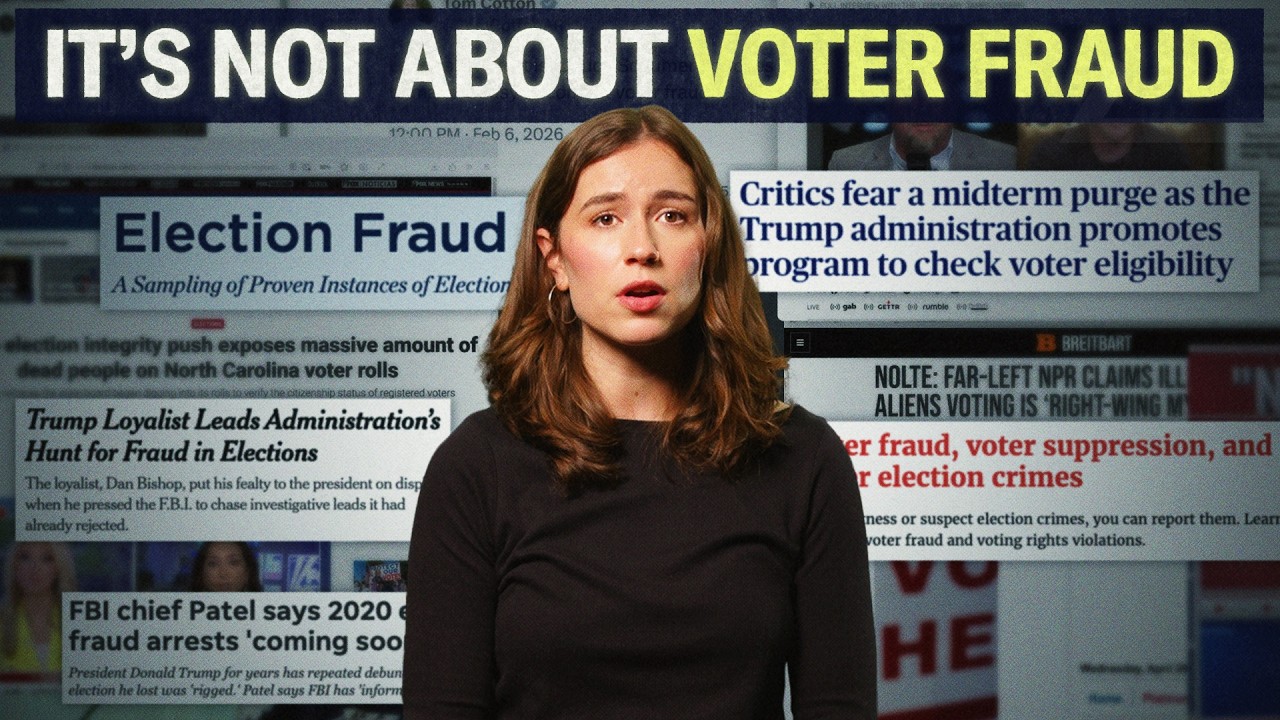
50% of voters say being forced to show a passport would be a barrier to voting, according to a new poll we conducted. Billionaires like Elon Musk, the Uihleins, and Leonard Leo are funding Trump’s attempts to take over elections and nullify your vote.
---
---
NO LNX
Economic collapse is coming — and the rich are already prepared to profit from it
Thom Hartmann May 04, 2026
The Wall Street Journal reports in an article titled “Trump Tells Aides to Prepare for Extended Blockade of Iran” that:
“President Trump has instructed aides to prepare for an extended blockade of Iran, U.S. officials said... In recent meetings, including a Monday discussion in the Situation Room, Trump opted to continue squeezing Iran’s economy and oil exports by preventing shipping to and from its ports. …
“For now, Trump is comfortable with an indefinite blockade, which he wrote Tuesday on Truth Social is pushing Iran toward a ‘State of Collapse.’”
So, Putin and America’s billionaires who religiously read the WSJ are officially tipped off to prepare for what may well be a worldwide repeat of the Republican Great Depression of the 1930s. Or at least a revisit to the GOP’s infamous Nixon-era crises of the 1970s, Reagan’s “Black Monday” 22% market crash, Bush’s 2008 “Great Recession,” and Trump’s 2020 massive botched-pandemic-response economic melt-down.
Trump and his people didn’t bother to say one word to average Americans — no press conference or warning — but they sure made certain that their billionaire buddies are informed.
And, of course, they’re not at all worried by this; recessions and depressions are when the morbidly rich like Trump and the 13 billionaires in his cabinet make their greatest fortunes. Businesses are failing, stock prices collapsing, and people are losing their homes, all fantastic buying opportunities for wealthy, cash-rich predators investors.
For example, when a handful of greedy Wall Street CEOs crashed the American economy in 2008, home prices (and, thus, homeowner equity) collapsed by 21%. Over 10 million Americans lost their homes to banking predators like “Foreclosure King” Steve Mnuchin, and tens of millions of others were underwater.
The stock market plummeted by over 50% in the last year of Bush’s presidency. On October 9, 2007 the Dow was at its all-time peak of 14,164 but by March 5, 2009 it had collapsed to 6,594. No bankers were ever prosecuted.
While millions of Americans lost their jobs and were wiped out as the Bush Crash started today’s homelessness crises, the top 1 percent saw it as one of the finest buying opportunities of the new century.
Working-class people were desperately selling their homes and unloading the stocks in their 401Ks at a loss just to pay the bills, as wages plummeted in the face of a loose labor market.
But the morbidly rich were doing great.
Between 2009 — the bottom of the Bush Crash — and 2012 when the recovery finally began under Obama, the top 1 percent of Americans saw their income grow by over 31 percent. Fully 95 percent of all of the income increases in the country were seized by the top 1 percent of Americans during that period.
As the economy recovered, rich people who’d bought stocks at the market bottom rode the S&P 500 up by 462 percent to 2020. A billion dollars invested in 2009 became $4.62 billion in just 11 years, a period during which the combined wealth of American billionaires went up by over 80 percent.
Then they did it again 10 years later!
The Trump/Covid Crash of 2020, “mismanaged” in a way to create maximum pain for working people, presented America’s morbidly rich with another brand new and huge opportunity to get even richer on top of a crisis brutalizing the rest of America.
As the market collapsed under Republicans and Trump, average Americans, now out of work, were again selling their homes and stocks at a loss just to buy food and medicine. But for the wealthy, it was a gift from God.
March 16, 2020 — just after Trump declared a pandemic and lockdown — the Dow sustained the largest single-day crash in its entire history. For the investor class, Trump and his billionaire buddies, this was an even better opportunity than the Bush crash of 2008!
Fewer than three months later, on June 4th, we learned that the seven richest people in America had seen their fortunes increase by fully 50 percent.
And with Trump’s massive tax cut for his fellow billionaires, they could keep most all of it: by that time the average American billionaire was paying less than 3 percent in income taxes (a situation that persists to this day).
Just during that one single terrible pandemic year of 2020, the Institute for Policy Studies documents, U.S. billionaires saw their net worth surge 62 percent by $1.8 trillion. Average billionaire wealth worldwide increased 27% in that one year alone.
American billionaires’ real taxes have fallen by 79 percent since Reagan’s election in 1980, and a 2012 analysis found that as much as $32 trillion of that is safely squirreled away in tax-fraud offshore shelters, about the same amount as their tax avoidance has left us as a national debt.
Which is why working-class Americans and our media should stop pretending that downturns are random acts of God. They’re predictable outcomes of GOP policy choices that get repeated whenever a Republican is in the White House — ten of the last eleven recessions happened when a Republican was president — and this one is being engineered right now in plain sight.
Republican deregulation weakens guardrails. Trade chaos disrupts production. Inequality hollows out demand. Tax breaks for the rich force cuts to government support for poor and middle class Americans. And when the system finally buckles, the losses to average working class people mean huge profits for the morbidly rich.
And this downturn could easily be the biggest one of our lifetimes, a singular achievement the Trump Crime Family will profit from massively, along with their billionaire cronies. As CNN reports, “About half the stuff Americans buy comes from Asia” and Asia is melting down from a lack of Middle Eastern oil. It’s hitting the rest of the world, too:
“The Middle East ships about 25% of the world’s polypropylene and 20% of polyethylene, two of the most-used plastics. It also accounts for a quarter of the world’s sulphur and 15% of its fertilizer.”
Not to mention a fifth of the world’s oil, most of the world’s helium, necessary to run MRI machines and make precision chips, and other crucial commodities. As Martin Wolf wrote for yesterday’s Financial Times:
“Fifty per cent of the world’s seaborne trade in sulphur passes through the Strait of Hormuz. So does 34 per cent of trade in crude oil, 29 per cent of liquefied petroleum gas, 19 per cent of liquefied natural gas, 19 per cent of refined oil products, 13 per cent of chemicals, including fertilisers, and nearly 10 per cent of aluminium. This is a chokepoint of the world economy.“
The oil shock has become so bad in Asia that, CNN notes, “Several major petrochemical producers, including South Korea’s Yeochun and PCS in Singapore, have declared ‘force majeure,’” meaning they can no longer honor their contracts to supply their customers because of circumstances out of their control.
And now it’s starting to show up here in the US in ways that go far beyond just the price at the pump.
Some are wondering if Trump’s efforts to bring down the world economy — which are explicitly helping Russia — are because Putin told him to do it.
That’s possible; our joining Netanyahu in illegally bombing Iran has also been a big boon to Putin’s regime, both in justifying his similarly illegal bombing of Ukraine and in jacking up world demand for (and the price of) Russian oil, which Trump has conveniently dropped sanctions on.
But it’s just as likely that this is simply the same type of stupid decision-making that has caused Trump to run every one of his dozens of companies except those subsidized by Russian or Middle Eastern money straight into the ground. Or it’s a two-fer, that benefits both American billionaires and Putin.
However it came about, buckle up. Hegseth’s pathetic performance before Congress yesterday tells us explicitly that the Trump regime has no plan to work out a peace deal with Iran any time soon.
While Putin, the Trump kids, and their fellow billionaires are rubbing their hands in glee, it’s going to be a hell of a year for the other 99% rest of us.
Get Thom Hartmann's daily columns on his Substack, Hartmann Report. Click here to join for free.
---
---
5 26
Don't Cry for Jeff Bezos's Yacht

May 5, 2026
He's selling it to avoid attention. Good.https://paulkrugman.substack.com/p/do...
...:40
40 seconds
okay. Obviously, playing the world's tiniest violin. Uh, we're not going to weep for Jeff Bezos's discomfort. Uh,
0:48
48 seconds
and yes, there's a certain amount of just plain satisfaction as seeing him taken down a peg, but I think there's a little bit more to it. This is not just
0:56
56 seconds
u you know invidious comparison and and uh and uh you know the hostility towards
1:04
1 minute, 4 seconds
people who have acquired great wealth although there's nothing wrong with that. Uh this is about the role of
1:13
1 minute, 13 seconds
moods vibes and the motivations of the malifactors of great wealth that play
1:20
1 minute, 20 seconds
such a a large role in the US political system. Now um as everybody should know
1:28
1 minute, 28 seconds
we have seen an extraordinary concentration of wealth at the top probably bigger than the concentration that took place in the guilded age. Uh
1:37
1 minute, 37 seconds
and uh it's gone along with something which is I think different from what we had in the late 19th century.
1:46
1 minute, 46 seconds
the in the late 19th century there were certain proprieties that people of great wealth you know felt that they had to uh
1:56
1 minute, 56 seconds
had to observe. They they had to maintain a certain pretense. The Victorian virtues were honored at least
2:04
2 minutes, 4 seconds
on the face of it. Um uh extremely wealthy men had marriages. Uh how presumably very many of them had
2:12
2 minutes, 12 seconds
mistresses as well. Uh there were certainly lots of you know the the the strictctures of conventional morality
2:18
2 minutes, 18 seconds
were not actually uh obeyed nearly as much as people wanted you to think but they wanted you to think. They they
2:25
2 minutes, 25 seconds
wanted to pretend to be good family men all of that. It was a kind hypocrisy was
2:33
2 minutes, 33 seconds
part of the package and hypocrisy is you the tribute that vice pays to virtue.
2:40
2 minutes, 40 seconds
Now we have a free-for-all. We have a very permissive culture uh which is not on the whole a bad thing. There's a lot
2:47
2 minutes, 47 seconds
of uh openness. There's a lot of misery that is avoided by having not having the to maintain the pretense that all
2:56
2 minutes, 56 seconds
marriages are happy that that people don't have you know whatever uh motivations they they have in reality.
3:02
3 minutes, 2 seconds
Um, but one of the things that's happened is that we have now a putoaucracy, a concentration of of
3:10
3 minutes, 10 seconds
incredible wealth and power at the top without even the hypocrisy of uh of of
3:18
3 minutes, 18 seconds
of morality, the hypocrisy of pretending to be virtuous. Um now there was a little bit you know politically there
3:25
3 minutes, 25 seconds
was some uh back backward pressure against that uh until
3:31
3 minutes, 31 seconds
Trump was elected the second time. And I think we have to bear in mind we have to take seriously the idea that an
3:39
3 minutes, 39 seconds
important reason that we are in the state we're in important reason that we have a uh a wouldbe fascist regime in
3:47
3 minutes, 47 seconds
power. I don't think they're quite managing to pull it off but they're definitely would if they could. um is that a handful of incredibly wealthy men
3:57
3 minutes, 57 seconds
wanted all restraints off. They wanted to be able to live the privilege of their great wealth. They wanted to be
4:05
4 minutes, 5 seconds
able to uh just flaunt their wealth uh performatively uh display their dominance uh not have
4:14
4 minutes, 14 seconds
to worry about people worrying whether they were uh you know chiding them for being uh politically incorrect just
4:22
4 minutes, 22 seconds
because they were abusive towards other people because of their gender, their their whatever their their uh their
4:29
4 minutes, 29 seconds
race, anything. Uh there was a Financial Times article just after the 2024 election with Wall Street people
4:36
4 minutes, 36 seconds
celebrating the fact that they were now free to say and again. Uh this is a pretty big deal. And I think
4:45
4 minutes, 45 seconds
if you look at the first year or so of the second Trump administration, the people at the top,
4:53
4 minutes, 53 seconds
the uh Elon Musk, Jeff Bezos, uh Mark Zuckerberg, they all were acting as if,
5:00
5 minutes
okay, no need to apologize, no need to pretend to be good. By the way, uh charitable giving has dropped way off.
5:08
5 minutes, 8 seconds
the the superw wealthy are just not doing the kind of reputation enhancing philanthropic giving that their
5:17
5 minutes, 17 seconds
predecessors in the guilded age engaged in. So this is a completely um you know amoral I got it you don't I'm in power
5:25
5 minutes, 25 seconds
my friend I'm friends with the people who hold ultimate power you don't have to worry uh you don't you don't I don't
5:32
5 minutes, 32 seconds
care what you think um and but it's not lasting it turns out and this is why I think this is somewhat
5:39
5 minutes, 39 seconds
important it turns out that the backlash is powerful enough uh scary enough at least you know not that I don't think
5:48
5 minutes, 48 seconds
that people like Bezos are actually scared that the uh torches and pitchforks are coming for them, but they are starting to realize that maybe they
5:57
5 minutes, 57 seconds
haven't purchased themselves total immunity the way they thought they had.
...
[sea change?]
---
---
https://www.alternet.org/alternet-exclusives/billionaire-media-trump/
Billionaires went all in on Trump — and lost big
:{John Stoehr April 08, 2026
It is not conspiratorial to suggest that the Washington press corps chose to help Donald Trump win the 2024 election by preventing most Americans from seeing the degree to which the former president had deteriorated mentally since leaving office.
Virtually all his public appearances and media interviews featured long stretches of incoherence as well as outright gibberish. That itself should have been the news, but it rarely was. Instead a gap formed between the real Trump and the Trump represented by the news media. That gap was so big it had a name: sanewashing.
We are now seeing the consequences of a cognitively impaired president – a democracy in tatters, a country at war, an economy on the brink – but that was the risk that the owners of the country’s most lucrative media properties were willing to take.
The decade leading up to the 2024 election featured social and political progress for women, Black people and people of color. The MeToo movement revealed the ugly reality of sexism. The country was rocked by a reckoning over institutional racism in the wake of George Floyd’s murder by a white cop. The pandemic empowered workers in ways largely unknown. Above all that was a president, Joe Biden, who put the government on the side of labor and the consumers who drive 70 percent of the economy.
These days we might call it a revolution against the Epstein class.
Which is why America’s cultural elites struck a bargain. He might be unfit mentally, and he might be dangerous politically, but it was better to have a second term for Donald Trump than a second term for a liberal administration that threatened to deepen gains made in the pursuit of liberty and justice for all.
America’s cultural elites needed a tool to smash the left.
Sure, he was deranged. Sure, he was a criminal and traitor. But the consequences of his reelection were unlikely to touch the elites while the consequences of the alternative very much would. So his liabilities were sanewashed and after he won, the press corps manufactured a consensus in which everything was going to be fine. The economy was good. Wokeism was defeated.
But here’s the odd thing. America’s cultural elites seem to actually believe their own propaganda. They seem to believe the reelection of Donald Trump was a correction, not only for America but for the media as well. They seem to believe that there really is a bias against white people and that once this bias is corrected, the news business will reap a populist windfall.
They’re wrong. There is no bias – anyway, not in the way they believe. That should be evident in the attempts to correct the “error” by the Washington Post, under the ownership of Jeff Bezos, and CBS News, under the leadership of Bari Weiss. Each has conspicuously reoriented their outfit toward the political right. The result has been a veritable bloodbath in lost profits.
That they are wrong is not evident, however, especially not to them. This alone is worth pondering. Many on the political left presume Bezos and Weiss are intentionally sabotaging the Post and CBS News. But, as Noah Berlatsky wrote recently, that’s more conspiracy than fact. They really do want to make money. Weiss in particular, Noah said, isn’t a saboteur. She’s just a losing loser.
I got in touch with Noah to talk about this and more, because I like him and because his newsletter is so insightful. It’s called Everything Is Horrible. Here’s the rest of our conversation.
You say Bezos and the Ellisons believe remaking their outlets in the mold of Fox will make them profitable. Yet they still believe that even after they have failed. In your view, why is that?
I think very wealthy people are surrounded by yes-men and are dazzled by their own success. They think they're brilliant and if their schemes go awry, it's someone else's fault or it's a sign of their willingness to think big, take risks, etc. Admitting they screwed up and are stupid would mean questioning whether they actually deserve all that power. Obviously, they can't do that.
You suggest that Weiss and the billionaires she represents think of themselves as tribunes of an authentic America. Will business failure correct that categorical error or nah?
I think that the wealthy are very reluctant to reassess their screw-ups. However, I do think that others watching them screw up are likely to become more skeptical of the idea that Trump and his billionaire cheering squad are the voice of the people.
You've already seen this I think as institutions have become more willing to fight and less willing to knuckle under, as it's become clear that Trump is not very popular. Disney and Kimmel were one example. More universities have started to push back. Democrats have become more willing to fight, etc.
What’s happening at CBS and others reflects the growing gap between media elites and normal people. It’s to the point now where Trump can claim victory in his war against Iran, and the press corps might choose to believe him, while consumers of the news watch the war burn up their wages. Will there be a correction at some point, as there would be on Wall Street?
The press has actually been pretty skeptical about the Iran war. There's some egregious cheerleading from people like New York Times columnist Bret Stephens and other neoconservative hacks, but it's nothing like with the Iraq War. I don't think the press would just shrug and go along with it if Trump declares victory.
I think this is largely because the public is so against the war. Media elites can be disconnected, but they also do react to what their audience wants, especially when there's a lot of bipartisan consensus. A significant section of the Republican Party and right wing is very angry about the war, and that means that media outlets feel empowered to criticize it – which I think they have done, which makes the war less popular, which makes the media more willing to criticize it and so on. It's a virtuous circle.
After the election, there was a media consensus that believed that Joe Biden was the aberration, not Trump, and that Trump, in coming back, was a restoration of normalcy. That consensus depended on Biden’s economy becoming Trump’s. Now that Trump’s economy is cratering, will the consensus change?
I'm not sure that I agree that the return of Trump was exactly seen as normal. Trump's often seen as an exciting deviation from the norm, and I think a lot of the excitement in elite circles was created by the sense of a definitive break with the past — Trump, they all believed, would crush the left rabble once and for all.
I think that the sense of fascist optimism among the elites has obviously soured. I don't know that it's useful to think of Trump as abnormal or an aberration exactly, though. He's dominated US politics for 11 years. He is the status quo. He's what America has decided to be. I think that we need to grapple seriously with the fact that overturning that status quo is going to require some sweeping changes. We aren't just going to snap back to normal when Trump is gone. This is normal, god help us.
Why do some on the left see conspiracy when Weiss and the oligarchs’ business failures are more easily explained by greed, cowardice, incompetence and the abuse of power?
I take it you mean. Why do some on the left (and not just the left!) believe that Weiss wants CBS to fail? That is, why do they think she's destroying it out of malice rather than incompetence?
I think there's a couple of things. One is that Weiss, Bezos and so forth really do want to kneecap the ability of journalists to criticize the regime. So reducing capacity and immiserating good reporters is a plus from their perspective. They want to destroy the old version of the Washington Post and CBS News, and doing so has been at least a partial win.
Second, I think there's always kind of an impulse to see your enemies as more organized, more effective and more competent than your side is. Republicans do this too. They're always talking about how Democrats are laser-focused and ruthless, etc. It's just one way that negative partisanship works.
Finally, I think people are sometimes afraid to hope? I often think about Bill Paxton in Aliens where he shouts, "Game over, man! Game over!" You wish for the end because then you can check out and don't have to live the painful bits of the end with the aliens catching and eating you. Which is understandable that you would rather miss that part! But of course if you check out and just assume the enemy is unbeatable, you aren't exploiting their weaknesses or doing what you can to defeat them.
So, yeah, I do not think that the struggle for media is over at all. Bezos and CBS have had very significant humiliations and losses. NOTUS is expanding its Washington newsroom with a lot of ex-Post staff; ABC News and NBC News have benefited and their ratings are up. The dream of a popular maga mainstream media bonanza is pretty dead, which I think leaves space open for other dreams and other approaches.
Obviously we're still all living in a nightmare. But Weiss and Ellison getting humiliated is good. Take the win when you can.
---
---
Legacy outlets that bent the knee to Trump haven’t just lost credibility — they’re bleeding readers and viewers
Trumpism is bad for business: CBS News ratings are in a tailspin six months into Bari Weiss’ tenure
Written by Matt Gertz
:{Published 03/25/26
It turns out that there isn’t a ratings bump for MAGA capitulation.
David Ellison, the son of President Donald Trump’s megabillionaire ally Larry Ellison, took control of CBS last year following a corrupt deal that saw its parent company settle a lawsuit with the president and agree to implement a new conservative ombudsman for CBS News. As part of that takeover, he also installed conservative journalist Bari Weiss at the helm, promising that her “entrepreneurial drive and editorial vision” would “invigorate” the network. But six months into Weiss’ rightward makeover of CBS, the fruits of her labors include cheers from Trump and Defense Secretary Pete Hegseth for making the network more palatable to their aims, complaints from the CBS newsroom that she is dismantling its independence — and, it now appears, a viewer exodus.
Status’ Oliver Darcy got ahold of some CBS News ratings data from the first quarter of 2026, and it is brutal. CBS Evening News has lost 7% of viewers year-over-year, placing it “on track for its lowest-rated first quarter of the 21st century in both total viewers and the advertiser-coveted 25-54 demographic,” while CBS Mornings plummeted 13% and “is pacing toward its lowest-rated quarter on record in both total audience and the key demo.” Meanwhile, the audiences of competitor shows at ABC News and NBC News grew over the same period.
The ratings collapse is a devastating indictment of the strategy Ellison and Weiss are executing at CBS — and a blaring warning for CNN if Ellison is able to complete his takeover of that network and let Weiss run the same playbook there.
Meanwhile, new data from the Alliance for Audited Media show that while average daily print circulation among major audited newspapers saw year-over-year declines across the board in the six months running through the end of September 2025, the biggest drops came at The Washington Post, which fell 21.2%, followed by the Los Angeles Times, down 19.8%. Their billionaire owners — Amazon founder Jeff Bezos and biotech mogul Patrick Soon-Shiong, respectively — had responded to Trump’s return to the White House by trying to shift their papers to the right.
None of this should come as a surprise.
Ellison and Weiss have suggested that the core problem for American media is that the public does not trust news outlets, and that the reason for this is that the public perceives those outlets as too far left and too critical of the right. They propose to win over a larger audience by deliberately course-correcting in the opposite direction.
“We are not producing a product that enough people want,” Weiss said at a CBS News staff town hall in January. Weiss attributed this to two factors. “First: Not enough people trust us. Not you. Us. As in: the mainstream media,” she said. “Second: We are not doing enough to meet audiences where they are. So they are leaving us.”
Weiss is correct that trust in traditional media has fallen dramatically in recent decades, particularly among conservatives — indeed, this is a banal truth that everyone remotely connected to the media knows. But her strategy of conceding that potential viewers are correct to distrust journalists and seeking to “meet audiences where they are” by signaling that coverage will now be deliberately shifted to the right has had the obvious result of driving away the existing audience without adding a new one.
CBS News’ viewers either liked what they were already watching or they liked what watching Edward R. Murrow’s old network said about them. When the network’s new ownership and management proposed taking its programming in a dramatically different direction in search of a different audience — as the wildly unpopular president cheered — the existing viewers could see that, and some decided that CBS is no longer worth their patronage.
Weiss’ theory of the case is that these losses could be made up by new viewers with more right-leaning views. But the decline in public trust for traditional media among Republicans stems at least in part from a decades-long strategy pursued deliberately by the GOP and conservative movement. That effort revolves around simultaneously denouncing news outlets as liberal propaganda while encouraging conservatives to instead patronize new, deliberately right-wing news sources. And it’s been taken to another level under Trump, who relentlessly attacks the press while using state power to reduce its influence and lift up the MAGA media operation.
That dynamic makes it wildly implausible that the shift Weiss enacted would win over a sizable new segment of viewers. Her version of CBS may garner praise from Trump, but people who might be swayed by his comments already have — and are likely already patronizing — a plethora of pro-Trump outlets. You could imagine a scenario where some slightly more right-wing viewers of the ABC and NBC news shows switched to watching the new CBS. But instead, the data Darcy cited suggests, CBS appears to be shedding viewers who are instead watching its competitors — or exiting broadcast television altogether as their news source.
As for Bezos’ Post and Soon-Shiong’s Times, when the owners similarly bet on trying to make their outlets more acceptable to Trump, their existing audiences looked for the exits and were not replaced. The efforts may win over the likes of Tucker Carlson or even the president himself, but MAGA isn’t rushing to buy subscriptions.
For Ellison, Bezos, and Soon-Shiong, the declines in their news outlets may be a small price to pay to win over Trump. Each owner has massive business holdings outside of the press and can afford the losses from tearing down their news outlets if it wins the Trump administration’s support for their desired mergers, contracts, or patents.
The journalists facing layoffs from their outlets — and the public who lose access to their reporting — are the ones who will actually suffer from this doomed strategy.
//
02/27/17
02/17/26
12/03/25
---
https://wareagle.substack.com/p/the-iran-war-exposes-the-farce-of
SUBSTACK
NO LNX
The Iran War Exposes the Farce of American “Representative Democracy”
J Richard Duke
Mar 03, 2026
The Iran War Exposes the Farce of American “Representative Democracy”
Ryan McMaken
“The Trump administration has unilaterally—without any Congressional debate or vote, of course—forced Americans into yet another war. This time, the war is a large-scale military campaign against Iran. Was there any groundswell of public support for this war? Did the Congress vote to spend more American tax dollars on another war? Apparently not. According to a March 1 poll from Reuters, only 27 percent of Americans polled said they support the US’s new war on Iran. Needless to say, few Americans have been calling their representatives in Congress asking for yet another Middle Eastern war.
:{:{So, why is the US now at war with Iran? Not even the administration appears to know for sure. After the war had already begun, the White House repeatedly changed its stated rationale for opening hostilities against Iran. At the beginning the US regime had been claiming it wanted regime change in Iran to “liberate” Iranians. Yet, by Monday, when Trump listed his reasons for starting the war, he didn’t mention regime change at all. Rather, the administration now seems to have settled on claims that the Iran regime was creating a missile program that, somehow, endangers the United States.}:
Yet, virtually no one believes that the Iranian regime has ever had long-range missiles capable of getting anywhere near US territory. Rather, the only “threat” to the United States is a threat to US bases which the US government has insisted on building 10,000 miles from US territory, and which have nothing to do with the safety of Americans in the United States.}:
On Monday, Rubio said that the United States began the war because the State of Israel planned to attack Iran, and that this would lead to Iranian reprisals against US bases. Rubio was essentially stating that Tel Aviv forced the US into the war. Trump today directly contradicted his Secretary of State—as well as the GOP Speaker of the House and GOP Senator Tom Cotton—and claimed “I might’ve forced their hand.”
Completely absent from all these confused and retroactive attempts to justify the war is any mention of the American people, their tax dollars, their freedoms, or even their alleged representatives in Congress. Nor is this surprising. The current war is a timely reminder that the US ruling elites regard the US taxpayers and ordinary Americans as little more than inconvenient afterthoughts in the formation of US foreign policy. At the same time, the US regime also claims to have the moral high ground precisely because the American regime is supposedly “democratic” with the support of “the people.”
Indeed, the Trump administration overall has helped make it abundantly clear that US elections and public opinion are almost completely irrelevant to the foreign policy. Throughout his campaigns, Donald Trump repeatedly claimed to be the peace candidate, announcing in his speeches that he would end wars, rather than start them. In the days before the 2024 election, the GOP posted this image in social media, clearly presenting the Trump administration as “the pro-peace ticket”:
Yet, less than a year into his second term, Donald Trump’s foreign policy looks largely indistinguishable from that of the foreign policy of Barack Obama or Joe Biden. Indeed, if the current war drags on, we’ll be able to say Trump’s foreign policy is reminiscent of the George W. Bush administration.
It was clear during the campaign that the Trump ticket was trying to take advantage of public sentiment which favored less US involvement in foreign wars. With American foreign policy, however, elections don’t matter. This was recently emphasized by the bumbling US ambassador to Israel, Mike Huckabee, in a recent interview with Tucker Carlson. Carlson began with a simple question for Huckabee:
Carlson: How much does it matter what Americans think?
Huckabee: Well, it matters every bit what Americans think.
[Huckabee is a delusional liar. - JRD]
Carlson then points out that about 21% of Americans support war with Iran. He asks Huckabee if that’s enough for the US regime to start a war with Iran. Huckabee states “We don’t live in a world where you have a poll taken to find out whether our policy should be in a particular direction...”
Carlson then points out that Huckabee had just said public opinion matters a lot and Huckabee says “we care deeply about it...”
[Huckabee is a liar. - JRD]
Carlson: “If we’re ignoring it, in what sense to we ‘care deeply about it?’”
Huckabee then offers a non sequitur: “I think we care deeply when we see there’s a threat.” Huckabee then continued with more word salad in a desperate attempt to make a connection between public opinion and his preferred policy of repeatedly starting elective wars with Middle Eastern regimes that are no threat to the US population.
[Huckabee, the Ambassador to Israel, is a former pastor who does NOT understand the Bible and is puts Israel first and American somewhere below. - JRD]
The reality, of course, is closer to Rubio’s explanation for the US’s involvement in the war: following the lead of the State of Israel.
This is apparently fine with Ambassador Huckabee, of course, who in his Carlson interview, was asked if Huckabee thinks the State of Israel has a “right” to take over most of the Middle East. Carslon stated: ”Does Israel have the right to that land?” Huckabee responded ”It would be fine if they took it all.”
And what if most Americans don’t share this opinion? Clearly, the US regime doesn’t care, and neither does Huckabee, or Donald Trump.
In spite of all the US regime’s posturing about “the will of the people” and “representation” in Congress, what really matters in Washington is serving powerful interest groups. The taxpaying public simply exists as a resource to be bled dry in favor of wars, protectionism, and federal spending which serves the ruling elite’s complex system of patrons and clients that keeps the elite in power.
When it comes to US foreign policy in the middle east, the dominant interest group is the State of Israel. This is executed through the American-Israeli Political Action Committee (AIPAC) and other elements of what foreign-policy scholars John Mearsheimer and Stephen walt call “the Israel lobby.” When Mearsheimer and Walt released their book The Israel Lobby in 2007, they were predictably accused of anti-semitism. Yet, the book was ahead of its time in describing how pro-Israel interest groups have been extremely successful in gaining financial, military, and strategic favors for Israel from US policymakers. It has all been done at the expense of American taxpayers. The result has been an American foreign policy elite that overwhelmingly favors incessant foreign intervention to favor a foreign state—the State of Israel—regardless of any concern for the cost borne by Americans or the potential for drawing the US into broader conflicts that do not in any way increase the security of the United States.
In 2007, The Israel Lobby seemed controversial to many. In 2026, it is merely a statement of the obvious—that US foreign policy is tailored to favor certain interest group, rather than the interests of ordinary voters. This, however, is how all interest group politics works. The voting public doesn’t matter, and it hasn’t mattered for a long time.
This is shown in empirical studies that have tried to find a connection between public opinion and actual policies favored in Washington. The connection is tenuous at best.
For example, in a 2014 study by Martin Gilens and Benajmin Page, the authors note that when it comes to “impacts on U.S. government policy ... average citizens and mass-based interest groups have little or no independent influence.” Gilens and Page note that “the preferences of economic elites ... have far more independent impact upon policy change than the preferences of average citizens do.”
This can be seen in Trump’s own fundraising given how one of his biggest donors, billionaire Miriam Adelson, is notable for an extreme pro-Israel position. This is, not surprisingly, reflected in Trump’s foreign policy.
The final conclusions of Gilens and Page are clear:
In the United States, our findings indicate, the majority does not rule—at least not in the causal sense of actually determining policy outcomes. When a majority of citizens disagrees with economic elites or with organized interests, they generally lose. Moreover, because of the strong status quo bias built into the U.S. political system, even when fairly large majorities of Americans favor policy change, they generally do not get it.
Perhaps no group of “economic elites” is more influential in foreign policy than those who control campaign funds distributed through pro-Israel interest groups like AIPAC, or through the spending of wealthy individuals like Adelson.
Other studies have come to similar conclusions. For example, in a 2017 paper on voter preferences, John Matsusake concluded that legislator preferences don’t correlate with voter preferences:
[W]hen legislator preferences differed from district opinion on an issue, legislators voted congruent with district opinion only 29 percent of the time. The data do not show a reliable connection between congruence and competitive election, term limits, campaign contributions, or media attention. The evidence is most consistent with the assumption of a citizen-candidate model that legislators vote their own preferences.
There is, of course, no such thing as a “district opinion,” but the general idea is clear enough: if a legislator’s campaign war chest depends on pleasing a specific interest group, then the preferences of the voters don’t really matter.
Similarly, in a 2016 study from Michael Barber, he writes on how votes in the US Senate bear little relation to public opinion: “[S]enators’ preferences diverge dramatically from the preference of the average voter in their state. The degree of divergence is nearly as large as if voters were randomly assigned to a senator.”
So, if policymakers are largely independent of the voters who the policymakers ostensibly “represent,” then what determines federal policy?
The current war is just the latest reminder that pluralism is wrong and elite theory is right. There is no “we the people.” There is no “representative democracy.” And, when it comes to the big stuff like war, federal spending, and the central bank, elections don’t matter. It’s why, no matter who gets elected, US foreign policy proceeds more or less as usual, year after year after year.
This is why it doesn’t matter that only about one in four Americans is interested in being on the hook for yet another Middle Eastern war with no apparent benefits for any average American. This is why the administration continues to engage in shifting claims about the origins of this conflict. The administration knows that claims about Iran being a threat to the American people are not tenable, and are on the same level as claims about Iraqi WMDs. Nor can the regime just come right out at say “our pro-Israel funders told us to fight Iran.” So, we have Rubio telling us the war was a “preemptive strike” against the potential blowback from US-funded Israeli strikes on Iran. This explanation is already falling apart, which is why Trump now denies it.
In the end, the regime doesn’t even really need to come up with a plausible explanation. The political fallout will settle largely on the current administration, and this will have little effect on the real governing elite which remains in control regardless which party is ostensibly “in power.”
Open link
SEE:
Why Parts of MAGA Feel ABANDONED After Trump Goes to War with Iran, with Marjorie Taylor Greene
---
---
AN 2 26
Donald Trump is losing support from almost every voting bloc there is as his second term wears on, but according to a new analysis from Thomas Edsall, the richest Americans are sticking by him. These "superrich" donors are now fueling a "Republican financial juggernaut," and they want favors in return.
"Determined to get a piece of the action, the very wealthy are lining up in droves," Edsall wrote in his latest New York Times column. "Despite Trump’s having lost ground in almost every demographic during his second term, one group stands firmly in the president’s camp: the superrich who have their wallets open."
These superrich voters, Edsall explained, are standing by with Trump thanks to his economic policies, which "have reinforced and, in some cases, intensified trends toward the increasing concentration of wealth and income at the highest levels." Citing data from the Federal Reserve, he noted that by the third quarter of last year — months into Trump's second term and right around the time he signed the "One Big Beautiful Bill" — the richest 0.1 percent's share of all the wealth in the U.S. had grown to 14.4 percent, up from 8.6 percent in 1989, while the share for the rest of the richest 1 percent grew to 17.3 from 14.2 percent.
Edsall further broke down how these superrich voters made a striking shift towards overt support for Republicans in the 2024 election. In years prior, the split between donations they made to Republicans and Democrats was closer to even, though the GOP held the edge. Citing data from the Washington Post, Edsall demonstrated just how much they made a rightward shift in 2024.
"Then that pattern abruptly shifted," Edsalld wrote. "Contributions by the very rich to Republicans grew from roughly $300 million in 2022 to just under a billion in 2024, while donations to Democrats fell from roughly $300 million to less than $200 million."
The Post's original report noted that "more than 80 percent of the federal campaign spending by the 100 wealthiest Americans in 2024 went to Republicans." Reporting from OpenSecrets found that one-time Trump ally Elon Musk was the biggest contributor that year, donating nearly $300 million.
By way of contributions to Trump's MAGA Inc. super PAC, the wealthy have continued to flood Trump with more money. The committee currently boasts over $300 million in cash-on-hand, with 90 percent of that amount coming in donations over $1 million. Edsall cited another report from the New York Times earlier this month, which found that the GOP overall has "an unheard-of edge of more than $550 million" over Democrats.
"The wealthy have created what amounts to a Republican financial juggernaut," Edsall wrote.
That level of fundraising around a president like Trump, who has no legal path to running for a third term, seems odd on the surface. However, Edsall observed, these donors are backing Trump in exchange for preferential treatment, including regulatory changes and investments, and favors, such as pardons.
"Evidence of the pervasive corruption is endemic, in the presidential pardons to donors and the well connected, in the regulatory favoritism found at key agencies, in the flow of special interest and foreign investments into the Trump family’s cryptocurrencybusinesses."
===
---
August 4, 2025
Trump’s MAGA Inc. SuperPAC Donor List is Littered with Corporate and Billionaire Influence Buyers
WASHINGTON D.C. — President Trump’s MAGA Inc. SuperPAC received $1 million or more from 58 donors since January, according to the SuperPAC’s most recent campaign finance disclosure filed last week.
The million-dollar donor list includes numerous corporate and billionaire donors with interests in influencing the Trump administration, including two crypto companies that were facing SEC investigations that have since been dropped and a seller of “skin substitute” products that benefited from the delay of a Biden-era Medicare rule to limit spending on their products.
“The real question this mega-donor list raises is not ‘how much,’ but ‘who from?’” said Jon Golinger, democracy advocate for Public Citizen. “By taking contributions from wealthy individuals and industries who want something from government, Trump’s SuperPAC has used pay-to-play to raise big money from special interests like a legalized shakedown.”
Public Citizen analyzed the new MAGA Inc. SuperPAC filing with the Federal Election Commission, covering the period of January 1 – June 30, 2025, and found the following:
- Corporations gave $73.2 million
- Billionaires gave $49.2 million
- Cryptocurrency corporations, executives, and investors gave $41.7 million
- Fossil fuel corporations and executives gave $26.8 million
- Healthcare corporations and executives gave $12 million
- Donations of $1 million or more from corporations and billionaires included:
- $25 million (combined) from Energy Transfer LP and CEO Kelcy Warren. Energy Transfer is suing the Pipeline and Hazardous Materials Safety Administration, asking a judge to declare the agency’s in-house enforcement system unconstitutional.
- $16 million from Jeff Yass, a billionaire who owns a stake in TikTok’s parent company. TikTok is facing a Department of Justice lawsuit alleging violations of the Children’s Online Privacy Protection Act.
- $10 million in February 2025 from Foris Dax, Inc., which operates Crypto.com. Crypto.com was under investigation by the SEC over allegations of allegedly trading unregistered securities. The SEC investigation was reportedly dropped in March 2025.
- $5 million from the “skin substitute” company Extremity Care. In April 2025, the Trump Administration postponed implementation of a Biden-era rule that would limit Medicare spending on skin substitute products.
- $1 million (combined) in January 2025 from Gemini Trust Company (DBA Gemini) co-founders Cameron and Tyler Winklevoss. At that time, Gemini was under investigation by the SEC for allegedly trading unregistered securities. The SEC investigation was reportedly dropped in February 2025.
---
---
an 2 26
Donald Trump's threats against a bridge connecting the U.S. and Canada flummoxed some of the leaders involved with its creation, but according to a New York Times report, the president's turn may be connected to the influence of a wealthy donor.
On Monday, Trump took to Truth Social with a threat to block the opening of the Gordie Howe International Bridge, a $4.7 billion project connecting Windsor, Ontario, and Detroit, which had been set to open soon. Trump claimed, falsely, that Canada would control both ends of the bridge and that it had been constructed using no American materials. Canadian Prime Minister Mark Carneytold reporters on Tuesday that he has called Trump and is working to resolve the matter.
“I explained that Canada paid for the construction of the bridge," Carney said. "That the ownership is shared between the state of Michiganand the government of Canada, and that in the construction of the bridge, obviously there’s Canadian steel and Canadian workers, but also US steel, US workers that were involved. This is a great example of cooperation between our countries.”
On Wednesday, the New York Times cited two anonymous administration sources who said that Trump's bridge outburst came only hours after Matthew Moroun, a Michigan-based billionaire and transportation magnate whose family owns the Ambassador Bridge, which also connects Windsor and Detroit. Moroun, the sources claimed, met with Trump's Commerce Secretary Howard Lutnick at the White House, with Lutnick later taking a call with the president shortly before his Truth Social post.
Moroun has been a prolific donor to Trump's political campaigns, and his business has long opposed the construction of the Gordie Howe International Bridge. Once opened, it will serve as a competitor to his family's own bridge and divert toll revenue away from it.
The new bridge, named for a late Detroit Red Wings hockey legend, was first proposed in the early 2000s and received approvals in the early 2010s, with construction finally commencing in the summer of 2018, during Trump's first term. As opposed to the Ambassador Bridge, the Gordie Howe is publicly owned. All throughout that time, the Moroun family, led by Matthew's father, Manuel Moroun, vigorously fought against it, alleging at one point that it violated the exclusive rights of his own bridge.
"The Moroun family has for decades mounted legal challenges to block or delay the competing project," the Times explained. "One of the challenges reached the Canadian Supreme Court, while the family has also lobbied extensively against it."
---
---
AN 1 26
An extensive new study from a team of Ivy League economists has uncovered just how much the Supreme Court has shifted towards favoring the wealthier side in any given case, with a New York Times report concludingreport concluding that you can "follow the money" to determine how it will in any given case.
The new study, dubbed "Ruling for the Rich," was published on Monday and hailed from the team of Yale's Fiona Scott Morton, Columbia's Andrea Prat and Columbia's Jacob Spitz. Adam Liptak, the leading Supreme Court correspondent for the Times, dug into its findings, noting that "the wealthy have the wind at their backs before the justices," and questioning whether or not they are living up to their oath to "do equal right to the poor and to the rich."
Per Liptak's analysis, the study found that Republican appointees, who have held a 6-3 majority on the Supreme Court since 2020 and an overall majority for much longer, are "far more likely than Democratic ones to side with the wealthy," and adding "that the Supreme Court has become deeply polarized in cases pitting the rich against the poor." This is now in sharp contrast to the court of the mid-20th Century, "when appointees of the two parties were statistically indistinguishable" in terms of favoring wealthier parties.
Specifically, the study found that Republican-appointed justices sided with wealthier parties in cases around 70 percent of the time. By comparison, in 1953, conservative justices sided with them only 45 percent of the time.
Speaking with Liptak about the findings, Adam Cohen, author of the book "Supreme Inequality," noted that the study essentially reiterated ideas about the court's conduct that "some of us have been observing for a long time."
“But it is great to see,” Cohen added. “Respected academics crunching the numbers and producing the data to show that this is exactly what has been going on.”
These findings come as leaders in both political parties are ramping up plans to radically alter their campaign finance plans ahead of an upcoming decision, in which the court is widely expected to lift the limits on how much party committees and campaigns are allowed to coordinate with each other. This, experts argue, would hand even more power to the wealthiest donors and further erode the power of small-dollar donors.
---
---
MMA
The year the media oligarchs bowed to Trump
Written by Matt Gertz
Published 12/03/25
We warned last year that Donald Trump’s second term as president would turbo-charge the political right’s burgeoning media-intimidation complex. Republican officials and right-wing billionaires were already trying to secure their political agenda by using their wealth, lawfare, and government power to silence journalists. And Trump, we wrote, using his authoritarian strategies, would force media moguls to choose between the journalistic integrity of the news outlets they oversee and their broader business interests, with the fate of the free press in the balance.
Twelve months later, it is clear that many of these corporate media owners have made their choice: They are damaging celebrated news outlets like CBS and The Washington Post out of some combination of personal preference and political expedience. While journalists at their outlets are still producing important stories that reveal the corruption and malfeasance of the Trump administration, it’s anyone’s guess how long they will be permitted to do so.
Trump has spent the last decade at war with the press. He has no regard for free speech, treats all dissent as inherently illegitimate, and uses every available tool to curtail critical journalism. The president’s years of anti-media diatribes have achieved their goal of destroying the credibility of potentially damaging reporting among his supporters, and in his second term, he has backed up those verbal attacks with a flurry of actions.
He and his administration have supplemented or even replaced members of the traditional press corps in favor of MAGA influencers and Trumpist outlets; defunded public media outlets in the U.S. and sought to dismantle them abroad; sued reporters and news outlets for publishing content he dislikes; and terminated rules protecting journalists from prosecutorial scrutiny, while targeting them with retaliatory immigration enforcement.
But Trump’s most unnerving assaults on the press involve his administration's use of state power as leverage against oligarchs who control broadcast and cable news operations and major newspapers. For billionaire owners or top executives at massive multimedia companies, news outlets typically represent a tiny fraction of their overall business interests. And those broader holdings create potential vulnerabilities — like regulatory scrutiny of mergers, federal contracting, and criminal investigations — that an authoritarian president can manipulate to encourage media moguls to cudgel their news outlets into line.
Trump’s strategies resemble those of Victor Orban, the Hungarian autocrat many on the American right take as a model, who has dismantled his country’s independent press and forced the sales of outlets to his allies. Trump's desired result is a cowed journalist corps that will produce Fox News-style propaganda venerating his successes and covering up his corruption and failures.
America’s media oligarchs often resisted Trump’s corrupt abuses of power in his first term, either enduring his attacks without constraining their news outlets or beating his administration in federal court. But in his second term, while some media organizations (including Media Matters) have fought to protect the First Amendment against Trump and his administration, certain wealthy magnates have chosen the path of cowardice, submission, and collaboration.
David and Larry Ellison
David Ellison is the son of Larry Ellison, the Oracle co-founder who is one of the richest men alive and a close friend and ally to Trump. The younger Ellison took control of CBS News in July after the Federal Communications Commission approved his Skydance Media’s purchase of CBS parent company Paramount. Trump-appointed FCC Chair Brendan Carr acted only after Paramount agreed to pay $16 million to settle an absurd lawsuit Trump filed over CBS News’ editing of an October interview with then-Democratic presidential nominee Kamala Harris — and after he secured pledges from Skydance to push the network’s coverage to the right.
Ellison followed through on his promise. The new ownership appointed “anti-woke” champion Bari Weiss as CBS News’ editor-in-chief and Kenneth Weinstein, a Trump-supporting right-wing think tanker, as its ombudsman. An October wave of layoffs hit nearly 100 CBS News employees, gutting the network’s teams focused on climate change and race and culture. Trump certainly seems happy with the changes — in a November 2 interview that marked his first appearance on the network since 2020, he praised Weiss as a “great new leader” and “great person” and described David Ellison’s takeover of CBS News as “the greatest thing that’s happened in a long time to a free and open and good press.”
With the CBS News takeover as proof of concept, Ellison and his father are each making moves to seize additional media outlets and move them in a Trumpy direction.
David Ellison is trying to buy Warner Bros. Discovery — and the administration is reportedly signaling that other bidders will face grueling oversight from federal regulators. “Trump wants WBD in the Ellisons’ hands, and insiders say it’s because he wants favorable coverage from its CNN news channel,” wrote the New York Post.
Larry Ellison has even reportedly “engaged in a dialogue” with the White House “about possibly axing some of the CNN hosts whom Donald Trump is said to loathe, including Erin Burnett and Brianna Keilar,” if the sale were to go through.
The Trump White House is also trying to broker a deal in which the social media giant TikTok, a news source for one-fifth of American adults and 43% of those under 30, would be sold to a coalition including companies controlled by Larry Ellison as well as fellow pro-Trump magnate Marc Andreessen.
- ### Jeff Bezos
Bezos owns The Washington Post, but his massive fortune comes from founding Amazon, the online retailing and web service giant, and he also owns the space technology company Blue Origin. During Trump’s first term, Bezos bore numerous potshots at what Trump termed the “Amazon Washington Post,” as well as his administration’s apparent retaliation against Amazon’s operations. But Bezos signaled that things would be different in a second term even before Trump’s election when he barred the Post’s editorial board from endorsing in the 2024 contest, blocking the publication of its piece supporting Harris.
The decision began a deterioration of Bezos’ relationship with the Post, accelerated further by his February demand that the paper’s Opinion section advocate without exception for “personal liberties and free markets.” Opinion editor David Shipley resigned rather than execute that pivot; his replacement, Adam O’Neal, an undistinguished reporter and editor previously at The Economist and The Wall Street Journal, has overseen buyouts and layoffs of the section’s veterans (my wife Alyssa Rosenberg, the section’s former letters and community editor, was among those who took the buyout) and hired several conservative writers, leading one of the paper’s right-wing columnists to boast, “We’re now a conservative opinion page.” The dramatic changes seem to have blown a hole in the Post’s subscriber numbers, with NPR’s David Folkenflik estimating “a net loss of a couple hundred thousand subscribers” at the end of February. With revenue plummeting thanks to Bezos’ decisions and the owner unwilling to eat the losses, more layoffs are reportedly on the way.
But defanging the Post — and finding a way to put money in the Trump family’s pockets — seems to be working out well for Bezos. His rewards include plum seats for Trump’s swearing-in, federal contracts for Blue Origin and Amazon Web Services, and the president publicly applauding him for “trying to do a real job with The Washington Post, and that wasn’t happening before.”
### Patrick Soon-Shiong
Like Bezos, Los Angeles Times owner Soon-Shiong has other business interests that left him vulnerable to Trump’s retaliation; he made his fortune in the biotech industry, and his medical patents and products are subject to federal oversight. Whether due to fear of retribution or a shift in his own political views, Soon-Shiong stepped up his oversight of the Times last year, beginning with the cancellation of a planned endorsement of Harris.
He subsequently shilled for Robert F. Kennedy Jr.’s confirmation as secretary of health and human services; announced a remaking of the editorial board, beginning with the addition of pro-Trump CNN commentator Scott Jennings; killed an editorial that criticized Trump’s Cabinet picks; announced the addition of an AI-powered “bias meter” to the paper’s opinion pieces, which was pulled after it downplayed the Ku Klux Klan; floated a conservative version of The View featuring right-wing actor Rob Schneider; launched “LA Times Studios,” a multimedia studio featuring influencers reading AI-generated scripts; sat for interviews with right-wing commentators including Tucker Carlson and Megyn Kelly; and put forward an ill-starred initial public offering plan which led The Hollywood Reporter to ask, “Does Patrick Soon-Shiong Want to Turn the L.A. Times Into a MAHA Memestock?”
As with Bezos’ actions at the Post, Soon-Shiong’s changes to the Times have resulted in plummeting circulation, an exodus of talent, and the diminishment of the paper’s influence. But his medical patents are still getting approved by the federal government.
- ### Bob Iger
Iger, who as the CEO of Disney oversees its subsidiary ABC, was at the center of two of the most craven media moves since Trump’s reelection.
First, his December 2024 decision to sign off on a $15 million “blood sacrifice to Trump,” settling a defamation lawsuit that ABC News’ lawyers thought they would win, only looks worse over time. The capitulation made clear to ABC staff that Iger would not support them in a stand-off with the president and set a precedent that media companies and other major corporations would knuckle under to his demands.
Second, after Carr threatened Disney and ABC’s affiliates with FCC retribution if they failed to “take actions” against Jimmy Kimmel over one of his monologues in September, Iger folded by suspending Kimmel’s show within hours. Carr’s threats made a mockery of the First Amendment — but Iger wasn’t willing to fight to uphold those rights in court. Iger relented and returned Kimmel to the airwaves only after an outcry by Hollywood talent and a spike in Disney+ cancellations.
What did Iger’s cowardice bring ABC? When ABC News chief White House correspondent Mary Bruce dared to ask Saudi Crown Prince Mohammed bin Salman a question about his role in the brutal murder of the U.S.-based dissident journalist Jamal Khashoggi during a joint Oval Office appearance with Trump, the president became enraged, lashing out at the journalist and calling her outlet “fake news” and “one of the worst in the business.”
“I think the license should be taken away from ABC because your news is so fake and it’s so wrong,” he later added, threatening to shut down a U.S. news outlet for producing reporting he doesn’t like in front of a foreign dictator who represses his own country’s media.
“And we have a great commissioner, a chairman, who should look at that," he added.
---
---
The Thanksgiving and Christmas holidays are typically known for philanthropic acts. However, one New York Times contributor is arguing that President Donald Trump has instead made "reverse philanthropy" one of the defining traits of his administration.
In a Thursday op-ed for the*Times*, writer Molly Jong-Fast defined "reverse philanthropy" as an act in which Trump expects the wealthiest to "give to him — or else." She then named multiple examples of Trump soliciting donations for both his second inauguration and now his $300 million ballroom, which will be replacing what used to be the East Wing of the White House.
"Instead of the richest helping the neediest, they pay tribute to the greediest. Remember the dozens of people and corporations who gave over a million dollars each to his inauguration? Mr. Trump then went to five crypto firms and eight tech companies, including some that helped fund the inauguration, for help building his ballroom. Which will itself be a place to gather fellow oligarchs and others who seek Mr. Trump’s favor," she wrote. "Think endless lavish fund-raising galas in honor of one recipient who will never truly be satisfied."
Jong-Fast — the daughter of author Erica Jong — lamented that Trump has made "rich people worse" by fostering a culture of "selfishness" among the richest members of American society. She contrasted arts patron Agnes Gund (noting that the Times called her "the last good rich person") with billionaires like Sam Bankman-Fried — who is in prison for fraud — and Elon Musk, who scored a one out of five on Forbes' 2023 philanthropy scale.
The Times contributor referenced a biennial survey conducted by Bank of America and the Indiana University school of philanthropy, which asks wealthy respondents about their altruism habits. In the 2024 poll, 45 percent of those surveyed said that they weren't giving as much to charity in order to "take care of family needs." That's a significant increase from the 2015 survey, when only 27 percent of affluent respondents listing that as their primary reason for not donating to charity.
"Trump sets the tone. His cabinet is very rich, and unlikely to be that concerned, or at least affected, by the true cost of Thanksgiving this year," Jong-Fast wrote. "Perhaps it fits with the broader picture: The rich are the richest they have ever been, and they seem mostly to be focused on … keeping their money."
"Philanthropy was always, on some level, a way for people with too much to feel better about that fact, or maybe about how they came to have all that loot in the first place," she added. "They need to be reminded of that. And of what they should be grateful for: this country, and its hardworking nonbillionaires trying to survive."
---
an 11 25
A new report in *The Atlantic* shows that despite President Donald Trump's campaign having ended a year ago, he has not stopped fundraising — and is now sitting on a $2 billion windfall.
"I want you to keep going," Trump told his top fundraiser Meredith O'Rourke the morning after he won his second term, The Atlantic reports.
Trump's second inaugural committee raised $241 million, "about $90 million more than organizers needed to fund the events — and nearly four times as much as Joe Biden had raised for his own inauguration, in 2021. But that was just the beginning," write Michael Scherer and Ashley Parker.
Trump, they write, wanted money for "political operations that many politicians support," but he also wanted it for "technically apolitical causes."
Among those causes, they write, include those that "offered corporations and wealthy individuals a chance to make tax-deductible contributions, including a dramatic White House renovation, the Kennedy Center for the Performing Arts (now under his control), his presidential library and a celebratory Army parade on his birthday."
"By August, Trump estimated that he had collected at least $1.5 billion since the election, more than all the money raised to support his 2024 campaign over two years, including funds raised by supportive independent super PACs," they report.
That amount is now near $2 billion, according to two people who spoke with the authors anonymously.
"Trump has kept careful track of the money coming in, regularly calling O’Rourke late at night for updates," according to the report. "He monitors who is giving, who is not, and the role of lobbyists who bundle donations, those familiar with his efforts told us."
"At times, the actual donation amount is less important to the president than the percentage of the donor’s overall assets. He thanks the most generous benefactors at swanky events at the White House and his clubs," they add.
"Trump and his aides cast donations to his political groups or priorities as acts of patriotism," they write.
Much of this windfall comes from companies or people who have business with the government, they report, including defense contractors, crypto investors and tech companies.
"A select group of companies and executives — Amazon, Lockheed Martin, Coinbase, Palantir CEO Alex Karp — are top donors to multiple Trump projects," they note.
None of this, they say, is normal, and "nothing on this scale was ever attempted by a sitting president prior to Trump."
"And he’s just getting started. He hasn’t stopped,” a third anonymous source tells them, “and I don’t anticipate that we will stop.”
Trump's "relentless fundraising" has alarmed ethics watchdogs, they write, despite Trump advisors saying his donations are merely from those who "support his political agenda."
Media and technology companies that Trump has sued, they report, "have collectively made $85 million in payments to some of his pet projects in order to settle the lawsuits," including Paramount and the parent company of YouTube.
“There are people being asked to do 10-to-25-million-dollar checks for the ballroom, for the inauguration, for the presidential library,” another person familiar with the requests tells The Atlantic. “That spigot is never going to close, ever. This is just the cost of doing business. They will write a multimillion-dollar check to avoid the $2 billion lawsuit. It’s a business decision.”
Trump continues to raise money for his library, and for the midterm elections in 2026, they say, but he is also collecting "funds for a dark-money group, Securing American Greatness," they write.
Trevor Potter, a former Republican chair of the Federal Election Commission (FEC) who now runs the Campaign Legal Center, tells The Atlantic in a statement, "While it is not unusual for lame duck presidents to fundraise for their Libraries, what we are seeing from President Trump in his first year of office is shockingly unprecedented."
“The president’s seemingly insatiable drive for money from corporations and billionaires seeking government favors (or merely hoping to procure protection from Trump attacks on their business interests) sends a clear signal to everyday Americans that their needs come far behind those of the ultrawealthy who are buying access and favor," Potter adds.
The corruption of Donald Trump and his children points to something deeply menacing - Alternet.org
---
TAX DODGE
AN 11 25
The Trump administration is quietly waging an all-out regulatory war on a Biden-era corporate tax that aimed to prevent large companies from dodging their tax liabilities while reporting huge profits.
The corporate alternative minimum tax (CAMT) was enacted as part of the Inflation Reduction Act, Democratic legislation that former President Joe Biden signed into law in 2022. The CAMT requires highly profitable US corporations to pay a tax of at least 15% on their so-called book profits, the figures reported to shareholders.
As the Institute on Taxation and Economic Policy has explained: “Many of the special breaks that corporations use to avoid taxes work by allowing companies to report profits to the IRS that are much smaller than their book profits. Corporate leaders prefer to report low profits to the IRS (to reduce taxes) and high profits to the public (to attract investors).”
But since President Donald Trump took office in January, his administration has issued guidance and regulatory proposals designed to gut the CAMT. The effort is a boon to corporate giants and rich private equity investors at a time when the Trump administration is relentlessly attacking programs for low-income Americans, including Medicaid and nutrition assistance.
TheNew York Times reported Saturday that “with its various tax relief provisions, the administration is now effectively adding hundreds of billions of dollars in new breaks for big businesses and investors” on top of the trillions of dollars in tax cuts included in the Trump-GOP budget law enacted over the summer.
“The Treasury is empowered to write rules to help the IRS carry out tax laws passed by Congress,” the newspaper added. “But the aggressive actions of the Trump administration raise questions about whether it is exceeding its legal authority.”
The administration’s assault on the CAMT has drawn scrutiny from members of Congress.
In a September 8 letter to US Treasury Secretary Scott Bessent, a group of Democratic lawmakers and Sen. Angus King (I-Maine) warned that the administration’s guidance notices “create new loopholes in the corporate alternative minimum tax for the largest and wealthiest corporations.”
“Most troubling, Notice 2025-27, issued this June, allows companies to avoid CAMT if their income—under a simplified accounting method—is below $800 million,” the lawmakers wrote. “The Biden administration previously set the safe harbor threshold precisely at $500 million in its proposed CAMT rule after calculating that a higher safe harbor threshold would risk exempting corporations that should be subject to CAMT under statute.”
“Now, less than nine months later and with zero justification, this new guidance summarily asserts that an $800 million safe harbor will not run that risk,” they continued. “We are seriously concerned that this cursory loosening of CAMT enforcement will simply allow more wealthy corporations to avoid paying their legally owed share.”
:{
---
AN 9 25
ROBT R
It’s too easy to accept the conventional view that the widening polarization of our society, and the decline of democracy, are due to the demagogue in the Oval Office.
That conventional view is way too simple. Follow the money. The underlying cause is the tsunami of legal bribes flowing from huge, wealthy corporations (and their oligarchic CEOs and major investors) into American politics.
That tsunami has grown dramatically over the last forty years. It underlies the crisis of democracy. It is fueling polarization. Democracy and social cohesion are impossible to sustain when big money is dictating political outcomes.
Over the last four decades, corporate political spending has more than quadrupled, adjusted for inflation.
Labor unions no longer provide a counterweight. Forty years ago, union PACs contributed about as much as corporate PACs. In the 2024 election, corporations outspent labor by more than 3 to 1.
According to a landmark study published in 2014 by Princeton professor Martin Gilens and Northwestern professor Benjamin Page, the preferences of the typical American have no influence at allon legislation emerging from Congress.
Gilens and Page analyzed 1,799 policy issues in detail, determining the relative influence of economic elites, business groups, mass-based interest groups, and average citizens. Their conclusion:
“The preferences of the average American appear to have only a minuscule, near-zero, statistically non-significant impact upon public policy.”
Gilens and Page found that lawmakers listen mainly to the policy demands of big business and wealthy individuals — those with the most lobbying prowess and deepest pockets to bankroll campaigns and promote their views.
It’s far worse now. Gilens and Page’s data came from the period 1981 to 2002 —before the Supreme Court opened the floodgates to big money in the Citizens United case, before Super PACs, before “dark money,” and before the Wall Street bailout.
Decades before Trump, corporations were already getting a high return on the money they invested in politics. I know. I was there. I had a front-row seat.
Over the last 40 years, corporate tax rates have plunged. Regulatory protections for consumers, workers, small investors, and the environment have been defanged. Antitrust has become so ineffectual that many big corporations face little or no competition.
Corporations have fought off safety nets and public investments that are common in other advanced nations, such as universal health care and paid family leave. They’ve attacked labor laws — reducing the portion of private-sector workers belonging to a union from a 35 percent forty years ago to just over 6 percent now.
They’ve collected hundreds of billions in federal subsidies, bailouts, loan guarantees and sole-source contracts. Corporate welfare for Big Pharma, Big Oil, Big Tech, Big Ag, Wall Street, and the largest military contractors now dwarfs welfare for people.
The profits of big corporations have reached record highs, and the ratio of CEO pay in large companies to average workers has ballooned from 20-to-1 in the 1960s, to nearly 300-to-1 now.
Most Americans, however, are going nowhere. The typical worker’s wage is only a bit higher today than it was forty years ago when adjusted for inflation.
The biggest casualty has been public trust in democracy.
In 1964, only 29 percent of voters thought government was “run by a few big interests looking out for themselves.” By 2013, 79 percent of Americans thought so.
A large portion of the American public has become so frustrated and cynical about democracy that they believe the blatant lies of a self-described strongman and support a political party that no longer stands for democracy.
Capitalism is compatible with democracy only if democracy is in the driver’s seat. But the absence of democracy doesn’t strengthen capitalism. It fuels despotism.
Ironically, the CEOs of many large American corporations are now finally confronting this reality. Despotism is bad for capitalism. Despots don’t respect property rights. They don’t honor the rule of law. They are arbitrary and unpredictable. All of this harms the owners of capital. Despotism also invites civil strife and conflict, which destabilize a society and an economy.
My message to every CEO in America: You need democracy but you’re actively undermining it by polluting it with big money and throwing much of your support behind a tyrant whose arbitrary and capricious decisions are threatening your businesses. It’s time for you to join the pro-democracy movement.
This is not only about economics. Widening inequality and a weakening democracy take a toll on the moral wellbeing of the nation, on the implicit social contract that binds us together, on the trust and cohesion we need to accomplish anything worthwhile.
In one of his first interviews, on September 14, Pope Leo XIV — history’s first U.S.-born pope — talked about the causes of the deep polarization he sees in America and elsewhere:
“Very significant is the continuously wider gap between the income levels of the working class and the money that the wealthiest receive. …Yesterday the news that Elon Musk is going to be the first trillionaire in the world. What does that mean and what’s that about? If that is the only thing that has value anymore, then we’re in big trouble.”
Trump is not the cause of the growing cynicism about democracy and the deepening polarization of our society. He’s the consequence and culmination of decades of neglect. We could not have remained on the road we were on toward ever-widening inequality and ever-greater political corruption.
If there’s a silver lining to this darkening cloud, it is that Trump may finally force us to confront this long-term crisis.
---
---
Buzz Machine founder and media critic Jeff Jarvis said the right no longer has the justification to call media “liberal media” anymore now that Trump has exercised complete control of the industry.
“We can, once and for all, end the trope of ‘liberal media,” Jarvis told CNN. “There are liberals in media, but the corporations are now either controlled by the right wing or frightened of it.”
Jarvis, who is also an associate professor at City University of New York's Graduate School of Journalism, described “a frightening usurpation of media by Trump and his allies” with the takeover of Viacom, CBS and Paramount by Trump allies Larry and David Ellison.
“We see what they’ve already done with CBS. … The producer of “60 Minutes” quit. The word is they’re going to hire so-called ‘heterodox’ writer Bari Weiss for a major role at CBS. They hired a conservative as ombudsman. So, the path of what they’re doing is already clear,” said Jarvis.
Jarvis said dissenting voices would normally find other places to broadcast, but that’s not so easy either now thanks to massive billionaire purchases of whole online communities.
“We still have blogs, but they aren’t what they used to be, right? We had TikTok, but that could be taken over. We have YouTube, but that’s also owned by a big corporation that will come under pressure shortly. So, it’s really troubling to see where any dissent can be heard in this country anymore.”
CNN reports the TikTok deal Trump announced Friday involves investments from several US-based firms, including the Ellisons and Andreesen Horowitz, a prominent pro-Trump VC firm.
“That troubles me greatly … because TikTok was a potential alternative to old mass media. So, it’s a tremendous consolidation, but it’s not just a business consolidation — it’s a political consolidation of media now at the higher level,” said Jarvis. “… the Trumpist MAGA is taking over a dying institution.
Jarvis added that the internet doomed mass media with its failed revenue mechanics.
“[The] myth, as I always teach my students, is that all readers see all ads, so we charge all advertisers for all readers, that we control their attention. That was never really true, but advertisers had nowhere else to go,” said Jarvis. “Now advertising has fallen off as a support. Instead, we have much of media going to paywalls and subscriptions, but there’s only so many things people are going to subscribe to, and what that does is put reliable, credible, authoritative information behind paywalls for the few who choose to pay for it.”
“Big old media has sacrificed its own influence,” he said.
---
---}:
duck 8 25
48 Hills
https://48hills.org › 2025 › 08 › the-big-gop-money-attacking-newsoms-redistricting-plan
The big (GOP) money attacking Newsom's redistricting plan
6 days agoThe work of Charles Munger, Jr., who is a big GOP donor Here's the interesting thing: The mailers appear to be funded by Charles Munger Jr, the son of a billionaire investor who portrays himself as a supporter of fair elections.
Deep-pocketed Republican donor launches 'misleading' mailers into Calif.
A quote plastered on the front of an anti-redistricting flyer prompted a clarifying statement from the organization
By Anabel Sosa,
Senior California Politics Reporter
Aug 27, 2025
California Gov. Gavin Newsom signs bills related to redrawing the state’s congressional maps on Aug. 21, 2025, in Sacramento, Calif.
Last week, scores of California households received a stark 8-by-11-inch flyer in the mail that declared, “We cannot save democracy by burning it down.” The mailer was sent out after Gov. Gavin Newsom announced that his proposal to redistrict California along partisan lines is headed to voters this November. But while the mailers, bankrolled by a major Bay Area donor to the Republic Party, were supposed to dissuade voters from approving the new congressional map, they included some misquotes that only led to more confusion.
The mailers were paid for by Protect Voters First, a campaign committee funded by Charles Munger Jr., a physicist who lives in Palo Alto and is the son of Warren Buffett’s late business partner. They urged voters to vote “no” on Proposition 50, the ballot measure for Newsom’s redistricting plan. The four-page mailer also had a quote from Gloria Chun Hoo, the president of the League of Women Voters of California, plastered on the front page: “Let’s protect the integrity of our democratic process and reject the dangerous idea of mid-cycle redistricting.”
The League of Women Voters, a leading good government group, immediately denied any involvement with Munger’s campaign.
A mailer from Protect Voters First in San Francisco. (Address details removed for privacy concerns.)
“You may have received a mailer from ‘Protect Voters First’ about the redistricting ballot initiative this November. By naming our organization and quoting Gloria Chun Hoo, the mailer wrongly implies that the League of Women Voters of California is part of their coalition and endorses the information contained in the flyer,” the organization said in a statement on Aug. 21. “This implication is not correct—we are not part of that coalition. The League of Women Voters of California did not authorize this action.”
A small attribution under the Hoo quote on the Protect Voters First flyer noted it had come from the Sacramento Bee. Hoo penned an op-ed for the paper that was published July 30, but it did not mention the Protect Voters First coalition.
Darius Kemp, the executive director of Common Cause, another good government group, said he was also quoted out of context. The flyer quoted him as saying “Point blank, this is a dangerous move” and defending independent redistricting as a system that works better. When reached for comment by SFGATE, Kemp referred to a news release issued by Common Cause on Aug. 22 that said, “Our position on mid-cycle redistricting is clear — we will not oppose mid-cycle redistricting efforts in states that meet our fairness criteria.”
Common Cause was initially critical of Newsom’s gerrymandering idea but later clarified its position before the mailers were sent out, saying in an Aug. 12 statement that the organization recognizes California’s effort as a “counterbalancing” measure in response to moves by Republicans in Texas. The organization has since said that the proposed new map for California meets its “fairness criteria.”
Charles Munger Jr., chairman of the Santa Clara County Republican Party, center, talks with Assemblyman Brian Jones, R-Santee, right, at the California Republican Party convention in Sacramento, Calif., Sunday, March 3, 2013.
:
While it’s still early days, it will be a two-month sprint for the “yes” and “no” campaigns to bring in millions of dollars — much of which will fund television ads and mailers like these that are targeted to sway undecided voters.
The national opposition campaign is led by former House Speaker Kevin McCarthy, who is recruiting national donors to contribute to the Stop Sacramento’s Power Grab committee, according to Politico. He is reportedly aiming to bring in upward of $100 million. Protect Voters First has already dumped $10 million toward the “no” effort. Meanwhile, Newsom’s campaign committee, called the Election Rigging Response Act, has already brought in over $11 million to support the redrawing of California’s map.
So far, it’s not clear what impact Protect Voters First’s flyers will have. What is clear is that they’ve confused voters. Even with the clarifying statements from Hoo and Kemp, some people online raised questions about whether those clarifications would reach enough voters. Right after the flyers went out, Reddit sleuths were seeking answers about who was behind the effort. One poster called the flyer “misleading s—t,” while another dug deeper: “went to the website listed at the bottom. in small letters at the bottom of the webpage is the name of the sponsor of this whole thing: Charles Munger Jr. So googled him: He donates millions to Republican CA candidates. SO, you guys in CA need to be fighting that. This Munger guy has very deep pockets and is obviously trying to get people to oppose the CA redistricting.”
A mailer from Protect Voters First in San Francisco.
Amy Thoma Tan, a spokesperson for Protect Voters First, maintained that those quotes were taken directly from newspaper op-eds but did not directly respond to claims that they mislead voters into thinking these organizations support Munger’s coalition specifically. She also did not specify how many households were targeted.
“The mailers were sent to Californians, therefore focused on fighting the gerrymandering happening here. Our coalition opposes gerrymandering in all states,” Tan told SFGATE.
---
AN 7 25
President Donald Trump has openly declared war on Rep. Thomas Massie (R-Ky.), who has been a consistent thorn in his side throughout his second term. Now, the billionaires funding Trump's primary campaign against Massie are being unmasked.
In a Thursday report for Politico, journalist Jessica Piper identified the three Republican megadonors behind the effort to oust Massie out of his northern Kentucky congressional district. According to Federal Election Commission (FEC) filings, hedge fund billionaire Paul Singer (known for taking Supreme Court Justice Samuel Alito on a luxury fishing trip) has so far contributed $1 million to the MAGA KY Political Action Committee (PAC), making him the leading funder of the anti-Massie effort.
In addition to Singer, hedge fund manager John Paulson has ponied up $250,000 to MAGA KY. And a super PAC tied to Miriam Adelson — the widow of Las Vegas casino magnate Sheldon Adelson — has so far donated $750,000 to the effort. Singer, Paulson and Adelson have net worths of $6.2 billion, $3.8 billion and $33.5 billion, respectively.
READ MORE:'You're paying that!' Michael Steele says Trump 'taking money out of Americans' pockets'
The $2 million from Singer, Paulson and Adelson has so far more than paid for the $1.2 million that MAGA KY has spent so far on the 2026 race in Kentucky's 4th Congressional District, which Massie has represented since 2012. But the Kentucky Republican has a sizable war chest of his own, with Politico reporting that he ended June with $1.7 million in his campaign account.
Trump singled out Massie after the six-term lawmaker joined all Democrats in voting against his "One Big Beautiful Bill Act" this summer. While Democrats opposed the legislation over its $1 trillion in cuts to Medicaid and more than $100 billion in cuts to food stamps, Massie railed against the bill for its gargantuan deficit spending — most of which went toward extending Trump's tax cuts that disproportionately benefit the wealthiest Americans.
Even though Trump has significant financial resources at his disposal to deploy against Massie, the Kentuckian is not likely to be an easy opponent for the president. Sen. Rand Paul (R-Ky.) called himself a "big supporter" of Massie, and said he would be campaigning with him across the Bluegrass State in 10 different cities across Massie's district. And anti-Massie Republicans have yet to coalesce around a single challenger. According to Ballotpedia, the only Republican who has formally declared her candidacy in the district is Nicole Lee Ethington, who is a registered nurse with no prior experience in elected office.
"They are wasting millions of dollars against me, and they are gonna lose the [House] majority because of that," Massie told NBC earlier this month.
---
---
an 6 25
...It’s mildly ironic that on June 11th, just days before the protests, Mr. Trump attended a performance of Les Misérables, a musical about the French Revolution. It’s downright humorous that some patrons paid $2 million to sit in a performance box, attend a VIP reception with the President, and take a photo with him; while others paid no less than $100,000 to attend the performance, a reception and receive a photo of the demagogue.
---
---}:
NY POST 6 25
---
---
AN 525
Protesters are planning to gather outside U.S. President Donald Trump's Virginia golf club Thursday night as the Republican leader dines inside with the top 220 investors in his meme coin, an event that watchdogs and ethics experts have described as astonishingly corrupt.
The investors, including Chinese crypto billionaire Justin Sun and other moguls, spent nearly $400 million combined to obtain access to the president, who has openly solicited purchases of the crypto token $TRUMP. The top 25 investors in Trump's meme coin, most of whom are anonymous, are slated to receive a VIP White House tour on Friday.
Bitcoin, which Trump once derided as a "scam," surged to a new all-time high ahead of the dinner.
"This dinner is corruption embodied," progressive organizers said ahead of the protests. "Offering special access to the president in exchange for a scheme that enriches the president borders on bribery. America is not for sale!"
"Never has there been a more shameless case of a U.S. president using their power and influence to line their own pockets."
Crypto journalist Eleanor Terrett reported Thursday that there will be no livestream of the dinner, and video gear will not be allowed.
In a social media post earlier this week, Sun—who was facing a Securities and Exchange Commission fraud case before the Trump administration halted it in February—wrote that he is "grateful for the invitation" to the dinner and "excited to connect with everyone, talk crypto, and discuss the future of our industry."
Norm Eisen, co-founder of Citizens for Responsibility and Ethics in Washington, said Thursday that Trump "might as well put up a for sale sign on the White House lawn"—a sentiment that others echoed ahead of the dinner.
"We already know an accused Chinese billionaire fraudster is the #1 holder of $TRUMP coin," said Tony Carrk, executive director of Accountable.US. "If the Trump family refuses to be transparent about who all these top $TRUMP holders are, it raises serious questions about the hidden agendas at play that could cost the American people or threaten our national security."
"Never has there been a more shameless case of a U.S. president using their power and influence to line their own pockets," Carrk added. "While the president wines and dines wealthy insiders from around the world, American working people are pushed further back in line, bracing for higher costs under Trump's regressive tariffs and budget plan."
NOW READ:'Trump's tactics are in fact communist': Former Tea Party congressman busts MAGA for what it is
---
---}:
NO LNX
Behind the 60-year Republican plot to destroy American democracy
Activist Phyllis Schafly wearing a "Stop ERA" badge, demonstrating with other women against the Equal Rights Amendment in front of the White House, Washington, D.C..
Thom Hartmann April 27, 2025
In a Daily Take here on Hartmann Report, I mentioned Russell Kirk and the origins of today’s hard right GOP. A few people replied with, “Who’s that?” and similar questions; others were incredulous that Republicans actually believed the middle class created by FDR’s New Deal was a bad thing. So, here’s the backstory to what I mentioned.
I was thirteen years old in 1964 when my dad, a Republican activist, gave me a copy of John Stormer’s book “None Dare Call It Treason.” The Goldwater campaign had sent it to him, and its claim that the State Department was filled with communists intent on handing America over to the USSR had his friends buzzing.
Ironically, Stormer’s book and the movement it ignited within the GOP is largely responsible for that party today standing on the precipice of fully endorsing fascism as an alternative to democracy in the US.
And it was started by morbidly rich men (it was all men back then) who wanted to use the threat of a “communist menace” to gut the union movement to increase their own corporate profits and CEO pay.
The founding premise of the modern conservative movement tracks back a generation before Stormer’s book to a Republican thought leader named Russell Kirk. He laid it out in his 1951 book The Conservative Mind: From Burke to Eliot, as I detail in The Hidden History of American Oligarchy.
Kirk argued that the middle class was becoming a threat to America; without clearly defined classes and power structures — essentially without the morbidly rich in complete control of everything — he worried that society would devolve into chaos.
The opening chapter of his book was about Edmund Burke, the Irish conservative who wrote, in 1790, that hairdressers and candlemakers should not be allowed to run for political office or even to vote:
“The occupation of a hairdresser or of a working tallow-chandler cannot be a matter of honor to any person — to say nothing of a number of other more servile employments. Such descriptions of men ought not to suffer oppression from the state; but the state suffers oppression if such as they, either individually or collectively, are permitted to rule. In this you think you are combating prejudice, but you are at war with nature...”
Kirk and his followers essentially predicted in 1951 that if today’s “hairdressers and working tallow-chandlers” — college students, women, working-class people, and people of color — ever got even close to social and political power at the same level as wealthy white men, there would essentially be a communist revolution in the US, handing us over to Stalin and his Politburo.
(Keep in mind, this was when racial segregation was legal and brutally enforced, the voting age was 21, campuses were almost entirely all-male, both abortion and birth control were illegal in most states, and women couldn’t open checking accounts or get credit cards without a husband’s, brother’s, or father’s signature.)
Throughout the 1950s, Kirk and his warnings of the dangers of an activist middle-class developed a small following; the most prominent of his proponents were William F. Buckley Jr. and Barry Goldwater. Most Republicans, though, considered him a crackpot.
But when the birth-control pill was legalized in 1961 and the Vietnam War heated up a few years later, those marginalized groups Kirk had warned his wealthy white male followers about began to rise up in protest.
Kids were burning draft cards, women were burning bras, and Martin Luther King Jr. was leading a movement for racial justice that the white power structure blamed for American cities burning. Gay liberation was also having a moment.
Meanwhile, the Arab Oil Embargoes of the 1970s had lit the flame of inflation, and unionized workers were striking all over America for wage increases to keep up with the rising cost of living.
Wealthy white conservatives freaked out as the morbidly rich promoted the idea that America was experiencing a “moral decline” that could only be fixed by ending the union movement and other “liberal” causes that shared the union movements’ populist goals.
They became convinced that they were seeing Kirk’s prophecy play out in real time on their television screens every night: the “communists” — those uppity racial minorities, women who’d forgotten their “rightful place in society,” students who objected to Vietnam, unionized workers, and gender minorities — were on the verge of “taking over” America.
These five movements all hitting America at the same time got the attention of conservatives and Republicans who had previously ignored or even ridiculed Kirk back in the 1950s. Suddenly, America’s most powerful and well-known conservative commentators (like William F. Buckley Jr.) were telling Republicans that Russell Kirk was, indeed, a prophet.
They’d finally found a politically acceptable “hook” to destroy the wealth of working-class people and transfer trillions into their own money bins: fear of communism and a prophesied social decay caused by an activist middle class.
The Republican/Conservative “solution” to the “crisis” these five movements represented was put into place in 1981 when Ronald Reagan was sworn into office: the explicit goal of the morbidly rich white men funding the so-called Reagan Revolution was to take the middle class down a peg to end the protests of the ’60s and ’70s, restore “social stability,” and increase corporate profitability.
Their plan was to declare war on labor unions so wages could slide back down again, end free college across the nation so students would live in fear rather than be willing to protest, and increase the penalties Nixon had already put on drugs so they could use those laws against their scapegoats, particularly the hippy antiwar protesters and Black people demanding an end to police killings. They also wanted to outlaw abortion, to put women “back in their place.”
Thus, Reagan massively cut taxes on rich people and raised taxes on working-class people 11 times. For example, he put income taxes on Social Security and unemployment payments, and put in a mechanism to track and tax tips income, all of which had previously been tax-free but were exclusively needed and used by middle-class people.
He ended the tax deductibility of credit-card, car-loan, and student-debt interest, overwhelmingly claimed by working-class people. At the same time, he cut the top tax bracket for millionaires and billionaires from 74% to 25%. (There were only a handful of billionaires in America then, in large part because of previous tax policies; today’s democracy-destroying explosion of billionaires followed Reagan’s, Bush’s, and Trump’s massive tax cuts on the rich.)
Reagan declared war on labor unions, crushed PATCO in less than a week, and over the next decade the result of his war on labor was that union membership went from about a third of the American workforce when he came into office to around 10% at the end of the Reagan/Bush presidencies. It’s just now beginning to recover from its low of 6% of the private workforce.
He and Bush also husbanded the moribund 1947 General Agreement on Tariffs and Trades (GATT, which let Clinton help create the WTO) and negotiated NAFTA, which Clinton signed and thus opened a floodgate for American companies to move manufacturing overseas, leaving American workers underemployed while radically cutting corporate labor costs and union membership.
And, sure enough, Reagan’s War on Labor cut average inflation-adjusted minimum and median wages by more, over a couple of decades, than anybody had seen since the Republican Great Depression of the 1920s and ’30s.
The billionaire’s investment in taking the middle-class down a peg was paying off by orders of magnitude.
Had Reagan not destroyed the nation’s unions, the median American income today would be well over $100,000 a year, minimum-wage households would have a family income of $86,000, and a single wage-earner would still be able to buy a house, a car, send the kids to college, and have a decent retirement (as my dad did, working a union job for 35 years in a tool-and-die shop).
Instead, CEOs today keep all that money for themselves and their investors.
And Reagan’s War on Colleges jacked up the cost of education so high that an entire generation is today saddled with more than $1.5 trillion in student debt: as predicted, many aren’t willing to jeopardize it all by “acting up” on campuses.
The key to selling this campaign of impoverishment to the American people to help out the billionaire class was the idea that the US shouldn’t protect the rights of workers, subsidize education, grant women equal rights, or enforce Civil Rights laws because, conservatives said, all of those things were aspects of “socialism.” And if America embraced socialism, we may as well be ruled by the Soviet Union.
As Reagan told us in his first inaugural, government “socialist” programs were not the solution to our problems, but instead were the problem itself.
He ridiculed the formerly-noble idea of service to one’s country and joked that there were really no good people left in government because if they were smart or competent they’d be working in the private sector for a lot more money.
He even told us that the nine most frightening words in the English language were, “I’m from the government, and I’m here to help.”
Following Lewis Powell’s 1971 memo, throughout the 1970s and 1980s Republican billionaires built a massive infrastructure of think tanks and media outlets to promote and amplify Reagan’s message that government supports of any sort for poor or working-class people were simply gateway drugs to socialism and, inevitably, communism.
It so completely swept America that by the 1990s even President Bill Clinton was saying things like, “The era of big government is over,” and “This is the end of welfare as we know it.” Limbaugh, Hannity and other right-wing radio talkers were getting millions a year in subsidies from billionaire-funded groups like the Heritage Foundation. Billionaire-owned Fox “News” today carries on the tradition.
It had been a pretty good scam for the billionaires who owned the GOP and wanted, back in the 1950s, to stop the union movement that was forcing them to share their profits with their workers.
First, they terrified Americans about communism and socialism, then convinced about half of us that those things came straight out of “liberal” social and economic movements.
Unions, feminism, acceptance of the queer community, civil rights, minimum wage increases, and even regulation of corporate behavior would, they told us, all lead to Soviet-style tyranny.
So, to save America from herself, Reagan gutted the American middle class, transferring over $50 trillion in wealth from working class people into the money bins of the morbidly rich.
By 2016, Americans were starting to figure out that they’d been screwed — and that Hillary Clinton’s husband had been in on it by continuing Reagan’s policies and doubling-down on free trade — and were loudly demanding change.
Into this maelstrom walked Donald Trump, proclaiming himself the savior of the country. In the GOP primary he pointed out how corrupt his opponents were, particularly Jeb Bush and Marco Rubio, and destroyed them, one after the other.
For the general election in 2016, he changed his tune and ran on what was traditionally a Democratic platform, saying he was going to bring jobs home, end so-called “free trade” policies [TPP], raise taxes on the rich so much that “my friends won’t talk to me anymore,” and make sure every American had free or low-cost healthcare and access to an affordable college education.
They were all lies — something Trump had become adept at during his business career — but they worked and sucked in disaffected workers who knew they’d been screwed but weren’t sure who did it to them or why.
So here we are.
We have an open fascist and apparent friend of authoritarian Russia as president after being convicted by a jury of his peers on 34 felony charges, having previously been adjudicated as responsible for sexual abuse (the judge called it “rape”) and fraud.
He’s putting into place people and policies that could turn America into an authoritarian nation like Russia or Hungary, and apparently wants to re-align the United States away from NATO and the EU and toward Russia, China, Iran, and North Korea.
We are literally facing the authoritarian future that John Stormer was warning us about back in 1964. Only instead of “communists” in the State Department, it’s a billionaire president with the avowed goal of ending union rights and locking up or using the Army with live ammunition against those who protest his policies.
And it all tracks back to wealthy conservatives funding a project in the 1960s to scare Americans about socialism and communism so they could stop the union-fueled growth of wages that were cutting into their profits.
Perhaps none dare call it treason. But I do.
NOW READ: The man-babies of MAGA never grew up because they never had to
---
===
ymail 4 25 patr million
...The gap between the wealthy and the rest of the country hasn’t been this wide since theGilded Age, when robber barons like Andrew Carnegie, John D. Rockefeller, and J.P. Morgan were around. According to the newForbes’ Billionaires List, America’s 902 billionaires wield a record $6.8 trillion in combined wealth, which is more than what theentire bottom half of the country holds. Over the last few decades, as inequality has skyrocketed,no less than $50 trillion has been redistributed from the bottom 90% to the top 1%.
---
---
an 4 25
Analysts accuse big U.S. tech firms of paying almost $278 billion less corporate income tax in the past decade compared with the statutory rate for U.S. companies making the same profits.
The Guardian reveals Amazon, Meta, Alphabet, Netflix, Apple and Microsoft —the “Silicon Six”— generated a combined $11 trillion in revenue and $2.5 trillion in profits over the last decade. But they paid an average of just 18.8% in combined national and federal corporation taxes, compared with an average 29.7% in the U.S., according to the Fair Tax Foundation (FTF).
“Our analysis would indicate that tax avoidance continues to be hardwired into corporate structures,” Fair Tax Foundation Chief Executive Paul Monaghan told The Guardian. “The Silicon Six’s corporate income tax contributions are, in percentage terms, way below what sectors such as banking and energy are paying in many parts of the world.”
READ MORE:'Don't you see what's happening?' Experts call Trump's latest move 'full blown fascism'
Analysis at FTF also discovered the companies had inflated their stated tax payments by $82 billion over the same period by including contingencies for tax they did not expect to pay. Monaghan added that these companies have "enormous political influence as well as economic power," in that they all spend hundreds of millions of dollars on lobbying government officials on key tax-writing committees to have more say in how the tax system works.
The Guardian reports that Netflix had the lowest rate of tax actually paid compared to profit at 14.7%, while Microsoft paid 20.4%. Amazon, meanwhile, had the worst tax conduct based on factors such as the total amount of tax paid, much if it through “obvious profit shifting” such as booking a sizeable portion of its U.K. income in low-tax Luxembourg. But Amazon’s corporate tax rate was still 19.6% ahead of Netflix and Meta (15.4%) and Apple (18.4%).
The report comes as leaders of many of these same tech companies’ influence genuflect to President Donald Trump. Amazon’s Jeff Bezos, Apple’s Tim Cook and Meta’s Mark Zuckerberg all attended Donald Trump’s second inauguration.
Read the full Guardian story at this link.
===
an 3 25
President Donald Trump’s and Elon Musk’s “Maganomics,” are a “dangerous combination of economic nationalism and the techno-right," economist Jonathon Portes wrote in The Guardian Thursday, citing a framework laid out by Harvard economist Dani Rodrik.
Portes, according to his bio, served as chief economist at the United Kingdom's Department for Work and Pensions from 2002 to 2008 and chief economist at the Cabinet Office from 2008 to 2011. He was also the director of the National Institute of Economic and Social Research.
For Portes, "economic nationalism" is exemplified by Trump advisers Peter Navarro and Steve Bannon – who, the economist wrote, want "to rebuild America’s traditional industrial strength behind tariff walls while deporting as many immigrants as possible." Elon Musk, meanwhile, represents the techno-right with his “AI-enabled libertarian future."
READ MORE: 'Massive cuts down the road': How MAGA is laying its 'pretext' to gut Social Security
“Musk’s vision is essentially that of Ayn Rand – that human progress and prosperity depends on the selfish actions of heroic individuals, and the sole role of government is to protect the (economic) freedoms of such individuals,” Portes wrote.
According to Portes, there is a "third element" to the president's economic framework: the Trump administration's participation in a massive transfer of wealth that benefits elites
Portes described this element as the "use of state power to benefit Trump and his supporters," writing it "hardly qualifies as an economic ideology, but is too big to be ignored."
Portes pointed to Musk's attempted takeover of a "lucrative" contract with the Federal Aviation Administration" and "Trump’s proposal of a sizable strategic crypto reserve" as examples of this "gigantic wealth transfer."
READ MORE: 'He’s getting bad advice': Trump is 'wreaking havoc' with the 'very good economy' he inherited
As Portes explained, there's little appetite among those in power to keep Trump's economic framework in check.
"There is little or no sign that elected Republican officials will push back either on principled or self-interested grounds," the economist wrote.
---
---
an 3 25
5m$ candlelight dinner maralago
-----
tools lil sis
mapping-the-billionaire-winners-of-the-2024-election
December 12, 2024
Author(s): Derek Seidman
Issues: Billionaires, Money in Politics
This is the first in a new series of LittleSis posts mapping out billionaire power in current U.S. politics, including the new Trump administration. To see the latest posts in this LittleSis series, sign up for our newsletter and follow us onX,Bluesky,Facebook, and[Instagram
no charts
It’s nothing new that, in 2024, billionaires once again plowed massive amounts of cash into the presidential and congressional elections. Dozens upon dozens of billionaires backed Trump and Harris with huge donations. According to one study, billionaire families spent a mind-boggling $2 billionon the recents elections.
That said, the sheer amount of cash flowing from just a tiny handful of billionaire donors — with $994 million from the top ten contributors alone, measured beforefinal-quarter contributions of 2024 were even disclosed — is astronomical. Moreover, the crassness of Trump’s open embrace of the ultra-wealthy feels shocking even by the standards of U.S. billionaire rule. Trump’s transition is refusing to disclose donors, and Trump’s authoritarian style and total disdain for any ethics around conflicts of interests, will give billionaires even more unchecked power.
The extent of directbillionaire influence within the administration is seen in the very make-up of Trump’s transition team and top appointees, whose ranks include multiple billionaires. Two of those billionaires — Linda McMahon and Howard Lutnick — are co-chairing Trump’s transition team, and thus overseeing the set-up of his incoming administration. Trump has further nominated McMahon for Education secretary and Lutnick for Commerce Secretary. Meanwhile, billionaire Scott Bessent is set to become Treasury Secretary, meaning two billionaires — Lutnick and Bessant — will occupy core positions overseeing financial and economic policy.
Trump has also appointed two billionaires, Vivek Ramaswamy and Elon Musk, as co-chairs of the new Department of Government Efficiency, which is tasked with advising the administration on government cuts and austerity. Musk, of course, is the wealthiest person alive, and Musk, Lutnick, and McMahon are known to be especially close with Trump.
All told, according to a November 2024 Americans for Tax Fairness report, “the combined wealth of President-elect Trump’s wealthiest nominees and transition team officials,” amounts to $313 billion — and this number has since climbed well over $400 billion with Elon Musk’s net worth skyrocketing. As former labor secretary Robert Reich has said, Trump’s regime “will be a billionaires’ ball.”
This post looks at some of the billionaires and billionaire groups — Wall Street elites to crypto tycoons, fossil fuel barons to Elon Musk — that are set to benefit from the incoming Trump administration.
Wall Street Billionaires
A host of powerful Wall Street billionaires lined up behind Trump as major donors and fundraisers toward his reelection and as donors to his GOP allies.
These Wall Street billionaires, concentrated in private equity and hedge funds, included Stephen Schwarzman of Blackstone (worth $53.8 billion), Ken Griffin of Citadel (worth$47 billion), Paul Singer of Elliott Management (worth $6.2 billion), John Paulson of Paulson & Co. (worth $3.8 billion), and Nelson Peltz of Trian Partners (worth $1.7 billion).
Two Wall Street billionaires — Howard Lutnick and Scott Bessant — are also set to become Commerce Secretary and Treasury Secretary, respectively. Other financial billionaires, like JPMorgan CEO Jamie Dimon, have reportedly been serving as a “sounding board” for Trump.
All told, according to Sludge, “[d]onors from the securities and investment industry contributed a total of $193.8 million to the Trump campaign and outside spending groups supporting him, more than any other industry,” as of September 22, 2024.
Wall Street’s support for Trump has not been entirely smooth. Some billionaires like Schwarzman, Peltz, Griffin and others had previously disavowed Trump, especially after the January 6, 2021 capitol insurrection, before crawling back.
Moreover, there are tensions between Wall Street and Trump over issues like tariffs (which Wall Street opposes) and mass deportations (which Wall Street also opposes, but for purely economic reasons, not any humanitarian grounds). Overall, the financial industry is not a fan of the volatility and unpredictability that can come with a Trump regime.
But all this is rivalled — and indeed, for most Wall Street barons, outweighed — by the enormous potential to enrich themselves under Trump.
Trump has promised to reduce the corporate tax rate and to weaken regulatory bodies like the Securities and Exchange Commission (SEC) and Consumer Financial Protection Bureau (CFPB), and Wall Street is salivating over a potential mergers and acquisitions boom under Trump.
There’s also the potential for Wall Street to cash in on the privatization of public assets. For example, Trump backers John Paulson and Bill Ackman are big investors in the federal government’s housing finance companies, Freddie Mac and Fannie Mae, which, theNew York Times reports, could be privatized under Trump and deliver huge windfalls to investors.
One private equity executive, commenting before the election, summed up Wall Street’s perspective on Trump: “We’ll get richer if he wins.”
To be sure, many Wall Street barons, from Michael Bloomberg to Jonathan Gray, backed Kamala Harris. But they will not be hurting under the new Trump administration (Gray, in fact, is President and Chief Operating Officer of Blackstone, where he’s second-in-line to the Trump-backing Schwarzman).
*Crypto Billionaires
The 2024 election cycle signaled the clear emergence of the crypto elite as a major political player. Prominent crypto billionaires — such as Cameron and Tyler Winklevoss (worth $2.7 billion each), Coinbase’s Brian Armstrong (worth $13.7 billion), investor Marc Andreessen (worth $1.9 billion), Ripple Labs’ Brad Garlinghouse, and others — plowed millions towards pro-crypto PACs while crypto billionaires donated and fundraised for Trump.
All told, a triad of crypto-led PACs — Fairshake, Project Progress, and Defend American Jobs — spent more than $265.5 million dollars during the 2024 election cycle, according to the Lever,who declared that “the cryptocurrency industry is perhaps the biggest winner of the 2024 election cycle.”
The crypto industry has been volatile and faced fines, with growing calls, including from the Biden administration, for stronger regulation. Many crypto billionaires backed Trump, who courted the industry and said he’d be the first “crypto president,” betting that he’d stem these regulatory calls and also replace current SEC head Gary Gensler.
It appears the Trump-backing crypto barons will now get their wish, with top Trump cabinet appointees and power players who are very friendly to the industry. Howard Lutnick, the billionaire Trump ally who Trump nominated as Commerce Secretary, is deeply pro-crypto and personally tied to the industry. Trump also tapped pro-crypto billionaire Scott Bessent as Treasury Secretary, who one crypto executive called the “perfect pick” who will be “most pro-innovation, pro-crypto Treasury [secretary] we’ve ever seen.”
Many crypto leaders want the Commodity Futures Trading Commission (CFTC), rather than the more powerful SEC, to supervise the industry, and Trump has signaled support for this. Trump has also nominated the crypto-allied Paul Atkins to head the SEC, fulfilling the crypto billionaire bloc’s wish to ditch Gary Gensler, who it sees as an ardent foe.
The denizens of Trump World are adamantly pro-crypto, with numerous figures — JD Vance, Howard Lutnick, Elon Musk, Robert Kennedy Jr., Pete Hegseth, Tulsi Gabbard, and others — tied to or invested in the industry. Trump’s own media company, Trump Media and Technology Group, which operates Truth Social, and which Trump has a 53% stake in that he says he’ll retain, is in talks to buy Bakkt, a cryptocurrency trading venue, while the Trump family has a newly-created crypto project called World Liberty Financial. The former CEO of Bakkt is Kelly Loeffler, who Trump has nominated to head the Small Business Administration, and Loeffler’s husband still runs Bakkt’s parent company.
Crypto saw a major downturn in 2022, and one of its shining stars, Sam Bankman-Fried, was arrested on fraud charges and subsequently found guilty and sentenced to 25 years in prison. But the industry’s started to bounce back, with Bitcoin hitting record highs and surging more after Trump’s victory. The industry and its billionaires have also attained cultural cachet in the Trumpian conservative universe as edgy, rule-breaking, and futuristic.
Another tech and crypto billionaire investor, David Sacks, publicly flipped toward supporting Trump during the election and helped line up Silicon Valley donors behind him with a fundraiser Sacks’ personally hosted. Now, Trump has named Sacks his artificial intelligence and cryptocurrency czar.
All told, crypto’s massive backing of Trump is reaping major rewards for industry billionaires, who will have pro-crypto regulators and close access to the administration, and who are set to see their wealth bloom even higher.
The rise of an aggressive, anti-regulatory pro-Trump donor bloc deeply overlaps with a split in Silicon Valley that turned some tech billionaires toward Trump. The Guardianestimates that the tech industry spent at least $394.1 million on the election, with the bulk of that coming from Elon Musk.
Tech’s Trump backers are already getting one top demand from their wishlist: Trump is replacing Federal Trade Commission chair Lina Khan, a tough regulator of AI and corporate mergers, with a more industry-friendly chair.
But to be sure, Kamala Harris and the Democrats had their own massive bench of Silicon Valley billionaire donors, including Reid Hoffman, Eric Schmidt, Bill Gates, Sheryl Sandberg, Ben Horwitz, and Laurene Powell Jobs. And while they wanted Harris to win, as Hoffman made clear in a somewhat conciliatory post-election Financial Times op-ed, his ilk will try to find a way to do just fine under a Trump administration.
*Elon Musk
Among Trump’s billionaire backers, Elon Musk is in a class of his own. Musk is worth over $433 billion. He is, by far, the world’s richest person. He owns and runs a constellation of influential, omnipresent corporations, including X (formerly Twitter), Tesla, and SpaceX. Few people in the world are more famous — or more powerful and wealthy — than Elon Musk.
When Musk endorsed Trump and threw himself into Trump’s election, it represented more than a mere endorsement. Musk is fusing the vast business operation, influence machine, and popular following that runs through him with the MAGA movement and Trump himself. Through this, he stands to benefit financially, but also attain higher heights of influence for his reactionary conspiracy-peddling and hyper-libertarian ideology. In short, Musk is fomenting true oligarchic power.
Musk spent at least $264 million to reelect Trump, according to investigative news outlet Sludge. He plowed the money into his very own America PAC, which focused on new voter turnout for Trump in swing states. Musk oversaw the PAC’s day-to-day operations. He even offered a $1 million daily giveaway to voters (for this, he’s being sued for fraud) and workers for America PAC have complained of horrible treatment.
Musk has now emerged as a close confidant of Trump and his family. And with Trump’s reelection, Musk stands to benefit as much as anyone. Since Trump was elected, Musk’s net worth has skyrocketed by around $130 billion.
There are several ways that Musk stands to benefit from the Trump administration. Musk oversees a truly massive business empire of electric vehicles, space satellites and space rockets, social media, artificial intelligence, and more. All these business interests are deeply impacted by government regulations and government contracts.
Though Musk pushes a hard libertarian ideology, he benefits from vast government subsidies. “Mr. Musk’s rocket company, SpaceX, effectively dictates NASA’s rocket launch schedule,” notes the New York Times. “The Defense Department relies on him to get most of its satellites to orbit. His companies were promised $3 billion across nearly 100 different contracts last year with 17 federal agencies.”
The New York Timesalso notes Musk’s “numerous and adversarial” entanglements with federal regulators. “His companies have been targeted in at least 20 recent investigations or reviews, including over the safety of his Tesla cars and the environmental damage caused by his rockets,” they write.
As the premier Trump insider, Musk will now have direct influence within, and allies overseeing, the government agencies — from the Securities and Exchange Commission (SEC) and the Federal Communications Commission (FCC) to Office of Management and Budget (OMB) and the Consumer Financial Protection Bureau (CFPB, which Musk wants to “delete”) — that carry out regulation, oversee investigations, and reward government contracts.
All this, of course, poses enormous conflicts of interest, with Musk openly influencing the very government entities that impact his own business operations and wealth.
Musk’s influence and cultural cachet also stand to grow further. His social media platform, X, which Musk dominates as a user and content shaper, will likely deepen as basic communications and media infrastructure for the MAGA movement.
Moreover, Trump has appointed Musk to head up the new Department of Government Efficiency (DOGE) with billionaire Vivek Ramaswamy. It’s an advisory body, not an official government agency, and it remains to be seen how much power and influence DOGE will actually have. It could be a lever for implementing hyper-austerity, or it could be a plaything for two libertarian billionaire bros. But the precedent of awarding a huge donor, and the world’s wealthiest person, with their own “department,” is ominous.
It’s worth noting that while Musk also has discrete interests tied to specific companies, his vast business empire gives him a larger, generalized power and set of interests located at the very heart of U.S. capitalism and its future. Space technology, electric vehicles, AI, social media: this is all at the center of research and development and hardening geopolitical rivalries. Like Amazon and Jeff Bezos, Musk business operations dominate, and are even synonymous with, the very infrastructure that billions of people and governments worldwide depend on.
*Fossil Fuel Billionaires
Trump rode to reelection promising to “drill, baby drill” and achieve U.S. “energy dominance” in the world. He sought $1 billion from the fossil fuel industry in exchange for advancing its interests. While the $1 billion mark fell short, Trump was strongly backed by oil and gas billionaires, and the fossil fuel industry will benefit from an ultra-friendly administration.
The industry gave more than $75 million to Trump and his allies in 2024, with $15 million of this coming from three oil billionaires who own private companies: Harold Hamm (Continental Resources), Kelcy Warren (Energy Transfer) and Jeffery Hildebrand (Hilcorp Energy).
Other billionaire fossil fuel donors included George Bishop of GeoSouthern Energy and coal magnate Joseph Craft III, as well as fossil fuel-tied “mine operators, shipbuilders, engineering firms, hedge funds and little-known oil producers,” said theNew York Times.
Trump has promised to ramp up fossil fuel production in the U.S., reapprove the Keystone XL oil pipeline, pull the U.S. out of the Paris Agreement, reauthorize oil drilling in Alaska’s Arctic National Wildlife Refuge in Alaska, and weaken EPA regulations, among other things.
Trump has signaled his clear intention to follow through with these promises by making industry-friendly appointments tied to top energy and environment positions. These include fracking executive (and drinker of fracking fluid) Chris Wright as Energy Secretary, Lee Zeldin as Environmental Protection Agency head, and Doug Burgum as Interior Secretary.
Wright is a fossil fuel zealot who, as Energy Secretary, will run the department with huge influence over U.S. energy, environmental and nuclear policies. The American Petroleum Institute, the industry group for Big Oil, praised the appointment of Wright and congratulated Trump on his victory.
Lee Zeldin is a Chair of America First Policy Institute (AFPI), a policy group backed by Christian Nationalist oil baron Tim Dunn, a major Trump donor who has publicly stated he wants to end the classification of CO2 as a pollutant.
But Doug Burgum, who served as governor of the fracking powerhouse state of North Dakota and has deep ties to the fossil fuel industry, stands to be the major player directing Trump’s energy policy. As Interior Secretary, he’ll oversee hundreds of millions of acres of federal land that oil companies are itching to drill on. But even more, he’ll be coordinating the administration’s “energy dominance” agenda as Trump’s “energy czar,” heading up Trump’s National Energy Council and occupying a seat on the National Security Council.
All told, oil billionaires like Hamm stand to benefit greatly from a new Trump administration that promises to be a close ally of fossil fuel interests, even if this means intensifying the climate chaos that’s destabilizing the world and causing massive human dislocation and suffering.
*Potential Fractures in Billionaire Rule?
There are other billionaire and corporate blocs set to benefit from Trump’s rule, such as private prison and detention companies like CoreCivic and GEO (who Trump Attorney General nominee Pam Biondi lobbied for). And there are a slew of massive individual billionaire donors, from the railroad heir magnate Timothy Mellon to ultra-right shipping barrons Richard and Elizabeth Uihlein, who gave enormous sums to Trump and other Republicans.
While we face daunting challenges in a period of intensified direct billionaire rule, it’s also worth remembering that there is potential for fissures within the billionaire class. Trump’s cabinet contains blocs that are in tension with each other: neocons versus isolationists, austerity backers who also want vast government subsidies for corporate elites, and people who want to calm markets versus people who want to impose tariffs or just seek political revenge. Trump is notoriously capricious and volatile and is quick to turn on those who were once insiders.
And of course, there’s the fundamental conflict between Trump’s mere rhetoric of populism and his true agenda of billionaire rule that will further immiserate the working class. This will be a challenging period for progressive forces, but the left should seek to monitor and, to the extent possible, exploit divisions among billionaires.
Note: Maps in this post may be updated as new information comes along
This is the first in a new series of LittleSis posts mapping out billionaire power in current U.S. politics, including the new Trump administration. To see the latest posts in this LittleSis series, sign up for our newsletter and follow us on X, Bluesky, Facebook, and Instagram.
---
===
an 3 25
During the 2024 presidential race, Donald Trump and the Republican National Committee (RNC) claimed that then-Vice President Kamala Harris and other Democrats were obsessed with culture-war issues when they needed to be focusing on the economy, inflation and the working class. A GOP ad famously said, "Kamala is for they/them, President Trump is for you."
Harris' campaign pushed back, warning that Trump's economic policies — from aggressive tariffs to tax cuts for millionaires and billionaires — would be terrible for the working class. But Trump's messaging worked: Trump won the popular vote by roughly 1.5 percent.
When Trump was inaugurated on Monday, January 20, 2025, however, he was surrounded by tech billionaires — an image that, critics argued, was inconsistent with the message of economic populism he pushed during his campaign.
READ MORE:A**larm sounded as Trump’s recent moves threaten to upend the Constitution
In an article published on March 2, Politico's Joshua Zeitz draws a parallel between "growing wealth inequality" in 2025 and the Gilded Age of the 19th Century — and lays out some reasons why conservatives should be worried about this disparity.
"At his second inauguration, as President Donald Trump promised to usher America into a new 'golden age,'" Zeitz observes, "he was surrounded in the Capitol Rotunda by a handful of tech billionaires whose companies account for roughly one-fifth of the market cap of U.S. public equities. It was a not-so-subtle sign that the second Trump Administration will be staffed, advised and led by titans of wealth. Which means that Trump's golden age looks an awful lot like a new Gilded Age."
:{:{Zeitz continues, "The Gilded Age was the era in the late 19th Century when business and industry dominated American life as never before or since. It was a period of unprecedented economic growth and technological progress, but also, of economic consolidation and growing wealth inequality. Titans of industry enjoyed enormous control over political institutions, while everyday Americans buckled under the strain of change. }:As the gap between the haves and the have-nots widened, political culture ultimately grew coarse — and violent. Then as now, growing income and wealth inequality opened a rift in American society, with a small group of elites amassing substantial power and influence."}:
The elites of the Gilded Age, Zeitz notes, included "industrial magnates like John D. Rockefeller and Andrew Carnegie" — whereas in 2025, they include Amazon's Jeff Bezos (who owns the Washington Post) and Tesla/SpaceX/X.com CEO Elon Musk.
READ MORE:Scarborough slams Lindsey Graham for 'twisting and contorting once again' to 'benefit' Trump
"Despite Trump's mass appeal among white working-class voters — and the fact that he performed better with working-class voters of other races than ever before — his coziness with billionaires like Musk and his pursuit of an economic agenda that focuses on tax breaks for the wealthiest Americans both suggest that his presidency will be more of a boon to modern-day tycoons than the average working person," Zeitz explains. "That could mean that the coming of America's second Gilded Age carries with it a warning for the GOP."
Zeitz adds, "By the 1890s, the pendulum had swung so hard in the direction of wealth and industry that America's brittle social compact threatened to come undone. In response to the extremes of the Gilded Age, a wave of progressive reform swept the nation from the 1890s to the 1910s, fundamentally reordering the social compact between citizens and their government."
READ MORE:'Putin is on the inside now': Trump team doesn't consider Russia a cybersecurity threat
*Joshua Zeitz's full article for Politico is available at this link.
===
---
an 1 25
In his farewell address, outgoing US President Joe Biden warned “an oligarchy is taking shape in America of extreme wealth, power and influence that literally threatens our entire democracy”.
The comment suggests that, under Donald Trump’s second term as president, it will be billionaires rather than the people who shape public policy.
There is certainly some evidence Biden’s ominous caution should be taken seriously. The world’s richest man and the owner of X, Elon Musk, has been a vocal supporter of the Republican candidate. Other billionaire tech moguls to visit Trump at his Mar-a-Lago mansion after his 2024 election victory include Meta’s Mark Zuckerberg, Amazon’s Jeff Bezos, Apple’s Tim Cook and Google chief executive Sundar Pichai.
There is nothing unusual about business leaders wanting the ear of an incoming president. What has concerned Biden and others is that so many of Trump’s influential backers also own media platforms and have the ability to sway public opinion.
Should these new tech titans be thought of as oligarchs?
What is an oligarchy?
Like many of the academic and scientific categories we still use today, oligarchy was originally defined by the Greek philosopher Aristotle.
In The Politics, he argued people are “political animals”, social by nature, and instinctively want to live in a community. He studied different governments of the ancient world and concluded there were six essential types.
A state could be ruled by a single leader, a small group of elites, or through mass participation of the people. If the leadership acted in the common advantage (koinê sumpheron), he termed these constitutions to be monarchy, aristocracy or polity, respectively.
If the constitutions became corrupt and the leadership acted only to advance their own self-interest, he labelled them tyranny, oligarchy and democracy.
[
So for Aristotle, an oligarchy is a corrupt form of government. It is when power is in the hands of a small group of elites who advance their own interests rather than the common good.
In Aristotelian terms, democracy is also a corrupt form of government in which the majority uses its power to abuse minorities. While the term democracy has been rehabilitated and is usually seen as a positive, the word oligarchy has retained its negative connotations.
When the United States was created, the founding fathers looked back to Aristotle, Polybius, Cicero and other ancient thinkers to try and create the best kind of constitution.
Following the Aristotelian tradition, they tried to design a mixed constitution where neither the one, the few nor the many could dominate the others. The president has great power. But their power is kept in check by Congress and the judiciary, which is in turn kept in check by the media and, ultimately, the people through regular elections.
Modern oligarchies
In modern politics, the term oligarch is most often used in a Russian context. After the collapse of the Soviet Union in 1991, opportunistic tycoons made enormous fortunes from buying up state assets such as energy companies and financial institutions, which also brought them significant political influence as a result.
Since Vladimir Putin became president in 2000, however, Russia has become increasingly authoritarian. While there is still an oligarchic class, their power has been reined in. They must not challenge Putin’s power or vision for the state.
Although China is ostensibly a communist state, the Gini index (the measure of social inequality) has blown out in recent years as a small group of elites become increasingly wealthy.
Despite the state’s official commitment to socialist principles, political scientist Ming Xia has argued China is now transitioning into a modern oligarchy.
What about the United States and Australia?
Despite Biden’s warning of a potential oligarchy, political scientists Martin Gilens and Benjamin Page argued back in 2014 the US already was one.
The US has the essential features of a liberal democracy (fair and regular elections, freedom of speech, and an independent press). But Gilens and Page worried large businesses and a small group of affluent citizens had a disproportionate influence on policy.
In Australia also, it could be argued an oligarchy is either emerging or has already taken hold.
Australia has a similar-sized economy to Russia and a growing list of billionaires who appear to have significant influence over government policy.
The power of the Murdoch family and their media empire is well-documented. We have also seen increased political activity from other billionaires including Gina Rinehart, Andrew Forrest and Clive Palmer – who went as far as to start his own political party.
There is no question billionaires in the US and Australia have enormous power and influence. But that in itself does not make an oligarchy.
In Aristotelian terms, the defining feature of an oligarchy is the ruling elite blatantly use their status for their own personal gain rather than the public good.
This is a moral judgement, and one that is increasingly hard to make when so many of the ultra-wealthy own traditional news media and social media platforms that can shape public opinion.
Nevertheless, any shift towards oligarchy should be a cause of alarm to all who value the long democratic tradition in both the US and Australia.
Whether it is a symptom of Trumpism, as Biden suggests, or part of a longer trend, strengthening our democratic institutions and curtailing the disinformation and misinformation that are all too prevalent on social media, is part of the solution.
Benjamin T. Jones, Senior Lecturer in History, CQUniversity Australia
This article is republished from The Conversation under a Creative Commons license. Read the original article.
===
===
Trump Inauguration dubbed 'a coronation of our country's descent into oligarchy'
https://www.alternet.org/trump-oligarchs/?utm_source=push_notifications)
an 1 25 common dr
Donald Trump was sworn in Monday as the 47th president of the United States with some of the richest people on the planet standing close behind him on the inaugural platform—a symbol of what observers described as the nation's slide toward oligarchy.
Tesla CEO Elon Musk, Amazon founder Jeff Bezos, Meta CEO Mark Zuckerberg, and Google CEO Sundar Pichai were granted "prime seats" at the event, positioned in front of many lawmakers and Trump Cabinet nominees. Amazon, Google, and Meta each donated $1 million to the president's inaugural fund, and Musk—the world's richest man—spent over $250 million backing the billionaire president's bid for a second White House term.
Tim Cook, Apple's billionaire CEO and a donor to the inauguration, was also in attendance at Monday's event, which was financedby Wall Street banks, tech giants, the pharmaceutical lobby, fossil fuel companies, crypto firms, and other corporate interests.
"Donald Trump's inauguration today is a coronation of our country's descent into oligarchy: billionaires and corporations spending hundreds of millions of dollars lining the pockets of another billionaire—now president—to usher in a presidency governed for and by the wealthy elite," Justice Democrats, a group that works to elect progressives to Congress, wrote in an email to supporters after Trump was sworn in.
"They're buying influence," the group continued. "And they can expect a massive return on their investment. Crypto is already seeing one with Trump promising an executive order handout to the Wall Street-backed Big Tech corporations on Day 1. Banks and developers are already winning out as Trump and Republicans put conditions on aid to desperate Americans who have lost their homes and need immediate disaster relief in California. This administration will be a boon for the already wealthy few and will be crushing to everyday people struggling to get by."
Nabil Ahmed, economic and racial justice director at Oxfam America, described a photo of Zuckerberg, Bezos, Pichai, and Musk standing together on the inaugural platform as "a defining photo for the new Gilded Age."
Trump's inauguration, Ahmed added, "makes clearer than ever the triumph of oligarchy—one that isn't incidental but intrinsic to the politics and policies that we're seeing set out."
Tesla and SpaceX CEO Elon Musk cheers as U.S. President Donald Trump speaks after being sworn in on January 20, 2025. (Photo: Saul Loeb/Pool/AFP via Getty Images)
Trump's second administration, which could be staffed by at least 13 billionaires, is expected to bring a fresh push for large-scale deregulation and another round of tax cuts for the rich and large corporations—a giveaway that's expected to be funded in part by cuts to Medicaid, federal nutrition assistance, and other key programs.
"Today marks the beginning of an administration dominated by billionaires and corporate interests," Americans for Tax Fairness (ATF) executive director David Kass said in a statement. "Unsurprisingly, a billionaire president and his top adviser—the wealthiest person on Earth—will prioritize passing $5 trillion in new tax cuts benefiting themselves and their wealthy allies, all at the expense of everyday Americans."
"Let's be clear: The next four years will be a tremendous challenge," said Kass. "We are committed to fighting back against a second Trump Tax Scam because the first one helped to double billionaire wealth and exploded the deficit. ATF and its coalition members will stand on the frontlines pushing back against these deeply harmful measures and fighting for a tax code and economy that works for everyone, not just the wealthy few."
Trump's return to the White House comes days after former President Joe Biden, in his farewell address to the nation, belatedly warned of the threat posed by "an oligarchy... of extreme wealth, power, and influence."
According to an Oxfam report released Monday, the world's billionaires saw their wealth surge by $2 trillion last year as progress against global poverty remained stagnant. The United States has more billionaires than any other country, and its campaign finance laws allow the ultrawealthy to pump unlimited sums into elections.
"With the inauguration of President Donald Trump and the installation of his team of billionaires, we must prepare for an administration that's set to pour fuel on already extraordinary inequality," Abby Maxman, president and CEO of Oxfam America, said Monday. "Our country and the world today are extremely unequal; for too long, big corporations and an ultrawealthy few have rigged the system in their own favor, at the expense of ordinary families."
"The Trump-Musk inequality agenda is not the only threat we are facing around the world, as leaders seek to divide us and conflict and climate change increase the number, severity, and duration of humanitarian crises," Maxman added. "But together, we can and must continue our fight against inequality here in the United States and globally."
an 1 25
During the United States' 2024 presidential race, Democratic nominee and Vice President Kamala Harris laid out a variety of reasons why she believed that Republican Donald Trump's policies would be terrible for working-class Americans if he won — from health care to tax policy to tariffs. But right-wing media outlets repeatedly attacked Harris as an "elitist," praising Trump as the "populist" in the race — which, in the end, President-elect Trump narrowly won.
Salon's Amanda Marcotte examines the MAGA movement's "populism" in a scathing article published on January 16, arguing that Trump and MAGA's alliance with billionaire tech bros exposes their "populism" as an "illusion."
"Trump's Diet Coke addiction has long been used by the grifter-in-chief to sell his fans on the big lie of his career: that, beneath all the private jets and over-the-top gilded decor, he's a 'regular' guy just like them," Marcotte observes. "He, too, houses the sugar-free caffeinated beverages as a vague gesture towards 'health' in between housing vegetable-free greasy meals of cheap hamburgers and sugary desserts. He must be an ordinary, salt-of-the-earth man! After all, he drinks a product found at every common supermarket."
READ MORE: Torture? Shoot protesters? Greenland? Questions Hegseth refused to answer
Marcotte adds, "Never mind that Trump would never sully himself by entering a grocery store. He pays people to do that for him.
Trump, the Salon journalist laments, is able to "trick" MAGA voters "into thinking the rich former reality TV star is one of them."
"On Tuesday, (January 14)," Marcotte observes, "NBC News reported that tech billionaires Elon Musk, Jeff Bezos, and Mark Zuckerberg will all have prominent seats on the platform at Trump's inauguration. The symbolism is unmistakable."
Marcotte continues, "Those seats are usually reserved for family members, former presidents, and prominent politicians. Giving those seats to billionaires signals loudly that this is a new era of oligarchy, without even an attempt to feign allegiance to pre-Trump notions of government for and by the people. President Joe Biden was alarmed enough to make this issue the focal point of his final speech in office."
READ MORE:Why this Trump nominee is 'a pleasant surprise' for Dems
During a recent appearance on the New Republic's "Daily Blast" podcast, economist and former New York Times columnist Paul Krugman was vehemently critical of Trump's "extremely regressive economic program" — warning that "working-class voters are going to face higher prices and upper-income voters are going to benefit from tax cuts."
"Sure, you may never be able to retire or own a home," Marcotte laments, " but it seems the r-word is coming back into fashion! I'd call that a bad trade-off."
READ MORE:Economist Paul Krugman explains why Trump voters are being 'brutally scammed'
===
---
pluto tv entre an 1 25
Davos, Switzerland used to be one of the world's top hotspots for the wealthy elite to hobnob with global heads of state. But one investor is skipping this year's Davos summit to be in President-elect Donald Trump's orbit.
The Daily Beast reported Wednesday that Shark Tank star Kevin O'Leary — who has a net worth of roughly $400 million — isn't planning to go to Switzerland for this year's gathering at Davos, which will take place between January 20th and 24th. Instead, the Canadian businessman views Mar-a-Lago as the most worthwhile destination to represent his interests.
"It’s the new Davos but with much warmer weather," O'Leary wrote for the Daily Mail. "This is where America's business is now being transacted."
READ MORE:'MAGA friendly' Fetterman blasted for accepting Trump Mar-a-Lago invite
To attend Mar-a-Lago, a potential visitor has to either purchase a membership for $1 million, or be the invited guest of a current member. O'Leary wrote that when he visited Trump's Palm Beach County, Florida estate on January 4, he rubbed elbows with Alberta, Canada Premier Danielle Smith, Italian Prime Minister Giorgia Meloni and Trump himself.
O'Leary wrote that he attended Mar-a-Lago earlier this month as a guest of wealthy philanthropist Bill Pulte, who Trump was considering to lead the Department of Housing and Urban Development (he ultimately nominated retired NFL player and former Texas state representative Scott Turner). He noted that upon entering the 17-acre, 126-room mansion, maitre'd Carmen de Oliveira — who he called "the most powerful woman in America you've never heard of" — will decide where a guest will sit, and how close that guest will be to the president-elect. O'Leary referred to Trump's table as "the center of the universe, the sun" and that all the other tables "rotate around it."
"If you don't yet know Carmen, she may seat you on Pluto," he wrote. "But if you're in good standing with her (I was fortunate that she is a fan of Shark Tank), then you get to sit close to the center and rub shoulders with the men and women, who will determine the direction of the country for the next four years."
The Shark Tank star sarcastically referred to as "Mr. Wonderful" has made a bid to buy TikTok in conjunction with billionaire investor Frank McCourt, as the popular short-form video app will be banned in the United States on January 19 unless it's sold to an American company. He argued that his bid "offers the best opportunity to purchase TikTok and keep it operational."
READ MORE:'Increased unhappiness' at Mar-a-Lago with Mike Johnson as GOP remains 'traumatized'
"[E]veryone that I need to speak to about my plans – from Secretary of State nominee Marco Rubio to incoming national security adviser Mike Waltz – is there at Mar-a-Lago," O'Leary wrote.
"You couldn't pay me to get on a plane to Davis[sic] right now," he added. "I'm just hanging around southern Florida, and when I'm invited, I'll drive up to Winter White House."
---
---
rww
01/14/2025
by
- Alan Feuer and Charlie Savage @ The York Times: Special Counsel Report Says Trump Would Have Been Convicted in Election Case
The report, which said the special counsel’s office stood “fully behind” the merits of the prosecution, amounted to an extraordinary rebuke of the president-elect.
- Steve Benen @ The Maddow Blog: The critical question Pete Hegseth dodged in his confirmation hearing
Would Pete Hegseth carry out an order to shoot American protesters on American streets? His reluctance to give a straight answer spoke volumes.
- Victor Nava @ The New York Post: Trump’s MAGA garbage truck expected to join inaugural parade
President-elect Donald Trump’s inaugural parade is expected to feature the MAGA-adorned garbage truck he rode last year in a nod to President Biden’s shot at the then-Republican nominee’s supporters.
- The Throckmorton Initiative: How Christian Nationalists Stretch the Truth
David Barton is the founder of Wallbuilders, a nonprofit group which promotes history stories with themes of America as a Christian nation. They often do a lot with a little bit of material.
- Kiera Butler @ Mother Jones: The Ultra-Christian Tech Bros Have Been Mingling at Mar-a-Lago
These Gen Z entrepreneurs bring a militant version of Christianity to Trump’s inner circles.
- Angry White Men: Auron MacIntyre Guest Blames Homeless People For Southern California Wildfires
On the latest episode of his YouTube show, BlazeTV host Auron MacIntyre interviewed “Peachy Keenan” about the ongoing Southern California wildfires. Keenan, a pseudonymous writer who authored an article for The Federalist decrying “anti-white racism,” blamed “schizophrenic” homeless people for starting the fires.
- Griffin Eckstein @ Salon: MAGA billionaires: Bezos, Musk and Zuckerberg rewarded with prime seats at Trump's inauguration
> With a combined net worth just shy of $1 trillion, the titans of Big Tech will all attend Trump's inauguration.
---
an 1 25
Early Monday morning, January 13, a bombshell announcement came from longtime Washington Post columnist Jennfier Rubin: She is leaving the Post and is starting a new publication with attorney Norm L. Eisen, known for his legal analysis for CNN and his years as ambassador to the Czech Republic under the Obama Administration.
Rubin isn't holding back in on her reasons for leaving the Post. The Never Trumper is highly critical of Post/Amazon owner Jeff Bezos for, she says, trying to curry favor with President-elect Donald Trump — who, Rubin believes, did the Post a huge disservice when he killed an endorsement of Vice President Kamala Harris during the 2024 election.
During a January 13 interview with CNN, Rubin said of The Contrarian — her new media venture with Eisen — "Our goal is to combat, with every fiber of our being, the authoritarian threat that we face."
READ MORE:Revealed: Allies are grilling career intel staff to ensure total loyalty to Trump
Rubin told CNN that Bezos and other media figures have "bent the knee" to Trump, lamenting, "the Post, along with most mainstream news outlets, has failed spectacularly at a moment that we most need a robust, aggressive free press."
Rubin was equally biting in an interview with CNBC, arguing that Bezos and others have "scrambled to enlist Trump-friendly voices."
The former Post columnist told CNBC, ":{Corporate and billionaire owners of major media outlets have betrayed their audiences' loyalty and sabotaged journalism's sacred mission — defending, protecting and advancing democracy."
In an official statement, Rubin complained, "The Washington Post’s billionaire owner and enlisted management are among the offenders. They have undercut the values central to The Post’s mission and that of all journalism: integrity, courage, and independence. I cannot justify remaining at The Post."
Rubin continued, "Jeff Bezos and his cronies accommodate and enable the most acute threat to American democracy — Donald Trump — at a time when a vibrant free press is more essential than ever to democracy’s survival and capacity to survive."
For many years, Rubin, now 62, was known as a conservative and voted GOP in presidential elections. But she has been a blistering critic of Trump, voting Democratic in the presidential elections of 2016, 2020 and 2024. And she has said that she no longer identifies as "conservative" because Trump and the MAGA movement have badly tarnished that word.
===
an 1 25
Yesterday, Mark Zuckerberg, CEO of Meta (Facebook, Instagram, and Threads), announced he was effectively ending efforts to curtail lies on his platforms. Here’s what you need to know and what it means. Today’s Office Hours question is the significance of this change.
Zuckerberg said the new protocol, soon to begin in the United States, is similar to the one used by X, called Community Notes. But Community Notes has proven to be no protocol at all. Musk put out vicious lies targeting Kamala Harris and obsequious lies favoring Trump during the recent presidential campaign, without any Community Notes warning readers they were lies.
Meta’s trust and safety and content moderation teams will be relocated to Texas from California, in order to “help remove the concern that biased employees are overly censoring content,” Zuckerberg added — thereby endorsing the rightwing view that Californians are somehow less trustworthy than Texans.
Make no mistake. This is all about currying favor with Trump before he takes over on January 20. Trump has long railed against Zuckerberg, claiming Meta’s fact-checking is unfair to conservatives.
It’s also about dealing with Elon Musk, who’s busily positioning X to be a right-wing megaphone. Zuckerberg doesn’t want to be outflanked on the right.
Meta executives told Trump officials about the change before they announced it to the public. Meta’s announcement coincided with an appearance by Joel Kaplan, Meta’s newly installed global policy chief, on “Fox & Friends” — a favorite show of Trump that’s popular with conservatives. Kaplan told the hosts that there had been “too much political bias” in the fact-checking program, again confirming rightwing talking points.
Kaplan, not incidentally, is a former Republican lobbyist with close ties in the Trump administration. His recent promotion is viewed as another attempt to curry favor with Trump.
Meta also added Dana White to its board. White is the C.E.O. of Ultimate Fighting Championship and a staunch Trump ally.
}:
===
no lnx
alternet-
Americans are doubling down on the thing that hurts them the most
Thom Hartmann January 07, 2025
Yesterday, Congress certified the electoral vote count making a billionaire president again, starting after he’s sworn in on January 20th.
Yes, we chose a billionaire. Again. After other billionaires spent billions to convince us to make that choice.
As you’re reading these words, billionaires from America and around the world are making pilgrimages to his shabby golf motel to kiss our upcoming billionaire president’s ass and hand him envelopes with $1 million checks that represent a few hours (at most) of income for most of them or their companies.
Meanwhile, our billionaire president-in-waiting is packing his cabinet — the heads of all of the most important federal agencies — with even more billionaires. This is all being celebrated over on billionaire-owned Fox “News” and on billionaire-owned hate radio networks, as well as in the billionaire-owned Washington Post, LA Times, and the roughly half of American local newspapers owned by billionaire hedge funds.
Other countries enjoy benefits like free healthcare and college; modern mass transit; and affordable housing, food, and drugs.
They also have inexpensive internet and phone service without companies listening in and selling their information, schools that don’t even need to mention school shooters, and streets and parks filled with pedestrians and children instead of tents for the homeless.
Additionally, they benefit from renewable electricity that gets cheaper every year while cleaning their environment.
We, on the other hand, have the world‘s largest collection of billionaires.
Most Americans probably didn’t realize this was the choice they were making in the election of 1980 when Reagan and Bush promised “Morning In America.”
We’d been battered by that generation’s version of the Covid shock: when Arab nations got together to punish us for taking Israel’s side and cut off our oil supply in 1973, it threw us into a decade-long period of “stagflation” (high unemployment and inflation).
Nixon couldn’t handle it; odd/even days at the gas pumps merely infuriated drivers.
Jerry Ford couldn’t handle it; his “WIN” (Whip Inflation Now) buttons were a sad joke that guaranteed he’d become a one-term president.
Jimmy Carter made some good progress — particularly with his plan for a “national solar bank” that would provide 20% of the country’s energy by 2000 — but Reagan’s campaign cut a deal with Iran to hold the American hostages until after the 1980 election, ending Jimmy’s hopes for a second term.
By the time Reagan ran for office in 1980, inflation was still a problem; it was an echo of the 1973 oil embargo, amplified by a second oil shock resulting from the 1979 Iranian revolution, again exploding American gasoline prices and cutting economic growth.
By that time, as I detail in The Hidden History of the American Dream, we were desperate.
Reagan — an even more talented actor than Trump (who NBC spent millions training to act for TV cameras) — convinced us he had it all figured out. At first, his promises were vague; something about supply-side economics, “trickle down,” and Laffer Curves that nobody really understood (and George HW Bush initially called “Voodoo Economics”).
Once he took office, America watched with hope and some trepidation as Reagan turned our economy inside-out, massively cut taxes on the country’s thirteen billionaires, repeatedly raised taxes on millions of working-class people, cut and taxed Social Security, stopped enforcing our anti-monopoly laws, gutted federal funds for education, killed off two-thirds of the country’s unions, and, negotiating the GATT and NAFTA agreements, beginning the process of offshoring over 60,000 factories.
Reagan never got inflation below 4 percent and he almost tripled the national debt (from $800 billion to roughly $2.2 trillion), but throwing around those trillions in borrowed money made it seem like the economy was getting better even as wages were frozen by monopolists and a lack of union representation.
And that’s how we got the billionaires.
Back in 1980, nobody in America was rich enough to shoot himself into space on a penis-shaped rocket, and superyachts were a fantasy. The nation’s richest man was shipping magnate Daniel Ludwig, whose net worth — at just a bit below $2 billion — wouldn’t even qualify him for today’s Forbes 500 list; he lived a low-key life and, like most wealthy men of that era, didn’t much involve himself in politics (there were laws back then against rich people subsidizing federal judges or politicians).
But Reagan’s changes in the tax code and destruction of unions led to a 50,000 billion dollar ($50 trillion) transfer of wealth from the pensions, homes, incomes, and bank accounts of middle class Americans into the money bins of the morbidly rich between 1981 and today.
We had only 13 billionaires from 1980 to 1986 but — with Reagan’s final tax cut which took the rate on multimillion-dollar incomes from over 70% down to 28% — that number began to explode. By 1990, there were 99 billionaires in America; today there are over 800 of them, representing a more-than-50-fold increase in just four decades.
Not content with simply grabbing much of America’s wealth for themselves, a handful of our billionaires next reached out for control of our government.
They created media empires, think tanks, and policy centers, both writing and then pushing their own legislation that was dutifully carried into law by politicians they’d bought off. They outright purchased the entire GOP, along with a large handful of elected “problem solver” Democrats.
They set up institutions to seize control of our independent judiciary; five corrupt Republicans on the Supreme Court returned the favor by fully legalizing billionaires buying elections with their Citizens United decision in 2010.
Total spending on federal elections — for president, the House, and the Senate combined — was $92 million in 1980, $103 million in 1984, and $324 million in 1988. How quaint!
Just one billionaire — Elon Musk — spent over a quarter billion dollars putting Trump into office this past fall. Other billionaires jumped in, pushing total 2024 spending over $7 billion (and that doesn’t count dark money, which is almost certainly billions more).
Saudi billionaires jumped in to help billionaire Musk purchase Twitter for $44 billion, turning it, along with an alleged army of Russian-billionaire-funded trolls pretending to be Americans, into a massive megaphone to elect billionaire-friendly Republicans including billionaire Trump.
They’re now building “conservative” colleges and primary schools, funded with state tax money thanks to bought-off politicians, that will educate the generation coming up that billionaires are a necessary and benevolent force in the world.
And we don’t talk about our nation’s billionaire problem because billionaires own or control so many of the nation’s channels of news and discussion from social media to television networks to newspapers.
Even simple, traditional political endorsements get censored; G-d forbid somebody (who won a Pulitzer!) should draw a cartoon showing media billionaires bowing down to our new billionaire president. Or speak out on billionaire-owned social media.
Maybe one day America will join the other 37 OECD “rich” nations in offering to our average- and low-income people nearly-free college and healthcare, removing guns from our streets and schools, housing the homeless, and building modern mass transit.
Maybe our middle class will again become socially and economically mobile, we’ll rid ourselves of over $2 trillion in student debt, and we’ll never again be the only developed country in the world where people lose everything to bankruptcy because somebody in the family got sick.
For at least the next four years, however, we must content ourselves with the proud knowledge that we have more billionaires than any other country in the world. That they now run out government, with their top 1 percent owning fully 40.5 percent of our nation’s entire wealth ($43.45 trillion). As the Forbes “Capitalist Tool” headline gloats: “The 3 Richest Americans Hold More Wealth Than Bottom 50% Of The Country.”
Yep, sure enough: We’re number one! And Trump and the GOP promise to do everything they can to keep it that way.
NOW READ: The criminals will soon be in charge: How Joe Biden helps normalize evil
===
---
cmd
Billionaire Megadonors Push State Courts Rightward
by Juliana Broad | November 26th, 2024
Elon Musk, Richard Uihlein, and Jeff Yass are among the billionaire Republican megadonors who aimed extensive resources at this year’s state court races.
---
an 12 24
tesla has big plant in china, thus he wants more investment
pres musk govt shutdn // kid cancer
'Unfathomable': Firefighters slam spending bill after Trump 'scuttled' 9/11 first-responders fund
---
===
rr AN 12 24
Today we don’t know if the United States government will shut down tomorrow because, first, Elon Musk followed by his co-president Donald Trump, persuaded House Republicans to vote against a compromise bill, and then, last night, Republicans couldn’t summon enough votes for a stripped-down continuing resolution because Trump insisted that it contain a measure lifting the debt ceiling.
This is not governing. Trump and the Republicans are not a governing party.
What’s the back story to all this? It’s the oligarchy that put Trump into the presidency.
A half-century ago, when America had a large and growing middle class, those on the “left” wanted stronger social safety nets and more public investment in schools, roads, and research. Those on the “right” sought greater reliance on the free market.
But as power and wealth have moved to the top, everyone else — whether on the old right or the old left — has become disempowered and less secure.
Today the great divide is not between left and right. It’s between democracy and oligarchy.
The word “oligarchy” comes from the Greek words meaning rule (arche) by the few (oligos). It refers to a government of and by a few exceedingly rich people or families who control the major institutions of society — and therefore have most power over other peoples’ lives.
So far, Trump has picked 13 billionaires for his administration. It’s the wealthiest in history, including the richest person in the world. They and Trump are part of the American oligarchy, even though Trump campaigned on being the “voice” of the working class.
America has experienced oligarchy twice before. Many of the men who founded America were slaveholding white oligarchs. At that time, the new nation did not have much of a middle class. Most white people were farmers, indentured servants, farm hands, traders, day laborers, and artisans. A fifth of the American population was Black, almost all of them enslaved.
A century later a new American oligarchy emerged comprised of men who amassed fortunes through their railroad, steel, oil, and financial empires — men such as J. Pierpont Morgan, John D. Rockefeller, Andrew Carnegie, Cornelius Vanderbilt, and Andrew Mellon. It was called the Gilded Age.
They ushered the nation into an industrial revolution that vastly expanded economic output. But they also corrupted government, brutally suppressed wages, generated unprecedented levels of inequality and urban poverty, pillaged rivals, shut down competitors, and made out like bandits — which is why they earned the sobriquet “robber barons.”
World War I and the Great Depression of the 1930s eroded most of the robber barons’ wealth, and much of their power was eliminated with the elections of Franklin D. Roosevelt in 1932 and Democratic majorities in the House and Senate.
America demanded fundamental reforms — a progressive income tax, corporate taxes, estate taxes, limits on the political power of large corporations, antitrust laws, laws enabling workers to form unions and requiring that employers negotiate with them, Social Security, the forty-hour workweek, unemployment insurance, civil rights and voting rights, and Medicare.
For the next half-century, the gains from growth were more widely shared and democracy became more responsive to the needs and aspirations of average Americans. During these years America created the largest middle class the world had ever seen.
There was still much to do: wider economic opportunities for Black people, Latinos, and women, protection of the environment. Yet by almost every measure the nation was making progress.
Starting around 1980, a third American oligarchy emerged.
Since then, the median wage of the bottom 90 percent has stagnated. The share of the nation’s wealth owned by the richest 400 Americans has quadrupled (from less than 1 percent to 3.5 percent) while the share owned by the entire bottom half of America has dropped to 1.3 percent, according to an analysis by my Berkeley colleagues Emmanuel Saez and Gabriel Zucman.
The richest 1 percent of Americans now has more wealth than the bottom 90 percent combined.
The only other country with similarly high levels of wealth concentration is Russia, another oligarchy.
All this has been accompanied by a dramatic increase in the political power of the super-wealthy and an equally dramatic decline in the political influence of everyone else.
While the Biden administration sought to realign America with its ideals, it did not and could not accomplish nearly enough. Trump’s lies and demagoguery exploited the anger and frustration of much of America — creating the false impression he was a tribune of the working class and an anti-establishment hero — thereby allowing the oligarchy to triumph.
In 2022, Elon Musk spent $44 billion to buy Twitter and turn it into his own personal political megaphone. Then, in 2024, he spent $277 million to get Trump elected, also using Twitter (now X) to amplify pro-Trump, anti-Harris messages.
These were good investments for Musk. Since Election Day, Musk’s fortune has increased by $170 billion. That’s because investors in Tesla and SpaceX have pushed their value into the stratosphere.
Trump has put Musk (and another billionaire, Vivek Ramaswamy) in charge of gutting government services in the name of “efficiency.” Musk’s investors assume that Musk will eliminate the health, safety, labor, and environmental regulations that have limited the profits of Musk-owned corporations, and that Trump will put more government money into SpaceX and xAI (Musk’s artificial intelligence company).
Unlike income or wealth, power is a zero-sum game. The more of it at the top, the less of it anywhere else.
The power shift across America is related to a tsunami of big money into politics. Corporate lobbying has soared. The voices of average people have been drowned out.
The American oligarchy is back, with a vengeance.
Not all wealthy people are culpable, of course. The abuse is occurring at the nexus of wealth and power, where those with great wealth use it to gain power and then utilize that power to accumulate more wealth. Today’s robber barons include Elon Musk, Jeff Bezos, Peter Thiel, David Sacks, Charles Koch, Jeff Yass, Ken Griffin, and Rupert Murdoch.
This is how oligarchy destroys democracy. As oligarchs fill the coffers of political candidates and deploy platoons of lobbyists and public relations flaks, they buy off democracy. Oligarchs know that politicians won’t bite the hands that feed them.
As long as they control the purse strings, there will be no meaningful response to the failure of most people’s paychecks to rise, nor to climate change, nor racism, nor the soaring costs of health insurance, pharmaceuticals, college, and housing, because those are not the main concerns of the oligarchy.
The oligarchs want lower taxes, which is what Trump, Musk, and other oligarchs are planning — an extension of the 2017 Trump tax cut, with an estimated price tag of at least $5 trillion.
They want no antitrust enforcement to puncture the power of their giant corporations. Instead, their corporations will grow larger, able to charge consumers even more. Trump is replacing Lina Khan, the trustbusting chair of the Federal Trade Commission, with a Trump crony.
There will be no meaningful constraint on Wall Street’s dangerous gambling addiction. The gambling will only increase.
Wall Street is already celebrating Trump’s victory. The stock market has reached new heights. But the stock market is inconsequential for most people, because the richest 1 percent own over half of all shares of stock owned by Americans while the richest 10 percent own over 90 percent.
There will be no limits to CEO pay. Wall Street hedge fund and private equity managers will also rake in billions more. Government will dole out even more corporate subsidies, bailouts, and loan guarantees while eliminating protections for consumers, workers, and the environment.
It will become a government for, of, and by the oligarchy.
The biggest divide in America today is not between “right” and “left,” or between Republicans and Democrats. It’s between democracy and oligarchy. The old labels — “right” and “left” — prevent most people from noticing they’re being shafted.
The propagandists and demagogues who protect the oligarchy stoke racial and ethnic resentments — describing human beings as illegal aliens, fueling hatred of immigrants, and spreading fears of communists and socialists.
This strategy gives the oligarchy freer rein: It distracts Americans from how the oligarchy is looting the nation, buying off politicians, and silencing critics. It causes Americans to hate each other so we don’t look upward and see where the wealth and power have really gone.
The way to overcome oligarchy is for the rest of us to join together and win America back, as we did in response to the oligarchy that dominated America’s last Gilded Age.
This will require a multiracial, multiethnic coalition of working-class, poor, and middle-class Americans fightingfordemocracy and againstconcentrated power and privilege.
It will require that the Democratic Party, or a new third party, tell the truth to the American people: that the major reason most peoples’ wages have gone nowhere and their jobs are less secure, why most families have to live paycheck to paycheck, why CEO pay has soared to 300 times the pay of the typical worker, and why billionaires are about to run our government, is because the market has been rigged against average working people by the oligarchy.
The agenda ahead is simply stated but it will not be easy to implement: We must get big money out of our politics. End corporate welfare and crony capitalism. Bust up monopolies. Stop voter suppression.
We must strengthen labor unions, give workers a stronger voice in their workplaces, create more employee-owned corporations, encourage worker cooperatives, fund and grow more state and local public banks, and develop other institutions of economic democracy.
This agenda is neither “right” nor “left.” It is the bedrock for everything else America must do.
It may seem an odd time in our history to suggest such reforms, but this is the best time. Trump and his oligarchy will inevitably overreach. The lesson from the last Gilded Age is that when the corruption and ensuing hardship become so blatant that they offend the values of the majority of Americans, the majority will rise up and demand real, systemic change.
It’s only a matter of time. A government shutdown that hurts average people, engineered by the richest person in the world, might just hasten it.
NOW READ:Elon Musk shows Mike Johnson who's boss
---