Binary Star
Classification of binary stars:
the clssification relies on how the companion star manifests its presence. It is possible for a given binary system to fit into more than one of these categories.
Two stars, of masses m1 and m2, orbiting their common center of mass (CM) at distances r1 and r2, respectively.
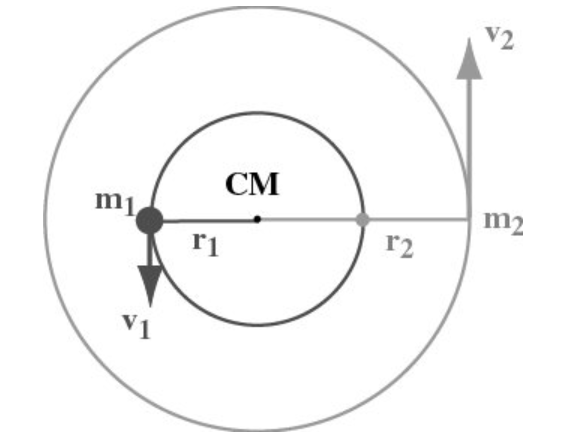
The more massive star is closer to the center of mass. The center of mass must always be between the two stars, so the stars lie on opposite sides of it.
\[m_1 r_1=m_2 r_2\]
The center of mass moves through space subject only to the external forces on the binary star system. The forces between the two stars do not affect the motion of the center of mass. For an observer at the center of mass the actual motion of the center of mass is ignored.
Since the center of mass must always be along the line joining the two stars, the stars must always be on opposite sides of the center of mass. This means that the stars orbit with the same orbital period P. In general, the period of the orbit is related to the radius, r, and the speed, v, by:
\[P=2\pi r/v\]
so:
\[v=2\pi r/P\]
Since the periods of the two stars must be the same:
\[\frac {2\pi}{P}=\frac {v_1}{r_1}=\frac{v_2}{r_2}\]
so:
\[\frac {v_1}{v_2}=\frac {r_1}{r_2}\]
but from the equation of the center of the mass:
\[\frac {r_1}{r_2}=\frac {m_2}{m_1}\]
so:
\[\frac {v_1}{v_2}=\frac {r_1}{r_2}=\frac {m_2}{m_1}\]
The distance between the two stars is r1 + r2, so the force on either star is given by Newton’s law of gravitation as:
\[F_g=G\frac{m_1m_2}{(r_1+r_2)^2}\]
Considering the star 1:
\[F_g=F_N\]
so:
\[G\frac {m_1m_2}{(r_1+r_2)^2}=m_1 .a_{r_1}\]
but:
\[a_{r_1}=\frac{v_1^2}{r_1}\]
so:
\[G\frac {m_1m_2}{(r_1+r_2)^2}=m_1 \frac {v_1^2}{r_1}\]
\[G\frac {m_2}{(r_1+r_2)^2}= \frac {v_1^2}{r_1}\]
but \(v_1=2\pi r_1/P\) and for \(R=r_1+r_2\)
\[G\frac {m_2}{R^2}= \frac {4\pi^2 r_1}{P^2}\]
\[R=r_1(1+r_2/r_1)\]
\[=r_1(1+m_1/m_2) \]
\[=(r_1/m_2 )(m_1+m_2)\]
so:
\[m_2=\frac {r_1}{R}(m_1+m_2)\]
\[G\frac {m_1+m_2}{R^3}= \frac {4\pi^2 }{P^2}\]
This equation can be used to calculate stellar masses.
Calculating The mass:
is process which includes of several steps, a parameter would be determined in each one:
- the period.
- R: If both stars are visible R can be determined.
- the sum of the masses: Once we know R and P, the equation can be used to determine the sum of the masses.
- the ratio of the masses: can be obtained, either from: 1) r1/r2, if both stars can be seen
2) v1/v2, if both Doppler shifts are observed.
Doppler shifts:
As\(v_1=\frac {2\pi r_1}{P}\) and \(v_2=\frac {2\pi r_2}{P}\)so:
\[v_1+v_2=\frac {2\pi}{P} (r_1+r_2)\]
\[v_1+v_2=\frac {2\pi}{P}R\]
\[R=\frac {P}{2\pi}(v_1+v_2)\]
substuiting in:
\[G\frac {m_1+m_2}{R^3}= \frac {4\pi^2 }{P^2}\]
So:
\[G\frac {m_1+m_2}{(v_1+v_2)^3}\ (\frac {2\pi}{P})^3= \frac {4\pi^2 }{P^2}\]
\[m_1+m_2=\frac {P}{2\pi G}(v_1+v_2)^3\]
Plane Inclination:
If a binary happens to be an eclipsing binary, then the observer is close to the plane of the orbit, and i is close to 90°. Otherwise its harder to determine i. If a circular orbit is projected at some angle on the plane of the sky it will appear elliptical.
If the orbit is inclined at an angle i, then the Doppler shifts only measure the components \(v_r=v\sin i\):
\[m_1+m_2=\frac {P}{2\pi G}(v_{1r}+v_{2r})^3/\sin^3 i\]
Mass Function:
It is often the case that only one Doppler shift can be observed. If v1 is measurable but not v2.
\[v_1+v_2=v_1(1+v_2/v_1)\]
but \(v_2/v_1=m_1/m_2\) so:
\[v_1+v_2=(m_1+m_2)\frac {v_1}{m_2}\]
substuiting this in:
\[m_1+m_2=\frac {P}{2\pi G}(v_1+v_2)^3\]
\[m_1+m_2=\frac {P}{2\pi G}(\frac {m_1+m_2}{m_2}v_1)^3\]
\[\frac {P}{2\pi G}(v_1)^3=\frac {m_2 ^3}{(m_1+m_2)^2}\]
for inclined plane:
\[\frac {P}{2\pi G}(v_{1r})^3=\frac {m_2 ^3\sin^3i}{(m_1+m_2)^2}\]
The quantity on the right-hand side of the equation is called the mass function. If only one Doppler shift was measurable, the masses can not be determined. Measuring the value of the mass function can, however, be helpful, especially when information on the masses are obtained by various spectral types through extensive statistical studies.
Total Energy: (Circular Orbits)
The energy of a binary system with circular orbits. It is the sum of the kinetic energies of the two stars plus the gravitational potential energy.
\[E=\frac12m_1v_1^2+\frac12m_2v_2^2-G\frac {m_1m_2}{R}\]
but, Centripetal acceleration gives:
\[\frac{m_1v_1^2}{r_1}=\frac{m_2v_2^2}{r_2}=G\frac{m_1m_2}{R^2}\]
so:
\(m_1v_1^2=r_1G\frac {m_1m_2}{R^2}\) and \(m_2v_2^2=r_2G\frac {m_1m_2}{R^2}\)
substuiting this:
\[E=(r_1+r_2)[\frac12G\frac{m_1m_2}{R^2}]-G\frac{m_1m_2}{R}\]
\[E=-\frac 12G\frac{m_1m_2}{R}\]
This equation resembles the equation for the total energy for an electron in its orbit:
\[E=-\frac12\frac {e^2}r\]
The negative energy means that the system is bound. This amount of energy is needed to break up the binary system. This is analogous to the binding energy of a hydrogen atom. (Binding energy of a binary system).
In a binary system, the center of mass of the two stars will be at one focus on the ellipse.
Evolution in close binaries
Close binaries
A close binary system is characterized by the proximity of two stars, wherein each star has a discernible impact on the structural characteristics of the other, resulting in mutual alterations.
Distortion
Each star's gravitational influence can significantly impact the structure of the other. This gravitational interaction leads to a distortion of the star's surface, with the companion exerting a stronger gravitational force on the near side compared to the far side. This distortion, resulting from variations in gravitational force, is referred to as a tidal effect, akin to the gravitational effects of the Sun and Moon on the Earth's ocean surface, causing tides.
Synchronization
The distortion of stars in a close binary system leads to internal dissipation of energy. The rotation of the stars causes different layers of material to interact in a fluid friction manner within the bulge. This energy loss is compensated by a reduction in both the orbital and rotational energy of the stars. Consequently, the orbits gradually circularize, and the stars become tidally synchronized, always presenting the same sides to each other. This synchronized configuration represents the system's lowest energy state, akin to the synchronized spin and orbital motion of the Moon around the Earth.
In certain scenarios within a binary system, there is a possibility for material from one star to be transferred from its surface onto the other star. This process is examined by observing the binary system from a coordinate system that rotates with the same period as the orbits.
When analyzing the energy of a particle within this system, the rotation of the coordinate system introduces an additional term alongside the gravitational potential.
This term is equal to:
\[\frac{J^2}{2mr^2}\]
where:
J is the angular momentum,
m is the mass
r is the distance
The additional term introduced by the rotation of the coordinate system can be conceptualized as the component in the potential energy responsible for the pseudo "centrifugal force" in the rotating system. Combining this term with the gravitational potential results in an effective potential suitable for describing particle motions. Surfaces of constant effective potential can be delineated, with the effective force (gravity plus "centrifugal") at any point on these surfaces being perpendicular to the surface. This analogy is similar to contour maps of gravitational potential or elevation on Earth, where gravitational force is perpendicular to contour lines, making it unnecessary to perform work when moving along an equipotential line.
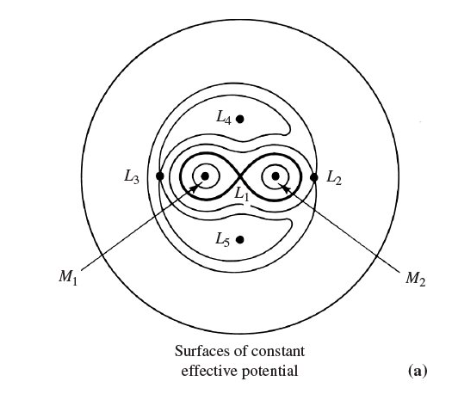
(a) from above, the intersection of surfaces of constant potential and the plane of the orbit. The heavy is the intersection of the Roche lobe and the plane of the orbit.
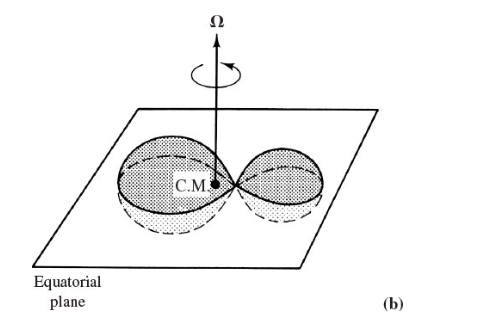
(b) A three-dimensional view of the Roche lobe. (In this case, M1 ≠ M2.)
Roche lobes
There are five points, called Lagrangian points, where the effective gravitational force is zero. These points are designated L1, L2, L3, L4, L5. The point L1 lies between the two stars, at the intersection point of the “figure eight” shaped surface. L1 is the dividing point between material being attracted to one star or the other. The two sides of the figure eight are called Roche lobes
In a fluid, equipotential surfaces must correspond to surfaces of constant pressure. Any deviation from this would create pressure differences, causing unbalanced forces that cannot be counteracted by gravitational forces, which are required to be perpendicular to the surfaces. Consequently, equipotential surfaces in a fluid must also be surfaces of constant density. This parallels the situation on Earth, where, according to the equation of hydrostatic equilibrium, pressure gradients are only permissible in the direction of the gravitational force, which is perpendicular to the potential lines.
Classification
When exploring the evolution of close binary systems, they are categorized into three classes:
(1) detached, where each star is entirely enclosed within its individual Roche lobe
(2) semidetached, where the photosphere of one star precisely occupies its portion of the Roche lobe
(3) contact binaries, where both stars are either at or exceed the Roche lobe.
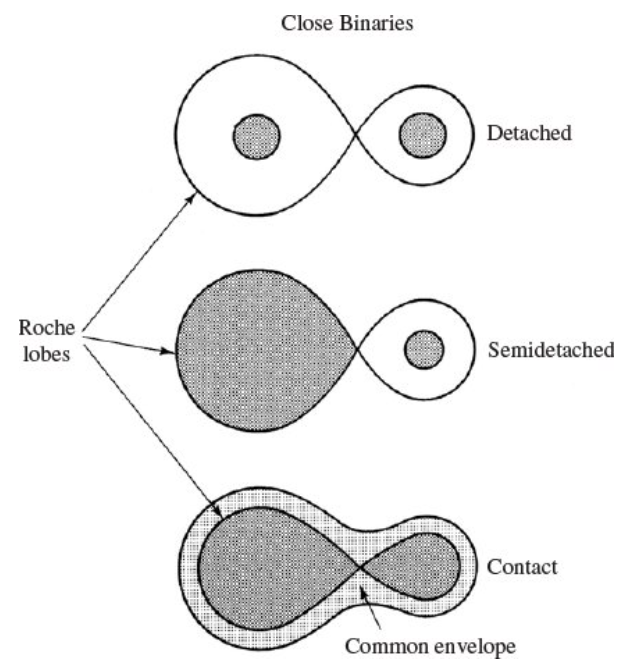
In binary systems, where approximately half of all stars are found, the presence of a companion significantly affects stellar evolution. This is especially notable in scenarios involving mass transfer in semidetached or contact binaries. The more massive star in a binary system typically evolves off the main sequence first, potentially leading to mass transfer when it becomes a red giant and fills its Roche lobe. The impact on the companion's evolution depends on its nature. As the more massive star sheds mass, its Roche lobe contracts, while the companion's Roche lobe expands, facilitating mass transfer until the stars achieve roughly equal masses. Afterward, slow mass transfer may persist. Ultimately, the star losing mass undergoes a transformation into a white dwarf or another collapsed object, such as a neutron star or black hole.
Systems with white dwarfs
In systems where the first star to evolve off the main sequence becomes a white dwarf, the subsequent evolution involves the companion undergoing its own main sequence evolution. As the companion becomes a red giant and fills its Roche lobe, mass transfer occurs in the opposite direction compared to the initial transfer. Mass now flows onto the white dwarf, but not all the infalling matter directly impacts the white dwarf. Due to angular momentum, some material goes into orbit around the white dwarf, forming an accretion disk. This disk is created because material can fall parallel to the axis of rotation but not perpendicular to it.
As material falls into the accretion disk, its potential energy decreases, leading to an increase in kinetic energy. However, only approximately half of the change in potential energy contributes to the increase in kinetic energy, as some energy is radiated away. The accretion disk plays a crucial role in this process. When the faster-moving gas collides with the accretion disk, it slows down, causing its temperature to rise. The heated gas can then emit radiation.
The energy available from the change in potential energy as mass falls in. If the mass starts at distance r1 from the white dwarf, and ends up a distance r2 from it, the luminosity is given by:
\[L\approx(\frac{dM}{dt})(\frac{GM}{r_2}- \frac{GM}{r_1})\]
\[L\approx GM\ (\frac{dM}{dt})(\frac{1}{r_2}- \frac{1}{r_1})\]
In this equation dM/dt is the rate at which mass is falling in, and M is the mass of the white dwarf. This equation represents the upper limit to the actual luminosity. That is because all of the energy gained in the infall is not converted into outgoing radiation. In fact, the formation of the accretion disk is crucial in this process. The accretion disk provides a place where the energy from the infalling material can be converted into heat. The heated disk then radiates.
Novae are observed instances where a star experiences a sudden increase in brightness by 5 to 15 magnitudes. These events, resembling the appearance of a new star, are occasionally recurrent over time scales of up to hundreds of years. Novae are associated with the ejection of mass, typically around 10-5 solar masses. The prevailing explanation attributes novae to thermonuclear explosions on the surfaces of white dwarfs, fueled by mass falling in from a companion star. The infalling material originates from the envelope of a red giant, containing hydrogen. Fusion of this hydrogen on the white dwarf's surface leads to a rapid and small-scale explosion, temporarily halting mass transfer. Subsequent resumption of mass transfer may trigger additional explosions.
Type I supernovae can be explained by mass transfer onto a white dwarf, leading to an increase in mass beyond the Chandrasekhar limit (MCH). Once the limit is exceeded, electron degeneracy can no longer support the star, resulting in a collapse. The energy released during the collapse initiates nuclear reactions, ultimately producing 56Ni through beta decay. Subsequent beta decay of 56Ni forms 56Co, which further decays to 56Fe. The light curves of type I supernovae exhibit double exponential behavior, with characteristic time scales corresponding to the two beta decays. This process is believed to contribute significantly to the production of iron in the universe. Type I supernovae display consistent peak brightness, making them reliable "standard candles" for distance measurements in distant galaxies.
The nuclear energy released in these reactions is greater than the binding energy of the white dwarf, and the star is destroyed, leaving no remnant. This explanation accounts for the light curves of type I supernovae, their spectra and luminosities, and their occurrence in what are thought to be old systems
Neutron stars in close binary systems
A neutron star and a normal star are in orbit around their common center of mass. As the normal star evolves into a red giant, it fills its Roche lobe, leading to the transfer of matter onto the neutron star. Initially, it was believed that such a system could not form, posing a challenge to its development. The issue arises from the fact that the presence of a neutron star implies a prior supernova explosion, typically from the more massive star in a binary system. This explosion ejects a significant portion of the mass, more than 50% of the original, potentially leading to an unbound system if the adjustment in orbit radius/period is too rapid. The scenario is analyzed for circular orbits, assuming stars of mass m1 and m2, an initial separation R, and circular orbit speeds:
\[\frac{m_1v_1^2}{r_1}=\frac{m_2v_2^2}{r_2}=G\frac{m_1m_2}{R^2}\]
The explosion of star 1 leaves it with a mass m, and the new energy is:
\[E=\frac12mv_1^2+\frac12m_2v_2^2-G\frac {m\ m_2}{R}\]
the value of m that makes E = 0:
\[\frac12mv_1^2+\frac12m_2v_2^2-G\frac {m\ m_2}{R}=0\]
\[mv_1^2+m_2v_2^2-2G\frac {m\ m_2}{R}=0\]
\[\frac{mv_1^2}{r_1}=\frac{m_2v_2^2}{r_2}=G\frac{m\ m_2}{R^2}\]
\[\frac{mv_1^2}{r_1}=\frac{m_2v_2^2}{r_2}\]
\[v_2^2=\frac{m}{m_2}\frac{r_2}{r_1}v_1^2\]
subsituting this:
\[mv_1^2+m_2(\frac{m}{m_2}\frac{r_2}{r_1}v_1^2)-2G\frac {m\ m_2}{R}=0\]
\[mv_1^2+mv_1^2(\frac{r_2}{r_1})-2G\frac {m\ m_2}{R}=0\]
\[v_1^2+v_1^2(\frac{r_2}{r_1})-2G\frac {m_2}{R}=0\]
...
...
\[m=m_1[\frac1{2+(m_2/m_1)}]\]
Note that for m1 being much greater than m 2 this approaches \(m_1/2\), meaning the massive star would have to lose half its mass. Note that result doesn’t change for elliptical orbits, since the equation for the energy is the same, with R replaced by the semi-major axis.
Therefore, the explosion should break up the binary system. This scenario explains the existence of “runaway stars”. These are individual stars moving through space with much higher than average speeds.
X-ray observations reveal systems in which a neutron star remains in orbit with a normal star, prompting investigations into the formation of such systems. Theoretical scenarios have been proposed to explain these observations:
- Supernova Bound Systems: Theoretical simulations suggest that specific initial conditions can result in bound systems even when the more massive star undergoes a supernova explosion. While many systems become unbound, certain combinations of parameters lead to bound configurations.
- Mass Transfer Before Supernova: Before a supernova event, the more massive star might transfer mass to the less massive star after filling its Roche lobe. Sufficient mass transfer before the explosion allows the system to remain bound.
- White Dwarf to Neutron Star Transition: Alternatively, the compact star may have initially been a white dwarf. Ongoing mass transfer from the companion could push the white dwarf's mass beyond the Chandrasekhar limit (1.44 solar masses). In such cases, electron degeneracy pressure can no longer support the star, causing it to collapse into a neutron star. This process could occur without a supernova explosion.
Note: General relativity predicts that a collapsed 1.44 solar mass white dwarf appearing as a neutron star would exert the gravitational force of a 1.3 solar mass star, raising the possibility that some stars classified as white dwarfs might actually be neutron stars.
Her X-1
In a binary system featuring a neutron star and a normal star, mass transfer from the normal star to the neutron star leads to irregular bursts of X-ray emission. Examining the case of Her X-1, a well-studied X-ray source, reveals key characteristics:
- System Details: Her X-1 is a binary system with a neutron star and a visible companion star (HZ Her) with a 1.7-day orbital period. The mass of the unseen neutron star companion is estimated to be between 0.4 and 2.2 solar masses.
- X-ray Pulses: X-rays emitted from the system pulse with a period of 1.24 seconds. The pulsation period exhibits regular changes throughout the 1.7-day cycle, suggesting a Doppler shift effect. The observed period variations are interpreted as the result of the Doppler shift, with longer periods when the source is moving away and shorter periods when it is approaching.
- Eclipses: The X-ray source experiences frequent eclipses, coinciding with the binary system's orbital period.
Note: The system's characteristics, especially the X-ray pulsations and eclipses, provide valuable insights into the dynamics and mass transfer processes within binary neutron star systems.
In a neutron star-binary system, X-ray observations of Her X-1 provide insights into its properties and potential future evolution:
- Mass Transfer: The estimated mass transfer rate from the normal star to the neutron star is approximately (10{-9} M/yr). The X-ray luminosity is around (10{37} erg/s), and the temperature is estimated at (108 K).
- X-ray Spectrum: The temperature corresponds to an X-ray frequency of (2 \times 10{18} Hz) or a wavelength of (0.14 nm). This places the emitted radiation in the X-ray part of the electromagnetic spectrum.
- Future Evolution: Theorists speculate that if the mass transfer rate increases significantly, the X-ray emission may be quenched. Outgoing X-rays could be obstructed by infalling material, leading the system to evolve into two compact objects.
- Millisecond Pulsars: Mass transfer in neutron star systems can explain the existence of millisecond pulsars with very short periods (a few milliseconds). Unlike normal pulsars, millisecond pulsars exhibit extraordinary stability, with some having (P/(dP/dt)) values as large as (10{10}) per year, indicating remarkable clock stability over time.
Mass transfer in binary systems can explain the formation and characteristics of millisecond pulsars:
- Angular Momentum Transfer: When material is transferred to the neutron star but not directed precisely at its center, it carries a significant amount of angular momentum. This leads to the formation of an accretion disk, where material orbits instead of directly impacting the neutron star's surface.
- Pulsar "Spinning Up": As material from the accretion disk moves inward and onto the pulsar, it imparts substantial angular momentum to the pulsar. This causes a rapid increase in the pulsar's rotation rate, resulting in a decrease in its period.
- Explanation for Millisecond Pulsars: The process elucidates how a normal pulsar can be transformed into a millisecond pulsar through this "spinning up" mechanism.
- Sustained High Rotation Rate: As long as mass transfer continues, the rotation rate of the millisecond pulsar can be maintained at a very high level. This phenomenon explains why the slowdown observed in millisecond pulsars is minimal compared to normal pulsars.
A notable binary system involves a radio pulsar discovered in 1974, exhibiting a periodic variation in its period. The pulsar's period changes akin to a Doppler shift, lengthening as it moves away and shortening as it approaches. This binary pulsar serves as a test for a prediction of general relativity—gravitational radiation.
Observations of this binary pulsar reveal a changing orbital period. This alteration in the orbital dynamics suggests a loss of energy, consistent with the emission of gravitational radiation from the orbiting bodies. These findings present a potential avenue for the indirect confirmation of gravitational radiation, marking a significant development in astrophysical research.
Systems with black holes
Neutron stars, supported by neutron degeneracy pressure, can collapse into a black hole if their mass exceeds 3 solar masses. Detecting stellar black holes is challenging due to the impossibility of direct observation, but their gravitational effects in binary systems, particularly through X-ray emissions, provide avenues for study. Neutron stars and black holes in binaries can emit X-rays due to infalling material.
Cyg X-1:
Cyg X-1, is a candidate binary system with its counterpart. This system provides an opportunity to study a black hole indirectly through its gravitational effects and radiation emissions. The counterpart, a spectroscopic binary exhibits brightness variations attributed to tidal effects from the unseen companion, leading to size variations during its orbit.
Doppler shift data analysis allows the determination of the mass function, estimating the unseen companion's mass. X-ray observations reveal rapid intensity variations, suggesting a small emitting region. The combination of a mass estimate exceeding 4 solar masses, along with the small size, strongly indicates that the unseen companion is likely a black hole.
The conclusion that the unseen companion is a black hole is derived from standard observational techniques, including spectrum analysis of the visible star and classical methods for studying spectroscopic binary orbits, particularly the mass function. While widely accepted, the black hole hypothesis is not unequivocal due to uncertainties in the visible star's mass, arising from assumptions and tidal distortion, and ambiguity in the orbital inclination. The possibility of a triple-star system has been considered, but searches for a third component have been unsuccessful.
Cyg X-1 was the primary stellar binary black hole candidate for a decade, prompting extensive investigations into numerous potential candidates by studying X-ray sources with identifiable optical counterparts.
LMCX-3
LMCX-3, an X-ray source, is potential candidate for a stellar binary black hole. The system, identified as a spectroscopic binary, lacks eclipses. Preliminary analyses suggested a compact object a mass range, with more detailed studies indicating it is likely greater than 6 M. Challenges include uncertainties in attributing optical light to the accretion disk rather than the visible star, but a reliable lower limit of 4 M has been established.
Nova Mon 1975:
The third candidate for a stellar binary black hole is a transient X-ray source known by various names, including Nova Mon 1975, depending on the catalog. This source is associated with optically recurrent novae. The X-ray and optical nova connections enabled a secure identification, facilitating detailed studies of the optical source.
Identified as a K5/7 dwarf, the low mass dwarf properties of this object, better understood, provided valuable insights. The K dwarf was found to be a spectroscopic binary. Analysis of the mass function established a lower limit of 3 solar masses for the compact companion, and a mass ratio analysis placed the compact object's mass between 4 and 9 solar masses.
Despite detailed studies of many objects, challenges persist in the reasoning chain, with LMCX-1 presenting difficulties due to two potential optical counterparts. Among the discussed candidates, Nova Mon 1975 stands out with arguably the strongest evidence for the existence of a black hole.
An unusual object: SS433
SS433, situated in a supernova remnant, is a binary system emitting periodic X-ray emissions, likely involving a black hole or neutron star. Optical observations reveal significant Doppler shifts, with a consistent asymmetry favoring redshifts over blueshifts. A constant 12,000 km/s offset in averaged velocities is present.
The binary features a member, potentially a black hole or neutron star, emitting jets in opposite directions within a 20° cone inclined by 80° to the line of sight. The compact object undergoes precession with a 164-day period, explaining Doppler shift variations. The 12,000 km/s offset is attributed to a transverse Doppler shift from the jet's substantial speed. X-rays originate from material falling into an accretion disk around the compact object. The binary, undergoing eclipses, allows mass estimates, with the companion's mass around 4 M, hinting at a potential black hole. Uncertainties leave room for it to be a neutron star. Ongoing theoretical work aims to understand jet collimation and the energy source propelling their high speeds.