Hogarth
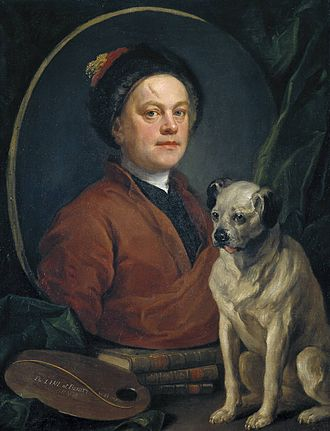
Self-portrait with his pug, Trump
Name: William Hogarth
Achievements: Appointed Sergeant-painter to the King in 1757
Born: November 10, 1697; London, England
Died: October 26, 1764; London, England
Field & Discipline: Art; Engraving; Painting
Language: English
Father: Richard Hogarth
Mother: Unknown
Siblings: Mary and Ann Hogarth
Spouse: Jane Thornhill-Hogarth
Children: None
Education: Silver-plate engraving apprenticeship
Major Work:
A Harlot’s Progress (1732)
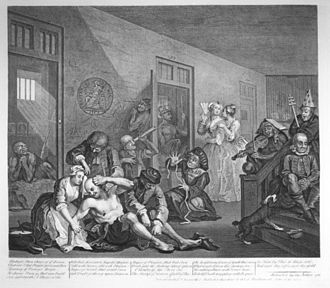
Rakes Progress (1735)
Life & Times:
Hogarth grew up in an area of London known as Grub Street that was inhabited mainly by unsuccessful writers, printers and publishers. His own father was a Latin scholar and schoolteacher who had moved to Grub Street with dreams of becoming an author of textbooks and dictionaries. Unfortunately, he was unable to make money as a writer and even served four years in a debtor’s prison.
Hogarth’s father’s failures made a lasting impression on him about the importance of financial independence. Hogarth had little interest in scholarship, and instead sought the security of a craftsman’s training. However, the family’s financial situation prevented Hogarth from apprenticing at a painter’s studio or an engraver’s workshop.
Instead, just before he turned sixteen, Hogarth started an apprenticeship with a silver-plate engraver of little distinction. By 1720 Hogarth had started his own business and was making an unsteady living as an engraver of low-priced designs for cheap novels, and other hack-work. As Hogarth’s business as an illustrator became increasingly dependant on booksellers he became determined to free himself financially from them.
By 1724 Hogarth had begun publishing and selling prints of his own satirical engravings based on current events in Britain. Hogarth adopted a subscription method, which guaranteed his income in advance whenever he published his own work.
In November of 1724 Hogarth joined Sir James Thornhill’s newly formed Free Drawing Academy. Thornhill appealed to Hogarth because he represented an affirmation of English art. Thornhill not only held the official post of Sergeant-painter to the King, but he was the first English-born artist to be knighted.
Hogarth despised what he saw as the art critic’s exclusive admiration for Renaissance masters and preference for foreign artists. Hogarth’s dislike of all things foreign created enemies for him early in his career. In particular Hogarth offended the architect [offended influential] William Kent*, who was part of a powerful clique that included the 3rd Earl of Burlington; an influential art critic and architect. Hogarth attacked their taste for Neo-Classical architecture, hinting that its Italian style indicated support for the Pope. In 1730 Kent retaliated by having several important royal commissions retracted.
Hogarth’s work was greatly influenced by English satirical writers. He was close friends with the English satirist [a pal of] Fielding* and greatly admired the satirist [admired] Jonathan Swift. He also knew [knew] Pope* , a leading poet who wrote satiric verse. Pope and Hogarth often chose the same targets, such as [satirized] Cibber* and his theatre company.
Hogarth began painting in 1728 and in the following years primarily painted small, informal group portraits, termed “conversation pieces.” These “conversations” were very successful and brought Hogarth a wealthy clientele. Hogarth’s paintings of this time owe a great debt to
[ influenced by] Watteau* and the elegant style of French Rococo art, as well as the introduction of theatrical subjects to British art. Hogarth regularly used conventions of the theatre to represent the trivialization of contemporary society.
Hogarth’s humorous engravings began to evolve into a new kind of narrative art, based on contemporary life. Hogarth abandoned portraiture for paintings that depicted the trivialization of contemporary society through tales of morality.
Utilizing a series of narrative paintings, like chapters in a book, Hogarth followed a character or group of characters through their encounter with some social evil. Hogarth’s series paintings not only ridiculed the viciousness and foolishness of society, but painted an obvious moral. Hogarth’s engravings of these paintings were enormously successful and provided him with financial and artistic independence.
Hogarth’s prints were so popular that unauthorized versions of his works were being reproduced and sold almost as fast as he created the originals. To protect himself from such piracy Hogarth helped write a proposal to include prints in the protections provided by the Copyright Act. Hogarth campaigned to win support for the proposal and it was passed by the British Parliament in 1735.
When Thornhill died in 1734, Hogarth re-established his art school as the St. Martins Lane Artists. By 1753 Hogarth had become estranged from the St. Martins Lane Artists because of their decision to set up a public academy under royal patronage. Hogarth believed this would undermine the spirit of equality he had organized the drawing academy around.
Hogarth had no further involvement with the school until 1767, by which time it was being called the Society of Artists of Great Britain. That year he contributed engravings to their exhibition catalogue and was elected to the committee, but he never exhibited with the group again.
Around 1740 Hogarth returned to portrait painting. He placed a painting of the philanthropist Captain Thomas Coran on semi-public display at the Foundling Hospital, which had been established by Coran for the benefit of orphans. Hogarth continued his connection with the charity, and in 1745 he convinced a group of fellow artists to donate works as decoration. The effort resulted in the first public exhibition of contemporary art in England.
In 1745 and 1751 Hogarth held public auctions of his work. Both were financial failures. Angered and embarrassed by the sales, he retreated into isolation. He emerged in 1753 with the publication of his most theoretical writing: The Analysis of Beauty. The book contained both practical advice on painting and criticisms of the art establishment. Though unfavorably received in England, the book was respected on the European continent. Two German editions were published in 1754 and one in Italian in 1761.
In 1762 Hogarth entered the arena of political satire with an unashamedly partisan engraving. The Times, Plate Iportrayed the [did controversial engraving of] Bute* as a lone firefighter, attempting to end the war with France, while businessmen fanned the flames and local politicians catered to them.
As a result, Hogarth’s friend and politician [attacked by] Wilkes, John* wrote a scathing essay that appeared in the London newspaper. It not only criticized Hogarth’s politics but attacked his artistry. Wilkes wrote about Hogarth in a regretful tone as if describing a once great talent that had fallen into mediocrity.
Hogarth spent the last year of his life in ill health writing autobiographical notes. He died of an aneurysm at his home.
Extra Connections:
He was influenced by the novelist [was influenced by] Samuel Richardson*.
His “conversation” paintings influenced [influenced] Gainsborough* .
He received a commission for a painting for the Theatre Royal from [commissioned by] Rich*.
His work influenced the writing of [influenced] Dickens*.
He had similar ideas as the writer [shared views with] Dr Johnson*.
He painted [painted] Charles Bridgeman* as a representation of fashionable extravagance.
He received commissions from [commissioned by] Garrick*.
A Rake’s Progress inspired [inspired] Stravinsky*’s opera, The Rake’s Progress. Igor Stravinsky's 1951 opera The Rake's Progress, with libretto by W. H. Auden
He corresponded with [corresponded with] Franklin*
Stanley Kubrick based the cinematography of his 1975 period drama film, Barry Lyndon, on several Hogarth paintings.
A rival was water-colorist Paul [a rival was] Sandby*
Assessment: Hogarth is remembered primarily for his satirical engravings of English society.
Oneliner: William Hogarth, great satirical engraver
Bibliography:
- Encyclopedia Britannica. “Hogarth, William” online. retrieved June 30, 2003. http://jlp.sjsu.edu:2051/eb/print?eu=41615.
- Bindman, David. Hogarth. New York: Oxford University Press, 1981.
- O’Connell, Sheila. “Hogarth, William” The New Grove Dictionary of Art Online ed. L. Macy http://www.groveart.com.
- Shesgreen, Sean. Hogarth and the Times-of-the-Day Tradition. Ithaca: Cornell University Press, 1983.
- Tansey, Richard G. and Fred S. Kleiner, ed. Art Through the Ages. 10th ed. New York: Harcourt Brace College Publishers, 1996.
Father: Richard Hogarth
Mother: Unknown
Siblings: Mary and Ann Hogarth
Spouse: Jane Thornhill-Hogarth
Children: None