Adams, John 2
See main node
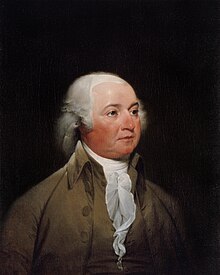
(Trumbull portrait)
John Adams, Jr. (October 30 [O.S. October 19] 1735 – July 4, 1826) was an American lawyer, author, statesman, and diplomat. He served as the second President of the United States (1797–1801), the first Vice President (1789–97),[1] and as a Founding Father was a leader of American independence from Great Britain.[2] Adams was a political theorist in the Age of Enlightenment who promoted republicanism and a strong central government.
His innovative ideas were frequently published. He was also a dedicated diarist and correspondent, particularly with his wife and key advisor Abigail.
He collaborated with his cousin, revolutionary leader Samuel Adams, but he established his own prominence prior to the American Revolution. After the Boston Massacre, despite severe local anti-British sentiment, he provided a successful though unpopular legal defense of the accused British soldiers, driven by his devotion to the right to counsel and the "protect[ion] of innocence".[3]
As a delegate from Massachusetts to the Continental Congress, Adams played a leading role in persuading Congress to declare independence. He assisted Thomas Jefferson in drafting the Declaration of Independence in 1776, and was its foremost advocate in the Congress. As a diplomat in Europe, he helped negotiate the eventual peace treaty with Great Britain, and acquired vital governmental loans from Amsterdam bankers. Adams was the primary author of the Massachusetts Constitution in 1780 which influenced American political theory, as did his earlier Thoughts on Government.
Adams' credentials as a revolutionary secured for him two terms as President George Washington's vice president (1789 to 1797) and also his own election in 1796 as the second president. In his single term as president, he encountered fierce criticism from the Jeffersonian Republicans, as well as the dominant faction in his own Federalist Party, led by his rival Alexander Hamilton. Adams signed the controversial Alien and Sedition Acts, and built up the army and navy in the face of an undeclared naval "Quasi-War" with France.
The major accomplishment of his presidency was a peaceful resolution of the conflict in the face of Hamilton's opposition. Due to his strong posture on defense, Adams is "often called the father of the American Navy".[4] He was the first U.S. president to reside in the executive mansion, now known as the White House.[5]
In 1800, Adams lost re-election to Thomas Jefferson, and retired to Massachusetts. He resumed his friendship with Jefferson upon the latter's own retirement by initiating a correspondence which lasted fourteen years.[6] He and his wife established a family of politicians, diplomats, and historians now referred to as the Adams political family. Adams was the father of John Quincy Adams, the sixth President of the United States. He died on the fiftieth anniversary of the adoption of the Declaration of Independence. Modern historians in the aggregate have ranked his administration favorably.
Contents
- 5 Conceptions of constitutional government
- 6 Vice Presidency
- 7 Presidential Election of 1796
- 8 Presidency: 1797–1801
- 13 Religious views
- 14 Biographies
- 15 See also
- 16 Notes
- 17 References
- 18 Primary sources
- 19 Further reading
- 20 External links
Early life and education
Further information: Adams political family
[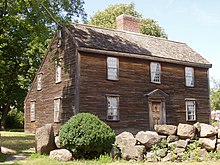 ](https://en.wikipedia.org/wiki/File:John_Adams_birthplace,_Quincy,_Massachusetts.JPG)Adams' birthplace in present-day Quincy, Massachusetts
John Adams was born on October 30, 1735 (October 19, 1735, Old Style, Julian calendar), to John Adams Sr. and Susanna Boylston. He had two younger brothers, Peter and Elihu.[5] Adams was born on the family farm in Braintree, Massachusetts.[6][b] His mother was from a leading medical family of present-day Brookline, Massachusetts. His father was a deacon in the Congregational Church, a farmer, a cordwainer, and a lieutenant in the militia.[7] Adams often praised his father and recalled their close relationship.[8] Adams's great-great-grandfather Henry Adams immigrated to Massachusetts from Braintree, Essex, England, around 1638.[7]
Adams's formal education began at age six at a dame school , conducted at a teacher's home, and was centered upon The New England Primer. He then attended Braintree Latin School under Joseph Cleverly, where studies included Latin, rhetoric, logic, and arithmetic. Adams's early education included incidents of truancy, a dislike for his master, and a desire to become a farmer. All discussion on the matter ended with his father's command that he remain in school. Deacon Adams hired a new schoolmaster named Joseph Marsh, and his son responded positively.[9] Adams later noted that "As a child I enjoyed perhaps the greatest of blessings that can be bestowed upon men – that of a mother who was anxious and capable to form the characters of her children."[10]
College education and adulthood
At age sixteen, Adams entered Harvard College in 1751, studying under Joseph Mayhew.[11] As an adult, Adams was a keen scholar, studying the works of ancient writers such as Thucydides, Plato, Cicero, and Tacitus in their original languages.[12] Though his father expected him to be a minister,[13] after his 1755 graduation with an A.B. degree, he taught school temporarily in Worcester, while pondering his permanent vocation. In the next four years, he began to seek prestige, craving "Honour or Reputation" and "more defference from [his] fellows", and was determined to be "a great Man".
He decided to become a lawyer, writing his father that he found among lawyers "noble and gallant achievements" but, among the clergy, the "pretended sanctity of some absolute dunces". He had reservations about his self-described "trumpery" and failure to share the "happiness of [his] fellow men".[14]
When the French and Indian War began in 1754, Adams, aged nineteen, felt guilty he was the first in his family not to be a militia officer. He did not go to war, but said "I longed more ardently to be a Soldier than I ever did to be a Lawyer".[15]
Law practice and marriage

Abigail Adams, a 1766 portrait of Abigail Adams by Benjamin Blyth
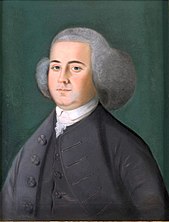 ]
John Adams, a 1766 portrait of Adams also by Blyth
In 1756, Adams began reading law under James Putnam, a leading lawyer in Worcester.[16] In 1758, he earned an A.M. from Harvard,[17] and in 1759 was admitted to the bar.[18] He developed an early habit of writing about events and impressions of men in his diary; this included James Otis Jr.'s 1761 legal argument challenging the legality of British writs of assistance, allowing the British to search a home without notice or reason. Otis's argument inspired Adams to the cause of the American colonies.[19]
In 1763, Adams explored various aspects of political theory in seven essays written for Boston newspapers. He offered them anonymously, under the pen name "Humphrey Ploughjogger", and in them ridiculed the selfish thirst for power he perceived among the Massachusetts colonial elite.[20] Adams was initially less well known than his older cousin Samuel Adams, but his influence emerged from his work as a constitutional lawyer, his analysis of history, and his dedication to republicanism. Adams often found his own irascible nature a constraint in his political career.[13]
In the late 1750s, Adams fell in love with Hannah Quincy; while they were alone, he was poised to propose but was interrupted by friends, and the moment was lost. In 1759, he met 15-year-old Abigail Smith, his third cousin,[21] through his friend Richard Cranch, who was courting Abigail's older sister. Adams initially was not impressed with Abigail and her two sisters, writing that they were not "fond, nor frank, nor candid".[22]
In time, he grew close to Abigail and they were married on October 25, 1764, despite the opposition of Abigail's mother. They shared a love of books and proved honest in their praise and criticism of each other. After his father's death in 1761, Adams had inherited a 9+1⁄2-acre (3.8 ha) farm and a house where they lived until 1783.[23][24] John and Abigail had six children: Abigail "Nabby" in 1765,[25] future president John Quincy Adams in 1767,[26] Susanna in 1768, Charles in 1770, Thomas in 1772,[27] and Elizabeth in 1777.[28] Susanna died when she was one year old,[27] while Elizabeth was stillborn.[28] All three of his sons became lawyers. Charles and Thomas were unsuccessful, became alcoholics, and died before old age, while John Quincy excelled and launched a career in politics.[29]
Career before the Revolution
Opponent of Stamp Act
Further information: Stamp Act
Adams rose to prominence leading widespread opposition to the Stamp Act of 1765. The Act was imposed by the British Parliament without consulting the American legislatures. It required payment of a direct tax by the colonies for stamped documents,[30][31] and was designed to pay for the costs of Britain's war with France. Power of enforcement was given to British vice admiralty courts, rather than common law courts.[32][31] These Admiralty courts acted without juries and were greatly disliked.[30] The Act was despised for both its monetary cost and implementation without colonial consent, and encountered violent resistance, preventing its enforcement.[32]
Adams authored the "Braintree Instructions" in 1765, in the form of a letter sent to the representatives of Braintree in the Massachusetts legislature. In it, he explained that the Act should be opposed since it denied two fundamental rights guaranteed to all Englishmen (and which all free men deserved): rights to be taxed only by consent and to be tried by a jury of one's peers. The instructions were a succinct and forthright defense of colonial rights and liberties, and served as a model for other towns' instructions.[33]
...
Counsel for the British: Boston Massacre
Further information: Boston Massacre
 Boston Massacre of 1770, an 1878 portrait by Alonzo Chappel depicting the Boston Massacre
Britain's passage of the Townshend Acts in 1767 revived tensions, and an increase in mob violence led the British to dispatch more troops to the colonies.[41] On March 5, 1770, when a lone British sentry was accosted by a mob, eight of his fellow soldiers reinforced him, and the crowd around them grew to several hundred. The soldiers were struck with snowballs, ice, and stones, and in the chaos the soldiers opened fire, killing five civilians, bringing about the infamous Boston Massacre. The accused soldiers were arrested on charges of murder. When no other attorneys would come to their defense, Adams was impelled to do so despite the risk to his reputation. He believed no person should be denied the right to counsel and a fair trial. The trials were delayed so that passions could cool.[42]
The week-long trial of the commander, Captain Thomas Preston, began on October 24 and ended in his acquittal, because it was impossible to prove that he had ordered his soldiers to fire.[43] The remaining soldiers were tried in December when Adams made his famed argument regarding jury decisions: "Facts are stubborn things; and whatever may be our wishes, our inclinations, or the dictates of our passion, they cannot alter the state of facts and evidence."[44] Adams won an acquittal for six of the soldiers. Two, who had fired directly into the crowd, were convicted of manslaughter. Adams was paid a small sum by his clients.[23]
According to biographer John E. Ferling, during jury selection Adams "expertly exercised his right to challenge individual jurors and contrived what amounted to a packed jury. Not only were several jurors closely tied through business arrangements to the British army, but five ultimately became Loyalist exiles." While Adams's defense was helped by a weak prosecution, he also "performed brilliantly."[45] Ferling surmises that Adams was encouraged to take the case in exchange for political office; one of Boston's seats opened three months later in the Massachusetts legislature, and Adams was the town's choice to fill the vacancy.[46]
The prosperity of his law practice increased from this exposure, as did the demands on his time. In 1771, Adams moved his family to Braintree, Massachusetts, but kept his office in Boston. Adams noted on the day of the family's move, "Now my family is away, I feel no Inclination at all, no Temptation, to be any where but at my Office." After some time in the capital, he became disenchanted with the rural and "vulgar" Braintree as a home for his family – in August 1772, he moved them back to Boston. He purchased a large brick house on Queen Street, not far from his office.[47] In 1774, Adams and Abigail returned the family to the farm due to the increasingly unstable situation in Boston, and Braintree remained their permanent Massachusetts home.[48]
American Revolution
Adams, who had been among the more conservative of the Founding Fathers, persistently held that while British actions against the colonies had been wrong and misguided, open insurrection was unwarranted and peaceful petition with the ultimate view of remaining part of Great Britain was a better alternative.[49] His ideas began to change around 1772, as the British Crown assumed payment of the salaries of Governor Thomas Hutchinson and his judges instead of the Massachusetts legislature. Adams wrote in the Gazette that these measures would destroy judicial independence and place the colonial government in closer subjugation to the Crown. After discontent among members of the legislature, Hutchinson delivered a speech warning that Parliament's powers over the colonies were absolute and that any resistance was illegal. John Adams, Samuel, and Joseph Hawley drafted a resolution adopted by the House of Representatives threatening independence as an alternative to tyranny. The resolution argued that the colonists had never been under the sovereignty of Parliament. Their original charter, as well as their allegiance, was exclusive to the King.[50]
The Boston Tea Party, a historic demonstration against the Tea Act and the British East India Company's tea monopoly over American merchants, took place on December 16, 1773. Protestors demolished 342 chests of tea worth about ten thousand pounds on the British schooner Dartmouth, anchored in Boston harbor. The Dartmouth owners briefly retained Adams as legal counsel regarding their liability for the destroyed shipment. Adams applauded the destruction of the tea, calling it the "grandest Event" in the history of the colonial protest movement,[51] and writing in his diary that the dutied tea's destruction was an "absolutely and indispensably" necessary action.[52]
Continental Congress
Member of Continental Congress
[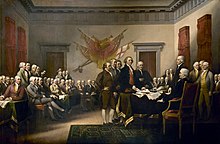 ](https://en.wikipedia.org/wiki/File:Declaration_of_Independence_%281819%29,_by_John_Trumbull.jpg)John Trumbull's Declaration of Independence depicting the Committee of Five presenting its draft of the Declaration to the Congress in Philadelphia; Adams appears in the center with his hand on his hip.
In 1774, at the instigation of Samuel Adams, the First Continental Congress was convened in response to the Intolerable Acts, a series of deeply unpopular measures intended to punish Massachusetts, centralize authority in Britain, and prevent rebellion in other colonies. Four delegates were chosen by the Massachusetts legislature, including John Adams, who agreed to attend,[53] despite an emotional plea from his friend, Attorney General Jonathan Sewall, not to.[54]
Shortly after he arrived in Philadelphia, Adams was placed on the 23-member Grand Committee tasked with drafting a letter of grievances to King George III. The members of the committee soon split into conservative and radical factions.[55] Although the Massachusetts delegation was largely passive, Adams criticized conservatives such as Joseph Galloway, James Duane, and Peter Oliver who advocated a conciliatory policy towards the British or felt that the colonies had a duty to remain loyal to Britain, although his views at the time did align with those of conservative John Dickinson. Adams sought the repeal of objectionable policies, but at this early stage he continued to see benefits in maintaining the ties with Britain.[56] He renewed his push for the right to a jury trial.[57] He complained of what he considered the pretentiousness of the other delegates, writing to Abigail, "I believe if it was moved and seconded that We should come to a Resolution that Three and two make five We should be entertained with Logick and Rhetorick, Law, History, Politicks and Mathematicks, concerning the Subject for two whole Days, and then We should pass the Resolution unanimously in the Affirmative."[58] Adams ultimately helped engineer a compromise between the conservatives and the radicals.[59] The Congress disbanded in October after sending the final petition to the King and showing its displeasure with the Intolerable Acts by endorsing the Suffolk Resolves.[60]
Adams's absence from home was hard on Abigail, who was left alone to care for the family. She still encouraged her husband in his task, writing: "You cannot be, I know, nor do I wish to see you an inactive Spectator, but if the Sword be drawn I bid adieu to all domestick felicity, and look forward to that Country where there is neither wars nor rumors of War in a firm belief that thro the mercy of its King we shall both rejoice there together."[61]
News of the opening hostilities with the British at the Battles of Lexington and Concord made Adams hope that independence would soon become a reality. Three days after the battle, he rode into a militia camp and, while reflecting positively on the high spirits of the men, was distressed by their poor condition and lack of discipline.[62] A month later, Adams returned to Philadelphia for the Second Continental Congress as the leader of the Massachusetts delegation.[63] He moved cautiously at first, noting that the Congress was divided between Loyalists, those favoring independence, and those hesitant to take any position.[64] He became convinced that Congress was moving in the proper direction – away from Great Britain. Publicly, Adams supported "reconciliation if practicable," but privately agreed with Benjamin Franklin's confidential observation that independence was inevitable.[65]
In June 1775, with a view of promoting union among the colonies against Great Britain, he nominated George Washington of Virginia as commander-in-chief of the army then assembled around Boston.[66] He praised Washington's "skill and experience" as well as his "excellent universal character."[67] Adams opposed various attempts, including the Olive Branch Petition, aimed at trying to find peace between the colonies and Great Britain.[68] Invoking the already-long list of British actions against the colonies, he wrote, "In my opinion Powder and Artillery are the most efficacious, Sure, and infallibly conciliatory Measures We can adopt."[69] After his failure to prevent the petition from being enacted, he wrote a private letter derisively referring to Dickinson as a "piddling genius." The letter was intercepted and published in Loyalist newspapers. The well-respected Dickinson refused to greet Adams and he was for a time largely ostracized.[70] Ferling writes, "By the fall of 1775 no one in Congress labored more ardently than Adams to hasten the day when America would be separate from Great Britain."[65] In October 1775, Adams was appointed the chief judge of the Massachusetts Superior Court, but he never served, and resigned in February 1777.[66] In response to queries from other delegates, Adams wrote the 1776 pamphlet Thoughts on Government, which laid out an influential framework for republican constitutions.[71]
Independence
 The Assembly Room at Independence Hall in Philadelphia, where the Second Continental Congress adopted the Declaration of Independence.
Throughout the first half of 1776, Adams grew increasingly impatient with what he perceived to be the slow pace of declaring independence.[72] He kept busy on the floor of the Second Continental Congress in Philadelphia, helping push through a plan to outfit armed ships to launch raids on enemy vessels. Later in the year, he drafted the first set of regulations to govern the provisional navy.[73] Adams drafted the preamble to the Lee Resolution of colleague Richard Henry Lee.[74] He developed a rapport with delegate Thomas Jefferson of Virginia, who had been slower to support independence but by early 1776 agreed that it was necessary.[75] On June 7, 1776, Adams seconded the Lee Resolution, which stated that the colonies were "free and independent states."[76] ....
Diplomatic service
Main article: Diplomacy of John Adams
Commissioner to France
Adams advocated in Congress that independence was necessary to establish trade, and conversely, trade was essential for the attainment of independence; he specifically urged negotiation of a commercial treaty with France. He was then appointed, along with Franklin, Dickinson, Benjamin Harrison from Virginia, Robert Morris from Pennsylvania, "to prepare a plan of treaties to be proposed to foreign powers." While Jefferson was laboring over the Declaration of Independence, Adams worked on the Model Treaty, which authorized a commercial agreement with France but contained no provisions for formal recognition or military assistance. The treaty adhered to the provision that "free ships make free goods," allowing neutral nations to trade reciprocally while exempting an agreed-upon list of contraband. By late 1777, America's finances were in tatters, and that September a British army had defeated General Washington and captured Philadelphia. More Americans came to determine that mere commercial ties between the U.S. and France would not be enough, and that military assistance would be needed. The defeat of the British at Saratoga was expected to help induce France to agree to an alliance.[96]
In November 1777, Adams learned that he was to be named commissioner to France, replacing Silas Deane and joining Franklin and Arthur Lee in Paris to negotiate an alliance with the hesitant French. James Lovell invoked Adams's "inflexible integrity" and the need to have a youthful man who could counterbalance Franklin's advanced age. On November 27, Adams accepted, wasting no time. Abigail was left in Massachusetts to manage their home, but it was agreed that 10-year-old John Quincy would go with Adams, for the experience was "of inestimable value" to his maturation.[97] On February 17, 1778, Adams set sail aboard the frigate Boston, commanded by Captain Samuel Tucker.[98] The trip was stormy and treacherous. Lightning injured 19 sailors and killed one. The ship was pursued by several British vessels, with Adams taking up arms to help capture one. A cannon malfunction killed one of the crew and injured five others. On April 1, the Boston arrived in France, where Adams learned that France had agreed to an alliance with the United States on February 6.[99] Adams was annoyed by the other two commissioners: Lee, whom he thought paranoid and cynical, and the popular and influential Franklin, whom he found lethargic and overly deferential to the French.[100] He assumed a less visible role but helped manage the delegation's finances and record-keeping.[101] Frustrated by the perceived lack of commitment on the part of the French, Adams wrote a letter to French foreign minister Vergennes in December, arguing for French naval support in North America. Franklin toned down the letter, but Vergennes still ignored it.[102] In September 1778, Congress increased Franklin's powers by naming him minister plenipotentiary to France while Lee was sent to Spain. Adams received no instructions. Frustrated by the apparent slight, he departed France with his son John Quincy on March 8, 1779.[103] On August 2, they arrived in Braintree.[104]
...
Vice presidency (1789–1797)
Election
Main article: 1788–1789 United States presidential election
On June 17, 1788, Adams arrived back in Massachusetts to a triumphant welcome. He returned to farming life in the months after. The nation's first presidential election was soon to take place. Because George Washington was widely expected to win the presidency, many felt that the vice presidency should go to a northerner. Although he made no public comments on the matter, Adams was the primary contender.[137] Each state's presidential electors gathered on February 4, 1789, to cast their two votes for the president. The person with the most votes would be president and the second would become vice president.[138] Adams received 34 electoral college votes in the election, second place behind Washington, who was a unanimous choice with 69 votes. As a result, Washington became the nation's first president, and Adams became its first vice president. Adams finished well ahead of all others except Washington, but was still offended by Washington receiving more than twice as many votes.[139] In an effort to ensure that Adams did not accidentally become president and that Washington would have an overwhelming victory, Alexander Hamilton convinced at least 7 of the 69 electors not to cast their vote for Adams. After finding out about the manipulation but not Hamilton's role in it, Adams wrote to Benjamin Rush that his election was "a curse rather than a blessing,"[139][140]
Although his term started on March 4, 1789, Adams did not begin serving as Vice President of the United States until April 21, because he did not arrive in New York in time.[141][142]
Tenure
[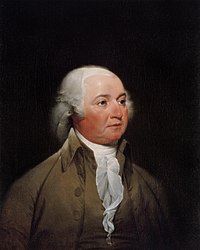 ](https://en.wikipedia.org/wiki/File:Official_Presidential_portrait_of_John_Adams_%28by_John_Trumbull,_circa_1792%29.jpg)A 1793 portrait of Adams by John Trumbull
The sole constitutionally prescribed responsibility of the vice president is to preside over the U.S. Senate, where the vice president was empowered to cast a tie-breaking vote.[143] Early in his term, Adams became deeply involved in a lengthy Senate controversy over the official titles for the president and executive officers of the new government. Although the House agreed that the president should be addressed simply as "George Washington, President of the United States", the Senate debated the issue at some length. Adams favored the adoption of the style of Highness (as well as the title of Protector of Their [the United States'] Liberties) for the president.[144] Some senators favored a variant of Highness or the lesser Excellency.[145] Anti-federalists in the Senate objected to the monarchical sound of them all; Jefferson described them as "superlatively ridiculous."[146] They argued that these "distinctions," as Adams called them, violated the Constitution's prohibition on titles of nobility. Adams said that the distinctions were necessary because the highest office of the United States must be marked with "dignity and splendor". He was widely derided for his combative nature and stubbornness, especially as he actively debated and lectured the senators. "For forty minutes he harangued us from the chair," wrote Senator William Maclay of Pennsylvania. Maclay became Adams's fiercest opponent and repeatedly expressed personal contempt for him in both public and private. He likened Adams to "a monkey just put into breeches."[147] Ralph Izard suggested that Adams be referred to by the title "His Rotundity," a joke which soon became popular.[148] On May 14, 1789, the Senate decided that the title of "Mr. President" would be used.[149] Privately, Adams conceded that his vice presidency had begun poorly and that perhaps he had been out of the country too long to know the sentiment of the people. Washington quietly expressed his displeasure with the fuss.[150]
 Portrait of George Washington by Gilbert Stuart, 1795. Washington rarely consulted Vice President Adams, who often felt marginalized and overshadowed by Washington's prestige.
As vice president, Adams largely sided with the Washington administration and the emerging Federalist Party. He supported Washington's policies against opposition from anti-Federalist Republicans.[151] He cast 29 tie-breaking votes, and is one of only three vice presidents who have cast more than 20 during their tenure, in addition to John C. Calhoun (31) and Kamala Harris (29).[152] He voted against a bill sponsored by Maclay that would have required Senate consent for the removal of executive branch officials who had been confirmed by the Senate.[153] In 1790, Jefferson, James Madison, and Hamilton struck a bargain guaranteeing Republican support for Hamilton's debt assumption plan in exchange for the capital being temporarily moved from New York to Philadelphia, and then to a permanent site on the Potomac River to placate Southerners. In the Senate, Adams cast a tie-breaking vote against a last-minute motion to keep the capital in New York.[154]
Adams played a minor role in politics as vice president. He attended few cabinet meetings, and the President sought his counsel infrequently.[143] While Adams brought energy and dedication to the office,[155] by mid-1789 he had already found it "not quite adapted to my character ... too inactive, and mechanical."[156] He wrote, "My country has in its wisdom contrived for me the most insignificant office that ever the invention of man contrived or his imagination conceived."[157] Adams's initial behavior in the Senate made him a target for critics of the Washington administration. Toward the end of his first term, he grew accustomed to assuming a marginal role, and rarely intervened in debate.[158] Adams never questioned Washington's courage or patriotism, but Washington did join Franklin and others as the object of Adams's ire or envy. "The History of our Revolution will be one continued lie," Adams declared. "The essence of the whole will be that Dr. Franklin's electrical Rod smote the Earth and out sprung General Washington. That Franklin electrified him with his Rod – and henceforth these two conducted all the Policy, Negotiations, Legislatures and War."[159] Adams won reelection with little difficulty in 1792 with 77 votes. His strongest challenger, George Clinton, had 50.[160]
On July 14, 1789, the French Revolution began. Republicans were jubilant. Adams at first expressed cautious optimism, but soon began denouncing the revolutionaries as barbarous and tyrannical.[161] Washington eventually consulted Adams more often, but not until near the end of his administration, by which point distinguished cabinet members Hamilton and Jefferson had resigned.[162] The British had been raiding American trading vessels, and John Jay was sent to London to negotiate an end to hostilities. When he returned in 1795 with a peace treaty on terms unfavorable to the United States, Adams urged Washington to sign it to prevent war. Washington chose to do so, igniting protests and riots. He was accused of surrendering American honor to a tyrannical monarchy and of turning his back on the French Republic.[163] John Adams predicted in a letter to Abigail that ratification would deeply divide the nation.[164]
Election of 1796
Main article: 1796 United States presidential election
....
Adams won the presidency by a narrow margin, receiving 71 electoral votes to 68 for Jefferson, who became the vice president; Pinckney finished in third with 59 votes, and Burr came in fourth with 30. The balance of the Electoral College votes were dispersed among nine other candidates.[179] This is the only election to date in which a president and vice president were elected from opposing tickets.[180]
Presidency (1797–1801)
Main articles: Presidency of John Adams and Diplomacy of John Adams
 President's House in Philadelphia, which was then the national capital; Adams occupied this Philadelphia mansion from March 1797 to May 1800.
Inauguration
Adams was sworn into office as the nation's second president on March 4, 1797. He followed Washington's lead in using the presidency to exemplify republican values and civic virtue, and his service was free of scandal.[181] Adams spent much of his term at his Massachusetts home Peacefield, preferring the quietness of domestic life to business at the capital. He ignored the political patronage and office-seeking which other officeholders utilized.[182]
Historians debate the wisdom of his decision to retain Washington's cabinet in light of its loyalty to Hamilton. The "Hamiltonians who surround him," Jefferson soon remarked, "are only a little less hostile to him than to me."[183] Although aware of Hamilton's influence, Adams was convinced that their retention ensured a smoother succession.[184] Adams maintained the economic programs of Hamilton, who regularly consulted with key cabinet members, especially the powerful Treasury Secretary, Oliver Wolcott Jr.[185] Adams was in other respects quite independent of his cabinet, often making decisions despite opposition from it.[186] Hamilton had grown accustomed to being regularly consulted by Washington. Shortly after Adams was inaugurated, Hamilton sent him a detailed letter filled with policy suggestions for the new administration. Adams dismissively ignored it.[187]
Failed peace commission and XYZ affair
Main article: XYZ Affair
[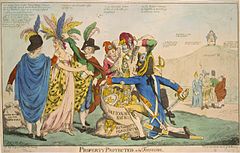 ](https://en.wikipedia.org/wiki/File:Property_protected_%C3%A0_la_fran%C3%A7oise.jpg)A 1798 political cartoon's depiction of the XYZ Affair with America as a female being plundered by Frenchmen
Historian Joseph Ellis writes that "[t]he Adams presidency was destined to be dominated by a single question of American policy to an extent seldom if ever encountered by any succeeding occupant of the office." That question was whether to make war with France or find peace.[188] In Europe, Britain and France were at war as a result of the French Revolution. Hamilton and the Federalists strongly favored the British monarchy against what they denounced as the political radicalism and anti-religious frenzy of the French Revolution. Jefferson and the Republicans, with their firm opposition to monarchy, strongly supported the French overthrowing their king.[189] The French had supported Jefferson for president in 1796 and became belligerent at his loss.[190] Adams continued Washington's policy of staying out of the war. Because of the Jay Treaty, the French saw America as Britain's junior partner and began seizing American merchant ships that were trading with the British. Most Americans were still pro-French due to France's assistance during the Revolution, the perceived humiliation of the Jay Treaty, and their desire to support a republic against the British monarchy, and would not tolerate war with France.[191]
On May 16, 1797, Adams gave a speech to the House and Senate in which he called for increasing defense capabilities in case of war with France.[192] He announced that he would send a peace commission to France but simultaneously called for a military buildup to counter any potential French threat. The speech was well received by the Federalists. Adams was depicted as an eagle holding an olive branch in one talon and the "emblems of defense" in the other. The Republicans were outraged, for Adams not only had failed to express support for the cause of the French Republic but appeared to be calling for war against it.[193]
Sentiments changed with the XYZ Affair. The peace commission that Adams appointed consisted of John Marshall, Charles Cotesworth Pinckney and Elbridge Gerry.[194] Jefferson met four times with Joseph Letombe, the French consul in Philadelphia. Letombe wrote to Paris stating that Jefferson had told him that it was in France's best interest to treat the American ministers civilly but "then drag out the negotiations at length" to arrive at most favorable solution. According to Letombe, Jefferson called Adams "vain, suspicious, and stubborn."[195] When the envoys arrived in October, they were kept waiting for several days, and then granted only a 15-minute meeting with French Foreign Minister Talleyrand. The diplomats were then met by three of Talleyrand's agents. The French emissaries (later code-named, X, Y, and Z) refused to conduct negotiations unless the United States paid enormous bribes, one to Talleyrand personally, and another to the Republic of France.[194] Supposedly this was to make up for offenses given to France by Adams in his speech.[196] The Americans refused to negotiate on such terms.[197] Marshall and Pinckney returned home, while Gerry remained.[198]
News of the disastrous peace mission arrived in the form of a memorandum from Marshall on March 4, 1798. Adams, not wanting to incite violent impulses among the populace, announced that the mission had failed without providing details.[199] He also sent a message to Congress asking for a renewal of the nation's defenses. The Republicans frustrated the President's defense measures. Suspecting that he might be hiding material favorable to France, Republicans in the House, with the support of Federalists who had heard rumors of what was contained in the messages, voted overwhelmingly to demand that Adams release the papers. Once they were released, the Republicans, according to Abigail, were "struck dumb."[200] Benjamin Franklin Bache, editor of the Philadelphia Aurora, blamed Adams's aggression for the disaster. Among the general public, the affair substantially weakened popular American support of France. Adams reached the height of his popularity as many in the country called for full-scale war against the French.[201]
Alien and Sedition Acts
Main article: Alien and Sedition Acts
 Thomas Jefferson, Adams's vice president, attempted to undermine many of his actions as president and eventually defeated him for reelection in the 1800 presidential election.
Despite the XYZ Affair, Republican opposition persisted. Federalists accused the French and their associated immigrants of provoking civil unrest. In an attempt to quell the outcry, the Federalists introduced, and the Congress passed, a series of laws collectively referred to as the Alien and Sedition Acts, which were signed by Adams in June 1798.[202] Congress specifically passed four measures – the Naturalization Act, the Alien Friends Act, the Alien Enemies Act and the Sedition Act. All came within a period of two weeks, in what Jefferson called an "unguarded passion." The Alien Friends Act, Alien Enemies Act, and Naturalization Acts targeted immigrants, specifically French, by giving the president greater deportation authority and increasing citizenship requirements. The Sedition Act made it a crime to publish "false, scandalous, and malicious writing" against the government or its officials.[203] Adams had not promoted any of these acts, but was urged to sign them by his wife and cabinet. He eventually agreed and signed the bills into law.[204]
...
Election of 1800
Main article: 1800 United States presidential election
 The 1800 United States presidential election results in which Adams was defeated by Thomas Jefferson
With the Federalist Party deeply split over his negotiations with France, and the opposition Republican Party enraged over the Alien and Sedition Acts and the expansion of the military, Adams faced a daunting reelection campaign in 1800.[169] The Federalist congressmen caucused in the spring of 1800 and nominated Adams and Charles Cotesworth Pinckney. The Republicans nominated Jefferson and Burr, their candidates in the previous election.[250]
The campaign was bitter and characterized by malicious insults by partisan presses on both sides. Federalists claimed that the Republicans were the enemies of "all who love order, peace, virtue, and religion." They were said to be libertines and dangerous radicals who favored states' rights over the Union and would instigate anarchy and civil war. Jefferson's rumored affairs with slaves were used against him. Republicans in turn accused Federalists of subverting republican principles through punitive federal laws and of favoring Britain and the other coalition countries in their war with France to promote aristocratic, anti-republican values. Jefferson was portrayed as an apostle of liberty and man of the people, while Adams was labelled a monarchist. He was accused of insanity and marital infidelity.[251] James T. Callender, a Republican propagandist secretly financed by Jefferson, degraded Adams's character and accused him of attempting to make war with France. Callender was arrested and jailed under the Sedition Act, which only further inflamed Republican passions.[252]
Opposition from the Federalist Party was at times equally intense. Some, including Pickering, accused Adams of colluding with Jefferson so that he would end up either president or vice president.[253] Hamilton was hard at work, attempting to sabotage the President's reelection. Planning an indictment of Adams's character, he requested and received private documents from both the ousted cabinet secretaries and Wolcott.[254] The letter was intended for only a few Federalist electors. Upon seeing a draft, several Federalists urged Hamilton not to send it. Wolcott wrote that "the poor old man" could do himself in without Hamilton's assistance. Hamilton did not heed their advice.[255] On October 24, he sent a pamphlet strongly attacking Adams's policies and character. Hamilton denounced the "precipitate nomination" of Murray, the pardoning of Fries, and the firing of Pickering. He vilified the President's "disgusting egotism" and "ungovernable temper." Adams, he concluded, was "emotionally unstable, given to impulsive and irrational decisions, unable to coexist with his closest advisers, and generally unfit to be president."[232] Strangely, it ended by saying that the electors should support Adams and Pinckney equally.[256] Thanks to Burr, who had covertly obtained a copy, the pamphlet became public knowledge and was distributed throughout the country by jubilant Republicans.[257] The pamphlet ended Hamilton's political career and helped ensure Adams's already-likely defeat.[256]
When the electoral votes were counted, Adams finished in third place with 65 votes, and Pinckney came in fourth with 64 votes. Jefferson and Burr tied for first place with 73 votes each. Because of the tie, the election devolved upon the House of Representatives, with each state having one vote and a supermajority required for victory. On February 17, 1801 – on the 36th ballot – Jefferson was elected by a vote of 10 to 4 (two states abstained).[169][179] It is noteworthy that Hamilton's scheme, although it made the Federalists appear divided and therefore helped Jefferson win, failed in its overall attempt to woo Federalist electors away from Adams.[258][d]
To compound the agony of his defeat, Adams's son Charles, a long-time alcoholic, died on November 30. Anxious to rejoin Abigail, who had already left for Massachusetts, Adams departed the White House in the predawn hours of March 4, 1801, and did not attend Jefferson's inauguration.[261][262] Including him, only five out-going presidents (having served a full term) have not attended their successors' inaugurations.[263] The complications arising out of the 1796 and 1800 elections prompted Congress and the states to refine the process whereby the Electoral College elects a president and a vice president through the 12th Amendment, which became a part of the Constitution in 1804.[264]
...
Post-presidency (1801–1826)
Initial years
Adams resumed farming at Peacefield in Quincy, Massachusetts and also began work on an autobiography. The work had numerous gaps and was eventually abandoned and left unedited.[270] Most of Adams's attention was focused on farm work.[271] He regularly worked around the farm, but mostly left manual labor to hired hands.[272] His frugal lifestyle and presidential salary had left him with a considerable fortune by 1801. In 1803, Bird, Savage & Bird, the bank holding his cash reserves of about $13,000, collapsed.[273] John Quincy resolved the crisis by buying his properties in Weymouth and Quincy, including Peacefield, for $12,800.[271] During his first four years of retirement, Adams made little effort to contact others, but eventually resumed contact with old acquaintances such as Benjamin Waterhouse and Benjamin Rush.[274]
Adams generally stayed quiet on public matters. He did not publicly denounce Jefferson's actions as president, believing that "instead of opposing Systematically any Administration, running down their Characters and opposing all their Measures right or wrong, We ought to Support every Administration as far as We can in Justice."[275][276] When a disgruntled James Callender, angry at not being appointed to an office, turned on the President by revealing the Sally Hemings affair, Adams said nothing.[277] John Quincy was elected to the Senate in 1803. Shortly thereafter, both he and his father crossed party lines to support Jefferson's Louisiana Purchase.[278] The only major political incident involving the elder Adams during the Jefferson years was a dispute with Mercy Otis Warren in 1806. Warren, an old friend, had written a history of the American Revolution attacking Adams for his "partiality for monarchy" and "pride of talents and much ambition." A tempestuous correspondence ensued between her and Adams. In time, their friendship healed.[279] Adams did privately criticize the President over his Embargo Act,[276] despite the fact that John Quincy voted for it.[280] John Quincy resigned from the Senate in 1808 after the Federalist-controlled State Senate refused to nominate him for a second term. After the Federalists denounced John Quincy as no longer being of their party, Adams wrote to him that he himself had long since "abdicated and disclaimed the name and character and attributes of that sect."[4]
After Jefferson's retirement from public life in 1809, Adams became more vocal. He published a three-year marathon of letters in the Boston Patriot newspaper, refuting line-by-line Hamilton's 1800 pamphlet. The initial piece was written shortly after his return from Peacefield and "had gathered dust for eight years." Adams had decided to shelve it over fears that it could negatively impact John Quincy should he ever seek office.
Although Hamilton had died in 1804 in a duel with Aaron Burr, Adams felt the need to vindicate his character against his charges. With his son having broken from the Federalist Party and joined the Republicans, he felt he could safely do so without threatening his political career.[281] Adams supported the War of 1812. Having worried over the rise of sectionalism, he celebrated the growth of a "national character" that accompanied it.[282] Adams supported James Madison for reelection to the presidency in 1812.[283]
Daughter Abigail ("Nabby") was married to William Stephens Smith, but she returned to her parents' home after the failure of the marriage; she died of breast cancer in 1813.[284]
Correspondence with Jefferson
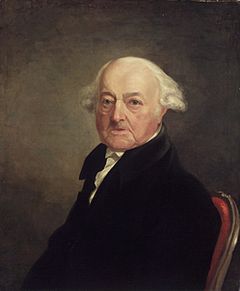 ])John Adams, a circa 1816 portrait by Samuel Morse
In early 1801, Adams sent Thomas Jefferson a brief note after returning to Quincy wishing him a happy and prosperous presidency. Jefferson failed to respond, and they did not speak again for nearly 12 years. In 1804, Abigail, unbeknownst to her husband, wrote to Jefferson to express her condolences upon the death of his daughter Polly, who had stayed with the Adamses in London in 1787. This initiated a brief correspondence between the two which quickly descended into political rancor. Jefferson terminated it by not replying to Abigail's fourth letter. Aside from that, by 1812 there had been no communication between Monticello, the home of Jefferson, and Peacefield since Adams left office.[285]
In early 1812, Adams reconciled with Jefferson. The previous year had been tragic for Adams; his brother-in-law and friend Richard Cranch had died along with his widow Mary, and Nabby had been diagnosed with breast cancer. These events mellowed Adams and caused him to soften his outlook.[281]
Their mutual friend Benjamin Rush, a fellow signer of the Declaration of Independence who had been corresponding with both, encouraged them to reach out to each other. On New Year's Day, Adams sent a brief, friendly note to Jefferson to accompany a two-volume collection of lectures on rhetoric by John Quincy Adams. Jefferson replied immediately with a cordial letter, and the two men revived their friendship, which they sustained by mail.
The correspondence that they resumed in 1812 lasted the rest of their lives, and has been hailed as among their great legacies of American literature. Their letters represent an insight into both the period and the minds of the two revolutionary leaders and presidents. The missives lasted fourteen years, and consisted of 158 letters – 109 from Adams and 49 from Jefferson.[286]
Early on, Adams repeatedly tried to turn the correspondence to a discussion of their actions in the political arena.[287] Jefferson refused to oblige him, saying that "nothing new can be added by you or me to what has been said by others and will be said in every age."[288] Adams made one more attempt, writing that "You and I ought not to die before we have explained ourselves to each other."[289] Still, Jefferson declined to engage Adams in this sort of discussion. Adams accepted this, and the correspondence turned to other matters, particularly philosophy and their daily habits.[290][e]
As the two men became older, the letters grew fewer and farther between. There was also important information that each man kept to himself. Jefferson said nothing about his construction of a new house, domestic turmoil, slave ownership, or poor financial situation, while Adams did not mention the troublesome behavior of his son Thomas, who had failed as a lawyer and become an alcoholic, resorting afterwards to living primarily as a caretaker at Peacefield.[293]
Last years and death

Peacefield, John Adams's home in [Quincy, Massachusetts]
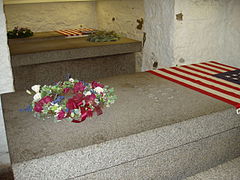
The tombs of John and Abigail Adams (far) and John Quincy and Louisa Adams (near), in the family crypt at United First Parish Church
See also: Death of Thomas Jefferson
Abigail died of typhoid on October 28, 1818, at their Quincy home, Peacefield.[294] The year 1824 was filled with excitement in America, featuring a four-way presidential contest that included John Quincy. The Marquis de Lafayette toured the country and met with Adams, who greatly enjoyed Lafayette's visit to Peacefield.[295] Adams was delighted by the election of John Quincy to the presidency. The results became official in February 1825 after a deadlock was decided in the House of Representatives. He remarked, "No man who ever held the office of President would congratulate a friend on obtaining it."[296]
On July 4, 1826, the 50th anniversary of the adoption of the Declaration of Independence, Adams died of a heart attack at Peacefield at approximately 6:20 pm.[297][298] His last words included an acknowledgement of his longtime friend and rival: "Thomas Jefferson survives." Adams was unaware that Jefferson had died several hours before.[299][300] At 90, Adams was the longest-lived US president until Ronald Reagan surpassed him in 2001.[301]
John and Abigail Adams's crypt at United First Parish Church in Quincy, Massachusetts, also contains the bodies of John Quincy and Louisa Adams.[302]
Political writings
...
Legacy
Historical reputation
See also: Bibliography of John Adams
Benjamin Franklin summed up what many thought of Adams, saying "He means well for his country, is always an honest man, often a wise one, but sometimes, and in some things, absolutely out of his senses."[343] Adams strongly felt that he would be forgotten and underappreciated by history. These feelings often manifested themselves through envy and verbal attacks on other Founders.[159][344] Edmund Morgan argues, "Adams was ridiculously vain, absurdly jealous, embarrassingly hungry for compliments. But no man ever served his country more selflessly."[345]
Historian George C. Herring argued that Adams was the most independent-minded of the Founders.[346] Though he formally aligned with the Federalists, he was somewhat a party unto himself, at times disagreeing with the Federalists as much as he did the Republicans.[347] He was often described as prickly, but his tenacity was fed by decisions made in the face of universal opposition.[346] Adams was often combative, as he admitted: "[As President] I refused to suffer in silence. I sighed, sobbed, and groaned, and sometimes screeched and screamed. And I must confess to my shame and sorrow that I sometimes swore."[348]
Stubbornness was seen as one of his defining traits, a fact for which Adams made no apology. "Thanks to God that he gave me stubbornness when I know I am right," he wrote.[349] His resolve to advance peace with France while maintaining a posture of defense reduced his popularity and contributed to his defeat for reelection.[350] Most historians applaud him for avoiding an all-out war with France during his presidency. His signing of the Alien and Sedition Acts is almost always condemned.[351]
According to Ferling, Adams's political philosophy fell "out of step" with national trends. The country tended further away from Adams's emphasis on order and the rule of law and towards the Jeffersonian vision of liberty and weak central government. In the years following his retirement from public life, as first Jeffersonianism and then Jacksonian democracy grew to dominate American politics, Adams was largely forgotten.[352] When his name was mentioned, it was typically not favorably.
In the 1840 presidential election, Whig candidate William Henry Harrison was attacked by Democrats on the false allegation that he had once been a supporter of John Adams.[353] Adams was eventually subject to criticism from states' rights advocates. Edward A. Pollard, a strong supporter of the Confederacy during the American Civil War, singled out Adams, writing:
The first President from the North, John Adams, asserted and essayed to put into practice the supremacy of the "National" power over the states and the citizens thereof. He was sustained in his attempted usurpations by all the New England states and by a powerful public sentiment in each of the Middle States. The "strict constructionists" of the Constitution were not slow in raising the standard of opposition against a pernicious error.[354]
In the 21st century, Adams remains less well known than many of his fellow Founding Fathers, in accordance with his predictions. McCullough argued that "[t]he problem with Adams is that most Americans know nothing about him." Todd Leopold of CNN wrote in 2001 that Adams is "remembered as that guy who served a single term as president between Washington and Jefferson."[355] He has always been seen, Ferling says, as "honest and dedicated", but despite his lengthy career in public service, is still overshadowed.[356]
Gilbert Chinard, in his 1933 biography of Adams, described the man as "staunch, honest, stubborn and somewhat narrow."[357] In his two-volume 1962 biography, Page Smith lauds Adams for his fight against radicals whose promised reforms portended anarchy and misery. Ferling, in his 1992 biography, writes that "Adams was his own worst enemy."[358] He criticizes him for his "pettiness ... jealousy, and vanity", and faults him for his frequent separations from his family. He praises Adams for his willingness to acknowledge his deficiencies and for striving to overcome them.[359]
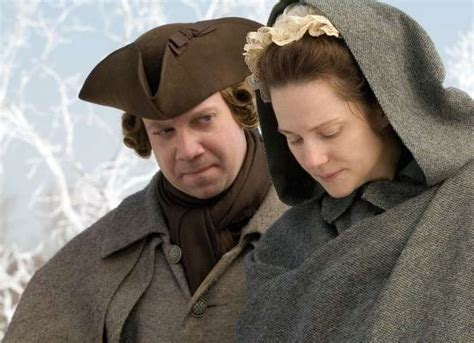
In 2001, McCullough published a biography of Adams, John Adams, in which he lauds Adams for consistency and honesty, "plays down or explains away" his more controversial actions, and criticizes his friend and rival, Jefferson. The book sold very well and was very favorably received and, along with the Ferling biography, contributed to a rapid resurgence in Adams's reputation.[360] In 2008, an excellent miniseries was released based on the McCullough biography, featuring Paul Giamatti as Adams. The show won four Golden Globe awards and 13 Emmy awards, more than any other miniseries in history.