Rossini
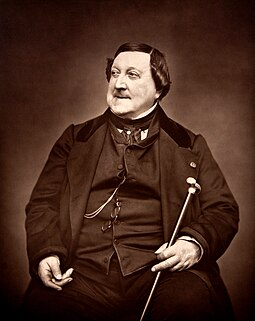
Name: Gioacchino Rossini
Achievements: A great Italian opera composer.
Born: February 29, 1792; Pesaro, Italy
Died: November 13, 1868; Passy, France (Aged 74)
Field & Discipline: Music; Composer
Language: Italian
Father: Father: Giuseppe Rossini
Mother: Anna Guidarini
Siblings: Unknown
Spouse: 1) Isabella Colbran; 2) Olympe Pellissier
Children: Unknown
Education: Philharmonic School, Bologna
Major Work:
“Barbiere de Seville” (1816, “Barber of the Seville”)
“La Cenerentola” (1817, “Cinderella”)
“Semiramide” (1823, “Zemila”)
“Guillaume Tell” (1829, “William Tell”)
Life & Times:
Rossini was taught to play the horn by his father, and became familiar with the music of [influenced by] Joseph Haydn* and [influenced by] Mozart*.
From 1806-10, Rossini studied cello, piano and counterpoint at music school in Bologna. In 1804, at the age of twelve he wrote music for string quartet; in 1806 he wrote his first operatic music; and in 1808 he wrote a cantata, heavily influenced by Hadyn and Mozart, which won the school prize and was performed in public.
In 1810, a family of itinerant singers called Morandi, recommended the eighteen year-old Rossini to the impressario of a theatre in Venice who needed a one-act comic opera in a hurry. In “La Cambriale di Matrionio” (“The Bill-of-Exchange of Marriage”) which was performed in Venice at the end of that year, Rossini found his authentic voice. He produced two comic operas in 1812 and a musical two-act comedy, “La Pietra del Paragone” (“The Touchstone”), performed at the Scala.
He was already improving comic Italian opera. He insisted that the singers sing only what the composer wrote, and at the same time insisted that the orchestra serve the singer; he enhanced his melodies in a foretaste of the ornamental “bel canto” style and permeated the whole opera with zest and energy.
In 1813 he composed “Tancredi”, an opera based on [used work by] Voltaire’s* drama. In the same year he repeated his success with the opera “L’Italiana in Algeri” (“The Italian Girl in Algiers”) which was written in less than three weeks. He was now sought after and in the next two years wrote eight operas. He was invited to work in Milan, Venice, Rome and in Naples where he met his opera singer wife with whom he used to provide musical entertainment at salons where [knew] Gabriele Rossetti* declaimed improvised verse.
In 1816, in just over a fortnight he wrote what is probably his best known work, “Il Barbiere de Siviglia” (1816, “The Barber of Seville”). Based on a play by Beaumarchais* and disliked at first by the Roman audiences it became a triumphant success. In the same year he wrote “Otello”, the definitive opera of William Shakespeare’s play until [work related to] Verdi* wrote his masterpiece.
In 1817 Rossini wrote “La Cenerentola” (“Cinderella”) and “La gazza ladra” (“The Thieving Magpie”), both of which remain among his most popular works. The Russian writer Aleksandr Pushkin took the idea for his play “Boris Godunov” from “La gazza Ladra”. When [knew] Donizetti* observed Rossini at work in Naples in 1821 he complained that he spent more time gossiping with the singers than conducting.
In 1822 he went to Vienna where he was greeted with adulation and expected to give impromptu recitals at every turn. He attended a concert conducted by [attended concert by] Karl von Weber* but what Rossini really wanted to do was meet [met] Beethoven* - who was then working on his ninth symphony and had earlier described Rossini’s music as frivolous. Having failed to get an introduction through [met] Salieri*, Rossini eventually met Beethoven who advised him to stick to comic operas.
Rossini was horrified at Beethoven’s poverty and he tried to raise financial support for him at a gala dinner given by [commissioned by] Metternich*, the Austrian statesman. Metternich commissioned Rossini to write some music for a diplomatic conference at Verona. Rossini conducted his musical offering and was feted by the French poet and diplomat Vicomte Francois de Chateaubriand, by Tsar Alexandra of Russia, the Emperor Francis of Austria and the British politician, the [met] Duke of Wellington*.
After the first performance of his opera “Semiramide” (“Zemilla”) at Venice in 1823, Rossini visited Paris. He then went to London where he was lionised and made a lot of money charging for his appearances at salons and soirees. He went to Brighton to stay with George IV in his new Pavilion and gave recitals at which the king joined in, singing along to [sang] Handel’s* “Hallelujah” chorus.
Rossini then went to Paris where he directed the Italian theatre for eighteenth months . He wrote a cantata on the death of [inspired by] Byron*. He wrote a lyric opera, “le Comte Ory”, for a libretto by [collaborated with] Scribe* and in 1826 his first French opera, “Le Siege de Corinthe” (“The Siege of Corinth”) was staged and was praised by the French composer [praised by] Berlioz*.
In 1829, “Guillaume Tell” (“William Tell”), based on a play by [adapted work by] Schiller*, received its first performance in Paris. It was greeted as a masterpiece and is his deepest and most serious work. He then made an agreement with the French government to compose an opera every two years for the French stage. However, after the revolution of 1830, his agreement was not honored and, being free of financial need, he never wrote another opera.
He remained at the hub of theatre life in Paris and was friendly with [a pal of] Liszt* and with [a pal of] Chopin* who is said to have asked to hear a tune by Rossini as he lay on his deathbed. He was admired by the writers [admired by] Balzac* and [admired by] Stendhal*, the painter [admired by] Delacroix* and the poet [admired by] de Musset*.
The composer [music arranged by] Czerny* composed arrangements of two of Rossini’s operas. Rossini was largely responsible for making Paris the center for opera in Europe. In 1836 Rossini returned to Bologna. He wrote songs and some religious music, and he acted as advisor to the music school for which he ordered music by [a fan of] Felix Mendelssohn* to be sent from Germany.
In the 1850’s, Rossini, who often recycled his information, was disturbed to hear that the publishers founded by [published by] Ricordi* planned to publish a complete edition of his operas. He did not co-operate with the venture but he did not oppose it.
Rossini’s health was bad and he returned to live in Paris in 1855 in order to get better medical care. He led a convivial life at his house in Paris and his villa in Passy, where he wrote a series of pieces entitled “Peches de viellesse” (“Sins of old age”) In 1860 Rossini was visited by the German composer [visited by] Wagner* who had described “Guillaume Tell” as the prototype grand opera. In 1864 Rossini wrote his “Petite Messe Solennelle”.
Extra Connections: The dish tournedos Rossini invented by master chef [eponymous dish by] Careme*
He attended Sarah [knew] Bernhardt*’s mother’s salon
He was an early admirer of French composer [admired]Saint Saens*
Assessment: Rossini transformed comic opera in Italy and his operas are still popular today.
Oneliner: Gioacchino Rossini, great opera composer
Bibliography:
- Osborne, Richard, Rossini, J M Dent & Sons Ltd., London, 1987.
- Till, Nicholas, Rossini, His Life and Times, Midas Books, New York, 1983.
- Weinstock, Herbert, Rossini, Oxford University Press, London, 1968.