Armstrong, Wm G
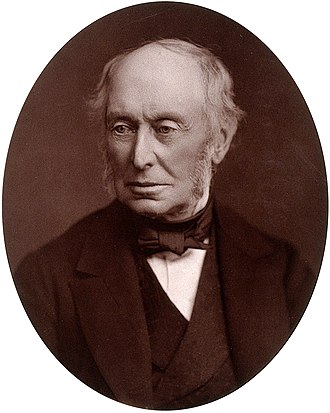
Achievements: Revolutionized artillery
Born: November, 26, 1810; Newcastle-upon-Tyne, England
Died: December 27, 1900; Cragside, England (Aged 90)
Field & Discipline: Engineering; Invention; Hydraulics; Gunmaking; Industrialist
Education: Private schools; grammar school in Bishop Auckland, England.
Major Work: Breech loading artillery; Hydraulic crane
Life & Times:
After completing his schooling, Armstrong became a clerk in a Newcastle legal firm, then completed his law studies with his sister's husband, William Henry Watson, in London. In 1833 he returned to his original firm in Newcastle and became a partner.
Though content to make a living as a lawyer, Armstrong had a love for science, and in his spare time did experiments with hydroelectric power. One day while fishing he concluded that a waterwheel used only one-twentieth of its potential power. So he wrote an article about it: "The application of water as a motive power for driving machinery," published in 1838.
In the early 1840s, Armstrong became intrigued by a story he had heard about a worker who received a sharp electric shock when one hand was in contact with a boiler and the other exposed to a jet of steam coming out of the same boiler. He wrote another article, speculating on the "electricity of effluent stream", and then set about producing a hydroelectric machine that consisted of a wrought iron boiler insulated by glass legs, from which steam escaped at high pressure to generate electricity. His invention greatly impressed the scientific community and in 1846, proposed by physicists [a supporter was] Faraday* and [a supporter was] Wheatstone,* Armstrong was elected a member of the Royal Society.
Armstrong then designed a hydraulic crane worked by water pressure acting directly on a piston in a cylinder. The piston movement acted on a gearing system to move the crane. Armstrong then quit his law practice and founded Armstrong & Company of Elswick, which soon began to produce hydraulic cranes.
In 1850, Armstrong developed the hydraulic pressure accumulator, one of his most important inventions. This consisted of a large cylinder containing a piston that could be loaded, with water pumped in by steam engine, to any desired pressure and then act as a power source. A modified version allowed ships to use hydraulic power to handle heavy gunnery.
The [made arms for] Crimean War* brought Armstrong into the field of weapons. In 1854, he designed submarine mines for use against Russian ships in Sebastopol Harbor. The following year he designed a three-pounder gun with a barrel made of wrought iron wrapped around an inner steel tube. Loaded at the breech, it fired a new, elongated shell, rather than the traditional round ball. By the end of 1856, Armstrong had produced a five-pounder gun of similar design. The British army adopted the "Armstrong" in 1859, prompting Armstrong to found the Elswick Ordnance Company to produce the gun, which was superior to any other armament of the time.
In 1867, Armstrong signed a deal with shipyard owner Charles Mitchell. Mitchell would build ships and Armstrong would arm them. The governments of Britain, Brazil, Italy, and China bought the ships. In 1880, Armstrong remodeled the "Armstrong" gun, and once again sold it to the British Army. A 150-mm/6-in breech-loader, with steel wire wound round the inner barrel, it was the model for all future artillery.
In 1880, Armstrong helped design the world's first armored cruiser. Protection for cruisers had become necessary because of the proliferation of powerful naval guns. Armstrong's challenge was to protect the ship but at the same time allow it to retain its speed and agility. In 1883, Mitchell merged his shipyard with Armstrong to form Sir W. G. Armstrong, Mitchell & Co. Ltd.. Armstrong headed the company, but was active only until the mid-1860s.
Armstrong also showed considerable talent in landscaping the gardens of his home, Cragside, installing various items of hydraulic equipment as well as creating a source of hydroelectric power which supplied the first electric light, developed by his friend, [a pal was] Joseph Swan*.
Extra Connections:
His work related to that of [work related to] Maudslay, Henry*, [work related to] Babbage* and [work related to] Whitworth*
One of his apprentices was [taught] Swinton*
He was a friend of [a pal of] Balfour*
William Morrow worked on his mansion
He was thought to be a possible model for George Bernard Shaw's arms magnate in Major Barbara
Assessment: One of the greatest of several 19th century Englishmen who were not only brilliant scientists but also highly successful industrialists.
Oneliner: WG Armstrong, British artillery and ship manufacturer
Bibliography:
- Peter McKenzie. W. G. Armstrong: the Life and Times of Sir William Armstrong. Baron Armstrong of Cragside. Longhirst Press. Newcastle-upon-Tyne. 1983.
Language: English
Father: William Armstrong
Mother: Ann Potter
Siblings: Ann
Spouse: Margaret Ramshaw
Children: None