Berzelius, JJ
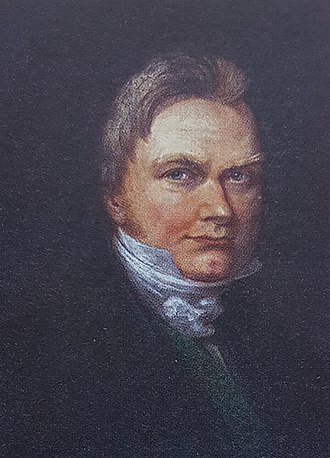
Achievements: Chemical symbols
Born: August 20, 1779; Väversunda, Ostergotland, Sweden
Died: August 7, 1848; Stockholm, Sweden (Aged 68)
Field & Discipline: Chemistry
Language: Swedish
Education: Uppsala University
Major Work: “Essay on Chemical Proportions” (1819)
Life & Times:
Berzelius’ stepbrother, Anders Gustaf Ekeberg, a well-known chemist, introduced him to chemistry, and in 1800, during the summer vacation from university, he met Sven Hedin, chief physician at the Medivi mineral springs and he received his first paid work for his analysis of the composition of the mineral water.
Having studied the work of [studied work of] Galvani* and learned of voltaic piles and the first means of generating a continuous flow of electricity, he wrote his doctoral dissertation on “the therapeutic effects of galvanic current on patients with a variety of ailments.” In 1803, he was given an unpaid job as assistant to the professor of medicine and pharmacy at the College of Medicine in Stockholm, arranged by Sven Hedin. He lodged with the wealthy mine owner, Wilhelm Hisinger and they carried out electrochemical research, including experiments with solutions of salts, a field in which [worked in same field as] Davy* was already working.
It was around this time that Berzelius discovered the new chemical element, cerium, at the same time as [co-discovered cerium with] Klaproth* in Berlin.
He met [met] Oersted* in Denmark in 1807 and discussed nature’s forces, which later led to Oersted’s activities in electromagnetism. After working with M. M. Pontin in 1808, Berzelius introduced the mercury cathode and discovered “ammonium amalgam.” He also developed the theory that all compounds are composed of electrically and chemically opposed parts, which introduced the concept of dualism to chemistry. Much of this research led to his later book, “Essay on Chemical Proportions” in 1819.
In 1810, he was appointed professor of medicine and pharmacy at the Medical College, then later at the Karolinska Institute. This gave him time to continue writing his Swedish chemical textbooks, following the earlier publication of his first volume. By the time the sixth volume was published in 1830, he had written the most influential textbook of its day.
Berzelius went to London in 1812, where he met the astronomer [met] William Herschel* and naturalist [met] Banks*. Returning to Sweden, he continued his research and, in 1815, discovered another new element, later broken down into yttrium and phosphorous by [influenced work of] Welsbach*. In 1818, he went to France to work with Dulong at the home of [worked in home of] Berthollet*, where he heard that he had been made secretary of the Swedish Academy of Science. With his income doubled, Berzelius became interested in chemical proportions and whether chemical compounds had a fixed composition.
At this time there was a controversy between Proust and C. L. Berthollet over constant proportions in chemical compounds, so Berzelius began a systematic study of combining weights.
He calculated the atomic weights of all but four of the known forty-nine elements, proving [proved theory of] Dalton’s* atomic theory. His rejection of [rejected ideas of] Avogadro*’s hypothesis led him to confuse some atomic and molecular weights, but Berzelius’ system, giving each chemical a letter symbol and each weight a number, was so accurate that it is still used today. The following year, he discovered a third new element, thorium, to which his assistants later added lithium, vanadium, and a number of lanthanides.
Berzelius developed an interest in organic substances and believed that living organic bodies contained a vital force, as part of the sum of their chemical and mechanical processes. He found that the combining laws for inanimate matter also applied to living material, bringing organic matter within the atomic concept. He became involved in a number of controversies over the theories of organic chemistry, notably with [argument with] Liebig* and [argument with] JBA Dumas*.
Further developments first noted by Berzelius (in earlier work by [anticipated by] Thenard*) included catalytic force, when a reaction occurs faster in the presence of another substance that does not itself appear to change. He coined the term “protein,” and formulated the names of halogens for the grouping of elements by similar chemical properties. For substances with the same chemical composition, but different physical properties, he introduced the concept of isomerism.
In his later years, Berzelius was less tolerant of new theories that contradicted his beliefs, one example being his refusal to accept chlorine as an element. Some scientists criticized him for holding back scientific progress but, in fact, Berzelius had already shaped the future study of chemistry. His contribution to science was further recognized when he was given the title of Baron in 1835.
Extra Connections:
His work related to that of [work related to] Alexander von Humboldt*, [work related to] Gauss*, [work related to] Brongniart*, [work related to] Goethe*, [work related to] Hofmann*.
He met [met] Jenny Lind* and [met] Maclure*
He taught the father of [taught father of] Winkler*.
Assessment: Berzelius dedicated his entire life to chemical research and he provided the letter and number system used in chemical formulae today.
Oneliner: J J Berzelius, Swedish inventor of chemistry symbols
- Bibliography: Melhado, Evan M. and Frängsmyr, Tore, Enlightenment Science in the Romantic Era: The Chemistry of Berzelius and its Cultural Setting, edited by Cambridge University Press, Cambridge, 1992.
Father: Samuel
Mother: Elizabeth Dorothea
Siblings: None
Spouse: Elizabeth Poppius
Children: None