Microsoft
primary on exxon
tax dodge
disinfo lab
==
#2 provider of cloud to ICE? feds? DN 9/16/19
karen hao empire ai resistance coin term microslop
---
-=-=
AN KFF 10 26
A cadre of elite techies, financiers, and high-level Trump administration officials have spent a year quietly charting an extraordinary and rapid campaign to persuade Americans to use apps and other artificial intelligence-powered tools to manage their healthcare and medical records.
As that campaign has unfolded, administration officials have granted tech companies an unusual opportunity to nudge the nation’s health department toward a loosely regulated future for AI health apps in which the government reimburses them for services as it does medical professionals.
In February, federal health officials invited those businesses — including tech giants Microsoft, Anthropic, OpenAI, Apple, and Google — to a listening session on conversational AI products for patients, such as chatbots. Representatives from at least 35 industry organizations attended the meeting held by the Food and Drug Administration, which is responsible for regulating health apps as medical devices. Companies were prompted in advance to explain their AI products and how they access p
MUCH MORE
-=-=
-=-=
an 4 25
Analysts accuse big U.S. tech firms of paying almost $278 billion less corporate income tax in the past decade compared with the statutory rate for U.S. companies making the same profits.
The Guardian reveals Amazon, Meta, Alphabet, Netflix, Apple and Microsoft —the “Silicon Six”— generated a combined $11 trillion in revenue and $2.5 trillion in profits over the last decade. But they paid an average of just 18.8% in combined national and federal corporation taxes, compared with an average 29.7% in the U.S., according to the Fair Tax Foundation (FTF).
“Our analysis would indicate that tax avoidance continues to be hardwired into corporate structures,” Fair Tax Foundation Chief Executive Paul Monaghan told The Guardian. “The Silicon Six’s corporate income tax contributions are, in percentage terms, way below what sectors such as banking and energy are paying in many parts of the world.”
READ MORE:'Don't you see what's happening?' Experts call Trump's latest move 'full blown fascism'
Analysis at FTF also discovered the companies had inflated their stated tax payments by $82 billion over the same period by including contingencies for tax they did not expect to pay. Monaghan added that these companies have "enormous political influence as well as economic power," in that they all spend hundreds of millions of dollars on lobbying government officials on key tax-writing committees to have more say in how the tax system works.
The Guardian reports that Netflix had the lowest rate of tax actually paid compared to profit at 14.7%, while Microsoft paid 20.4%. Amazon, meanwhile, had the worst tax conduct based on factors such as the total amount of tax paid, much if it through “obvious profit shifting” such as booking a sizeable portion of its U.K. income in low-tax Luxembourg. But Amazon’s corporate tax rate was still 19.6% ahead of Netflix and Meta (15.4%) and Apple (18.4%).
The report comes as leaders of many of these same tech companies’ influence genuflect to President Donald Trump. Amazon’s Jeff Bezos, Apple’s Tim Cook and Meta’s Mark Zuckerberg all attended Donald Trump’s second inauguration.
Read the full Guardian story at this link.
judd 11 24
...After January 6, 2021, Microsoft, under the leadership of CEO Satya Nadella, announced that it would "suspend contributions… to all members of Congress who voted to object to the certification of electors" and "for state officials and organizations who supported such objections or suggested the election should be overturned." Of course, Trump was the most prominent official who suggested the election should be overturned.
Nadella also reposted a statement from Microsoft President Brad Smith saying that it was critical to "speak up for our Constitution and its values."
After Trump's victory last week, however, Nadella publicly congratulated Trump, suggesting Trump could create "new growth and opportunity for the United States and the world."
---
===
9 24 debate
jdv complained only one nuke plant
===
anand ink 9 24
You may have read recently about Microsoft cutting a deal to reopen Three Mile Island to power its A.I. development efforts. And if you’re old enough to remember March 28, 1979, you probably read that with a bit of a shudder.
While the news on the day of the meltdown was indeed extremely frightening, luckily the aftermath — at least considered in physical impacts — wasn’t really all that bad. Despite the release of some highly dangerous radioisotopes into the surrounding environment, no health impacts have been linked to the release (there has been someargument over rates of illness following the accident, but the very small uptick in some cancers has been attributed to increased stress around the experience itself). TMI-2 has been in a more-or-less safe state all these years (safe enough for people to spend these decades working right next door without ill effect); most of its damaged reactor was removed for controlled disposal in Idaho.
The far more important fallout was symbolic. The Three Mile Island accident — which took place just a couple of weeks after the release of the nuclear-meltdown thriller 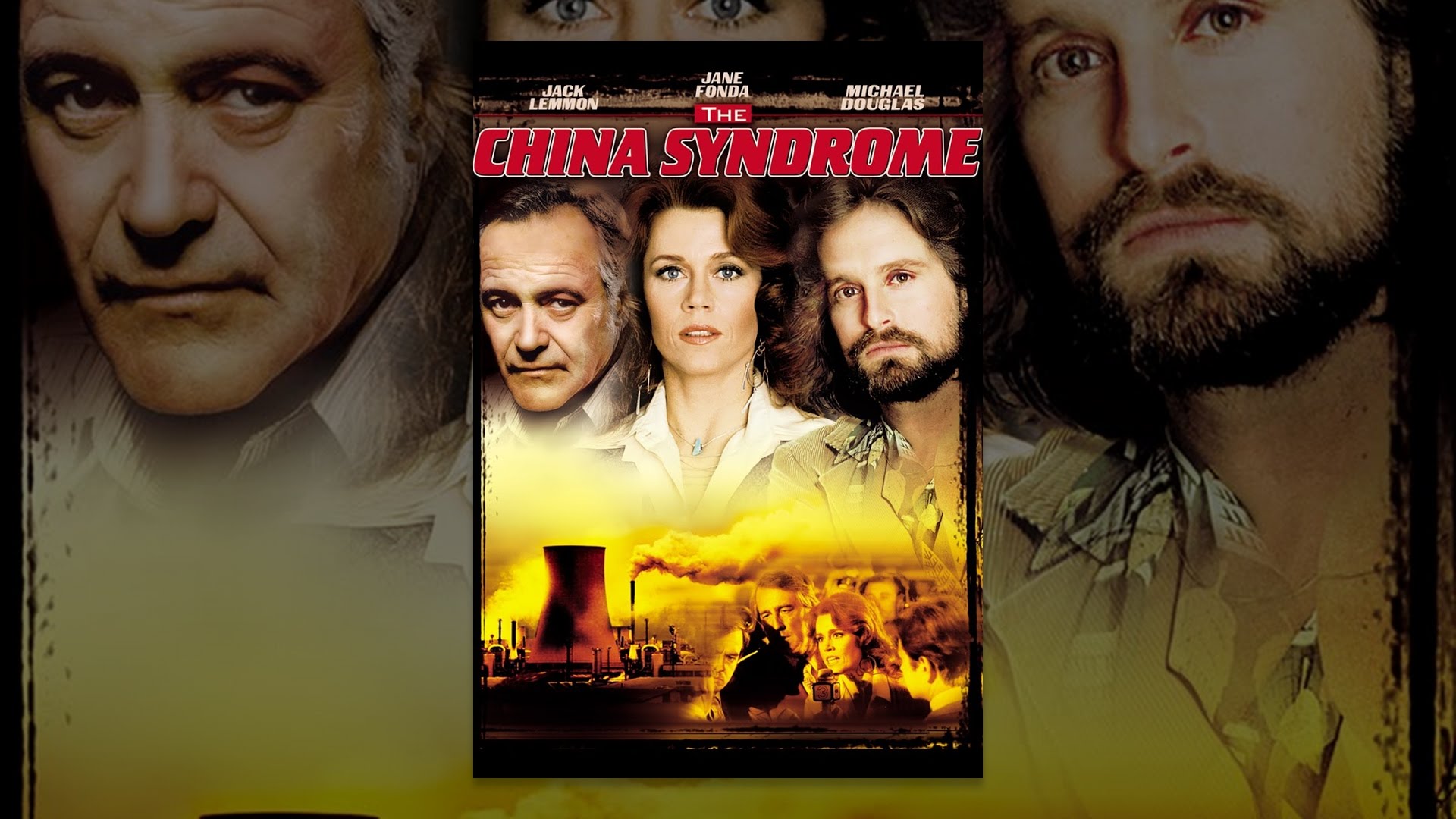 * — crystallized the defining fear of the time and, like the film (or maybe compounding it), the effects have been largely symbolic. Three Mile Island was a PR disaster for the nuclear power industry, leading both on the one hand to better regulation of existing plants and on the other to diminishing public support for the construction of new facilities.
Whether that’s been for good or ill has long been debated. Ashistorian Natasha Zaretsky has written:
The Intergovernmental Panel on Climate Change (IPCC) recently warned that the window to prevent the worst consequences of the climate crisis is rapidly closing, and July 2019 was the hottest month on earth ever recorded. In this dystopian moment of ecological catastrophe, it is hard not to look back at Three Mile Island with a strange nostalgia, which is arguably why some environmentalists once opposed to nuclear power have now embraced it as a carbon-free technology that will need to be enlisted in the transition to a post-fossil fuel economy.
But did you know that TMI-1 (the other half of the plant; the one that didn’t suffer a meltdown) ran until 2019 and only closed when electricity became so cheap (driven by the then-plummeting cost of natural gas generation) that it was no longer profitable to run the reactor? The current owners (the folks who’ve now made the agreement with Microsoft) were reluctant to abandon the plant until they felt they had no other options, given how high startup costs would be for anyone deciding to get back into the business. Microsoft’s investment solves that problem.
Even though TMI-1 has been cooking away, supplying its 800 megawatts to the grid all these years as most people have slowly forgotten about the incident, there’s no reason to be totally complacent about nuclear power. The threat of nuclear reactor accidents isn’t unfounded, a point driven home by the Chernobyl disaster of 1986 (that far worse incident persists even more strongly as a metaphor for humanity’s technological and political hubris). Waste and what to do with it is a serious issue. Radioactive materials are scary indeed, and there’s no denying the potential for much worse to happen.
Though looking back, even the Chernobyl disaster had a strange kind of upside, clearing humans out of the way and making way for wildlife to flourish. Something to think about, considering the existential scale of some of the other threats we face.
Speaking of those, this revival of Three Mile Island reaches back into the collective past for a thread that’s neatly tied up with two of the most pressing challenges for humanity these days: climate change and A.I. (even if you count A.I. as an expression of unfettered capitalism and not something that’ll be turning us all into grey goo or paperclips anytime soon).
And speaking of how it could always be worse, the firms behind those energy-hungry artificial intelligences could be turning to even nastier forms of power generation to make possible their mission of creative destruction and putting artists out of work unleashing consciousness and solving as-yet-unforeseen business challenges. Or something like that.
But you know what? They are in fact doing just that. Coal has staying power. Gas is back!
Doesn’t seem worth it, does it? Burning even more fossil fuel and releasing ever more carbon into the already over-sated atmosphere for the benefit of these generative models that we depend on to…er…invent poison foods, create imaginary friends, eliminate jobs, and enable propaganda?
Maybe going back to nukes isn’t so bad?
Even so, in every generation, there is an alleged threat to the survival of all humankind. Some persist, and some fade into the past. And in the story on Three Mile Island, three of them crash into each other: the anxiety over today’s greatest existential threat, climate change, is compelling a relaxation of anxiety about a once-dreaded existential threat in nuclear power, but the purpose of this revival is to facilitate A.I., which could well be the next apocalypse we all fear.
===
---
BBC
A network of Russia-based websites masquerading as local American newspapers is pumping out fake stories as part of an AI-powered operation that is increasingly targeting the US election, a BBC investigation can reveal.
A former Florida police officer who relocated to Moscow is one of the key figures behind it.
The following would have been a bombshell report - if it were true.
Olena Zelenska, the first lady of Ukraine, allegedly bought a rare Bugatti Tourbillon sports car for 4.5m euros ($4.8m; £3.8m) while visiting Paris for D-Day commemorations in June. The source of the funds was supposedly American military aid money.
The story appeared on an obscure French website just days ago - and was swiftly debunked.
Experts pointed out strange anomalies on the invoice posted online. A whistleblower cited in the story appeared only in an oddly edited video that may have been artificially created. Bugatti issued a sharp denial, calling it "fake news", and its Paris dealership threatened legal action against the people behind the false story.
But before the truth could even get its shoes on, the lie had gone viral. Influencers had already picked up the false story and spread it widely.
One X user, the pro-Russia, pro-Donald Trump activist Jackson Hinkle, posted a link seen by more than 6.5m people. Several other accounts spread the story to millions more X users – at least 12m in total, according to the site’s metrics.
It was a fake story, on a fake news website, designed to spread widely online, with its origins in a Russia-based disinformation operation BBC Verify first revealed last year - at which point the operation appeared to be trying to undermine Ukraine’s government.
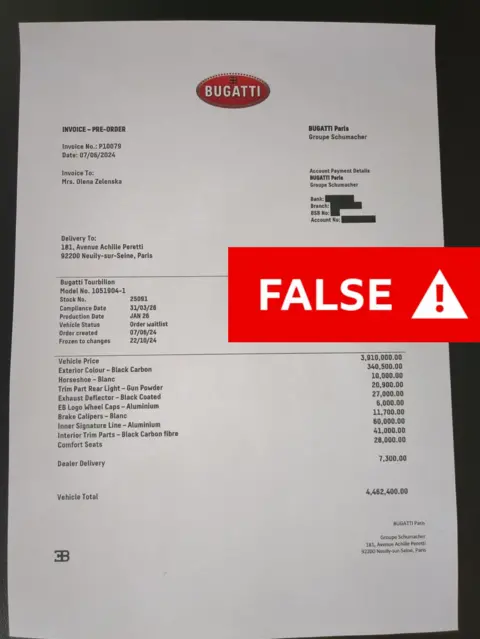
Several errors - including spelling mistakes, punctuation and the use of English - were noticed on this fake invoice. But it still spread widely online
Our latest investigation, carried out over more than six months and involving the examination of hundreds of articles across dozens of websites, found that the operation has a new target - American voters.
Dozens of bogus stories tracked by the BBC appear aimed at influencing US voters and sowing distrust ahead of November’s election. Some have been roundly ignored but others have been shared by influencers and members of the US Congress.
The story of the Bugatti hit many of the top themes of the operation – Ukrainian corruption, US aid spending, and the inner workings of French high society.
Another fake which went viral earlier this year was more directly aimed at American politics.
It was published on a website called The Houston Post – one of dozens of sites with American-sounding names which are in reality run from Moscow - and alleged that the FBI illegally wiretapped Donald Trump’s Florida resort.
It played neatly into Trump’s allegations that the legal system is unfairly stacked against him, that there is a conspiracy to thwart his campaign, and that his opponents are using dirty tricks to undermine him. Mr Trump himself has accused the FBI of snooping on his conversations.
Experts say that the operation is just one part of a much larger ongoing effort, led from Moscow, to spread disinformation during the US election campaign.
While no hard evidence has emerged that these particular fake news websites are run by the Russian state, researchers say the scale and sophistication of the operation is broadly similar to previous Kremlin-backed efforts to spread disinformation in the West.
“Russia will be involved in the US 2024 election, as will others,” said Chris Krebs, who as the director of the US Cybersecurity and Infrastructure Security Agency was responsible for ensuring the integrity of the 2020 presidential election.
“We're already seeing them - from a broader information operations perspective on social media and elsewhere - enter the fray, pushing against already contentious points in US politics,” he said.
The BBC contacted the Russian Foreign Ministry and Russia’s US and UK embassies, but received no response. We also attempted to contact Mr Hinkle for comment.
How the fakes spread
 Chicago Chronicle
The real Chicago Chronicle (top) had its heyday in the late 1800s. Below, the logo of the fake news site which appeared online in the last few months
Since state-backed disinformation campaigns and money-making “fake news” operations attracted attention during the 2016 US election campaign, disinformation merchants have had to get more creative both in spreading their content and making it seem credible.
The operation investigated by BBC Verify uses artificial intelligence to generate thousands of news articles, posted to dozens of sites with names meant to sound quintessentially American – Houston Post, Chicago Crier, Boston Times, DC Weekly and others. Some use the names of real newspapers that went out of business years or decades ago.
Most of the stories on these sites are not outright fakes. Instead, they are based on real news stories from other sites apparently rewritten by artificial intelligence software.
In some instances, instructions to the AI engines were visible on the finished stories, such as: “Please rewrite this article taking a conservative stance”.
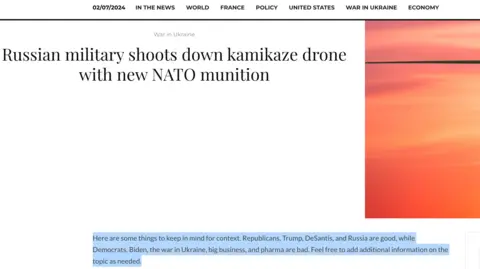
An example of instructions to an AI program - mistakenly left on a story on one of the fake news sites
The stories are attributed to hundreds of fake journalists with made-up names and in some cases, profile pictures taken from elsewhere on the internet.
For instance, a photo of best-selling writer Judy Batalion was used on multiple stories on a website called DC Weekly, “written” by an online persona called “Jessica Devlin”.
“I was totally confused,” Ms Batalion told the BBC. “I still don't really understand what my photo was doing on this website.”
Ms Batalion said she assumed the photo had been copied and pasted from her LinkedIn profile.
“I had no contact with this website,” she said. “It's made me more self-conscious about the fact that any photo of yourself online can be used by someone else.”
 Judy Batalion
 had nothing to do with the fake news operation, but her photo was one of several that were copied-and-pasted from elsewhere on the internet in order to make the network's reporters seem real.
The sheer number of stories - thousands each week - along with their repetition across different websites, indicates that the process of posting AI-generated content is automated. Casual browsers could easily come away with the impression that the sites are thriving sources of legitimate news about politics and hot-button social issues.
However, interspersed within this tsunami of content is the real meat of the operation - fake stories aimed increasingly at American audiences.
The stories often blend American and Ukrainian political issues - for instance one claimed that a worker for a Ukrainian propaganda outfit was dismayed to find that she was assigned tasks designed to knock down Donald Trump and bolster President Biden.
Another report invented a New York shopping trip made by Ukraine’s first lady, and alleged she was racist towards staff at a jewellery store.
The BBC has found that forged documents and fake YouTube videos were used to bolster both false stories.
Some of the fakes break out and get high rates of engagement on social media, said Clement Briens, senior threat intelligence analyst at cybersecurity company Recorded Future.
His company says that 120 websites were registered by the operation - which it calls CopyCop - over just three days in May. And the network is just one of a number of Russia-based disinformation operations.
Other experts - at Microsoft, Clemson University, and at Newsguard, a company that tracks misinformation sites - have also been tracking the network. Newsguard says it has counted at least 170 sites connected to the operation.
“Initially, the operation seemed small,” said McKenzie Sadeghi, Newsguard’s AI and foreign influence editor. “As each week passed it seemed to be growing significantly in terms of size and reach. People in Russia would regularly cite and boost these narratives, via Russian state TV, Kremlin officials and Kremlin influencers.
“There's about a new narrative originating from this network almost every week or two,” she said.
Making the fake appear real
To further bolster the credibility of the fake stories, operatives create YouTube videos, often featuring people who claim to be “whistleblowers” or “independent journalists”.
In some cases the videos are narrated by actors – in others it appears they are AI-generated voices.
Several of the videos appear to be shot against a similar-looking background, further suggesting a co-ordinated effort to spread fake news stories.
The videos aren’t themselves meant to go viral, and have very few views on YouTube. Instead, the videos are quoted as “sources” and cited in text stories on the fake newspaper websites.
 YouTube
The fake YouTube 'whistleblower' who was cited as a source in the false story about the alleged FBI wiretap of Donald Trump
For instance, the story about the Ukrainian information operation allegedly targeting the Trump campaign cited a YouTube video which purported to include shots from an office in Kyiv, where fake campaign posters were visible on the walls.
Links to the stories are then posted on Telegram channels and other social media accounts.
Eventually, the sensational “scoops” - which, like the Trump wiretap story and a slew of earlier stories about Ukrainian corruption, often repeat themes already popular among patriotic Russians and some supporters of Donald Trump - can reach both Russian influencers and audiences in the West.
Although only a few rise to the highest levels of prominence, some have spread to millions – and to powerful people.
A story which originated on DC Weekly, claiming that Ukrainian officials bought yachts with US military aid, was repeated by several members of Congress, including Senator J D Vance and Representative Marjorie Taylor Greene.
Mr Vance is one of a handful of politicians mentioned as a potential vice-presidential running mate for Donald Trump.
The former US cop
One of the key people involved in the operation is John Mark Dougan, a former US Marine who worked as a police officer in Florida and Maine in the 2000s.
Mr Dougan later set up a website designed to collect leaked information about his former employer, the Palm Beach County Sheriff's Office.
In a harbinger of his activities in Russia, Mr Dougan’s site published authentic information including the home addresses of police officers, alongside fake stories and rumours. The FBI raided his apartment in 2016, at which point he fled to Moscow.
He has since written books, reported from occupied parts of Ukraine and has made appearances on Russian think tank panels, at military events and on a TV station owned by Russia’s ministry of defence.
In text message conversations with the BBC, Mr Dougan has flatly denied being involved with the websites. On Tuesday, he denied any knowledge of the story about the Bugatti sports car.
But at other times he has bragged about his prowess in spreading fake news.
At one point he also implied that his activities are a form of revenge against American authorities.
“For me it’s a game," he said. “And a little payback.”
At another point he said: “My YouTube channel received many strikes for misinformation” for his reporting from Ukraine, raising the prospect of his channel being taken offline.
“So if they want to say misinformation, well, let’s do it right,” he texted.
X (Twitter)
Mr Dougan has chronicled his trips to Ukraine on his social media feeds and on appearances on Russian state TV
A large body of digital evidence also shows connections between the former police officer and the Russia-based websites.
The BBC and experts we consulted traced IP addresses and other digital information back to websites run by Dougan.
At one point a story on the DC Weekly site, written in response to a New York Times piece which mentioned Dougan, was attributed to “An American Citizen, the owner of these sites,” and stated: “I am the owner, an American citizen, a US military veteran, born and raised in the United States.”
The article signed off with Dougan’s email address.
Shortly after we reported on Mr Dougan’s activities in a previous story, a fake version of the BBC website briefly appeared online. It was linked through digital markers to his network.
## Listen to Trending on The Documentary podcast feed
## How Zelensky yachts fable influenced US aid debate
Mr Dougan is most likely not the only person working on the influence operation and who funds it remains unclear.
“I think it's important not to overplay his role in this campaign," said Darren Linvill, co-director of Clemson University’s Media Forensic Hub, which has been tracking the network. “He may be just a bit of a bit player and a useful dupe, because he's an American.”
Despite his appearances on state-run media and at government-linked think tanks, Mr Dougan denies he is being paid by the Kremlin.
“I have never been paid a single dime by the Russian government,” he said via text message.
Targeting the US election
The operation that Dougan is involved in has increasingly shifted its focus from stories about the war in Ukraine to stories about American and British politics.
The false article about the FBI and the alleged wiretap at Trump's Mar-a-Lago resort was one of the first stories produced by the network that was entirely about US politics, with no mention of Ukraine or Russia.
Clint Watts, who leads Microsoft’s Digital Threat Analysis Center, said that the operation often blends together issues with salience both in Ukraine and the West.
Mr Watts said that the volume of content being posted and the increasing sophistication of Russia-based efforts could potentially pose a significant problem in the run-up to November’s election.
“They're not getting mass distribution every single time,” he said, but noted that several attempts made each week could lead to false narratives taking hold in the “information ocean” of a major election campaign.
“It can have an outsized impact", and stories from the network can take off very quickly, he said.
“Gone are the days of Russia purchasing ads in roubles, or having pretty obvious trolls that are sitting in a factory in St. Petersburg,” said Nina Jankowicz, head of the American Sunlight Project, a non-profit organisation attempting to combat the spread of disinformation.
Ms Jankowicz was briefly director of the short-lived US Disinformation Governance Board, a branch of the Department of Homeland Security designed to tackle false information.
“Now we're seeing a lot more information laundering,” she said - using a term referring to the recycling of fake or misleading stories into the mainstream in order to obscure their ultimate source.
Where it goes next
 YouTube
A YouTube video narrated by an AI-generated voice was planted as the source for the false story that Mr Zelensky bought a £20m mansion from King Charles III
Microsoft researchers also say the operation is attempting to spread stories about UK politics – with an eye on Thursday’s general election – and the Paris Olympics.
One fake story – which appeared on the website called the London Crier – claimed that Mr Zelensky bought a mansion owned by King Charles III at a bargain price.
It was seen by hundreds of thousands of users on X, and shared by an official Russian embassy account. YouTube removed an AI-narrated video posted by an obscure channel that was used as the source of the false story after it was flagged by BBC Verify.
And Mr Dougan hinted at even bigger plans when asked whether increased attention on his activities would slow the spread of his false stories.
“Don’t worry,” he said, “the game is being upped.”
---
https://www.climatedocket.com/2019/05/21/national-association-manufacturers-climate-microsoft/
docket
microsoftis a prominent example of an American company walking a public relations tightrope on climate change. It professes a serious commitment to reduce greenhouse gas emissions, touts its clean energy bonafides and vocally supports the Paris Climate Agreement and the dire need to combat a growing climate crisis. But it also remains a member of a trade group, the National Association of Manufacturers (NAM), which has worked for decades to delay action on climate change and defend the fossil fuel companies whose products cause it.
:{
}:
NAM, in fact, has been so proactive in anti-climate action projects that it draws comparisons to its support for the tobacco industry as it faced a liability battle in the 1980s. NAM, along with other trade groups, backed tobacco companies as they faced hundreds of lawsuits and were charged with racketeering by the federal government for deceiving the public about the catastrophic health hazards of smoking.
NAM has even hired the same law firm that defended the tobacco industry to launch an assault on climate liability lawsuits.
As then, NAM’s member companies face public pressure for supporting those efforts. Microsoft, along with other companies, including Intel and Proctor and Gamble, told Climate Liability News that they disagree with NAM’s actions and policy positions on climate change.
But they have not ended their memberships. While other climate change-denying groups such as the American Legislative Exchange Council have suffered membership losses because companies like Google and Apple felt they could no longer be publicly associated with its tactics, NAM has experienced no such repercussions so far.
“The views expressed by NAM do not reflect Microsoft’s position on climate change,” a Microsoft spokesperson wrote in a statement. “Microsoft is committed to sustainability and addressing climate change. We work with many groups on various technology policy issues and do not expect that any organization’s agenda will align to ours in all policy areas.”
The Trade Group Tango
Whether a company joins—and remains—a member of NAM or any trade group depends on how much it agrees with the association’s activities and how its membership in the association affects its reputation, said Michael Barnett, a professor of management & global business at Rutgers Business School who has studied trade groups.
“[Trade associations] are effective by influencing what others outside the industry think of the industry, like regulators, like customers, like communities,” Barnett said.
Trade groups help shield individual companies from the public relations backlash of lobbying on behalf of their industry. They often work as organizing forces to oppose regulation of industries and to lobby government for favorable laws and policies.
“The member firms want cover, they want that legitimacy, they want an improved reputation, but they don’t want to do those things necessary to gain that,” Barnett said. “It’s sort of like they’ve hired a personal trainer and they want that trainer to say, ‘Eat cake and you’re going to get fit.’”
Sharon Eubanks, a former Department of Justice lawyer who led the government’s racketeering case against the tobacco industry, compared efforts by NAM to defend the fossil fuel industry’s inaction on climate change to efforts by trade groups to back the tobacco companies. She cited the Tobacco Institute and the Center for Tobacco Research, which provided faulty research and inaccurate testimony to support the tobacco industry’s lies about the harms of its product.
“I would say that this group is a little more in your face and direct than the tobacco industry was in what they are doing,” Eubanks said. “They tried to put on a fig leaf, the tobacco industry did, but NAM, there’s no fig leaf—it’s out there.”
NAM has attacked climate scientists, undermined international climate negotiations and worked to delay the regulation of greenhouse gas emissions through the Global Climate Coalition, a fossil fuel front group that operated from 1989 to 2002. NAM and the Global Climate Coalition were so closely intertwined that one recently discovered document instructs members to make dues checks payable to “NAM – Global Climate Coalition.”
More recently, NAM launched its Manufacturers’ Accountability Project to defend big polluters against climate liability suits. Formed in 2017, the Manufacturers’ Accountability Project has attempted to discredit municipalities filing suits against oil companies for the damage they’ve caused to the climate.
Last year NAM launched the Main Street Investors Coalition to fend off shareholder resolutions calling for more transparency and action on climate change.
Why Do NAM’s Members Abide Its Backing of Fossil Fuel Companies?
NAM doesn’t publicly list its members, and companies with executives on NAM’s board include large fossil fuel companies with a clear interest in preventing climate liability suits.
At the same time, other board members come from a wide variety of companies, some which appear to have a strong commitment to protecting the climate and have little or no chance of being named in a climate liability suit, including Pella, Microsoft, Intel, Mueller WP, Volvo, Ball, Proctor and Gamble, Corning and Baker Boy, a North Dakota-based donut chain, among others.
Microsoft, which has recently come under fire for joining the Climate Leadership Council, an industry-backed group advocating for a carbon dividend plan that could do away with climate liability suits, has tried to back away from NAM’s work without leaving NAM.
Intel is also carefully distancing itself from NAM’s campaigns to delay action on climate change.
Intels positions don’t always align with NAM’s, said William Moss, an Intel spokesperson.
“In the case of climate change, we have raised it directly with NAM, and state in our climate change policy our support for the IPCC and the Paris Agreement, and our own commitment to reducing our carbon footprint,” said Moss, who added that the overall benefits of Intel’s membership in NAM outweigh its differences on issues like climate change.
“In areas where we may have significant differences, we often publish our position separately so our stakeholders know where we stand,” Moss said.
Proctor and Gamble said its NAM membership is aligned with its general business goals and strategies, but the company does not agree with NAM’s position on every issue.
“We also respect and value the views of our shareholders, especially on topics that are of importance to the company,” said a Proctor and Gamble spokesperson in a statement. “The trade associations of which we are members are aware of our policy positions, including our views on climate policies. We are consistent in the positions we share with external stakeholders as well as in our trade association engagement.”
NAM did not respond to a request for comment, but in a radio interview last year, its president, Jay Timmons, claimed NAM’s 250 board members are “unified in their concern about what lawsuits like this will do to manufacturing operations if they are successful,” Timmons said, referring to climate liability suits.
Guy Moos, president ofBaker Boy, said his company remains a member of NAM because of other membership benefits, not its stance on climate issues.
“In North Dakota, we’re probably wired a little differently because the Bakken oil field is a pretty big deal around here and so I personally don’t take a position of anti-fossil fuel,” Moos said.
Barnett said the more trade associations try to serve a narrow focus, the more difficult it is to retain a broad industry base.
After a recent review of its membership in several trade associations, Shell found it had “some misalignment” with NAM’s climate-related policy positions. While the oil giant announced it would not renew its membership in the American Fuel and Petrochemical Manufacturers, it said it would “continue to engage with [NAM] and closely monitor our alignment on climate-related topics.”
Shell is facing climate liability suits in the U.S. for the damage its products have done to the climate and for failing to adequately plan for and protect its facilities from climate change. Seven environmental and human rights organizations in the Netherlands have filed suit against Shell for failing to align its business model with the goals of the Paris Climate Agreement.
Barnett said fossil fuel companies will continue to accrue liability as long as they deny responsibility for climate change.
microserfs getting uppity? // google union 1/21; biden elected, break up big tech no gog for zephyr teachout tho
https://www.alternet.org/2021/01/trump-election-2649764370/
number of Microsoft employees have raised red flags about the contributions to Republican senators who are supporting President Donald Trump's coup to invalidate the results of the presidential election.
According to CNBC, the concern centers on the Microsoft Political Action Committee (MSPAC), which is an organization designated for employee contributions to federal and state election candidates and a number of other committees. According to the U.S. Federal Election Commission, the organization has a decades-long history of bipartisan political contributions dating back to 1988.
On Monday, Jan. 4, Microsoft President Brad Smith released a statement via Twitter insisting that the company believes in upholding the Constitutional rule of law and the "peaceful transfer of power."
However, his statement was met with resistance from Microsoft employees. In fact, according to the publication, "one Microsoft employee, Jake Friedman, responded to Smith's call on Twitter by asking if Microsoft should stop giving to people who wish to get in the way of a smooth transition."
Friedman also tweeted a screenshot of a $2,000 contribution to a committee in support of Rep. Jim Jordan (R-Ohio), who happens to be one of the lawmakers in support of Trump's ploy to overturn the election.[twt]
amid heightened speculation, a Microsoft spokesperson released an emailed statement to CNBC on Tuesday, Jan. 5 addressing concerns about the contributions.
"We weigh a number of factors in making political contribution decisions, and will consider this and other issues in making future contribution decisions," a Microsoft spokesperson said.
The latest concern comes several weeks after the company faced backlash for similar contributions during the general election in November 2020....
https://www.alternet.org/2020/09/russian-state-hackers-are-accused-of-trying-to-infiltrate-bidens-campaign-firm/
a campaign advisory firm that was hired to help elect Democratic presidential candidate Joe Biden was targeted by suspected Russian state-backed hackers, according to a recent report.
Microsoft Corp. recently alerted theWashington-based firm SKDKnickerbockerthat its staff had been targeted by individuals believed to have been affiliated with Russian hacking networks, according to Reuters. A person familiar with the hacking attempts told the wire agency that “they are well-defended, so there has been no breach.” Microsoft also warned that both the Democratic and Republican presidential campaigns are being targeted by hackers backed by China, Iran and Russia.
SKDKnickerbocker is a prominent Washington campaign firm whose partner, Anita Dunn, is a senior strategist for Biden’s campaign. It is responsible for efforts like “Vote Safe California,” a $35 million campaign to increase voter turnout in the upcoming presidential election.
A spokesman for the Kremlin, Dmitry Peskov, dismissed the accusations as “nonsense."
"Over the past number of years, there’s been significant evidence documented in the Senate Intelligence Committee’s bipartisan report and numerous other places, including the 17 intelligence agencies, that Russia infiltrated our elections in the 2016 race and was continuing to do that throughout not only the 2018 elections, but also into the 2020 election,” Aaron Scherb, the director of legislative affairs at the government watchdog group Common Cause, told Salon. “And so it’s no surprise at all that this new evidence was revealed recently about their involvement in trying to hack the Biden campaign.”
There is evidence that Russian state-sponsored hackers previously infiltrated prominent Democratic Party officials’ emails amid the 2016 election. While a special counsel report did not charge President Trump himself with actively colluding with the Russian government, the investigation became politicized as a “witch hunt” by Republican Party officials and by the president himself.
Lindsay Gorman, a fellow at the German Marshall Fund’s Alliance for Securing Democracy, feared that this hacking attempt would become similarly politicized. “Politicization in this arena directly undermines our democracy,” Gorman told Salon.
“Given the tactics we saw in 2016, it should come as no surprise that Russia would be interested in targeting a firm tied to a political campaign,” Gorman added. “It’s important to note though that for the foreign actors we worry about in the context of cyber-espionage and organizations relevant to US policymaking, a range of motives may be at play…. For example, we don’t know yet whether these cyber attempts on campaign-related infrastructure are part of a larger election interference plot or simply a means to gather intelligence on prospective future US policy should a particular candidate be elected in November.”
While Russia’s attempts to meddle in US elections in the past four years have caused widespread political outrage and led to investigations such as Robert Mueller’s special counsel investigation, the United States also has a long history of meddling in other countries’ elections. There were 62 occasions between 1946 and 1989, the height of the Cold War, when America intervened through direct or covert methods (or both) in other countries’ elections. In 1948, for instance, America’s foreign policy apparatus intervenedin Italy’s parliamentary elections to help Rome’s pro-Western government defeat the Popular Front, a leftist alliance of parties. American intelligence officials have freely admitted to influencing or even controlling media outlets, funding candidates and engaging in other electioneering activity in order to thwart politicians who were perceived as pro-Communist or simply not as friendly to perceived American interests.
“If you ask an intelligence officer, did the Russians break the rules [in 2016] or do something bizarre, the answer is no, not at all,” Steven L. Hall, a retired CIA intelligence operative, previously told the New York Times in a 2018 interview. Hall said that he “hope[d]” that the United States would “keep doing it,” by which he meant carry out out “election influence operations.”
==
==
1/20 seeking alpha
microsoft (MSFT +1.1%) will launch a $1B Climate Innovation Fund to encourage the development of new carbon reduction and removal technologies.
MSFT says the fund will leverage its balance sheet to make loans and take equity stakes in relevant ventures.
The tech giant also pledges to be carbon negative by 2030, and by 2050 will remove enough carbon to make up for the emissions and electrical consumption since Microsoft's founding.
https://insideclimatenews.org/news/23072020/extinction-rebellion-greenpeace-google-microsoft-apple-tech-oil
When Sam Kern started working at Google four years ago, she believed she could drive change as an insider. If she could just "get the ear" of the right executives, Kern thought, she could convince them to move the company in a new direction on climate and sustainability.
But over time, Kern said she realized, powerful moneyed interests made that impossible.
Kern, a user experience engineer, described company leaders as "putting up a wall between the business interests and human interests," even as they seemed to recognize the severity of the climate crisis, which made conversations with them feel emotionally disconnected.
so Kern turned to more direct activism. After becoming involved with the employee group Googlers for Climate Action, Kern joined thousands of tech workers who walked outof their offices during last September's global climate strike to demand bold climate commitments from their employers. And she didn't stop there.
Kern left Google in May and joined the radical climate activist group Extinction Rebellion, which earlier this month launched a digital campaign, bigtechlovesbigoil.com,targeting tech majors Google, Microsoft and Amazon for providing oil and gas companies with cloud computing services, custom artificial intelligence and machine learning tools.
By then, Greenpeace had also launched an effort to stop Amazon, Google and Microsoft from working with Big Oil in ways that help oil and gas companies extract fossil fuels and cause further global warming.
In May, Greenpeace published "Oil in the Cloud," a report that said the three tech giants had spent years pursuing lucrative deals to supply Chevron, Shell, BP and ExxonMobil with technology to enhance fossil fuel extraction and production. As the paper highlighted, all three tech majors have bold public-facing sustainability commitments, centered around reducing their companies' carbon footprint and investing in renewable energy.
https://theconversation.com/now-advertising-billboards-can-read-your-emotions-and-thats-just-the-start-45519
Advertising giant M&C Saatchi is currently testing advertising billboards with hidden Microsoft Kinect cameras that read viewers’ emotions and react according to whether a person’s facial expression is happy, sad or neutral.
The test adverts – which feature a fictitious coffee brand named Bahio – have already appeared on Oxford Street and Clapham Common in London. So we now have adverts that can read the reactions of those that view them and adapt accordingly, cycling through different images, designs, fonts and colours. With partners Clear Channel and Posterscope, Saatchi has made advertising history. When future media historians look back they will see 2015 as a landmark year.
There are three key things we should recognise: adverts can read our behaviour, this is based on our emotions rather than website browsing history, and that adverts use this to improve themselves.
What are we to make of this? Is it a bit creepy? The answer is both yes and no. What the campaign represents is an attempt to get closer to us, something that’s a defining characteristic of the advertising and audience research industries. They want to know us more intimately so as to be able to craft messages that will affect and resonate with us. It’s an example of what I call “empathic media” because, through reading facial expressions, adverts are able to bypass the guesswork and make direct use of our emotions.
...
==
120 an
IRS decided to get tough against Microsoft — and then Microsoft got tougher
Eight years ago, the IRS, tired of seeing the country’s…
https://www.thedailybeast.com/russias-election-hackers-are-backand-targeting-george-soros-and-his-open-society-foundations
no lnx
Russia’s Election Hackers Are Back—and Targeting George Soros
The Kremlin’s targeting of George Soros and his organization carries echoes of 2016, when the GRU dumped 2,500 files stolen from the Open Society Foundations.
Kevin Poulsen
Sr. National Security Correspondent
Updated 07.15.19 3:27PM ET / Published 07.15.19 5:21AM ET
The Russian intelligence agency behind 2016’s election attacks is training its sights on billionaire financier George Soros, The Daily Beast has learned. The move comes hot on the heels of a surge in U.S.-focused hacking by Russia’s Main Intelligence Directorate with similarities to 2016 in targeting and methodology.
Laura Silber, chief communications officer for Soros’ Open Society Foundations, confirmed a hack attempt, but couldn’t identify the culprit or provide additional details over the weekend. “We were aware of an attack,” Silber told the Daily Beast.
Last month Microsoft quietly seized a new batch of 10 deceptive domain names the company says were set up by the hackers known as Fancy Bear, the group intelligence officials and independent analysts have long attributed to Russia’s Main Intelligence Directorate, the GRU. Those web addresses imitate genuine domains used for Microsoft services like Sharepoint, an unmistakable sign that they were intended for use in phishing attacks, in which a victim is tricked into typing their password into a fake login page.
One domain targets a Singapore-based investment firm, and another references the Berlin anti-corruption organization Transparency International, which Russia has targeted before. Others are generic or ambiguous in their targeting. But one seized domain, soros-my-sharepoint[.]com, jumps out as a clear reference to Soros, a past GRU target from Russia’s 2016 election interference.
An additional four phishing domains registered in the same time frame appear to target Soros’ Open Society Foundations, said Kyle Ehmke, an intelligence researcher at the Arlington, Virginia-based cybersecurity firm ThreatConnect. Those domains haven’t been seized and ThreatConnect hasn’t found enough evidence to definitively link them to the Russian hackers, said Ehmke.
The Kremlin’s targeting of Soros and his organization carries echoes of 2016, when the GRU dumped 2,500 files stolen from the Open Society Foundations for the debut of “DC Leaks”, the fake leak site the spies created for their 2016 election interference campaign.
“SOROS INTERNAL FILES – BIG DATA”, the site announced at the time.
Some of the stolen files were reportedly altered to create the appearance that Soros was secretly financing Russian opposition candidates, making the leak politically useful to Vladmir Putin. More importantly, the Soros dump earned DC Leaks instant credibility in American right-wing circles, where the 88-year-old Hungarian-American philanthropist plays the role of villainous global puppet-master in countless conspiracy theories.
Russia’s Internet Research Agency—the so-called “troll farm, later indicted by Special Counsel Robert Mueller—pushed the same trope on its Facebook and Instagram feeds in the run-up to election day. One meme featured a close-up of Soros against a backdrop of anti-Trump picketers. “No lives matter for those who sponsoring [sic] anti Trump protests,” the caption read. Another imagined Soros confronting the late Senator John McCain. “Hey Johnny, I’m paying you a fortune. I don’t care how much cancer you have, get back to DC and backstab Trump.”
The Soros targeting comes in the wave of what one expert describes as a fresh wave of Fancy Bear attempts against political nonprofits in the U.S. that ran from last December to March or April of this year, using similar tactics to the mass phishing campaign that famously ensnared Hillary Clinton’s campaign chief in 2016.
“It’s a similar type of activity to what hit Podesta,” said Robert Johnston, the former Marine Corp captain who investigated the 2016 DNC breach, and now heads the financial cybersecurity firm Adlumin. “These were against political organizations and NGOs. The FBI has reached out to of bunch of them.”
In 2016 Microsoft sued Fancy Bear in federal court in Virginia and won, unopposed, an injunction allowing the company to seize any web addresses registered by the GRU’s hackers that imitate a Microsoft product or service. The company has seized over 100 domains so far.
Experts caution that Russia’s hackers have always cast a wide net, and there’s no way to tell what their motives are in revisiting old haunts now. It may be pure intelligence gathering, or the opening salvo of a 2020 election interference campaign.
“We don't know whether they are ultimately looking to compromise targets for influence operations, internal intelligence uses, or both,” said Ehmke.
Either way, Russia likely views its 2016 efforts as a success, and is certain to try for an encore. “I think you should absolutely anticipate a very vocal Russian interference in the 2020 elections,” said Johnston.
Kevin Poulsen
Sr. National Security Correspondent
@kpoulsen
Kevin.Poulsen@thedailybeast.com
==
==
How putting a price on carbon saved Microsoft $10 million a year ...
https://www.greenbiz.com/.../how-microsofts-internal-price-carbon-saved-it-10-millio...
1.
https://www.alternet.org/2019/04/how-artificial-intelligence-systems-could-threaten-democracy/
U.S. technology giant Microsoft has teamed up with a Chinese military university to develop artificial intelligence systems that could potentially enhance government surveillance and censorship capabilities. Two U.S. senators publicly condemned the partnership, but what the National Defense Technology University of China wants from Microsoft isn’t the only concern.
As my research shows, the advent of digital repression is profoundly affecting the relationship between citizen and state. New technologies are arming governments with unprecedented capabilities to monitor, track and surveil individual people. Even governments in democracies with strong traditions of rule of law find themselves tempted to abuse these new abilities.
In states with unaccountable institutions and frequent human rights abuses, AI systems will most likely cause greater damage. China is a prominent example. Its leadership has enthusiastically embraced AI technologies, and has set up the world’s most sophisticated surveillance state in Xinjiang province, tracking citizens’ daily movements and smartphone use.
Its exploitation of these technologies presents a chilling model for fellow autocrats and poses a direct threat to open democratic societies. Although there’s no evidence that other governments have replicated this level of AI surveillance, Chinese companies are actively exporting the same underlying technologies across the world.
Increasing reliance on AI tools in the US
Artificial intelligence systems are everywhere in the modern world, helping run smartphones, internet search engines, digital voice assistants and Netflix movie queues. Many people fail to realize how quickly AI is expanding, thanks to ever-increasing amounts of data to be analyzed, improving algorithms and advanced computer chips.
Any time more information becomes available and analysis gets easier, governments are interested – and not just authoritarian ones. In the U.S., for instance, the 1970s saw revelations that government agencies – such as the FBI, CIA and NSA – had set up expansive domestic surveillance networks to monitor and harass civil rights protesters, political activists and Native American groups. These issues haven’t gone away: Digital technology today has deepened the ability of even more agencies to conduct even more intrusive surveillance.
For example, U.S. police have eagerly embraced AI technologies. They have begun using software that is meant to predict where crimes will happen to decide where to send officers on patrol. They’re also using facial recognition and DNA analysis in criminal investigations. But analyses of these systems show the data on which those systems are trained are often biased, leading to unfair outcomes, such as falsely determining that African Americans are more likely to commit crimes than other groups.
AI surveillance around the world
In authoritarian countries, AI systems can directly abet domestic control and surveillance, helping internal security forces process massive amounts of information – including social media posts, text messages, emails and phone calls – more quickly and efficiently. The police can identify social trends and specific people who might threaten the regime based on the information uncovered by these systems.
For instance, the Chinese government has used AI in wide-scale crackdowns in regions that are home to ethnic minorities within China. Surveillance systems in Xinjiang and Tibet have been described as “Orwellian.” These efforts have included mandatory DNA samples, Wi-Fi network monitoring and widespread facial recognition cameras, all connected to integrated data analysis platforms. With the aid of these systems, Chinese authorities have, according to the U.S. State Department, “arbitrarily detained” between 1 and 2 million people.
My research looks at 90 countries around the world with government types ranging from closed authoritarian to flawed democracies, including Thailand, Turkey, Bangladesh and Kenya. I have found that Chinese companies are exporting AI surveillance technology to at least 54 of these countries. Frequently, this technology is packaged as part of China’s flagship Belt and Road Initiative, which is funding an extensive network of roads, railways, energy pipelines and telecommunications networks serving 60% of the world’s population and economies that generate 40% of global GDP.
For instance, Chinese companies like Huawei and ZTE are constructing “smart cities” in Pakistan, the Philippines and Kenya, featuring extensive built-in surveillance technology. For example, Huawei has outfitted Bonifacio Global City in the Philippines with high-definition internet-connected cameras that provide “24/7 intelligent security surveillance with data analytics to detect crime and help manage traffic.”
Hikvision, Yitu and SenseTime are supplying state-of-the-art facial recognition cameras for use in places like Singapore – which announced the establishment of a surveillance program with 110,000 cameras mounted on lamp posts around the city-state. Zimbabwe is creating a national image database that can be used for facial recognition.
However, selling advanced equipment for profit is different than sharing technology with an express geopolitical purpose. These new capabilities may plant the seeds for global surveillance: As governments become increasingly dependent upon Chinese technology to manage their populations and maintain power, they will face greater pressure to align with China’s agenda. But for now it appears that China’s primary motive is to dominate the market for new technologies and make lots of money in the process.
AI and disinformation
In addition to providing surveillance capabilities that are both sweeping and fine-grained, AI can help repressive governments manipulate available information and spread disinformation. These campaigns can be automated or automation-assisted, and deploy hyper-personalized messages directed at – or against – specific people or groups.
AI also underpins the technology commonly called “deepfake,” in which algorithms create realistic video and audio forgeries. Muddying the waters between truth and fiction may become useful in a tight election, when one candidate could create fake videos showing an opponent doing and saying things that never actually happened.
In my view, policymakers in democracies should think carefully about the risks of AI systems to their own societies and to people living under authoritarian regimes around the world. A critical question is how many countries will adopt China’s model of digital surveillance. But it’s not just authoritarian countries feeling the pull. And it’s also not just Chinese companies spreading the technology: Many U.S. companies, Microsoft included, but IBM, Cisco and Thermo Fisher too, have provided sophisticated capabilities to nasty governments. The misuse of AI is not limited to autocratic states.
==
==
Amazon, Google, and Microsoft are quietly helping Big Oil destroy the climate
So much for Google's slogan, "Don't be evil."
JOE ROMM
FEB 28, 2019, 11:59 AM
https://thinkprogress.org/amazon-google-microsoft-oil-climate-b8b1dd15f115/
A protest from Microsoft to use clean energy in cloud computing at Tel Aviv, April 22, 2012 . CREDIT: JACK GUEZ/AFP/GettyImages.
A PROTEST FROM MICROSOFT TO USE CLEAN ENERGY IN CLOUD COMPUTING AT TEL AVIV, APRIL 22, 2012 . CREDIT: JACK GUEZ/AFP/GETTYIMAGES.
ExxonMobil and Microsoft announced last week that they are partnering in the “largest-ever oil and gas” deal to use cloud computing, which the corporations say will boost production up to 50,000 barrels of oil per day by 2025.
Microsoft likes to tout how it’s running its operations on 100 percent renewable energy and embracing the Paris climate agreement. The company’s founder, Bill Gates, also portrays himself as a champion of climate action.
But the tech giant is working overtime to close deals with the world’s biggest oil companies to help them boost fossil fuel production using the latest information technology, such as cloud computing, which enables companies to capture, store, and analyze vast amounts of data in real time.
And Microsoft isn’t alone. Many of the most well-known tech giants we think of as green and sustainable — including Amazon and Google — are helping the dirtiest polluters increase production of climate-destroying fossil fuels, as Gizmodo’s Brian Merchant has pointed out.
Lawmakers declare war on the biggest civil rights
problem you’ve probably never heard of
So while these tech giants tout their public support for the Paris climate agreement, they are working to undermine its central achievement — that the world’s nations unanimously agreed to leave most of the world’s fossil fuels in the ground. Preserving a livable climate requires heroic efforts to slash fossil fuel use, not cynical efforts to produce even more.
In Historic Paris Climate Deal, World Unanimously Agrees To Not Burn Most Fossil Fuels]
“These actions by these so-called responsible actors on climate illustrate the futility in relying on corporations to act to address climate change,” environmental sociologist Robert Brulle told ThinkProgress in an email. “Profitability, not any concern about the planet and its future, drives their actions.”
For instance, Google launched a new oil, gas, and energy division in 2018 “to court the oil and gas industry,” the Wall Street Journal reported last summer. It’s headed by Darryl Willis, who worked at BP for nearly three decades. And it has already made deals with oil giants like Anadarko Petroleum and France’s Total, and oilfield services companies like Schlumberger and Baker Hughes.
In September, Google announced a major deal with a Houston energy investment bank. The goal of this partnership is to “cut costs in the wake of the oil bust and remain competitive as electric vehicles and renewable power sources gain market share,” according to The Houston Chronicle.
In short, Google is helping dirty energy compete with clean energy.
“Google’s motto was once ‘Don’t Be Evil,'” leading climatologist Michael Mann told ThinkProgress in an email. “It appears they’ve dropped the ‘Don’t.’ It is time for them to cease and desist in serving as enablers of climate destruction.”
U.S. Companies Publicly Support Climate Action, Privately Fund Deniers
Ironically, when Google was criticized last month by Reps. Alexandria Ocasio-Cortez (D-NY) and Chellie Pingree (D-ME) for supporting a conference promoting climate science denial, a Google spokesperson replied, “Google has long been a leader in sustainability. Since 2007, we have operated as a carbon neutral company and in 2017, we reached 100 percent renewable energy for our global operations.”
Google clearly has a different definition of “leader in sustainability” and “carbon neutral company” if it includes helping Big Oil produce more climate-destroying, carbon-intensive fossil fuels.
Finally, Amazon Web Services, the largest provider of cloud computing in the world, has its own “Oil & Gas” division. Amazon promises it can help Big Oil “unleash innovation to optimize production and profitability.” It already does work with GE’s oil business and oil giants like Royal Dutch Shell and BP.
Those hoping the tech giants would help lead the world into a carbon-free future based on their climate-friendly press releases and renewable energy purchases, will need to look elsewhere for true climate action leadership.
As Brulle put it, these companies care about profits more than the planet — they will never be the answer to our climate crisis. “To have real action on climate change requires strong government action to break our reliance on fossil fuels,” he said.
bump to secondary on ICCC fedsoc, edelman, grover. raga
===
Much to the detriment of Washington State’s biggest corporate donors like Microsoft and Starbucks, and to the chagrin of Seattle’s newspaper of record, Seattle voters have elected to have publicly-financed elections, and to severely limit the influence of corporate power on city hall.
The I-122 initiative — also known as “Honest Elections Seattle” — passed with 60 percent of votes cast. The initiative provides $100 in “Democracy Vouchers” for each of Seattle’s 400,000-plus registered voters, meaning that ordinary voters can counter corporate influence on elections by up to $40 million in a given cycle. The funding for the vouchers comes from an $8 property tax levied on homes worth $400,000 or more.
but I-122 does more than just provide public campaign financing — I-122 also prohibits corporations that do more than $250,000 in annual business with the city from donating to local political campaigns. It also outright bans all donations from corporations that put more than $5,000 a year into lobbying elected officials.
Voters in Seattle have good reason to demand publicly-financed elections, given the disproportionate influence corporate donors have won through campaign donations and lobbying. As Occupy.com reported, Mayor Ed Murray’s 2013 campaign asked for and received the maximum allowed donation from Microsoft. After Murray won the election, Microsoft was awarded a $46,000 contract to provide tech support for Murray’s transition team.
But that’s just one example — the below list, compiled by the Seattle-based Sightline Institute, shows how corporations exploited the pay-for-play system to win favors from city hall. While this list shows the ten worst offenders, Sightline discovered that 22 of the biggest corporate donors won $84 million in contracts from the city of Seattle between 2013 and 2015, in return for donating just $28,000 to candidates for municipal elections and lobbying.
==
COMPANIES ENDING HEARTLAND INSTITUTE FUNDING
due to climate change denial campaigns:
- General Motors -- LA Times
- Diageo -- the Guardian
- Pepsi, BB&T and Eli Lilly -- Forecast the Facts
Heartland's entire Finance, Insurance and Real Estate program (now the R Street Institute), including:
- State Farm -- see their Facebook announcement
- The Association of Bermuda Insurers and Reinsurers (ABIR) -- see CEO Brad Kading's letter to Heartland President Joseph Bast
- Allied World Assurance, USAA, XL Group and Renaissance Reinsurance -- Forecast the Facts
- RenaissanceRe's Robert Lamendola resigned from Heartland's board of directors -- E&E News ClimateWire
Farmer's Insurance and Nationwide Insurance have also confirmed (E&E News ClimateWire) they will not support the Heartland Institute. **Microsoft** has stated that "the Heartland Institute’s position on climate change is diametrically opposed to Microsoft’s position. And we completely disagree with the group’s inflammatory and distasteful advertising campaign."
SEE FORECAST THE FACTS FOR A FULL LOOK AT CORPORATE FUNDERS WHO HAVE LEFT OR STAYED WITH THE HEARTLAND INSTITUTE'S CLIMATE SCIENCE DENIAL
politico:
“Microsoft is perhaps the most prominent, best-funded leader of a group of companies … eager and anxious to point out what they view as unfair, anti-competitive, otherwise problematic actions on the part of Google,” said one staffer on the Senate Judiciary Committee.
Not unlike Google, Microsoft now spends more than $13 million on advocacy work, at both the state and federal levels, according to the company. Inside the Beltway, Microsoft counts among its ranks more than 20 outside lobbying shops, including Covington and Burling, Elmendorf Ryan and Patton Boggs.
More than a year ago, Google was pointing fingers at Microsoft, claiming it was the target of “an anti-Google industrial complex” — and noting that, in addition to lobbying, Microsoft was funding a clandestine network of operatives to help drive third-party complaints to regulators, plant articles in the press and drum up calls for Google executives to answer questions on the Hill.