Jackson, A Pres 2
see main node
Andrew Jackson (March 15, 1767 – June 8, 1845) was an American lawyer, planter, general, and statesman who served as the seventh president of the United States from 1829 to 1837. Before being elected to the presidency, he gained fame as a general in the U.S. Army and served in both houses of the U.S. Congress. Although often praised as an advocate for ordinary Americans and for his work in preserving the union of states, Jackson has also been criticized for his racial policies, particularly his treatment of Native Americans.
Jackson was born in the colonial Carolinas before the American Revolutionary War. He became a frontier lawyer and married Rachel Donelson Robards. He briefly served in the U.S. House of Representatives and the U.S. Senate, representing Tennessee. After resigning, he served as a justice on the Tennessee Supreme Court from 1798 until 1804. Jackson purchased a property later known as the Hermitage, becoming a wealthy planter who owned hundreds of African American slaves during his lifetime.
In 1801, he was appointed colonel of the Tennessee militia and was elected its commander the following year. He led troops during the Creek War of 1813–1814, winning the Battle of Horseshoe Bend. The subsequent Treaty of Fort Jackson required the indigenous Creek population to surrender vast tracts of present-day Alabama and Georgia. In the concurrent war against the British, Jackson's victory at the Battle of New Orleans in 1815 made him a national hero.
He later commanded U.S. forces in the First Seminole War, which led to the annexation of Florida from Spain. Jackson briefly served as Florida's first territorial governor before returning to the Senate. He ran for president in 1824, winning a plurality of the popular and electoral vote, but no candidate won an electoral majority. In a contingent election, the House of Representatives elected John Quincy Adams with Henry Clay's support. Jackson's supporters alleged that there was a "corrupt bargain" between Adams and Clay and began creating their own political organization that would eventually become the Democratic Party.
Jackson ran again in 1828, defeating Adams in a landslide. In 1830, he signed the Indian Removal Act. This act, which has been described as ethnic cleansing, displaced tens of thousands of Native Americans from their ancestral homelands east of the Mississippi and resulted in thousands of deaths. Under Jackson, the integrity of the federal union was challenged when South Carolina threatened to nullify a high protective tariff set by the federal government.
He threatened the use of military force to enforce the tariff, but the crisis was defused when it was amended. In 1832, he vetoed a bill by Congress to reauthorize the Second Bank of the United States, arguing that it was a corrupt institution that benefited the wealthy. After a lengthy struggle, he and his allies dismantled the Bank. In 1835, Jackson became the only president to pay off the national debt. He also survived the first assassination attempt on a sitting president. In one of his final presidential acts, he recognized the Republic of Texas.
In his retirement, Jackson stayed active in politics. He supported the presidencies of Martin Van Buren and James K. Polk, as well as the annexation of Texas, which was accomplished shortly before his death. Jackson's legacy remains controversial, and opinions on him are frequently polarized. Supporters characterize him as a defender of democracy and the constitution, while critics point to his reputation as a demagogue who ignored the law when it suited him. Scholars and historians have consistently ranked Jackson's presidency as significantly above-average, although his reputation among experts has declined since the late 20th century.
- Early life and education
- Revolutionary War
- Early career
- Military career
- Presidential aspirations
- Presidency (1829–1837)
- Later life and death (1837–1845)
- Personal life
- Legacy
- Writings
- Notes
- References
- Bibliography
- External links
Early life and education
Andrew Jackson was born on March 15, 1767, in the Waxhaws region of the Carolinas. His parents were Scots-Irish colonists Andrew Jackson and Elizabeth Hutchinson, Presbyterians who had emigrated from Ulster, Ireland, in 1765.[1][2] Jackson's father was born in Carrickfergus, County Antrim, around 1738,[3] and his ancestors had crossed into Northern Ireland from Scotland after the Battle of the Boyne in 1690.[4] Jackson had two older brothers who came with his parents from Ireland, Hugh (born 1763) and Robert (born 1764).[5][4]
...
Revolutionary War
 The Brave Boy of the Waxhaws, a Currier and Ives lithograph depicting a young Jackson defending himself against Loyalist major Coffin during the American Revolutionary War
Jackson and his older brothers, Hugh and Robert, served on the Patriot side against British forces during the American Revolutionary War. Hugh served under Colonel William Richardson Davie, dying from heat exhaustion after the Battle of Stono Ferry in June 1779.[10] After anti-British sentiment intensified in the Southern Colonies following the Waxhaws Massacre on May 29, 1780, Elizabeth encouraged Andrew and Robert to participate in militia drills.[11] They served as couriers and scouts,[12] and participated with Davie in the Battle of Hanging Rock on August 6, 1780.[13]
Andrew and Robert were captured in April 1781 when the British occupied the home of a Crawford relative. A Loyalist major named Coffin demanded to have his boots polished. Andrew refused, and the major slashed him with a sword, leaving him with scars on his left hand and head. Robert also refused and was struck a blow on the head.[14] The brothers were taken to a prisoner-of-war camp in Camden, South Carolina, where they became malnourished and contracted smallpox.[15] In late spring, the brothers were released to their mother in a prisoner exchange.[16] Robert died two days after arriving home, but Elizabeth was able to nurse Andrew back to health.[17] Once he recovered, Elizabeth volunteered to nurse American prisoners of war housed in British prison ships in the harbor of Charleston, South Carolina.[18] She contracted cholera and died soon afterwards, before being buried in an unmarked grave.[19] The war not only made Jackson an orphan at age 14,[20] but led him to despise values he associated with Britain, in particular aristocracy and political privilege.[21]
Early career
Legal career and marriage
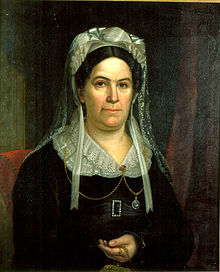 An 1823 portrait of Rachel Jackson by Ralph Eleaser Whiteside Earl, now housed at The Hermitage in Nashville, Tennessee.
After the American Revolutionary War, Jackson worked as a saddler,[22] briefly returned to school, and taught reading and writing to children.[23] In 1784, he left the Waxhaws region for Salisbury, North Carolina, where he studied law under attorney Spruce Macay.[24] He completed his training under John Stokes,[25] and was admitted to the North Carolina bar in September 1787.[26] Shortly thereafter, his friend John McNairy helped him get appointed as a prosecuting attorney in the Western District of North Carolina,[27] which would later become the state of Tennessee. While traveling to assume his new position, Jackson stopped in Jonesborough. While there, he bought his first slave, a woman who was around his age.[28] He also fought his first duel, accusing another lawyer, Waightstill Avery, of impugning his character. The duel ended with both men firing in the air.[29]
Jackson began his new career in the frontier town of Nashville in 1788 and quickly moved up in social status.[30] He became a protégé of William Blount, one of the most powerful men in the territory.[31] Jackson was appointed attorney general in 1791 and judge advocate for the militia the following year.[32] He also got involved in land speculation,[33] eventually forming a partnership with fellow lawyer John Overton.[34] Their partnership mainly dealt with claims made under a 'land grab' act of 1783 that opened Cherokee and Chickasaw territory to North Carolina's white residents.[35]
While boarding at the home of Rachel Stockly Donelson, the widow of John Donelson, Jackson became acquainted with their daughter, Rachel Donelson Robards. The younger Rachel was in an unhappy marriage with Captain Lewis Robards, and the two were separated by 1789.[36] After the separation, Jackson and Rachel became romantically involved,[37] living together as husband and wife.[38] Robards petitioned for divorce, which was granted on the basis of Rachel's infidelity.[39] The couple legally married in January 1794.[40] In 1796, they acquired their first plantation, Hunter's Hill,[41] on 640 acres (260 ha) of land near Nashville.[42]
Early public career
Jackson became a member of the Democratic-Republican Party, the dominant party in Tennessee.[31] He was elected as a delegate to the Tennessee constitutional convention in 1796.[43] When Tennessee achieved statehood that year, he was elected to be its U.S. representative. In Congress, Jackson argued against the Jay Treaty, criticized George Washington for allegedly removing Democratic-Republicans from public office, and joined several other Democratic-Republican congressmen in voting against a resolution of thanks for Washington.[44] He advocated for the right of Tennesseans to militarily oppose Native American interests.[45] The state legislature elected him to be a U.S. senator in 1797, but he resigned after serving only six months.[46]
Upon returning to Tennessee, Jackson was elected as a judge of the Tennessee superior court.[47][48] In 1802, he also became major general, or commander, of the Tennessee militia, a position that was determined by a vote of the militia's officers. The vote was tied between Jackson and John Sevier, a popular Revolutionary War veteran and former governor, but the current state governor, Archibald Roane, broke the tie in Jackson's favor. Jackson later accused Sevier of fraud and bribery.[49] Sevier responded by impugning Rachel's honor, resulting in a shootout on a public street.[50] Soon afterwards, they met to duel, but parted without having fired at each other.[51]
Planting career and slavery
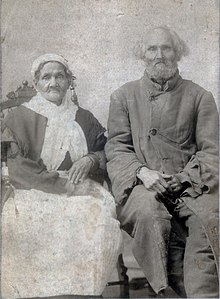 Aaron and Hannah Jackson, two slaves owned by Jackson, photographed by Theodore Schleier in 1865, now housed at The Hermitage in Nashville.
Jackson resigned his judgeship in 1804.[52] He had almost gone bankrupt when the credit he used for land speculation collapsed in the wake of an earlier financial panic.[53] He had to sell Hunters Hill, as well as 25,000 acres (10,000 ha) of land he bought for speculation, and bought a smaller 420-acre (170 ha) plantation near Nashville that he would call the Hermitage.[54] He focused on recovering from his losses by becoming a successful planter and merchant.[54] The Hermitage would grow to 1,000 acres (400 ha),[55] making it one of the largest cotton-growing plantations in the state.[52]
...
Duel with Dickinson and adventure with Burr
In May 1806, Jackson fought a duel with Charles Dickinson. They had gotten into an argument over a horse race, and Dickinson allegedly uttered a slur against Rachel.[50] During the duel, Dickinson fired first, and the bullet hit Jackson in the chest. The wound was not life-threatening because the bullet had shattered against his breastbone.[64] Jackson returned fire and killed Dickinson. The killing tarnished Jackson's reputation.[65]
Later in the year, Jackson became involved in former vice president Aaron Burr's plan to conquer Spanish Florida and drive the Spanish from Texas. Jackson had first gotten to know Burr in 1805 when he stayed with the Jacksons at the Hermitage during a tour of what was then the Western United States that he had embarked on after mortally wounding Alexander Hamilton in the Burr–Hamilton duel.[66] Burr eventually persuaded Jackson to join his adventure. In October 1806, Jackson wrote James Winchester that the United States "can conquer not only the Floridas at that time there was an [East Florida and a West Florida], but all Spanish North America".[67] He informed the Tennessee militia that it should be ready to march at a moment's notice "when the government and constituted authority of our country require it",[68] and agreed to provide boats and provisions for the expedition.[66] Jackson sent a letter to president Thomas Jefferson telling him that Tennessee was ready to defend the nation's honor.[69]
Jackson also expressed uncertainty about the enterprise. He warned the Governor of Louisiana William Claiborne and Tennessee Senator Daniel Smith that some of the people involved in the adventure might be intending to break away from the United States.[70] In December, Jefferson ordered Burr to be arrested for treason.[66] Jackson, safe from arrest because of his extensive paper trail, organized the militia to capture the conspirators.[71] Jackson testified before a grand jury at Burr's trial in 1807, implying that it was Burr's associate James Wilkinson who was guilty of treason, not Burr. Burr was acquitted of the charges.[72]
Military career
War of 1812
Creek War
Main article: Creek War
On June 18, 1812, the United States declared war on the United Kingdom.[73] Though the causes of the War of 1812 were primarily about maritime issues,[74] the war provided the white settlers on the southern frontier the opportunity to overcome Native American resistance to settlement, undermine British support of the Native American tribes,[75] and pry Florida from the Spanish.[76]
Jackson immediately offered to raise volunteers for the war, but he was not called to duty until after the United States military was repeatedly defeated in the American Northwest. After these defeats, in January 1813, Jackson enlisted over 2,000 volunteers,[77] who were ordered to head to New Orleans to defend against a British attack.[78][79][80][81] When his forces arrived at Natchez, they were ordered to halt by General Wilkinson, the commander at New Orleans and the man Jackson accused of treason after the Burr adventure. A little later, Jackson received a letter from the Secretary of War, John Armstrong, stating that his volunteers were not needed,[15] and that they were to be disbanded and any supplies were to be handed over to Wilkinson.[82] Jackson refused to disband his troops; instead, he led them on the difficult march back to Nashville, earning the nickname "Hickory" (later "Old Hickory") for his toughness.[83]
After returning to Nashville, Jackson and one of his colonels, John Coffee, got into a street brawl over honor with the brothers Jesse and Thomas Hart Benton. Nobody was killed, but Jackson received a gunshot in the shoulder that nearly killed him.[84]
Jackson had not fully recovered from his wounds when Governor Blount called out the militia in September 1813 following the August Fort Mims Massacre.[85] The Red Sticks, a confederate faction that had allied with Tecumseh, a Shawnee chief who was fighting with the British against the United States, killed about 250 militia men and civilians at Fort Mims in retaliation for an ambush by American militia at Burnt Corn Creek.[86][87]
Jackson's objective was to destroy the Red Sticks.[88] He headed south from Fayetteville, Tennessee in October with 2,500 militia, establishing Fort Strother as his supply base.[89] He sent his cavalry under General Coffee ahead of the main force, destroying Red Stick villages and capturing supplies.[90][91] On November 3, Coffee defeated a band of Red Sticks at the Battle of Tallushatchee. Later in the month, Jackson defeated another band of Red Sticks who were besieging Creek allies at the Battle of Talladega.[92
...
Battle of New Orleans
Main article: Battle of New Orleans
 The Battle of New Orleans, a 1910 portrait by Edward Percy Moran depicting the Battle of New Orleans
Jackson arrived in New Orleans on December 1, 1814.[110] There he instituted martial law because he worried about the loyalty of the city's Creole and Spanish inhabitants. He augmented his force by forming an alliance with Jean Lafitte's smugglers and raising units of free African Americans and Creek,[111] paying non-white volunteers the same salary as whites.[112] This gave Jackson a force of about 5,000 men when the British arrived.[113]
The British arrived in New Orleans in mid-December.[114] Admiral Cochrane was the overall commander of the operation;[115] General Edward Pakenham commanded the army of 10,000 soldiers, many of whom had served in the Napoleonic Wars.[116] As the British advanced up the east bank of the Mississippi River, Jackson constructed a fortified position to block them.[117] The climactic battle took place on January 8 when the British launched a frontal assault. Their troops made easy targets for the Americans protected by their parapets, and the attack ended in disaster.[118] General Pakenham was killed and the British suffered over 2,000 casualties; the Americans had suffered about 60 casualties.[119]
The British decamped from New Orleans at the end of January, but they still remained a threat.[120] Jackson refused to lift martial law and kept the militia under arms. He approved the execution of six militiamen for desertion.[121] Some Creoles registered as French citizens with the French consul and demanded to be discharged from the militia due to their foreign nationality. Jackson then ordered all French citizens to leave the city within three days,[122] and had a member of the Louisiana legislature, Louis Louaillier, arrested when he wrote a newspaper article criticizing Jackson's continuation of martial law. U.S. District Court Judge Dominic A. Hall signed a writ of habeas corpus for Louailler's release. Jackson had Hall arrested too. A military court ordered Louiallier's release, but Jackson kept him in prison and evicted Hall from the city.[123] Although Jackson lifted martial law when he received official word that the Treaty of Ghent, which ended the war with the British, had been signed,[124] his previous behavior tainted his reputation in New Orleans.[125]
Jackson's victory made him a national hero,[126] and on February 27, 1815, he was given the Thanks of Congress and awarded a Congressional Gold Medal.[47] Though the Treaty of Ghent had been signed in December 1814 before the Battle of New Orleans was fought,[127] Jackson's victory assured that the United States control of the region between Mobile and New Orleans would not be effectively contested by European powers. This control allowed the American government to ignore one of the articles in the treaty, which would have returned the Creek lands taken in the Treaty of Fort Jackson.[128]
First Seminole War
Main article: Seminole Wars § First Seminole War
 A circa 1846 engraving of the trial of Robert Ambrister by William Croome in John Frost's Pictorial Life of Andrew Jackson
Following the war, Jackson remained in command of troops in the southern half of the United States and was permitted to make his headquarters at the Hermitage.[129] Jackson continued to displace the Native Americans in areas under his command. Despite resistance from the Secretary of the Treasury William Crawford, who tried to help the Native Americans retain their land, Jackson signed five treaties between 1816 and 1820, including the Treaty of Tuscaloosa and the Treaty of Doak's Stand,[130] in which the Creek, Choctaw, Cherokee and Chickasaw ceded tens of millions of acres of land to the United States.[131]
...
Indian Removal Act
Further information: Indian removal, Indian Removal Act, and Trail of Tears
[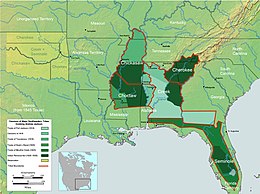 ](https://en.wikipedia.org/wiki/File:Cessions_Southeastern_Tribes-_Andrew_Jackson.jpg)The Indian Removal Act and treaties involving Jackson before his presidency displaced most of the major tribes of the Southeast from their traditional territories east of the Mississippi.
Jackson's presidency marked the beginning of a national policy of Native American removal.[208] Before Jackson took office, the relationship between the southern states and the Native American tribes who lived within their boundaries was strained. The states felt that they had full jurisdiction over their territories; the native tribes saw themselves as autonomous nations that had a right to the land they lived on.[214] Significant portions of the five major tribes in the area then known as the Southwest—the Cherokee, Choctaw, Chickasaw, Creek, and Seminoles— began to adopt white culture, including education, agricultural techniques, a road system, and rudimentary manufacturing.[215] In the case of the tensions between the state of Georgia and the Cherokee, Adams had tried to address the issue encouraging Cherokee emigration west of the Mississippi through financial incentives, but most refused.[216]
In the first days of Jackson's presidency, some of the southern states had passed legislation extending state jurisdiction to Native American lands.[217] Jackson supported the states' right to do so.[218][219] His position was later made clear in the 1832 Supreme Court test case of this legislation, Worcester v. Georgia. Georgia had arrested a group of missionaries for entering Cherokee territory without a permit; the Cherokee declared these arrests illegal. The court under Chief Justice John Marshall decided in favor of the Cherokee: imposition of Georgia law on the Cherokee was unconstitutional.[220] Horace Greeley alleges that when Jackson heard the ruling, he said, "Well, John Marshall has made his decision, but now let him enforce it."[221] Although the quote may be apocryphal, Jackson made it clear he would not use the federal government to enforce the ruling.[222][223][224]
Jackson used the power of the federal government to enforce the separation of the Native American tribes and whites.[225] In May 1830, Jackson passed the Indian Removal Act through Congress.[226] It gave the president the right to negotiate treaties to buy tribal lands in the eastern part of the United States in exchange for lands set aside for Native Americans west of the Mississippi,[227] as well as broad discretion on how to use the federal funds allocated to the negotiations.[228] The law was supposed to be a voluntary relocation program, but it was not implemented as one. Jackson's administration often achieved agreement to relocate through bribes, fraud and intimidation,[229] and the leaders who signed the treaties often did not represent the entire tribe.[230] The relocations could be a source of misery too: the Choctaw relocation was rife with corruption, theft, and mismanagement that brought great suffering to that people.[231]
 Portrait of Jackson by Ralph E. W. Earl (c. 1830, North Carolina Museum of Art)
In 1830, Jackson personally negotiated with the Chickasaw, who quickly agreed to move.[232] In the same year, Choctaw leaders signed the Treaty of Dancing Rabbit Creek; the majority did not want the treaty but complied with its terms.[233] In 1832, Seminole leaders signed the Treaty of Payne's Landing, which stipulated that the Seminoles would move west and become part of the Muscogee Creek Confederacy if they found the new land suitable.[234] Most Seminoles refused to move, leading to the Second Seminole War in 1835 that lasted six years.[230] Members of the Muscogee Creek Confederacy ceded their land to the state of Alabama in the Treaty of Cusseta of 1832. Their private ownership of the land was to be protected, but the federal government did not enforce this. The government did encourage voluntary removal until the Creek War of 1836, after which almost all Creek were removed to Oklahoma territory.[235] In 1836, Cherokee leaders ceded their land to the government by the Treaty of New Echota.[236] Their removal, known as the Trail of Tears, was enforced by Jackson's successor, Van Buren.[237]
Jackson also applied the removal policy in the Northwest. He was not successful in removing the Iroquois Confederacy in New York, but when some members of the Meskwaki (Fox) and the Sauk triggered the Black Hawk War by trying to cross back to the east side of the Mississippi, the peace treaties ratified after their defeat reduced their lands further.[238]
During his administration, he made about 70 treaties with American Indian tribes. He had removed almost all the Native Americans east of the Mississippi and south of Lake Michigan, about 70,000 people, from the United States;[239] though it was done at the cost of thousands of Native American lives lost because of the unsanitary conditions and epidemics arising from their dislocation, as well as their resistance to expulsion.[240] Jackson's implementation of the Indian Removal Act contributed to his popularity with his constituency. He added over 170,000 square miles of land to the public domain, which primarily benefited the United States' agricultural interests. The act also benefited small farmers, as Jackson allowed them to purchase moderate plots at low prices and offered squatters on land formerly belonging to Native Americans the option to purchase it before it was offered for sale to others.[241]
Nullification crisis
Main article: Nullification crisis
...
Panic of 1837
Main article: Panic of 1837
 Lithograph cartoon of the Panic of 1837 published by H. R. Robinson (1837). Jackson is symbolized by "Glory" in the sky with top hat, spectacles, and pipe.
Despite the economic boom following Jackson's victory in the Bank War, land speculation in the west caused the Panic of 1837.[306] Jackson's transfer of federal monies to state banks in 1833 caused western banks to relax their lending standards;[307] the Indian Removal Act made large amounts of former Native American lands available for purchase and speculation.[308] Two of Jackson's acts in 1836 contributed to the Panic of 1837. One was the Specie Circular, which mandated western lands only be purchased by money backed by specie. The act was intended to stabilize the economy by reducing speculation on credit, but it caused a drain of gold and silver from the Eastern banks to the Western banks to address the needs of financing land transactions.[309] The other was the Deposit and Distribution Act, which transferred federal monies from eastern to western state banks. Together, they left Eastern banks unable to pay specie to the British when they recalled their loans to address their economic problems in international trade.[310] The panic drove the U.S. economy into a depression that lasted until 1841.[306]
Physical assault and assassination attempt
[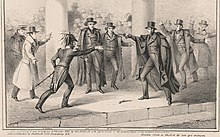 Lithograph of attempted assassination of Andrew Jackson published by Endicott & Co. (1835).
Jackson was the first president to be subjected to physical assault as well as an assassination attempt.[311] On May 6, 1833, Robert B. Randolph struck Jackson in the face with his hand because Jackson had ordered Randolph's dismissal from the navy for embezzlement. Jackson declined to press charges.[312] While leaving the United States Capitol on January 30, 1835, Richard Lawrence, an unemployed house painter from England, aimed a pistol at Jackson, which misfired. Lawrence pulled out a second pistol, which also misfired. Jackson attacked Lawrence with his cane until others intervened to restrain Lawrence, who was later found not guilty by reason of insanity and institutionalized.[313][314]
Slavery
During Jackson's presidency, slavery remained a political issue.[315] Though federal troops were used to crush Nat Turner's slave rebellion in 1831,[316] Jackson ordered them withdrawn immediately afterwards despite the petition of local citizens for them to remain for protection.[317] Jackson considered the issue too divisive to the nation and to the delicate alliances of the Democratic Party,[318] while sympathetic newspapers argued for excluding slavery from federal politics and keeping it at the state level.[319]
Jackson's view was challenged when the American Anti-Slavery Society formally agitated for abolition[320] by sending anti-slavery tracts through the postal system into the South in 1835.[318] Jackson condemned these agitators as "monsters"[321] who should atone with their lives[322] because they were attempting to destroy the Union by encouraging sectionalism.[323] The act provoked riots in Charleston, and pro-slavery Southerners demanded that the postal service ban distribution of the materials. To address the issue, Jackson authorized that the tracts could be sent only to subscribers, whose names could be made publicly accountable.[324] That December, Jackson called on Congress to prohibit the circulation through the South of "incendiary publications intended to instigate the slaves to insurrection".[325]
Foreign affairs
[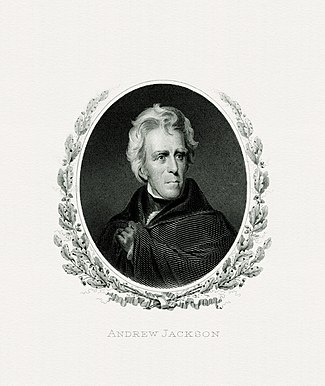
Engraved portrait of Jackson as president by the Bureau of Engraving and Printing. This portrait has appeared on the $20 bill since 1929.[326]
The Jackson administration successfully negotiated trade agreements with Great Britain, Spain, Russia, the Ottoman Empire, and Siam.[327] In his First Annual Message to Congress, Jackson addressed the issues of spoliation claims, demands of compensation for the capture of American ships and sailors by foreign nations during the Napoleonic Wars.[328] Using a combination of bluster and tact, he successfully settled these claims with Denmark, Portugal, and Spain,[327] but he had difficulty collecting spoliation claims from France, which was unwilling to pay an indemnity agreed to in an earlier treaty. Jackson asked Congress in 1834 to authorize reprisals against French property if the country failed to make payment, as well as to arm for defense.[328] In response, France put its Caribbean fleet on a wartime footing.[329] Both sides wanted to avoid a conflict, but the French wanted an apology for Jackson's belligerence. In his 1835 Annual Message to the Congress, Jackson asserted that he refused to apologize, but stated that he did not intend to "menace or insult the Government of France".[330] The French were assuaged and agreed to pay $5,000,000 (equivalent to $141,838,700 in 2022) to settle the claims.[331]
Since the early 1820s, large numbers of Americans had been immigrating into Texas, a territory of the newly independent nation of Mexico.[332] As early as 1824, Jackson had expressed a desire to acquire the region for the United States.[333] In 1829, he attempted to purchase it, but Mexico did not want to sell. By 1830, there were twice as many settlers from the United States as from Mexico, leading to tensions with the Mexican government that started the Texas Revolution. During the conflict, Jackson covertly allowed the settlers to obtain weapons and money from the United States.[334] They defeated the Mexican military in April 1836 and soon afterward declared the region an independent country, the Republic of Texas. The new Republic asked Jackson to recognize and annex it. Although Jackson wanted to do so, he was hesitant because he was unsure it could maintain independence from Mexico.[327] He also was concerned because Texas had legalized slavery, which was an issue that could divide the Democrats during the 1836 election. Jackson recognized the Republic of Texas on the last full day of his presidency, March 3, 1837.[335]
...
Legacy
 Equestrian statue of Jackson by Charles Keck in front of the Jackson County Courthouse, Kansas City, Missouri (1934). Commissioned by Judge Harry S. Truman
See also: List of memorials to Andrew Jackson
Jackson's legacy is controversial[380][381] and polarized.[382] Jackson's contemporary, Alexis de Tocqueville, depicted Jackson as the spokesperson of the majority and their passions.[383] He has been variously described as a frontiersman personifying the independence of the American West,[384] a slave-owning member of the Southern gentry,[385] and a populist who promoted faith in the wisdom of the ordinary citizen.[386] He has been represented as a statesman who substantially advanced the spirit of democracy[387] and upheld the foundations of American constitutionalism,[388] as well as an autocratic demagogue who crushed political opposition and trampled the law.[389][390]
In the 1920s, Jackson's rise to power became associated with the idea of the "common man".[391] This idea defined the age as a populist rejection of social elites and a vindication of every person's value independent of class and status.[392] Jackson was seen as its personification,[393] an individual free of societal constraints who can achieve great things.[394] In 1945, Arthur M. Schlesinger Jr.'s influential Age of Jackson redefined Jackson's legacy through the lens of Franklin D. Roosevelt's New Deal,[395] describing the common man as a member of the working class struggling against exploitation by business concerns.[396]
In the twenty-first century, Jackson's Indian Removal Act (Trail of Tears) has been described as ethnic cleansing:[397] the use of force, terror and violence to make an area ethnically homogeneous.[398] To achieve the goal of separating Native Americans from the whites,[399] coercive force such as threats and bribes were used to effect removal [400] and unauthorized military force was used when there was resistance,[229] as in the case of the Second Seminole War.[401] The act has been discussed in the context of genocide,[402] and its role in the long-term destruction of Native American societies and their cultures continues to be debated.[403]
His legacy has been variously used by later presidents. Abraham Lincoln referenced Jackson's ideas when negotiating the challenges to the Union that he faced during 1861, including Jackson's understanding of the constitution during the nullification crisis and the president's right to interpret the constitution.[404] Franklin D. Roosevelt used Jackson to redefine the Democratic Party, describing him as a defender of the exploited and downtrodden and as a fighter for social justice and human rights.[405][406] Donald Trump used Jackson's legacy to present himself as the president of the common man,[407] praising Jackson for saving the country from a rising aristocracy and protecting American workers with a tariff.[408] In 2016, President Barack Obama's administration announced it was removing Jackson's portrait from the $20 bill and replacing it with one of Harriet Tubman.[409] Though the plan was put on hold during Trump's presidency, President Joe Biden's administration resumed it in 2021.[410]
Jackson is usually rated highly as a president, but his reputation is dropping.[411] His contradictory legacy is shown in opinion polls. A 2014 survey of political scientists rated Jackson as the ninth-highest rated president but the third-most polarizing. He was also rated the third-most overrated president.[412] In a C-SPAN poll, Jackson was ranked the 13th in 2009, 18th in 2017, and 22nd in 2021.[413]
see main node
Name: Andrew Jackson
Nickname/Alias: President Jackson; Old Hickory
Achievements: President of the United States
Born: March 15, 1767; Waxhaw settlement, SC
Died: June 8, 1845; Nashville, Tennessee (Aged 78)
Field & Discipline: Military; Government; Politics; President; General
Language: English
Father: Andrew Jackson
Elizabeth Hutchinson
Siblings: Hugh; Robert
Spouse: Rachel Donelson
Children: Adopted son: Andrew
Education: Presbyterian Academies, Waxhaw, SC; law school, Salisbury, SC
Life & Times:
Jackson left school at 13 in 1880 to fight the British. He took part (probably as a messenger) in the battle of Hanger Rock in August of that year. Four years later, he went to Salisbury, SC to study law and was admitted to the bar in 1787. In 1788 he moved to Nashville, TN, and for the next seven years established himself as a successful public prosecutor and lawyer.
In 1795, Jackson was elected to the convention that drafted the Tennessee constitution and in 1796, when Tennessee became a state, he was the sole Tennessee representative to the House of Representatives. He was one of only three men to vote against paying tribute to[opposed tribute to] Washington* on his retirement because he thought that the [disapproved of] Jay* treaty, which had been negotiated with the British during Washington's presidency, was dishonorable.
In 1797, he was elected to the Senate, but disliked the atmosphere and disapproved of [disapproved of] John Quincy Adams*'s administration. ( [thought dangerous by] Jefferson* labeled Jackson a dangerous man of extreme passions.)
In 1798, Jackson resigned as senator and was elected to the Tennessee state superior court, where he served until 1804, then resigned to pursue a business career. He sold his plantation and moved with his wife and slaves to a site outside Nashville that he called the Hermitage. He worked as a merchant while his wife ran the plantation.
When war with Britain broke out in 1812, Jackson, a major-general in the Tennessee militia, was sent to fight the Creek Indians, who had attacked the southern frontier. He won several spectacular victories and his admiring men nicknamed him "Old Hickory". He was then commissioned as a major-general in the U.S. Army.
At the end of 1812, when it was feared Britain was planning an attack on New Orleans from Jamaica, Jackson was dispatched there, and immediately put the city under martial law. It was clear that if the British took New Orleans, they would almost certainly renege on a peace treaty which was being negotiated in Belgium.
When the attack came in January, 1815, Jackson saved the day. His men, stationed behind a rampart, mowed down more than 2,000 British soldiers in less than two hours. The number of American dead was less than 20. The stupendous victory made Jackson a national hero and earned him a promotion to commander of the southern U.S. Army.
Because of his legal expertise, Jackson was asked to negotiate land settlements with Indian tribes. In 1818, on a mission to negotiate a land deal with the Seminole Indians in Spanish Florida, Jackson took it upon himself to cross the Florida border, capture St. Marks and Pensacola and proclaim the establishment of a provisional American government in Florida.
During this process, he ordered the execution of two British subjects for spying. He notified President [resigned commission under] Monroe* of what he had done, resigned his command, and returned to Nashville.
Though this behavior shocked America, Jackson was defended in cabinet by the Secretary of State John Quincy Adams, and his own popularity with the people ensured that resolutions condemning his action were voted down. Spain agreed to give up Florida and in 1821, Monroe appointed Jackson governor of the new territory. He took the time to establish an efficient administration, then resigned.
In 1822, Tennessee legislators unanimously nominated Jackson for the Presidency, and to help him along, elected him to the Senate in 1823. But Adams was elected president and Jackson returned to Tennessee. His supporters, however, were undaunted. They formed an organization around him, which later became the Democratic party, and Jackson won resoundingly over Adams in 1829.
During his two Presidential terms, 1829-1837, Jackson accomplished many of his stated aims of: "reform, retrenchment and economy". He managed to pay off the national debt of $60 million by 1835, but to do so he had to sell public land, veto numerous public works schemes such as the construction of lighthouses and the dredging of harbors, and impose a high import tariff.
He was strongly nationalist and declared that no state could leave the Union or remove federal law from the statute books. He declared that government should be open to all, and that the people were sovereign. He proposed the direct election of presidents, senators and judges, and argued for the right of voters to instruct their representatives. He worked to have the southern Indians removed to an area beyond the Mississippi, for reasons of national defense.
Jacksonpursued the interests of the United States abroad, negotiating compensation from France for seizure of shipping during the Napoleonic wars, and settling claims with Denmark and the Kingdom of Naples. He resolved the dispute with Britain over the West Indies, and in 1833 a trade treaty was signed with Siam, the first U.S. treaty with an Asian nation.
Extra Connections: [supported by] Buchanan* and [supported by] Polk* supported him for election.
He declared a national day of mourning at death of last Founding Father [declared day of mourning for] Charles Carroll* of Carrollton
Assessment: Recent appraisals label him opportunist and reactionary, but he was a brilliant general and able president who upheld nationalist principles, paid off the national debt, and warily negotiated with foreign powers
Oneliner: Andrew Jackson, President of the United States
Bibliography:
- Remini, Robert V, The Life of Andrew Jackson, Harper & Row, New York, 1988.