Deane, Silas
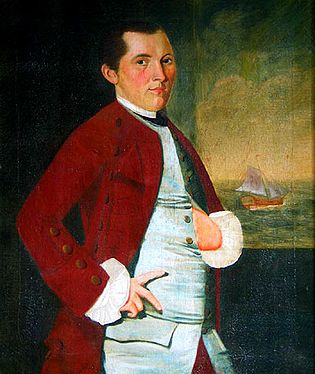
Nickname/Alias: Silas Dean (added the final e to his name after 1761); “Ticonderoga”
Achievements: Arranged French arms supply, to support the American independence effort, through Rodrigue Hortalez and Company
Born: December 24, 1737; Groton, Connecticut
Died: September 1789; Deal, Kent, England
Field & Discipline: Politics; Government; Diplomacy
Language: English
Father: Blacksmith Silas Dean
Mother: Sarah Barker
Siblings: six siblings
Spouse: 1) Mehitable Nott Webb; 2) Elizabeth Saltonstall Ebbets
Children: one biological child, five step-children
Education: Yale Law School
Life & Times:
Silas Deane was born December 24th 1737 in Groton, Connecticut. His father, Silas Dean the elder, was a blacksmith who worked to put his son through Yale. After graduating from Yale in 1758, Deane moved to the community of Wethersfield where he taught school and studied law. After the deaths of his parents in 1760 and 1761, Deane brought his six siblings to live with him.
He passed the bar in 1763 and soon after married a widow named Mehitable Nott Webb, acquiring five step-children and capital and contacts from her family’s mercantile business in the union. They had one child together before Mehitable died from tuberculosis in 1767.
Before two years had passed, Deane married Elizabeth Saltonstall Ebbets, the granddaughter of a former Connecticut governor. His new wife gave Deane access to a new political circle and in 1768 Deane became one of two deputies for Wethersfield to the General Assembly. Deane’s rise in politics was hindered, however, by lawsuits filed by his first wife’s family over his handling of funds and real estate belonging to the Webbs. The suits were not settled until the 1790s.
His connection to the Susquehannah Company through the Saltonstalls helped to counteract the negative effects of the Webb lawsuits. The Susquehannah Company was a group of merchants using the Connecticut charter’s sea-to-sea clause to claim land in Pennsylvania’s Wyoming Valley. Deane helped the company and became the leading expansionist in the colony by 1774.
After Boston’s port was closed in 1774, Deane kept Wethersfield at the front of efforts to aid the city and as a result of his efforts he was named Secretary of the Connecticut Committee of Correspondence and one of Connecticut’s three delegates to the First Continental Congress.
In both the First Continental Congress in 1774 and the Second Continental Congress the following year, Deane concentrated his efforts on committees concerned with arming the Continental Army and providing for a navy that was just being created. In the First Continental Congress he worked alongside 54 other delegates including [a colleague of] George Washington*, [a colleague of] John Adams*, [a colleague of] Samuel Adams*, John [a colleague of] Jay*, and Patrick Henry. Among the new delegates in the Second Continental Congress were [a colleague of] Benjamin Franklin*, [a colleague of] Thomas Jefferson*, and [a colleague of] John Hancock*.
In 1775 he earned the nickname “Ticonderoga” by budgeting £300 for Ethan Allen and Benedict Arnold’s expedition to capture Fort Ticonderoga. Despite his successes, Deane was not nominated for a third term in October 1775. Governor John Trumbull told Deane the Connecticut Assembly found him un-teachable and incorrigible.
After finishing his term in the Connecticut Assembly, Deane contracted with the Secret Commission to travel to France to purchase goods for trade with the Indians. He was also sent to France by the Committee of Secret Correspondence to ascertain the French reaction to the movement towards American Independence and to acquire arms. Deane began his mission in France in July 1776. He didn’t speak any French and received little instruction from Congress. Deane was received by the foreign minister, Vergennes, who chose Caron de [did deal with] Beaumarchais*, a playwright, as the agent to send funds for the American Revolution.
A company, Rodrigue Hortalez and Company, was loaned royal funds to buy unused arms from government arsenals. The arms were then sold on credit to Deane and Congress, and were used to defeat the British at Saratoga in 1777. Deane’s shipments of American tobacco to Beaumarchais were insufficient to repay the debt owed and Congress found it convenient to accept the arms shipments as personal gifts from the French government rather than transactions. Not wanting to contradict the official position of neutrality, Vergennes did not argue.
Deane exceeded his mission, however, and began contracting French soldiers for the Continental Army. One of his successes in this respect was the Marquis de [hired] Lafayette*. Deane also used his inside knowledge of international relations to deal on the London Stock Exchange. In December 1776, Deane was joined in Europe by Benjamin Franklin and Arthur Lee. Franklin focused on French public opinion while Lee went on trips of military diplomacy into Spain and Prussia, leaving Deane to himself.
In 1778, Franklin, Deane, and Lee achieved what they had set out to accomplish: they established military and commercial and political Franco-American Alliances. Soon after, Deane learned the he had been recalled by Congress but was given no reason why. He returned to find his contracts with French officers being contested and his financial actions in Europe being questioned. Deane fought the accusations by publishing a letter in the Pennsylvania Gazette in December 1778.
This split Congress into two factions. Among those who denounced Deane was [enemy of] Thomas Paine*. In the process Paine revealed Deane’s secret dealings with the French and as a consequence Deane lost his post as Secretary to the Committee for Foreign Affairs. After a little over a year of argument, Deane was discharged without indictment.
Deane attempted to vindicate himself and regain his fortune, but failed. In the spring of 1781 a series of intercepted letters were published. The letters suggested that Deane had traitorously joined the British. The letters argued that Americans should give up alliances with France, and reconcile with Britain. The year the letters became public Deane was living in Ghent. By March 1783 he was living in London, where thieves stole his papers and offered them for sale to Thomas Jefferson.
Plans to build a canal from Lake Champlain to the St. Lawrence River led Deane to embark for America in September of 1789 but within four hours of departure he was so ill the ship returned to port in Deal, England, where Deane died. The cause of his death is unknown and it has been speculated that he either committed suicide or was poisoned.
Extra Connections:
He toured several manufacturing towns in England in late 1783, considering plans for steam engines that could operate grist mills, even consulting James Watt for advice.
He knew [knew] William Williams*, [knew] William Floyd*, [knew] Richard Henry Lee*, [knew] Benjamin Harrison*, [knew] Francis L Lee*
Supported submarine attack of the Turtle in Revolutionary War (along with Washington, Jefferson and Franklin).
Assessment: An influential player in Franco-American relations during the American Revolution. He was an enigmatic, possibly corrupt, and opportunistic statesman in the early days of the formation of the United States.
Oneliner: Silas Deane, American Independence diplomat
Bibliography:
- American National Biography Online Feb. 2000. Access Date: Thu Jun 7 00:42:13 CDT 2007.
- Louis W. Potts. "Deane, Silas"; http://www.anb.org.proxy.lib.ohio-state.edu/articles/01/01-00213.html.
Audio/Visual:
- http://www.silasdeaneonline.org/#silas; resource for grades 9-12.
- http://mc04.equinox.net/wdsmuseum/deanehouse.html; his home in Wethersfield.