Gibbon
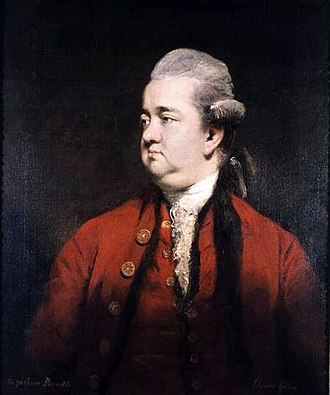
Name: Edward Gibbon
Achievements: History of the Roman Empire
Born: May 8, 1737; Putney, Surrey, England
Died: January 16, 1794; London, England (Aged 57)
Field & Discipline: History; Historian
Language: English
Father: Edward Gibbon
Mother: Judith Porten
Siblings: None survived infancy
Spouse: None
Children: None
Education: Kingston grammar school; Westminster school, London; Private tutors; Magdalen College, Oxford
Major Work:
"The History of the Decline and Fall of the Roman Empire" (1776-88)
Life & Times:
In 1753 Gibbon was received into the Roman Catholic church. His father was appalled, since Roman Catholics were still barred from public office, so Gibbon was sent to Lausanne where he was put under the care of Daniel Pavillard, a Calvinist minister. Under Pavillard's guidance, he followed an organized programme of reading for the first time in his life and returned to the Protestant religion.
By the time his father recalled him in 1758, had become engaged to Suzanne Curchod, the daughter of a Swiss minister. Gibbon's father was annoyed and Gibbon was made to break off the engagement. Suzanne later became [engaged to] Mme Necker* and the mother of [fiancée became mother of] De Stael*.
Over the next five years Gibbon continued to read and educate himself while he made up his mind what historical subject he would write about. In 1759 he completed an essay in French titled "Essai sur l'Etude de la Litterature" ("Essay on the Study of Literature") and from 1760-62 he served as captain in the Hampshire militia, an experience which he valued for its insights into military life. During this time he met [met] Wilkes*, who was serving in the Buckinghamshire militia.
In 1763 he was free to travel and visited Paris where he met intellectuals including [met] Diderot* and [met] d'Alembert*.
He then stayed in Lausanne for a year, during which time he read the classics in preparation for a visit to Italy. In April 1764 he went to Florence and five months later moved on to Rome. On 15 October he was sitting in the Capitol when he first had the idea of writing about the decline and fall of Rome.
After visiting Naples, Venice and Verona he travelled back to his father's estate in Hampshire in June 1765. He was still not sure what should be his major literary project and began to write a history of the Swiss. A Swiss friend, Deyverdun came over to join him and together they published two volumes of "Memoires litteraires de la Grande Bretagne" (1768-9, "Literary memoirs of Great Britain").
After his father died in 1770, Gibbon finally began work on his history of the Roman Empire. He was now financially independent and in 1772, having sold off his father's estate, he set up a home in London.
In 1774 he became a Member of Parliament for Liskeard in Cornwall and a supporter of Lord North's government during the American war. Gibbon also became part of the fashionable literary set in London and was elected a member of The Club, a society set up by the artist Sir Joshua Reynolds* of which [club member with] Dr Johnson* was the leading light.
Gibbon was disliked by both Johnson and his sidekick, [club member with] Boswell*, but he formed a close friendship with Reynolds and with the actor [club member with] Garrick*.
The first volume of Gibbon's history of the Roman Empire came out in February 1776 and was a triumphant success in spite of criticism about the ironic tone he used when covering the rise of Christianity. Gibbon dealt with critics such as [criticized by] Joseph Priestley*, by pointing out that religions were a part of human history and should be treated as such, and established an important principle followed by historians and other writers after him.
In 1779, he answered his critics in "A Vindication of Some Passages in the Fifteenth and Sixteenth Chapters of the Decline and Fall of the Roman Empire". Gibbon did not rush to complete his history and occupied some of his time at anatomy lectures given by [attended lectures by] William Hunter* at the Royal College of Surgeons.
In the same year the government awarded him a lucrative job as commissioner of trade and plantations. Soon afterwards Gibbon wrote a defence of the government's American policy in response to criticism from other European states. Gibbon himself was not particularly political, and when he lost his seat at the election of 1780 it did not bother him.
He was free to concentrate on his history and in 1781 published the second and third volumes. He considered ending the work there, having got to the fall of the Roman Empire in the West, c 480 AD. But when North's government fell in 1782 Gibbon's job as a commissioner was abolished.
To save money, he went to join Deyverdun at Lausanne in 1783, taking his library with him, and over the next four years he completed his work, which covers the history of the Roman Empire in the East up to the fall of Constantinople, and ends with chapters on mediaeval and Renaissance Rome.
Throughout the entire history, Gibbon took the view that civilization had declined since classical times and that the fall of Rome symbolized a fall from the intellectual morality of the classical period. By extending his work to cover the Renaissance he indicated that a renewal of classical ideals might be possible. He wrote the last words in June 1787 and returned to England shortly afterwards.
In 1788 his work was published to great praise and during the impeachment of [watched impeachment of] Hastings* in the house Gibbon was complimented by [a pal of] Sheridan*.
Gibbon returned to Lausanne and after Deyverdun's death in 1789 stayed on in his friend's house and began writing his memoirs. In 1793 he returned to England to visit a friend and died suddenly in London.
Extra Connections: Visited [visited] D’Holbach*
Decline praised by Hume and ...Mounting a bandwagon of praise for the later volumes were such contemporary luminaries as Adam Smith, William Robertson, Adam Ferguson, Lord Camden, and Horace Walpole. Adam Smith told Gibbon that "by the universal assent of every man of taste and learning, whom I either know or correspond with, it sets you at the very head of the whole literary tribe at present existing in Europe."[33] In November 1788, he was elected a Fellow of the Royal Society, the main proposer being his good friend Lord Sheffield.[34]
In 1783 Gibbon had been intrigued by the cleverness of Sheffield's 12-year-old eldest daughter, Maria, and he proposed to teach her himself. Over the following years he continued, creating a girl of sixteen who was both well educated, confident and determined to choose her own husband. Gibbon described her as a "mixture of just observation and lively imagery, the strong sense of a man expressed with the easy elegance of a female".[35]...
Gibbon is considered to be a son of the Enlightenment and this is reflected in his famous verdict on the history of the Middle Ages: "I have described the triumph of barbarism and religion."[52] However, politically, he aligned himself with the conservative Edmund Burke's rejection of the radical egalitarian movements of the time as well as with Burke's dismissal of overly rationalistic applications of the "rights of man".[53]
Gibbon's work has been praised for its style, his piquant epigrams and its effective irony. Winston Churchill memorably noted in My Early Life, "I set out upon...Gibbon's Decline and Fall of the Roman Empire [and] was immediately dominated both by the story and the style. ...I devoured Gibbon. I rode triumphantly through it from end to end and enjoyed it all."[54] Churchill modelled much of his own literary style on Gibbon's. Like Gibbon, he dedicated himself to producing a "vivid historical narrative, ranging widely over period and place and enriched by analysis and reflection."[55]...
The subject of Gibbon's writing, as well as his ideas and style, have influenced other writers. Besides his influence on Churchill, Gibbon was also a model for Isaac Asimov in his writing of The Foundation Trilogy, which he said involved "a little bit of cribbin' from the works of Edward Gibbon".[58]
Assessment: Gibbon's "Decline and Fall" is recognised as a tour de force.
Oneliner: Edward Gibbon, major English historian
Bibliography:
- Craddock, Patricia, Young Edward Gibbon, Gentleman of Letters, John Hopkins University Press, Baltimore and London, 1982.
- Craddock, Patricia, Edward Gibbon, Luminous Historian, John Hopkins University Press, Baltimore and London, 1989.