Morris, Robert
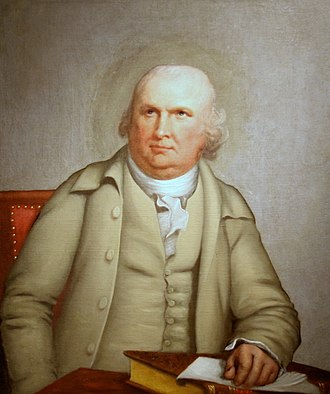
Achievements: Signed the Declaration of Independence. Rescued the U.S. economy from ruin during the War of Independence
Born: January 31 1734; Liverpool, England
Died: May 8, 1806; Philadelphia, Pennsylvania (Aged 72)
Field & Discipline: Business; Politics; Merchant
Education: Little formal education
Major Work: Arranged the American financing of the War of Independence.
Life & Times:
At 13, Morris left England for Oxford, Maryland, to join his father, agent for a Liverpool tobacco merchant. His father sent him to school in Philadelphia, and a position was found for him in the firm of Charles Willing & Company, who imported goods from the West Indies and Europe. When Morris was 20, Charles Willing died, leaving the business to his son, Thomas, three years older than Morris. In 1764, when Morris was 30, Thomas made him a partner. By the time of the War of Independence, Morris and Willing was an important part of Philadelphia business.
The week following the Boston Tea Party Governor John Penn in Philadelphia was lobbied to call an Assembly to discuss the British actions. When Penn refused, Morris and other prominent citizens held a meeting of their own at which six resolves were passed. Out of this came the first Continental Congress, which sent an appeal to George III for fairness, and recommended local bans on British imports and exports until satisfactory action was taken by London.
News of the battles of Lexington and Concord brought about the Second Continental Congress. Morris was not a delegate to this session but, by July, 1775 he was named vice-president of the Committee of Safety, and given the task of procuring as much gunpowder as possible. He set about fortifying the Delaware River and equipping an army. In spite of this he opposed the Declaration of Independence, believing reconciliation with Britain was still possible.
In 1775, Morris was elected to the Pennsylvania Assembly and joined the Second Continental Congress. In 1776, with some reluctance, he agreed to sign the Declaration of Independence and supported the War when it finally came. He was named to the Secret Committee, responsible for exporting produce, importing arms, for foreign trade, and for distributing supplies to the army. This commission that was extremely lucrative and between 1775 and 1777, one quarter of the Committee's expenditures went into the coffers of Morris and Willing.
Morris had plenty of detractors who wondered about his motives. [was Declaration of Independence co-signer with] John Adams* and [ was Declaration of Independence co-signer with] Samuel Adams*, [ was Declaration of Independence co-signer with] Franklin*,[suspected by] Jay*, and [ was Declaration of Independence co-signer with] Jefferson* all accused Morris of using his offices for financial advantage. By 1781, Morris had become the most influential merchant in the colonies and was enormously rich, while the Government was close to bankrupt.
Congressional methods of funding the army were inept and disastrous. Inflation was soaring. Desperate, Congress called in Morris and asked him to be Superintendent of Finance. Morris agreed and selected politician [employed] Gouverneur Morris,* (no relation) to be his assistant. They became lifelong friends.
The major problem facing Morris was how to equip the army and restore the credit of the United States. [a colleague of] Washington* desperately needed supplies, so Morris made contracts with private firms for cash. He even used himself -- in either his public or private capacity -- as collateral.
He persuaded the states to contribute, reorganized the administration of the treasury, and imposed strict economic measures in all departments.
France lent a large amount money. Because of Morris's endeavors Congress was able to fund the Yorktown campaign of 1781, which effectively ended the war. To fund the nation's debt, Morris established the Bank of North America in 1782, the first national bank of the United States, in accordance with Hamilton's desire. Funds were raised through private investors. The French again sent funds and Morris, himself, became a donor.
Morris then set about reviving the economy. He issued Morris Notes, a form of money that could be reimbursed at the Office of Finance. Morris's aim was to make tax collecting easier, and to replace the use of gold and silver. He proposed raising revenues by levying a five per cent income tax, a poll tax, and a duty on alcohol. He also suggested that the states be required to support the national government financially by paying the taxes they owed it, and he appointed agents to collect the taxes.
He also proposed taking out domestic and foreign loans to stimulate the economy. The soldiers of the revolutionary army were now demanding their wages, which pleased Morris because he thought that would force Congress into following his proposals. But Congress rejected his measures, finding them too radical.
Morris finally resigned in 1784, when he became Delegate to the Annapolis Convention, which was to negotiate the removal of barriers in inter-state trade. This convention called for a second convention to "render the Constitution of the Federal Government Adequate to the exigencies of the Union.” In 1784 Morris, with other investors, underwrote the voyage of the ship Empress of China, the first American vessel to visit the Chinese mainland, which began America in the opium trade. His company was previously involved in the slave trade.
At the Federal Convention of 1787, Morris supported the new Constitution, and was one of the men who signed it. He also was one of two men (the other was [ was Declaration of Independence co-signer with] Roger Sherman*,) who signed the Declaration of Independence, the Articles of Confederation, and the Constitution of the United States.
Between 1789 and 1795, Morris served in the United States Senate and was one of the leading supporters of [a supporter of] Alexander Hamilton.* But he was anxious to return to his business interests, and at the next election, he rejected a move to make him Secretary of the Treasury.
When the depression hit in the mid-1790s, he had assets but no ready capital, and faced financial disaster. By 1797, he was besieged by creditors and in 1798 was put in debtor's prison. It took an Act of Congress, more than three years later, to solve his problems with a bill allowing a defaulter to be declared bankrupt on the petition of their creditors. Gouverneur Morris came to Morris's rescue, took him in, brought him back to health, and sent him off with enough funds to live comfortably for the last four years of his life.
Extra Connections:
Morris and Roger Sherman were the only two people to sign all three significant founding documents of the United States, the Declaration of Independence, the Articles of Confederation, and the U.S. Constitution.
The dollar sign ("$") was in common use among private merchants during the middle of the 18th century. It referred to the two columns draped with scrolls on the Spanish milled dollar, which predated the US Dollar. Morris was the first to use that symbol in official documents.
Along with Washington and Benjamin Franklin, Morris is one of only three Founding Fathers depicted in “The Apotheosis of Washington,” the 1865 fresco that still decorates the interior of the Capitol dome.
-=-=
AMERICAN CONNECTIONS
ROBERT MORRIS (PA) was forty-two. By the time of
Independence he was already a hard-nosed middle-aged businessman doing
deals in Britain, Portugal, Spain, and the Caribbean. So the war was
just a minor interruption. But he gave it his full attention, joining
forty-one congressional committees, in particular that of "Secret
Trade." The committee agenda: get what America needed to keep on
fighting. The deals for everything from bullets to flour went on behind
closed doors (and even with British suppliers), so rumors flew that
Morris was making more than a few bucks on the side.
In 1781 Morris was given control of the nation's finances (best
described as catastrophic and getting more so) and set up the Bank of
North America to borrow money from the states so as to bail out the
government and the army (broke and unpaid).
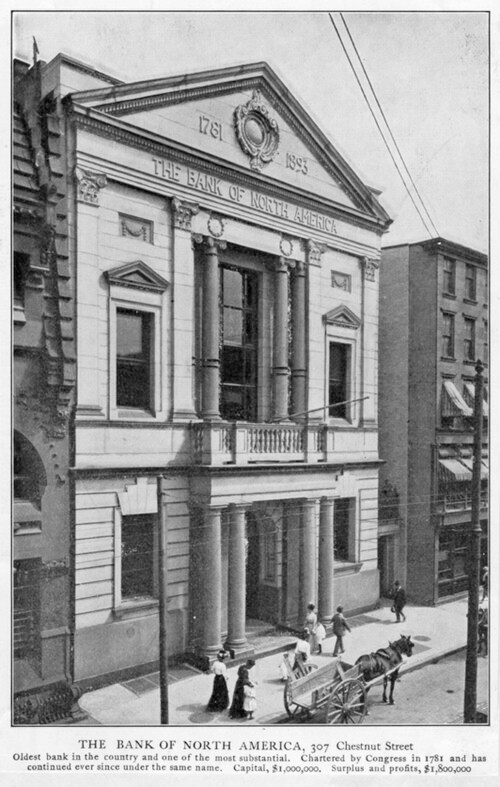
Morris resigned when the states wouldn't divvy [US "ante] up. Back in full-time trade by 1784 Morris bought shares in the first ship (the Empress of China) to sail from
the United States to the Orient. And made 30 percent profit on a cargo
of silver, wine, and Pennsylvania ginseng. Music to the ears of one
Daniel Boone, dealer in bargeloads of ginseng (good for dysentery,
colic, cramps, and what ails you).
Boone was nothing like the hype that surrounded him after Adventures
of... appeared in 1784 and created the legend of the coonskin
cap and the bear-killing, classically educated sharpshooter and general
superman. In fact businessman Boone wore monogrammed buttons and, like
many, speculated in land. On one occasion, like many, he loaned money to
archswindler, ruthless charmer, and general cad Gilbert Imlay, a New
Jersey ex-soldier back in the United States to get away from romantic
imbroglios in Europe.
These had included an affair in Paris with a liberated feminist writer
named Mary Wollstonecraft, already famous for her shocking best seller,
Vindication of the Rights of Woman. The relationship with
Imlay resulted in a daughter named Fanny (who was not so liberated and
would one day OD in a hotel room). After Fanny's birth, Mary looked
after Imlay's business interests in Scandinavia while he ran off with
yet another actress. History settles accounts: Nobody remembers Imlay,
but the world knows Mary as the died-in-childbirth mother (by a later
affair) of Mary Shelley, author of Frankenstein.
One of Wollstonecraft's pals was minor scribbler Anne Cristall (Southey was a fan) , whose brother Joshua was painting porcelain when Mary met him and persuaded
him into full-time watercoloring. Cristall's first twenty years were the
worst, often spent living on water and potatoes. The problem was that
the Brit Royal Academy considered watercolors not to be art but
something mapmakers did, so Cristall's landscapes didn't sell well. Then
came marriage and eighteen years in bucolic nowhere, producing more
unsuccessful work. And then Cristall died. A hundred years later he's
been reassessed as "the father of English watercolors" and you couldn't
afford him.
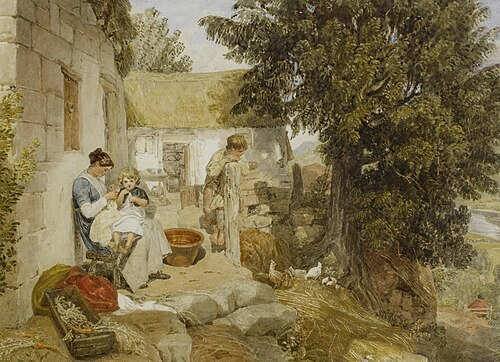
Cristall got his start (and more than potatoes) at the house of Dr.
Thomas Monro, insanity expert (on George III's madness) who knew nothing
about insanity and was the fourth generation of Monro to run the London
Bethlehem (pronounced "Bedlam") asylum, until exposed for cruel
practices (chains, no treatment). He did better as an art maven,
inviting starving artists home (see "potatoes" above) to paint in return
for supper. No fool Monro, one of his hungry mouths was named J. M. W.
Another one was Cornelius Varley, whose artistic ambitions (great)
outstripped his talents (small). This may have been one of the reasons
Varley patented the Graphic Telescope in 1811 to help him draw. Mirrors
attached to the telescope put an image on paper and you traced it out.
Not quite enough to do anything about Varley's lack of ability.
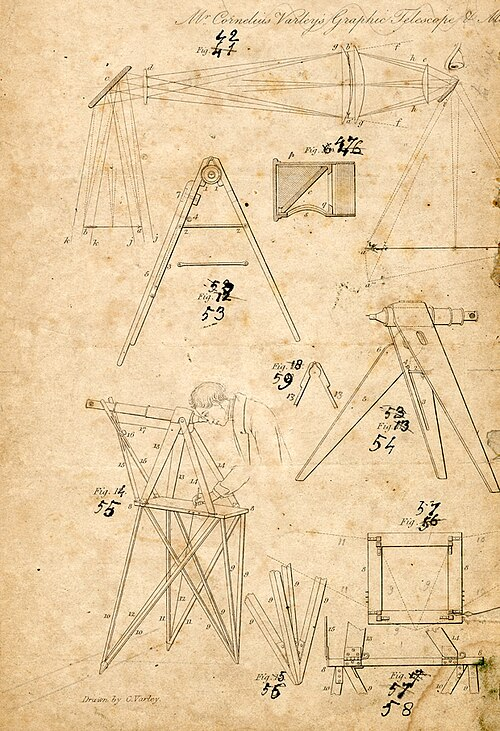
A replica of Varley's graphic telescope was built for the Through the Looking Lens exhibition held at the American Philosophical Society Museum in 2013.[13][14]^
His work, when remembered, is generally regarded as forgettable. The closest
Varley would ever get to the big time was when his gizmo was used in
1820 by Thomas Horner at the top of the dome of St Paul's Cathedral to
create a giant, full-circle panorama of London.
The final canvas measured forty-two thousand square feet, and in order to show it off
(for money) a speculator friend of Horner's sponsored the construction
of the Regent's Park Coliseum.
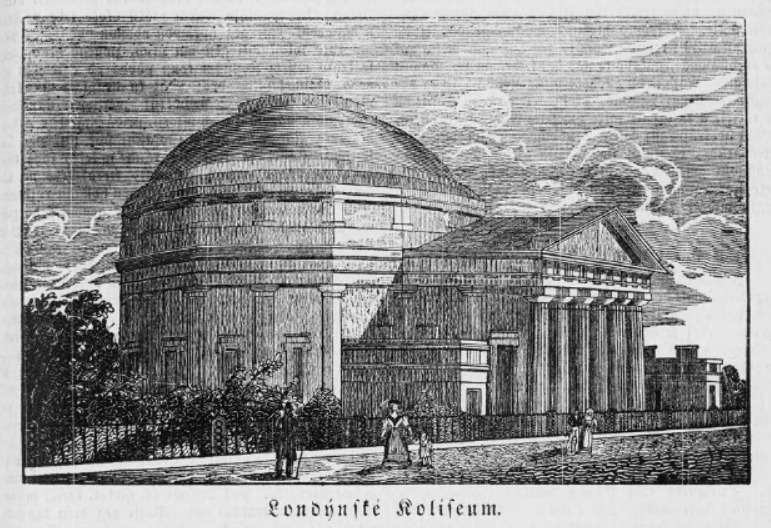
Where, in the first passenger elevator (the "ascending room"), you could rise up the painting.
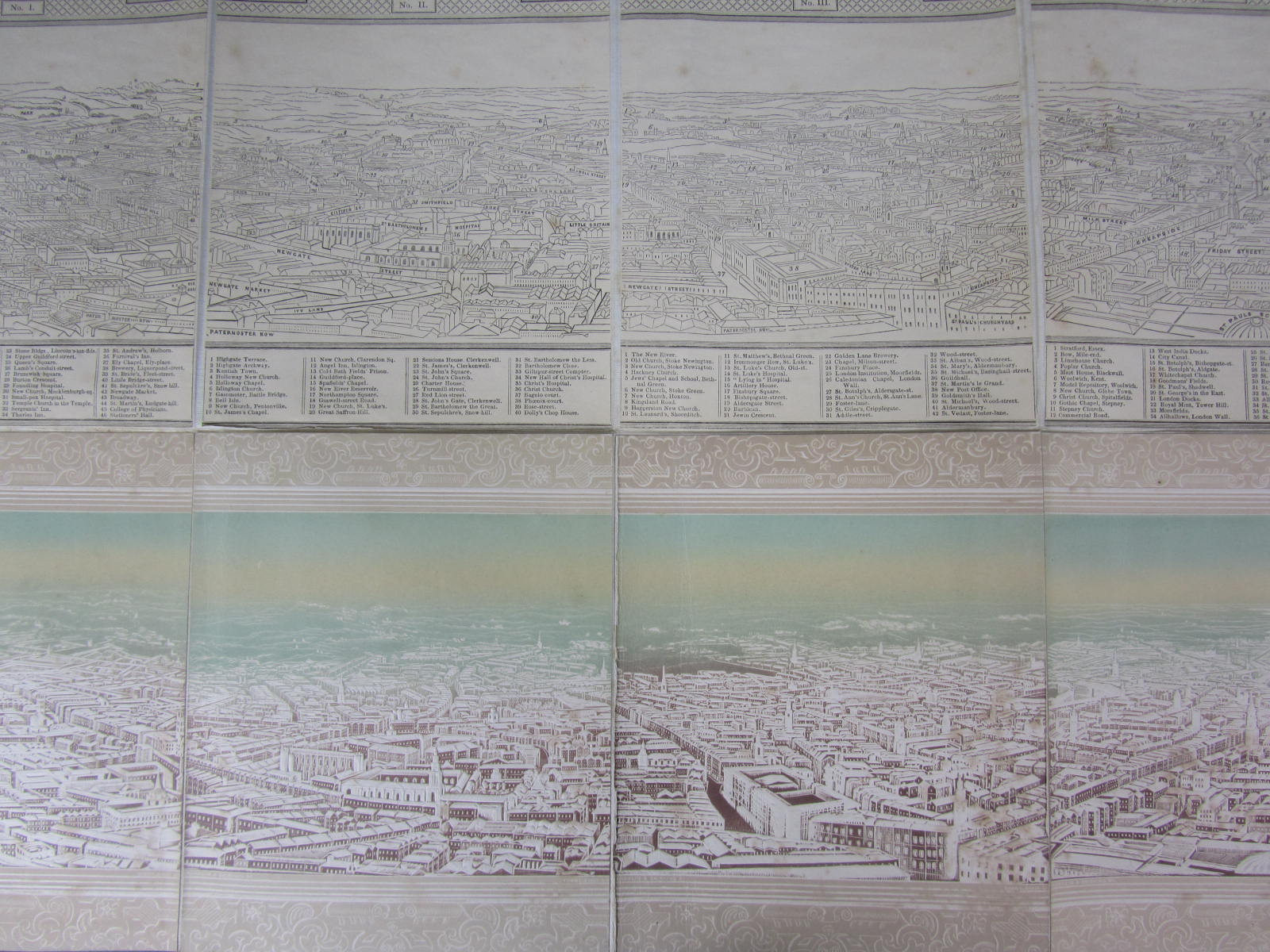
Alas, takings were low (in spite of added attractions including an aviary, organ, and Swiss chalet), and the financial backer turned out too extravagant for
everybody's own good. Bankruptcy followed and the backer absconded to
the United States. Followed shortly by Horner, who then went insane in
Pennsylvania.
However, the Coliseum did good things for its architect, Decimus Burton,
who'd trained under John Nash, helped with bits of Nash's Regent's Park
terraces, and was good at producing exact copies of Greek and Roman
without ever leaving his drawing board. Examples: Hyde Park Corner Arch
and the Athenaeum Club. In his defense it must be said that the
wonderful glass-and-iron Palm House at Kew Botanical Gardens was all his
own work.
Decimus's brother James was a rum cove. After a bad start, in 1820 he
managed to get to Pompeii too late to take up Sir Humphry Davy's offer
of assistantship in unrolling eruption-carbonized papyri, so he headed
off to Egypt to look for coal (working for Muhammad Ali Pasha, founder of modern Egypt). Searching for something else to dig, he took a desultory look-around and in the Valley of the Kings (where he found a list of kings) did a bit of excavation and general tomb-robbing.
The Valley of the Kings garnered significant attention following the discovery of the tomb of Tutankhamun in 1922,[9]^ and is one of the most famous archaeological sites in the world.
Slave girls and a hookah habit then contributed to Burton's disappearance
into the Nile Delta for five years. In 1828 he resurfaced and headed
back to London with slave girl and giraffe in tow (the animal slipped on
ice and died; the slave girl became his spouse).
In 1839 James bumped into a distant Canadian relative and judge, Thomas
Chandler Haliburton (in London looking for classy ancestors), and the
two of them discovered a family link with major scribbler Sir Walter
Scott. Haliburton, who coined such phrases as: "blood out of a stone,"
"drink like a fish," and "the early bird gets the worm," was about to
burst on the Eng. Lit. scene with his own stories. Satirical tales of
life in Nova Scotia "as seen by Sam Slick, Yankee clockmaker and
peddler." The colorful Slick was a runaway bestseller on both sides of
the Atlantic (and netted Haliburton an honorary Oxford degree) after the
original essays first appeared as regular columns in the Novascotian.
The paper's editor, publisher, and printer, Joseph Howe, was already big
in local politics. After years of agitation by colonial Nova Scotians
for democratic elections, in 1867 the London Parliament passed the
British North American Act, which turned Canada into a confederation.
Exactly what autonomy-loving Nova Scotians didn't want. So Howe (by this
time ex-prime minister) led calls for the act's repeal. Then,
inexplicably, he changed his tune and took a job in the new Canadian
federal government. This about-face was one of the only two significant
victories in the life of Nova Scotia lieutenant governor Sir Charles
Hastings Doyle, the other being his success in foiling the Great 1866
Irish Invasion of New Brunswick.
After the U.S. Civil War the Brits, worried about a possible U.S. attack
on Canada, sent over thousands of troops and trained even more local
Canadian militia. Quite by accident this was done just in time for the
botched Fenian (Irish independence movement) botched attempt to take
over New Brunswick and set up a republic in exile. On invasion day
hardly any of the Irish volunteers turned up at the appointed spot on
the American side of the border, and they squabbled when they did. When
they finally crossed into Canada, oops, in front of them was a massively
superior Brit force armed to the teeth. And behind the Fenians the
Americans were closing the border to block further Irish reinforcements
(which weren't coming, anyway).
Undeterred, the Fenians fell back on Plan B: build a submarine and sink
the British Royal Navy. Fortunately in this regard Paterson, New Jersey,
contained a sympathetic Irishman, John Holland, who'd read Jules Verne
and was nuts for the subaquatic. With Fenian backing, by 1881 Holland's
thirty-one-foot three-crew Fenian Ram was secretly scooting
up and down the Hudson.
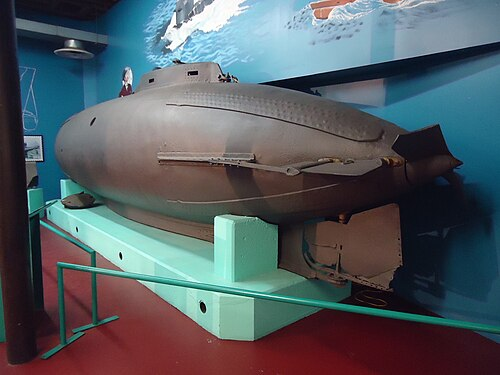
There followed yet another internal Fenian
squabble (this time about not getting their money's worth from Holland)
and in dead of night the Ram was stolen. Alas, no Fenian
could drive it and that was the end of that.
But not for Holland, who by 1900 had sold his "Holland-6" to the U.S.
Navy. Minor problem: None of Holland's subs included a means to see
where they were going. Enter Sir Howard Grubb with what was to become
the standard periscope for the next fifty years. From 1868 to 1926 Grubb
built any scope of any type used anywhere in the British Empire. He also
developed anti-dazzle headlights and a sniper gunsight and ran his
business into the ground. But not before he had helped to change the
universe.
On May 29, 1919, one of Grubbs's gizmos (a sun-tracking coelostat, to be
precise) was used at Sobral, a remote spot in northeast Brazil and one
of two sites chosen by the Royal Astronomical Society to observe the
total solar eclipse on that rare day. Rare because the sun was passing
in front of a particularly dense lot of stars.
This fact was essential to the purpose of math-astronomy-physics genius Sir Arthur Eddington (lived with mother, Quaker, bicycled, baggy tweeds), who was at the
other eclipse site, on the island of Principe off West Africa.
The Principe Expedition was organized by Sir Frank Watson Dyson, KBE, FRS,[1]^ FRSE (8 January 1868 – 25 May 1939), an English astronomer and the ninth Astronomer Royal. He is remembered today largely for introducing the Greenwich time signal ("six pips") to BBC radio, and for the role he played in proving Einstein's theory of general relativity. Although Frank Dyson and theoretical physicist Freeman Dyson were not known to be related, their fathers Rev Watson Dyson and George Dyson both hailed from West Yorkshire where the surname originates and is most densely clustered.[14]^ Freeman Dyson credited Sir Frank with sparking his interest in astronomy: because they shared the same last name, Sir Frank's achievements were discussed by Freeman Dyson's family when he was a young boy.
Before the eclipse Eddington took pix of the relevant bit of
night sky. Then he photographed the eclipse. Then he superimposed one
picture on the other. Sure enough, a star close to the sun had moved. Or
rather, the light from the star had moved. Proving that the sun's
gravity had bent the starlight, shifting the star's image. Einstein's
theory of general relativity was right! Congrats all round!
Except from major thinker Bertrand Russell, who thought Eddington's
scientific work was ruined by his Christianity. Russell was probably the
twentieth century's greatest rationalist. His ideas left other major
philosophers "thunderstruck." He was in love with geometry, got a Nobel
for literature, was the author of History of Western
Philosophy and founder of the Campaign for Nuclear

The CND symbol, designed by Gerald Holtom in 1958. It has become a nearly universal peace symbol used in many different versions worldwide.[1]^
He met Lenin and (here's the clincher) taught Wittgenstein.
No slouch. Nor with women. An advocate of free love (it cost him an
American university chair), he married four times.
The third left him after her torrid affair with Arthur Koestler.
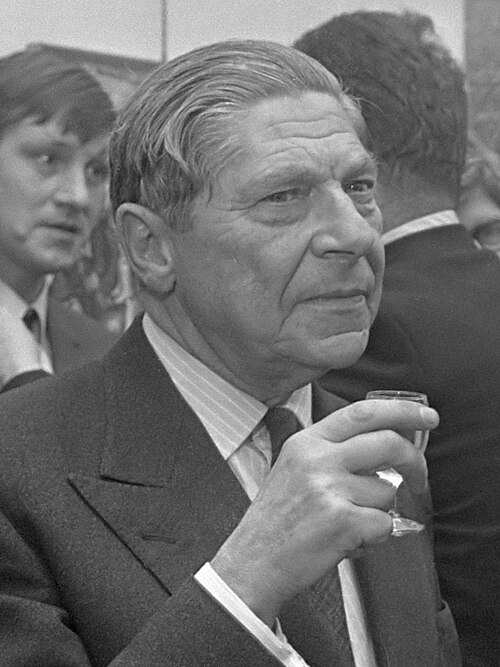
Variously described as arrogant, drunken, sexually predatory (there were
rumors of rape), dogmatic, violent, and neurotic, the chain-smoking
Koestler hit the big time with his novel Darkness at Noon.
He spied on Franco HQ in the Spanish Civil War, then was a war correspondent until captured by Mussolini's troops (pal of George Orwell and Bertrand Russell). In
1940 Koestler joined that home of deserters the French Foreign Legion.
And then deserted. He had a fling with Simone de Beauvoir. Married three
times. And on one occasion urinated in a car radiator that was
threatening to overheat.
Larger than life, in 1983 Koestler, suffering from leukemia and
Parkinson's disease, killed himself. Later that day his wife committed
suicide. Some said he'd put her up to it. Their joint bequest endowed a
professorial chair in parapsychology (the only one in Britain) at
In 1983 the first to occupy the chair was American ROBERT MORRIS.
Language: English
Father: Robert Morris, Sr.
Mother: Unknown
Siblings: Thomas Wise (half brother)
Spouse: Mary (Molly) White
Children: Robert; Thomas; William; Hetty; Charles; Maria; Henry
-=-=
He was a signer of the Declaration of Independence with [was a Declaration of Independence co-signer with]John Hancock*, [was a Declaration of Independence co-signer with]Josiah Bartlett*, [was a Declaration of Independence co-signer with]William Whipple*, [was a Declaration of Independence co-signer with]Robert Treat Paine*, [was a Declaration of Independence co-signer with]Stephen Hopkins*, [was a Declaration of Independence co-signer with]William Ellery*, [was a Declaration of Independence co-signer with]Samuel Huntington*, [was a Declaration of Independence co-signer with]William Williams*, [was a Declaration of Independence co-signer with]William Floyd*, [was a Declaration of Independence co-signer with]Philip Livingston*, [was a Declaration of Independence co-signer with]Francis Lewis*, [was a Declaration of Independence co-signer with]Lewis Morris*, [was a Declaration of Independence co-signer with]Richard Stockton*, [was a Declaration of Independence co-signer with]John Witherspoon*, [was a Declaration of Independence co-signer with]Francis Hopkinson*, [was a Declaration of Independence co-signer with]John Hart*, [was a Declaration of Independence co-signer with]Abraham Clark*, [was a Declaration of Independence co-signer with]Robert Morris*, [was a Declaration of Independence co-signer with]Benjamin Rush*, [was a Declaration of Independence co-signer with]John Morton*, [was a Declaration of Independence co-signer with]George Clymer*, [was a Declaration of Independence co-signer with]James Smith*, [was a Declaration of Independence co-signer with]George Taylor*, [was a Declaration of Independence co-signer with]James Wilson*, [was a Declaration of Independence co-signer with]George Ross*, [was a Declaration of Independence co-signer with]Caesar Rodney*, [was a Declaration of Independence co-signer with]George Read*, [was a Declaration of Independence co-signer with]Samuel Chase*, [was a Declaration of Independence co-signer with]William Paca*, [was a Declaration of Independence co-signer with]Thomas Stone*, [was a Declaration of Independence co-signer with]Charles Carroll*, [was a Declaration of Independence co-signer with]Benjamin Harrison*, [was a Declaration of Independence co-signer with]Thomas Nelson*, [was a Declaration of Independence co-signer with]Francis Lightfoot Lee*, [was a Declaration of Independence co-signer with]Carter Braxton*, [was a Declaration of Independence co-signer with]William Hooper*, [was a Declaration of Independence co-signer with]Joseph Hewes*, [was a Declaration of Independence co-signer with]John Penn*, [was a Declaration of Independence co-signer with]Edward Rutledge*, [was a Declaration of Independence co-signer with]Thomas Heyward*, [was a Declaration of Independence co-signer with]Thomas Lynch Jr.*, [was a Declaration of Independence co-signer with]Arthur Middleton*, [was a Declaration of Independence co-signer with]Button Gwinett*, [was a Declaration of Independence co-signer with]Lyman Hall*, [was a Declaration of Independence co-signer with]George Walton*, [was a Declaration of Independence co-signer with]George Wythe*, [was a Declaration of Independence co-signer with]Elbridge Gerry*, [was a Declaration of Independence co-signer with]Richard Henry Lee*, [was a Declaration of Independence co-signer with]Oliver Wolcott*, [was a Declaration of Independence co-signer with]Matthew Thornton*, [was a Declaration of Independence co-signer with]Thomas McKean*.
Assessment: Did an inestimable service to his country in time of war and financial ruin.
Oneliner: Robert Morris, Declaration of Independence signer
Bibliography:
- Frederick Wagner, Robert Morris Audacious Patriot, Dodd, Mead & Company. New York. 1976.
Robert Morris | Descendants of the Signers of the Declaration of Independence