Hancock, John
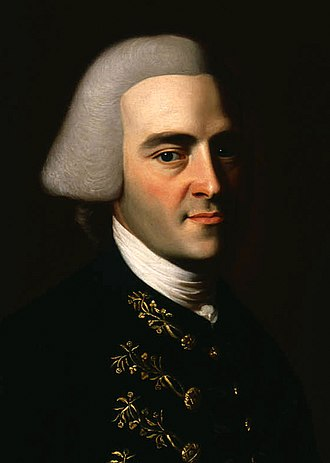
John Hancock (January 23, 1737 [O.S. January 12, 1736] – October 8, 1793) was a merchant, smuggler, statesman, and prominent Patriot of the American Revolution. He served as president of the Second Continental Congress and was the first and third Governor of the Commonwealth of Massachusetts.
He is remembered for his large and stylish signature on the United States Declaration of Independence, so much so that the term "John Hancock" has become, in the United States, a synonym for a signature.[2]
Before the American Revolution, Hancock was one of the wealthiest men in the Thirteen Colonies, having inherited a profitable mercantile business from his uncle, himself a prominent smuggler.[3]
Hancock began his political career in Boston as a protégé of Samuel Adams, an influential local politician, though the two men later became estranged. As tensions between colonists and Great Britain increased in the 1760s, Hancock used his wealth to support the colonial cause. He became very popular in Massachusetts, especially after British officials seized his sloop Liberty in 1768 and charged him with smuggling.
Although the charges against Hancock were eventually dropped, as Professor Peter Andreas, author of Smuggler Nation: How Illicit Trade Made America explains, "It is perhaps appropriate that the first signer of the Declaration of Independence was Boston's most well known merchant-smuggler, John Hancock."[4]
Hancock was one of Boston's leaders during the crisis that led to the outbreak of the American Revolutionary War in 1775. He served more than two years in the Continental Congress in Philadelphia, and as president of Congress, was the first to sign the Declaration of Independence. Hancock returned to Massachusetts and was elected governor of the Commonwealth, serving in that role for most of his remaining years. He used his influence to ensure that Massachusetts ratified the United States Constitution in 1788.
Contents
Early life
According to the Gregorian calendar, John Hancock was born on January 23, 1737; according to the Julian calendar then in use, the date was January 12, 1736.[5] He was born in Braintree, Massachusetts, in a part of town that eventually became the separate city of Quincy.[6] He was the son of the Reverend John Hancock of Braintree and Mary Hawke Thaxter, who was from nearby Hingham. As a child, Hancock became a casual acquaintance of young John Adams, whom the Reverend Hancock had baptized in 1735.[7][8]
The Hancocks lived a comfortable life, and owned one slave to help with household work.[7]
After Hancock's father died in 1744, John was sent to live with his uncle and aunt, Thomas Hancock and Lydia (Henchman) Hancock. Thomas Hancock was the proprietor of a firm known as the House of Hancock, which imported manufactured goods from Britain and exported rum, whale oil, and fish.[9] Thomas Hancock's highly successful business made him one of Boston's richest and best-known residents.[10][11] He and Lydia, along with several servants and slaves, lived in Hancock Manor onBeacon Hill. The couple, who did not have any children of their own, became the dominant influence on John's life.[12]
After graduating from the Boston Latin School in 1750, Hancock enrolled in Harvard College and received a bachelor's degree in 1754.[13][14]
Upon graduation, he began to work for his uncle, just as the French and Indian War (1754–1763) had begun. Thomas Hancock had close relations with the royal governors of Massachusetts and secured profitable government contracts during the war.[15] John Hancock learned much about his uncle's business during these years and was trained for eventual partnership in the firm. Hancock worked hard, but he also enjoyed playing the role of a wealthy aristocrat and developed a fondness for expensive clothes.[16][17]
From 1760 to 1761, Hancock lived in England while building relationships with customers and suppliers. Upon returning to Boston, Hancock gradually took over the House of Hancock as his uncle's health failed, becoming a full partner in January 1763.[18][19][20] He became a member of the Masonic Lodge of St. Andrew in October 1762, which connected him with many of Boston's most influential citizens.[21]
When Thomas Hancock died in August 1764, John inherited the business, Hancock Manor, two or three household slaves, and thousands of acres of land, becoming one of the wealthiest men in the colonies.[22][23] The household slaves continued to work for John and his aunt, but were eventually freed through the terms of Thomas Hancock's will; there is no evidence that John Hancock ever bought or sold slaves.[24]
Growing imperial tensions
After its victory in the Seven Years' War (1756–1763), the British Empire was deep in debt. Looking for new sources of revenue, the British Parliament sought, for the first time, to directly tax the colonies, beginning with the Sugar Act of 1764.[25] The earlier Molasses Act of 1733, a tax on shipments from the West Indies, had produced hardly any revenue because it was widely bypassed by smuggling, which was seen as a victimless crime.
Not only was there little social stigma attached to smuggling in the colonies, but in port cities, where trade was the primary generator of wealth, smuggling enjoyed considerable community support, and it was even possible to obtain insurance against being caught. Colonial merchants developed an impressive repertoire of evasive maneuvers to conceal the origin, nationality, routes and content of their illicit cargoes. This included the frequent use of fraudulent paperwork to make the cargo appear legal and authorised. And much to the frustration of the British authorities, when seizures did happen local merchants were often able to use sympathetic provincial courts to reclaim confiscated goods and have their cases dismissed. For instance, Edward Randolph, the appointed head of customs in New England brought 36 seizures to trial from 1680 to the end of 1682 – and all but two of these were acquitted. Alternatively merchants sometimes took matters into their own hands and stole illicit goods back while impounded.[26]
The Sugar Act provoked outrage in Boston, where it was widely viewed as a violation of colonial rights. Men such as James Otis and Samuel Adams argued that because the colonists were not represented in Parliament, they could not be taxed by that body; only the colonial assemblies, where the colonists were represented, could levy taxes upon the colonies. Hancock was not yet a political activist; however, he criticized the tax for economic, rather than constitutional, reasons.[25]
Hancock's political success benefited from the support of Samuel Adams, the clerk of the House of Representatives and a leader of Boston's "popular party", also known as "Whigs" and later as "Patriots". The two men made an unlikely pair. Fifteen years older than Hancock, Adams had a somber, Puritan outlook that stood in marked contrast to Hancock's taste for luxury and extravagance.[32][33] Apocryphal stories later portrayed Adams as masterminding Hancock's political rise so that the merchant's wealth could be used to further the Whig agenda.[34] Historian James Truslow Adams portrayed Hancock as shallow and vain, easily manipulated by Adams.[35]
Historian William M. Fowler, who wrote biographies of both men, argued that this characterization was an exaggeration, and that the relationship between the two was symbiotic, with Adams as the mentor and Hancock the protégé.[36][37]Hancock emerged as a leading political figure in Boston just as tensions with Great Britain were increasing. In March 1765, he was elected as one of Boston's five selectmen, an office previously held by his uncle for many years.[28]
Soon after, Parliament passed the 1765 Stamp Act, a tax on legal documents, such as wills, that had been levied in Britain for many years but which was wildly unpopular in the colonies, producing riots and organized resistance. Hancock initially took a moderate position: as a loyal British subject, he thought that the colonists should submit to the act, even though he believed that Parliament was misguided.[29]
Within a few months, Hancock had changed his mind, although he continued to disapprove of violence and the intimidation of royal officials by mobs.[30] Hancock joined the resistance to the Stamp Act by participating in a boycott of British goods, which made him popular in Boston. After Bostonians learned of the impending repeal of the Stamp Act, Hancock was elected to the Massachusetts House of Representatives in May of 1766.[31]
Townshend Acts crisis
After the repeal of the Stamp Act, Parliament took a different approach to raising revenue, passing the 1767 Townshend Acts, which established new duties on various imports and strengthened the customs agency by creating the American Customs Board. The British government believed that a more efficient customs system was necessary because many colonial American merchants had been smuggling. Smugglers violated the Navigation Acts by trading with ports outside of the British Empire and avoiding import taxes. Parliament hoped that the new system would reduce smuggling and generate revenue for the government.[38]
Colonial merchants, even those not involved in smuggling, found the new regulations oppressive. Other colonists protested that new duties were another attempt by Parliament to tax the colonies without their consent. Hancock joined other Bostonians in calling for a boycott of British imports until the Townshend duties were repealed.[39] In their enforcement of the customs regulations, the Customs Board targeted Hancock, Boston's wealthiest Whig. They may have suspected that he was a smuggler, or they may have wanted to harass him because of his politics, especially after Hancock snubbed Governor Francis Bernard by refusing to attend public functions when the customs officials were present.[40][41]
On April 9, 1768, two customs employees (called tidesmen) boarded Hancock's brig Lydia in Boston Harbor. Hancock was summoned, and finding that the agents lacked a writ of assistance (a general search warrant), he did not allow them to go below deck. When one of them later managed to get into the hold, Hancock's men forced the tidesman back on deck.[42][43][44][45] Customs officials wanted to file charges, but the case was dropped when Massachusetts Attorney General Jonathan Sewall ruled that Hancock had broken no laws.[46][40][47] Later, some of Hancock's most ardent admirers would call this incident the first act of physical resistance to British authority in the colonies and credit Hancock with initiating the American Revolution.[43]
Liberty affair
The next incident proved to be a major event in the coming of the American Revolution. On the evening of May 9, 1768, Hancock's sloop *Liberty* arrived in Boston Harbor, carrying a shipment of Madeira wine. When custom officers inspected the ship the next morning, they found that it contained 25 pipes of wine, just one fourth of the ship's carrying capacity.[48][49][50] Hancock paid the duties on the 25 pipes of wine, but officials suspected that he had arranged to have more wine unloaded during the night to avoid paying the duties for the entire cargo.[49][51] Hancock had earlier been heard refuting the authority of the customs officials, although two tidesmen who had stayed on the ship overnight gave a sworn statement that nothing had been unloaded.[52][48]

Portrait of Hancock by John Singleton Copley, c. 1765
One month later, while the British warship HMS *Romney* was in port, one of the tidesmen changed his story, saying that he had been forcibly held on the Liberty on the orders of John Hancock while it had been illegally unloaded. When released, the tidesmen were subjected to "such threats and denunciation of vengeance, death and destruction in case they divulged the affair." The following day the Liberty was again boarded and seized when officials found 20 barrels of tar and 200 barrels of oil on board for which no bond had been posted and no permit to load obtained.[53]
[54][55][56]
On June 10, customs officials seized the Liberty. Bostonians were already angry because the captain of the Romney had been impressing colonists, and not just deserters from the Royal Navy, an arguably illegal activity.[57] A riot broke out when officials began to tow the Liberty out to the Romney.[58][59] The confrontation escalated when sailors and marines coming ashore to seize the Liberty were mistaken for a press gang.[60] After the riot, customs officials relocated to the Romney, and then to Castle William (an island fort in the harbor), claiming that they were unsafe in town.[61][55] Whigs insisted that the customs officials were exaggerating the danger so that London would send troops to Boston.[62]
British officials filed two lawsuits stemming from the Liberty incident: an in rem suit against the ship, and an in personam suit against Hancock, who had previously been heard dismissing the authority of British Customs officials. The first suit, filed on June 22, 1768, resulted in the confiscation of the Liberty in August. Customs officials then used the ship for anti-smuggling operations until it was burned by angry colonists in Rhode Island the following year.[63][64][65]
The second trial began in October 1768, when charges were filed against Hancock and five others for allegedly unloading 100 pipes of wine from the Liberty without paying the duties.[66][67] If convicted, the defendants would have had to pay a penalty of triple the value of the wine, which came to £9,000. With John Adams serving as his lawyer, Hancock was prosecuted in a highly publicized trial by a vice admiralty court, which had no jury and did not always allow the defense to cross-examine the witnesses.[68] After dragging out for nearly five months, the proceedings against Hancock were dropped without explanation.[69][70][71]
Although the charges against Hancock were dropped, many writers later described him as a smuggler.[72] The accuracy of this characterization has been questioned. "Hancock's guilt or innocence and the exact charges against him", wrote historian John W. Tyler in 1986, "are still fiercely debated."[73] Historian Oliver Dickerson argued that Hancock was the victim of an essentially criminal racketeering scheme perpetrated by Governor Bernard and the customs officials. Dickerson believed that there is no reliable evidence that Hancock was guilty in the Liberty case, and that the purpose of the trials was to punish Hancock for political reasons and to plunder his property.[74]
Opposed to Dickerson's interpretation were Kinvin Wroth and Hiller Zobel, the editors of John Adams's legal papers, who argued that "Hancock's innocence is open to question", and that the British officials acted legally, if unwisely.[75] Lawyer and historian Bernard Knollenberg concluded that the customs officials had the right to seize Hancock's ship, but towing it out to the Romneyhad been illegal.[76] Legal historian John Phillip Reid argued that the testimony of both sides was so politically partial that it is not possible to objectively reconstruct the incident.[77]
Aside from the Liberty affair, the degree to which Hancock was engaged in smuggling, which may have been widespread in the colonies, has been questioned. Given the clandestine nature of smuggling, records are scarce.[78]
If Hancock was a smuggler, no documentation of this has been found. John W. Tyler identified 23 smugglers in his study of more than 400 merchants in revolutionary Boston, but found no written evidence that Hancock was one of them.[79] Biographer William Fowler concluded that while Hancock was probably engaged in some smuggling, most of his business was legitimate, and his later reputation as the "king of the colonial smugglers" is a myth without foundation.[40]
Massacre to Tea Party
The Liberty affair reinforced a previously made British decision to suppress unrest in Boston with a show of military might. The decision had been prompted by Samuel Adams's 1768 Circular Letter, which was sent to other British American colonies in hopes of coordinating resistance to the Townshend Acts. Lord Hillsborough, secretary of state for the colonies, sent four regiments of the British Army to Boston to support embattled royal officials, and instructed Governor Bernard to order the Massachusetts legislature to revoke the Circular Letter. Hancock and the Massachusetts House voted against rescinding the letter, and instead drew up a petition demanding Governor Bernard's recall.[81] When Bernard returned to England in 1769, Bostonians celebrated.[82][83]
The British troops remained, however, and tensions between soldiers and civilians eventually resulted in the killing of five civilians in the Boston Massacre of March 1770. Hancock was not involved in the incident, but afterwards he led a committee to demand the removal of the troops. Meeting with Bernard's successor, Governor Thomas Hutchinson, and the British officer in command, Colonel William Dalrymple, Hancock claimed that there were 10,000 armed colonists ready to march into Boston if the troops did not leave.[84][85] Hutchinson knew that Hancock was bluffing, but the soldiers were in a precarious position when garrisoned within the town, and so Dalrymple agreed to remove both regiments to Castle William.[84] Hancock was celebrated as a hero for his role in getting the troops withdrawn.[86][85] His reelection to the Massachusetts House in May was nearly unanimous.[87][88]
This portrait of Hancock was published in England in 1775.[89]
After Parliament partially repealed the Townshend duties in 1770, Boston's boycott of British goods ended.[90] Politics became quieter in Massachusetts, although tensions remained.[91] Hancock tried to improve his relationship with Governor Hutchinson, who in turn sought to woo Hancock away from Adams's influence.[92][93] In April 1772, Hutchinson approved Hancock's election as colonel of the Boston Cadets, a militia unit whose primary function was to provide a ceremonial escort for the governor and the General Court.[94][95]
In May, Hutchinson even approved Hancock's election to the Council, the upper chamber of the General Court, whose members were elected by the House but subject to veto by the governor. Hancock's previous elections to the Council had been vetoed, but now Hutchinson allowed the election to stand. Hancock declined the office, however, not wanting to appear to have been co-opted by the governor. Nevertheless, Hancock used the improved relationship to resolve an ongoing dispute. To avoid hostile crowds in Boston, Hutchinson had been convening the legislature outside of town; now he agreed to allow the General Court to sit in Boston once again, to the relief of the legislators.[96]
Hutchinson had dared to hope that he could win over Hancock and discredit Adams.[97]
To some, it seemed that Adams and Hancock were indeed at odds: when Adams formed the Boston Committee of Correspondence in November 1772 to advocate colonial rights, Hancock declined to join, creating the impression that there was a split in the Whig ranks.[98] But whatever their differences, Hancock and Adams came together again in 1773 with the renewal of major political turmoil. They cooperated in the revelation of private letters of Thomas Hutchinson, in which the governor seemed to recommend "an abridgement of what are called English liberties" to bring order to the colony.[99] The Massachusetts House, blaming Hutchinson for the military occupation of Boston, called for his removal as governor.[100]
Even more trouble followed Parliament's passage of the 1773 Tea Act. On November 5, Hancock was elected as moderator at a Boston town meeting that resolved that anyone who supported the Tea Act was an "Enemy to America".[101] Hancock and others tried to force the resignation of the agents who had been appointed to receive the tea shipments. Unsuccessful in this, they attempted to prevent the tea from being unloaded after three tea ships had arrived in Boston Harbor. Hancock was at the fateful meeting on December 16, where he reportedly told the crowd, "Let every man do what is right in his own eyes."[102][103] Hancock did not take part in the Boston Tea Party that night, but he approved of the action, although he was careful not to publicly praise the destruction of private property.[104]
Over the next few months, Hancock was disabled by gout, which would trouble him with increasing frequency in the coming years. By March 5, 1774, he had recovered enough to deliver the fourth annual Massacre Day oration, a commemoration of the Boston Massacre. Hancock's speech denounced the presence of British troops in Boston, who he said had been sent there "to enforce obedience to acts of Parliament, which neither God nor man ever empowered them to make".[105] The speech, probably written by Hancock in collaboration with Adams, Joseph Warren, and others, was published and widely reprinted, enhancing Hancock's stature as a leading Patriot.[106]
Revolution begins
Parliament responded to the Tea Party with the Boston Port Act, one of the so-called Coercive Acts intended to strengthen British control of the colonies. Hutchinson was replaced as governor by General Thomas Gage, who arrived in May 1774. On June 17, the Massachusetts House elected five delegates to send to the First Continental Congress in Philadelphia, which was being organized to coordinate colonial response to the Coercive Acts. Hancock did not serve in the first Congress, possibly for health reasons, or possibly to remain in charge while the other Patriot leaders were away.[107][108]
Gage soon dismissed Hancock from his post as colonel of the Boston Cadets.[109] In October 1774, Gage canceled the scheduled meeting of the General Court. In response, the House resolved itself into theMassachusetts Provincial Congress, a body independent of British control. Hancock was elected as president of the Provincial Congress and was a key member of the Committee of Safety.[110] The Provincial Congress created the first minutemen companies, consisting of militiamen who were to be ready for action on a moment's notice.[110][111]
Gage received a letter from Lord Dartmouth on April 14, 1775, advising him "to arrest the principal actors and abettors in the Provincial Congress whose proceedings appear in every light to be acts of treason and rebellion".[116][117][118] On the night of April 18, Gage sent out a detachment of soldiers on the fateful mission that would spark theAmerican Revolutionary War. The purpose of the British expedition was to seize and destroy military supplies that the colonists had stored in Concord. According to many historical accounts, Gage also instructed his men to arrest Hancock and Adams; if so, the written orders issued by Gage made no mention of arresting the Patriot leaders.[119]
Gage apparently decided that he had nothing to gain by arresting Hancock and Adams, since other leaders would simply take their place, and the British would be portrayed as the aggressors.[120][121]On December 1, 1774, the Provincial Congress elected Hancock as a delegate to the Second Continental Congress to replace James Bowdoin, who had been unable to attend the first Congress because of illness.[110][113] Before Hancock reported to the Continental Congress in Philadelphia, the Provincial Congress unanimously reelected him as their president in February 1775.
Hancock's multiple roles gave him enormous influence in Massachusetts, and as early as January 1774 British officials had considered arresting him.[114] After attending the Provincial Congress in Concord in April 1775, Hancock and Samuel Adams decided that it was not safe to return to Boston before leaving for Philadelphia. They stayed instead at Hancock's childhood home in Lexington.[112][115]
Although Gage had evidently decided against seizing Hancock and Adams, Patriots initially believed otherwise. From Boston, Joseph Warren dispatched messenger Paul Revere to warn Hancock and Adams that British troops were on the move and might attempt to arrest them. Revere reached Lexington around midnight and gave the warning.[122][123]
Hancock, still considering himself a militia colonel, wanted to take the field with the Patriot militia at Lexington, but Adams and others convinced him to avoid battle, arguing that he was more valuable as a political leader than as a soldier.[124][125] As Hancock and Adams made their escape, the first shots of the war were fired at Lexington and Concord. Soon after the battle, Gage issued a proclamation granting a general pardon to all who would "lay down their arms, and return to the duties of peaceable subjects"—with the exceptions of Hancock and Samuel Adams. Singling out Hancock and Adams in this manner only added to their renown among Patriots.[126]
President of Congress
In Congress on June 15, 1775, Massachusetts delegate John Adams nominated George Washington as commander-in-chief of the army then gathered around Boston. Years later, Adams wrote that Hancock had shown great disappointment at not getting the command for himself. This brief comment from 1801 is the only source for the oft-cited claim that Hancock sought to become commander-in-chief.[133] In the early 20th century, historian James Truslow Adams wrote that the incident initiated a lifelong estrangement between Hancock and Washington, but some subsequent historians have expressed doubt that the incident, or the estrangement, ever occurred.
According to historian Donald Proctor, "There is no contemporary evidence that Hancock harbored ambitions to be named commander-in-chief. Quite the contrary."[134] Hancock and Washington maintained a good relationship after the alleged incident, and in 1778 Hancock named his only son John George Washington Hancock.[135] Hancock admired and supported General Washington, even though Washington politely declined Hancock's request for a military appointment.[136][137]
With the war underway, Hancock made his way to the Continental Congress in Philadelphia with the other Massachusetts delegates. On May 24, 1775, he was unanimously elected President of the Continental Congress, succeeding Peyton Randolph after Henry Middleton declined the nomination. Hancock was a good choice for president for several reasons.[127][128] He was experienced, having often presided over legislative bodies and town meetings in Massachusetts. His wealth and social standing inspired the confidence of moderate delegates, while his association with Boston radicals made him acceptable to other radicals.
His position was somewhat ambiguous, because the role of the president was not fully defined, and it was not clear if Randolph had resigned or was on a leave of absence.[129] Like other presidents of Congress, Hancock's authority was mostly limited to that of a presiding officer.[130] He also had to handle a great deal of official correspondence, and he found it necessary to hire clerks at his own expense to help with the paperwork.[131][132]
When Congress recessed on August 1, 1775, Hancock took the opportunity to wed his fiancée, Dorothy "Dolly" Quincy. The couple was married on August 28 in Fairfield,Connecticut.[138][139]
John and Dorothy would have two children, neither of whom survived to adulthood. Their daughter Lydia Henchman Hancock was born in 1776 and died ten months later.[140] Their son John was born in 1778 and died in 1787 after suffering a head injury while ice skating.[141][142]
While president of Congress, Hancock became involved in a long-running controversy with Harvard. As treasurer of the college since 1773, he had been entrusted with the school's financial records and about £15,000 in cash and securities.[143][144]
In the rush of events at the onset of the Revolutionary War, Hancock had been unable to return the money and accounts to Harvard before leaving for Congress.[144] In 1777, a Harvard committee headed by James Bowdoin, Hancock's chief political and social rival in Boston, sent a messenger to Philadelphia to retrieve the money and records.[145] Hancock was offended, but he turned over more than £16,000, though not all of the records, to the college.[146][147][148]
When Harvard replaced Hancock as treasurer, his ego was bruised, and for years he declined to settle the account or pay the interest on the money he had held, despite pressure put on him by Bowdoin and other political opponents.[149][150] The issue dragged on until after Hancock's death, when his estate finally paid the college more than £1,000 to resolve the matter.[149][150]
Hancock served in Congress through some of the darkest days of the Revolutionary War. The British drove Washington from New York and New Jersey in 1776, which prompted Congress to flee to Baltimore,Maryland.[151]
Hancock and Congress returned to Philadelphia in March 1777, but were compelled to flee six months later when the British occupied Philadelphia.[152] Hancock wrote innumerable letters to colonial officials, raising money, supplies, and troops for Washington's army.[153] He chaired the Marine Committee, and took pride in helping to create a small fleet of American frigates, including the USS *Hancock*, which was named in his honor.[154][155]
Signing the Declaration
Hancock was president of Congress when the Declaration of Independence was adopted and signed. He is primarily remembered by Americans for his large, flamboyant signature on the Declaration, so much so that "John Hancock" became, in the United States, an informal synonym for signature.[156] According to legend, Hancock signed his name largely and clearly so that King George could read it without his spectacles, but the story is apocryphal and originated years later.[157][158]

Hancock's signature as it appears on the engrossed copy of the Declaration of Independence
Contrary to popular mythology, there was no ceremonial signing of the Declaration on July 4, 1776.[157] After Congress approved the wording of the text on July 4, a copy was sent to be printed. As president, Hancock may have signed the document that was sent to the printer, but this is uncertain because that document is lost, perhaps destroyed in the printing process.[159] The printer produced the first published version of the Declaration, the widely distributed Dunlap broadside.
Hancock, as President of Congress, was the only delegate whose name appeared on the broadside, although the name of Charles Thomson, secretary of the Continental Congress, but not a delegate, was also on it. This meant that until a second broadside was issued six months later with all of the signers listed, Hancock was the only delegate whose name was publicly attached to the treasonous document.[160] Hancock sent a copy of the Dunlap broadside to George Washington, instructing him to have it read to the troops "in the way you shall think most proper".[161]
Hancock's name was printed, not signed, on the Dunlap broadside; his iconic signature appears on a different document—a sheet of parchment that was carefully handwritten sometime after July 19 and signed on August 2 by Hancock and those delegates present.[162] Known as the engrossed copy, this is the famous document on display at the National Archives in Washington, D.C.[163]
Return to Massachusetts
Back in Boston, Hancock was reelected to the House of Representatives. As in previous years, his philanthropy made him popular. Although his finances had suffered greatly because of the war, he gave to the poor, helped support widows and orphans, and loaned money to friends. According to biographer William Fowler, "John Hancock was a generous man and the people loved him for it. He was their idol."[169] In December 1777, he was reelected as a delegate to the Continental Congress and as moderator of the Boston town meeting.[170]
In October 1777, after more than two years in Congress, President Hancock requested a leave of absence.[164][165] He asked George Washington to arrange a military escort for his return to Boston. Although Washington was short on manpower, he nevertheless sent fifteen horsemen to accompany Hancock on his journey home.[166][167] By this time Hancock had become estranged from Samuel Adams, who disapproved of what he viewed as Hancock's vanity and extravagance, which Adams believed were inappropriate in a republican leader. When Congress voted to thank Hancock for his service, Adams and the other Massachusetts delegates voted against the resolution, as did a few delegates from other states.[130][168]
Hancock rejoined the Continental Congress in Pennsylvania in June 1778, but his brief time there was unhappy. In his absence, Congress had elected Henry Laurens as its new president, which was a disappointment to Hancock, who had hoped to reclaim his chair. Hancock got along poorly with Samuel Adams, and missed his wife and newborn son.[171] On July 9, 1778, Hancock and the other Massachusetts delegates joined the representatives from seven other states in signing the Articles of Confederation; the remaining states were not yet prepared to sign, and the Articles would not be ratified until 1781.[172]
Hancock returned to Boston in July 1778, motivated by the opportunity to finally lead men in combat. Back in 1776, he had been appointed as the senior major general of the Massachusetts militia.[173] Now that the French fleet had come to the aid of the Americans, General Washington instructed General John Sullivan of the Continental Army to lead an attack on the British garrison at Newport, Rhode Island, in August 1778.
Hancock nominally commanded 6,000 militiamen in the campaign, although he let the professional soldiers do the planning and issue the orders. It was a fiasco: French Admiral d'Estaing abandoned the operation, after which Hancock's militia mostly deserted Sullivan's Continentals.[174][175] Hancock suffered some criticism for the debacle but emerged from his brief military career with his popularity intact.[176][177] He was a charter member of the American Academy of Arts and Sciences in 1780.[178]
After much delay, the new Massachusetts Constitution finally went into effect in October 1780. To no one's surprise, Hancock was elected Governor of Massachusetts in a landslide, garnering over 90% of the vote.[179] In the absence of formal party politics, the contest was one of personality, popularity, and patriotism. Hancock was immensely popular and unquestionably patriotic given his personal sacrifices and his leadership of the Second Continental Congress. James Bowdoin, his principal opponent, was cast by Hancock's supporters as unpatriotic, citing among other things his refusal (which was due to poor health) to serve in the First Continental Congress.[180]
Bowdoin's supporters, who were principally well-off commercial interests from Massachusetts coastal communities, cast Hancock as a foppish demagogue who pandered to the populace.[181]
Hancock governed Massachusetts through the end of the Revolutionary War and into an economically troubled postwar period, repeatedly winning reelection by wide margins. Hancock took a hands-off approach to governing, avoiding controversial issues as much as possible. According to William Fowler, Hancock "never really led" and "never used his strength to deal with the critical issues confronting the commonwealth."[182]
Hancock governed until his surprise resignation on January 29, 1785. Hancock cited his failing health as the reason, but he may have become aware of growing unrest in the countryside and wanted to get out of office before the trouble came.[183] Hancock's critics sometimes believed that he used claims of illness to avoid difficult political situations.[184] Historian James Truslow Adams wrote that Hancock's "two chief resources were his money and his gout, the first always used to gain popularity, and the second to prevent his losing it".[185]
The turmoil that Hancock avoided ultimately blossomed as Shays' Rebellion, which Hancock's successor James Bowdoin had to deal with. After the uprising, Hancock was reelected in 1787, and he promptly pardoned all the rebels.[186][187] Hancock was reelected to annual terms as governor for the remainder of his life.[188]
Final years
In 1787, in an effort to remedy the perceived defects of the Articles of Confederation, delegates met at the Philadelphia Convention and drafted the United States Constitution, which was then sent to the states for ratification or rejection. Hancock, who was not present at the Philadelphia Convention, had misgivings about the new Constitution's lack of a bill of rights and its shift of power to a central government.[191] In January 1788, Hancock was elected president of the Massachusetts ratifying convention, although he was ill and not present when the convention began.[192]
Hancock mostly remained silent during the contentious debates, but as the convention was drawing to close, he gave a speech in favor of ratification. For the first time in years, Samuel Adams supported Hancock's position.[193] Even with the support of Hancock and Adams, the Massachusetts convention narrowly ratified the Constitution by a vote of 187 to 168. Hancock's support was probably a deciding factor in the ratification.[194][195]
When he had resigned as governor in 1785, Hancock was again elected as a delegate to the Continental Congress, known as the Confederation Congress after the ratification of the Articles of Confederation in 1781. Congress had declined in importance after the Revolutionary War, and was frequently ignored by the states. Congress elected Hancock to serve as its president, but he never attended because of his poor health and because he was not interested. He sent Congress a letter of resignation in 1786.[190]
Hancock was put forth as a candidate in the 1789 U. S. presidential election. As was the custom in an era where political ambition was viewed with suspicion, Hancock did not campaign or even publicly express interest in the office; he instead made his wishes known indirectly. Like everyone else, Hancock knew that George Washington was going to be elected as the first president, but Hancock may have been interested in being vice president, despite his poor health.[196] Hancock received only four electoral votes in the election, however, none of them from his home state; the Massachusetts electors all voted for another Massachusetts native, John Adams, who received the second-highest number of electoral votes and thus became vice president.[197]
Although Hancock was disappointed with his performance in the election, he continued to be popular in Massachusetts.[197]
His health failing, Hancock spent his final few years as essentially a figurehead governor. With his wife at his side, he died in bed on October 8, 1793, at 56 years of age.[198][199] By order of acting governor Samuel Adams, the day of Hancock's burial was a state holiday; the lavish funeral was perhaps the grandest given to an American up to that time.[200][201]
American Connections
JOHN HANCOCK was thirty-nine. He was an
egomaniac and nobody liked him. He signed first because he was presiding officer of the Continental Congress. You can tell from the size and flamboyance of his signature on the Declaration (biggest by far) why he was unpopular. When he left Congress to the automatic vote of thanks, none of his Massachusetts colleagues would sign it. Somebody called him "pompous, vain and self-important."
Hancock got what he wanted because everybody owed him money. Thanks to whale oil trade, real estate, and most of all, government contracts; he was a mover and shaker, so in 1785 he became seventh "President of the United States in Congress Assembled" (of the ten presidents under the Articles of Confederation). Illness caused Hancock to step aside for the eighth POTUSICA (as the Secret Service might have termed it), Nathaniel Gorham.
Gorham had spent some time on the wild side as a privateer attacking
British shipping. What he lacked in public speaking he more than made up for in political smarts, even going so far (in 1786 during a brief,
armed insurrection against the Massachusetts government) as to suggest the need for an American constitutional monarch to provide political stability. Gorham approached Prince Henry of Prussia with the offer. No,thanks. Others had the same idea and even major players like Monroe and Hamilton (and some say Washington himself ) sent a delegation to discuss an American royalty with the claimant to the British throne, Prince Charles Edward Stuart (aka "Bonnie Prince Charlie").
However, long before things came to a regal pass, the insurrection in
Massachusetts subsided and republicanism looked as if it would survive.
Besides, Prince Charlie felt obliged to decline on grounds of poor
health---a euphemism for being permanently crocked and beating his wife.
At this time Charlie (a legend in his own lunchtime) was living in
Florence on overextended credit, playing bad cello, calling himself
"Charles III of England" and being regularly visited by you-never-know
aristos and various hangers-on with an eye to the main Stuart-comeback chance.
One such visitor was florid, bushy-eyebrows John Moore, ex-Glasgow
doctor turned tutor and culture-vulture-tour-of-Europe companion to the umpteenth Duke of Hamilton. The duke dropped in on such eminences as Empress Maria Theresa of Austria, Emperor Frederick the Great of Prussia, and (inevitably) Voltaire. All of which went into Moore's little notebook and ended up as a multivolume work ("A View of Society and Manners in...") about what-was-hot-and-what-was-not in demimonde Italy, Switzerland, Germany, and France. Everything a traveling Brit wannabe had to know. The work flew off the shelves and gave Moore overnight literary cred even with such real writers as Dr. Samuel Johnson. And Johnson's ménage à trois (some say sado-maso) lady friend Mrs. Hester Thrale.
Hester was a tiny, plump, witty Welsh twenty-five-year-old when Johnson met her. Minutes later he had moved in and was great pals with
Eton-and-Oxford Henry Thrale (with whom Hester had a platonic marriage). The lady herself (who had coarse hands but delicate writing) hosted dinner parties for Johnson and his literary cronies, made jokes in
Latin, French, Spanish, and Italian, and generally enlivened the
otherwise less-than-glamorous house in Deadman's Place from which Thrale ran his brewery. Until the stroke that killed him and turned Hester into what the papers called an "amorous widow."
The Anchor Brewery (bought by Robert Barclay and still going strong today), next to the Old Globe Theatre, boasted that it sold ale
"from Russia to Sumatra" thanks to Henry Thrale's business acumen. Which failed him only once, when he tried making beer without hops or malt and lost so much money Hester's family had to bail him out. But he was canny enough to recognize the value of new technology when he saw it and was the first to use the new hydrometer (introduced by the Excise to measure the alcoholic strength of booze so they could tax it
appropriately---initially, to pay for the war against the American
rebels; and then for some other excuse).
Hydrometers floated more or less deeply in a more or less alcoholic
liquid, and in 1803 the hydrometer developed by Bartholomew Sikes was
designated official. A year later, after Sikes had turned up his toes,
his widow found that "official" meant an order for two thousand
instruments. So she made sure her daughter's husband, Robert Bate, got
the contract. Everybody lived happily ever after. With that kind of
backing, Bate was able to branch out and make telescopes, barometers,
spectacles, theodolites, the official Troy pound for the U.S. Mint, and
anything else required in a world crazy about measurement. Including one gizmo that measured nothing. A toy, really. In 1819 Bate built the
kaleidoscope for its inventor, eminent Scottish science buff David Brewster.
Brewster's little multimedia-before-multimedia was an instant rave. And then was pirated right and left. Story of the ingenious Brewster's life, really. At a time when there was everything still to discover, Brewster discovered. He also set up the British Association for the Advancement of Science, became an honorary something everywhere, and wrote 299 scientific papers on arcana ranging from spectroscopy to refraction to polarization to crystals to photography. And 1,240 other articles (for the general public) on God, life on other planets, philosophy, railroads, physics, and whatever else was required by the editors of the slew of mags from which Brewster tried to make a living.
Alas, all he's remembered for today is the no-profit kaleidoscope.
On which in 1817 a serious dissertation was penned. "In the memory of
man, no invention...ever produced such an effect," enthused writer and
physician Mark Roget, whose feelings of inadequacy drove him to wider interests, in one case, foreshadowing Hollywood. In 1825 Roget wrote that if you saw a moving carriage wheel through a window with a vertical Venetian blind the slats didn't stop you seeing the wheel rotate
persistence of vision being what the eye does to fill the gaps in
between the frames of a movie).
Roget also filled other gaps. His great Thesaurus produced in 1852, answered the scribbler's "tip-of-the-tongue" problem with an exhaustive list of synonyms (similar expressions) useful for every occasion (event).
Similarly useful was Roget's Library of Useful Knowledge, which included an article on optics by Henry Kater. Who started life measuring large bits of India and was best known for his amazingly accurate pendulum. Gravity affects pendulum swing, and Kater showed that a one-second swing in London required a pendulum 39.13929 inches long.
Kater also asked the classic question: "If the universe is infinite then everywhere you look you should see a star. So why is much of the sky dark?" One answer came from the pen of a man better known for his grisly tales of murder. First thriller writer, poet, critic, and drunk (it killed him) Edgar Allan Poe's last work, "Eureka," suggested that if the
universe were infinite then the darkness was where stars would be, if
they weren't so infinitely far away that their light never reached us.
This was all part of Poe's Big Bang theory (a hundred years before the
Poe's gee-whiz imagining was described by Poe's editor
Evert Duyckinck as "a mountainous piece of absurdity." Poe wasn't the
only insultee. It was Duyckinck who also called Melville's
Moby-Dick "intellectual chowder."
For over thirty years Duyckinck ruled the editorial roost in New York,
publishing anybody who was anybody (Hawthorne, Melville, Longfellow, Cooper, Irving, et al.) and frightening the rest. And helping to move American literature out from under Eng. Lit. In 1860 Duyckinck produced an anthology of poetry illustrated in England by the Dalziel family of engravers. Back in 1840 they'd done the first edition of
Punch Magazine and then in 1841 that of the [Illustrated
London News.
The Dalziels kicked off the Victorian mania for the pictorial press and their gilt-embossed Fine Art Gift Books (the original coffee-table adornments) were deemed collectibles while the the Dalziels were still alive. The Dalziels also reproduced the work of the Pre-Raphaelite Brotherhood, who aimed to go back to the simplicity of art-before-Raphael with painting that was so detailed it was photographic, none more so than the work of Holman Hunt, who even dressed up in Arab costume (in his studio) to paint when he was working in Cairo.
He and his fellow traveler Thomas Seddon, both devout Christians, then moved on to Palestine and were so blown away by their first view of Jerusalem on June 3, 1854, that they spent months on works about Jesus that made them both a fortune. Seddon had arrived in Egypt ahead of Hunt and bumped into (and painted) another great cross-dresser, Richard Burton (on the way to his third Forbidden City, in disguise as an Arab sheikh).
Explorer Burton (who claimed to speak forty-six languages and dialects) wrote more travel books than the Blue Guide, and his Great Idea was to find the lake that was the source of the Nile. He found the wrong lake but made the front page anyway. After which, in 1861, he became consul in Fernando Po (small dot off West Africa) and then hit the big time with Santos (smaller dot, deepest Brazil).
On cabin-fever escape trips out of Santos to Rio Burton met and
conversed in Arabic with Brazilian emperor Pedro II, aka Dom Pedro de
Alcantara João Carlos Leopoldo Salvador Bibiano Francisco Xavier de
Paula Leocadio Miguel Gabriel Rafael Gonzaga de Bragança e Borbón. A
plump bookworm with a dumpy wife (and enjoying the occasional side
affair), Pedro aimed to modernize Brazil. To which end he spent years
elsewhere looking at police precincts, city waterworks, trains, schools,
and (in 1876) the U.S. Centennial Exhibition in Philadelphia. Where he
was transfixed by Bell's telephone ("My God! It talks!") and spent four
hours a day for two weeks looking at every exhibit with Brazilian
potential.
He missed the lecture by Brit surgeon and antiseptic freak
Joseph Lister (of "Listerine"), who was visiting Philadelphia to
publicize operating-theater use of his new carbolic antiseptic spray.
In Lister's audience (as much transfixed by carbolic as Pedro was by
telephones) sat Robert Wood Johnson, apprentice pharmacist, who realized there might be a market for a more individualized application of
Lister's idea. Within ten years Robert and his brothers were Johnson &
Johnson. Within a century they were a multi-billion-dollar international
company. And "Band-Aid" was in the dictionary.
By the 1990s the company was a major supporter of the new National
Marrow Donor Program. In 1991, with the aim of increasing public
involvement in the program, retired U.S. Admiral Elmo Zumwalt
established the Marrow Foundation. In 1996 the Zumwalt Community Award went to a Charlotte, North Carolina, radio talk-show host for
above-and-beyond work on the bone-marrow drive.
The name of the radio host was JOHN HANCOCK.