Adams, Samuel
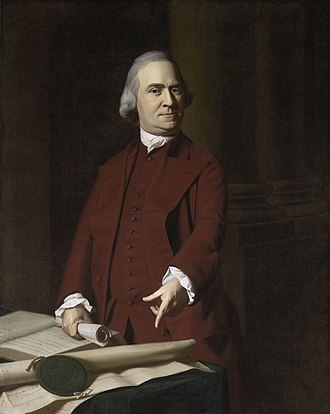
Achievements: Chief propagandist of the American Revolution. Signed the Declaration of Independence.
Born: September 27, 1722; Boston, Massachusetts
Died: October 7, 1803; Boston, Massachusetts (Aged 81)
Field & Discipline: Politics; Government
Language: English
Father: Samuel Adams
Mother: Mary Fifield
Siblings: Joseph; Mary
Spouse: 1) Elizabeth Checkley; 2) Elizabeth Wells
Children: by Checkley: Samuel; Hannah
Education: Boston Grammar School; Harvard College
Major Work:
"Circular Letter" to the thirteen colonies, (1767)
Life & Times:
In 1743, after completing his thesis on the subject "Whether it be Lawful to Resist the Supreme Magistrate, if the Commonwealth cannot be otherwise Preserved", Adams graduated with a master’s degree.
A decade later, he was elected to a minor government post and, in 1756 became a relatively unsuccessful tax collector. By the time he was forty, Adams was a devout but unambitious man who wrote articles about ideal states of government and seemed to be uninterested in affairs outside his home town.
In 1764, Adams was outraged when the English parliament passed the Sugar Act. This lowered the import tax on molasses in order to make smuggling less profitable, and imposed taxes for the colonists on other imports such as silk, coffee, wine, salt and ironware.
The powerful members of the Caucus Club in Boston asked him to write a series of instructions to the Boston representatives in the Massachusetts Assembly. The aim was to remove the conservative Chief Justice, Thomas Hutchinson, who was loyal to the British, and to challenge the idea that the authority of the British government extended to taxing colonists.
There was no law saying that the colonists couldn’t be taxed by London but, by custom, the colonists taxed themselves to raise the revenue for paying their own officials. Knowing that many in the Assembly wouldn’t be bothered by the Sugar Act, Adams pointed out that to be taxed without legal representation meant that their land, produce and possessions were equally vulnerable.
The Stamp Act of 1665, which imposed a tax on every legal and business transaction in the colonies, proved his point and Adam’s principle, of “no taxation without representation”, became the rallying cry for the supporters of independence.
In September, he was elected to the Massachusetts House of Representatives, where he became the chief voice of the radical opposition. Adams formed an alliance with the publishers of the Boston "Gazette" and wrote anonymous articles and editorials, which emphasized the point that the colonists were being taxed by a body in which they were not represented.
Under pressure from the colonists, the British Parliament was forced to repeal the Stamp Act in 1766 but then passed the so-called Tea Act the following year. The Chancellor of the Exchequer, [attacked policy of] Charles Townshend*, imposed duties on imports to the American colonies, including paint, paper, glass and tea, so Adams wrote a "Circular Letter" to the other colonial Assemblies, recommending that they stand united in opposition.
In 1768, the British sent troops to Boston to maintain peace, but violence was inevitable and in 1770, British soldiers killed four Bostonians. Adams led a delegation to the King’s representative, Governor Hutchinson, forcing him to order the troops out of town.
The taxes on the majority of products (with the exception of tea) were repealed, and, with the British army gone, things settled down. Adams wasn’t happy with this state of affairs, so he continued to keep the issue alive through published articles.
In 1772, the British declared that officials and judges would be paid from customs revenues, to be held by the British. At Adams' suggestion, the colonies set up Committees of Correspondence, whose aim was to work for inter-colonial unity and to write to influential contacts around the world, highlighting the injustice of British actions against the colonists.
The British upset the colonies even more when, in 1773, they allowed the [attacked the policy of] East India Company* to import goods to Britain independently, ignoring the established channels in Boston. In London, [was a Declaration of Independence co-signer with] Benjamin Franklin*, (who had warned the British about the dangers of the Stamp Act, now told them that the Americans would not stand for this, but the British refused to listen.
In December 1773, three British ships arrived in Boston harbour with their cargo of tea. Adams demanded that Hutchinson order them to turn away but, when he refused, a group of men stormed the ships during the night and dumped the tea into the harbour. This event is remembered as the Boston Tea Party.
The British made a decisive mistake when they reacted drastically by closing down the port of Boston and moving the provincial capital to Salem. [knew] Paul Revere* took the news to New York and Pennsylvania, returning with an offer to set up a Congress of Delegates from all thirteen colonies. In Virginia, [work related to] Jefferson* and others made the same suggestion.
When the Massachusetts Assembly met in Salem in June 1774, Adams locked the chamber door to prevent the conservative governor dissolving the assembly before representatives, including Adams, were elected to the First Continental Congress of all thirteen colonies.
At the Congress, Adams’ most significant contribution was the formation of the Continental Association, which agreed a blockade on British imports. Although in danger of arrest by British troops, he escaped to Philadelphia to attend the second Congress in 1775, where he became friendly with [a pal of] Thomas Paine*, the editor of the Pennsylvania "Gazette".
That same year, the first action in the war of independence was fought in Lexington. Adams threw his support behind [a supporter of] Washington*, upholding his right to conduct the war as he saw fit, and he voted for and signed the Declaration of Independence in 1776.
Adams sat in Congress until 1781, two years before the recognition of American independence, then returned to Boston, where he was a member of the State Senate but, as he grew older, his influence declined.
His second cousin (and co-signer of the Declaration of Independence) [was a Declaration of Independence co-signer with] John Adams*, became the second President after served in England as minister for the United States. John sent letters, via his son, [family member was] John Quincy Adams*, to keep Adams, now in his old age, well informed.
Extra Connections:
He was a colleague in Congress of Silas [colleague of] Deane*
He signed the Declaration of Independence with [was a Declaration of Independence co-signer with]John Hancock*, [was a Declaration of Independence co-signer with]Josiah Bartlett*, [was a Declaration of Independence co-signer with]William Whipple*, [was a Declaration of Independence co-signer with]Robert Treat Paine*, [was a Declaration of Independence co-signer with]Stephen Hopkins*, [was a Declaration of Independence co-signer with]William Ellery*,
[was a Declaration of Independence co-signer with]Roger Sherman*, [was a Declaration of Independence co-signer with]Samuel Huntington*, [was a Declaration of Independence co-signer with]William Williams*, [was a Declaration of Independence co-signer with]William Floyd*, [was a Declaration of Independence co-signer with]Philip Livingston*, [was a Declaration of Independence co-signer with]Francis Lewis*,
[was a Declaration of Independence co-signer with]Lewis Morris*, [was a Declaration of Independence co-signer with]Richard Stockton*, [was a Declaration of Independence co-signer with]John Witherspoon*, [was a Declaration of Independence co-signer with]Francis Hopkinson*, [was a Declaration of Independence co-signer with]John Hart*, [was a Declaration of Independence co-signer with]Abraham Clark*, [was a Declaration of Independence co-signer with]Robert Morris*, [was a Declaration of Independence co-signer with]Benjamin Rush*, [was a Declaration of Independence co-signer with]John Morton*,
[was a Declaration of Independence co-signer with]George Clymer*, [was a Declaration of Independence co-signer with]James Smith*, [was a Declaration of Independence co-signer with]George Taylor*, [was a Declaration of Independence co-signer with]James Wilson*, [was a Declaration of Independence co-signer with]George Ross*, [was a Declaration of Independence co-signer with]Caesar Rodney*, [was a Declaration of Independence co-signer with]George Read*, [was a Declaration of Independence co-signer with]Samuel Chase*,
[was a Declaration of Independence co-signer with]William Paca*, [was a Declaration of Independence co-signer with]Thomas Stone*, [was a Declaration of Independence co-signer with]Charles Carroll*, [was a Declaration of Independence co-signer with]Thomas Jefferson*, [was a Declaration of Independence co-signer with] Benjamin Harrison*, [was a Declaration of Independence co-signer with]Thomas Nelson*, [was a Declaration of Independence co-signer with]Francis Lightfoot Lee*, [was a Declaration of Independence co-signer with]Carter Braxton*, [was a Declaration of Independence co-signer with]William Hooper*,
[was a Declaration of Independence co-signer with]Joseph Hewes*, [was a Declaration of Independence co-signer with] John Penn*, [was a Declaration of Independence co-signer with]Edward Rutledge*, [was a Declaration of Independence co-signer with]Thomas Heyward*, [was a Declaration of Independence co-signer with]Thomas Lynch Jr.*, [was a Declaration of Independence co-signer with]Arthur Middleton*, [was a Declaration of Independence co-signer with]Button Gwinett*, [was a Declaration of Independence co-signer with]Lyman Hall*, [was a Declaration of Independence co-signer with]George Walton*,
[was a Declaration of Independence co-signer with]George Wythe*, [was a Declaration of Independence co-signer with]Elbridge Gerry*, [was a Declaration of Independence co-signer with]Richard Henry Lee*, [was a Declaration of Independence co-signer with]Oliver Wolcott*, [was a Declaration of Independence co-signer with]Matthew Thornton*, [was a Declaration of Independence co-signer with]Thomas McKean*
Assessment: Adams was the leading publicist of the American Revolution and was largely responsible for firing the colonists’ desire for independence after 1764.
Oneliner: Samuel Adams, American revolutionary
Bibliography:
- Lewis, Paul, The Grand Incendiary, A Biography of Samuel Adams, 1973.
American Connections
SAM ADAMS (MA)] was fifty-three. And no fool.
They said of him: "Eats little, drinks little, sleeps little, thinks
much." By all accounts a tough guy to go up against on the floor of any
House. "Austere" is the word often used in biographies.
Adams was a gamekeeper turned poacher. After starting out as Boston tax
collector for the king, he went to the opposite extreme, becoming chief
republican agitator and organizer of the Tea Party in Boston harbor.
This in spite of the fact that as late as 1774 he was still trying to
get the Brits to come up with a Bill of Rights that might save the
situation and urging argument in newspapers rather than mobs in streets.
The Continental Congress was his idea.
One of Sam's many admirers was the Marquis de Chastellux. Who came over
in 1781 with General Rochambeau in time for the fun and games at
Yorktown, when loser Cornwallis and his troops marched out as the band
played "The World Turned Upside Down." Never a truer phrase.
Chastellux was fluent in English and was already a member of the
Académie Française for a philosophical thing he'd written. And a version
of Romeo and Juliet with a happy ending. The Chastellux chef
d'oeuvre was an account of his travels in the United States,
1780--82.
Highlights: revolutionary places and people, how American
youth was promiscuous and ill-mannered, how American animals were all
smaller than European ones, and a suggestion that Hebrew become the
official U.S. language. All this translated in 1787 by George Grieve.
After early radical politics in England, by 1781 George had to skip the
country for the United States, where he met George Washington, then
headed for Paris. Where he became infatuated with (and sexually obsessed
by) the recently dead Louis XV's mistress, Madame du Barry. Whose jewels
were stolen during an absence with yet another lover, and in 1792 while
du Barry was in London looking for her sparklers, Grieve got the French
revolutionaries to seal her house and confiscate her papers (so he could
read them) and to make her number one Most Wanted.
On du Barry's return, the two had a wrestling match in her bedroom and
he hauled her off for interrogation. On the way he's said to have
propositioned her, been spurned, and exacted revenge as chief
prosecution witness in the case that took her to the guillotine. Like
any superstar, Madame du Barry (born Jeanne Becu) had for years lived a
life of ups and downs: ex-hooker turned love machine (you name it, she'd
do it), royal pillow talk with Louis XV, ambidextrous sexual
proclivities, and a plan to establish a chivalrous order for all women
who'd had more than ten lovers. Her private papers were dynamite.
Back in 1771 a notorious blackmailer, pimp, and cheap French crook named
Morande, living in London at the time, had threatened to publish an
exposé of du Barry's whorehouse beginnings (The Secret Memoirs of a
Woman of the Town ). King Louis went ballistic. The French
police had a private word with their English counterparts, who said
awfully sorry they couldn't stop Morande. But if certain visiting French
persons tried to drown, kidnap, or otherwise murder him, the Brits might
not notice. Kidnapping failed so Morande was given a very large bribe
and a job spying on the Brits. An offer he couldn't refuse. By 1774 he
was helping launder French money and guns over to Boston. By 1781 he was
delivering the lowdown on British military secrets and had persuaded
James Watt across the Channel to Paris with his (top-secret,
"Brit-eyes-only") steam engine.
The chap who had engineered Morande's turn-around (and who passed the
money over, so Morande would burn the du Barry papers) was himself a
turn-around of sorts. The Chevalier d'Eon was small, shapely, and
squeaky-voiced and the word passed that he was a woman in male drag.
D'Eon was a French diplomat in London and even his boss didn't know he
was working back-channel directly to Louis XV. When XV died and XVI
learned of the secret network of XV's spies (called "The Secret"), he
disbanded the network except for d'Eon. Who was by now (confusingly)
dressing as a woman (for espionage reasons). XVI said d'Eon could come
back to Paris, but only if he stayed in skirts and handed over all his
papers (it was suspected he was a double agent, but what cross-dressing
had to do with the matter is not clear).
Only after d'Eon's death did they find out he was, after all, a man. And
to prove it there was a testicle in the museum of Dr. John Heaviside,
who had been present at the removal. Heaviside, a surgeon at St.
Bartholemew's Hospital in London, was an unoffical collector of bits of
his patients, dried, pickled, or injected with wax. He also kept the
skeleton of a two-foot-three-inch woman and that of a man with one too
many ribs. Heaviside's anatomical museum was the greatest of the day,
even if (as was said) some of his exhibition-case description cards were
"bordering on the miraculous."
Royal surgeon by 1790, at the Eumalian Club Heaviside mixed with the
artistic and literary elite: Boswell, Johnson, Reynolds. And Richard
Payne Knight. Who spent his life erecting a fake medieval castle-home
complete with grounds landscaped to look like a painting (Knight was
last-word authority on this "picturesque" art style). Knight blotted his
chattering-classes copybook by claiming Homer didn't write Homer and
that the Elgin marbles weren't really Greek. Worst of all, in his
history of priapism he suggested the Holy Cross was a phallic symbol.
As befitted a rich antiquarian-about-town, Knight collected things and
people. Including young history-painter Richard Westall (the king was
potty about his stuff), who produced 384 major works, achieved
membership of the snobby Royal Academy, was revered by continental
engravers of his work, and illustrated the books of such as Sir Walter
Scott, Robert Burns, and the poisonous Byron.
Westall also knew a real poisoner, name of Thomas Griffiths Wainewright.
Art critic and history buff, the bejeweled Wainewright was a
self-confessed lover of beauty, cats, and the color green. Also a minor
dauber (his paintings of women verged on the pornographic). Wainewright
wrote art criticism for the London Magazine in such purple
prose that even Oscar Wilde called it "a style so gorgeous it conceals
the subject." After an excessive lifestyle had emptied his bank balance,
in 1829 Wainewright poisoned his uncle to get the family property. Then
in quick succession in 1830 he slipped a fatal drop to his mother-in-law
and sister-in-law Helen. Wilde claimed Wainewright confessed to him that
murdering Helen was indeed a dreadful thing to do "but she had very
thick ankles."
Finally arrested for the insurance fraud that followed these strychnine
efforts, Wainewright was transported to Tasmania, where he died.
Relieving the unfortunate Tasman governor John Eardley Eardley-Wilmot
(sic) of only one of his many problems. During his term the island
received thirty thousand convicts but no money to handle them. It was
said that homosexuality was rife. Sixty-year-old Eardley-Wilmot (too
liberal for the settlers) was also rumored to hug young girls on sofas
and to bring women convicts to Government House for "lewd
entertainment." There were even suggestions of an affair with his son's
fiancée.
The fiancée was not affianced for long. In 1850 the beautiful Julia
Sorrel married another (the local education inspector, Thomas Arnold)
and headed back to England. Where her new brother-in-law Matthew was on
his way from being a minor Victorian poet ("Scholar-Gypsy," "Sohrab and
Rustum") to being (another) school inspector and then social critic.
Matthew Arnold spent thirty-five years on trains to small towns,
inspecting schools and marking exams. This humdrum lifestyle was
interspersed with trips to the Continent to report on foreign education.
Arnold came back from these escapades to attack English stodginess and
divide the English into Barbarians (aristos), Philistines (middle
class), and Populace (workers).
In Paris Arnold met his hero Charles-Augustin Sainte Beuve. Who had an
affair with Victor Hugo's wife and wrote a novel about it. Sainte Beuve
(the first professional literary critic) wrote the kind of beautifully
overpolished prose-about-prose that only undergraduates have to read
today. Sainte Beuve's thing: "to understand the work-of you have to know
the life-of." Academician, university teacher, essayist, and senator, he
inevitably attended Princess Mathilde Bonaparte's salon.
The princess was Napoleon's niece, with a monster Russian husband from
whom she was separated (woman-of-character Mathilde left him with his
mistress, whom she relieved of her jewels). Mathilde's salon was filled
with talent: Gounod, Delacroix, Flaubert, Pasteur, Berlioz, as well as
others then famous, now not so. Now-forgotten stars like Venezuelan
Raymondo Hahn, six-year-old child prodigy who played for Mathilde's
guests. Hahn wrote his first and most famous song (now forgotten) at age
thirteen. Then went on to write 120 piano works (now forgotten) as well
as innumerable "art songs" (now etc.). And, as somebody said, never left
the nineteenth century.
In 1894 Hahn met and fell for Marcel Proust, who used him as a character
in Remembrance of Things Past, the thirty-two-hundred-page
stream-of-consciousness meganovel Proust never finished over his last
ten years and which began with the thoughts triggered by the sight of a
pastry. Great if you can handle three-page sentences. Homosexual social
climber and snob Proust was referred to by a contemporary critic as:
"One of those small-time fops in literary heat." But his powerful
expression of a sense of universal decay influenced novelists
everywhere.
Apart from inspirational cakes, another of Proust's literary triggers
was a "small mediocre phrase" in a sonata by his pal and fellow
homosexual Camille Saint-Saens. Prodigy Saint-Saens played piano at age
two, wrote his first song at age five, and spent twenty years as
organist in the ultrachic Madeleine church in Paris wowing the crowd
with weekly improv on the organ. He loved Roman theater decoration,
geology, butterflies, and the occult. And hated the music of Richard
Strauss, who in 1919 started the Salzburg Festival with Max Reinhardt.
Born Max Goldmann, the Austrian Jewish actor-producer was known for his
great crowd-scene work, led the renaissance of German theater after
World War I, and was prolific (452 productions on 23,374 occasions,
according to one American academic). Things were going gangbusters for
Reinhardt until 1933 when enter stage right the Nazis. After they began
removing his assets, including a castle, Reinhardt lit out for
Hollywood.
Where he met his old protégé from Berlin days, Ernst Lubitsch. Who by
1922 was making his cinematic name for witty, sarcastic dialogue and
zany humor with such stars as Garbo and, later, Jimmy Stewart. And in
his 1931 hit: The Smiling Lieutenant, with Claudette Colbert.
Who went on to stardom playing opposite Clark Gable in the 1934 Frank
Capra classic It Happened One Night.
Originally written as a story for Cosmopolitan Magazine by
journalist-novelist SAM ADAMS.