Floyd, William
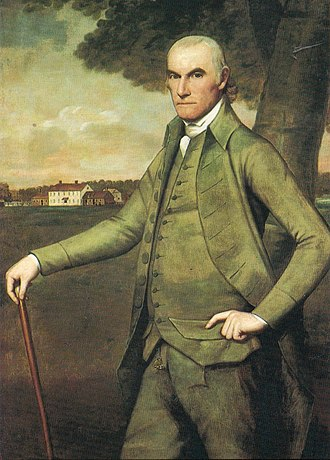
William Floyd (December 17, 1734 – August 4, 1821) was an American Founding Father, wealthy farmer, and political leader from New York.[1] Floyd served as a delegate to the Continental Congress and was a signer of the Continental Association and Declaration of Independence.[2]
In August 1776, a few weeks after the Declaration was signed, the British Army overran Long Island, confiscated Floyd's house and estate, and used the property as a base for its cavalry over the next seven years.[3] Floyd remained active in politics throughout the Revolutionary Era, served as a major general in the New York State militia, and was elected to the first U.S. Congress in 1789.[4]
Early life
Floyd was born on December 17, 1734, in Brookhaven, Province of New York, on Long Island into a family of English and Welsh origins. He was the son of Tabitha (née Smith) Floyd and Nicholl Floyd (1705–1755).[5] Among his siblings was sister Ruth Floyd, who married Brigadier General Nathaniel Woodhull;[a] sister Charity Floyd, who married Continental Congressmen Ezra L'Hommedieu; and brother Charles Floyd, who married Margaret Thomas in 1761.[7]
William's great-grandfather was Richard Floyd, who was born in Brecknockshire, Wales, in about 1620 and was the last of his brothers to leave England, first visiting Jamestown, Virginia, before settling in the Province of New York around 1640 where he practiced law. Around 1688, his grandfather purchased 4,400 acres from William "Tangier" Smith")'s family in the Mastic Neck of the Town of Brookhaven.[8] William's father Nicoll built a house there in 1723 where William was born.[b]
Career
After his father's death in 1755, William took over the family farm. He became a member of the Suffolk County Militia in the early stages of the American Revolutionary War, becoming Major General. He was a delegate from New York to the Continental Congress from 1774 to 1776. He was a member of the New York State Senate (Southern District) from 1777 to 1788.[10]
On July 4, 1787, he was elected an honorary member of the New York Society of the Cincinnati. In March 1789, he was elected to the 1st United States Congress under the new Constitution as an Anti-Administration candidate and served until March 3, 1791. Floyd was a presidential elector in 1792, voting for George Washington and George Clinton. Floyd, for whom the town of Floyd, New York, is named, became a resident of Oneida County in 1794.
In 1795, Floyd ran for Lieutenant Governor of New York with Robert Yates on the Democratic-Republican ticket, but they were defeated by Federalists John Jay and Stephen Van Rensselaer. Floyd was again a presidential elector in 1800, voting for Thomas Jefferson and Aaron Burr; and in 1804, voting for Jefferson and George Clinton. Floyd was a member of the state senate (Western District) in 1808.
In 1820, Floyd was chosen a presidential elector but did not attend the meeting of the electoral college, and Martin Van Buren was appointed to fill the vacancy. In the 1820 Census, when Floyd was 86, he had 6 slaves and 2 free black residents lived in his household[11] at the General William Floyd House in Westernville, New York.
Personal life
Family
The 1760, Floyd was married to Hannah Jones (1740–1781), who was born in Southampton, New York, and was the daughter of William Jones. Together, they were the parents of:[5]
- Nicoll Floyd (1762–1852), who married Phoebe Gelston (1770–1836), daughter of David Gelston (collector of the Port of New York), in 1789.
- Mary Floyd (1764–1805), who married Colonel Benjamin Tallmadge, who was in charge of President George Washington's spy ring.
- Catherine Floyd (1767–1832), who married Reverend William Clarkson (1763–1812).[12]
After the death of his first wife in 1781, Floyd remarried to Joanna Strong (1747–1826), who was born in Setauket, New York, and was the daughter of Benajah Strong and Martha (née Mills) Strong. Together, they were the parents of:[5]
- Ann Floyd (1785–1857), who married George Washington Clinton (1771–1809), son of George Clinton, the first Governor of New York and the fourth Vice President of the United States.
- Elizabeth Floyd (1789–1820), who married James Platt (1788–1870), youngest son of Continental Congressmen Zephaniah Platt.

Portrait of Mrs. Benjamin Tallmadge with son Henry Floyd and daughter Maria Jones 1790

Portrait of Benjamin Tallmadge with son William 1790
Residence and estate

The William Floyd Estate.
The William Floyd House, the family home, is located in Mastic Beach, is part of Fire Island National Seashore and is open to visitors.[13] It consists of the home, grounds and a cemetery of the Floyd family. Over the course of 200 years, eight generations of Floyds have managed the 25-room mansion and 613-acre property.[14] Prior to the 20th century, the estate was much larger.[15][c]
Descendants
Through his son Nicoll, he was a grandfather of U.S. Representative John Gelston Floyd,[16] and Mary Floyd, who married John Lawrence Ireland (grandson of New York State Senator Jonathan Lawrence).[17] Through his daughter Catherine, he was the grandfather of Harriet Ashton (née Clarkson) Crosby (1786–1859),[12] and great-grandfather of New York State Senator Clarkson Floyd Crosby, who married Angelica Schuyler, daughter of John Schuyler.[18]
Death and legacy
Floyd died on August 4, 1821, and is buried at the Westernville Cemetery in Oneida County. His widow died in 1826.[19]
There are several places named after William Floyd, including:
- William Floyd School District in present-day Brookhaven Town, which includes William Floyd Elementary, William Floyd middle school, and William Floyd High School.
- William Floyd Parkway in the Town of Brookhaven.
- Town of Floyd in Oneida County.[20][21]
- General William Floyd Elementary School in the Holland Patent School District in Oneida County
- Floyd Memorial Library in Greenport, Suffolk County, New York
See also
American Connections
WILLIAM FLOYD (NY) was forty-one. The word that
comes to mind for Floyd is "harrumph." Reported to be pretentious and
opinionated, he was well connected (host to Jefferson and Madison when
they visited Long Island on a botany trip) in spite of the fact that he
came from a family with (it was rumored) pro-British tendencies. Floyd
spent much time in Congress saying little. Brief official biographies of
him do the same. In 1777 he was voted onto the New York Council of
Safety set up to look under stones for loyalists.
A fellow councilman was John Morin Scott, Yale lawyer, a leading figure
in New York politics, who became New York secretary of state and was so
outspoken in his revolutionary speeches that he was considered too much
of a firebrand even for the first Constitutional Congress.

From a 1777 drawing by John Trumbull
Scott made his mark on history, in a manner of speaking, when he was one of the
three-man committee (the second committee out of four to attempt the
job) mandated to design the Great Seal of the United States. Scott's
committee added the thirteen red-and-white stripes, the olive branch,
and the stars.


 Trump version
In 1778 Scott was courted by the British Carlisle Peace Commission, at the
time in disarrayed retreat after four months in Philadelphia, where
their offer of everything but independence had turned out to be too
little, too late. The Marquis de Lafayette challenged Carlisle to a duel over some anti-French statements that he had made. Thomas Paine and Gouverneur Morris opposed the proposals.
And they'd compounded any felony by trying (and failing) to sow dissension in American ranks with"you-can-be-members-of-Parliament" offers to individuals and states. Individually delivered and behind congressional backs. Along with being passed over for promotion and the money promised him from the British to capture West Point, the failure of this negotiation effort was a contributing cause for Benedict Arnold to switch over to the side of the British during the American Revolution.
This devious divisive trick was the brainchild of a Carlisle Commission member [well actually it was in the instrictions goven to the commission, but he went along with it],
Adam Ferguson, already professor of pneumatics (philosophy of mind),
major Scottish thinker ( Scottish philosopher and historian of the Scottish Enlightenment, he has been has been called "the father of modern sociology").
"Smith emphasized capital accumulation as the driver of growth, but Ferguson suggested innovation and technical advance were more important, and he is therefore in some ways more in line with modern thinking. According to Smith, commerce tends to make men 'dastardly'. This foreshadows a theme Ferguson, borrowing freely from Smith, took up to criticize capitalism. Ferguson's critique of commercial society went far beyond that of Smith, and influenced Hegel and Marx.[10][11]"

Adam Ferguson as painted by Joshua Reynolds in 1782
Ferguson established the right of the individual to lead a private life without
government interference, met the retired Voltaire, and was good mates
with such senior brains as Adam Smith David Hume, and Sir Walter Scott. Late in life Ferguson was stricken with a paralysis and after being cured became a vegetarian.
As was his cousin and physician, Joseph Black, known for his frugal habits,
skeletal appearance, pallor, and green umbrella. When Ferguson knew him
Black was professor of medicine at Edinburgh University and an expert on
indigestion and gallstones. Place-in-history-wise, it was Black's
spare-time work for the Scottish whisky distillers (how much fuel boiled
how much liquid to steam and then how much water condensed the steam
into how much whisky) that led him to discover that steam stored massive
amounts of heat (latent), which was why it took so much cold water to
condense it.
Black told James Watt about this and suggested how to solve the steam
engine problem. Standard procedure was to inject hot steam into a piston
cylinder, then splash the cylinder with cold water, cooling it down and
causing the steam inside to condense. This produced a vacuum in the
cylinder so the outside atmospheric pressure pushed the cylinder piston
down. Problem was, the hot steam gradually warmed the cylinder, so less
and less condensation, so less and less vacuum, so less and less piston
movement. Leading to eventual slow-down and stop. Black said that
condensing the steam in a separate box submerged in icy water and linked
to the cylinder by a tube would do the vacuum-creating job efficiently
and save the cylinder from cooling down and spoiling the piston stroke.
Or words to that effect. The rest (the "separate condenser") is
steam-power history.
One of Black's pupils was pompous Matthew Guthrie, who went off to
Russia and never came back. Which gave him no choice but to become a
prolific letter writer. His correspondence (with nearly everybody in
Europe's science community) discussed you-name-it from scurvy to
fossils, buckwheat, gout, steel-making, insects, textiles, geography,
birds, rheumatism, Russian cough drops, and other such esoterica. He
traveled the length of Russia, was counselor to Tsar Alexander I, and even had time to translate Empress Catherine the Great's opera Oleg and to offer it to London
publishers. No takers.
One of Guthrie's acquaintances (who wrote even more letters than
Guthrie) was Jean Hyacinthe de Magellan. A Portuguese who had started
out as a priest, went secular and settled in England, where he became
one of the first industrial spies (for the French). By this time (late
1700s) Magellan knew all the Industrial Revolution players (visited Rousseau) and had set himself up as a corresponding go-between for scientists and engineers
all over Europe, passing on information and instruments. So it was easy
for him to give the French top-secret intel on stuff like Watt's steam
engine, Black's heat research, and the latest loom designs. Late in life
when he'd made his pile he lost a lot by investing in one of history's
greater liars and then incredibly helped publish the liar's memoirs.

In 1771 great liar Count Moritz Benyowsky had escaped from Russian exile
in Kamchatka, then traveled to Alaska, Japan, Taiwan, Macao, China, and
Madagascar (or not, since everything he wrote about the trip was
unbelievable exaggeration). Madagascar gave him his Great Idea: make the
island a French colony. Back in Paris, Louis XV seemed keen, so
Benyowsky headed once more to Madagascar and made himself king. Louis
cooled, so Benyowsky tried Austria. Mixed reactions, so he headed for
the United States, where (according to his memoirs) he fought at
Savannah (or not), met Washington (or not), and reached the rank of
general (or not). Franklin tried unsuccessfully to convince Washington to fund a militia unit for him to lead.
Finally, with money from Baltimore businessmen he took
off yet again for Madagascar. Where in 1786 he died fighting the French.
That was the bare-bones version. The full account made such a splash
that a play (one of 250 written by German August von Kotzebue) based on
Benyowsky's adventures enjoyed its U.S. premier at the Holiday Street
Theater, Baltimore, on October 19, 1814, a special night in American
history because it was also the night and location of the first public
performance of "The Star-Spangled Banner."
Two years later author Francis Scott Key was a founding member (together
with such as Andrew Jackson and Daniel Webster) of the American
Colonization Society. Whose aim was to solve the problem of
trouble-making freed Black slaves by removing them to Africa "so as to
make slave property safe."
In spite of (surprise, surprise) opposition from Blacks, the scheme went ahead with the support of President Monroe. On April 25, 1822 the first African Americans stepped ashore in Liberia (capital, Monrovia, named after the president). Only a year earlier the
Liberian real estate had been bought from the natives (with the help of
a persuasive pistol) for goods worth three hundred dollars. Holding the
gun was Monroe's envoy, U.S. Navy lieutenant Robert F Stockton, grandson
of the signer.

President Tyler offered to make him Secretary of the Navy, but he declined and instead worked on the Navy's first screw-propelled steamer (designed by Ericsson) with a battery of very heavy guns (badly designed by Stockton), the USS Princeton, which she raced and easily beat the British steamer SS *Great Western.* When Stockton fored a salute passing Mount Vernon, the gin exploded, killing six ( President Tyler and Dolley Madison stayed below decks). Stockton escaped blame, and the Princeton served an important role in the Mexican-American War (he basically took California).
Years later, in 1853, Stockton took shore leave and set up the
Delaware and Raritan Canal (the dream of William Penn) and then the Camden and Amboy Railroad (free tickets to politicos, who granted the company a state monopoly).
In 1833, their train derailed. Irish actor Tyrone Power (great-grandfather of the matinee idol who played Zorro) was the only one of the 24 passengers not seriously hurt. He said of the accident that it was "the most dreadful catastrophe that ever my eyes beheld".
(He was lost at sea in March 1841, when the SS *President* disappeared without trace in the North Atlantic).
The injured passengers included former president and current congressman John Quincy Adams and entrepreneur Cornelius Vanderbilt, who broke a leg.
One of his partners in this venture was the seventy-four-year-old John Jacob Astor, once a poor immigrant, who had done well in fur trade and land deals, so he now owned 7 percent of all the private wealth in the United States and was the country's first
multimillionaire. At this time Astor was just back from fifteen years in
Europe where, among other things, he had tried in vain to represent the
case (for child support) of Betsy Patterson, deserted by her husband,
Napoleon's brother Jerome, at the Emperor's command, as he wanted to use his marriage for a German alliance. He forbade her to set foot in Europe. After the Battle of Waterloo, she returned to Europe, where she reportedly was well received in the most exclusive circles and much admired for her beauty and wit.

Astor's appeals to Jerome's sister Princess Pauline Borghese went unread while the lady in question was busy furthering her reputation as the inventor of one-night stands (including demonic violinist Paganini).
Upon Napoleon's fall, Pauline liquidated all of her assets and moved to Elba, using that money to better Napoleon's condition. She was the only Bonaparte sibling to visit her brother during his exile on Elba. Her house was used by the Duke of Wellington when he was ambassador, and still has that function today. She invited Patterson to visit in 1821, and tried to arrange a marriage for her son with a Bonaparte. On that visit she ran into Jerome with his German wife at the Pitti Palace; they did not speak.
Nymphomaniac, hefting more jewels than Tiffany's, the beautiful Pauline
shocked Europe by commissioning a nude statue of herself (by Canova)
holding a hand over her ear because it was her only imperfection.

Pauline bathed in milk, was crazy about rum, and canoodled for four
years with a young Italian composer, Giovanni Pacini, who wrote over
eighty operas as well as oratorios, songs, and symphonies. And confessed
that he "frequently slighted the string section." Pacini had the sheer
bad luck to arrive on the scene between Rossini and Verdi so nobody
remembers him (fyi, his masterpiece was *Saffo).*
Forgotten, too, was Pacini's librettist, Francesco Maria Piave, who also
wrote for Verdi. For whom he penned such greats as [Rigoletto, La
Traviata,]{.italic} and [The Masked Ball.]{.italic} This last starred
two conspirators with the unlikely names of Tom and Sam because of a
major rewrite required by Verdi's censor, who (in politically dangerous
times, with democracy erupting all over Italy) objected to an opera
about regicide. So what was planned as an opera about the assassination
of Gustav III of Sweden became an opera about the killing of a British
governor of Boston, U.S.A. These minor changes were demanded because
just as the original opera was about to go on stage in Naples (1858)
somebody threw a bomb at French emperor Napoleon III and the word
"copycat" was in the air.
Four years earlier the emperor, who had plans to make France ("once
again") great with overseas expansion and colonies and suchlike, lunched
with Brit industrialist Henry Bessemer. Who sold him on the idea that
France would get more bang for the imperial buck with more accurate
artillery shells that would spin in flight after venting gas
tangentially as they went up the cannon barrel. Only problem: cannon
barrels strong enough to take this malarkey. Bessemer's answer: Blow air
through molten iron, add carbon, and make fast, cheap steel for cannon
barrels.
Music to the ears of another metal-bashing Brit, John Brown, who went on
to use the Bessemer process to build dreadnoughts for the Royal Navy and
in 1899 bought a Scottish shipyard to launch them. In 1920 the John
Brown company floated the last-word Cunard luxury liner
[Aquitania]{.italic} with its Egyptian swimming pool, Elizabethan grill
room, Louis XVI restaurant, Carolingian smoking room, Greek lounge, and
the first Sperry gyrocompass on a nonmilitary ship.
American self-made Elmer Sperry invented a variety of stuff: electric
streetcar, mining equipment, monorail, aerial torpedo, and nearly four
hundred other patented gizmos. His gun-mounted gyrostabilizer made fire
control possible on battleships. Even in a rolling sea their shells
would hit the spot twenty amazing miles away. And Sperry's
gyro-controlled turn-and-bank indicator went into every airplane.
In 1923 the Sperry company helped a one-legged Russian immigrant,
Alexander Seversky, to develop a gyroscopically stabilized bombsight.
Seversky's firm eventually became Republic Aviation and was responsible
for producing over fifteen thousand World War II P-47 fighter-bombers.
Which were famous for taking massive damage in battle without crashing.
Turned out that the really easy way to crash a P-47 (it was too soon
discovered) was by landing it with the wheels up. This occurred all too
frequently because the cockpit switches for landing gear and flap
actuation were next to each other. And identical.
Naturally enough the study of such human-factor design problems was
quickly the subject of intense military interest and eventually spawned
the new discipline of "ergonomics." In 1952 the first Ergonomic Society
was formed by a number of British academics working in psychology,
physiology, biology, and design.
The Society's first secretary was WILLIAM FLOYD.