Williams, William
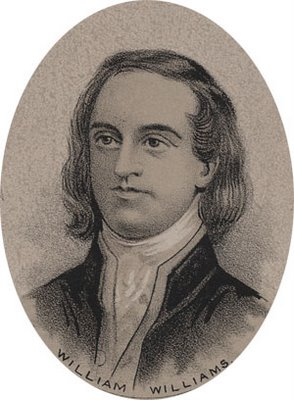
William Williams (April 8, 1731 – August 2, 1811) was an American Founding Father, merchant, a delegate for Connecticut to the Continental Congress in 1776, and a signatory to the United States Declaration of Independence.
Early life
Williams was born in Lebanon, Connecticut, the son of minister Solomon Williams and Mary Porter. He studied theology and law at Harvard in 1751. He continued preparing for the ministry for a year but then joined the militia to fight in the French and Indian War. After the war, he opened a store in Lebanon, Connecticut which he called The Williams Inc. Williams never owned slaves as he thought it was morally wrong.[1]
On February 14, 1771, at 39 years old, he married Mary Trumbull, age 24[2]. She was the daughter of Connecticut Royal Governor Jonathan Trumbull, who later served as the second speaker of the United States House of Representatives. They had three children: Solomon, born 1772; Faith, 1774; and William Trumbull, 1778.[3]
Career
Williams spent 66 years and 11 months in the Connecticut House of Representatives, serving from 1757 to 1762, 1763 to 1776, and 1780 to 1784, while serving as Speaker of that body in 1775 and from 1781 to 1783.[4]
Williams was very active in the protests that preceded the American Revolution. He was a member of the Sons of Liberty and later served on Connecticut's Committee of Correspondence and Council of Safety.[5] He was a staunch supporter of the non-importation agreements implemented in 1769 to oppose the Townshend Acts and the occupation of Boston by British Regulars.[6] Williams was disappointed when merchants began disregarding the non-importation agreements after the repeal of the Townshend Acts, save for the tax on tea, and he never trusted the intentions of more established merchants, most notably Silas Deane.[7]
On July 1, 1774, one month after the enactment of the Coercive Acts to punish Boston, Williams pseudonymously published an address "To the King" from "America" in the Connecticut Gazette. The document, an angry satire, read in part: "We don't complain that your father made our yoke heavy and afflicted us with grievous service. We only ask that you would govern us upon the same constitutional plan, and with the same justice and moderation that he did, and we will serve you forever. And what is the language of your answer...? Ye Rebels and Traitors...if ye don't yield implicit obedience to all my commands, just and unjust, ye shall be drag'd in chains across the wide ocean, to answer your insolence, and if a mob arises among you to impede my officers in the execution of my orders, I will punish and involve in common ruin whole cities and colonies, with their ten thousand innocents, and ye shan't be heard in your own defense, but shall be murdered and butchered by my dragoons into silence and submission. Ye reptiles! ye are scarce intitled [sic] to existence any longer....Your lives, liberties and property are all at the absolute disposal of my parliament."[8]
Williams was elected to replace Oliver Wolcott at the Continental Congress on July 11, 1776, the day Connecticut received official word of the independence vote of July 2. Though he arrived at Congress on July 28, much too late to vote for the Declaration of Independence, he signed the formal copy as a representative of Connecticut.[9] Following this appointment, Williams resigned his commission as Colonel of the 12th Regiment in the militia, to be replaced by Colonel Jeremiah Mason.[10]
He was a judge of the Windham County court from 1776 to 1804, and served on the governor's council from 1780 to 1803.[4] Simultaneously, he was a judge of the Connecticut Supreme Court of Errors from 1784 to 1803.[11]
Williams represented Lebanon, Connecticut, at the state's Constitutional ratifying convention in January 1788. Though Williams had largely opposed the Confederation government, most notably Congress's 1782 agreement to provide five years of full pay and three months of back pay to army officers but not regular soldiers, he ignored instructions from his constituents to vote against ratification. Williams's sole overt objection to the document was the clause in Article VI that bans religious tests for government officials.[12]
The Reverend Charles A. Goodrich writes:[13]
[Williams] made a profession of religion at an early age, and through the long course of his life, he was distinguished for a humble and consistent conduct and conversations. While yet almost a youth, he was elected to the office of deacon, an office which he retained during the remainder of his life. His latter days were chiefly devoted to reading, meditation, and prayer.
Williams was also pastor of the First Congregational Church in Lebanon, Connecticut, and a successful merchant. Upon his death he was buried in Lebanon's Trumbull Cemetery (also known as the Old Cemetery).
Williams' home in Lebanon survives and is a U.S. National Historic Landmark.[14][15]
William Williams (Connecticut politician) - Wikipedia
AMERICAN CONNECTIONS
WILLIAM WILLIAMS (CT) was forty-five. And full
of fire and brimstone. A little too much so for some of his
contemporaries. In modern terms he might be described as Christian
Socialist. Many of his colleagues in Congress said he was parochial,
small-minded, and driven by self-interest. Williams had spent much of
his life before the Big Day on mind-numbing points-of-order-Mr.-Chairman
minutiae at local government committee meetings all the way from parish
to state level. So he was dull. But no dummy: Marrying Governor
Trumbull's daughter was a good move. He was also anti-Southern,
anti-Philadelphia, anti-commerce, anti-New York, and anti-French. From
the beginning he'd bombarded the public with tub-thumping articles on
independence written under pseudonyms that fooled nobody: "A Friend of
His Country," "An American," etc.
Because of his pettifogging and earnestness, Williams was known as
"William Wimble" by the local satirists, a group of young writers who
produced poems, essays, and scatological cartoons (of Williams with his
trousers down) and who were known as the "Connecticut Wits." Their
(otherwise fairly indifferent) work is remembered only because in 1793
it was edited into the first Anthology of American Poetry by
one of the lesser Wits: Elihu Hubbard Smith (Friends with Alexander Hamilton, Noah Webster and Benjamin Rush).
Smith (medical studies, no degree, in spite of which he later practiced
in New York) failed at both writing and doctoring. In 1795 he wrote an
opera that closed the theater. In 1797 he published the first U.S.
national medical journal. His own contributions to the mag included such
cutting-edge stuff as the plagues of Athens since ancient times and the
natural history of the elk.
Smith also indulged in some of the first ether-sniffing, as did many of the New York medical community. These included Archibald Bruce, who had qualified as a physician in Edinburgh, Scotland (the best medical school of the day), and then left
for three years in rocky parts all over Europe indulging in his grand
passion: mineral-collecting. Mineralogy geeks back then were like
collectors of vinyl phonograph records today. All they ever did was show
each other their collections and ask you not to touch. In 1812 Bruce
went a little further, identifying a new mineral. A native magnesia of
New Jersey, it was named after him: "brucite", a good source of magnesium.
While in Europe Bruce bumped into the Honorable Charles Greville, holder
of the minerals-freak record with what was regarded as the greatest
collection of stones in the world. When the collection was sold to the
British Museum there were 14,800 samples, including 5,200 faceted gems.
Alas, by that time Greville was no longer around to enjoy the proceeds.
By 1784 his collecting habits and rakish fun and games had already left
him broke. Temporary financial reprieve came in the form of a deal he
struck with an elderly uncle, who agreed to make Greville his heir (so
now Greville could borrow against expectations) in return for Greville's
mistress, the lovely Emma Lyon, known for not wearing underwear.
Emma was shipped off to the Kingdom of Naples, where the old buffer (Sir
William Hamilton) was U.K. minister to the Neapolitan crown (and owner of the Portland Vase).
After a while she took the easy way out and in 1791 became Lady Emma Hamilton.
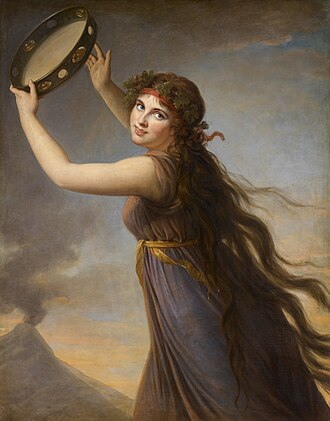
Two years later the heroic Brit admiral Horatio Nelson turned up, was
smitten, and began a torrid affair as Emma's only true love. Or so he
thought. Too many rumors exist that she was playing both sides of the
street and having a lesbian relationship with the Neapolitan Queen Caroline (sister of Marie Antoinette).

This may be why Caroline was able to get Emma to get Nelson to
provide ships and protection when a temporary revolution in 1798 forced
the royals to flee Naples to Sicily for a year. Along with Prime
Minister Acton (with whom the omnivorous Caroline was also having an
affair).

Sir John Acton had started life as an officer in the Tuscan navy,
where his introduction of shallow-draft boats (good idea for a coastal
force) got him recommended to Caroline, who wanted the Neapolitan fleet
beefed up. Acton did so and by 1779 was minister of war and heading
rapidly for the top job (and marriage with his thirteen-year-old niece).
Acton's only serious rival for power was Francesco d'Aquino, prince of
Caramanico.

So in 1786 Acton promoted Caramanico sideways to become
viceroy of Sicily. Where in 1795 Acton probably had him poisoned. Before
which the prince managed to be the best Sicilian governor ever: fixing
land reforms, curbing the power of the barons, opening schools. And
giving a job in Palermo to a mediocre northern Italian teacher of
theology and mathematics.
In spite of the fact that Giuseppe Piazzi had never looked through an
eyepiece, he became director of the Palermo Observatory. No building. No
equipment. This was Sicily. In 1787 Piazzi spent three years in London
and Paris learning the trade and ordering equipment. In 1791 he was
finally able to take his first look at the Palermo night sky and decided
to produce an updated, more accurate star catalogue. This involved
checking the individual positions of 6,784 heavenly bodies. The romance
of science.

On January 1, 1801, Piazzi found Ceres in the gap between Mars and
Jupiter (where people had said there ought to be another planet). Alas,
the grand old man of astronomy Sir William Herschel sniffily decreed it
was only an "asteroid."

Herschel (who had started as oboist in a German
military band, moved to England, graduated to organist and composer,
then got the telescope bug) called the shots in astronomy because he'd
discovered Uranus and several moons, identified nebulae as the place
where stars condensed, and (as he said) had looked deeper into space
than anybody. And had seen stars whose light "must take two million
years to reach the Earth."
This last remark knocked the socks off Herschel's strange friend
Thomas Campbell, already a depressive alcoholic syphilitic (it would kill his
wife) trying unsuccessfully to make a career as a poet.
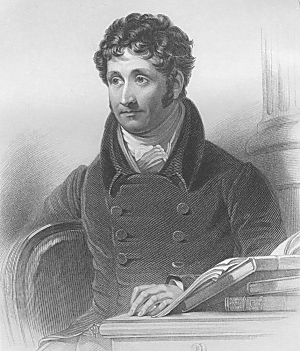
Campbell enjoys the dubious distinction of being the first Brit to write a poem with an
American theme. Catchy title: "Gertrude of Wyoming" (as in Wyoming Massacre, not the state).
Like all of his work it left not a mark. Campbell did, however, manage single-handedly to kick-start the project for what would become University College, London.
And ran a literary mag, with quality contributors like essayist William
Hazlitt. In 1822 Campbell gave a rave review on a piece by Hew Ainslie,
Scottish brewer, poet, and expat.
Ainslie (seeing the writing on the wall for his writing) had just left
for the United States. After a couple of years in New York state
discovering he was also not meant for farming, in 1825 Ainslie arrived
at the newly founded utopian commune of New Harmony, Indiana. A year
later Ainslie left when "harmony" turned out to be a misnomer. Rows,
back-stabbing, and incompetence characterized the social experiment, and
it shut down soon after. Back in brewing, Ainslie finally did well and
settled in Kentucky.
Meanwhile, New Harmony's CEO, British libertarian mill owner Robert
Owen, had gone home in a huff, leaving his son R Dale Owen to become an
American citizen. After a more-senses-than-one flirtation with the ideas
of another reformer, Fanny Wright (at her Nashoba commune for freed
black slaves in Tennessee), Robert ended up in the Indiana legislature
and then the U.S. Congress. Where he pushed through the Smithsonian bill
as well as speaking and publishing on divorce, education, birth control,
and other such op-ed stuff, including the abolition of slavery. This may
be why pro-slavery President Franklin Pierce got Owen out of the way in
1853 by sending him as U.S. representative to Naples, Italy.
No place for liberal views like Owen's, the place was being run by King
Ferdinand II (known as "Bomba" after he bombarded Sicily's main cities
in 1848, the year of Europe-wide revolution).

Some of Bomba's character references give a flavor of the man: treacherous, corrupt,
superstitious, egocentric, bigoted, dictatorial, and badly educated. By
1851 it is reckoned he had forty thousand political prisoners. By the
time he died in 1859 Bomba had made it virtually certain that his son
and heir wouldn't be around for long.
Francis II didn't help things by being a weak, vacillating namby-pamby
keen on persecutions and massacres, whose own palace guard mutinied.
When he had the ringleaders shot, the guard disbanded and left him.

So in 1860 one shove from the advancing Garibaldi and Francis was out of
there with wife and all the loot he could carry.
A year later Garibaldi was in control. And a return-from-exile
thirty-four-year-old chemist was back in his lab. Stanislao Cannizzaro
knew more about atoms and molecules than most people, at a time when
nobody was even sure if atoms were indeed the smallest bits of
molecules. In 1860 this small matter was top of the agenda at the
first-ever chemistry conference (in Karlsruhe, Germany). Cannizzaro
turned up and solved the puzzle by showing how you could use the
behavior of molecules to tell things about the atoms inside them.
Nine years later a Russian named Dmitri Mendeleyev used Cannizzaro's
ideas to arrive at the most fundamentally important concept in the
history of chemistry. He designed the Periodic Table, in which the
chemical elements are arranged in columns according to their atomic
weight and their tendency to interact with other molecules. This
periodic arrangement suddenly made possible the prediction of chemical
behavior.

Strangely enough, when the fourteenth edition of the
*Encyclopedia Britannica* came out in 1929 Mendeleev got a
write-up but only for his teaching techniques.
By 1937 the fourteenth edition was still going (though not strong) when
it came to the attention of University of Chicago veep William Benton,
who discovered that the encyclopedia was reluctantly owned by Sears Roebuck. Benton's offer to chip in a hundred thousand dollars of his own
money helped persuade Sears to give the Britannica to the
University of Chicago, where under Benton's able administration sales
increased fifty-fold and the university made millions.
Benton had begun as an advertising executive partnered with Chester
Bowles in Benton and Bowles, inventors of soap opera, pioneers of
consumer research, and in 1936 the sixth-biggest ad agency in the world
("Look, Ma, No Cavities," "When E.F. Hutton Talks, People Listen" and "Good to the last drop" for Maxwell House coffee) .
During World War II Bowles left the agency and went into
price-administration work for the government. In 1944 the Advertising
Club of Western Massachusetts gave him their Pynchon medal for
excellence in public service.
In 1962 the medal winner was Edward Breck, promoter of the shampoo
hysteria created by his "Breck Girls" ad campaign, featuring an image
(sensuous yet chaste, seductive yet girl-next-door, sexy yet apple-pie)
that shaped American womanhood's self-perception for fifty years.
Examples:
- 1968 Cheryl Tiegs
- 1968 Cybill Shepherd
- 1971, 1973 Jaclyn Smith
- 1972, 1974 Kim Basinger
- 1974 Brooke Shields
- 1975 Farrah Fawcett
- 1981 Christie Brinkley
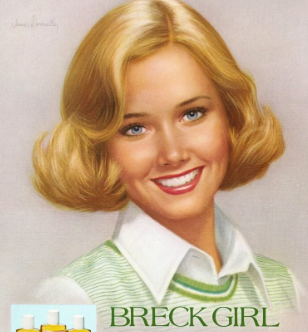
The artist responsible for the campaign from the late 1950s until his
death in 1976 was WILLIAM WILLIAMS.