Thornton, Matthew
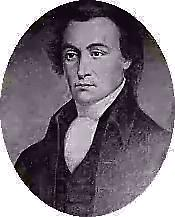
Matthew Thornton (March 3, 1714 – June 24, 1803) was an Irish-born Founding Father of the United States who signed the United States Declaration of Independence as a representative of New Hampshire.
Background and early life
Thornton was born in Ireland in 1714 to James and Elizabeth (née Jenkins) Thornton, who were Scots-Irish.[2] At the time of the Siege of Derry in 1689, James Thornton lived on a farm within a mile of Derry, and this is where Matthew was probably born,[3] although Lisburn[1] and Limerick[4] have also been suggested as birthplaces.
In 1716, Thornton's family immigrated to North America when he was three years old, settling first in Wiscasset, Maine.[5][6] On July 11, 1722, the community was attacked by Native Americans.[6] James and Elizabeth Thornton fled from their burning home with Matthew, moving shortly thereafter to Worcester, Massachusetts.[7]
Thornton completed studies in medicine at Leicester.[6] He became a physician and established a medical practice in Londonderry, New Hampshire.[6] He was appointed as a surgeon for the New Hampshire Militia troops in an expedition against Fortress Louisbourg in 1745.[8] He served in the New Hampshire Provincial Assembly from 1758-1762, had royal commissions as justice of the peace, and served as colonel in the militia from 1775 until his resignation in 1779.[9]
In 1760 Thornton married Hannah Jack, and the couple had five children.[6] Thornton became a Londonderry selectman, a representative to and president of the Provincial Assembly, and a member of the Committee of Safety, drafting New Hampshire's plan of government after dissolution of the royal government, which was the first state constitution adopted after the start of hostilities with England.[10]
Continental Congress
Thornton served as the president of the New Hampshire Provincial Congress in 1775, and from January to September 1776, as speaker of the New Hampshire House of Representatives.[11] He was elected to the Continental Congress after the debates on independence had occurred, but as he did not arrive in Philadelphia until November 1776, he was granted permission to actually sign the Declaration of Independence four months after the formal signing in July.[12]
Later life
He became a political essayist. He retired from his medical practice and in 1780 moved to Merrimack, New Hampshire, where he farmed and operated Thornton's ferry with his family. Although he did not attend law school,[12] he served as a judge on the New Hampshire Superior Court from 1776-1782.[11]
In 1783, Thornton represented the towns of Merrimack and Bedford in the New Hampshire House of Representatives, and then Hillsborough County in the New Hampshire Senate from 1784-1787, while simultaneously serving as a state counselor from 1785–86 and as a state representative again for Merrimack in 1786.[13] His wife Hannah died in 1786.[14]
Death and legacy
Thornton died in Newburyport, Massachusetts, while visiting his daughter. He was 89 years old.[12] Matthew Thornton is buried in Thornton Cemetery in Merrimack, and his cenotaph reads "The Honest Man."[15]
The town of Thornton, New Hampshire, is named in his honor, as is a Londonderry elementary school, and Thorntons Ferry School in Merrimack. Thornton's residence in Derry, which was part of Londonderry at the time, is listed on the National Register of Historic Places. He is featured on a New Hampshire historical marker (number 79) along U.S. Route 3 in Merrimack.[16]
Thornton was the uncle of Capt. Matthew Thornton, a suspected Loyalist who was charged with treason related to actions just before the Battle of Bennington in 1777. Ebenezer Webster, father of Daniel Webster, was enlisted to investigate the allegation. At his trial Capt. Thornton pleaded not guilty. Evidence was presented both for and against and the jury found him not guilty, whereupon he was discharged.[17]
See also
Memorial to the 56 Signers of the Declaration of Independence
Biography by Rev. Charles A. Goodrich, 1856
- 1714 births
- 1803 deaths
- Continental Congressmen from New Hampshire
- 18th-century American politicians
- Signers of the United States Declaration of Independence
- People of colonial New Hampshire
- People of New Hampshire in the American Revolution
- Politicians from Newburyport, Massachusetts
- American people of Scotch-Irish descent
- Members of the New Hampshire House of Representatives
- New Hampshire state court judges
- People from Derry, New Hampshire
- People from Merrimack, New Hampshire
- 19th-century American Episcopalians
- 18th-century American physicians
- Founding Fathers of the United States
Matthew Thornton | Descendants of the Signers of the Declaration of Independence