Sherman, Roger
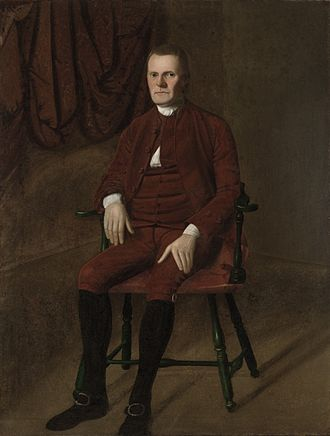
Roger Sherman (April 19, 1721 – July 23, 1793) was an early American statesman, lawyer, and a Founding Father of the United States. He is the only person to sign all four great state papers of the United States: the Continental Association, the Declaration of Independence, the Articles of Confederation, and the Constitution.[1][2] He also signed the 1774 Petition to the King.
Born in Newton, Massachusetts Sherman established a legal career in Litchfield County, Connecticut, despite a lack of formal education. After a period in the Connecticut House of Representatives, he served as a justice of the Superior Court of Connecticut from 1766 to 1789. He represented Connecticut at the Continental Congress, and he was a member of the Committee of Five that drafted the Declaration of Independence.
Sherman served as a delegate to the 1787 Philadelphia Convention, which produced the United States Constitution. After Benjamin Franklin, he was the second oldest delegate present at the convention. Sherman favored granting the federal government power to raise revenue and regulate commerce, but initially opposed efforts to supplant the Articles of Confederation with a new constitution.[3] After supporting the establishment of a new constitution, Sherman became a key delegate and main opponent of James Madison's Virginia Plan by introducing the Connecticut Compromise that won the approval of both the more and less populous states.[4][5][6]
After the ratification of the Constitution, Sherman represented Connecticut in the United States House of Representatives from 1789 to 1791. He served in the United States Senate from 1791 to his death in 1793.
Early life and family
Sherman was born into a family of farmers in Newton, Massachusetts. His father was William and mother Mehetabel Sherman. The Shermans left Newton and settled in what became the town of Stoughton, Massachusetts 17 miles (27 km) southeast of his home in Newton, when Roger was two. Sherman's education did not extend beyond his father's library and grammar school, and his early career was spent as a shoemaker.[7] However, he had an aptitude for learning, access to a good library owned by his father, and a Harvard-educated parish minister, Rev. Samuel Dunbar, who took him under his wing.
In 1743, his father's death made Sherman move with his mother and siblings to New Milford, Connecticut. There, in partnership with his brother William, he opened the town's first store,[7] a cobbler shop, and earned a position as the county surveyor in 1745. The income from this office enabled him to buy land and to earn a favorable reputation throughout the county. Sherman published a series of almanacs between 1750 and 1761. He also studied law on his own, passing the bar in 1754.[8]
He very quickly introduced himself in civil and religious affairs, rapidly becoming one of the town's leading citizens and eventually town clerk of New Milford. He became county surveyor of New Haven County in 1745 and began providing astronomical calculations for almanacs in 1759.
Sherman was married two times and had a total of fifteen children with thirteen reaching adulthood. Sherman married Elizabeth Hartwell (born August 31, 1726 in Stoughton, Massachusetts) on November 17, 1749.[9] Elizabeth died on October 19, 1760.[10] Sherman married Rebecca (also spelled Rebekah) Prescott (born on May 20, 1742, in Danvers, Massachusetts) on May 12, 1763 and had eight children: Rebecca, Elizabeth, Roger, Mehetabel (1st), Mehetabel (2nd), Oliver, Martha and Sarah.[11] Sherman is distantly related to Union general William Tecumseh Sherman. ^[12]^
Political career
Early political career
Despite the fact that Sherman had no formal legal training, he was urged to read for the bar exam by a local lawyer and was admitted to the bar of Litchfield, Connecticut in 1754, during which he wrote "A Caveat Against Injustice"[7][13] and was chosen to represent New Milford in the Connecticut House of Representatives from 1755 to 1758 and from 1760 to 1761. Sherman was appointed justice of the peace in 1762 and judge of the court of common pleas in 1765. During 1766, Sherman was first elected to the Governor's Council of the Connecticut General Assembly, where he served until 1785. Sherman served as Justice of the Superior Court of Connecticut from 1766 to 1789.
Sherman was also appointed treasurer of Yale College, and awarded an honorary Master of Arts degree. He was a professor of religion for many years, and engaged in lengthy correspondences with some of the theologians of the time. During February 1776, Sherman, George Wythe, and John Adams were members of a committee responsible for establishing guidelines for U.S.
Embassy officials in Canada with the committee instructions that included, "You are to declare that we hold sacred the rights of conscience, and may promise to the whole people, solemnly in our name, the free and undisturbed exercise of their religion. And ... that all civil rights and the rights to hold office were to be extended to persons of any Christian denomination." In 1784, Sherman was elected mayor of New Haven, which office he held until his death.[7]
Continental and Confederation Congress
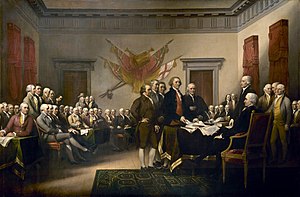
The Declaration of Independence by John Trumbull (1819) depicts the Committee of Five presenting its work to Congress. Sherman is second from the left.
As a member of the First Continental Congress, Sherman signed the Continental Association to impose an economic boycott on British trade. In the Second Continental Congress, Sherman was appointed to the Committee of Five that drafted Declaration of Independence.[14] Sherman was also a member of the committee of 13 that was responsible for preparing a draft constitution for the new nation.[15]
During debate, Sherman proposed a bicameral national legislature where states would be represented equally.[6] The committee of 13 rejected Sherman's proposal, adopting a unicameral legislature and what would become the Articles of Confederation.[16] As a member of the Confederation Congress, Sherman was a signatory of the Treaty of Paris which ended the Revolutionary War.
Constitutional Convention
Sherman came into the Convention without the intention of creating a new constitution. He saw the convention as a means to modify the already existing government. Part of his stance was concerned with the public appeal. He defended amending the articles declaring that it was in the best interest of the people and the most probable way the people would accept changes to a constitution.[17] "The problem with the old government was not that it had acted foolishly or threatened anybody's liberties, but that it had simply been unable to enforce its decrees."[4] Sherman advanced the idea that the national government simply needed a way to raise revenue and regulate commerce.[4]
Sherman's views were heavily shaped by Connecticut's position as a particularly isolationist state. Connecticut operated almost without much need from other states, using its own ports[18][19][20][21] to trade with the West Indies[22][23] instead of utilizing ports in Boston,[17] and feared that "...the mass of people lacked sufficient wisdom to govern themselves and thus wished no branch of the federal government to be elected directly by the people".[24][25]
His views were also influenced by his personal beliefs and Puritan views.[7] Sherman opposed slavery and used the issue as a tool for negotiation and alliance.[7] He believed that slavery was already gradually being abolished and the trend was moving southward.[26] Sherman saw that the issue of slavery could be one that threatened the success of the Constitutional Convention. Therefore, Sherman helped shape compromises that benefited the slave states in order to obtain unlikely allies from the Carolinas due to the economies of their home states.[4][5]
Sherman is also known for his stance against paper money with his authoring of Article I, Section 10 of the United States Constitution and his later opposition to James Madison over the Bill of Rights.[6][27] He believed that these amendments would diminish the role and power of the states over the people.[28]
Mr. Wilson & Mr. Sherman moved to insert after the words "coin money" the words "nor emit bills of credit, nor make any thing but gold & silver coin a tender in payment of debts" making these prohibitions absolute, instead of making the measures allowable (as in the XIII art) with the consent of the Legislature of the U.S. ... Mr. Sherman thought this a favorable crisis for crushing paper money. If the consent of the Legislature could authorize emissions of it, the friends of paper money would make every exertion to get into the Legislature in order to license it."[29]
Sherman also had very little interest in creating an executive branch with much authority. He suggested that no constitutional provision needed be made for the executive because it was "nothing more than an institution for carrying the will of the Legislature into effect".[26]
Representation
See also: Connecticut Compromise

Foundation of the American Government. Roger Sherman is closest behind Morris, who is signing the Constitution. 1925 painting by John Henry Hintermeister.[30]
Two proposed options for the formation of the legislative branch emerged in the deliberations.[6] One was to form a bicameral legislature in which both chambers had representation proportional to the population of the states, which was supported by the Virginia Plan. The second was to modify the unicameral legislature that had equal representation from all of the states, which was supported by the New Jersey Plan introduced by William Paterson that Sherman helped author.[6]
Sherman saw no reason for a bicameralism. He defended the unicameral legislature of the Articles of Confederation by stating that the more populous states had not "suffered at the hands of less populous states on account of the rule of equal voting".[4] Sherman, Elbridge Gerry and others were of the shared opinion that the elected composition of the national government should be reserved for the vote of state officials and not for election by the will of the people. Sherman was wary of allowing ordinary citizen participation in national government and stated that the people "should have as little to do as may be about the Government. They want information and are constantly liable to be misled".[26]
While Sherman was a devout supporter of a unicameral legislature, he recognized that this goal was unattainable because it would not receive the support of the more populous states. With the aide of Oliver Ellsworth, Sherman repeatedly proposed a bicameral compromise where one house had representation proportional to the population, and the other had equal representation for the states.[6]
Some scholars have identified Sherman as a pivotal delegate at the Convention because of his role in settling the debate over representation.[3][5][26] At important moments in the deliberations, Sherman consistently pushed the interests of the less populous states. When delegates were unable to reconcile the differences between his plan and Madison's Virginia Plan, Sherman helped to get the issue of representation in Congress delegated to a Grand Committee of which he was not only a member but whose membership was sympathetic to the views of the less populous states.[5]
The plan that emerged from the Grand Committee, originally introduced by Sherman, and which known as became the Connecticut Compromise, was designed to be acceptable to both the more and less populous states: the people would be represented proportionally in one branch of the legislature, called the House of Representatives (the lower legislative house).[6] The states would be represented in another house called the Senate (the upper house). In the lower house, each state had a representative for every one delegate. In the upper house, each state was guaranteed two senators, regardless of its size. In terms of modes of election, Sherman supported allowing each state legislature to elect its own senators.[26] In the House, Sherman originally proposed that the suffrage of the House should be figured according to the "numbers of free inhabitants" in each state.[4]
Later career
Sherman was elected as a United States Representative in the First Congress, and then to the Senate in the Second and Third Congress until his death in 1793.[27] In 1790 both Sherman and Richard Law were appointed to revise the confused and archaic Connecticut statutes, which they accomplished. Throughout his life, Sherman was a major benefactor of Yale College, acting as the university's treasurer for many years and promoting construction of a college chapel.[7]
Sherman opposed appointment of fellow signer Gouverneur Morris as minister to France because he considered that high-living Patriot to be of an "irreligious nature".[31]
Death and burial site
Sherman died in his sleep on July 23, 1793, after a two-month illness diagnosed as typhoid fever.[32] The Gazette of the United States (Philadelphia), August 17, 1793, p. 508, reported an alternate diagnosis, "He was taken ill about the middle of May last, and from that time declined till his death. His physician supposed his disorder to be seated in his liver." He was buried in New Haven Green. In 1821, when that cemetery was relocated, his remains were moved to the Grove Street Cemetery.[33]
Jonathan Edwards Jr. gave a funeral sermon at the ceremony for Sherman on July 25, 1793. He praised his contributions to his friends, family, town, and country, noting Sherman's piety and excellence in study.
Legacy
The Committee of Five, including Sherman, is depicted on the pediment of the Jefferson Memorial in a sculpture by Adolph Alexander Weinman.
Sherman is especially notable in United States history for being the only person to sign all four great state papers of the United States, the Articles of Association, the United States Declaration of Independence, the Articles of Confederation, and the United States Constitution.[34] Robert Morris, who did not sign the Articles of Association, signed the other three. John Dickinson also signed three, the Continental Association, the Articles of Confederation and the United States Constitution. He was involved with the Declaration of Independence but abstained, hoping for a reconciliation with Britain.
Sherman is one of the most influential members of the Constitutional Convention.[3][5][35] He is not well known for his actions at the Convention because he was a "terse, ineloquent speaker" who never kept a personal record of his experience, unlike other prominent figures. At 66 years of age, Sherman was the second eldest member at the convention following Benjamin Franklin (who was 81 years old at the time). Yet he was a critical opponent of James Madison and the more populous states.[5][6] Sherman was also one of the most active members of the Convention, Sherman made motions or seconds 160 times (compared to Madison's 177 times).[3]
The town of Sherman, Connecticut was named for Roger Sherman.[36] Sherman, as a member of the Committee of Five, is portrayed on the pediment of the Jefferson Memorial.
See also
- List of United States Congress members who died in office (1790–1899)
- Memorial to the 56 Signers of the Declaration of Independence
...
Further reading
- Dictionary of American Biography
- Boardman, Roger Sherman, Roger Sherman, Signer and Statesman, 1938. Reprint. New York: Da Capo Press, 1971.
- Boutell, Lewis Henry, The Life of Roger Sherman, Chicago: A.C. McClurg & Co., 1896.
- Gerber, Scott D., "Roger Sherman and the Bill of Rights." Polity 28 (Summer 1996): 521–540.
- Hoar, George Frisbie, The Connecticut Compromise. Roger Sherman, the Author of the Plan of Equal Representation of the States in the Senate, and Representation of the People in Proportion to Numbers in the House, Worcester, MA: Press of C. Hamilton, 1903.
- Rommel, John G. (1979). *Connecticut's Yankee patriot, Roger Sherman*. Connecticut bicentennial series. Vol. 34. American Revolution Bicentennial Commission of Connecticut. ISBN 978-0-918676-20-7. OCLC 651919763.
External links
- From Rev. Charles A. Goodrich, *Lives of the Signers to the Declaration of Independence*, 1856
- United States Congress. "Roger Sherman (id: S000349)". Biographical Directory of the United States Congress.
- Sherman, Thomas Townsend (1920). *Sherman Genealogy Including Families of Essex, Suffolk and Norfolk, England*. T. A. Wright. p. 345.
- Baldwin-Greene-Gager family of Connecticut at Political Graveyard
- Sherman-Hoar family at Political Graveyard
- Roger Sherman Papers Yale University
- Roger Sherman, Revolutionary and Dedicated Public Servant Connecticut History
- History of Sherman's boyhood home of Stoughton, Massachusetts
- Chisholm, Hugh, ed. (1911). "Sherman, Roger". Encyclopædia Britannica (11th ed.). Cambridge University Press.
- 1721 births
- 1793 deaths
- People from Canton, Massachusetts
- People of colonial Massachusetts
- People of colonial Connecticut
- Sherman family (U.S.)
- American people of English descent
- American Congregationalists
- Continental Congressmen from Connecticut
- Signers of the Articles of Confederation
- Signers of the Continental Association
- Signers of the United States Declaration of Independence
- Signers of the United States Constitution
- Pro-Administration Party members of the United States House of Representatives from Connecticut
- Pro-Administration Party United States senators from Connecticut
- Members of the Connecticut General Assembly Council of Assistants (1662–1818)
- Members of the Connecticut House of Representatives
- Mayors of New Haven, Connecticut
- Connecticut state court judges
- Shoemakers
- People from New Milford, Connecticut
- Lawyers from New Haven, Connecticut
- People of Connecticut in the American Revolution
- Deaths from typhoid fever
- Burials at Grove Street Cemetery
- Members of the United States House of Representatives from Connecticut
...On June 11, a committee was appointed to draft a Declaration of Independence “Jefferson, Adams, Franklin, Sherman, and Robert R. Livingston. Livingston, representing New York, seems to have doubted whether the time for action had yet come. His absence from Philadelphia prevented his signing the Declaration as adopted. Jefferson prepared the paper, submitted it to Adams and Franklin where a few minor changes were made, and then to the whole committee where it was unanimously approved. The Declaration was presented to Congress on June 28. Certain changes were made while the document was under discussion, notably the elimination of the passage condemning the slave trade.
...
Roger Sherman | Descendants of the Signers of the Declaration of Independence
American Connections
ROGER SHERMAN (CT) was fifty-five. By this time
he'd had years of experience in business (small farm, surveyor, general
store) and public service (justice of the peace). Down-to-earth, a
talented politico, good at agreement rather than confrontation, Sherman
was a key figure in the Great Compromise that resolved the problem of
small states' voting rights by going for the two-house system (in one
house the number of representatives reflected the population of a state
while the other had two senators for each state).
Six feet tall and blue-eyed, Sherman impressed people with his pithy
views (sample: "Minorities talk, majorities vote"). He signed more
documents than any other member of Congress: Declaration & Resolve 1774,
Declaration of Independence, Articles of Confederation, and
Constitution. He was also on the Committee for Postponed Matters that
set up the Electoral College and defined the president's powers.
Fellow Postponed Matters committeeman was Rufus King, Harvard graduate
and lawyer who in 1795 was sent as U.S. minister to London, where he got
the Brits to settle for six hundred thousand Pounds war reparations
(cheap at the price). In 1799, with Federalism back home not rock solid
(and definitely not in need of a sudden influx of unstable "republican"
radicals), King also got London to agree to prevent certain Irishmen from
emigrating to the States after their recent (failed) uprising.
The 1798 Irish rebellion (imitating similar efforts in France) had put
the wind right up the English. Even though the "United Irishmen"
movement had been infiltrated and all their plans revealed (so that on
May 23, when the secret republican army turned up at the secret rallying
points in Dublin they found themselves in a hands-up situation with
government troops already there), one bunch managed to take the town of
Wexford. There followed three months of fighting and very nasty mutual
atrocities all over Ireland, abetted but not aided by French support
(the first arrivals didn't land thanks to bad weather and incompetence;
the second arrivals landed and failed thanks to good weather and
incompetence).
The Irish rebellion was finally put down: thirty thousand people died
and countless properties were gutted. Windows were smashed, including
those of the rather plain Maria Edgeworth, in Edgeworthstown, County
Longford, where her (English) family had owned the town for two hundred
years. Ironically, the damage was done by pro-Brits who suspected her
father of Irish sympathies. Maria painted a vivid picture of the
rebellion in her novel Patronage, the first of fifteen books
that established her as Ireland's leading woman writer. Her greatest
success, Castle Rackrent, was a Gothic novel all about the
downtrodden position of women. The book (as one critic said) was like
Ireland: full of "whiskey, decay, rot, guttering candles, tobacco, damp,
horse-dung and dust."
In 1802 when the Edgeworths were on a visit to Paris, one morning at
breakfast the door opened and Maria's father shoved into the room a
middle-aged and rather pompous Swede, who thereupon proposed marriage.
Maria refused, ostensibly because he wouldn't come to Ireland and she
wouldn't go to Sweden. It must have been a fast exchange of views.
Abraham Niclas Clewberg-Edelcrantz took it on the chin and left to
complete his tour of Europe inspecting theaters and picking up new
industrial ideas for Sweden's king Gustav IV.
Niclas was an odd bird: earlier private secretary to Gustav III, after which director of the Royal Swedish Theaters, in 1794 he invented (copied?) a semaphore system
remarkably like that of Frenchman Claude Chappe of earlier the same
year.
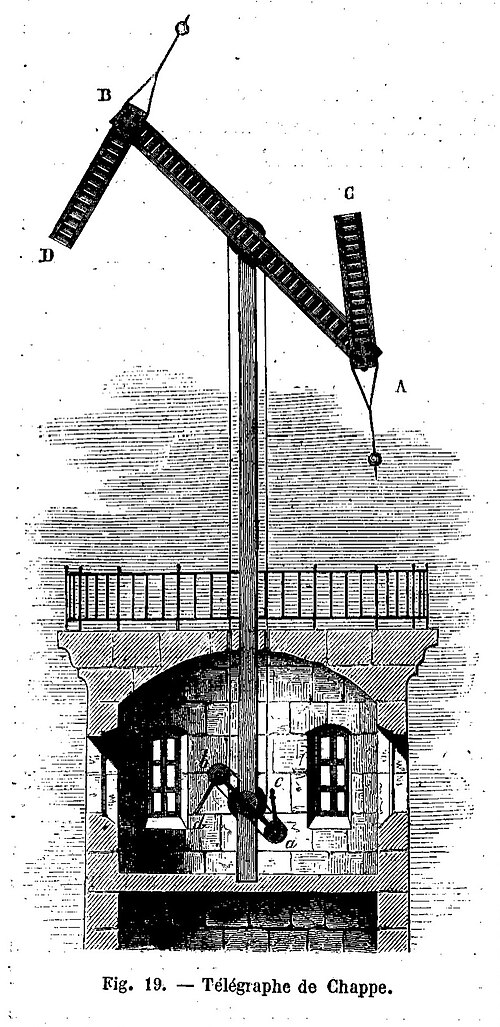
By 1803 Niclas was in Birmingham, England, buying steam engines
from James Watt.
One of Watt's lesser-known pals was William Playfair, inventor of the
line chart, the bar chart, and the pie chart. Since he lived in an age
obsessed by trade and economics it's hard-to-believe-but-true that
Playfair's charts never made it to the boardroom until modern times.
Back in 1777 Playfair had spent three years drawing engines for Watt,
then tried and failed to sell Watt's copier (write document in mix of
wet ink and gum arabic, press against tissue paper while wet, read copy
through tissue), then tried and failed to run a silver-plating business
(typically, Playfair's businesses went: overambitious ideas, followed by
fights with partners, major debts, bankruptcy).
In 1785 Playfair started writing about economics and critiqued Adam Smith. Some nerve.
In 1789 Playfair was in Paris associating with Joel Barlow in the
American Scioto scam. The Scioto Associates' cunning plan was to sell
options on 5 million acres in Ohio to Frenchmen who thought they were
buying title to their land. Two shiploads of unfortunates even went
there and discovered the small-print truth. By which time Playfair was
long gone.
Another Scioto associate got out from under, too.
Andrew Craigie had been the first (and only) U.S. chief apothecary
during the War of Independence. Then (surprise) went into the
pharmaceutical business (failed), then financial speculation (failed),
then the Scioto enterprise (failed). Accused of little more than "not
doing anything to stop Scioto," he avoided prison and carried on with
his speculative life. This included a grand (failed) plan to put
together an international consortium to buy the U.S. debt to France.
After being ruined by speculation in a bridge in Cambridge,
Massachusetts, and the purchase of Washington's old headquarters,
Craigie sank into penury and in 1819 died. Leaving his wife in the
headquarters to take in lodgers.
One of whom, in 1837, was Henry Wadsworth Longfellow (who would later
own the building). At the time Longfellow was still only an academic.
He'd done six years teaching modern languages at Bowdoin (after they
made him go to Europe for three years to learn French, Spanish, Italian,
and German) and in 1834 had become a Harvard French and Spanish tutor,
although his favorite language was Italian, and he spent years on a
translation of Dante's Divina Commedia
Around 1838 Longfellow and a colleague tried (and failed) to help a
young Italian visitor to get a job at the university. Antonio Gallenga
had been teaching Italian at Harvard Young Ladies' School for two years.
Finally, when nothing better turned up he returned to England. Where as
a young Italian freedom fighter (the reason he had been on the run in
the United States as "Luigi Mariotti") he was greeted with open arms and
immediately welcomed into salon life. Which in 1839 London meant being
taken up (if that's all it was) by Marguerite Countess of Blessington,
man-eater, writer of "silver-fork" novels of upper-class manners, and
the toast of the town. Admirers included Dickens, Disraeli, et al.
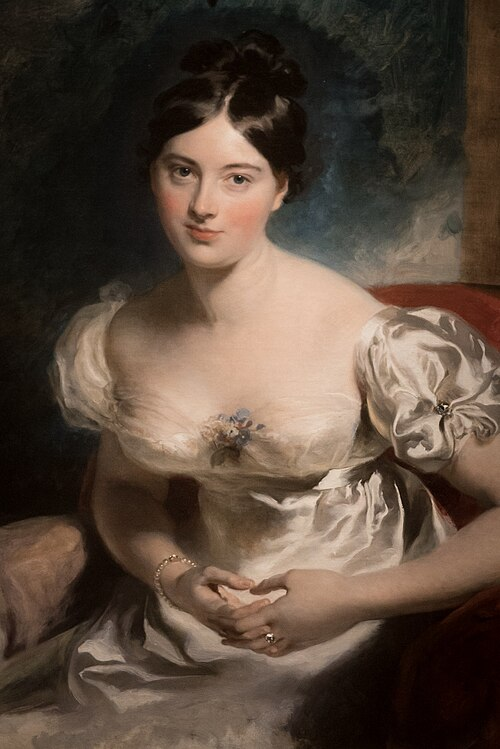
Blessington's up-and-down career had to this point included a forced
child-bride marriage (he died drunk), a liaison with an army man (who
charged ten thousand pounds to walk away), marriage to rich Irish
landowner Earl Blessington (he died of a stroke), and finally a long
relationship with handsome Count d'Orsay (twenty years younger and
married to the countess's stepdaughter).

Portrait by d'Orsay of Lord Byron's daughter, Ada, who would become known as the mathematician Ada Lovelace.
Blessington, best known for her Conversations with Lord Byron,was already living and loving well beyond her means when the 1845 Irish Potato Famine struck and
suddenly she had to leave London for lower-cost-of-everything France
once the bottom had dropped out of the Irish agricultural market and the
income arriving from her Irish estates vanished.
As did the hopes of a man hoping to head the other way. The potato
famine delayed the opening of the Queen's College in Cork, Ireland, so
it wasn't until 1849 that things over there picked up again, and math
genius George Boole finally had an Irish job to go to. Up to this point
Boole had had the least interesting life of any intellectual giant in
history. For the first fifteen years he ran schools in nondescript
places like Lincoln, while starting to write math papers, published in
various nondescript mags. Then in 1847 he wrote the amazing,
world-changing Mathematical Analysis of Logic.
Generally ignored (even by nondescript mags), the article said that logic could be
handled by algebra, e.g., using 0 and 1 to mean "no" or "yes" (or
"off"/"on," or "none"/"all", etc.). Added to which, if, say, x
represented "dog" and y represented "brown," then using 0 1 as
"none/all": (1-x) (1-y) would mean "all objects that are neither brown
nor dogs" (are you still here?).
Sixty years later this gobbledygook electrified Claude Shannon,
American inventor of information theory,
when he realized that electrical circuits (on/off) could solve Boolean
algebra logic equations. We call the result "digital." Geoffrey Hinton is a great-grandson of Boole, and is well known for research in Artificial Intelligence (AI).
In 1864 Boole's wife, Mary, killed him when he caught a chill and she,
thinking that "like cured like," threw buckets of cold water over him
and he died. Mary was an eccentric lady who joined fringe groups like
the antivivisectionists and next-world communicators. She was the first female member of the Society for Psychical Research which she joined in 1882. However, being the only female member at the time, she resigned after six months. Some other early members included the renowned chemist Sir William Crookes, physicist Sir Oliver Lodge, Nobel laureate Charles Richet, and psychologist William James.
Her belief in homeopathic remedies like the one that put paid to her husband had taken root when she was a child in France, where her father had gone to be
treated by Samuel Hahnemann, founder of homeopathy and bane of
pharmacists.
Hahnemann (his maxim: "Doctors...can change a minor illness into a
serious one") expressed opposition to the contemporary fashion for
bloodletting and purges. His evident success during the cholera epidemic
of 1830 made him popular with the British royal family, so in 1850 a
Hahnemann Hospital was opened in London. A year later one of the founder
members, Hungarian Matthias Roth (another runaway agitator), opened the
Institute for the Cure of Diseases by Swedish Gymnastics. This technique
included slow leg movement and structured coughing. Models of gymnastic
positions were shown to enraptured crowds at the Paris Expositions of
On the latter occasion (the Franco-Prussian War now over and paid for)
the financially extravagant Exposition attracted 13 million visitors to
fifty-three thousand exhibits lit by forty-three hundred gas jets. Star
attraction: the Trocadéro Palace, a Byzantine-Moorish affair described
by one eminent critic as looking like "a bath-house of ill repute." In
which top of the bill was the monster organ, played by many, including
Liszt, Franck, and Saint-Saens and built by Aristide Cavaille-Coll,
who'd erected over five hundred such instrumental extravagances,
including the one in Notre Dame cathedral. The organs Aristide built
were unusual in that they were capable of making very gradual
transitions from pp to ff . This influenced the writing of composers of the time such as Saint-Saens (whose work is full of pp to ff ).
When the Trocadero Palace was torn down in 1936, Aristide's organ was
refurbished and electrified by Victor Gonzalez. Who passed on his
know-how to German organ builder Rudolf von Beckerath. Who (after World
War II) passed on his know-how to an American, John Brombaugh.
In 1980 Brombaugh built an organ for the Christ Episcopal Church in
Tacoma, Washington. In February 1996 the church hosted an organ recital
of composers known to Bach: Brunckhorst, Praetorius, Buxtehude,
Pachelbel, C. P. E. Bach, and the old man himself.
The organist was ROGER SHERMAN.