Whipple, William
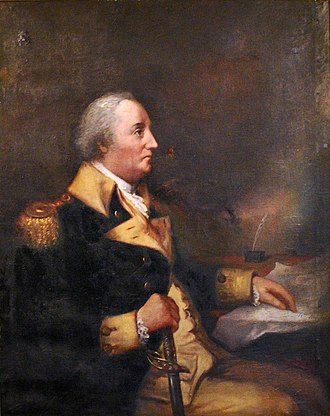
William Whipple Jr. (January 25, 1731 NS January 14, 1730 [OS] – November 28, 1785) was an American Founding Father and signatory of the United States Declaration of Independence. He represented New Hampshire as a member of the Continental Congress from 1776 through 1779.[1] He worked as both a ship's captain and a merchant, and he studied in college to become a judge. He died of heart complications in 1785, aged 55.[1]
Early life and education
Whipple was born in Kittery in Massachusetts Bay (now Maine)[2] in the William Whipple House to Captain William Whipple Sr. and his wife Mary (née Cutt).[3] He was educated at a common school until he went off to sea, where he became a ship's master at age 21.[4][5] He married his first cousin Catherine Moffat in 1767,[4] and they moved into the Moffatt-Ladd House on Market Street in Portsmouth in 1769.[6][4] Their son William Whipple III died in infancy.[5] Whipple was a descendant of Samuel Appleton, early settler in Ipswich, Massachusetts.[7]
Whipple earned his fortune participating in the triangular trade between North America, the West Indies and Africa, dealing in goods such as wood, rum and slaves.[4] ^[8][9][5] He established himself as a merchant in Portsmouth in 1759, in partnership with his brother Joseph.[10]
Political career
In 1775, New Hampshire dissolved the British Royal government and organized a House of Representatives and an Executive Council known collectively as a Provincial Congress, and Whipple was elected to represent Portsmouth.[11] He became a member of the Committee of Safety. He was then elected to the Continental Congress, and he signed the United States Declaration of Independence. He was the second cousin of fellow signatory Stephen Hopkins.[3] In January 1776, Whipple wrote to fellow signatory Josiah Bartlett of the approaching convention:
This year, my Friend, is big with mighty events. Nothing less than the fate of America depends on the virtue of her sons, and if they do not have virtue enough to support the most Glorious Cause ever human beings were engaged in, they don't deserve the blessings of freedom.[4]
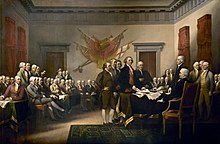
Declaration of Independence by John Trumbull (1818); Whipple is pictured sitting second from the left;[12] next to fellow New Hampshire delegate Josiah Bartlett.
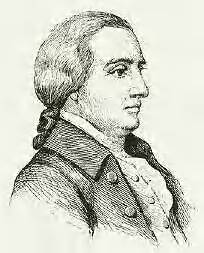 ])William Whipple
Whipple freed his enslaved servant, Prince Whipple,[13] believing that no man could fight for freedom and hold another in bondage.[6] He wrote:
A recommendation is gone thither for raising some regiments of Blacks. This, I suppose will lay a foundation for the emancipation of those wretches in that country. I hope it will be the means of dispensing the blessings of Freedom to all the human race in America.[5]
Military career
Whipple was given his first commission by the New Hampshire Provincial Congress in 1777. At Saratoga, Whipple was placed in command of a brigade, consisting of four regiments of militia. Whipple commanded Bellow's regiment, Chase's regiment, Moore's regiment, and Welch's regiment. As a result of their meritorious conduct at the Battle of Saratoga, Whipple and Colonel James Wilkinson were then chosen by Major General Horatio Gates to determine terms of capitulation with two representatives of General John Burgoyne. Whipple then signed the Convention of Saratoga, the effective surrender of General Burgoyne and his troops.[14]
Whipple was then appointed along with several other officers to escort Burgoyne and his army back to Winter Hill, Somerville, Massachusetts. Whipple passed the news of the victory at Saratoga to Captain John Paul Jones, who informed Benjamin Franklin, who was in Paris at the time. News of the victory proved valuable to Franklin throughout alliance negotiations with the French. In 1778, Whipple followed his commanding officer, General John Sullivan to the Battle of Rhode Island, where he commanded Evans' regiment, Peabody's regiment, and Langdon's light horse regiment. After General Sullivan ordered retreat, Whipple and other officers resided in a house near the battlefield. The approaching enemy fired a field piece from a range of three-quarters of a mile. The shot tore through a horse lashed outside the house and severely wounded the leg of one of Whipple's brigade majors, which later required amputation.[15]
Death
 The Surrender of General Burgoyne by John Trumbull (1821); Whipple is fifth from the right, standing beside General John Glover
After the war, Whipple became an associate justice of the Superior Court of New Hampshire. On November 28, 1785, he suffered from a heart ailment and died after fainting from atop his horse while traveling his court circuit. He was buried in what is now the North Cemetery in Portsmouth, New Hampshire.[16] His headstone was replaced with a new memorial in 1976 in conjunction with the United States Bicentennial.[citation needed]
See also
- New Hampshire Historical Marker No. 114: North Cemetery
- William Whipple House, his birthplace in Kittery
- Memorial to the 56 Signers of the Declaration of Independence
...
In 1759, at the age of 29, having acquired substantial wealth, he relinquished the seafaring life, and went into business with two of his brothers on Bow Street on Spring Hill in Portsmouth.
After a disappointing courtship, wherein he was left at the alter by his fiancée, Whipple later married his cousin Catherine Moffat, then 35 years of age, in 1767. In 1769, the Whipple’s moved into the Moffat home, a distinguished Georgian colonial home still standing in Portsmouth.
Catherine Moffat was the daughter of the Honorable John Moffat and Catherine (Cutt) Moffat. John Moffat was the grandfather of Governor John Langdon, a signer of the Constitution, who was a close collaborator of Whipple, Josiah Bartlett, and Matthew Thornton during the Federal period. Her grandfather, Robert Cutt, was a shipwright who left Bristol and emigrated to Kittery in 1663.
Mr. Whipple soon entered with spirit into the controversy between Great Britain and the colonies, and being distinguished for the general probity of his character, as well as for the force of his genius, was frequently elected by his townsmen to offices of trust and responsibility. In 1764 Whipple was on a committee to prevent tea from being landed at Portsmouth.
...The intrepid conduct of General Stark, in the ever-memorable defense of Bennington in September, must be only alluded to in this place. The advantage thus gained, laid the foundation for the still more signal victory which was obtained in October by General Gates. For the first time, General Burgoyne became sensible of the danger of his situation. He had regarded the men of New Hampshire, and the Green Mountains, with contempt. But the battle of Bennington taught him both to fear and respect them. In a letter addressed about this time to Lord Germaine, he remarked: “The New Hampshire Grants, till of late but little known, hang like a cloud on my left.”
Leaving Portsmouth to join General Gates, Whipple was attended by a faithful Negro servant, Prince, a native of Africa. An interesting story has come down about a conversation between the two men. “Prince,” said the general, one day, as they were proceeding to their place of destination, “we may be called into action, in which case, I trust you will behave like a man of courage, and fight bravely for the country.” “Sir,” replied Prince, in a manly tone, “I have no wish to fight and no inducement, but had I my liberty, I would fight in defense of the country to the last drop of my blood.” “Well,” said the general, “Prince, from this moment you are free.” Later investigation suggests that Prince was not freed until later.
The militia from the neighboring states hastened to reinforce the army of General Gates, which was now looking forward to an engagement with General Burgoyne. This engagement soon took place at Saratoga, and ended in the surrender of the royal army to the American troops. In this desperate battle General Whipple commanded New Hampshire troops. On that occasion, his meritorious conduct was rewarded by his being jointly appointed with Colonel Wilkinson, as representatives of General Gates, to meet two officers from General Burgoyne, and settle the terms of capitulation.
Whipple was also selected as one of the officers appointed to conduct the surrendered army to their destined encampment on Winter Hill, in the vicinity of Boston. Meeting John Paul Jones in Boston, Whipple passed him a note saying: “Purchase in France for Madame Whipple several pairs of gloves, and enough black cloth to make several cloaks and dresses.” On November 1, the Ranger sailed for France with the news of Burgoyne’s surrender, and the report made its way to Benjamin Franklin in Paris. This news was the event that persuaded the French court to form an Alliance with the United States, an Alliance which made possible the end of hostilities at Yorktown in 1781.
Soon after delivering General Burgoyne to the authorities in Boston, Whipple entertained his good friend John Adams and Reverend Ezra Stiles who was soon to become President of Yale. The clergyman noted in his diary, “Spent the evening with General Whipple in company with John Adams.” They must have shared some interesting views on the improved prospects for American independence. Soon after, Stiles dined with Whipple, and the company included General Glover of Marblehead, who had had the pleasure of escorting many of Burgoyne’s troops back to Boston.
In 1778, General Whipple, with a detachment of New Hampshire militia, was engaged, under General Sullivan, in executing a plan which had for its object the retaking of Rhode Island from the British. By some misunderstanding, the French fleet, under Count D’Estaing, which was destined to co-operate with General Sullivan, failed to render the expected assistance, in consequence of which General Sullivan was obliged to retreat. General Sullivan, with his troops, occupied a position on the north end of the island. One morning, while several officers were breakfasting in the general’s quarters, a detachment of British troops were perceived on an eminence, at the distance of about three quarters of a mile. A field piece was soon after discharged by the enemy, the ball of which, after killing one of the horses at the door, passed through the side of the house, into the room where the officers were sitting, and so shattered the leg of General Whipple, that immediate amputation became necessary.
During the remaining years of Mr. Whipple’s life, he filled several important offices. In 1780, he was elected a representative to the general assembly of New Hampshire, the duties of which office he continued to discharge during several re-elections, with much honor to himself, and to the general acceptance of his constituents.
After freeing his own slaves, Whipple wrote as follows to Josiah Bartlett, “The last accounts from South Carolina were favorable. A recommendation is gone thither for raising some regiments of blacks. This, I suppose, will lay a foundation for the emancipation of those wretches in that country. I hope it will be the means of dispensing the blessings of Freedom to all humanity in America.”
...
William Whipple | Descendants of the Signers of the Declaration of Independence
American Connections:
WILLIAM WHIPPLE (NH) was forty-six. With a life
of seafaring and commerce behind him, he was already a man of some
financial standing when the time came to take a stand. Whipple was an
easygoing, unassuming type and might have left history without a mark
other than his signature had he not been chosen in 1777 as general of
militia to negotiate the terms of surrender by the British after
Saratoga. That Brit defeat would bring the French in on the side of the
Americans and make independence virtually certain.
Saratoga was the military swan song of experienced British general
"Gentleman Johnny" Burgoyne. Heading down from Canada to hit the
American rebels (and traveling with thirty carts of personal effects
including champagne and a mistress), Burgoyne's supply line stretched
too thin. And his New York reinforcements never materialized. And there
were twenty thousand against his six thousand. And it was raining. And
the Americans weren't fighting in a gentlemanly manner. And all the
other excuses. So he never stood a chance. Went home to England,
recriminations, and a successful playwright career.
Years earlier, before leaving England for America, Burgoyne had already
written his first stage piece, a comedy titled Maid of the
Oaks, celebrating the marriage of his nephew the Earl of Derby. The bash took place at Epsom, just outside London, at the house
("The Oaks") Burgoyne had leased to the earl. Like Burgoyne, the earl
was an inveterate gambler, horse fancier, and steward of the local
races. On May 4, 1780, he started a new annual race over a mile and
three quarters for three-year-old colts and fillies (prize money in
modern terms of about seventy thousand). The name of the race depended on the flip of a coin. Which is why the Epson Derby's not called the "Bunbury" (as it would have been if the other guy had won the toss).
But Sir Thomas Charles Bunbury's horse Diomed won that first Derby so he got his own back. Bunbury was the grand panjandrum of English racing, a boozer and (because he spent more time with mare than wife) cuckold.
The best thing about Bunbury was his brother, Henry William. By all accounts a charmer. After the obligatory cultural Grand Tour of Europe Henry settled down to the unexacting life of the super-rich, indulging in his hobby, drawing caricatures. His work became instantly collectible
because, unlike his acerbic contemporary Hogarth, Bunbury's drawings never went for the jugular. In 1787 Henry produced The Long Minuet as Danced at Bath, poking fun at dancers in a drawing eighty-four inches long. The first strip cartoon.
Bunbury was also groom of the bedchamber to George III's second son, and in 1787 at Windsor Castle he met a sad second mistress of the queen's wardrobe, an unmarried lady in her midthirties with two rave-success novels Evelina and Camilla under her belt. And
being chased round the garden by the mad king.
Fanny Burney resigned the royal job in 1791 and two years later was sad no more. Lightning struck in the form of a dashing Royalist French army officer in exile. Fanny married him and as Mrs. D'Arblay lived happily ever after. Until 1811 when, in Paris, she was diagnosed with breast cancer. Her account of the twenty-minute mastectomy conducted without anesthetic (it didn't exist and she fainted twice) makes some of the most chilling reading of all time ("I then felt the Knife tackling against the breast bone---scraping it!").
Holding the scalpel was General Dominique-Jean Larrey, the already
legendary favorite surgeon of [Napoleon],(https://app.thebrain.com/brain/f3e16344-7cd9-4fa3-ae1d-59876e128474/9b5b81c3-9ab5-5bd7-bcd3-5458023e1a2d) famous for having done two
hundred successful amputations in one day during the Russian campaign.
Larrey had also invented the battlefield "flying ambulance" in 1797, so
he was the soldier's friend. Good thing, as it turned out, when at
Waterloo he was captured by the Germans. About to be shot, he was
recognized, taken to Prussian field marshal Gebhard von Blucher, and
then sent home with an escort because two years earlier he'd saved the
marshal's son.
Seventy-two-year-old Blücher was an old soldier in every sense. A
fanatical leader of cavalry charges, he loved war, drink, women, and
gambling. He retired and staged a comeback three times. And toward the
end went ga-ga, convinced he was pregnant with an elephant. By 1814 he
was so famous an English engineer named a new locomotive after him.
Mispronounced by the locals as "Blusher," it was the first engine to use
flanged wheels. When its steam escape valve frightened the horses,
engineer George Stephenson sent the steam up the smokestack, thereby boosting the draft, fanning the flames under the boiler, and doubling the power of his engine. This was one of the reasons Stephenson's "Rocket" won the 1829 Rainhill locomotive competition.
First prize was the contract to haul the first-ever passenger trains running on the new Manchester-to-Liverpool track. Coming second at Rainhill (by a smidgen) was "Novelty," a loco built by Swede John Ericsson. Who went off in a huff to America and in 1862 would become world-famous for building the semisub USS Monitor
Ericsson's first idea for the U.S. Navy had been a propellered frigate.
They jumped at it. On February 28, 1844, all seven hundred tons of the
screw-driven USS Princeton were floating down the Potomac. On
board, the newly invented linoleum flooring and a glitzy champagne
get-together featuring President Tyler, Dolley Madison, and the whole Washington in-crowd. The Secretary of the Navy called for one last shot from the ship's giant twelve-inch Peacemaker gun. Which exploded. The secretary and five others were killed.
Temporary SecNav replacement [Lewis Warrington](https://en.wikipedia.org/wiki/Lewis_Warrington_(United_States_Navy_officer) (illegitimate grandson for Frnch Commander at Yorktown), looked around for safer artillery and found it in the form of John Dahlgren. By 1862 the
Dahlgren gun was standard equipment (thick breech, less likely to
explode), and Dahlgren was the Navy's ordnance maven with the ear of Lincoln. In 1865, now rear admiral and widower, Dahlgren married forty-year-old Madeleine Vinton, who wrote anonymous novels of a tastefully Catholic kind and was known as the queen of social etiquette.
A leading light in the anti-women's-vote movement (she said for women to be allowed the ballot box would be "immodest" and bad for marriages), in 1878 Madeleine's name was on the bill that made sure the women's vote didn't happen.
Madeleine also spoke several languages, and her translations included a
piece by French aristo Charles Forbes de Montalembert. The count was a devout Catholic who spent all his life trying to square several circles:
total obedience to Rome but the need for church reform, separation of
French Church from State, no religious influence in French education,
left-wing politics but respect for the aristocracy. Naturally, he made
enemies of everybody. Including the pope, who shut down his newspaper.
Montalembert also helped found the help-the-poor Society of St. Vincent de Paul , and proposed an Ancient Monument Department to save places like Notre Dame cathedral from falling down from decay and neglect.
In 1836 Montalembert married a descendant of St. Elizabeth of Hungary.
His wife had breathing problems, so in 1844 Montalembert took her to the healthful climate of Madeira. Where an English clergyman, on the island for similar reasons since the year before, lodged with his wife in a
room opposite the cathedral in Funchal. So the two couples met. Like
Montalembert, John Mason Neale was Gothic-Revival and social-conscience, so they got on like a church on fire. Neale (twenty languages, a believer in head-bump-reading) was so High Anglican he was almost Roman.
He also wrote ninety-nine hymns, including "Good King Wenceslas," as
well as several Anglo-Catholic novels, not one of which is remembered.
In 1854 (eight years before death from overwork) Neale founded the Order of St. Margaret for nuns with nursing in mind. By 1870 there were fifty members of the order. By 1887 they had a colonial outpost in Colombo, Ceylon. Where in 1892 one Sister Angela was principal of Bishopsgate School for Christian girls (French, drawing, piano), built on
cinnamon-gardens land bought for the diocese by Reg Copleston, "boy"
bishop of Colombo (aged twenty-seven).
Reg was keen to involve locals in the church and also became an instant
expert on the ancient native language: Pali. The vexed question of
whether Pali was Indo-European was settled in 1895 (it was) by the
vexed, recently arrived Wilhelm Geiger, German professor who up to this point had only been expert on ancient Persian and the dialect of
Baluchistan. So Pali was a snip. Geiger spent six months in Colombo,
then translated the ancient Pali chronicle Mahavamsa and
wrote the definitive Pali grammar. Not a great read.
Geiger's son Hans made more of a name by inventing the Geiger counter. He developed the prototype at Manchester U. (in England) so as to be able to count the alpha particles his colleague physicist Ernest
Rutherford had found coming off radioactive materials. This led him to
investigate how the alpha particles behaved when they hit something.
This showed Rutherford (take his word) that there was a ton of power
locked up in an atomic nucleus if you could release it. In 1905 Einstein
showed how you could do that with e = mc2 (take
his word). Seven years later Einstein was a Nobel Laureate and had moved on to the relatively more complex matter of general relativity and how gravity affected space (take his word).
Einstein was at Zurich Polytechnic at the time.
Where a faculty colleague was Croat organic chemist Leopold Ruzicka
(1939 Nobel; hobbies Dutch painters and Alpine plants). Ruzicka was an
archnoodler who lived at his workbench and helped to give the world
artificial flavors and sex hormones. Which was why in 1931 he was
grabbed as director of research and development by the Swiss company
Firmenich, for whom he produced the first artificial raspberry taste.
And you read it first here.
By 2003 Firmenich was worldwide and flavor of every month with food
manufacturers. That year one of their new non--exec. directors was Heinz Imhof (global experience in agribusiness), who in 2002 had resigned from the honorary position of president of the International Food and Agribusiness Management Association (IAMA), a fifty-country organization set up to handle "food-chain" issues.
Imhof's successor as IAMA president in 2002 came from the Harris Nesbitt Food Group in the United States. His name was WILLIAM WHIPPLE.