Livingston, Philip
Philip Livingston (January 15, 1716 – June 12, 1778) was an American Founding Father, merchant, politician, and slave trader from New York City. He represented New York at the October 1774 First Continental Congress, where he favored imposing economic sanctions upon Great Britain as a way of pressuring the British Parliament to repeal the Intolerable Acts.[1] Livingston was also a delegate to the Second Continental Congress from 1775 to 1778, and signed the Declaration of Independence.[2]
Early life and education
Livingston was born in Albany, New York, on January 15, 1716,[3] the fourth surviving son of Philip Livingston (1686–1749), 2nd Lord of the Manor, and Catherine Van Brugh Livingston, the daughter of New York Mayor Pieter Van Brugh. Along with his brother, William Livingston (1723–1790), he grew up in the Albany area, dividing his time between his father's Albany townhouse and the manor house in Linlithgo, at the junction of the Roeliff Jansen Kill and the Hudson River.[4]
Livingston graduated from Yale College in 1737.
Career
Mercantile career
Following graduation, he returned to Albany to undergo a mercantile apprenticeship under his father.[5] Through his father's influence, he obtained clerkships in Albany's municipal government.[6] Livingston subsequently moved to New York City and pursued a career in the import business, trading with the British West Indies. During King George's War, Livingston made a fortune provisioning British forces and engaging in privateering. He also speculated heavily in real estate and the slave trade, financing at least fifteen slave-trading voyages, which transported hundreds of enslaved Africans to New York.[7]
He purchased a stone townhouse on Duke Street, Manhattan, a forty-acre estate in Brooklyn Heights and personally owned several slaves, one of whom ran away in November 1752; Livingston published advertisements in several city newspapers, including the New-York Mercury and New-York Gazette, offering a reward for his recapture. He also served as an alderman of the East Ward from 1754 to 1762.[3][7]
Livingston also became involved in the establishment of King's College and helped to organize the New York Society Library in 1754.[8] In 1756 he was president and founding member of the St. Andrew's Society, New York's first benevolent organization, and he founded New York City's first chamber of commerce in 1768.[6] Livingston was also one of the first governors of New York Hospital.[2]
Politics
In 1754, Livingston was a delegate to the Albany Congress. There, he joined delegates from several other colonies to negotiate with Indigenous nations and discuss common plans for dealing with the French and Indian War. Livingston became an active promoter of efforts to raise and fund troops for the war. According to Cynthia A. Kiemer, he owned shares in six privateers, making him one of the colony's leading investors.[6]
He served as a member of the provincial house of representatives from 1763 to 1769 and in 1768 served as speaker.[3] In October 1765, he attended the Stamp Act Congress, which produced the first formal protest to the Crown as a prelude to the American Revolution. He joined New York City's Committee of Correspondence to continue communication with leaders in the other colonies, and New York City's Committee of Sixty.[2] When New York established the New York Provincial Congress in 1775, he was named its president.
He was selected as one of the delegates to the Continental Congress.[9] His brother William, a prominent lawyer in New Jersey, was also a delegate to the Continental Congress from 1774 to June 1776. In July 1775, Philip signed the Olive Branch Petition, a final attempt to achieve an understanding with the Crown.
When the British occupied New York City, Philip and his family fled to Kingston, New York, where he maintained another residence.[2] During this time, his abandoned slaves "may have sought their freedom in enemy-occupied Manhattan, where the British offered freedom to any black Americans willing to aid them in stamping down the American 'rebellion.'"[7] After the Battle of Long Island, General George Washington and his officers met at Philip's residence in Brooklyn Heights and decided to evacuate the island. The British subsequently used Philip's Duke Street home as a barracks and his Brooklyn Heights residence as a Royal Navy hospital.[2]
After the adoption of the new New York State Constitution, he was appointed to the New York State Senate southern district in 1777, while continuing to sit in the Continental Congress.[10] Livingston suffered from dropsy, and his health deteriorated in 1778.[6]
Personal life
[ ](https://en.wikipedia.org/wiki/File:Christina_ten_broeck_%281718-1801%29_nehemiah_partridge_1720_oil_on_canvas.jpg)Christina Ten Broeck in a childhood oil portrait by Nehemiah Partridge
On April 14, 1740, he married Christina Ten Broeck (1718–1801), daughter of Dirck Ten Broeck (1686–1751) and Margarita Cuyler (1682–1783). Christina was the sister of Albany Mayor Abraham Ten Broeck and the great-granddaughter of Albany Mayor Dirck Wesselse Ten Broeck (1638–1717), through her maternal grandfather, Wessel Ten Broeck (1664–1747).[11] Together, Philip and Christina had nine children:[12]
- Philip Philip Livingston (1741–1787), who married Sara Johnson (1749–1802)[4][13]
- Dirck "Richard" Livingston (b. 1743), who died unmarried.[4]
- Catherine Livingston (1745–1810), who married Stephen van Rensselaer II (1742–1769) in 1764. After his death, she married Eilardus Westerlo (1738–1790) in 1775.[4]
- Margaret Livingston (1747–1830), who married Dr. Thomas Jones (1733–1794) of New York.[4][14]
- Peter Van Brugh Livingston (b. 1751), who died unmarried.[4]
- Sarah Livingston (1752–1814), who married Rev. John Henry Livingston (1746–1825), her second cousin.[15]
- John Abraham Livingston (1754–1782), who served as commissary to the Continental Army during the Revolutionary War and who died unmarried in Charleston, South Carolina.[4]
- Alida Livingston (b. 1757), who died unmarried.[4]
- Henry Philip Livingston (b. 1760), a captain in General Washington's Life Guard, who died unmarried.[4]
Death
On Jume 12, 1778, Livingston died suddenly while attending the sixth session of Congress in York, Pennsylvania,[9] and is buried in the Prospect Hill Cemetery there. Livingston was a Presbyterian and a Mason.[16] When Livingston died, his estate was insufficient to meet his debts, and his executors renounced the administration of the estate.
On February 25, 1785, the New York Legislature passed an act, entitled An Act for vesting the Estate of Philip Livingston, late of the City of New-York, Esquire, deceased, in Trustees for the Payment of his Debts, and other Purposes therein mentioned,[15] which named as trustees his son and heir, Philip Philip Livingston, Isaac Roosevelt, and Robert C. Livingston, his nephew who was a son of Robert Livingston, 3rd Lord of the Manor. The trustees were responsible for administering Livingston's "property, pay all debts, and discharge the pecuniary legacies."[15] After his son's death in 1788, Rev. John Henry Livingston, Thomas Jones, both his sons-in-law, Henry Brockholst Livingston, his nephew, and Alexander Hamilton were appointed the executors of his will.[15]
Descendants
Through his son Philip, the only of his sons to have children, he was the grandfather of Philip Henry Livingston (1769–1831) and Edward Philip Livingston (1779–1843), the Lieutenant Governor of New York.[13]
Through Philip Henry, he was the great-grandfather of Edward Livingston (1796–1840), Speaker of the New York State Assembly. His granddaughter, Christina Livingston, married John Navarre Macomb (1774–1810), the son of Alexander Macomb (1748–1831) and brother of Maj. Gen. Alexander Macomb (1782–1841).[4]
Through his daughter Catherine, he was the grandfather of Stephen Van Rensselaer III (1764–1839), the patroon of Rensselaerswyck, Philip S. Van Rensselaer (1767–1824), the Mayor of Albany, Rensselaer Westerlo (1776–1851), a U.S. Representative, and Catharine Westerlo (1778–1846), who married John Woodworth, the New York State Attorney General.[17][18]
Legacy
Livingston Avenue and the former Philip Livingston Magnet Academy, both in Albany, New York, are named for him.[6] A public school in Brooklyn, PS 261 in Boerum Hill, used to be named for him, but the name was changed in 2022 to the Zipporiah Mills School, to honor the memory of a beloved and influential former principal at the school.[19]
See also
References
American Connections
PHILIP LIVINGSTON (NY) was sixty. And the
nearest thing America had to an aristo. He faced the fight for
independence with serious reservations, expecting it would lead America to civil war when left-wing extremists tried to take over. Livingston thought this because he was a leading member of the New York elite, owner of extensive estates, fashionably married, and rich from his activities in privateering and trade.
But he pitched in with the ordinary revolutionaries (and did his best to
keep things from going too far to the left). In 1775 Livingston was a
member of the Committee for Secret Correspondence and met the mysterious Julian de Bonvouloir. Black sheep of minor French nobility, lame, and broke, de Bonvouloir had spent some time in America, so when Louis XVI started looking for somebody to check out how serious the American rebels really were, he asked the French ambassador in London for a name and de Bonvouloir was it.
His operational orders were to go into deep cover, put nothing on paper,
be deniable if discovered, and sound out the possibility of French
support for the revolutionaries. De Bonvouloir reported that the
Americans were ready, willing, and able to revolt. And they would win.
But, he added, the Americans, too, were pussy-footing: Would French
money and arms be forthcoming? Would the French stay out of Canada?
Could they have some French engineers?
De Bonvouloir's report clinched matters and France was in to the tune of
millions in guns, ships, men, and money. Alas, the report arrived back
in London too late to reach the Duc de Guines, the ambassador who'd
fingered de Bonvouloir in the first place (the Duc and his friend King Frederick of Prussia were both accomplished flautists and they commissioned from Mozart the familiar Concerto for Flute and Harp (K. 299), written in 1778 when he was tutor to the duke's daughter).
Guines had already been repatriated for scandalous behavior with Lady Elizabeth Craven. Wasn't really his fault. Lady Craven's open infidelities were noteworthy even in an age that tolerated such peccadilloes. So what she and de Guines got up to must have been something extraordinary (one mag, leaving much to the imagination, said: "criminal intercourse").
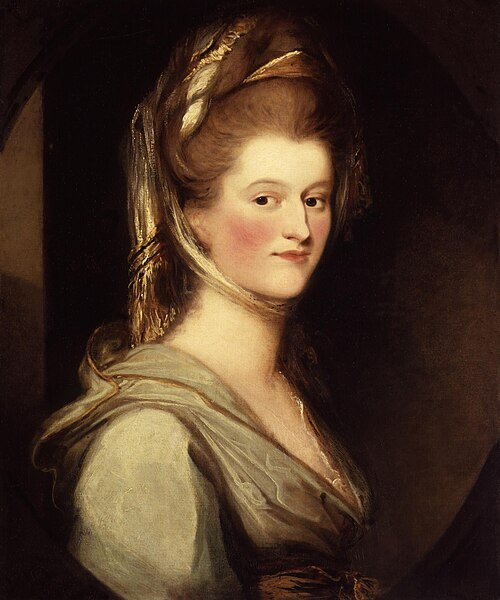
Beautiful and witty, Lady Craven wrote light farces and knew all the
literary lions. She knew Samuel Johnson and James Boswell, and became a close friend of Horace Walpole, who published her early works.
After one infidelity too many, in 1783 her husband left.
Then so did she. On a fun-and-sex tour of Europe and then Istanbul
before returning to marriage with a Prussian royal. While in Istanbul
she was squired around by the French ambassador, Count de Choiseul-Gouffier(pal of Talleyrand and Catherine the Great) , who later tried (and failed) to get permission to chip the marble frieze off the Parthenon (at the time, Turkish) before Elgin(https://app.thebrain.com/brain/f3e16344-7cd9-4fa3-ae1d-59876e128474/00000000-0000-0000-0000-000000000000) thought of it.
And then, with Homer in hand, the count had headed
south looking for a historically real Troy. Then back home in 1789 the
French Revolution happened and suddenly the count was out of a job.
So he took off for St. Petersburg, where he found work as Catherine the Great's librarian. And met the lovely Elisabeth Vigée-Lebrun, the most famous lady painter in France and on the run from the French
revolutionaries because she'd done a slew of royal portraits, including
no fewer than thirty of Queen Marie-Antoinette. Who was by now headless.
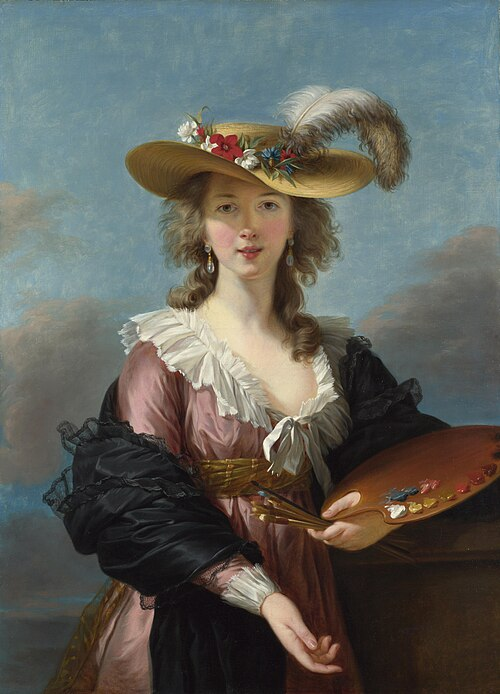
Vigée-Lebrun's forte was her delicate touch and the way she dressed her
sitters in ornate costumes and headdresses to make them look even more refined than they were. She did the same for the Russian elite.
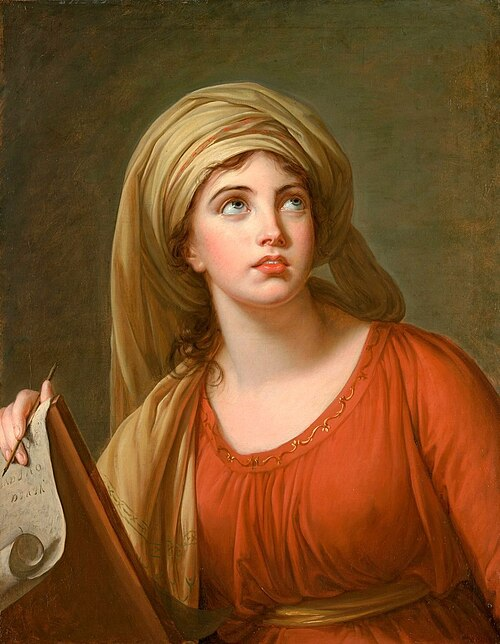
Life Study of Lady Hamilton as the Cumaean Sybil, 1792, Metropolitan Museum of Art. This was widely considered to be one of Vigée Le Brun's greatest works, and was greatly received wherever it was displayed.
She travelled extensively, making pilgrimages to see great paintings, and also the homes and graves of great writers. On her way out of Paris just ahead of the mob Vigée-Lebrun had hidden in the house of an architect pal, Alexandre-Théodore Brongniart, who then left town for the anonymity of the French Deep South, aka Bordeaux, where he hid out till the dust settled and Napoleon was firmly in the saddle.
Whereupon Brongniart's earlier experience building palaces for
princes and their mistresses got him the job of chief of public works.
Brongniart's best effort: the Paris Bourse. Second best: the layout of
the Père Lachaise Cemetery, which had recently been opened to provide space for the massive increase in dead bodies thanks to the revolution.
Shortly after Lachaise went into business in 1804 it became clear that
people thought it was too far out of town to be much of a dead center.
So the Paris prefect Nicholas Frochot hit upon a great promotional
wheeze. He collected bits of fancy statuary, sepulchers, etc., from
local museums and scattered them around Lachaise. He then exhumed the bones of Molière and LaFontaine and moved them to the cemetery. In 1817 he did the same with national-hero medieval lovers
Soon le tout Paris was dying to be buried in Lachaise. These
corpses-to-be included Balzac, Chopin, Gertrude Stein, Oscar Wilde, and (in 1825) Adam Seybert, who established the first mineralogy collection in the United States in the 1790s, containing over 1,725 crystals and rocks. The noted mineralogist and first professor of science at Yale, Benjamin Silliman, traveled to Philadelphia to view the collection,[11] and have Seybert analyze minerals from Silliman's collection. He assured President Madison we were prepared for the War of 1812, the only time the comander in chief was in the field. His wife Dolley famously evacuated the capitol with Washington’s portrait, and the rout was so rapid it was called the Blandenburg Races.
Seybert was a U.S. congressman who had risen without trace, settled in
Paris a year before his death, and whose single claim to fame was (in
1818) his unreadable Statistical Annals of the United States
1789-1818. In which he tried to disprove Malthus's idea that
the American population would double every twenty-five years.
Unfortunately, he got his data wrong, and the book was slaughtered by
Sydney Smith's devastating piece in the Edinburgh Review. The
article included the immortal line: "Who reads an American book? Or goes to an American play?"
Smith was the master of the one-liner: "I never read a book before
reviewing; it prejudices a man"; "Correspondences are like smallclothes
[undershorts] before the invention of suspenders: it is impossible to
keep them up." He was a great ladies' man and wonderful with children
and everybody loved "dear Sydney." After starting the Edinburgh
Review in 1802, Smith moved to London and hung out with the Holland House set (Lord Holland, a pioneer of germ theoryW)who advised Darwin that The Voyage of the Beagle was not worth publishing),
Holland’s son married Smith's daughter Saba, who ran a left-leaning salon for the city wits). Some of Smith's often-quoted sayings were first recorded in Lady Holland's memoir, including:
“Why, you never expected justice from a company, did you? They have neither a soul to lose, nor a body to kick.”
Smith espoused causes: save chimney sweeps, provide legal aid, give women equality. And his lectures were so popular they caused carriage jams.
In 1803 Smith's mag slanged a new set of plays, attacking the concept
behind them (different treatments of the violent emotions). "Plays on
the Passions," by Joanna Baillie (her plan was for three sets of
trilogies on love and hatred) was a first attempt at subtle
psychological drama in an age of big productions and overblown acting,
so the work received a mixed welcome. Sponsored by Sir Walter Scott and performed by superstar actors Edmund Kean
(pet lion in his drawing room, temporarily got rid of the happy ending of King Lear) , Sarah Siddons (pal of Ada’s mother Lady Byron), and William Macready ( who tells her death scene so powerful the stage manager was forced to calm the audience that she was alive). The “Siddons fever”, which “raised the price of smelling salts and hartshorn”, often included fits of fainting, hysterics and physical paroxysms as part of the enjoyment.
Baillie was probably the greatest woman writer of her generation. Introduced to the literary set by her aunt, the well-known poet Anne Hunter, Baillie was innovative, a shrewd observer of character, and wrote plays and poetry, which finally achieved their just due around 1836. Just after Baillie had visited Ealing Grove agricultural school, in London.
The school (carpentry, masonry, and market gardening) was set up for the "vagrant classes" by Baillie's confidante Lady Annabella Byron. Who back in 1815 had fallen for and married the lame and lunatic Lord Byron.
One year and a daughter later they split and she never saw him again. Which for Annabella would have been too soon, given what she'd gone through with him. Byron was (as one of his many mistresses, Lady Caroline Lamb, said) "mad, bad and dangerous to know." There were stories of violence and "much worse." Not long after the separation from Annabella, Byron left for foreign adventures and more women, and never came back.
One day Annabella found a sympathetic American ear and told it what the "much worse" had been: Byron's incestuous relationship with his
stepsister Augusta and a resultant baby. Her confidante waited till
Annabella was well dead before the 1870 publication of a book on the
subject. Harriet Beecher Stowe's aim, apart from revealing what a skunk Byron had been, was to raise the whole matter of behavior such as incest in the context of women's rights. Much too outspoken for her readers, the book failed.
Unlike her earlier piece of ground-breaking social commentary, Uncle
Tom's Cabin, in which Blacks were portrayed for the first time
as real human beings. Cabin made Stowe an instant
international star and a ton of money. Much of which went into trying to
save her son Fred from booze. By sixteen he was an alcoholic.
Treatments like the water cure (drink a lot of it, sleep in sheets soaked with it) failed. The Civil War took him to Gettysburg and enforced sobriety. On the second day of the battle he got shrapnel in the head and an invalid's discharge. Back to drink.
One of his fellow sufferers (from the artillery barrage) was Wesley Merritt, fast-tracked cavalryman who had a good war and ended up
commanding one cavalry wing of the Army of the Shenandoah. The other wing got George Custer. Abraham Lincoln took the extraordinary step to promote three captains to brigadier general, Merritt, Custer and Elon J. Farnsworth, though the latter died of five wounds leading a suicidal attack after Pickett’s Charge (the "high-water mark of the Confederacy"). Merritt was part of the board of inquiry into Custer’s defeat at the Little Big Horn. The news of that battle had stunned those attending the 1876 Centennial birthday celebration in Phildelphia, including General Sheridan, commander of all U.S. troops in the West; when a newsboy handed him the special edition of the New York Herald he looked at the headline and shouted! “This can’t be true!”
In 1882 (by this time known as the "boy general") Merritt was named superintendent of the U.S. Military Academy and arrived at West Point, New York. So, too (as a cadet) did the man later to become known as General of the Armies "Black Jack" Pershing.
Whose only failure in a golden career came in 1916 when he was sent to
Mexico to catch Pancho Villa after a group of Villistas had attacked,
pillaged, and burned Columbus, New Mexico.
Bandit, revolutionary, and national hero Villa ran off into the mountains, where the locals hid him. In the end Pershing was obliged to give up and cable Washington headquarters: "Villa is everywhere and Villa is nowhere."
Villa himself had other fish to fry. Mexico was, as usual, in the
"my-turn-to-be-president" mode and the name of the game was to change sides when it suited the career. So Villa's ex-dearest friend and
revolutionary Vesustiano Carranza was now his enemy, anti-revolutionary, and president.
And making Villa's life difficult with his Carranza Air
Force. One plane. Maintained by an itinerant American, Malcolm Loughead, a car mechanic down from California, where being a gold prospector had not panned out. Nor had a plane built by him and his brother Allen.
The Model G seaplane, which was finished in June 1913 and became the "first successful tractor seaplane". It was also the only aircraft the company ever produced.[4] They gave people rides in the Model G during the Panama-Pacific Exposition, a fair held in 1915 that celebrated the "completion of the Panama Canal and San Francisco's successful recovery from the disastrous 1906 earthquake".
By 1919 the brothers were back in the United States trying to sell
Malcolm's hydraulic brake in Detroit. In order to make life easier they
also changed their name to the more-pronounceable "Lockheed."
Eventually the brothers gave up on hydraulics and went back to
plane-making, and from then on it was onward and upward. Except for one nasty moment in 1973 when the Dutch government was looking for a new anti-submarine aircraft. Lockheed's Orion was one of the alternatives that would fit the bill and to help the decision the Lockheed Company slipped Prince Bernhardt (Queen Juliana's consort) just over one million dollars in return for his "good offices."
When the story broke in 1976 Bernhardt was forced to resign most of his
high-profile (and often lucrative) directorships. One of these was the
nonprofit presidency of the World Wildlife Fund, which Bernhardt now
turned over to Britain's Prince Philip. WWF hired ex-British special forces to combat ivory trafficking, but instead they participated in it. An investigation was demanded by Nelson Mandela.
In 2000 the WWF went to law to protect its initials, requiring the World Wrestling Federation to become World Wrestling Entertainment in 2002. Trump has a long association with the WWE, funders of his campaigns, and Linda McMahon presided over the destruction of the Department of Education.
In March 2003 she announced the appointment of its new chief financial officer. His name was PHILIP LIVINGSTON. ( Former offensive tackle 1981 World Champion Raiders)