Heyward, Thomas
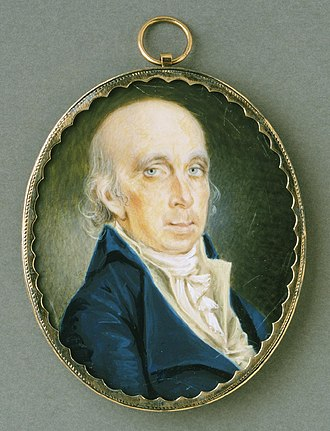
Thomas Heyward Jr. (July 28, 1746 – March 6, 1809) was an American Founding Father, lawyer, jurist, and politician.[1] Heyward was active politically during the Revolutionary Era. As a member of the Continental Congress representing South Carolina, he signed the Declaration of Independence and Articles of Confederation. Heyward's imprisonment in Florida by the British for nearly a year and the loss of a considerable number of slaves led to his being proclaimed a martyr of the revolution.
Life
Heyward was born in St. Luke's Parish (now known as Jasper County),[2][3] South Carolina, the son of Mary (Miles) and Daniel Heyward.[4] He was educated at home, then traveled to England to study law where he was a member of the Honourable Society of the Middle Temple. He was elected to the Continental Congress in 1775 and the following year was the last delegate to sign the Declaration of Independence.[5]
Heyward returned to South Carolina in 1778 to serve as a judge. In 1778, he presided over a trial in which several persons were tried for treason; they were convicted and executed within view of the British lines.[6] In command of a militia force, he was taken prisoner by the British during the siege of Charleston. On August 27, 1780, British troops took him from his Charleston home (presently owned by the Charleston Museum) at 87 Church Street and detained him in the Old Exchange Building. They confiscated all of his slaves, and although he later reclaimed some of them, 130 were permanently confiscated and transported to sugar plantations in Jamaica,[7] a loss of $50,000 in property.[8]
It was this loss of slaves that resulted him being later proclaimed by the press as a martyr of the revolution.[6] Hours after being arrested, he and 28 other "ringleaders of the rebellion" were relocated to a guard ship in the harbor. On September 4, they were transported to St. Augustine, Florida, and remained there for about 11 months until they were freed in a prisoner exchange.[9] His fellow prisoner and commander Moultrie was traded for General Burgoyne. While in prison, Heyward transposed a popular English song, "God Save the King" into "God Save the States".[10]
In 1784, he was elected a member of the American Philosophical Society.[11] He continued to serve as a judge after the war, retiring from the bench in 1798. He is buried at Old House Plantation near Ridgeland, South Carolina.[12] The house was added to the National Register of Historic Places in 1997.[13]
In 1970, when the Supreme Court ordered that public schools must be integrated, a group associated with the White Citizen's Council opened a school named Thomas Heyward Academy in Ridgeland, South Carolina.[14][15]
Marriage and family
 The Thomas Heyward House at 18 Meeting St., Charleston, South Carolina, a fine example of Adamesque design
Heyward was married twice, at age 26 and at age 40, and each wife was named Elizabeth. His first wife, born in 1753, was the daughter of Colonel John and Sarah Gibbes Mathews and the sister of South Carolina governor John Mathews. She died in childbirth in 1782 in Philadelphia, where she had gone to be with Heyward upon his release as a prisoner of war. She is buried there in St. Peter's Episcopal Church yard. They had six children, but only one son, Daniel, survived childhood.
His second wife was the daughter of Colonel Thomas and Mary Elliott Savage of Charleston. They had three children who lived to adulthood: Thomas, William and Elizabeth. Notable descendants include DuBose Heyward, whose novel and later stage play *Porgy* portrayed Black African-Americans and was transformed by George Gerswhin into Porgy and Bess, an American opera that achieved both credit as a musical masterpiece and criticism for pervasive racism.[16][17]
In addition to his wives, he impregnated at least one of the women he enslaved, making him the grandfather of Thomas E. Miller, one of only five African Americans elected to Congress from the South in the 1890s.[18] At one time, the Heyward family had the largest slaveholding in the United States.[19]
See also
Thomas Heyward Jr. - Wikipedia
Siege of Charleston:
During the American Revolutionary War, Middleton served in the defense of Charleston from the attempt to end the way by splitting the colonies by Generals Cornwallis and Clinton.
Clinton had issued the Philipsburg Proclamation in 1779, promising freedom for slaves owned by Patriots who escaped to British lines and aided their cause. Slaves left both the city and countryside around Charleston to join the British around the city. Among those former slaves, known as Black Loyalists, evacuated by the British after the war was John Kizell, who had been captured as a child from the area of Sierra Leone and transported to South Carolina. He eventually returned to Sierra Leone and aided the American Colonization Society.
After the city's fall to the British in 1780, Middleton was sent as a prisoner of war to St. Augustine, Florida (along with Edward Rutledge and Thomas Heyward Jr.), until exchanged in July the following year. Also spent a year on one of the notorious prison ships, the Jersey. Afterward favored tar and feathering loyalists (Am Conn).
Aftermath
The British captured some 5,266 prisoners, 311 artillery pieces, 9,178 artillery rounds, 5,916 muskets, 33,000 rounds of ammunition, 15 Regimental colours, 49 ships and 120 boats, plus 376 barrels of flour, and large magazines of rum, rice and indigo.[2] Following the surrender, the captured ordnance was brought to a powder magazine. A Hessian officer warned that some of the guns might still be loaded, but he was ignored. One prematurely fired, detonating 180 barrels of powder, further discharging 5,000 muskets in the magazine. The accident killed approximately 200 people and destroyed six houses.[2]
The prisoners of the siege were diverted to multiple locations, including prison ships, the old barracks where the College of Charleston is today (two barracks buildings are shown on early maps of the campus[11]), and the Old Exchange and Provost "Dungeon". Prison hulks awaited the majority of the 2,571 Continental prisoners, while parole was granted to the militia and civilians who promised not to take up arms. This ended the power of an American army in the South.[3]: 70
The defeat was a serious blow to the American cause.[12] It was the largest surrender of an American force under arms until the 1862 surrender of Union troops at Harper's Ferry during the Antietam Campaign. The surrender left no substantial army in the South, and the colonies were wide open for a British advance. The British troops consolidated their hold, and had driven the remaining Continental Army troops from South Carolina consequent to the May 29 Battle of Waxhaws.
During their surrender the American forces were denied honours of war, leading General George Washington to deny the same to the British during their surrender at the Siege of Yorktown. Washington said, "The same Honors will be granted to the Surrendering Army as were granted to the Garrison of Charles Town."[10]
On June 5, Clinton sailed back to New York City, believing his presence necessary to defend against a potential Franco-American attack, leaving command of the southern theater to Lord Cornwallis, with orders to reduce opposition in North Carolina. Though the effects of the surrender at Charleston were substantial, the British error in strategy soon became apparent. As no popular uprising of Loyalists took place, control of the countryside was difficult. Instead, resistance in South Carolina degenerated into a period of chaotic guerrilla warfare in the outlying areas.