Paca, William
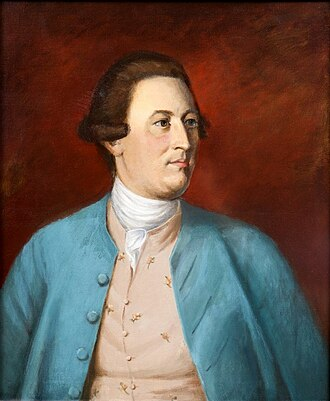
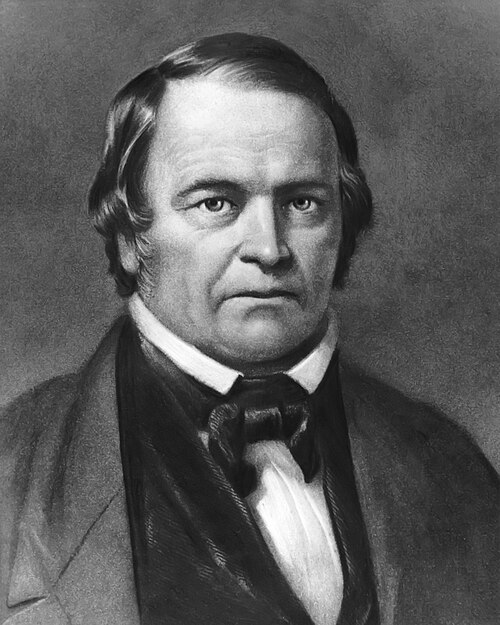
William Paca (October 31, 1740 – October 13, 1799) was a Founding Father of the United States who was a signatory to the Continental Association and the United States Declaration of Independence. He was a Maryland delegate to the First Continental Congress and the Second Continental Congress, governor of Maryland, and a district judge of the United States District Court for the District of Maryland.
Early life
Born on October 31, 1740, in Abingdon, Province of Maryland, British America,[1] Paca entered school at the Philadelphia Academy and Charity School in 1752, and went on to attend the College of Philadelphia (now the University of Pennsylvania), graduating in 1759 with a Bachelor of Arts degree.[2] He was also to receive a Master of Arts degree from the same institution in 1762, though this required no further study, only that Paca request it and be in good standing.[3] He also attended the Inner Temple in London and read law in 1761[1] with Stephen Bordley and was admitted to the bar that year.[2] Paca entered private practice in Annapolis starting in 1763.[2]
Paca was the child of John Paca (c. 1712 – 1785), a wealthy planter in the area of English heritage, and his wife Elizabeth Smith (?-c. 1766).[2] He was the second son of the family, after his elder brother Aquila, and had five sisters.[3] He courted Mary Chew,[4] the daughter of a prominent Maryland planter, and they were married on May 26, 1763. They had three children, though only their son John Philemon survived into adulthood.[3]
Political career
Paca was a member of the lower house of the Maryland Proprietary Assembly from 1767 to 1774.[1] He was a delegate to the First Continental Congress and the Second Continental Congress from Maryland from 1774 to 1779.[1] He was a signer of the United States Declaration of Independence in 1776.[1] He was a member of the Maryland Senate from 1776 to 1777, and from 1778 to 1780.[1] He was a judge of the Maryland General Court in 1778.[1] He was a judge of the Court of Appeals in Cases of Capture from 1780 to 1782.[5] He was governor of Maryland from 1782 to 1785.[1]
He was a member of the Maryland House of Delegates in 1786.[1] He was influential in establishing Washington College in Chestertown, Maryland, in 1786.[6] He was a delegate to the Maryland State Convention of 1788, to vote whether Maryland should ratify the proposed Constitution of the United States.[7][6]
Among the other young lawyers in Annapolis at the time was Samuel Chase, who became a close friend and political colleague of Paca.[2] Paca and Chase led local opposition to the British Stamp Act of 1765 and established the Anne Arundel County chapter of the Sons of Liberty.[2]
Federal judicial service
Paca received a recess appointment from President George Washington on December 22, 1789, to the United States District Court for the District of Maryland, to a new seat authorized by 1 Stat. 73.[1] He was nominated to the same position by President Washington on February 8, 1790.[1] He was confirmed by the United States Senate on February 10, 1790, and received his commission the same day.[1]
Paca's career on the federal bench had a significant impact on the admiralty jurisdiction of the Federal courts and what was to become the principal business of the Supreme Court over the subsequent four decades. As the first federal judge for the District Court of Maryland, he rendered an opinion on the case of Betsey that had far reaching consequences when it was overturned by the Supreme Court.
In that case, Paca argued on solid precedents of international and British law that the District Court did not have jurisdiction over the awarding of prizes brought into American ports by foreign privateers. The Supreme Court asserted otherwise in seriatim opinions and established an exclusive jurisdiction over prize cases vested in the Federal District Courts that took that privilege away from what had been the responsibility of foreign consulates. Paca's opinion was the first District Court opinion to be published, and although ultimately reversed, it provides insight into the extensive legal training of a signer of the Declaration of Independence and an author/compiler of several provisions of what became the Bill of Rights.[8]
Death and legacy
Paca's judicial service terminated on October 13, 1799, due to his death at his estate of Wye River, in Queen Anne's County, Maryland,[1] and was interred in a family cemetery on the estate.[6][Note 1]
Paca was admitted as an honorary member of The Society of the Cincinnati in the state of Maryland in 1783.[9][10] "The resolution conferring the honor, adopted November 22, 1783, reads in part: ... In consideration of the abilities, merit, patriotism of His Excellency, Governor Paca, this society direct that Secretary-General Williams wait on His Excellency and inform him that this society do themselves the honor to consider him as an honorary member."[11] He later served as the vice president of the Maryland Society from 1784-1787.[12] Unlike hereditary members, honorary members are not eligible to be represented by a living descendant.[13]
His Annapolis home, the Paca House and Garden, was added to the National Register of Historic Places and designated a National Historic Landmark in 1971.[14] The William Paca Club in New Providence, New Jersey, is named in his honor. The club cites the fact that Paca was the only Italian-American besides Caesar Rodney to sign the Declaration of Independence as the reason for bestowing him this honor.[15] Paca-Carroll House at St. John's College is named for Paca and fellow signer of the Declaration of Independence, Charles Carroll.[16]
Paca also fathered two illegitimate daughters: Hester, born in Philadelphia in 1775 to a “mulatto” woman named Levina; and Henrietta Maria, his second daughter with that name, born c. 1777 to Sarah Joice of Annapolis. It is important to note that Paca provided for the education and welfare of both of his “natural” daughters. Though there is no record of Hester reaching adulthood, Henrietta Maria did, and records show that she married and moved with her husband to Kentucky.
William Paca | Descendants of the Signers of the Declaration of Independence
AMERICAN CONNECTIONS
WILLIAM PACA (MD was thirty-five. And smart,
good-natured, well-spoken, and elegant enough to be called a dandy. A
rich, London-trained lawyer, Paca married money and built the first
Maryland Georgian mansion with ornamental garden. Paca was a
pro-Independence member of the Maryland Assembly. And while his
colleague in Congress Samuel Chase did the handwaving and rhetoric, Paca
was strategic and reasoning.
Paca had two wives, three terms as governor, and became the first judge
of the Federal District Court of Maryland. In 1783 he persuaded the
Assembly to approve setting up Washington College in Chesterton, the
first U.S. College to be chartered after independence.
The college is named after George Washington, who pledged 50 guineas to the college, served on its board of visitors and governors until 1789, and consented to have the college named in his honor whilst he lived; the only college named after him to have this distinction. ^[7]^ It became coeducational in 1891.
Paca's partner in this educational effort was the quarrelsome and slovenly William Smith. Who had been provost at the College of Philadelphia from 1751 until the
establishment was closed down in 1789 after an outbreak of political and
religious backstabbing.
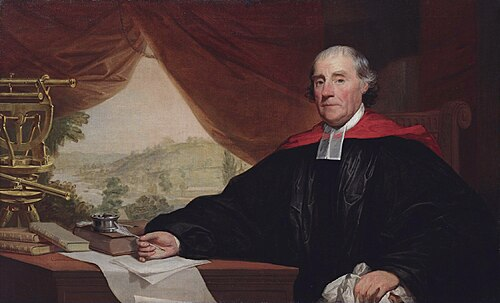
Portrait by Gilbert Stuart
Smith's unfriendly attitude to his ex-supporter
Ben Franklin didn't help. Nor did the rumors that Smith was less than
revolutionary and more than drunk.
In Philadelphia one of Smith's grads was the wealthy Jacob Duche (Huguenot descent), who visited London and then returned to the College of Philadelphia as
professor of oratory. Logically enough he turned out to be good at
preaching and was asked to be chaplain to the Continental Congress and
give the opening prayer in 1774 and again in 1776. Things went oops for
Duche when he wrote to Washington suggesting the Declaration of
Independence be torn up. The letter was leaked to the papers and by 1778
Duche was an exile in London, chaplain to the Asylum for Female Orphans
in Lambeth and getting deeply into the mystical Swedenborgian sect.
Protestant and extremely serious. In 1780 Duche asked Francois
Barthelemon, a rising star on the London musical scene, to write the
music to a hymn: "Awake My Soul."
Barthelemon wrote operas, concertos, ballets, and symphonies, and on one
occasion wrote the music for a song while looking over the shoulder of
the poet (actor David Garrick) as he was writing the words. Barthelemon
conducted every major orchestra in London (including those at Sadlers
Wells, Drury Lane, and Covent Garden), played the violin at Windsor
Castle, and on trips abroad entertained the aristocracy and royalty of
Germany, France, and Italy.
In 1791 fellow composer Joseph Haydn came on a visit from Austria and
gave music lessons to Barthelemon's daughter. Haydn was already a
European music superstar with hundreds of compositions under his belt.
Included in Haydn's amazingly prolific output were his settings to 398
Scottish songs commissioned by persuasive Edinburgh publisher George
Thomson. Whose friend Dr. Henry Reeve (pal of Coleridge, Banks and Davy) visited Haydn in Vienna in 1805 during a year-long continental tour visiting the medical sights (i.e.,important doctors, professors, asylums, hospitals) before returning to
London to write up his experiences. This included a paper on cretinism
and a report of experiments he had conducted in Germany on the torpidity
of hamsters and hedghogs (he said the cold sent them to sleep).
In the spring of 1806, he became acquainted with Alexander von Humboldt, and was among the auditors of Johann Gottlieb Fichte.
Reeve's brother-in-law Richard Taylor also had Germanic connections in
the shape of Friedrich Koenig, inventor of the mechanized printing
press, which he developed with financial help from Taylor. Koenig's
steam-powered machine used a system of rollers to deliver ink to a
leather roller, which then inked the typeface (moved into position by
another roller).
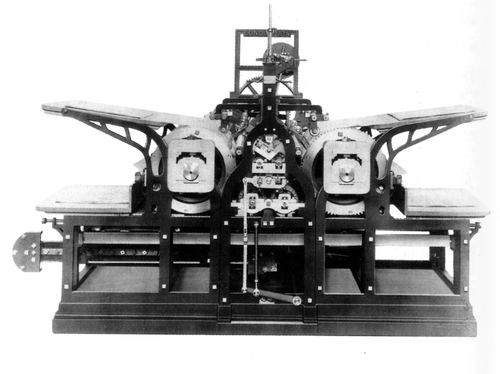
Paper on yet another roller was then pressed onto the
inked typeface. In 1814 the Koenig press could print both sides of
eleven hundred sheets in an hour and the London Times bought
two.
At the time the paper's owner, John Walter II, was trying hard to boost
sales from the low level to which his father had let them sink. By the
time Walter finished the Times was the greatest newspaper in
Europe. Walter hassled governments of the day, lobbied for parliamentary
reform, and gave the paper a reputation for in-your-face political
independence. Walter also hired continental correspondents who mailed
translations and comments on foreign-language newspaper reports. Also a
London editor, six reporters, and a theater critic, Barron Field (pal of Charles Lamb).
Field's job was to break with tradition (paid-for puff pieces usually
written by the playwright himself) and write unbiased reviews, accept no
free tickets, and not socialize with the playwrights and theater
managers. In his spare time Field was studying law and in 1814 left the
paper to become a judge in New South Wales, Australia. He hated the
country ("the after-birth of Creation"), wrote two poems ("Botany Bay
Flowers," and "The Kangaroo"), and collected his pay. When his contract
ended it was not renewed, and in 1824 Field headed happily back to
London. To a welcoming epistle in verse from his old friend and fellow
scribbler Leigh Hunt.
Hunt's work has generally been eclipsed (with good reason) by that of
his close pals Byron, Keats, Shelley, and Lamb. He spent most of his
life between sickness and debt, saddled with an alcoholic wife and being
bailed out by the others. Still, his mag, The Examiner,
lasted for thirteen years, contained some of his best essays and
reviews, and brought the Romantic poets to public attention. On the
occasion when Hunt called the Prince Regent George (IV) a "libertine" the libel got
him put in jail for two years. His single major poem ("The Story of
Rimini") shocked the public with its incest-adultery theme.
One of Hunt's helpful friends (who provided him with a piano in jail)
was Vincent Novello.
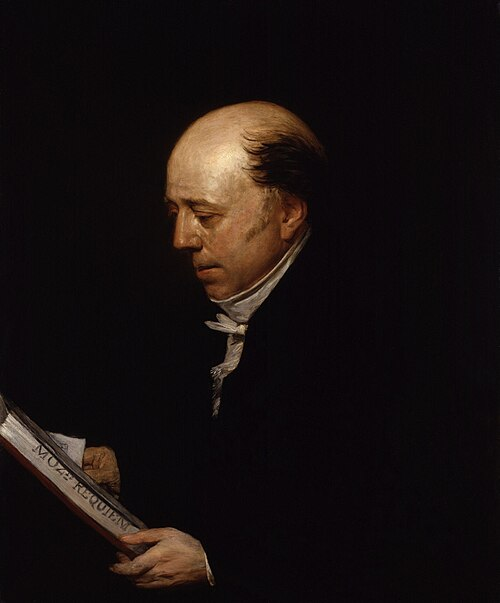
At the age of sixteen the myopic Novello had been
hired as organist for the Portuguese embassy chapel in London. Then he
became obsessed with publishing music, because at the time sheet music
was handwritten and scarce. Novello scoured the British Museum,
churches, chapels, and his friends' libraries looking for manuscripts
and then printing the music together with notes on performance and
instrumentation as well as how-to remarks for conductors. Modern printed
sheet music begins with Novello.
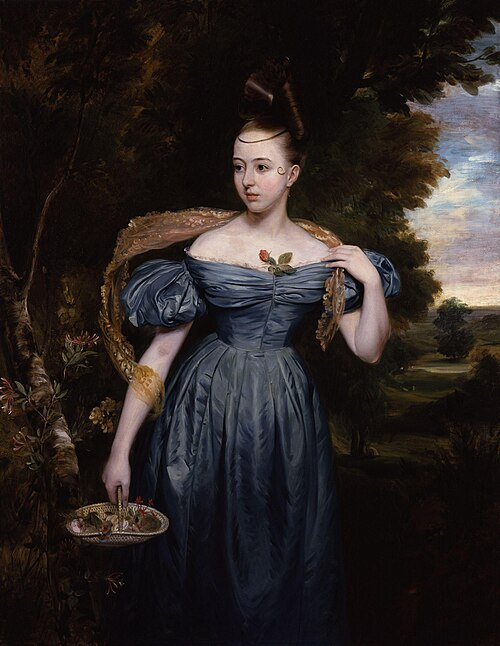
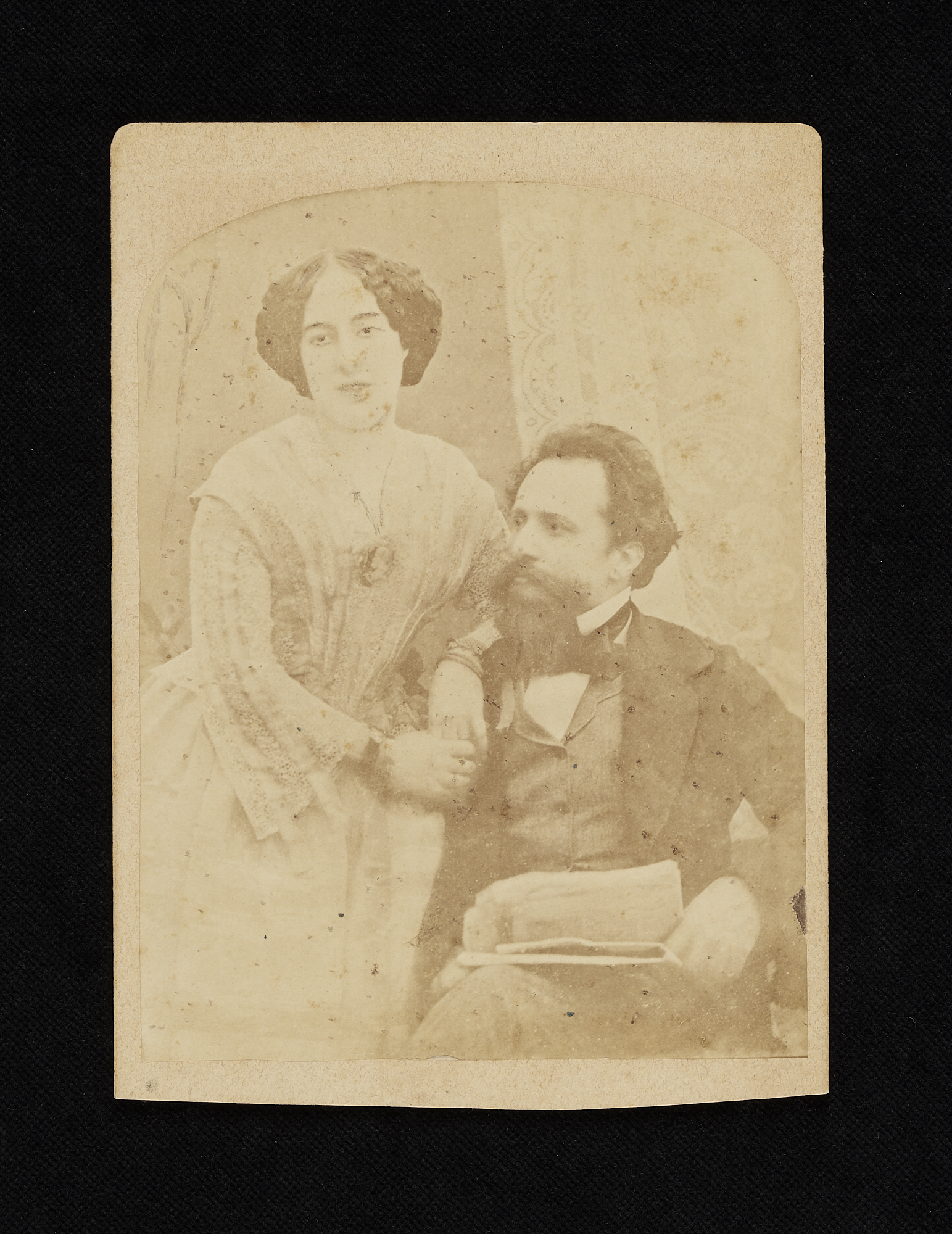
Unsurprisingly, his daughter Clara was one of the best vocalists of her
generation (Queen Victoria was a fan), married an Italian count, and
inspired Rossini to give her lead roles and become a lifelong admirer.
By the time Clara met Gioacchino Rossini he was already the greatest
Italian composer alive and an international star with prestige, money,
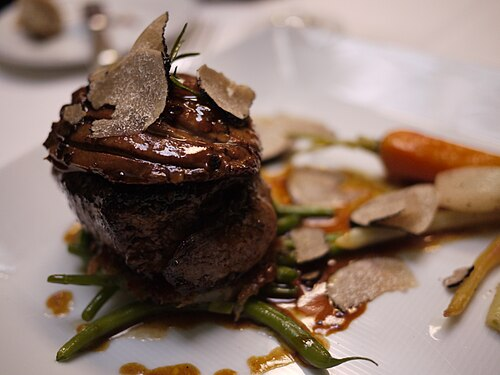
acclaim, and influence. And a dish had been named after him (by the
great French chef Carême): *tournedos Rossini*.
Rossini wrote at breakneck speed. The Barber of Seville took only three
weeks to write, and many of his operas were finished in a month. He
churned it out, saying once: "Give me a menu and I'll set it to music."
Most of the time Rossini was helped by good librettists like Eugène
Scribe, who in 1828 wrote the words of The Count Ory. It was
only Scribe's third opera after nearly 150 musical-comedy scripts.
Scribe's work was production-line stuff, with assistants to provide
jokes, story-lines, ideas, dialogue, and a card-index of plots. He wrote
more than 450 plays to the same formula: Things go complicatedly wrong
and then hilariously resolve. He took a percentage of the receipts and
by the age of forty was a millionaire. The names of Scribe and Auber became as linked in French minds as those of Gilbert and Sullivan later were in British ones.[10]^
Henrik Ibsen thought highly of his work, and drew on it in his own early writing; Bernard Shaw also drew on it, in his Arms and the Man.[29]^ In 1855 Scribe had his only direct collaboration with Giuseppe Verdi.
Scribe's audience was the new French middle class, which is why the
young poet and critic Théophile Gautier attacked him for being
bourgeois. Which Gautier was trying not to be, with two mistresses,
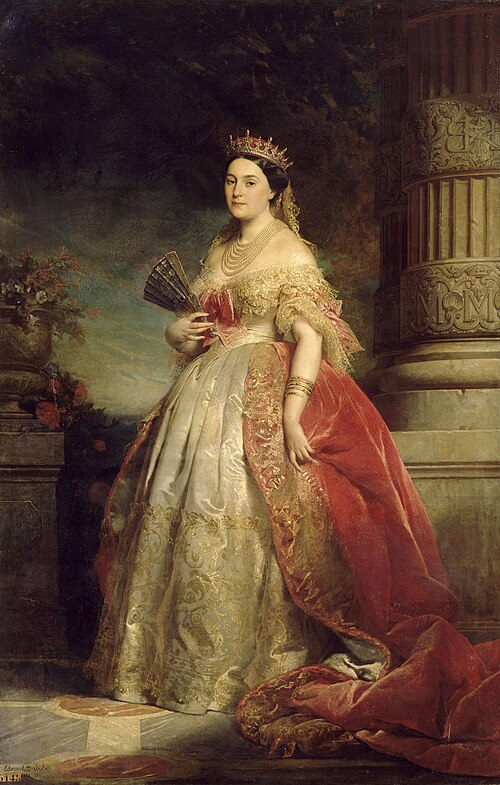
three illegitimate children, a possible affair with Princess Mathilde
Napoleon, star of everybody's salon, leader of the more off-the-wall
Romantics, and painter turned writer of plays, poems, essays, reviews,
and poetry.
He also wrote the storyline of one of the most popular
ballets of all time: Giselle.

Carlotta Grisi, his great love, as Giselle, 1842
His major novel, Mademoiselle de Maupin, rocked the bourgeoisie with its sexual themes.

The fictional Mademoiselle de Maupin, from Six Drawings Illustrating Théophile Gautier's Romance Mademoiselle de Maupin, by Aubrey Beardsley, 1897
Above all Gautier's writings popularized the concept of "art for art's
sake." And the use of hash. The Armée d'Orient, along with a contingent of 151 scientists and anthropologists from the Commission des Sciences et des Arts, brought quantities of hashish home with them from Napoleon's expedition to Egypt. The French conquest of Algeria of 1830 to 1847 further increased the popular consumption of hashish.[3]^
Once a month in the 1840s he and other experimenters would visit a
particular hotel to eat the green paste and hallucinate. All of this
under the observant eye of eminent psychiatrist Dr. Jacques-Joseph
Moreau, the first to suggest that insanity wasn't caused by physical
damage in the brain but by chemical changes in the way it worked. Moreau
discovered this by watching the effects of varying doses of marijuana on
his patients (and pals) and observing that the drug caused long-term
personality change. In 1845 he wrote it all up as Hashish and Mental
Alienation.
In the United States, Moreau's work was reviewed by Dr. Amariah Brigham,
Connecticut psychiatrist and director of the Hartford Retreat for the
Insane. It was Brigham who introduced the process of
institutionalization and behavioral therapy that would become standard
treatment in modern psychiatry. Founder of the *American Journal of*
Insanity, Brigham wrote about the influence of evangelism on
mental health because he was worried that the contemporary Millerite
revivalist movement posed the threat ("greater than malaria") of what he
called "religious insanity."
By this time preacher William Miller's message ("Get Ready for the
Imminent End of the World!!") was packing hundreds of thousands into
tents for prayer meetings at which believers went ecstatic, saw visions,
heard voices, and more.
When Miller's predicted date for the Second
Coming (1844) came and went the movement nearly disintegrated. Many of
the faithful were at a loss. These included the charismatic Sojourner
Truth (aka Isabella Baumfree), a freed slave. Who turned to abolitionism
and made her name speaking out against slavery, together with the
movement's major figure, Frederick Douglass.
Sojourner (she said the Holy Spirit had suggested the name change) was
also the object of Harriet Beecher Stowe's admiration and an essay.
Sojourner met Lincoln and failed to get the Washington, D.C., streetcars
desegregated, or western land given to freed slaves. Sojourner also
fought hard to stop the transportation of emancipated African Americans
to Monrovia, Liberia, a practice begun back in 1820 by the American
In 1858 the Navy's *SS Niagara* took another boatload to their
new life in Africa, a year after the ship's maiden voyage, during which
she had laid the first (failed) transatlantic cable. It took three more
attempts before success in 1866 when linking the main
twenty-three-hundred-mile cable with the Irish shore station involved a
special twenty-seven-mile stretch of twenty-tons-a-mile,
ninety-tons-breaking-strain armored connector line. Manufactured and put
in place by the W. T. Henley company.
Which in 1913 hired a fourteen-year-old draftsman named Alfred
Hitchcock. By 1920 Hitchcock was designing silent movie titles. In 1925
he directed his first film: The Pleasure Garden. Over the
following decades he became an international cinema figure with such
successes as The Lady Vanishes (1939), Rear Window
(1953), and most famous of all, Psycho (1960). In 1959
Hitchcock directed a comedy thriller, North by Northwest,
starring Cary Grant. A bit-part ("A Farmer") in the movie was played by
Andy Albin.
In 1972 Albin acted in the film *1776,* playing the role of
WILLIAM PACA.