Rutledge, Edward
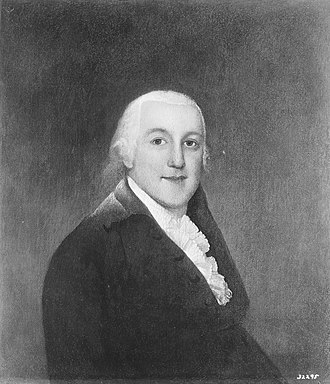
Edward Rutledge (November 23, 1749 – January 23, 1800) was an American Founding Father and politician who signed the Continental Association and was the youngest signatory of the Declaration of Independence. He later served as the 39th governor of South Carolina.
Early life and education
Rutledge was born in Charleston, South Carolina. He was the youngest of seven children (5 sons and 2 daughters) born to Dr. John Rutledge and Sarah Hext, who was 15 when her first child (John) was born. His father was a physician and colonist of Scots-Irish descent; his mother was born in South Carolina and was of English descent. Following his elder brothers, John and Hugh, he studied law in London at the Inns of Court. In 1772 he was admitted to the English bar (Middle Temple)[1] and returned to Charleston to practice.
He was married on March 1, 1774, to Henrietta Middleton (17 November 1750 – 22 April 1792), daughter of Henry Middleton. The couple had three children:
- Major Henry Middleton Rutledge (5 April 1775 – 20 January 1844)
- Edward Rutledge (20 March 1778 – 1780)
- Sarah Rutledge (1782–1855)
Rutledge had a successful law practice with his partner, Charles Cotesworth Pinckney. He became a leading citizen of Charleston. He owned more than 50 enslaved people.[2]
Career
American Revolution
During the American Revolution, Rutledge served along with his brother John representing South Carolina in the Continental Congress (1774-1776). He worked to have African Americans expelled from the Continental Army.[2] Although a firm supporter of colonial rights, he (as a delegate) was instructed initially to oppose Richard Henry Lee's Resolution of independence; South Carolina's leaders were unsure that the time was "ripe".[3] At age 26 he was the youngest delegate to sign the Declaration of Independence.
He returned home in November 1776 to take a seat in the General Assembly. He served as a captain of artillery in the South Carolina militia, and fought at the Battle of Beaufort in 1779. In May 1780, Rutledge was captured along with his co-signers of the Declaration of Independence, Arthur Middleton and Thomas Heyward during the siege of Charleston and were taken to St. Augustine, Florida. They were released during a prisoner exchange in July 1781.[4]
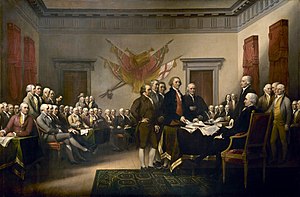
Rutledge is standing on the far right in John Trumbull's Declaration of Independence.
Later life and death
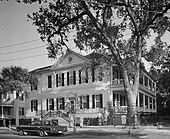 ])
The Edward Rutledge House in Charleston
After his release he returned to the General Assembly, where he served until 1796. He was known as an active legislator and an advocate for the confiscation of Loyalist property. Like John Rutledge, Edward Rutledge opposed the Jay Treaty and the Anglophilic stance he perceived in the Federalist Party.[5] As an elector in the 1796 presidential election, Rutledge voted for the two Southern candidates, Republican Thomas Jefferson and Federalist Thomas Pinckney.[6]
Rutledge had not been close with the victor John Adams dating back to their days in the Continental Congress, but he approved of Adams's defense policies towards France during the Quasi-War.[7] The opposition afforded Adams's measures by Vice President Jefferson, and the Congressional Republicans angered Rutledge because he now saw the Republicans as more partial to France than to American interests, a situation similar to the pro-British feelings he sensed in the Federalists during the Jay Treaty debates.[8] Rutledge thereafter ceased communication with Jefferson.[8] Rutledge served in the state senate for two years, then was elected governor in 1798.
Governor Rutledge, while attending an important meeting in Columbia, had to be sent home because of his gout. He died in Charleston before the end of his term. Some said at the time that he died from apoplexy resulting from hearing the news of George Washington's death.[2] Since 1971, his home in Charleston is now a National Historic Landmark,[9] and is privately owned and operated as a bed & breakfast, the Governor's House Inn.
See also

AMERICAN CONNECTIONS
EDWARD RUTLEDGE (SC) was twenty-six. And worried
that independence would put power in the hands of the "cunning"
northerners with their hard-left, "leveling" (egalitarian) ideas. He was
a London-trained lawyer, a member of the South Carolina elite, and
reluctant to go to war, favoring a deal that would give America autonomy
within the British Empire. As late as June 1776 he was still lobbying
(he got references to slavery removed from the Declaration).
On September 6 that year, together with "leveler" John Adams and
middle-of-the-road Ben Franklin, the conservative Rutledge stepped off a
barge at British military headquarters on Staten Island to be met by a
guard of honor and the leader of the Brit negotiating team, Admiral
Richard Howe (known from his swarthy complexion as "Black Dick"). Howe
asked for the Declaration to be withdrawn. The Americans said no. After
three hours it was over, and war was inevitable. Two days later the Brits
took New York.
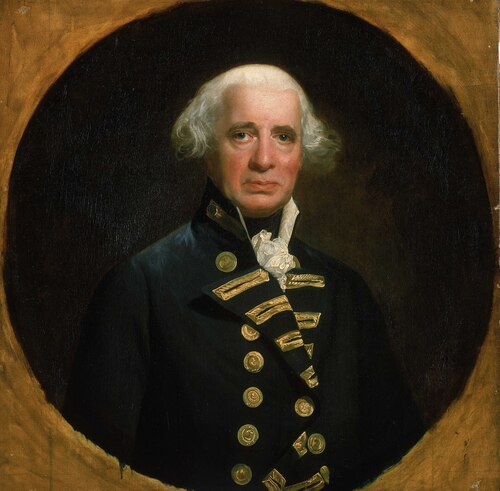
At the beginning of the American War of Independence, Howe was known to be sympathetic to the colonists. He had known Benjamin Franklin since late 1774 and was joined in a commission with his brother, General Sir William Howe, head of the land forces, to attempt a reconciliation.[7]^
Because Howe was known to be generally sympathetic to the American cause, parliamentary hard-liners in London worked behind his
back to make things difficult. Once hostilities were official Howe did
his best with his mission to blockade the American coastline and prevent
French supplies from getting in. But the ships and backup he needed
never materialized. Unable to trust his own government, in 1778 Howe
resigned and went home, where he was attacked in the press and put out
to grass.
Five years later a new government gave him command again and he nursed
the Royal Navy through an outbreak of peace (no jobs). Things warmed up
as the Anglo-French situation turned scary. In 1790 there were rumors of
an imminent French invasion, and Howe was put in charge of the Channel
Fleet. The same year he cleaned up the chaotic naval messaging system
(an invitation to dinner was often signaled by hanging a tablecloth over
the side and signals could only be sent to all ships at once). Howe
introduced the idea of using flags to represent a numerical code.
Thirteen years later Admiral Home Popham took signaling reform all the
way and published Telegraphic Signals.
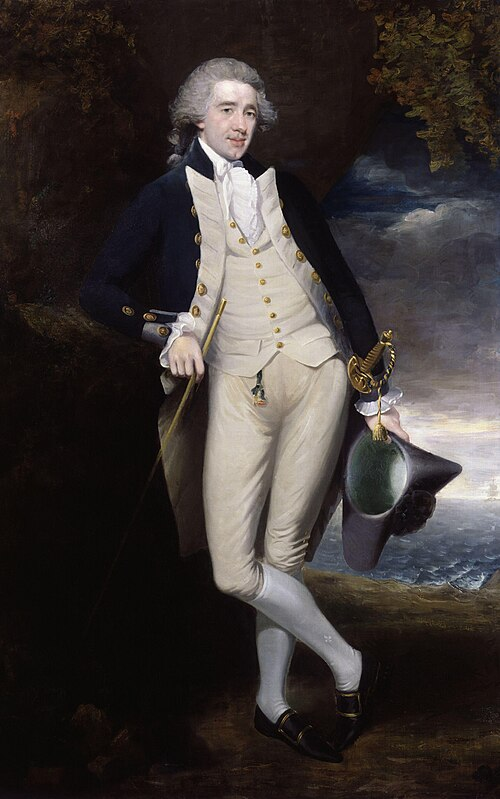
Popham's system used flags to represent the numbers 0--9. Flying two 1's meant "10+1." Flying three 1's meant "100+10+1." Numbers indicated by flags could then be
checked off against a code book where each number represented a word or
phrase. By 1813 Popham's signalers were able to choose from six thousand
phrases and sixty thousand words.
Popham was one of the most scientific seamen of his time, and was elected to the Royal Society in 1799 ^[4]. He did much useful survey work, and was the author of the code using signal flags adopted by the admiralty in 1803 and used for many years.[3]^ These were most famously used for the signal "England expects that every man will do his duty".

The Battle of Trafalgar by J. M. W. Turner shows the last three letters of the signal flying from the Victory.
... It took First Lord Sir John Laughton only 29 words to dismiss that code adopted by Admiral Nelson. It was not until 1816 that prejudice against Popham's previous court-martial was put aside and the system's brilliance fully recognized.[19]^
Popham was also an entreprenurial type. Back in 1787 when peacetime naval jobs were few and far between he'd bought a ship and gone into Far Eastern trade (both with and against the EIC). When war with the French looked likely he got back in service. In 1804 he was asked to take a look at a new high-tech idea being offered to the Admiralty by an
American inventor. It was a "submarine bomb" (a floating mine).
Inventor Robert Fulton had been back and forth between the French and
English, playing them off against each other for his new terror weapon.
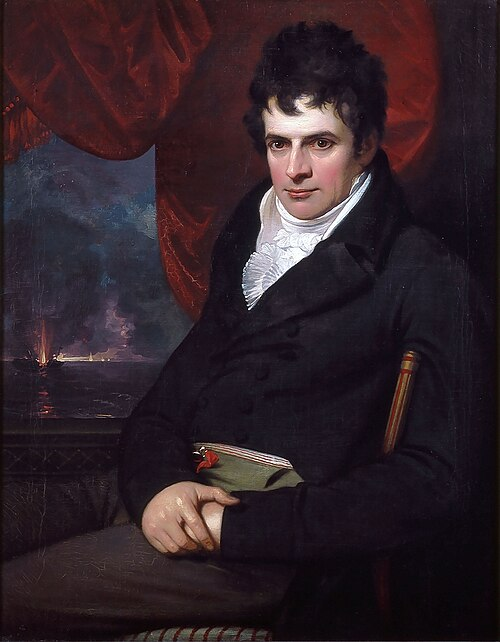
Tactic didn't work. After the Brits turned him down in 1797 Fulton spent
time in Paris being number trois in a ménage à trois with the American Joel Barlow and wife.
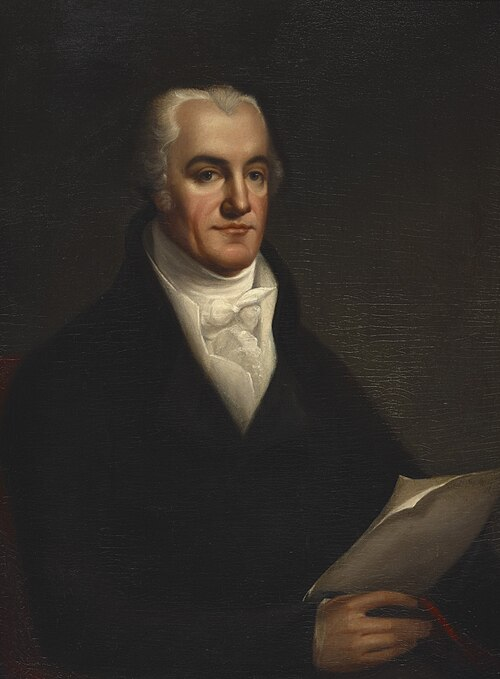
Barlow
In 1800, Fulton had been commissioned by Napoleon Bonaparte, leader of France, to attempt to design a submarine; he then produced Nautilus, the first practical submarine in history.[1]^
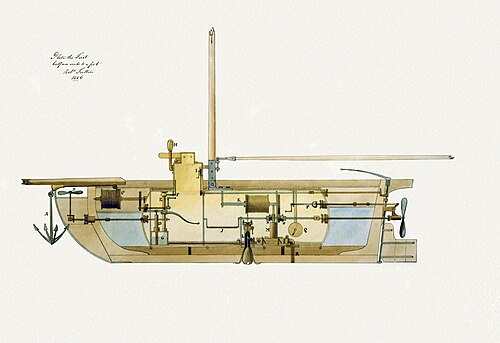
The twenty-foot wooden boat was crewed by two
men cranking a handle to turn a propeller and sunk to their shoulders in
the water. The aim was to creep, unseen, up-current of a target ship and
release the mines. The current would then do the rest (wooden cask, a
hundred pounds of gunpowder, cork float, flintlock mechanism on top,
gizmo eventually bumps into ship's hull, bang). This time the Brits paid
Fulton just to stay away from the French.
Fulton's most successful scheme was for a paddle-wheel steamboat. In the
long run, with financial help from rich American partner and U.S.
minister to France Robert Livingston, Fulton returned to the States and
by 1807 had a working prototype steaming up and down the Hudson. Fulton
may have had the steamboat idea from an early working acquaintance with
the English Lord Stanhope, who was interested in building a canal back
in the days when Fulton was also in that business. Stanhope already had
a steamboat patent and was a serious spare-time geek.
During the day he was in the House of Lords haranguing the government on
liberal issues, including parliamentary reform, the French Revolution
(he called himself "Citizen Stanhope"), freedom of the press, and the
activities of radical activist friends who were being dumped in the
Australian penal colony. In his other spare time Stanhope invented a
printing press, a pyrometer, fireproofing (his demo involved burning the
ground floor while interested parties ate ice cream on the upper floor,
unscathed), a multiplying-and-dividing machine, and a floating mine
(before Fulton).
Stanhope was also impossible to live with, subsisting as he did on soup
and sweetened barley water. Members of his family left him as soon as
they could. One such early absconder was Stanhope's daughter Hester.
From 1803 to 1806 she played hostess for her bachelor uncle William Pitt
(prime minister). In 1810 she went to Gibraltar, then Malta (where she
took a lover), then (with lover) Istanbul, Cairo (where the viceroy
entertained her lavishly and she responded in like style), Palestine,
Lebanon, Syria, and finally Lebanon again. Lady Hester threw money about
and shocked locals by wearing Turkish male clothing (adopted after shipwreck). She met the pasha dressed thus, and she refused to wear a veil even in Damascus. In Jerusalem, the Church of the Holy Sepulchre was cleared of visitors and reopened in her honour.
Learning from fortune-tellers that her destiny was to become the bride of a new messiah, she made matrimonial overtures to Ibn Saud, chief of the Wahhabi Arabs and leader of the First Saudi State.[9]^ She decided to visit the city of Palmyra, even though the route went through a desert with potentially hostile Bedouins.[10]^
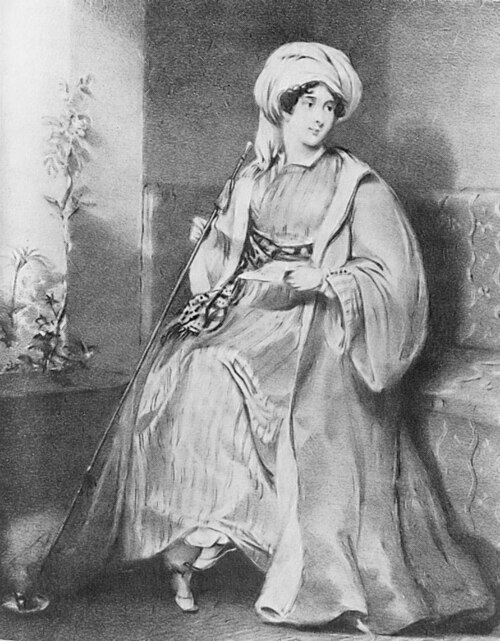
In 1813 while they were in Syria Hester's lover went back to England
when his father cracked the whip. A year later Hester was back in
Lebanon, alone, settling into a house in the hills behind Sidon and
later moving deeper into the hills to a ruin at Dar Jun. Where she
rebuilt, refurbished, set out a garden, and, surrounded by her thirty
cats, servants, and slaves, held lavish court for visiting European and
local bigwigs. Gradually her debts grew unmanageable. Finally, when her
pension back home was diverted to pay the creditors, Hester wrote a
complaining letter to Queen Victoria, took to her bed, and died.
In 1816 one of Hester's more eccentric visitors was William Bankes. Who
dressed like an Arab, sported a bushy beard, and stayed with Hester for
three weeks before leaving after an argument.
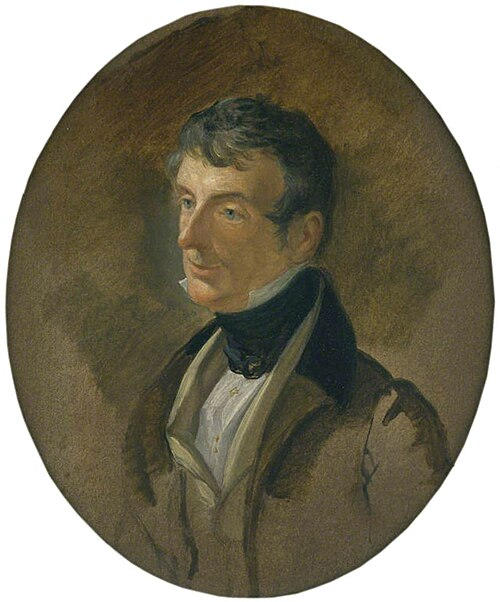
At the time Bankes (recently rich from an inheritance) was on his first trip around the
Middle East "collecting" antiques, sketching, writing reams of
descriptive scribble, drawing maps, and copying hieroglyphs. On his
second trip, in 1818 (financed by an even bigger inheritance), Bankes
excavated, "collected," even more Egyptian bits, and barged back to
England an obelisk, which he erected on his estate at Kingston Lacy,
Dorset, in front of the house (the Duke of Wellington lent a gun carriage). The Greek and Egyptian hieroglyphic inscriptions on the obelisk played a role in the decipherment of ancient Egyptian hieroglyphs (a sort of second Rosetta Stone, though he did not get on with Champollion).
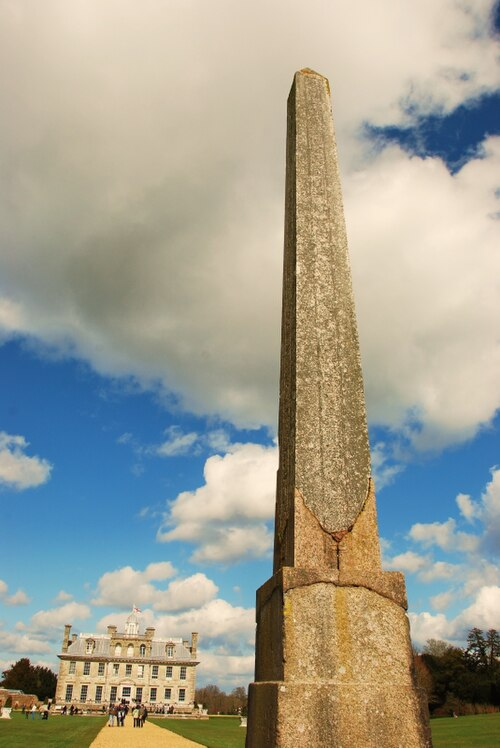
Kingston Lacy was a modest brick residence that
Bankes was now able to afford to upgrade (after yet another inheritance)
with the help of a young English architect he'd met in Syria and who was
now doing home-improvement jobs for the gentry. In 1835 Charles Barry
encased Kingston Lacy in stone and called it "Italianate."
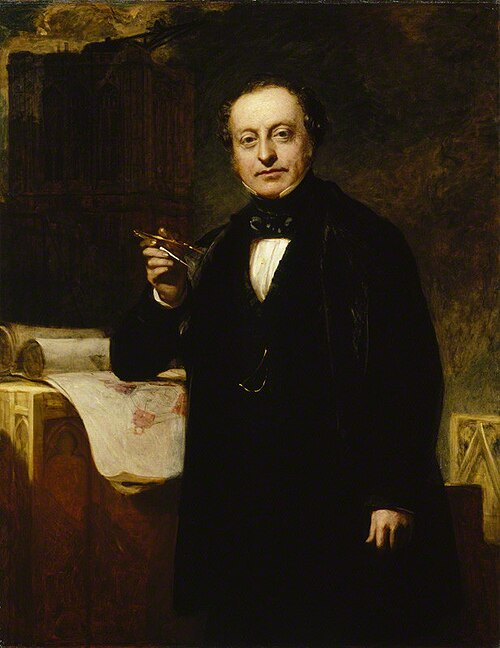
Barry was on the verge of greatness. The previous year he'd watched the
Houses of Parliament become a smoldering heap of ashes and was now
waiting to hear who was going to get the rebuilding job. He did. And it
took him the rest of his life.
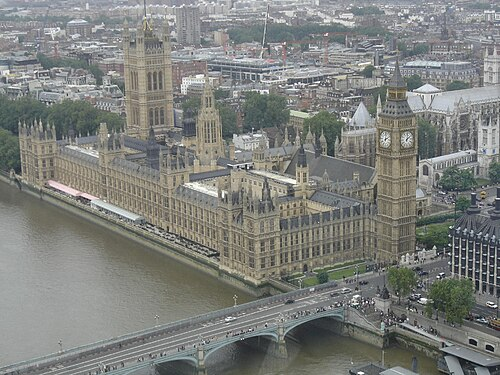
Barry's coworker on what is perhaps the
most famous piece of pseudo in architectural history was A. W. N. Pugin,
who in 1841 got so caught up in Gothic he wrote The True Principles of
Pointed or Christian Architecture, all about how medieval
buildings were good for you and we all needed more of them.
At the end of Pugin's life, in February 1852, Barry visited him in Ramsgate and Pugin supplied a detailed design for the iconic Palace clock tower, in 2012 dubbed the Elizabeth Tower but popularly known as Big Ben. The design is very close to earlier designs by Pugin. The tower was Pugin's last design before descending into madness.
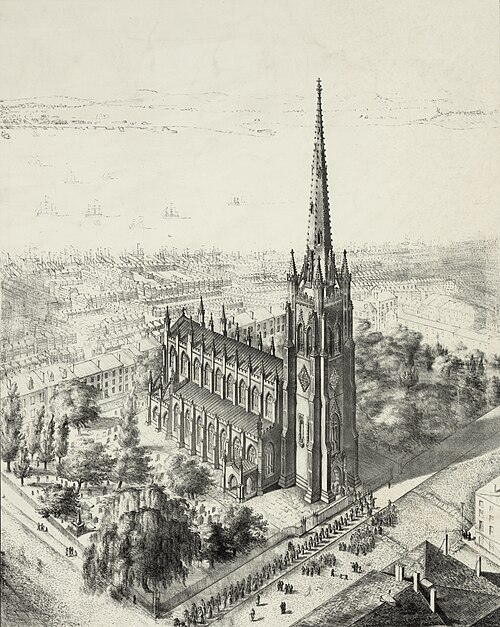
Pugin's ideas were music to the ears of a new young immigrant in New York. In a country short of architects, cabinetmaker Richard Upjohn drew houses so well
people asked him to build for them. He eventually produced a how-to book
of church designs, which was copied all over the country as far west as
Wisconsin. In New York he entirely rebuilt Trinity Church in Pugin's
style, and when it was finished in 1846 it kicked off the American
Gothic Revival.
Trinity Church held the title of tallest building in the United States until 1869, when it was surpassed by St. Michael's Church, Old Town, Chicago. Trinity continued to be the tallest in New York City, with its 281-foot (86 m) spire and cross, until it was surpassed in 1890 by the New York World Building.[19]^ Following the September 11 attacks, Trinity organized respite services at St. Paul's Chapel for first responders and volunteers at Ground Zero.
While Church fathers regarded Gothic Revival as the bee's knees, not so much
sculptor Horatio Greenough, who thought it was dreadful and said
so. He might have been having a bad day, since much the same remarks had
been recently passed regarding his own monumental statue of George
Washington. Intended for the new Capitol Rotunda, it showed G.W. naked
with a cloak over his knees and pointing to the sky. Critics made noises
about "getting into the bath."
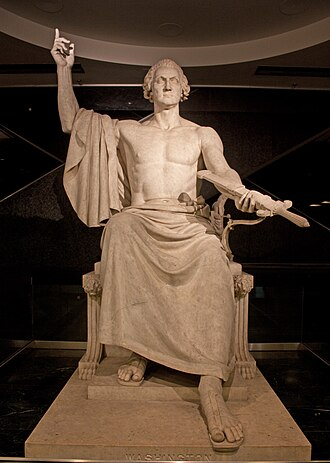
Then the statue turned out too heavy and
became the target of pigeons outside for sixty years. Ended up in the
Smithsonian. Greenough's other customers seemed happy enough with his
"portrait busts" of such as Adams, Lafayette, Fenimore Cooper, and Sam
From 1861 on, when Morse wasn't inventing the telegraph or being a
professor of design or the American agent for Daguerre's new camera, he
was on the charter board of Vassar College. Matthew Vassar was a very
successful brewer with interests in banking, whaling, and other
enterprises in Poughkeepsie (yet another Huguenot). In September 1824, he was among those welcoming the Marquis de Lafayette to Poughkeepsie on the occasion of the General's visit to the United States.[2]^
He decided to do something philanthropic with his money and after seven years' planning got the go-ahead for a women's college.
The project benefited from the attentions of a major
promoter of women's causes, Sarah J. Hale, editor of Godey's Lady's
Magazine, in which she agitated (among many other causes) for
the completion of the Bunker Hill Monument, raising $30,000
at a weeklong fair that sold handmade jewelry, quilts, baskets, jams, jellies, cakes, pies, and autographed letters from Washington, James Madison, and the Marquis de Lafayette.[42][43]^ Hale "made sure the 221-foot obelisk that commemorates the battle of Bunker Hill got built."[42]^
She also supported Liberian colonization, the
renovation of Mount Vernon, the end of tight lacing in women's dress,
and the use of anesthetic during childbirth. She also worked for seventeen years to establish the Thankgsgiving holiday (largely unknown in the South). In support of the proposed national holiday, Hale wrote presidents Zachary Taylor, Millard Fillmore, Franklin Pierce, James Buchanan, and Abraham Lincoln. Her initial letters failed to persuade, but the letter she wrote to Lincoln convinced him to support legislation establishing a national holiday of Thanksgiving in 1863,[32]^ considered a unifying day after the stress of the Civil War.[33]
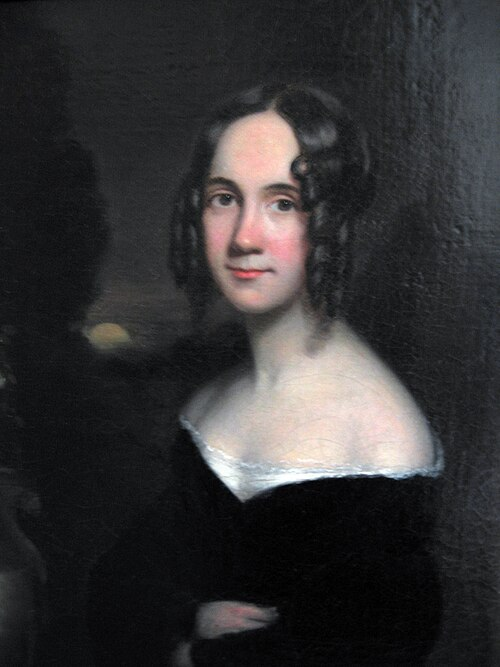
Sarah also made Matthew drop the "Female" from the college name. And she
made sure the faculty included women. So when Vassar opened in 1865
Maria Mitchell was the first female professor of astronomy in America.
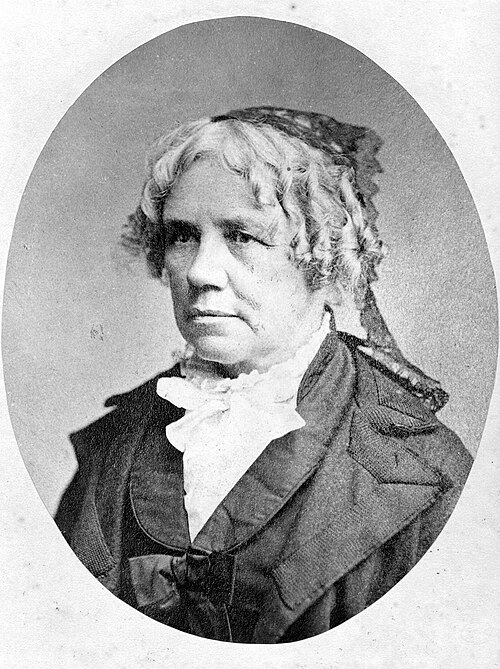
Maria Mitchell was born on August 1, 1818, on the island of Nantucket, Massachusetts, to Lydia Coleman Mitchell, a library worker, and William Mitchell, a schoolteacher and amateur astronomer.[7]Additionally, Nantucket's importance as a whaling port meant that wives of sailors were left for months, sometimes years, to manage affairs at home while their husbands were at sea, thus fostering an atmosphere of relative independence and equality for the women of the island.[11]^ At her home on Nantucket, she entertained a number of prominent academics such as Ralph Waldo Emerson, Herman Melville, Frederick Douglass, and Sojourner Truth.[5][30]^
Mitchell traveled to Europe in 1857. While abroad, Mitchell toured the observatories of contemporary European astronomers Sir John and Caroline Herschel and Mary Somerville.[6]^ She also spoke with a number of natural philosophers including Alexander von Humboldt, William Whewell, and Adam Sedgewick before continuing her travels with Nathaniel Hawthorne and his family.[6]^ Mitchell never married, but remained close to her immediate family.
A self-taught amateur (higher education wasn't available to women at the
time), Mitchell was a formidable woman, active in promoting women's
education, organizing Women's Clubs all over the country, the first woman
member of the American Academy of Arts and Sciences in 1850 (and befriended many of its members, including the director of the Smithsonian Institution, Joseph Henry )
and she was the discoverer of a comet ("Miss Mitchell's Comet"). Mitchell was celebrated at the Seneca Falls Convention for the discovery and calculation later that year.[23]^
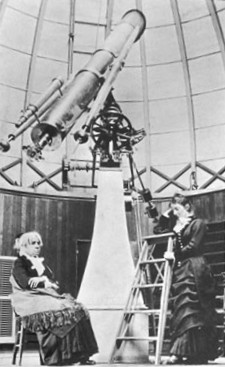
And her students loved her. One of the stars to come out of the department soon after Mitchell's retirement in 1888 was Phoebe Waterman, who went on to become one of the
first two women to take a Ph.D. at Berkeley.
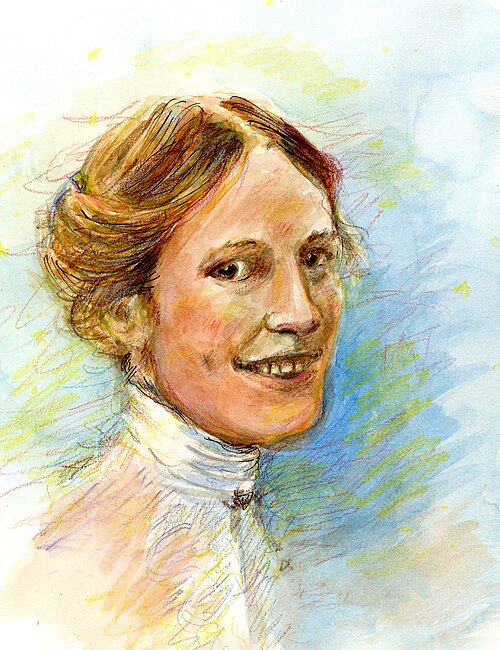
In 1913 Phoebe was offered a job at the National Observatory in Cordova, Argentina, and boarded ship for Buenos Aires. After an on-board romance she returned to the
United States almost immediately and a year later was married to chemist
Otto Haas. When the two met, Haas had been heading for South America
with some of his firm's new product. Haas and his partner Otto Rohm ran
a chemical company. Later, in 1920, Rohm returned to the subject of his
German doctorate (acrylic chemistry) and developed polymethyl
methacrylate (PMMA). Which by 1936 was on the market as "Plexiglas."
By the 1950s PMMA was being used as a mold (key attribute: it didn't
stick) by surgeons making templates for pieces of a person's bone they
were going to replace with prostheses. By 2002 the Zimmer Corporation
was using PMMA to service the orthopedic market and giving five hundred
thousand dollars to the education and outreach program of the American
Orthopedic Foot and Ankle Society.
In 2005 one of the society's major figures was orthopedic surgeon EDWARD
RUTLEDGE.