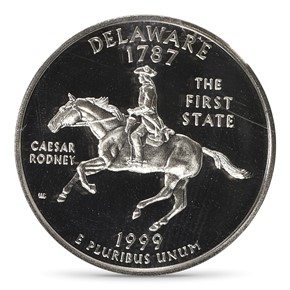
Rodney, Caesar
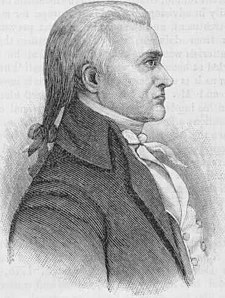
20th-century image; no contemporary portrait exists.[1]
Caesar Rodney (October 7, 1728 – June 26, 1784)[2] was an American Founding Father, lawyer, and politician from St. Jones Neck in Dover Hundred, Kent County, Delaware.
He was an officer of the Delaware militia during the French and Indian War and the American Revolutionary War, a Continental Congressman from Delaware, a signer of the Continental Association and Declaration of Independence, and president of Delaware during most of the American Revolution.
Rodney family and early years
See also: Rodney family of Delaware
 Coat of Arms of Caesar Rodney
Rodney was born on October 7, 1728, on his family's plantation, "Byfield", on St. Jones Neck in East Dover Hundred, Kent County, Delaware. Caesar was the eldest son of 2 children of Caesar and Elizabeth Crawford Rodney and grandson of William Rodney. William Rodney emigrated to the American colonies in 1681–82, along with William Penn,[3] and was speaker of the Colonial Assembly of the Delaware Counties in 1704.[3][4]
Rodney's mother was the daughter of the Rev. Thomas Crawford, Anglican rector of Christ Church at Dover.[3] Among the Rodney family ancestors were the prominent Adelmare family in Treviso, Italy,[5] as attested by genealogy studies.[6]
Byfield was an 849-acre farm worked by over 200 slaves.[7] The Rodneys were, by the standards of the day, prosperous members of the local gentry. At Rodney's death, he owned 15 slaves, which he freed on varying schedules due to age;[8] it earned sufficient income from the sale of wheat and barley to the Philadelphia and West Indies markets to provide enough cash and leisure to allow members of the family to participate in the social and political life of Kent County.[3]
Caesar was educated when he was 13 or 14 years old. He attended The Latin School, part of the academy and the College of Philadelphia (now known as University of Pennsylvania) in Philadelphia, Pennsylvania[9] until his father's death. Caesar was the only one of the Rodney children to receive anything approaching a formal education.[10] Caesar Rodney's father died in 1746, and Caesar's guardianship was entrusted to Delaware Supreme Court Justice Nicholas Ridgely by the Delaware Orphan's Court.[3]
Professional and political career
Thomas Rodney described his brother at this time as having a "great fund of wit and humor of the pleasing kind, so that his conversation was always bright and strong and conducted by wisdom..."[10] He lived as a bachelor, was generally esteemed and was indeed very popular. He had professed his love and affection for several Delaware ladies at various times but was never a successful suitor.[3] Accordingly, he easily moved into the political world formerly occupied by his father and guardian.
At age twenty-seven in 1755, he was elected sheriff of Kent County and served the maximum three years allowed.[3] This was a powerful and financially rewarding position, in that it supervised elections and chose the grand jurors who set the county tax rate.
After serving his three years, he was appointed to a series of positions including Register of Wills, Recorder of Deeds, Clerk of the Orphan's Court, Justice of the Peace, and judge in the lower courts. During the French and Indian War, he was commissioned captain of the Dover Hundred company in Col. John Vining's regiment of the Delaware militia.[11] They never saw active service. From 1769 through 1777, he was an associate justice of the Supreme Court of the Lower Counties.
Eighteenth-century Delaware was politically divided into loose factions known as the "Court Party" and the "Country Party."[11] The majority Court Party was generally Anglican, strongest in Kent and Sussex Counties, worked well with the colonial proprietary government, and was in favor of reconciliation with the British government.
The minority Country Party was largely Ulster-Scot, centered in New Castle County, and quickly advocated independence from the British. In spite of being members of the Anglican Kent County gentry, Rodney and his brother Thomas increasingly aligned themselves with the Country Party, a distinct minority in Kent County.[11] As such, he generally worked in partnership with Thomas McKean from New Castle County and in opposition to George Read.
American Revolution
Rodney joined McKean as a delegate to the Stamp Act Congress in 1765 and was a leader of the Delaware Committee of Correspondence.[12] He began his service in the Assembly of Delaware in the 1761/62 session and continued in office through the 1775/76 session. Several times he served as speaker, including the momentous day of June 15, 1776, when "with Rodney in the chair and Thomas McKean leading the debate on the floor," the Assembly of Delaware voted to sever all ties with the British Parliament and King.[13]
[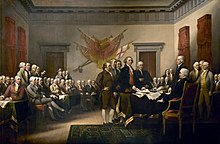
Declaration of Independence, by John Trumbull (1818) portrays the presentation of the Declaration of Independence to Congress. Rodney is not depicted.[14]
Rodney served in the Continental Congress along with McKean and Read from 1774 through 1776.[3] Rodney was in Dover tending to Loyalist activity in Sussex County when he received word from McKean that he and Read were deadlocked on the vote for independence. To break the deadlock, Rodney rode 70 miles through a thunderstorm on the night of July 1, 1776, arriving in Philadelphia "in his boots and spurs" on July 2, just as the voting had begun.[13]
He voted with McKean and thereby allowed Delaware to join eleven other states in voting in favor of the resolution of independence. The wording of the Declaration of Independence was approved two days later; Rodney signed it on August 2. Backlash in Delaware led to Rodney's electoral defeat in Kent County for a seat in the upcoming Delaware Constitutional Convention and the new Delaware General Assembly.[13][15]
 Equestrian statue of Caesar Rodney on Rodney Square. (Removed from its pedestal at least temporarily on June 12, 2020. Location currently unknown.)[16][17]
Upon learning of the death of his friend John Haslet at the Battle of Princeton, Rodney rushed to the Continental Army to try to fill his place. Haslet was succeeded as colonel by David Hall as General George Washington returned Rodney home to be Delaware's wartime governor and major-general of Delaware militia. The regiment Haslet had built was virtually destroyed at the Battle of Camden in 1780.[18] Rodney, as major-general of the Delaware militia, protected the state from British military intrusions and controlled continued Loyalist activity, particularly in Sussex County, site of the 1780 Black Camp Rebellion.
Amidst the catastrophic events following the Battle of Brandywine and the British occupation of Wilmington and Philadelphia, a new General Assembly was elected in October 1777. First, it promptly put Rodney and McKean back into the Continental Congress. Then, with state President John McKinly in captivity and President George Read completely exhausted, they elected Rodney as President of Delaware on March 31, 1778. The office did not have the authority of a modern governor in the United States, so Rodney's success came from his popularity with the General Assembly, where the real authority lay, and from the loyalty of the Delaware militia, which was the only means of enforcing that authority.
Meanwhile, Rodney scoured the state for money, supplies and soldiers to support the national war effort. Delaware Continentals had fought well in many battles from the Battle of Long Island to the Battle of Monmouth, but in 1780 the army suffered its worst defeat at the Battle of Camden in South Carolina. The regiment was nearly destroyed and the remnant was so reduced it could only fight with a Maryland regiment for the remainder of the war. Rodney had done much to stabilize the situation, but his health was worsening, and he resigned his office on November 6, 1781, just after the conclusive Battle of Yorktown.
Rodney was elected by the Delaware General Assembly to the United States Congress under the Articles of Confederation in 1782 and 1783 but was unable to attend because of ill health. However, two years after leaving the state presidency he was elected to the 1783/84 session of the Legislative Council and, as a final gesture of respect, the council selected him to be their speaker. His health was now in rapid decline and even though the Legislative Council met at his home for a short time, he died before the session ended....
...No portrait of Caesar Rodney exists. We know that he was tormented throughout his life by asthma, and that his adult years were plagued by a facial cancer. He experienced expensive, painful, and futile medical treatments on the cancer. The clearest account of his appearance is found in John Adams’s diary of September 1774: “Saturday . . . this forenoon Mr. Caesar Rodney of the lower counties on Delaware River, was introduced to us. Caesar Rodney is the oddest-looking man in the world; he is tall, thin, and slender as a reed, pale; his face is not bigger than a large apple, yet there is sense and fire, spirit, wit and humor in his countenance.”
Caesar never married and left no children. We know he professed his love and affection for several Delaware ladies at various times, but was never a successful suitor. It is likely that he accepted these disappointments and put his energy into becoming the single most valuable and productive Delaware citizen....
The apex of Caesar Rodney’s service to his state occurred in the spring of 1776. He, along with Thomas McKean and George Read, were the three Delaware delegates to the Continental Congress. The explosive issue of actual independence was the question of the hour.
On June 7, Richard Henry Lee of Virginia introduced a brief thunderbolt of a resolution: “Resolved, that these United Colonies are, and of right ought to be free and independent states . . .” The awesome consequence of this to the country, and the lives and fortunes of these delegates can hardly be overstated. The entire Congress was potentially placing their necks in a British noose, and the future of the Colonies at mortal risk.
The discussion of the Resolution occupied several contentious weeks. Unanimous agreement eluded its supporters, and a recess was declared. On June 15, 1776, the Delaware Assembly released their three divided delegates to vote their individual judgment in Philadelphia. The Congress reconvened on July 1, 1776.
However, Caesar Rodney was in Delaware dealing with militia creation and Tory problems. The Delaware vote on independence was deadlocked with McKean “for” and Read “against.” A dramatic story began to unfold. McKean sent a courier to Caesar Rodney advising him of the deadlock, and Caesar Rodney immediately left for Philadelphia, either on horseback (as depicted in the epic statue on Rodney Square in Wilmington Delaware) or by carriage, as his brother Thomas’s letter states.
Riding all night in a torrential rainstorm, he arrived at Independence Hall on July 2, 1776 muddy, wet, and fatigued but “booted and spurred”, and seriously ill. The eighty-mile trip had consumed eighteen hours, and much of his vitality. He was strong enough to break the Delaware tie and vote for independence, adding Delaware to the successful vote that day, and the eventual unanimous vote later in July. Shortly thereafter, all three Delaware delegates signed the Declaration of Independence.
Rodney’s own account of his dramatic ride and the Declaration of Independence is contained in a letter he wrote to his brother Thomas, which reads in part:
“I arrived in Congress (tho detained by thunder and rain) time enough to give my voice in the matter of independence . . . We have now got through the whole of the declaration and ordered it to be printed so that you will soon have the pleasure of seeing it.”...
Rodney left most of his real estate to his nephew, Caesar Augustus Rodney. It also provided for the gradual emancipation of his 200 slaves....
Caesar Rodney | Descendants of the Signers of the Declaration of Independence
American Connections
CAESAR RODNEY (DE) was forty-seven. And loaded.
And by the time of Independence, deep into the murky waters of local
Delaware politics. On July 1 he was in South Delaware on antiloyalist
business when he heard from a colleague in Philadelphia that the third
Delaware delegate (of three) was going to vote against the Declaration
and that Rodney had to get there fast to tip the balance. Riding all
night through thunderstorms, he arrived on July 2 just in time for the
vote. Never mind Paul Revere.
Rodney's younger brother Thomas was equally busy throughout the war as a
militiaman and member of Congress. In 1803 Jefferson made him U.S. judge
for the Mississippi Territory, and he moved to middle-of-nowhere
Natchez.
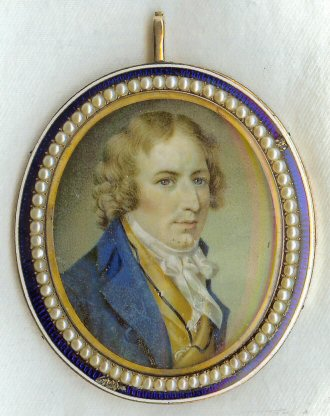
Where he met the extraordinary Harman Blennerhassett, a tall,
stooping, shortsighted Irish aristo who, having incestuously married his
young niece and scandalized the local Irish upper crust, was obliged to
leave for America. He was also on the run because of his association with the secret Society of United Irishmen (rebellion of 1798, led by Wolfe Tone, Napoleon demurred).
Where he bought an island in the Ohio River near Parkersburg (later polluted by Dupont with "forever chemicals") and spent most of his money building a great mansion with library, landscaped gardens, and a music room where he played the
violin. In this other Eden the Blenerhassetts put on Shakespeare plays
and entertained anybody who turned up.
In May 1805 one such turner (in more senses than one) was recent
ex-vice president of the U.S. Aaron Burr. Who came to dinner and blew
away Blennerhassett with tales of a Mexican empire, to be grabbed from
Spain and which would include the (newly American) Louisiana Territory.
Burr would be emperor and Blennerhassett would be involved in some
well-paid capacity. Fellow plotter in this hugger-mugger was James
Wilkinson, general of the American armies and governor of Upper
Louisiana. And double agent for the Spaniards. Blennerhassett started
recruiting soldiers and building boats.
In 1806 Wilkinson got cold feet and told President Jefferson (almost)
everything. Jefferson ordered troops to find Burr and Blennerhasset.
They did. In 1807 at the trial for treason in Richmond, Virginia, the
case was dismissed for lack of evidence. At the same time without
Jefferson's knowledge Wilkinson had already sent a spy into Spanish
territory. Lieutenant Zebulon Pike had no idea what Wilkinson was up to
but his reconnaisance mission was supposedly to check out what the
Spaniards were doing on the southwest border of Louisiana and tell
Wilkinson.
Pike headed west and ended up on the Rio Grande, where he was jumped by
the Spaniards (who it turned out had been advance-warned by Wilkinson)
and escorted back to American territory. By this time Wilkinson was on
trial, so Pike had nobody to brief on his trip. Pike's interpreter on
the expedition had been Antoine Vasquez, whose brother worked for Manuel
Lisa, one of the heroic figures of the early fur-trapping days. Lisa was
a general merchant in St. Louis (flea-pit, sewage in the streets)
selling everything from guns to chamber pots to such as explorers Lewis
In 1811 a competitor arrived on the scene. W. P. Hunt had been hired by
New York financier John Jacob Astor to travel to the mouth of the
Columbia River in Orgeon where Astor wanted to set up a fur-trading
colony. Lisa was worried that Hunt would gate-crash his market and
chased after him. Starting three weeks and 240 miles behind Hunt, Lisa
plunged into one of the greatest keelboat chases in American history. He
caught up with Hunt on June 11, the two men sorted things out, Hunt
headed on for Oregon, and Lisa started back for St. Louis with Hunt's
two English botanists.
One of whom, John Bradbury, sent all his specimens back home when he got
to St. Louis. Some of the plants ended up with Aylmer Burke Lambert, a
chaotic botanizer who exasperated his colleagues because typically he'd
heap together collections of dried plants and then leave them
uncatalogued (though a pal of Joseph Banks, and member of the Royal Society).
Lambert's real passion was prehistoric English burial
mounds, which he excavated with his lifelong pal William Cunnington, the
first proper archeologist. Cunnington opened over 450 funeral chambers
and found bones and gold in almost every one. His careful scraping and
cataloguing also revealed fossils, which he sent to William "Strata"
Smith with notes on depth, distribution, etc. (See The Map that Changed the World, a biography of Smith by Simon Winchester).
By this time surveyor Smith was all over Britain digging holes and
telling people (from the fossils he came across) whether they would find
iron, coal, or clay. In an industrializing, raw-materials-hungry time,
Smith's was a valuable skill. He also identified the best routes for
canal builders. And produced the first stratigraphic geological map of
Great Britain, initially pooh-poohed by academics but belatedly
recognized, as was Smith. In 1838 he was invited to join a government
stone-hunting commission.
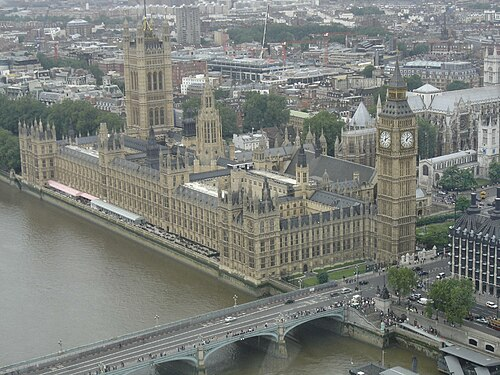
The stone was needed for the greatest building project of the British
nineteenth century: the new British Houses of Parliament (the old ones
had burned down in 1834). Out of fourteen hundred design submissions
from ninety-seven architects, the winner was Charles Barry, already busy
on public buildings such as the Reform Club and also able to turn
anybody's ancentral home into Renaissance, Egyptian, Classical, or
Arabesque.
The government had decided that the new Parliament building should be
Gothic. The resultant fake-medieval extravaganza by Barry kicked off the
entire Gothic Revival. But if the ornate scrollwork of Parliament's
exterior caused eyestrain, the real excesses were to be found inside.
Interior decorator Frederick Crace's firm was the one-stop shop for all
social climbers (to whom he sold heraldic wallpaper), and in the Houses
of Parliament Crace gave new meaning to "over the top," swamping the
place in curlicue woodwork, gilding by the bucketful, lush canopies,
silk walls, flowery carpets, heraldic escutcheons on walls, green-gold
brocades, and swags and tassles with everything. The place became (and
still is) excess-with-umbrella-stands.
Crace also did the royal interiors at Windsor and Buckingham Palace,
including a "Gothic" bedroom for Prince Albert. The mind boggles. In
1852 Crace also founded the Photographic Society. Fellow member was a
snake-oil type who had recently opened a photographic studio in London.
Jabez Meal had spent several years in Philadelphia learning the trade
and calling himself "Professor Highschool." Back in 1847 London he
changed his name to John Edward Mayall, set up the American
Daguerreotype Institution, and encouraged everybody (including Queen
Victoria) to think he was American.
In 1847 Mayall photographed a seventy-three-year-old man he took to be a
judge. It was J. M. W. Turner, the most famous painter of the day, who
quizzed Mayall about the rainbow effect in Mayall's photo of Niagara.
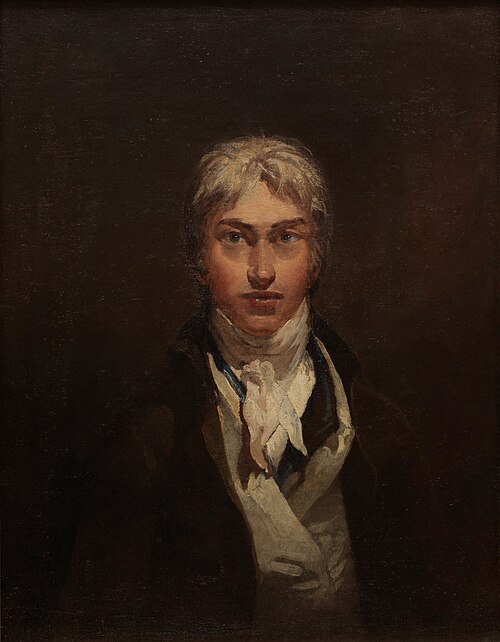
Turner was either idolized for his dazzling modernist color poems or
reviled for the same reason. In over fifty years of work he traveled
constantly, sketching and painting prolifically for exhibitions and book
illustrations (for poems, Bibles, travel books, and the never-ending
"Views of..." ) Today the collection of (only some of ) Turner's work at
the Tate Gallery in London totals three hundred oils and nineteen
thousand watercolors and sketches. And the erotica long thought to have
been burned by his admirer and friend John Ruskin.
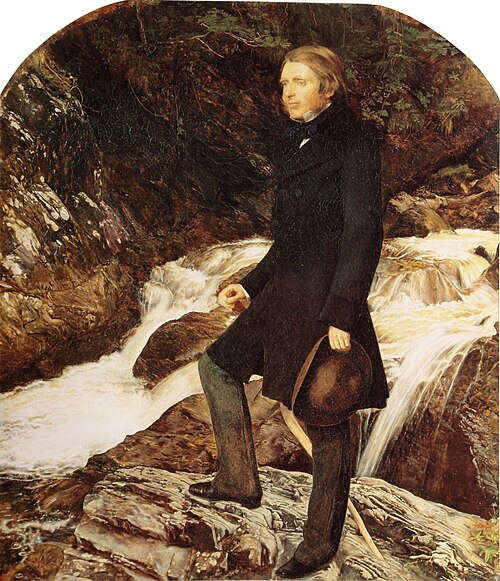
Who had first met Turner in 1840 because his father had been one of
Turner's early patrons. The twenty-one-year-old John had just left
Oxford for reasons of ill health and soon afterward headed for the
Continent to recover. In 1842 he read some of the attacks on Turner and
decided to defend the painter in his major multi-volume Modern
Painters. In which Ruskin began to develop a theory of art and
imagination that moved away from the Romantic view. He also started
writing acerbic art reviews that frightened everybody.
In 1851 Venice he began his greatest work: The Stones of
Venice, a full-blown reassessment of the Renaissance and a
revival of the long-ignored Byzantine and Gothic. The book woke up the
entire literary and artistic community and made Ruskin famous. Result:
In the later 1850s he met and became cheerleader for the new
Pre-Raphaelite painters (Rossetti, Holman Hunt, Burne-Jones, and
Millais) and encouraged rich friends to commission their work. One of
these well-heeled buyers was a new American friend, Boston Brahmin
And this is good old Boston,
The home of the bean and the cod,
Where the Lowells talk only to Cabots,
And the Cabots talk only to God.
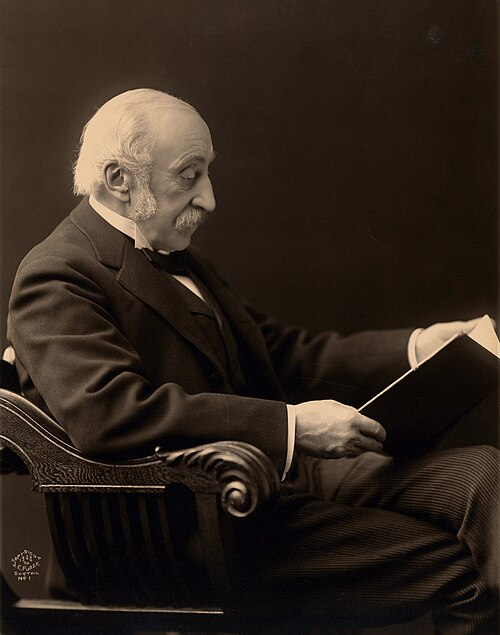
After a quick visit to India for the family business (and a look around
at the culture) in 1850 Norton began twenty years of one-night stands
around Europe, using his family contacts to meet English scientists,
French painters, Scots aristos, even Swiss peasants. He learned Italian.
Then came essays on Coleridge, Native American burial practices, and
politics for the North American Review (with a Lowell) , and eventually his own
mag, The Nation (with Olmsted and William James, among others; Teddy Roosevelt and Twain were fans). His essays continued eclectic: everything from the Vatican Council to the English class system and the *Rubaiyat of Omar Kayyam ("the Astronomer-Poet of Persia" see Arab Astronomy), from the time of First Crusade). By 1874 Norton was Harvard (and the first U.S.) professor of art history.
Shortly thereafter Ralph Waldo Emerson, one of Norton's fellow members
at the snooty Saturday Club, gave a Shakespeare lecture in nearby
Amherst and changed the life of Henry Folger head of Rockefeller's Standard Oil ( He was a first cousin six times removed of Benjamin Franklin and a nephew of J. A. Folger, the founder of Folger Coffee). Folger was so inspired by
Emerson's talk he dedicated his life to setting up the world's biggest
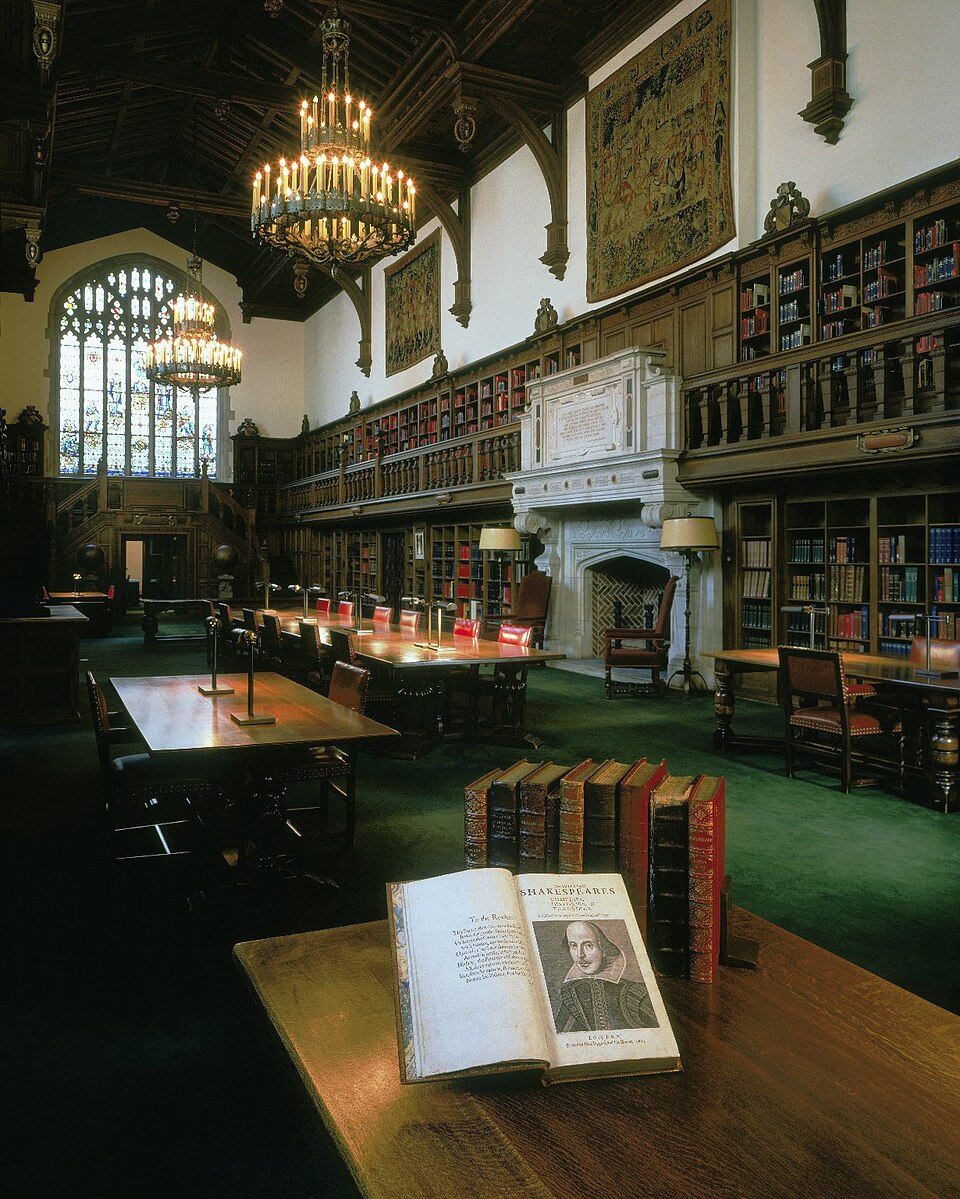
collection of Shakespeariana, and when the Folger Shakespeare Library
finally opened in 1932 it held seventy-nine of the 240 extant
first-folio copies of Shakespeare. And scads of associated period stuff.
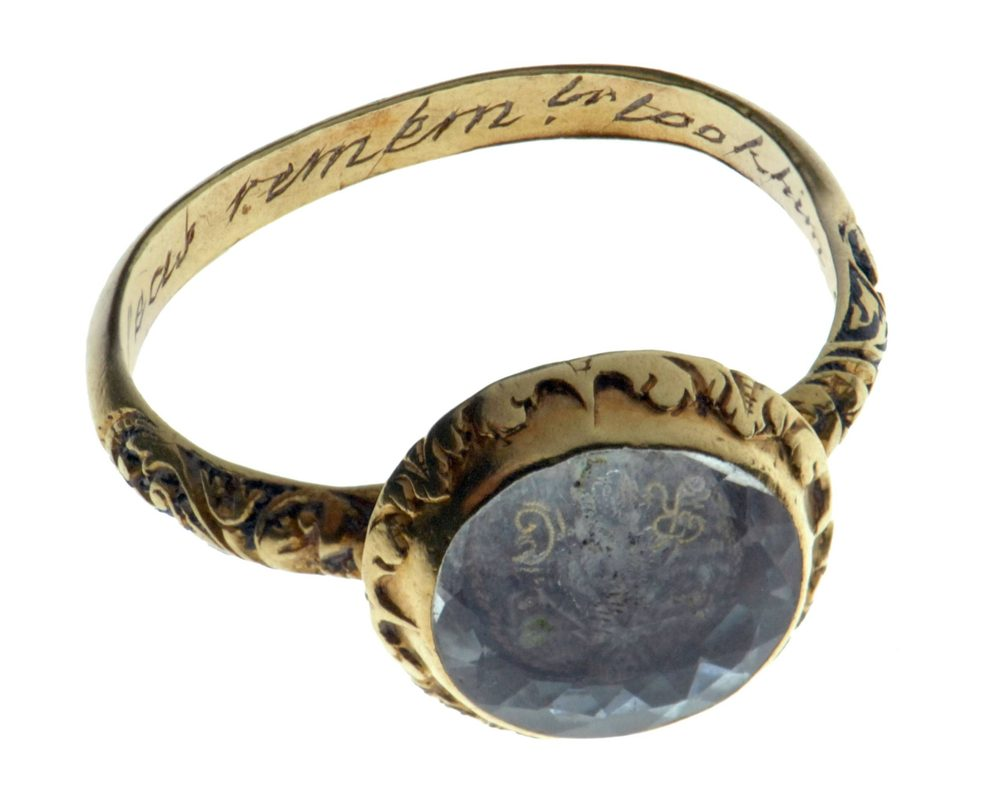
Mourning ring inscribed "The Cruell seas remembr. took him in Novembr. 92"]
Needless to say, Folger wasn't a fan of Elizabeth Gallup, who in 1899
wrote her first book about how Shakespeare wasn't Shakespeare but
Francis Bacon ( Her decipherments also "discovered" that Bacon was the son of Queen Elizabeth, heir to the throne, and the author of the works of Christopher Marlowe, George Peele, and Robert Burton). By 1916 when she was deeply into decoding the cryptograms she had "discovered" in the Shakespearean texts and was revealing more
extraordinary "facts" about the Bard and Bacon, Elizabeth was assisted
briefly by Elezebeth Smith, who subsequently interested fellow
researcher William Friedman in her deciphering work. And then married
him. During Prohibition bootleggers used encrypted Morse Code, which they broke. One of the individuals Friedman helped to indict was Al Capone.[4]
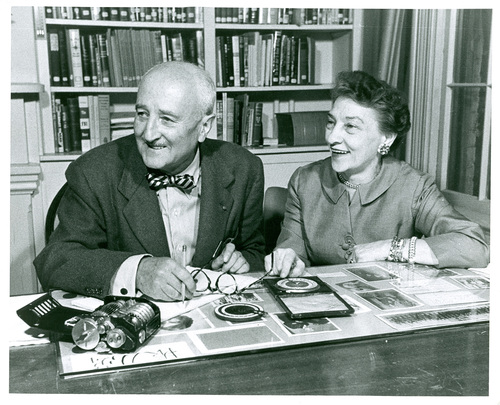
The Friedmans went on to become America's top cryptographers, and in
1939 William's group of codebreakers cracked the secret of the Japanese
PURPLE encoding machine. In 1941 an American cypher team visited their
Brit counterparts at the Bletchley Park cypher research center, where
they exchanged one of their copies of the Japanese machine for the
design of the German Enigma, which had just been decoded by the team in
Bletchley's Hut 8.
One of the Hut 8 geeks was Hugh Alexander, Turing's number two, British chess champion and stamp collector. After the war Alexander returned to his job as head of
research for the John Lewis department store in London. One of his
colleagues there, a department chief named Rudolf Bing, was an Austrian
immigrant who had managed the Glyndebourne Opera until World War II
closed it. In 1945 Bing suggested a new world-class festival to make up
for the (temporary, postwar) loss of Salzburg. In 1947 Bing directed the
first Edinburgh festival. His top-down style clashed with the amateur DIY hippie insurgents.
College troupes like the Cambridge Footlights and the Oxford Revue regularly staged shows, with future stars like John Cleese, Michael Palin, Emma Thompson, Stephen Fry and Hugh Laurie cutting their teeth before rising to global fame.
In 1971, audiences might have caught Robin Williams playing the servant Traino in a Wild West reimagining of Shakespeare’s “The Taming of the Shrew.
Tom Stoppard’s breakout play “Rosencrantz and Guildenstern Are Dead,” an absurdist take on two minor messenger characters in William Shakespeare’s “Hamlet,” debuted at the Fringe in 1966 before conquering London and Broadway. And the Tony-winning musical “SIX” (2017), which reimagines the ill-fated wives of England’s Henry VIII as an all-girl pop group, used the Fringe as its launchpad to the West End.
By 1997 the Edinburgh event welcomed hundreds of performances by
amateurs, that year including the American Theater High School Festival.
For which an American school group performed the play The Night Thoreau
Spent in Jail, directed by their art drama teacher Eddy Seager.
In 1998 Seager taught art at Seger, taught at art at Caesar Rodney High School in Camden, DE; he inspired the design that won the competition for a new U.S. quarter. It
became known as the Delaware Quarter. Seager's design featured a man
riding a horse.
The rider was CAESAR RODNEY.