Wolcott, Oliver
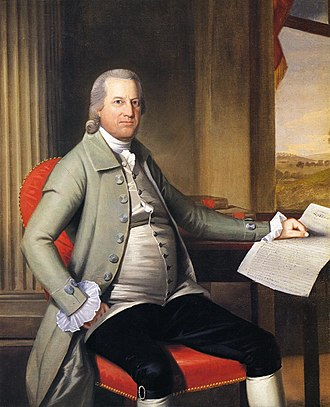
Oliver Wolcott Sr. (/ˈwʊlkət/ *WUUL-kət*; November 20, 1726 – December 1, 1797) was an American Founding Father and politician. He was a signer of the United States Declaration of Independence and the Articles of Confederation as a representative of Connecticut, and the nineteenth governor of Connecticut. Wolcott was a major general for the Connecticut militia in the Revolutionary War serving under George Washington.[1]
Early life
 Coat of Arms of Oliver Wolcott Sr.
Wolcott was born in Windsor, Connecticut, the youngest of 10 children born to colonial Governor Roger Wolcott and Sarah Drake Wolcott. His elder brother was Erastus Wolcott. He attended Yale College, graduating in 1747 as the top scholar in his class.[2] Upon graduation, New York Governor George Clinton granted Wolcott a captain's commission to raise a militia company to fight in the French and Indian Wars (King George's War (1744–1748)).[3]
Captain Wolcott served on the northern frontier defending the Canadian border against the French until the Treaty of Aix-la-Chapelle of 1748.[3][4][5] He then moved to newly settled Goshen in northwestern Connecticut to practice and study medicine with his brother Alexander.[3] He then moved to Litchfield and became a merchant; he was appointed sheriff of the newly created Litchfield County, Connecticut, serving from 1751 to 1771. He married Lorraine (Laura) Collins of Guilford, Connecticut, on January 21, 1755.[6] They had five children: Oliver (who died young), Oliver Jr., Laura, Mariann, and Frederick.
Career
American Revolutionary War
Wolcott had two careers during the war years as one of Connecticut's principal delegates to the Continental Congress and also a militia officer.[7] He participated in the American Revolutionary War as brigadier general and then as major general in the Connecticut militia. As a representative in the Continental Congress, he was a strong advocate for independence.
Early in the growing struggle with Great Britain, Wolcott made it clear that the colonists would not give up their rights and privileges.[8] In February 1776, he stated: "Our difference with Great Britain has become very great. What matters will issue in, I cannot say, but perhaps in a total disseverance from Great Britain."[9] The early support for independence led him to important roles during the war, both as military leader and as member of the Continental Congress.
Wolcott saw extensive militia service during the American Revolution. On August 11, 1776, Connecticut officials ordered him to march the Seventeenth Regiment of militia to New York and join George Washington's army. Upon arriving at Washington's camp, Connecticut Governor Jonathan Trumbull appointed Wolcott brigadier general in command of all the state's militia regiments in New York. He led 300 to 400 volunteers from his brigade to help General Horatio Gates and Benedict Arnold defeat General John Burgoyne at the Battles of Saratoga.[10]
In May 1779, Wolcott was promoted to major general in command of all Connecticut militia.[11] That summer, he saw combat in protecting the coastline from Tryon's raid.[12] He was largely unsuccessful in his combat with Major General William Tryon. Over the course of the war, he showed great disdain towards his opposition, describing the British in his memoirs as "a foe who have not only insulted every principle which governs civilized nations but by their barbarities offered the grossest indignities to human nature."[13]
Continental Congress
At the beginning of the Revolution, Congress had made Wolcott a commissioner of Indian affairs to persuade the northern Indian nations to remain neutral. His qualifications for that role came from his early experience on the northern front of the French and Indian War. He was asked, along with Richard Butler and Arthur Lee, to negotiate a peace treaty with the Six Nations at Fort Schuyler.[12]
He was elected to the Continental Congress in 1775. He became seriously ill in 1776 and did not sign the Declaration of Independence until some time later.
Beyond his postwar diplomatic role, Wolcott aspired to higher office. He was elected Lieutenant Governor of Connecticut as a Federalist in 1786 and served in that position for ten years. Wolcott became governor when Samuel Huntington died on January 5, 1796, holding the office until his own death at age 71.[14]
Death and legacy
Wolcott died on December 1, 1797, in Litchfield,[1][15][16] where he is interred at East Cemetery. Historian Ellsworth Grant remembers Wolcott's Revolutionary War efforts in stating that, "It is doubtful if any other official in Connecticut during this period carried so many public duties on his shoulders."[12]
 The grave of Oliver Wolcott Sr.
Oliver Wolcott Jr., his son, served as Secretary of the Treasury under Presidents George Washington and John Adams and as governor of Connecticut. His descendants include Congregationalist minister Samuel Wolcott, D.D.; Edward O. Wolcott, a United States Senator from Denver; Anna Wolcott Vaile,[17] who established the Wolcott School for Girls in Denver;[18] ethnologist George Gibbs; chemist Oliver Wolcott Gibbs; Brigadier General Alfred Gibbs; and mountaineer Roger Wolcott Toll.[19]
The town of Wolcott, Connecticut, bears his name.[20] In Torrington, Connecticut, there is a school named after him, The Oliver Wolcott Technical High School. His home in Litchfield was declared a National Historic Landmark in 1971. In 1798, Fort Washington on Goat Island in Newport, Rhode Island was renamed Fort Wolcott and was an active fortification until 1836; it later became the site of the United States Naval Torpedo Station.
See also
- Oliver Wolcott House, Litchfield, Connecticut, Built 1753
- Memorial to the 56 Signers of the Declaration of Independence
Bibliography
- "A Guide to the Oliver Wolcott, Sr. Papers, from 1638-1834." Connecticut Historical Society, 2016.
- Grant, Ellsworth. "From Governor to Governor In Three Generations," (The Connecticut Historical Society Bulletin, Volume 39 no.3, Hartford, July 1974), 65—77".
- Jensen, Merrill (1978). The Documentary History of the Ratification of the Constitution: Volume III Ratification of the Constitution by the States Delaware, New Jersey, Georgia and Connecticut. Madison: State Historical Society of Wisconsin.
- Mahoney, Patrick. "Soldier, Patriot, and Politician: The Life of Oliver Wolcott". Connecticut History.org. CThumanities. Retrieved 30 November 2016.
- Stark, Bruce. "Oliver Wolcott". American National Biography Online.
External links
- American National Biography Online, Oliver Wolcott.
- Biography by Rev. Charles A. Goodrich, 1856
- Litchfield Historical Society
- National Governors Association
- The Political Graveyard
- The Peter Force Library at the Library of Congress has an important compilations of pamphlets that were assembled by Oliver Wolcott.
- 1726 births
- 1797 deaths
- Connecticut militiamen in the American Revolution
- Militia generals in the American Revolution
- Continental Congressmen from Connecticut
- 18th-century American politicians
- Signers of the Articles of Confederation
- Governors of Connecticut
- Connecticut Federalists
- Connecticut sheriffs
- Signers of the United States Declaration of Independence
- American Congregationalists
- Yale College alumni
- People from Windsor, Connecticut
- People from South Windsor, Connecticut
- Burials in Connecticut
- Lieutenant Governors of Connecticut
- Federalist Party state governors of the United States
- Military personnel from Connecticut
- Members of the American Antiquarian Society
- Founding Fathers of the United States
...Gov. Roger Wolcott, Oliver’s father, was born in 1679 in Windsor CT, and died there in 1767. Living in the frontier village of Windsor, Roger did not have the opportunity to attend formal school. However, once he learned to do so, he read extensively, including books on law. He was apprenticed to a weaver around the age of 12.
In 1702, he married Sarah Drake, built a home at Windsor. They had 15 children, but only eight survived childhood. In 1707, he was elected a selectman for the town of Windsor, and he was admitted to the bar and to the General Assembly in 1709, at the advanced age of 30. A year later he became a Justice of the Peace.
During Queen Anne’s war in 1711, Roger joined the militia on their expedition to Québec as the supply master.
...On July 9, 1776, Wolcott was in New York City when General George Washington read the Declaration of Independence to his troops. A demonstration in the streets followed, after which a group of soldiers and patriots toppled the 4,000-pound equestrian statue of King George III. The statue, which had been erected in Bowling Green in 1770, was made of lead coated with a fine layer of gold leaf, and it was either shattered or smashed into many pieces by the crowd.
In their fury, the crowd cut off the statue’s head, severed the nose, and mounted what remained of the head on a spike outside a tavern. It is said that the head of the statue was sent back to England in a display of rebellion. Wolcott arranged for the collection of pieces of the statue and shipment to the port of Norwalk, Connecticut. Here they were loaded onto ox carts and rolled the 60-some miles to the general’s home in Litchfield. There, in the orchard behind their house, Oliver, Laura, and their children, together with some local patriotic ladies, melted the lead and shaped it into bullets for the war effort.
Wolcott’s son, Frederick, would later attest that his father took an axe and chopped up some of the lead pieces himself. In a memorandum purporting to be in the handwriting of Oliver Wolcott, now in the possession of the Connecticut Historical Society, there is a list of who helped to make bullets, which totaled 42,088. The list includes the Wolcott children. “Mrs. Marvin 6,058; Ruth Marvin 11,592; Laura [age 15] 8,378; Mary Ann [age 11] 10,790; Frederick [age 9] 936; Mrs. Beach 1,802; made by sundry persons 2,182; gave Litchfield militia on alarm 50; let the regiment of Col. Wigglesworth have 300.” (General Wolcott would later take the bullets to Saratoga, where he and his militia helped defeat the British Army under General Burgoyne.)...
Oliver Wolcott | Descendants of the Signers of the Declaration of Independence