Hooper, William
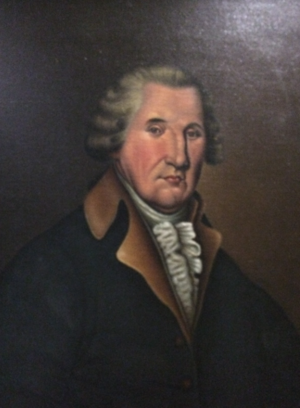
William Hooper (June 28, 1742 – October 14, 1790)[1] was an American Founding Father, lawyer, and politician.[2] As a member of the Continental Congress representing North Carolina, Hooper signed the Continental Association and the Declaration of Independence.
Early life
William Thomas Hooper Sr. was the first child of five, born in Boston, Massachusetts on June 28, 1742. His father, William Hooper, was a Scottish minister who studied at the University of Edinburgh prior to immigrating to Boston. His mother, Mary Dennie, was the daughter of John Dennie, a well-respected merchant from Massachusetts. Hooper's father had hoped that William would follow in his footsteps as an Episcopal priest[3] and placed his son at the age of seven in Boston Latin School headed by Mr. John Lovell, a highly distinguished educator.
In 1757, at age 16, Hooper entered Harvard University where he was highly regarded as an industrious student.[4] In 1760, Hooper graduated from Harvard with honors, obtaining a Bachelor of Arts. However, after graduating, Hooper did not wish to pursue a career in the clergy as his father had hoped. Instead, he decided on a career in law, studying under James Otis, a popular Boston attorney who was regarded as a radical. Hooper studied under Otis until 1764 and once completing his bar exam decided to leave Massachusetts in part because of the city's abundance of attorneys.[citation needed]
Life in North Carolina
In 1764, Hooper moved temporarily to Wilmington, North Carolina, where he began to practice law and became the circuit court lawyer for Cape Fear. Hooper began to build a highly respected reputation in North Carolina among the wealthy farmers as well as fellow lawyers. Hooper increased his influence by representing the colonial government in several court cases. In 1767, Hooper married Anne Clark, the daughter of a wealthy early settler to the region and sheriff of New Hanover County.[5] They had three children: William (b. 1768), Elizabeth (b. 1770), and Thomas (b. 1772).[6] Hooper moved quickly up the ranks, first in 1769 when he was appointed as deputy attorney of the Salisbury District, and then in 1770 when he was appointed deputy Attorney General of North Carolina.
Initially, Hooper supported the British colonial government of North Carolina. As deputy attorney general, in 1768 Hooper worked with Colonial Governor William Tryon to suppress a rebellious group known as the Regulators who participated in the War of the Regulation. The Regulators had been operating in North Carolina for some time, and in 1770 it was reported that the group dragged Hooper through the streets in Hillsborough during a riot. Hooper advised that Governor Tryon use as much force as was necessary to stamp out the rebels and even accompanied the troops at the Battle of Alamance in 1771.[7] He served in the Province of North Carolina House of Burgesses in 1775.[8]
American Revolution involvement
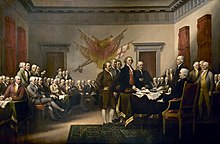 ])John Trumbull's painting, Declaration of Independence, depicting the five-man drafting committee of the Declaration of Independence presenting their work to the Congress.
Hooper missed the initial vote approving it on the Fourth of July, 1776, but was able to sign it on August 2, 1776.
Hooper's support of the colonial governments began to erode, causing problems for him because of his past support of Governor Tryon. Hooper had been labeled a Loyalist and therefore he was not immediately accepted by Patriots. Hooper eventually was elected to the North Carolina General Assembly in 1773, where he became an opponent to colonial attempts to pass laws that would regulate the provincial courts. This in turn helped to sour his reputation among Loyalists. Hooper recognized that independence was likely to occur and mentioned this in a letter to his friend James Iredell, saying that the colonies were "striding fast to independence, and ere long will build an empire upon the ruins of Great Britain."[9]
During his time in the assembly Hooper slowly became a supporter of the American Revolution and independence. After the governor disbanded the assembly, Hooper helped to organize a new colonial assembly. Hooper was also appointed to the Committee of Correspondence and Inquiry. In 1774, Hooper was appointed a delegate to the First Continental Congress, where he served on numerous committees. Hooper was again elected to the Second Continental Congress, but much of his time was split between the congress and work in North Carolina, where he was assisting in forming a new government. This caused him to miss the vote approving the Declaration of Independence; however, he arrived in time to sign it on August 2, 1776.[10]
In 1777, because of continued financial concerns, Hooper resigned from Congress and returned to North Carolina to resume his law career. Throughout the Revolution the British attempted to capture Hooper, and with his country home in Finian vulnerable to British attacks, Hooper moved his family to Wilmington.
In 1781, the British captured Wilmington, to where Cornwallis and his forces fell back after the Battle of Guilford Court House,[11] and Hooper found himself separated from his family. In addition, the British burned his estates in both Finian and Wilmington, so Hooper was forced to rely on friends for food and shelter during this time, as well as nursing him back to health when he contracted malaria. Finally, after nearly a year of separation, Hooper was reunited with his family, and they settled in Hillsborough, North Carolina, where Hooper continued to work for the North Carolina assembly until 1783.
 William Hooper's original grave in Hillsborough, North Carolina
Post-Revolution years
After the Revolution Hooper returned to his career in law, but he lost favor with the public because of his political stance. Hooper fell in line with the Federalist Party because of his influential connections, his mistrust of the lower class, and his widely criticized soft dealings with Loyalists,[12] toward whom he was generally forgiving.
This kind and fair treatment made some even label him a Loyalist. Hooper was again called to public service in 1786, when he was appointed a federal judge in a border dispute between New York and Massachusetts, though the case was settled out of court. In 1787 and 1788, Hooper campaigned heavily for North Carolina to ratify the new United States Constitution, but by this time Hooper had become quite ill, and he died on October 14, 1790, at the age of 48.[13] He was laid to rest in the Presbyterian Churchyard in Hillsborough, North Carolina. His remains were later reinterred at Guilford Courthouse National Military Park.
His home at Hillsborough, the Nash-Hooper House, was declared a National Historic Landmark in 1971.[14][15] It is located in the Hillsborough Historic District.
See also
AMERICAN CONNECTIONS
WILLIAM HOOPER (NC) was thirty-four. Handsome,
charming (a bit of a swell), the well-heeled lawyer had earlier taken
the side of the royal governor in putting down a tax revolt and then
tried hard for compromise instead of conflict, hoping till the very last
minute for a reconciliation with the Brits. Even though in the end he
went with the majority, he still wanted the U.S. government to be
half-elected, half-appointed.
After the war Hooper lobbied for restoration of loyalist property. So
did his good friend James Iredell, famous for having written the 1774
letter predicting Independence. Before the war Iredell had published
articles suggesting the answer to the problem would be two independent
governments ruled by the same monarch. Much later as a Supreme Court Justice, nn important part of Iredell's duties on the Supreme Court was circuit riding, since those courts had no judges of their own.
Circuit riding placed substantial demands on the justices, particularly during the early years of the federal judiciary. Roads were often poor or nonexistent, bridges were scarce, and travelers sometimes had to ford rivers or rely on ferries. Travel was generally by horseback or horse-drawn carriage and offered little protection from severe weather. Accommodations along the routes were also limited; inns frequently offered little privacy or comfort, and travelers sometimes had to share rooms or beds with strangers.[6][7]^ Iredell experienced such conditions himself, on one occasion sharing a room with five other people and a bed with another traveler.[7]^ One year he rode 1900 miles. The hazards of circuit travel also affected Iredell personally. In 1792, while traveling in a horse-drawn gig, his horse attempted to run off. The carriage struck a tree, throwing Iredell to the ground, after which one of its wheels ran over his leg and severely injured him.[6]^ He was also robbed on a later circuit journey.[7]^
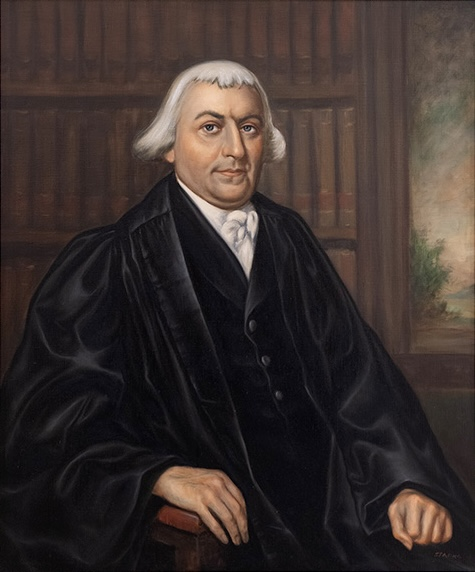
From 1777 Iredell was a North Carolina Superior Court judge, and he is
today remembered for his 1787 opinion that no state legislature may pass
an act contrary to the state constitution. The case in question regarded
confiscated loyalist property. After the war a house, grounds, and wharf
in New Bern, North Carolina, were owned by a certain Singleton, who had
state deeds to prove it. The previous, loyalist owner, Elizabeth Bayard,
petitioned for restitution. The judge decided to send the matter to a
jury trial in spite of the fact that a North Carolina act stated that
confiscated loyalist property could not be the subject of jury trial.
Iredell ruled that the state constitution gave everybody the right to a
jury trial, in every case, loyalist or not.
Iredell's cocounsel was William Davie. After a busy war (seriously
wounded; commanded Andrew Jackson) the conservative,
go-easy-on-loyalists Davie settled into local politics. Where he hassled
fellow legislators about the need for a railroad and an up-to-date
education system. He then persuaded the state to set up the University
of North Carolina, got agreement for the Chapel Hill site (after serving
"exhilarating beverages" at the committee meeting), wrote the
university's charter, laid the cornerstone, organized the curriculum,
made sure students wouldn't whisper in church, keep dogs, or be untidy,
and hired the faculty. The oldest public university in the nations, though "Members of the Board of Trustees were among the largest slave owners in the state."[15]:^ 17–18

William Davie (at right wearing Freemason apron) laying the cornerstone of Old East.
One of whom was Joseph Caldwell (also a Freemason) , who arrived in 1796 as the second math professor, then became president in 1804. As well as publishing two
major books on geometry, Caldwell was the South's premier astronomer and
mathematician. In 1824 he persuaded legislators to give him six thousand
bucks to go to Europe and buy astronomical instruments and books. When
he got back with the bits and pieces in 1827 he built the university's
observatory, the first in the United States designed for educational
purposes.
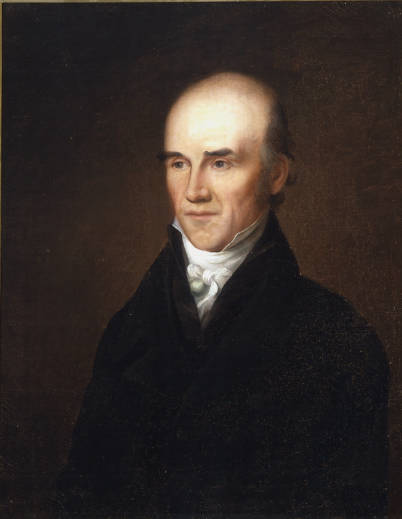
No surprise, Caldwell was one of the three hundred-odd geeks subscribing
to the Mathematical Correspondent, a very-limited-circulation
journal catering to the tastes of math problem-solvers. One of the other
subscribers (who ordered fifty copies) was English nerd Andrew Mackay.
Who surveyed the exact position of Aberdeen, Scotland, wrote a major
paper on how to do longitude (good stuff for sailors crossing the
Atlantic), failed to get a Scots university job, and, annoyed, moved to
London where he taught math, navigation, geography, architecture,
engineering, "the sciences," and astronomy. Pal of John Playfair, worked for the East India Company.
Mackay was a natural for reference book compilers on the lookout for
material, and he wrote for the Encyclopaedia Britannica. And
then contributed stuff on navigation for Abraham Rees's
Cyclopaedia. Great attention is paid to English biography; the botanical articles were generally contributed by Sir James Edward Smith and the music articles by Charles Burney (father of the writers Frances Burney and Sarah Burney, of the explorer James Burney, and of Charles Burney, a classicist and book donor to the British Museum).
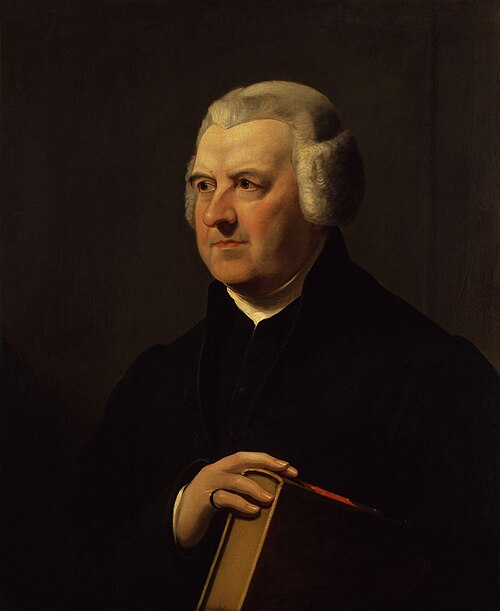
Rees was a London-based Welsh Presbyterian
minister (and charismatic preacher) who tutored in math, science, and
Hebrew. In 1802 he started the Cyclopaedia. Published in
1820, it ran to over five hundred articles in thirty-nine volumes with
plates and an atlas. Rees signed up more than a hundred contributors,
most of them free-churchmen, others military, journalistic, or radical.
One was Agnes C. Hall.
Agnes Hall's particular interests were botany and agriculture, and she
wrote for several reference works besides Rees's. In her spare time she
also wrote novels (pen name: Rosalie St. Clair), including The Banker's
Daughters of Bristol. Give it a miss. She also wrote a historical novel based on the massacre of Glencoe.[2]^ Glencoe was also a popular topic with 19th-century poets, notably Sir Walter Scott's "Massacre of Glencoe".[50]^ ..., T. S. Eliot's "Rannoch, by Glencoe" and "Two Poems from Glencoe" by Douglas Stewart.[51]^
A Song of Ice and Fire author, George R. R. Martin, cites the Glencoe Massacre and the Black Dinner as his two historical inspirations for the infamous Red Wedding in his 2000 book A Storm of Swords.[53]^ and Game of Thrones; "The Rains of Castamere" is considered one of the most shocking episodes in TV history.[20][21^
Agnes's favorite activity was translating from French. Mainly the tourist guides of the
period, mainly titled Travels in...] One of her translations
was Travels in the African Seas by French herbalist Bory
Saint-Vincent, who had knocked around quite a bit and published a map
showing the Atlantic location of Atlantis.
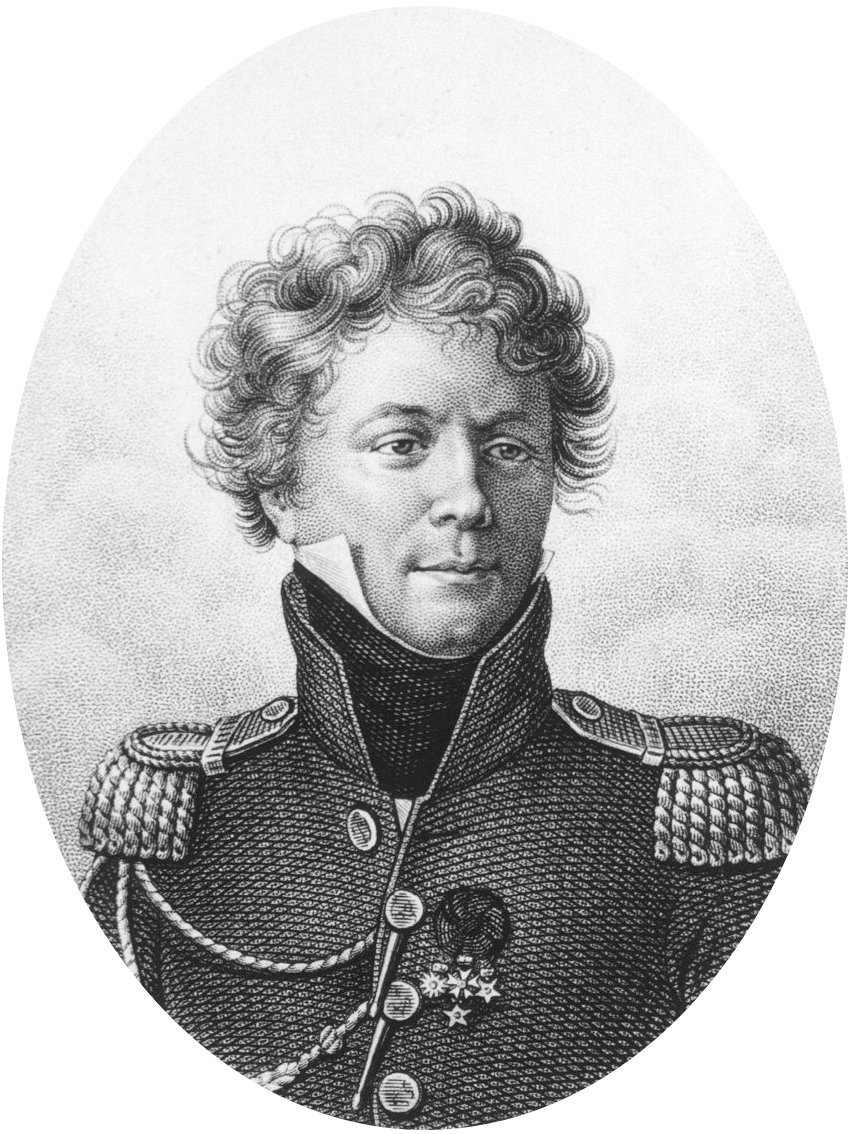
Early in life, after jumping ship in Mauritius during the French
expedition to Australia, Saint-Vincent wandered round the local islands,
then went home to join Napoleon's army and became so Bonapartist that
for years after Napoleon had lost, Saint-Vincent was obliged to live in
disguise. Finally, by 1820, memories had faded, so he came out from
behind the beard. And his botanical work became known. In 1828 he was
chosen to head the French (military-scientific) expedition to Morea in
the Greek Peloponnese, which was Turkish but wanted to be Greek.
The Greeks there had been fighting Turkish occupation since 1821. By
1825 the Turks had brought in Egyptian troops, and nasty atrocities were
piling up on both sides. The French, English, and Russians were keen to
keep the anarchy from spreading, so in 1827 an allied fleet arrived and
moved into the Bay of Navarino, where the Turkish-Egyptian fleet was
anchored. At one point a Royal Navy frigate sent a boat to request that
sorry chaps but could a Turkish fireship please be moved. Missing the
point, the Turkish captain loosed off, killing several of the Brit boat
crew. All hell broke loose. When it was over, three quarters of the
Turkish-Egyptian fleet was sunk and the accidental Battle of Navarino
was over.
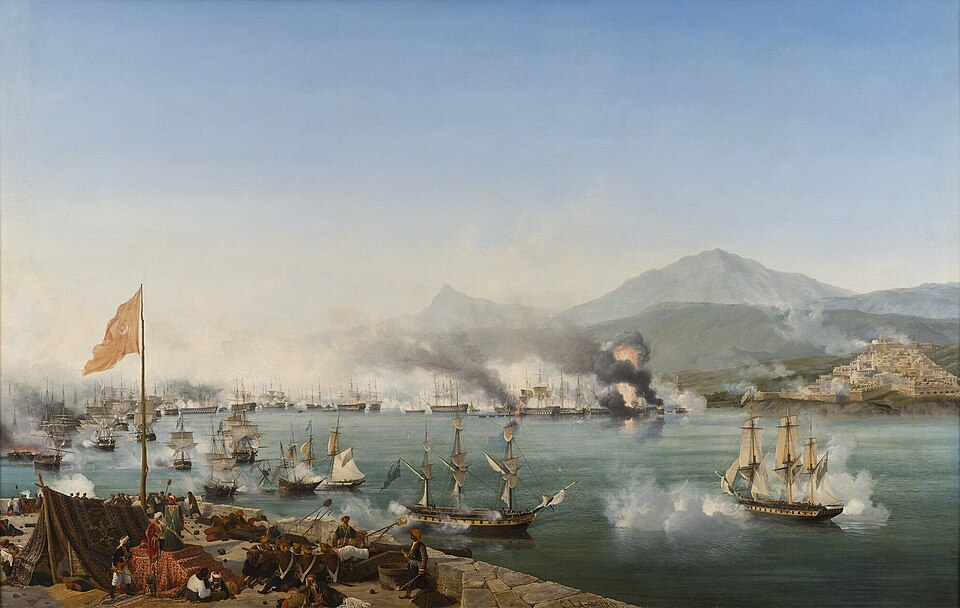
One of the Royal Navy ships was the Talbot, carrying
fifteen-year-old William Neale.
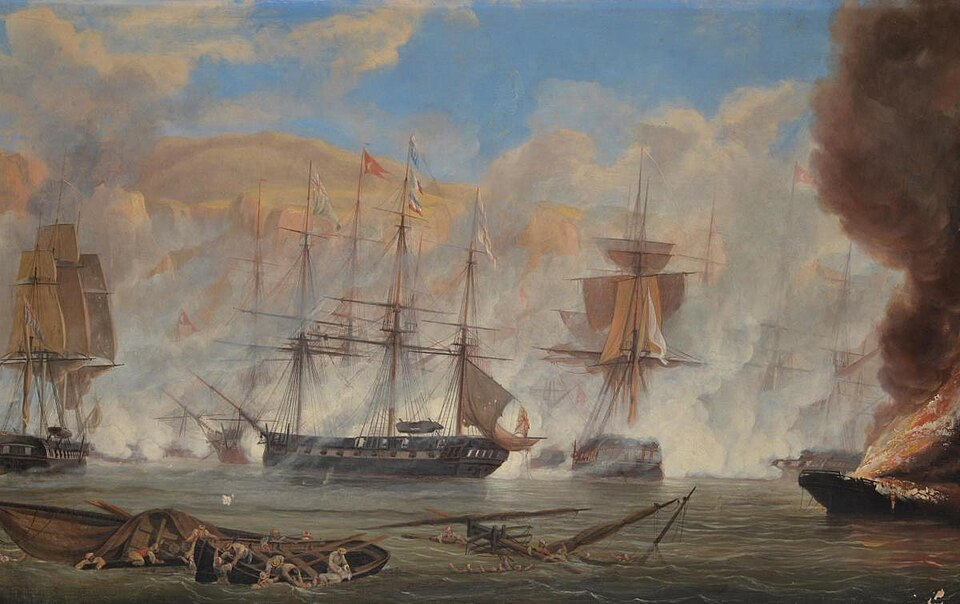
He later used his navy experiences in
novels like The Port Admiral. Fellow writer and retired navy
hero Frederick Marryat rubbished the book, and he and Neale ended up
having a scuffle with walking sticks in Trafalgar Square. Marryat knew
inventor Charles Babbage and was designer of a lifeboat (and signal flag code).
Marryat was born at Great George Street in Westminster, London.[2]^ His father was Joseph Marryat, a "merchant prince" of Huguenot descent and member of Parliament, as well as slave owner and anti-abolitionist, and his American mother was Charlotte, née von Geyer, of Boston.[3][4]^ As a youth, Marryat tried to run away to sea several times before he was permitted to enter the Royal Navy in 1806 as a midshipman aboard HMS *Imperieuse*, a frigate commanded by Lord Cochrane, who later served as inspiration for Marryat and other authors.
After a brilliant Royal Navy career he turned to writing (with more success than
Neale) such classics as Peter Simple (1834) and Mr. Midshipman Easy (1836).
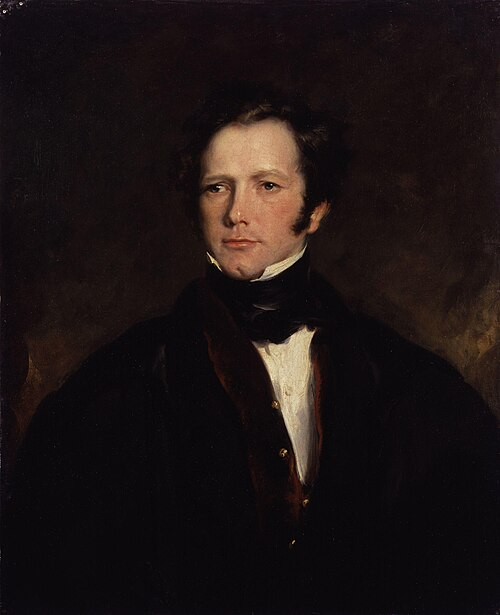
In 1837 he traveled for a year in Canada and the United States, where he
met Eliphalet Nott, the controversial and innovative president of Union
College in Schenectady, New York.
Among his successful pulpit efforts at Albany was a sermon on the death of Founding Father Alexander Hamilton, entitled On the Death of Hamilton, condemning the practice of dueling, that had profound influence in curtailing the custom and remains recognized to this day as an exemplary period example of the orator's art.[2]^
Chartered in 1795,[9]^ Union College was the first non-denominational institution of higher education in the United States, and the second college established in the State of New York. Only Columbia University, founded in 1754 as King's College,[10]^ preceded Union in New York state.
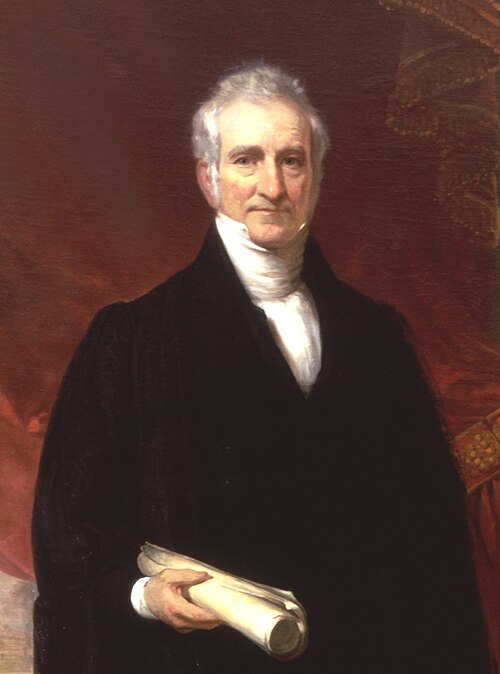
Nott had dragged the college into modernity with lottery-sourced finance and a curriculum including science, medicine, and engineering, and as a result by 1820 the biggest graduating class in the United States. Nott was noisy on such subjects
as slavery (anti-), booze (anti-), and religion (pro-). He held over thirty
patents for various efficient heating systems, including the "Nott
stove," which successfully burned hard-to-burn smokeless anthracite coal, which was named for him.[2]^
As did the boiler of his new steamboat, the SS Novelty, built
in 1826 at the Novelty shipyards on Fourteenth Street, New York City.
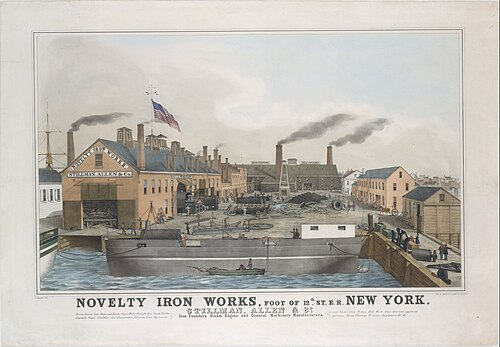
After a number of ownership changes, in 1861 the Novelty Works were
given the contract to manufacture the turret of the latest naval secret
weapon, the ironclad semisubmersible *USS Monitor.*
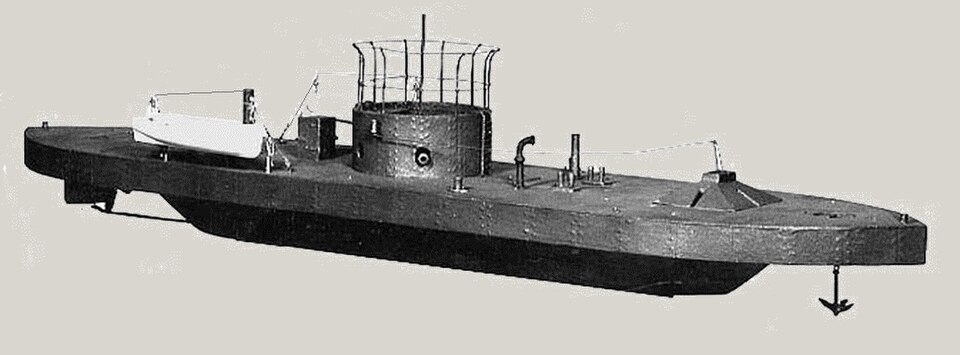
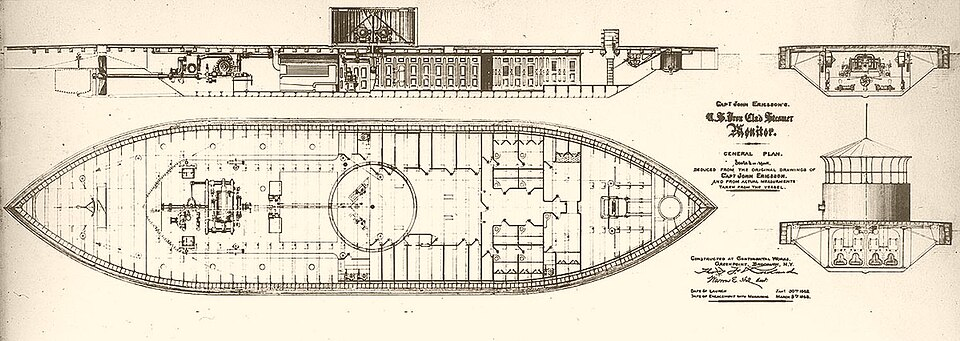
John Ericsson's revolutionary ship was designed to patrol shallow southern
coastal waters and to enforce Lincoln's embargo on Confederate merchant
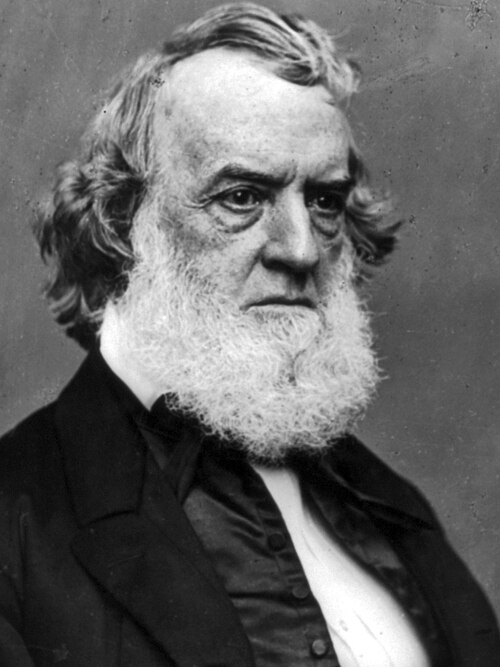
shipping. This program was directed by Secretary of the Navy Gideon
Welles, who at the start of the Civil War found himself with the job of
building a Union navy virtually from scratch.
Although opposed to the Union blockade of Southern ports, he duly carried out his part of the Anaconda Plan, largely sealing off the Confederate coastline and preventing the exchange of cotton for war supplies. This is viewed as a major cause of Union victory in the Civil War, and his achievement in expanding the Navy almost tenfold was widely praised. Welles was also instrumental in the Navy's creation of the Medal of Honor. Lincoln nicknamed him his "Neptune". He was not an ancestor of Orson Welles as the actor had claimed on The Dick Cavett Show.[20]^
Welles recruited people like John Murray Forbes. His cousin Francis Blackwell Forbes (1839–1908) is the great-grandfather of 2004 U.S. Democratic presidential candidate John Forbes Kerry, key to global action on Global Warming
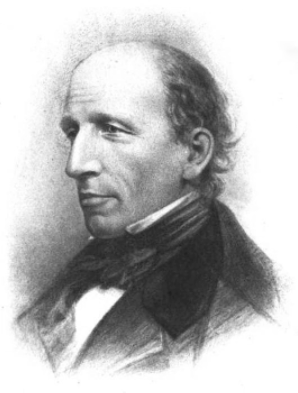
Forbes was already rich from early opium smuggling to China and then
from speculative and very successful railroad investment. By this time
he was also building ships, which, at Welles's suggestion, he sold to
Congress for the US Navy. And got even richer. Forbes also supported
the Black cause and on one occasion sheltered fugitive John Brown. Later
in life he became involved in humanitarian work, financing Lifeboat
Societies and Sailors' Retirement Homes. He also encouraged northerners
to settle in Florida and wintered there himself.
In 1872 one of Forbes's Florida guests was the painter William Morris
Hunt.

William Morris Hunt self-portrait, 1866
Hunt was recovering from the effects of the Boston Fire.
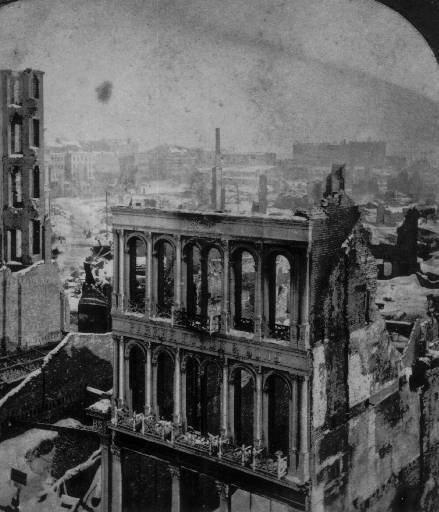
In 1852, Boston became the first city in the world to install telegraph-based fire alarm boxes.[5]^ The boxes served as a fire warning system. If the lever inside of the alarm box was pulled, the fire department was notified, and the alarm could be traced back to the box via a coordinate system so that firefighters were dispatched to the correct location. All of the fire alarm boxes were kept locked from when the system was installed in 1852 until after the Great Fire of 1872 to prevent false alarms. A few citizens in each area of Boston were given a key to the boxes, and all other citizens had to report fires to the key-holders, who could then alert the fire department.[6]^ In 1872, witnesses watched the fire spread before the area's key-holder was found and could unlock the alarm box to alert the Boston Fire Department. Twenty minutes after the fire was first noticed, firefighters arrived on the scene.[1]^ Because of a horse flu epidemic, they hired 500 guys to haul the equipment.

A fire alarm box in Boston in 2010
The Great Fire destroyed all his paintings, including a portrait of Lincoln and five
large works by the French artist Jean François Millet. With whom in 1851
Hunt had spent two years (of a twelve-year stay in Europe) at Barbizon,
outside Paris, learning to paint in Millet's realistic style. While in
Florida, Hunt painted landscapes. One was Rainbow Creek. Five
years later he was at work on two large murals for the Assembly Chamber
of the New York State Capitol. In 1867, for instance, Hunt and his wife sailed to Paris to attend the opening of the Exposition Universelle.
At one point back in 1859 Hunt had run a summer painting school attended
by writer Henry James. Ten years later James was comfortably settled in
Europe, writing novels about Americans in Europe (and full of the newly
fashionable psychological realism). James went over famously with famous
French and English writers, and when he settled in a small village in
Sussex his local cronies included Kipling, Ford Madox Ford, and Joseph
One of James's close friends was young American writer Edith Wharton,
who came from the same upper-crust background as James. She wintered in
Paris, summered in Newport, social-seasoned in New York, and spent her
life writing about it all.
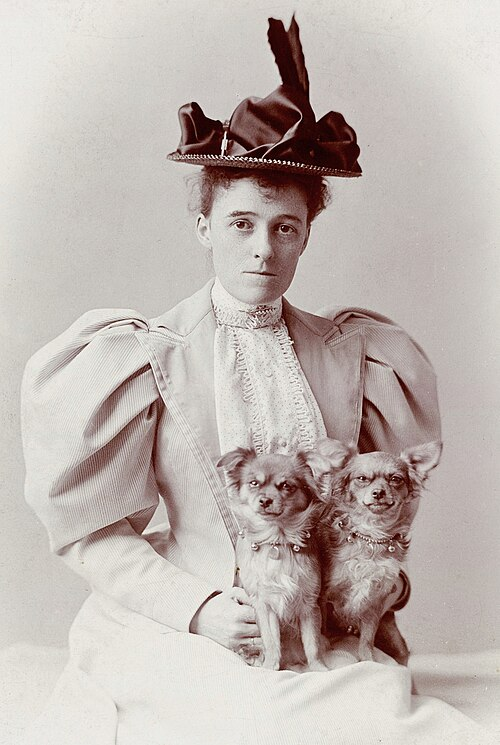
Condemned to an unhappy marriage, she found
brief sexual fulfillment in a secret affair with an American journalist.
This may explain her admiration for a Romanian princess and writer for
whom the same kind of satisfaction was a daily occurrence.
Sometimes referred to unkindly as the grande horizontale,
Princess Marthe Bibesco was beautiful, talented, intelligent, and "knew"
everybody in Europe from royals to politicos.
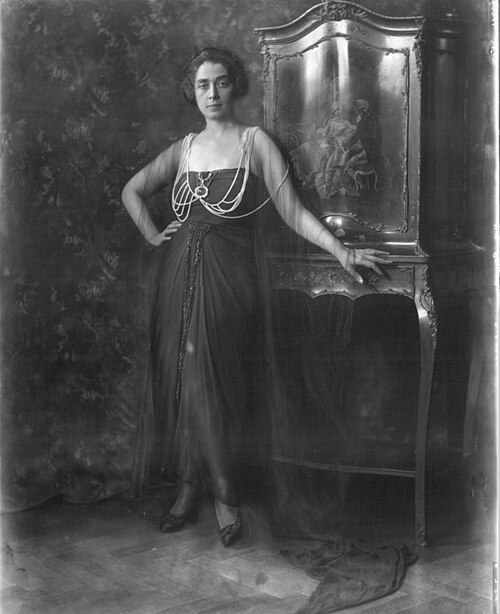
Her books were greeted by Marcel Proust as masterpieces of style.
At the same time Bibesco was also turning out bodice-rippers under the pen name Lucille Decaux. She spent her life traveling around Europe staying in palaces after losing her own in Romania. Above all (with a husband busy on innumerable love
affairs), Bibesco was a man-eater. As in (at least): a German crown
prince, a French president, a king of Spain, a French socialist MP, and
a British prime minister. Whose air minister and "friend" of Bibesco was
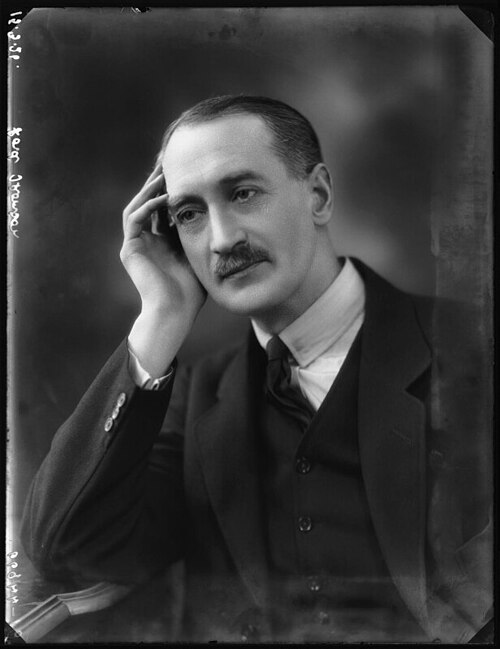
In 1924 Thomas had okayed the construction of two passenger-carrying
airships, the R100 ( to be built by a private company) and the R101
(government-built). He died when it crashed; Princess Marthe he dedicated four books to "C.B.T." and visited the site of the R101 accident.
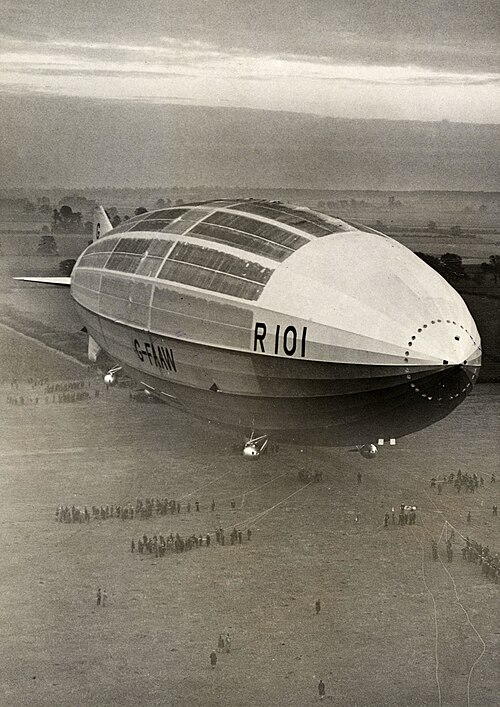
Managing director of the R100 company was Charles
Dennistoun Burney. After a successful transatlantic run by the R100 in
June 1930, the future of airships ended with the catastrophic crash in
France of the R101 later that year.
After World War II the inventive Burney turned to development of stern-fishing trawlers, and in 1954 the first of these was off Newfoundland, soon to be joined by many others.
By 1960 the Newfoundland Grand Banks cod were being fished in
unsustainable numbers and the "factory-ship" trawlers were generating
serious Canadian opposition.
The protests were led by longtime Newfoundland legislator Chesley
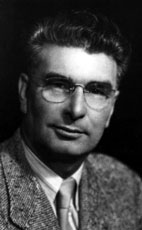
Who later became a member of the Canadian Senate Committee on
Science Policy and in 1975 helped found the Planetary Association for
Clean Energy. By 1989 PACE had thirty-six hundred members in sixty
countries and was a U.N.-recognized Nongovernment Organization. In 1983
the association conference on nonconventional power in Augusta, Georgia,
heard a paper on the Earth's gravitational field as a source of energy.
The original experimental work for the paper had been done a few years
earlier (before his death) by Berkeley physicist WILLIAM HOOPER.