Clark, Abraham
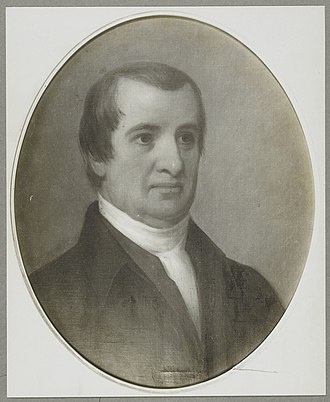
Abraham Clark (February 15, 1726 – September 15, 1794) was an American Founding Father, politician, and Revolutionary War figure.[1] Clark was a delegate for New Jersey to the Continental Congress where he signed the Declaration of Independence and later served in the United States House of Representatives in both the Second and Third United States Congress, from March 4, 1791, until his death in 1794.
Early life
Clark was born in Elizabethtown in the Province of New Jersey. His father, Thomas Clark, realized that he had a natural grasp for math so he hired a tutor to teach Abraham surveying. While working as a surveyor, he taught himself law and went into practice. He became quite popular and became known as "the poor man's councilor" as he offered to defend poor men who could not afford a lawyer. He was a slaveholder.[2]
Clark married Sarah Hatfield circa 1749,[3] with whom he had 10 children.[4] While she raised the children on their farm, Clark was able to enter politics as a clerk of the Provincial Assembly. Later he became high sheriff of Essex County and in 1775 was elected to the Provincial Congress. He was a member of the Committee of Public Safety.
Political career
Early in 1776, the New Jersey delegation to the Continental Congress was opposed to independence from Great Britain. As the issue heated up, the state convention replaced all their delegates with those favoring the separation. Because Clark was highly vocal on his opinion that the colonies should have their independence, on June 21, 1776, they appointed him, along with John Hart, Francis Hopkinson, Richard Stockton, and John Witherspoon as new delegates.[5] They arrived in Philadelphia on June 28, 1776, and voted for the Declaration of Independence in early July.
Clark remained in the Continental Congress through 1778, when he was elected as Essex County's Member of the New Jersey Legislative Council. New Jersey returned him twice more, from 1780 to 1783 and from 1786 to 1788. Clark was one of New Jersey's three representatives at the aborted Annapolis Convention of 1786, along with William C. Houston and James Schureman.[6] In an October 12, 1804 letter to Noah Webster, James Madison recalled that Clark was the delegate who formally motioned for the Constitutional Convention, because New Jersey's instructions allowed for consideration of non-commercial matters.[7][8]
Clark, more than many of his contemporaries, was a proponent of democracy and the common man, supporting especially the societal roles of farmers and mechanics. Because of their emphasis on production, Clark saw these occupations as the lifeblood of a virtuous society, and he decried the creditor status of more elite men, usually lawyers, ministers, physicians, and merchants, as an aristocratic threat to the future of republican government.[9] Unlike many Founding Fathers who demanded deference to elected officials, Clark encouraged constituents to petition their representatives when they deemed change necessary.[10]
In May 1786, Clark, aided by thousands of petitions in the preceding months, pushed a pro-debtor paper money bill through the New Jersey legislature.[11] To garner support for the paper money bill and espouse his populist vision for New Jersey's future, Clark, under the pseudonym "A Fellow Citizen," published a forty-page pamphlet entitled The True Policy of New-Jersey, Defined; or, Our Great Strength led to Exertion, in the Improvement of Agriculture and Manufactures, by Altering the Mode of Taxation, and by the Emission of Money on Loan, in IX Sections in February 1786.[12]
Death and legacy
Clark retired before the state's Constitutional Convention in 1794. He died from sunstroke at his home. Clark Township in Union County, New Jersey, is named for him, as is Abraham Clark High School in Roselle, New Jersey. Clark is buried there at the Rahway Cemetery in Rahway, New Jersey.[13][14]
See also

- List of United States Congress members who died in office (1790–1899)
- Memorial to the 56 Signers of the Declaration of Independence
ABRAHAM CLARK (NJ) was fifty. And not a man you
crossed with impunity. "A lively wit and very satirical," they said.
Clark spent the run-up to conflict trying to make sure America wasn't
getting rid of one shackle only to replace it with another. An early
republican, he was against centralized government and was leery about
the "greedy" businessmen who would profit from the war and then take
over.
His best shot in this battle came early in the 1780s when the war
started to generate a large number of small debtors (like farmers) who
were land-rich but cash-poor. Clark's solution was to print one hundred
thousand pounds of paper money backed by real estate and issued in loans
by a New Jersey state commission. In this way people could borrow the
paper money against their land, settle their debts, and pay off the loan
over a number of years.
Clark's Trenton, New Jersey, money printer was Isaac Collins, who'd been
turning out official documents since 1770. Isaac was a Quaker and for a
while the Friends shunned him because of the way he used his first
newspaper (the New Jersey Gazette) to raise money, supplies,
and general support for Washington's army and other war-related stuff.
In 1779 Collins produced the first "Family Bible." Amost all Bibles back
then were designed to be carried in saddlebags, but Isaac's was big
enough for the family to gather around it. Demand was so great he got
three thousand preorders and the final print went to five thousand.
Isaac had his kids check the proofs eleven times looking for typos. They
spotted all but two: a broken letter and a missed punctuation mark.
One of Isaac's Gazette contributors was Quaker John Woolman,
who is credited with nothing less than the birth of the modern social
conscience.
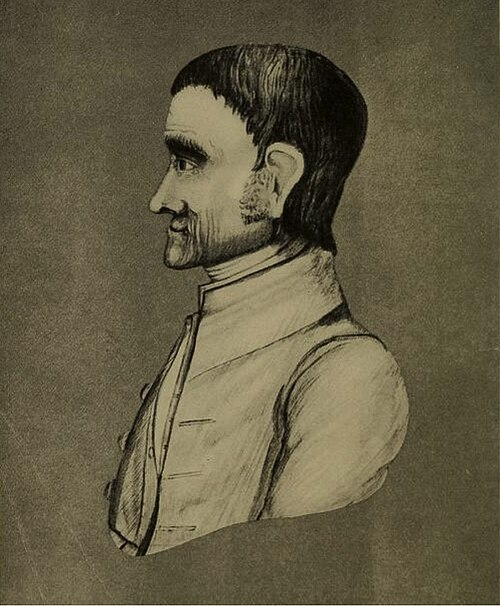
One of the first anti-slavery voices in America, Woolman
spent three dangerous weeks living with Native Americans to find out
what their life was like. He urged his fellow Quakers not to pay taxes
for war-making. He traveled around speaking out on these issues of
conscience. When he crossed the Atlantic to England in 1772 he chose to
travel steerage so as to share discomfort with the poor. Once in
England, for animal-welfare reasons he walked everywhere so as not to
use the "flying" (nonstop) coaches because he heard they often ran
horses to death. Later that year Woolman arrived for a Quaker meeting in
York, sick with smallpox.
Taken to a house outside the city, he died, tended by Sarah, daughter of
local Friend William Tuke. Who'd been an antislavery activist as long as
Woolman and who'd started several Quaker schools. Years later in 1790 a
Quaker woman died in York Asylum for the Insane and Tuke became aware of
the conditions under which the mentally ill were forced to live: treated
like animals, cuffed, and without medical treatment or minimal personal
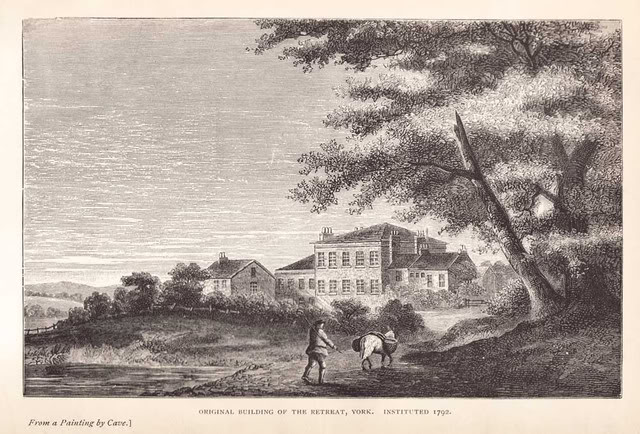
hygiene. After two years of research and visits to asylums Tuke opened
"The Retreat." His patients were treated as if they were sane, kept in
clean, pleasant living conditions, encouraged to socialize with other
patients, given decent food and occupational therapy classes. Unheard
of.
Tuke's lifelong role model in mental health was a French doctor friend
of Ben Franklin, Philippe Pinel. A famous painting shows Pinel removing
the chains from the insane in Paris. In fact the pic was a propaganda
job set up by the revolutionaries, and it was somebody else who did the
unshackling. Besides mental health, Pinel's other great work was a giant
book of diseases catalogued by symptom. This was the taxonomy-craze era:
idea being that if you could describe a disease (and especially reduce
it to as many subclassifications as possible) you could understand it.
"Nosology" (as this approach to disease was called) included such gems
as: "Disease: nostalgia. Symptoms: an overwhelming inclination to go
home."
Over a third of Pinel's book dealt with fever treatments, one of which
had been suggested by a pupil, François Joseph Victor Broussais.
Remembered for his simple and effective approach to any condition. For
Broussais all disease was caused by the excessive accumulation of blood.
So copious bloodletting (with leeches) would effectively get rid of the
accumulation. More often than not this killed the patient. But the
technique was great news for the German leech industry. At the height of
demand France was importing 42 million of the little German suckers. In
an attempt to boost French leech-farming, Napoleon set up the Society
for the Encouragement of National Industry.
Its first president, Jean-Antoine Chaptal, made paper white for the
first time with his idea of using chlorine to bleach linen rags. He also
invented "chaptalization": In a cloudy year with little sunshine,
alcohol levels in fermenting wine could be maintained by adding sugar.
It was one of his colleagues, Napoleon's inspector general of health,
Antoine-Augustin Parmentier, who suggested grape juice would do the
trick better.
Parmentier was also the guy who persuaded the Paris Faculty of Medicine
to declare the potato edible. Ever since he'd spent time in a German POW
camp back in the 1760s, forced to live off potatoes, Parmentier was a
convert to the humble spud. At a time when potatoes were fed only to
animals (and POWs), converting the public to the tuber required some
effort. So Parmentier staged elaborate potato-every-course dinners for
the likes of Franklin and famous chemist Lavoisier, sent bouquets of
potato flowers to the queen, and invented an haute cuisine potato soup
known to this day as potage Parmentier. You may have had it.
Fittingly, a close acquaintance of Parmentier was horticulture expert
Philippe-Victoire de Vilmorin, who ran a seed company, married a
daughter of the king's botanist, then partnered with the botanist and
renamed the company Vilmorin-Andrieux. By mid-nineteenth century the
firm was a national institution, collecting seeds from all over the
world, producing the first-ever book dedicated to veggies (including two
hundred pages on cabbages and four thousand images of every plant the
company grew) and breeding the modern carrot. Every year from 1850 the
company sent their clients a beautifully designed, full-color,
all-vegetable poster, produced by the latest chromolithography
technique. This used up to twenty thin stone plates each carrying the
same design but only one of the colors in the final composition.
Pressing the same sheet of paper on each plate in turn produced
extremely high-quality multicolor images.
King of chromolithography was Welsh designer Owen Jones, who literally
wrote the book. In this case, Grammar of Ornament, the
definitive statement on design, which included six hundred illustrations
of patterns from cultures all over the world. By the 1850s Jones was the
final design authority and his stuff was everywhere: on playing cards,
menus, calendars, stamps, endpapers of books, even biscuit wrappers. And
at the Crystal Palace Great Exhibition of 1851, where he designed the interiors. His
bright polychrome classical-architecture "Greek Court" (he thought this
historically accurate) generated such an outcry he was forced to an
Apology written in 1856 with his pal George Lewes.
Who was already raising eyebrows when his wife had her second child by
their live-in friend Thornton Hunt. Lewes was a second-rate poet and
novelist (one contemporary assessment: "execrable") but a first-rate
reviewer, essayist, and general intellectual gadfly. He wrote on
everything for everybody and was friendly with Dickens. After finishing
a major Goethe biography in 1855 he left home to live with and shepherd
the career of novelist George Eliot (real name Mary Ann Evans). Turning
to science in 1859 Lewes wrote Physiology of the Common Life.
Ten years later the book changed the career of a young Russian student
priest south of Moscow, who dropped the habit in favor of physiology.
Ivan Pavlov ended up with drooling dogs and a Nobel. The world ended up
with the dubious benefit of knowing and worrying about the conditioned
reflex. Pavlov did some of his early physiology lab work in Breslau with
Rudolf Heidenhein, much exercised by the problem of body heat. Which he
discovered was generated by muscles.
Heidenhein also invented the "gastric pouch" for collecting stomach juices and was one of the first to study hypnosis in a scientific manner. One of his fellow
physiologists, Viennese Joseph Breuer, made the great mesmeric leap in
1880 when he hypnotized a young woman with multiple problems: paralyzed
arm, violent cough, no appetite, water phobia, and frequent delerium.
After putting her under the influence Breuer talked the reasons out of
her and she recovered. He told his young colleague Sigmund Freud and
psychoanalysis was born.
In 1881 Freud coauthored a piece on aphasia in children with his friend
and doctor Oscar Rie. Whose daughter Marianne married Ernst Kris in 1927
when art historian Kris was a curator at the Vienna Cultural Museum.
Marianne (born May 27, 1900) would marry Kris in 1927 and become a well-known analyst in the United States. Especially known for her work in psychoanalysis with children, among her adult patients were Marilyn Monroe and Diana Trilling; one of her closest friends was Anna Freud.
Ernst Kris moved into psychoanalysis and in 1940, on the run
from the Nazis, was visiting prof. at the New School for Social Research
(now New School University) in New York.
A little later at Harvard the Krises' own daughter Anne met another
Vienna runaway and psychoanalytic whiz, Eric Kandel, whose own rather
different take on the brain would lead him into neurobiology and the
epochal study of memory in the giant sea-snail Aplysia. The
snail's chief attraction was that it had few, large, simple cells in its
nervous system, which meant it was less difficult than other creatures
to get to understand. For this snail-brain work, in 2000 Kandel shared a
Nobel with Paul Greengard and Arvid Carlsson.
In 1968 Carlsson had discovered another basic brain mechanism: the
process by which tiny amounts of chemicals pass across the synaptic gap
between one brain cell and another and, on arrival, cause the target
cell to fire. The discovery of these neurotransmitters and their
function made it possible for drug-makers Eli Lilly to produce the
antidepressant Prozac (which has an effect on neurotransmission) and
create the second-biggest-selling medication in the United States.
Lilly was also cosponsor in the construction of the new Hoosier Dome at
Indianapolis, where the Colts played their first game in 1984. One of
the later Colts players was Todd Keene, who left football to become
president (in 2005) of an evangelical group known as The Power Team. The
Team's approach was to focus the interest of the congregation by
performing extraordinary feats of strength (Keene's speciality was to
crush concrete blocks between his arms) and then deliver their Gospel
message.
In 2005 one of the Team was named ABRAHAM CLARK.