Middleton, Arthur
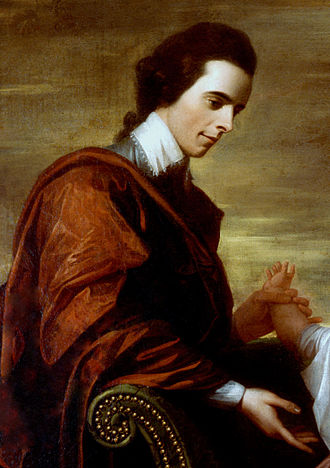
Arthur Middleton (June 26, 1742 – January 1, 1787) was a Founding Father of the United States, signer of the United States Declaration of Independence, and a representative from South Carolina in the Second Continental Congress.
Life
Middleton was born in Charleston, Province of South Carolina, in 1742. His parents were Henry Middleton and Mary Baker Williams, both of English descent. He was educated in Britain at Harrow School, Westminster School, and Trinity Hall, Cambridge.[1] He studied law at the Middle Temple and traveled extensively in Europe where his taste in literature, music, and art was developed and refined. In 1764, Arthur and his bride Mary Izard settled at Middleton Place.
Keenly interested in Carolina, Middleton was a more radical thinker than his father. He was a leader of the American Party in Carolina and one of the boldest members of the Council of Safety and its Secret Committee. In 1776, Middleton was elected to succeed his father in the Continental Congress and subsequently was a signer of the United States Declaration of Independence. Also in 1776, he and William Henry Drayton designed the Great Seal of South Carolina. His attitude toward Loyalists was said to be ruthless, this stood in contrast to other South Carolina patriots such as Francis Marion who led the effort to reconcile with the loyalists after the war ended.[2][3]
During the American Revolutionary War, Middleton served in the defense of Charleston from the attempt to end the way by splitting the colonies by Generals Cornwallis and Clinton.
Clinton had issued the Philipsburg Proclamation in 1779, promising freedom for slaves owned by Patriots who escaped to British lines and aided their cause. Slaves left both the city and countryside around Charleston to join the British around the city. Among those former slaves, known as Black Loyalists, evacuated by the British after the war was John Kizell, who had been captured as a child from the area of Sierra Leone and transported to South Carolina. He eventually returned to Sierra Leone and aided the American Colonization Society.
After the city's fall to the British in 1780, Middleton was sent as a prisoner of war to St. Augustine, Florida (along with Edward Rutledge and Thomas Heyward Jr.), until exchanged in July the following year. Also spent a year on one of the notorious prison ships, the Jersey. Afterward favored tar and feathering loyalists (Am Conn).
Aftermath
The British captured some 5,266 prisoners, 311 artillery pieces, 9,178 artillery rounds, 5,916 muskets, 33,000 rounds of ammunition, 15 Regimental colours, 49 ships and 120 boats, plus 376 barrels of flour, and large magazines of rum, rice and indigo.[2] Following the surrender, the captured ordnance was brought to a powder magazine. A Hessian officer warned that some of the guns might still be loaded, but he was ignored. One prematurely fired, detonating 180 barrels of powder, further discharging 5,000 muskets in the magazine. The accident killed approximately 200 people and destroyed six houses.[2]
The prisoners of the siege were diverted to multiple locations, including prison ships, the old barracks where the College of Charleston is today (two barracks buildings are shown on early maps of the campus[11]), and the Old Exchange and Provost "Dungeon". Prison hulks awaited the majority of the 2,571 Continental prisoners, while parole was granted to the militia and civilians who promised not to take up arms. This ended the power of an American army in the South.[3]: 70
The defeat was a serious blow to the American cause.[12] It was the largest surrender of an American force under arms until the 1862 surrender of Union troops at Harper's Ferry during the Antietam Campaign. The surrender left no substantial army in the South, and the colonies were wide open for a British advance. The British troops consolidated their hold, and had driven the remaining Continental Army troops from South Carolina consequent to the May 29 Battle of Waxhaws.
During their surrender the American forces were denied honours of war, leading General George Washington to deny the same to the British during their surrender at the Siege of Yorktown. Washington said, "The same Honors will be granted to the Surrendering Army as were granted to the Garrison of Charles Town."[10]
On June 5, Clinton sailed back to New York City, believing his presence necessary to defend against a potential Franco-American attack, leaving command of the southern theater to Lord Cornwallis, with orders to reduce opposition in North Carolina. Though the effects of the surrender at Charleston were substantial, the British error in strategy soon became apparent. As no popular uprising of Loyalists took place, control of the countryside was difficult. Instead, resistance in South Carolina degenerated into a period of chaotic guerrilla warfare in the outlying areas.
Death, family and legacy
 Coat of Arms of Arthur Middleton
Middleton died on January 1, 1787, at age 44 and was buried in the family tomb in the Gardens at Middleton Place.[4] The death notice from the State Gazette of South-Carolina describes him as a "tender husband and parent, humane master, steady unshaken patriot, the gentleman, and the scholar." The plantation passed to Henry, his eldest son, later governor of South Carolina, U.S. Representative and minister to Russia.
Middleton was an ancestor of actor Charles B. Middleton, who played Ming the Merciless in the Flash Gordon movies of the 1930s.
Middleton's son-in-law was Congressman Daniel Elliott Huger who was the grandfather-in-law of Confederate General Arthur Middleton Manigault.
Middleton's sister, Susannah Middleton, was the great-great-grandmother of Baldur von Schirach, onetime leader of the Hitler Youth and later governor ("Gauleiter" or "Reichsstatthalter") of the Reichsgau Vienna, who was convicted of crimes against humanity at the Nuremberg trials.
 The tomb of Arthur Middleton at Middleton Place
The United States Navy ship USS *Arthur Middleton* (AP-55/APA-25) was named for him.
See also

References
- ^ "Middleton, Arthur (MDLN759A)". A Cambridge Alumni Database. University of Cambridge. The Biographical Directory of the United States Congress says Middleton "attended school at Hackney, Westminster School, and St. John's College, Cambridge University, in England".
- ^ The Swamp Fox: How Francis Marion Saved the American Revolution By John Oller pg. 227
- ^ The Swamp Fox: How Francis Marion Saved the American Revolution By John Oller pg. 341
- ^ *Congressional Record*
External links
- United States Congress. "Arthur Middleton (id: M000696)". Biographical Directory of the United States Congress.
- Middleton Place
- Biography by Rev. Charles A. Goodrich, 1856
{nl}Signers of the United States Declaration of Independence|
|
- 1742 births
- 1787 deaths
- Politicians from Charleston, South Carolina
- South Carolina colonial people
- Middleton family
- American people of Barbadian descent
- American people of English descent
- Signers of the United States Declaration of Independence
- Continental Congressmen from South Carolina
- 18th-century American politicians
- American slave owners
- People of South Carolina in the American Revolution
- American Revolutionary War prisoners of war held by Great Britain
- People educated at Harrow School
- People educated at Westminster School, London
- Alumni of Trinity Hall, Cambridge
- Members of the Middle Temple
- Burials in South Carolina
- Founding Fathers of the United States