Lynch, Thomas
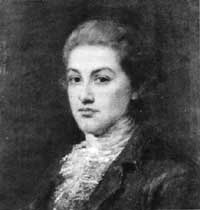
Thomas Lynch Jr. (August 5, 1749 – December 17, 1779) was a signer of the United States Declaration of Independence as a representative of South Carolina and a Founding Father of the United States. His father was a member of the Continental Congress who had signed the 1774 Continental Association, and when he stepped down because of illness Lynch Jr. was selected to fill his post.
Early life
Lynch Jr. was born at Hopsewee Plantation in Prince George Parish, Winyah, in what is now Georgetown, South Carolina, the son of Thomas Lynch and his wife, Beverly Allston Lynch. Before Thomas Lynch Jr. was born, his parents had two daughters named Sabina and Esther who were born in 1747 and 1748.
His mother was the daughter of Gilliém Marshall Dé'Illiard of Iberville Parish, Louisiana, whose brother George William Dilliard of Virginia is credited with changing the Dilliard name to its current spelling, made introductions during a ball held at the childhood home of John Drayton Sr., Magnolia Plantation and Gardens. Also in attendance were prominent families such as the Middleton's, Randolph's, and Rutledge. In this marriage they gave birth to a daughter named Aimeé Constance in 1755, who later married John Drayton.[2]
Lynch's grandfather was Jonas Lynch from County Galway ancestral line; the Lynch family were expelled from Ireland following their defeat in the Irish wars of William of Orange.[3] Lynch Sr. had emigrated from Kent, England, to South Carolina.[4] Lynch Sr. was a prominent figure in South Carolina politics which contributed to access of opportunity in high education and wealth.[5]

Lynch Jr. was schooled at the Indigo Society School in Georgetown before his parents sent him to England, where he received honors at Eton College and at Gonville and Caius College, Cambridge.[1] He studied law and political philosophy at the Middle Temple in London. His father admired his English education and encouraged him to remain in Great Britain to study law and the principles of the British constitution.[4] After eight years away from America, he returned to South Carolina in 1772. Although it was his father's dream, Thomas Lynch Jr. decided to end his pursuit of a profession in law.
Lynch Jr. married Paige Shubrick on May 14, 1772.[6] Following their marriage, the couple lived at Peach Tree Plantation which was located in close proximity to his homeland plantation.[6] He enjoyed cultivating the land and remained active in political dialogue in his community.[6]
His father died from a stroke in December, 1776, his mother later married another influential political figure, South Carolina Governor William Moultrie. His sister Sabina Hope Lynch married James Hamilton; one of their sons was James Hamilton Jr., who became governor in the state in 1830.
Career

Lynch was elected a member of the Provincial Congress on February 11, 1775. This committee was formed to prepare a plan of government and represent the people of South Carolina. Lynch served alongside Charles Cotesworth Pinckney, John Rutledge, Charles Pinckney, Henry Laurens, Christopher Gadsden, Rawlins Lowndes, Arthur Middleton, Henry Middleton, Thomas Bee, and Thomas Heyward Jr. in the Provincial Congress.[7] This group formed the South Carolina constitution. Many people objected to this document including the Continental Congress. It stood as a temporary constitution as many believed there would be reconciliation with Great Britain.[8]
Lynch became a company commander in the First South Carolina regiment on June 12, 1775. He was commissioned by the Provincial Congress. After being appointed, he gathered men and led a march into Charlestown, South Carolina. Amid the march, he became very sick with a bilious fever which prevented him from continuing.[4]
When he recovered, he was unable to fulfill his position. During his recovery, he received news about his father's declining health.[4] In hope that he could manage his father's illness, Lynch asked his commanding officer, Colonel Christopher Gadsden, if he could travel to Philadelphia.[4] His request was denied originally, but after receiving news of his election to the Continental Congress, he was allowed to travel to his father.
On March 23, 1776, the General Assembly of South Carolina named Lynch to the Continental Congress as a sixth delegate.[9] Although he was ill, Lynch Jr. traveled to Philadelphia to sign the Declaration of Independence. Thomas Lynch Sr. and Thomas Lynch Jr. were the only father and son to serve in the Continental Congress.[4] He was the second youngest delegate in the Continental Congress and filled in his father's place due to illness.[5] The youngest signer, South Carolinian Edward Rutledge, was younger by three months.[10][11]
Less than a month after signing the Declaration of Independence, Lynch threatened that South Carolina would secede from the United States in a threat representing the interests his constituents. "If it is debated, whether their Slaves are their Property, there is an End of the Confederation."[12][13]
After signing the Declaration of Independence, an ill Thomas Lynch Jr. set out for home with his ailing father. On the way to South Carolina, his father suffered a second stroke and died in Annapolis, Maryland, in December 1776.[2] Thomas Lynch Jr. retired in early 1777.
Death
After two more years of illness in South Carolina, where he resided with his wife at Peachtree Plantation on the South Santee River, many suggested that he travel to Europe in search for a different atmosphere.[2] He and his wife sailed for respite on the brigantine Polly to St. Eustatius in the West Indies on December 17, 1779.[14] The ship is known to have disappeared shortly after, standing as the last record of his life, and he and his wife were lost at sea.[6] At age 30, he was the youngest signer of the Declaration of Independence to die.
Before dying at sea, he made a will requiring that the heirs of his female relatives change their last name to Lynch in order to inherit his family estate.[6] His sister, Sabina responded by changing her name. She and her husband owned and managed the Peachtree Plantation until their son was of age.[6] Their son, John Bowman Lynch and his wife had three male children. Henry C. Lynch died in 1843 (1828-1843). Thomas B. Lynch died in the American Civil War.[6](1821-1864). James (N.M.) Lynch died in 1887 (1822-1887). Upon the death of Sabina, the estate passed to Lynch's youngest sister Aimeé Constance Dé'Illiard Drayton in accordance with his will that the estate remain in the family.
Legacy
Lynch's birthplace was the Hopsewee Plantation. It is on the National Register of Historic Places and was declared a National Historic Landmark in 1971.
In his 1856 book, Lives of the Signers to the Declaration of Independence Rev. Charles A Goodrich lauds Lynch "as a man of exalted views and exalted moral worth". Goodrich continues to describe him "In all the relations of life, whether as a husband, a friend, a patriot, or the master of the slave, he appeared conscious of his obligations, and found his pleasure in discharging them."[15]
Autographs by Thomas Lynch Jr. are among the rarest by signers of the Declaration of Independence. His time in Congress lasted less than a year, and much of this time was spent in poor health. Only a single letter has survived, along with a few signatures on historical documents.[16] Many of his autographs have scattered, and others were lost in a fire.[17] Today, Lynch's autograph sells for as much as $250,000.[17]
See also
- List of people who disappeared mysteriously at sea
- Memorial to the 56 Signers of the Declaration of Independence
Father nearly managed a deal with Lord Drummond that might have avoided independence, but then his letters were exposed.
Elected to both the First and Second Continental Congresses,[2] Lynch joined Benjamin Franklin and Benjamin Harrison on a committee sent to Cambridge, Massachusetts, to confer with General George Washington upon "the most effectual method of continuing, supporting, and regulating the Continental Army." In the ensuing discussions, Washington told the committee of his plan to arm ships to prey upon British supply lines. The gentlemen from Congress approved of the scheme and recommended it to Congress, thus giving essential political support to the establishment of "George Washington's Navy," the first organized naval force of the new nation.
AMERICAN CONNECTIONS
THOMAS LYNCH, JR. (SC)]{.bold1}]{.calibre17}, was twenty-six and the
youngest signer. And either "uncouth and tedious" (Adams) or "sensible
and well-spoken" (Benjamin Rush). Lynch dropped out of London law
school, then as a member of the South Carolina planter elite he
dutifully went into public service and in 1776 was sent to Congress to
look after his sick congressman dad (who had a stroke, was unable to
sign the Declaration, and died). Thomas got there just in time for the
vote. He'd earlier picked up malaria during his brief military service
and doctors advised the health-giving properties of the Caribbean. So
Lynch and wife set sail in 1779. The ship went down and they drowned.
Lynch senior had been highly regarded by all as an experienced politico,
although he was a moderate who favored colonial autonomy within the
British Empire. Because of this he was involved in the cliffhanger 1775
New York negotiations with Lord Drummond. Over a month, the sides came
close to agreement on two key issues: England had no right to tax the
colonies and America would obey the trading restrictions imposed by
Britain. Things were looking good. It seemed as if the moderate southern
proreconciliation majority would tip the balance against the radical,
proindependence North. Then suddenly Drummond's secret letters to his
government (about the talks) were leaked to Congress. At which point
everything hit the fan and any hope of a deal went out the window.
None of this bothered Drummond's relative Henry, son of a viscount and
head of the bank acting as paymaster to the U.K. troops in North
America. With over ten thousand men to pay, the contract made Henry's
bank rich. There were also eighteen U.K. regiments on the books, and
average annual profits were healthy enough for Henry to be able to lend
Prime Minister Lord North the modern equivalent of $4 million for an
election campaign.
Like all young men in the world of finance then and now Henry worked
hard and played hard. Particularly at the "boisterous" twelve-member
dining club known as "The Gang" (of aristos, financiers, and politicos).
A fellow club drunk was ex--wine merchant Thomas Harley, son of an earl
and after 1770 Henry's partner in supplying clothing and blankets to the
troops in America. Harley had been sheriff of London and was an MP. He
was also a mover and shaker in the London financial district. No
surprise, Harley was very rich and spent his money (as most of them did)
conspicuously. In his case on stately-home real-estate at Berrington
Hall, Hertfordshire. In 1778 he refurbished the place (as most of them
did) in the latest Neoclassical style. Which usually meant having a
colossal Ionic portico stuck on the front of whatever you owned, a posh
marble staircase added inside, and (sometimes) a library.
The Berrington Hall refurbishment was done by a father-and-son-in-law
team. The grounds were done by the father, Lancelot "Capability" Brown,
the greatest landscape gardener in England and famous for creating parks
and gardens using natural features to embellish the buildings they
surrounded. Brown's best trick was the "ha-ha," a sunken trench that
prevented livestock (decorously placed, in a particular setting) from
entering another, different setting in which they would not be so
decorous. The surprise when visitors came across this hidden feature
caused them to exclaim "Ha-ha!" (Or else that's all nonsense and the
expression came from the Old English word for hole: \\\\\\\[hoeh.]{.italic})
Brown's son-in-law, Henry Holland, Jr., reworked the Berrington Hall
buildings. Holland's first big job in his own right was Brooks's Club in
London. Then he went on to built brick terraces (Sloan Street, Cadogan
Place), which became must-haves for the socially aspirant. The star in
Holland's architectural crown was Carlton House, London, which he did
for the Prince Regent. Holland also embellished many country seats for
such as the Althorps, Princess Diana's ancestors. And he renovated the
Drury Lane and Covent Garden theaters in London.
While busy on Carlton House Holland saw the work of a young draughtsman,
C. H. Tatham, and hired him. By 1793 Tatham was in Rome, drawing, making
plaster casts, and picking up bits of ancient ruins for Holland. Over
two years he met all the English expats and a couple of U.K. princes
having fun. One of the royals was "excavating" with an Irish
painter-dealer-spy and social climber, Robert Fagan. The purpose of
Fagan's archeology was to find hidden treasures and then sneak them out
of Italy to London where they would sell for a fortune. Same went for
artworks belonging to Italian princes, panic-stricken in 1796 by the
imminent arrival of the invading French and selling heirlooms to people
like Fagan at knock-down prices (Titians, Lorrains, etc). Fagan bricked
up the loot until such time as the French had gone and in the meantime
moved off to Florence to spy for London. When the invaders had gone
Fagan unbricked his ill-gotten gains and carried on where he'd left off.
One of Fagan's buyers was Thomas Hope, collector, furniture designer,
esthete, and stinking rich because his family was in banking (the Hope
Bank helped the United States to buy Louisiana). Hope collected over
fifteen hundred ancient vases during his eight years touring the
Mediterranean, Turkey, and Egypt, where he also caught the bug for
things Pharaonic. Returning to London as the best-informed person on
canopic vases, sphinxes, heads of Ra, mummies, and other such Nilotic
arcana, Hope then blew away the art world when he opened his Egyptian
"Black Room" and issued visitors' passes to the discerning and
well-heeled.
Hope was inspired to all this by an 1802 book, \\\\\\\[Journey in Upper and
Lower Egypt]{.italic}, written by French diplomat-turned-historian
Jean-Dominique Vivant Denon, who'd gone with the scholarly commission
that accompanied Napoleon's abortive invasion of Egypt in 1798 (main
aim, which failed: cut the Brits off from India). Denon and pals grabbed
all they could carry and sketched or measured the rest. When they got
home Egyptomania gripped France, where stylish builders added
lion-headed, winged everything to everything. Denon later traveled with
Napoleon and told him what art to snatch on the way past in Austria,
Poland, Italy, Spain, and Germany. Then returned to Paris to be director
of imperial museums (i.e., organize the booty).
In 1824 young American ex--military engineer and canal designer Loammi
Baldwin II turned up to inspect the fashionable Denon-inspired French
monuments and then went back to the States to suggest Bunker Hill ought
to be an obelisk. Baldwin had also taken a look at the Antwerp docks.
This stood him in good stead when in 1827 he moved on to his magnum
opus: the first granite-built, steam-pumped dry docks in America at
Charlestown, Massachusetts, and Norfolk, Virginia. Capable of handling
the biggest ships in the American fleet.
Baldwin got the job from Secretary to the Navy Samuel L. Southard, a New
Jersey lawyer and congressman who might have done an efficient and
effective job except for the fact that his plans to enlarge the navy
were thwarted by a penny-pinching Congress. As were his plans to send
the United States Exploring Expedition to the South Pacific to improve
navigational knowledge of the area and draw charts and maps, in response
to pressure from businessmen who wanted their cargoes not to hit rocks.
Finally, in 1838 the expedition was approved. Four ships moved off under
the command of Charles Wilkes and spent four years sailing down the
Pacific, along the Antarctic coastline, and up through the Atlantic. The
big event of the trip happened on July 19, 1840, when Wilkes made the
discovery of the Antarctic land mass. The flotilla carried 82 officers,
9 scientists and artists, and 342 sailors. It returned with 100,000
artifacts and specimens. Many of which were badly labeled, damaged, or
lost in transit to the Smithsonian.
Not good news for the trip's organizer of materials, Charles Pickering,
probably the best naturalist in the United States and busiest member of
the science team on the expedition. After he'd finished saving and
logging what he could (of the badly labeled, damaged, etc.), Pickering
set off on his own great mission "to enumerate all the races of man." In
October 1843 he visited Egypt, East Africa, Arabia, and India. In 1848
he produced \\\\\\\[The Races of Man.]{.italic} There were, said Pickering,
eleven races. The big question (for people who believed biblical
chronology): Where had Adam lived (Africa?)? And how had the races
separated into eleven over the (too short?) biblical time span?
Pickering fudged the issue, probably because of religious pressure.
Not so his friend Samuel Morton. From 1830 Morton began collecting
skulls (by mail) from all over the world and came to the conclusion that
the human races had multiple origins. Then he went a step further. He
said black skulls were the smallest, North American native skulls were
midsized, and Caucasian (white) skulls were biggest. And that these
measures related to stages of development. Caucasians were therefore
superior. Which meant slavery was okay and so was colonialization.
Skulls also convinced Morton that black and white were separate species.
Morton picked up his craniology from George Combe, a phrenologist who
believed the brain housed all the organs of character. And if one organ
were extra-well-developed there'd be a bump on the skull just above the
organ (of "benevolence," "criminality," "amativeness," etc.). This bump
could be identified by feeling the head. Great lovers had a bump behind
the left ear, in case you want to check. Once a bump had been located
its size could be precisely measured and the strength of that particular
characteristic known. Combe made this flim-flam popular in the United
Kingdom (even Queen Victoria went for it), and in 1838 he lecture-toured
America where the theory was already being huckstered by brothers
Lorenzo and Orson Fowler.
By 1842 the Fowlers had New York City offices where they would measure
your head and analyze your problems. The aim of both Combe and the
Fowlers was primarily social reform. If head bumps could identify an
individual's shortcomings then maybe something could be done to lengthen
the odds. As in the case of rehabilitating criminals or improving the
condition of new immigrants. In the second half of the nineteenth
century head-bump-reading fed straight into the welfare work of the
American Progressivists, who were addressing the problem of overcrowded
cities (immigration), bad working conditions (industrialization), and
local government (corruption).
In 1897 a Columbia-educated Progressive, Charles Sprague Smith, set up
the People's Institute in New York. Aim: arrange lectures to educate the
workers, the poor, and the newly immigrant in matters such as the
political process, science, literature, and history. Smith's lectures
were held anywhere rooms could be found in schools and colleges after
the end of the working day. At one point the hall at Cooper Union was
used. In 1923, W. W. Norton suggested printing the "Cooper Union
Lectures" and founded the People's Institute Publishing Company to do
so. This job soon became full-time. Norton changed the firm's name to W.
W. Norton Publishing Co., Inc., and started turning it into a proper
printing house. It did well.
By the late twentieth century well-known Norton authors included
physicist Richard Feynman, economist Paul Krugman, and paleontologist
Stephen Jay Gould. In 1997 the company published \\\\\\\[The
Undertaking]{.italic}---\\\\\\\[Life Studies from the Dismal Trade,]{.italic} a
chronicle of small-town life and death by a poet-undertaker from
Milford, Michigan.
His name was THOMAS LYNCH.