Gwinnett, Button
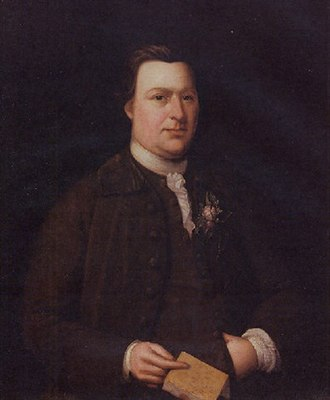
Button Gwinnett (March 3, 1735 – May 19, 1777) was a British-born American Founding Father who, as a representative of Georgia to the Continental Congress, was one of the signers (first signature on the left) of the United States Declaration of Independence.[1]
Gwinnett was also, briefly, the provisional president of Georgia in 1777, and Gwinnett County (now a major suburb of metropolitan Atlanta) was named for him. He was named in honor of his mother’s cousin, Barbara Button, who became his godmother.[2][3] Gwinnett was killed in a duel by rival Lachlan McIntosh following a dispute after a failed invasion of East Florida.
Early life and education
 Coat of Arms of Button Gwinnett
Gwinnett was born in 1735 in the parish of Down Hatherley in the county of Gloucestershire, England, to a Welsh father, the Reverend Samuel Gwinnett, (Gwinnett deriving from the Welsh kingdom of Gwynedd) and his wife, Anne. He was the third of his parents' seven children, born after his older sister Anna Maria and his older brother Samuel. There are conflicting reports as to his exact birthdate, but he was baptized in St Catherine's Church in Gloucester on April 10, 1735. It is believed that he attended the College School, held in Gloucester Cathedral (now called The King's School) as did his older brother, but there is no surviving evidence to substantiate this.
He started his career apprenticed to his uncle William Gwinnett, a greengrocer in Gloucester, then moved to Wolverhampton in Staffordshire in 1754 after obtaining a further apprenticeship with an ironmonger there named John Weston Smith. On 19 April 1757 he married Ann Bourne, daughter of a greengrocer, at St. Peter's Church, Wolverhampton. In 1762, the couple, who parented three daughters, departed Wolverhampton and emigrated to America.[4]
Gwinnett's business activities took him from Newfoundland to Jamaica. Never very successful, he moved to Savannah, Georgia, in 1765, and opened a store. When that venture failed, he bought (on credit) St. Catherine's Island,[5] as well as a large number of enslaved people,[6] in order to attempt to become a planter. Though his planting activities were also unsuccessful, he did make a name for himself in local politics and was elected to the Provincial Assembly.[7]
Political career
Gwinnett did not become a strong advocate of colonial rights until 1775, when St. John's Parish, which encompassed his lands, threatened to secede from Georgia because of the colony's conservative response to the events of the times. During his tenure in the Assembly, Gwinnett's chief rival was Lachlan McIntosh, and Lyman Hall was his closest ally.[8]
Gwinnett was appointed to represent Georgia at the Continental Congress, where he voted in favor of the Declaration of Independence, adopted by Congress on July 2, 1776. He signed the famous parchment copy on August 2, 1776. After signing the Declaration, he was accompanied as far as Virginia by Carter Braxton, another of the signers, carrying a proposed state constitution drawn up by John Adams. During his service in the Continental Congress, Gwinnett was a candidate for a brigadier general position to lead the 1st Regiment in the Continental Army but lost out to McIntosh. The loss of the position to his rival embittered Gwinnett greatly.
Gwinnett served in the Georgia state legislature, and in 1777 he wrote the original draft of Georgia's first state constitution. He became Speaker of the Georgia Assembly, a position he held until the death of the President (Governor) of Georgia Archibald Bulloch. Gwinnett was elevated to the vacated position by the Assembly's Executive Council.[9] In this position, he sought to undermine the leadership of McIntosh. Tensions between Gwinnett and McIntosh reached a boiling point when the General Assembly voted to approve Gwinnett's attack on British Florida in April 1777.[10]
Death
As acting Delegate of the Congress from Georgia and commander-in-chief of Georgia's military, Gwinnett was the superior of his rival McIntosh. Gwinnett had McIntosh's brother arrested and charged with treason. He also ordered McIntosh to lead an invasion of British-controlled East Florida, which failed. Gwinnett and McIntosh blamed each other for the defeat, and McIntosh publicly called Gwinnett "a scoundrel and lying rascal".[11]
Gwinnett then challenged McIntosh to a duel, which they fought on May 16, 1777, at a plantation owned by deposed Royal Governor James Wright.[12] The two men exchanged pistol shots at twelve paces, and both were wounded.[13] Gwinnett died of his wounds on May 19, 1777, and is believed to have been buried in Savannah's Colonial Park Cemetery.[14][15] McIntosh, although wounded, recovered and went on to live until 1806. He was not charged in connection with Gwinnett's death.
Legacy
Gwinnett's autograph is highly sought by collectors as a result of a combination of the desire by many top collectors to acquire a complete set of autographs by all 56 signers of the U.S. Declaration of Independence, and the extreme rarity of the Gwinnett signature; there are 51 known examples,[16] since Gwinnett was fairly obscure prior to signing the Declaration and died shortly afterward. Only ten of those are in private hands.[17] The 1953 Isaac Asimov short story "Button, Button" concerns an attempt to obtain a genuine (and therefore valuable) signature of Gwinnett by means of a device that can move objects through time.
Gwinnett County, Georgia, a suburban county outside Atlanta, is named after him[18] and he is one of the three Georgia signers of the Declaration of Independence honored with the Signers Monument in Augusta.[19]
See also

- Memorial to the 56 Signers of the Declaration of Independence
- List of U.S. state governors born outside the United States
Killed in duel soon after signing, this expression “rarer than BG” ref to autograph
[The Name's Familiar II - Laura Lee - Google Books
-=-=
AMERICAN CONNECTIONS
BUTTON GWINNETT (GA) was forty-one. An immigrant
from England, he failed at business and farming so went into local
Georgia politics, organizing the left-wing back-country vote. After
signing in Philadelphia Gwinnett went home and got embroiled in rows
about who ran the military. Of which there were two kinds: continental
troops and Georgia militia.
Gwinnett's political archrival Lachlan Macintosh commanded the troops
and Gwinnett the militia.
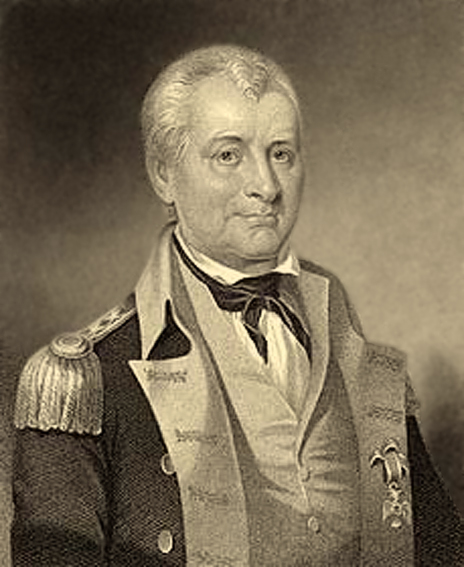
In 1777, while Gwinnett was president of
Georgia, an attack was mounted on British Florida and Gwinnett took
political control of all troops. The attack failed, Macintosh blamed
Gwinnett, and they dueled. Both were hit, but Gwinnett died from his wounds. The following year another unsuccessful attack was mounted. The Brits took Savannah
and other bits of Georgia.
On this occasion the Brits were led by General Augustine Prevost, whose
brother was also a general but not so good at it.
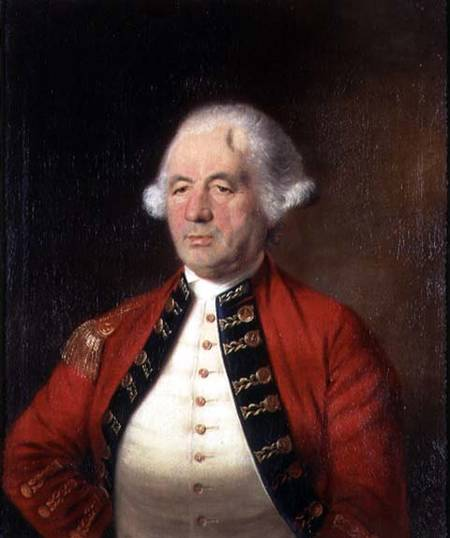
After a period in the Caribbean (governing various islands), in 1811 George Prevost became commander-in-chief, British forces in North America. So when 1812
happened it was his job to invade the United States. He made two
attempts and failed both times (earning from his troops the nickname:
"our little nincompoop").
Back in the Caribbean one of Prevost's personal staff had been army
officer Colquhoun Grant.
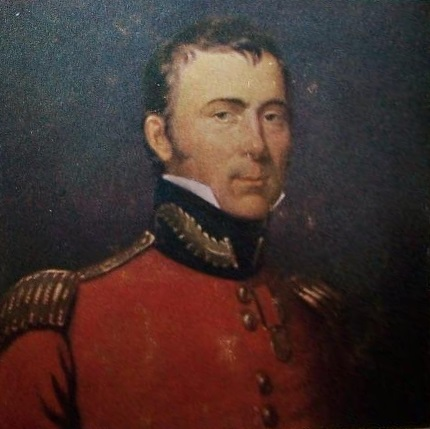
By 1811 Grant was in Spain where the Duke of
Wellington was fighting Napoleon. Grant was a brilliant linguist whose
job was to get behind enemy lines and relay intel back to Wellington.
Grant never thought of himself as a spy, and always rode in full uniform, often behind enemy lines, to note the positions and strength of the enemy.
Grant was captured by French forces on 16 April 1812. As he was in uniform, he was treated as an officer and gentleman by his captors, who offered him parole, which Grant accepted. His servant Leon, a local guide, was not so fortunate, and was shot.
When he was captured and taken to Salamanca he escaped and was able to
get to Paris by masquerading as an American officer. Finally he made it
back to his boss, who promoted him head of Intel.
Grant's escape from Salamanca had been facilitated by Patrick Curtis,
rector of the Irish College in Salamanca, another of Wellington's spies
and professor of astronomy at the local university. In 1817 he retired
to Dublin, where in 1818 he put his name forward for the vacant Catholic
archbishopric of Armagh and was astonished when the pope said yes. In
1823 Curtis's Protestant counterpart in Armagh (the primate of the
Church of Ireland) appointed a new director of the Armagh Observatory.
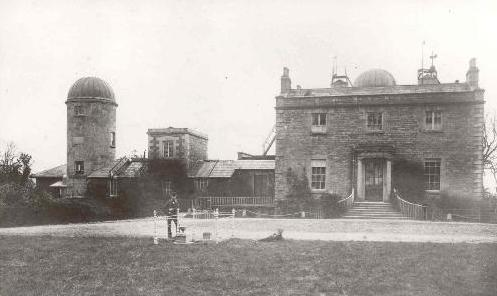
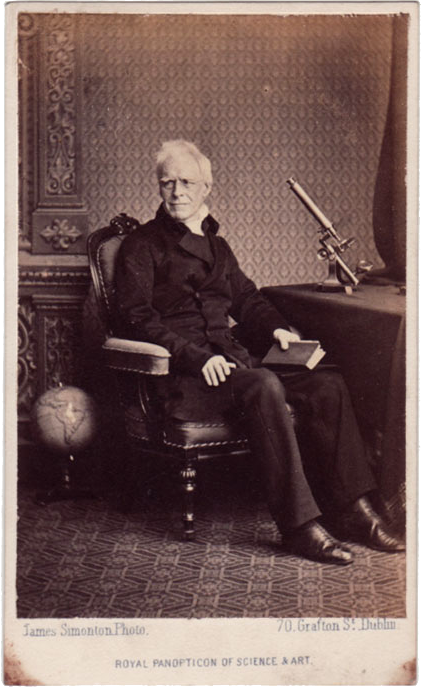
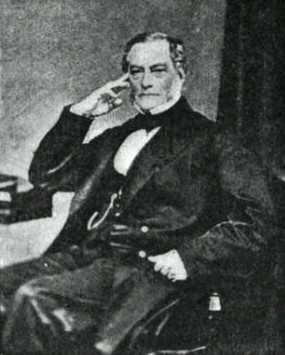
The Reverend Romney Robinson had started as a child prodigy at Belfast
Academy, then (aged twelve) went to Trinity College, Dublin, where he
was elected a fellow at eighteen. Once in position at Armagh he did a
5,345-star catalog and generally kept busy for fifty-nine years (longest
observatory directorship in history).
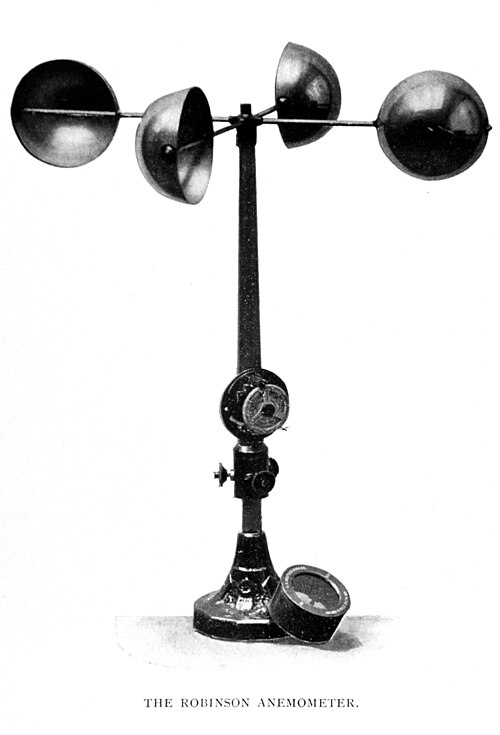
He also invented the
(now-standard) cup-anemometer for measuring wind speed.
He also generally re-equipped the observatory with the help of Dubliner Thomas Grubb.
Whose experience as a cast-iron billiard-table-maker gave him a flair
for the heavyweight, so he made particularly good large telescopes. In
Armagh's case a fifteen-inch reflector with a clock drive (it moved the
telescope four degrees a minute so it could follow the same star while
the Earth turned). Telescopy paid badly, so Grubb's day job was at the
Irish Bank making machines for designing, printing, and numbering
banknotes.
His firm was instrumental to the war efforts in World War I and would change its focus from telescope making to aiding the allies in their war efforts.[4]^ This would include the creation of gun-sights[13]^ and submarine periscopes.[11]^ The escalation of the war – particularly in 1916 – caused the firm to be under military guard.[11]^ In 1918, the factory would be moved to St. Albans, England in fear that Grubb-Parsons would be vulnerable in the weaker Ireland.[11]^
Back in 1837 Grubb also turned out twenty sets of magnetometers for the
Trinity College prof. of science, Humphrey Lloyd. Whose plan was to set
up a network of magnetic stations on British colonial sites around the
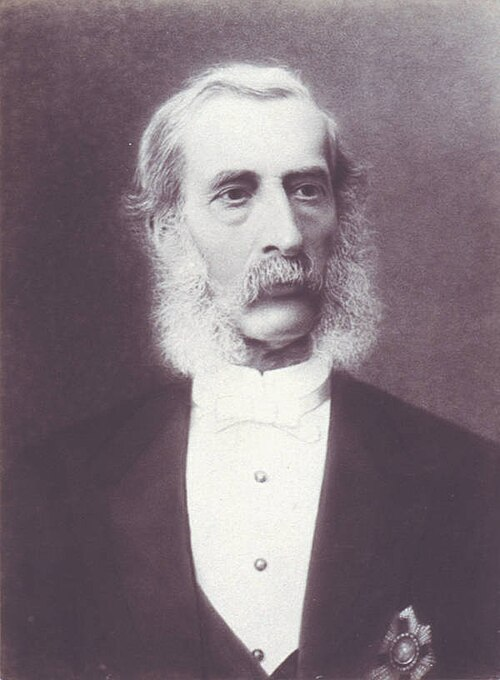
empire. In 1839 Lloyd spent the summer training a young army lieutenant
in magnetic matters. John Lefroy (evangelical, Sunday school teacher in
his spare time) set off to measure magnetism on the mid-Atlantic island
of St. Helena (the circuitous route via the Canaries, Cape Verde, and
Trinidad took them three months).
Two years going nowhere on St. Helena
were followed by a spectacular 5,475-mile trip in Canada (by canoe and
snowshoe) taking 314 magnetic observations along the way.
While he was on St. Helena, Lefroy was able to watch the disinterment of
one of history's more magnetic personalities. On October 8, 1840, two
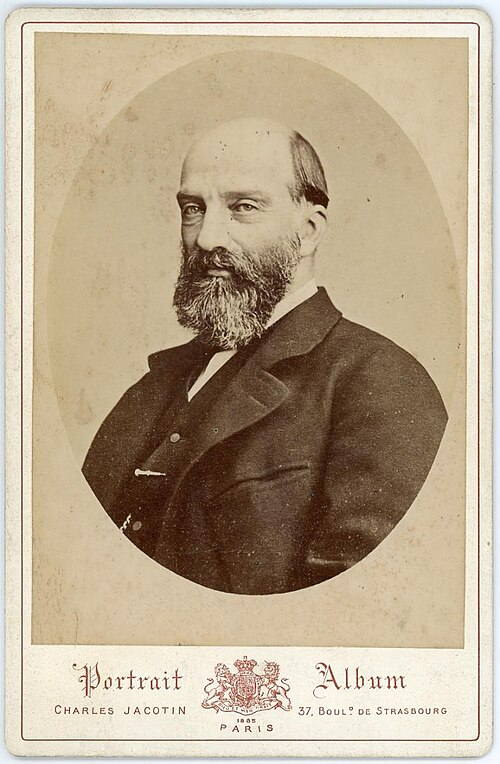
French warships arrived carrying Prince de Joinville (French King
Louis-Philippe's son) and various harrumphs, everyone in full dress and
medals.
Over the next few days they and the Brits running St. Helena
argued about how many guns' salute the about-to-be-dug-up Napoleon would
get (French: "103"; British: "21").
At midnight on October 15, they started excavating. At 9:00 A.M., they hauled up the box and opened it. The emperor (in perfect condition) was transferred to an
ebony coffin inside an oak sarcophagus and hauled down to the harbor.
Commemorative gifts were handed out all round (except, for some reason,
to Lefroy) and the ships made off, throwing much of their furniture and
equipment overboard to make better speed. By the way: twenty-one guns.
Upon his return to London in April 1853, Lefroy held various office positions in the British Army. He became involved in the army reform, and in that function corresponded from 1855 to 1868 with Florence Nightingale*.* During the Crimean War he began the negotiations that would eventually see the Dardanelles Gun being gifted to Britain.[3]^
Back home the Revolution of 1848 then sent Prince de Joinville off to
exile in England. In 1861 he arrived at the White House asking if there
was anything a French prince could do to help.
He placed the services of his son and two of his nephews at the disposal of the government.[1]^ President Lincoln appointed him and his nephews to the staff of Major General George B. McClellan.[3]^ In June 1862, disagreements with the US position towards Mexico caused the prince to withdraw from the Union forces, and he returned to Europe.[3]^
In earlier in 1862 he found himself witnessing the first successful Union Balloon Corps flights at the battle of the Chicahominy when "Professor" Thaddeus Lowe got to a thousand feet and reported on what he could see of Confederate movements
(including useful stuff like where the enemy artillery was and in which
direction to fire).
This happened because Lincoln had earlier been impressed by Lowe's
hovering five hundred feet above Washington, D.C., and sending telegraph
messages down a wire. The man who arranged Lowe's presidential demo was
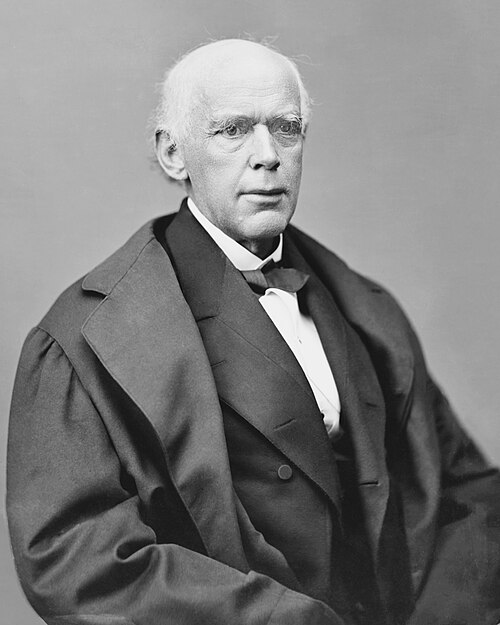
A radical abolitionist campaigner who had spent a number
of years earning the name "Attorney General of Fugitive Slaves," Chase's
view was that the Constitution left slavery up to the individual states,
so blacks were only slaves in slave states. In 1861 Lincoln appointed
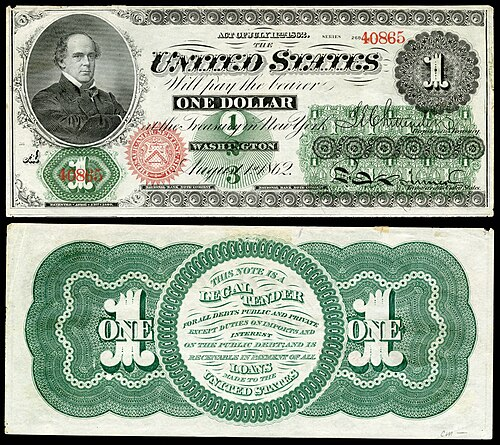
Chase secretary of the Treasury. In order to finance the war, Chase
established paper money as legal tender (the first "greenbacks") and set
up a national banking system.
He then added insult to injury with a new
"Internal Revenue Service" set up to collect the first "income tax."
He took part in reconnaisance that led to the Confederates' ironclad, the CSS *Virginia.[32]^ Chase's participation in the reconnaissance ended with the surrender of Norfolk and the destruction of the *Virginia.[33]^
Part of Chase's mandate was to deal with Confederate estates abandoned
by their proprietors. On the South Carolina Sea Islands the local
plantation owners had fled the scene, quitting their land and ten
thousand now-unemployed not-free-not-slave blacks. Seeing the
opportunity for a rehearsal of postwar Reconstruction, in 1862 Chase set
up the Port Royal Experiment, designed to educate and prepare freed
slaves for life after Union victory. Hospitals and schools were set up
on the islands and land was offered to those who'd worked it, at
twenty-five cents an acre.
The Port Royal Experiment initiated a systematic outcry for the education of the freed slaves. Numerous organizations were established and continued educating the freed people. On March 3, 1865, roughly two months before the end of the Civil War, the Freedmen's Bureau was established. Within the next five years, it had established 4,239 schools, employed 9,307 teachers, and instructed 247,333 students.
Once Lincoln was assassinated, the price of land was hiked to
eleven bucks. No freed slave could afford that price, the entire scheme
fizzled, and by 1865 most of the original owners were back in place,
paying slave wages to their now-free workers.
Disappointed Port Royal Experiment volunteers included Charlotte Grimke,
who'd volunteered to teach in the scheme and spent a year there before
ill health forced her resignation.
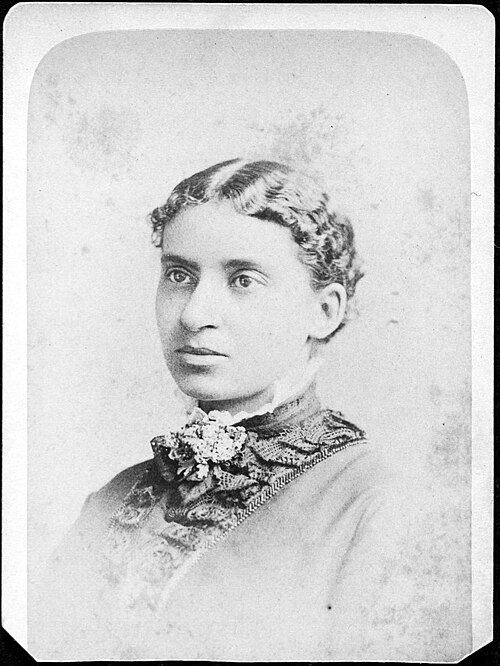
Grimke was a rarity for 1862: a woman who was well-educated, literate, intelligent, cultured, multilingual, and black. In 1864 her account of the Experiment appeared in The Atlantic Monthly.
Forten struck up a deep friendship with Robert Gould Shaw, the Commander of the all- Black 54th Massachusetts Regiment during the Sea Islands Campaign.
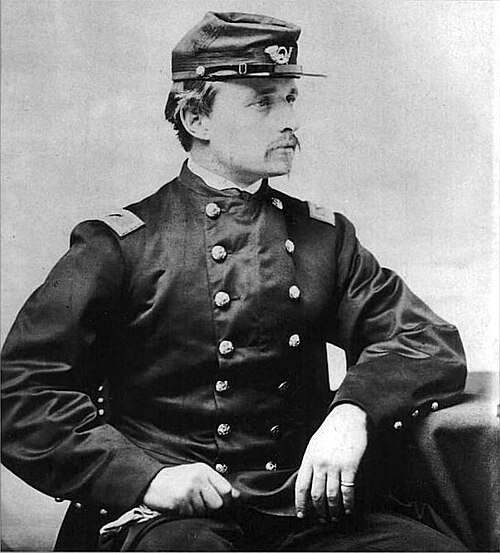
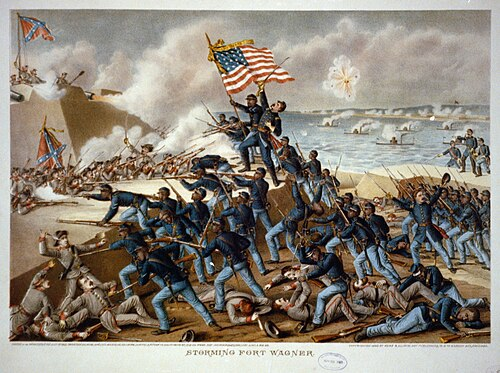
She was present when the 54th stormed Fort Wagner on the night of July 18, 1863. Shaw was killed in the battle, and Forten volunteered as a nurse to the surviving members of the 54th.
Five years later came her translation of the French
play Madame Thérèse, written by a duo from Alsace, France.
Emile Erckmann wrote and Charles Alexandre Chartrain arranged the
publishing. They produced more than twenty novels and short stories
under the pseudonym Erckmann-Chartrain. One of their plays Le Juif
Polonais) was to establish the career of Britain's premier
Victorian actor, after being translated by a nondescript ex-lawyer named
Leopold Lewis and titled The Bells.
Today the the play is stock for student and amateur drama groups because
it requires little skill and less subtlety (tavern-keeper in debt
welcomes rich Jewish overnight guest, murders him for his money, then
dies of horror at hearing the merchant's ghostly sleigh bells). In 1871
when a new young actor named Henry Irving went into melodramatic
overdrive in the lead role at the Lyceum Theater, London, he became an
overnight sensation. And never looked back.
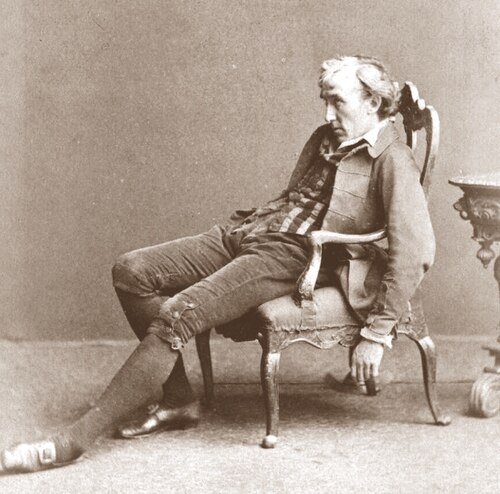
As the haunted murderer Mathias in The Bells, 1872
Irving played every role to excess. And in an era of amazing new electricity he kept the old-fashioned gas and limelight for maximum dramatic effect. Bram Stoker was his business manager. In 1878 he and new acting partner Ellen Terry did Shakespeare from A to Z.
Including four tours in America, where in 1885 they played Much
Ado to full houses at the Columbia Theater, Chicago. Watched
from the front stalls by Marshall Field and son.
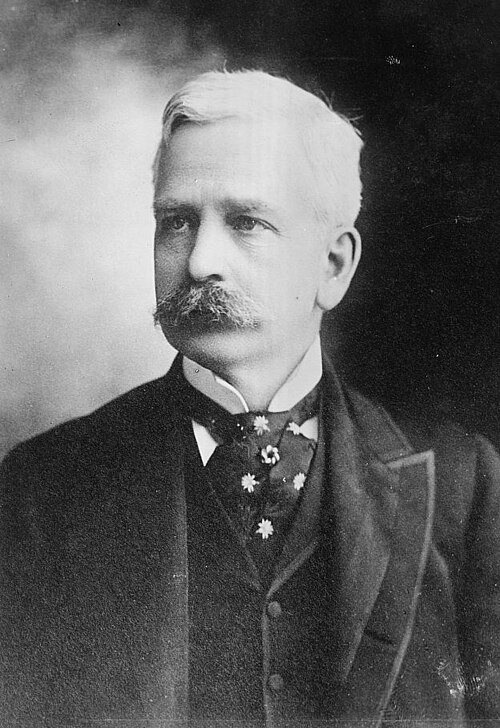
Field was dry goods from the age of seventeen. Arriving in Chicago in 1856 he worked his way up (in dry goods) to a partnership. Bought his partner out. Set up
Marshall Field and Company in 1881. Went from dry goods to retail, the
first store with an overseas buying office (in Manchester, England), and
one of the first with fixed prices and full refund. Field got very rich
and gave lots of it away to the University of Chicago, the Academy of
Fine Arts, and the Field Museum. The museum and its collections originated from the 1893 World's Columbian Exposition and the artifacts displayed at the fair.[11][12]^
Field was a very active member of the the Jekyll Island Club, also known as the Millionaires Club, on Jekyll Island, Georgia. Its members came from many of the world's wealthiest families, most notably the Morgans, Rockefellers, and Vanderbilts. In November 1910, leading members of the American financial sector, including Paul Warburg and members of J.P. Morgan, met on the island in secret to draft legislation for a central bank which would later influence the Federal Reserve Act.
Field died in New York City, New York, on January 16, 1906, at age 71 of pneumonia contracted after playing golf on New Year's Day with his nephew, his secretary, and Abraham Lincoln's eldest son Robert Todd Lincoln.[13]^
Earlier he spent over eight hundred thousand dollars on his new Chicago store. One of the finest examples (they say) of "Richardsonian Romanesque."
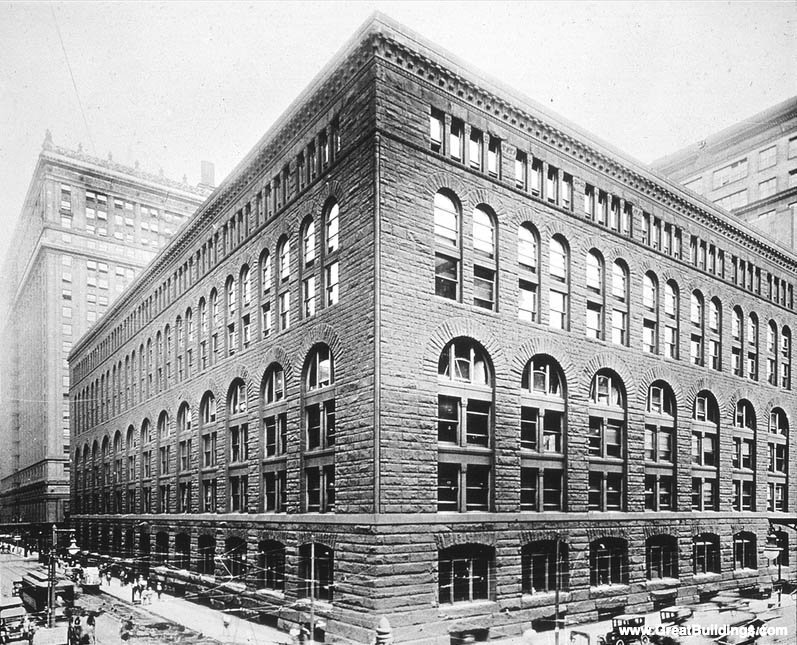
H. H. Richardson had a thing for the eleventh-century Romanesque
architecture of southern France (massive walls, semicircular arches).
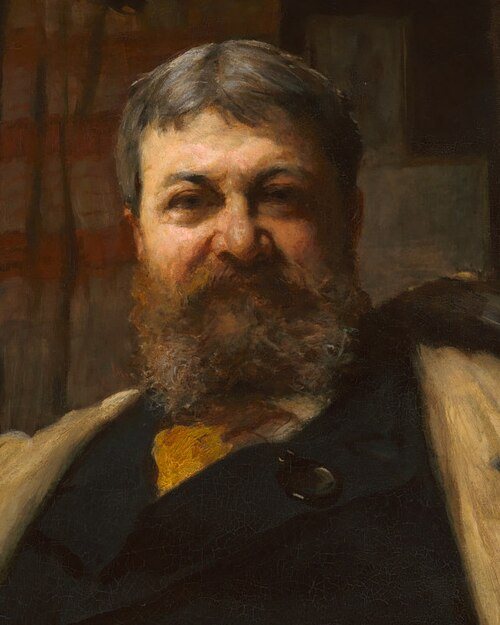
He set the style for a Romanesque Revival in the United States with his
Trinity Church, in Boston. Loved or hated. Never ignored. Along with Louis Sullivan and Frank Lloyd Wright, Richardson is one of "the recognized trinity of American architecture."[1]^
He was also the great-grandson of inventor and philosopher Joseph Priestley, who is usually credited with the discovery of oxygen.[5]^
Richardson influenced people like Frank Lloyd Wright and Fenimore C. Bate, whose
pièce de résistance (in more ways than one) was a Disney-before-Disney
castle on Bolivar Street, Cleveland. The Grays' Armory was supposed to
be an arsenal and drill hall but soon turned into a social center
(Sousa, boxing matches, proms). In 1918 the armory hosted the opening
night of the new Cleveland Orchestra.
Six years later the orchestra took on press agent James Thurber, who'd
just spent four years as reviewer for the Columbus Evening
Dispatch.
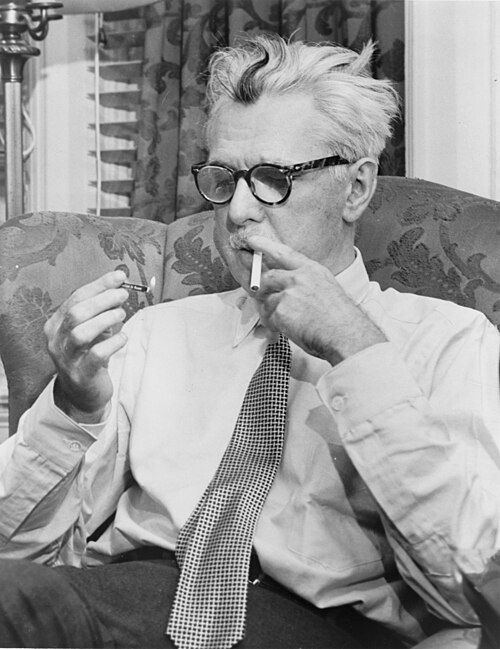
In February 1927 Thurber met E. B. White at a party in Greenwich Village. White was working at The New Yorker, and helped Thurber to get hired there. Soon he was on his way to fame, especially for his delicious cartoons of aggressive women, bewildered men, and amorphous dogs.
In the 40's he struggled with alcohol while living on Martha's Vineyard; there While recuperating, Thurber met Mark Van Doren, and they become lifelong friends. A bit later in New York City, as he could not drive he had to rely on the New Yorker office boy to chauffeur him; this was the young Truman Capote, then eighteen years old.
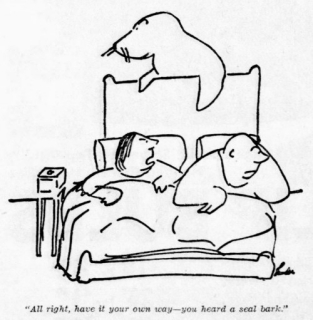
During the anti-Communist McCarthy years, in the 1950s, Thurber was never subpoenaed by Congress or harassed for his occasionally liberal views.[158][note^ ^9]^ He was and had always been opposed to communism, but was outraged by the treatment of his fellow writers.[159]^
He is best remembered for The Secret Life of Walter Mitty, filmed
in 1947 and starring Danny Kaye.
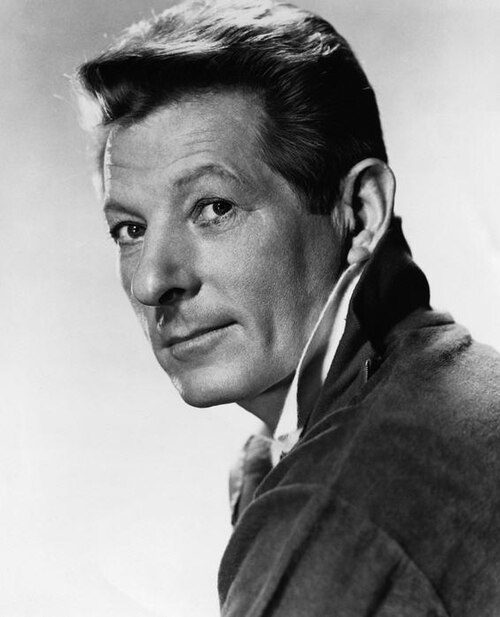
A year later Kaye was at the London
Palladium for the first of four tours of the United Kingdom, where he
was a sensation, especially with the royals.
In 1952 Kaye took with him an English pop group, the Beverley Sisters, their style was loosely modelled on that of their American counterparts, The Andrews Sisters.
who were in the States at the time. Thanks to Kaye, their Palladium
debut began a singing career that was still going strong in 2005. In
1958 Joy Beverley married Billy Wright, soccer star of Wolverhampton
Wanderers. Wright became a national hero, playing for England 105 times
and captaining the national team ninety times (including three World Cup
finals). In 1994 he died, and his funeral at St. Peter's Church,
Wolverhampton, brought the city to a standstill.
In the church births-marriages-and-deaths register, together with
Wright's name there are baptismal records for three eighteenth-century
girl babies. The first (Amelia) was christened in 1758, the second (Ann)
in 1759, and the third (Elizabeth) in 1762, just before the family left
for America with their father, whose marriage is also recorded in St.
Peter's parish register.
The little girls' father was BUTTON GWINNETT.