Smith, James
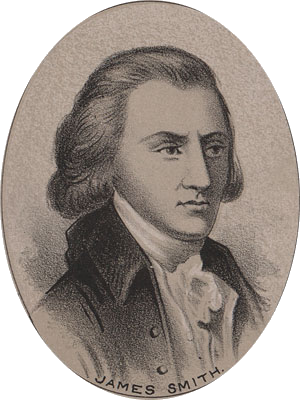
James Smith (September 17, 1719[1][2] – July 11, 1806), a Founding Father of the United States, was an Irish/American lawyer and a signer to the United States Declaration of Independence as a representative of Pennsylvania.
He was born in Ireland; his family immigrated to Chester County, Pennsylvania, in 1729.[1] Smith attended the Philadelphia Academy.[3] He studied law at the office of his brother George and was admitted to the bar in Pennsylvania, initially practicing near Shippensburg and later near York.[4] He became captain of the militia there. He was appointed to the provincial convention in Philadelphia in 1775, to the state constitutional convention in 1776, and was elected to the Continental Congress, where he signed the Declaration of Independence. He was reelected to Congress in 1785 but declined to attend because of his advanced age.
Smith died on July 11, 1806, and is buried in York, Pennsylvania, First Presbyterian Churchyard. The University of Delaware has a dormitory on its North Campus bearing his name.
See also
References...
External links
- http://www.libraryireland.com/biography/JamesSmith.php
- Biography by Rev. Charles A. Goodrich, 1856
- United States Congress. "James Smith (id: S000558)". Biographical Directory of the United States Congress.Categories:
- 1719 births
- 1806 deaths
- People from Ulster
- American Presbyterians
- Presbyterians from Pennsylvania
- American people of Scotch-Irish descent
- Continental Congressmen from Pennsylvania
- 18th-century American politicians
- Signers of the United States Declaration of Independence
- Foundrymen
- Irish writers
- University of Pennsylvania alumni
- Politicians from York, Pennsylvania
- Politicians from Chester County, Pennsylvania
- 18th-century Irish people
- 19th-century Irish people
- Founding Fathers of the United States
James Smith (Pennsylvania politician) - Wikipedia
AMERICAN CONNECTIONS
JAMES SMITH (PA) was about sixty-three. And
thinking ahead. When he wrote his name on the Declaration, Smith was
already on the committee set up to plan the structure of postwar
government. Although colleagues called Smith eccentric he was
essentially a quiet, no-fireworks, behind-the-scenes guy. Smith had
started in law, then given that up for iron-making, then given that up
for law again.
In 1784 he acted as counselor for Pennsylvania in one of those
half-forgotten affairs that occurred so often immediately after
Independence while things were still settling down. Or in this case,
not. Smith's legal brief regarded a disagreement that hadn't been
resolved in more than a hundred years. Back in 1684 King Charles II had
relied on guesstimate maps to grant Pennsylvania a charter for settling
a piece of land. Unfortunately the grant-to-settle rights for the same
land had previously also been given (by the same king, using a different
map) to Connecticut. Seems crazy but back in those days, who knew?
The location in question was the Wyoming Valley in western Pennsylvania
(or Connecticut, if you saw things that way). In 1783 Connecticut
settlers were driven out of the valley by Pennsylvanians at a cost of
150 lives and thousands of refugees. But all was not over. In 1786 Ethan
Allen arrived with some of his Green Mountain Boys, offering the
Connecticut Wyoming settlers help in setting up a new state (to be
called Westmoreland).

Allen had done the same state-forming thing once
before when he'd declared independence from New York state of an area of
green mountain country on the Canadian border.
Before the place (Vermont) was finally admitted as a state of the Union,
Allen had even flirted for two years with the idea of secession to
Canada (see elsewhere).
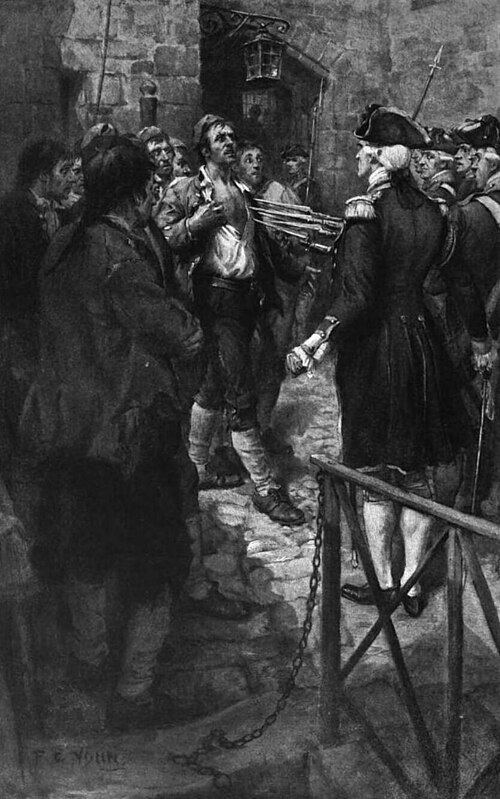
Engraving depicting Allen before his captors in Montreal
At one point during all this he was involved in
naming a town (St. Johnsbury) after a French friend, Hector St. John de
Crèvecoeur, who wrote a book of fictional letters from a "Farmer James"
describing life in rural America and asking for the first time: "What is
an American?" (Crèvecoeur's answer: a new man, with new principles, free
of European prejudice.)
Neutral during the war, Crèvecoeur made several U.S.-France trips.
In 1779, during the American Revolutionary War, Crèvecœur tried to leave the country to return to France because of the faltering health of his father. Accompanied by his son, he entered British-occupied New York City, where he was imprisoned as a suspected American spy for three months. Eventually, he was released and sailed for England, but was shipwrecked off the coast of Ireland.[1]^ From England, he sailed to France, where he was briefly reunited with his father.
Back in Paris he was hailed as his own best example of "American new man" and
became the darling of salon chatterers. After a first publication
(successful) in London, in 1793 his Letters from an American
Farmer appeared in Philadelphia published by Matthew Carey,
aka "Scriblerius O'Pindar."
The pseudonym was for Carey's protection,
since he tended to make powerful enemies for whose jugular he'd
journalistically gone. On the run from British-ruled Ireland (for
penning revolutionary stuff about giving Catholics the vote), Carey met
and impressed the Marquis de Lafayette, who loaned him four hundred
dollars to start his first American newspaper, the Pennsylvania
Herald (it failed). Carey also produced the first American
atlas, (under his son, the Encyclopedia Americana ; Joseph Bonaparte, former king of Naples and Spain and older brother of Napoleon Bonaparte, contributed to the Americana; his contributions on French topics include a 25,000-word biography on the former emperor of France, which was the encyclopedia's longest biographical article.[2]^
In 1848, John Sutter read the encyclopedia's article on "Gold" as part of his efforts to verify the authenticity of the gold found in his mill, a discovery that would start the California Gold Rush.[6]).
Carey also started the first American Sunday school society, and had a very
boring brother.
John Carey taught classics, French, and shorthand in London. He wrote
essays (now long forgotten), edited a series of fifty classical texts
(now long unread), and produced the best insomnia cure of all time:
Latin Prosody Made Easy. In 1803 he had an idea: save souls
from shipwreck by shooting (at them, from the shore) a wooden ball on a
line. Said endangered souls would then haul in the line attached to rope
with which they would then be then pulled to shore. Carey did nothing
more about it. In 1808 George Manby came up with the same idea, inspired
by the loss of the Snipe, which foundered (and all aboard
were drowned) within sight and sound of the beach.
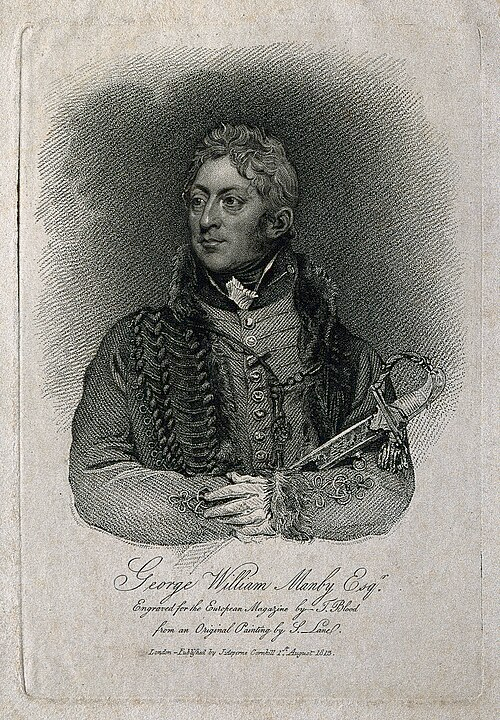
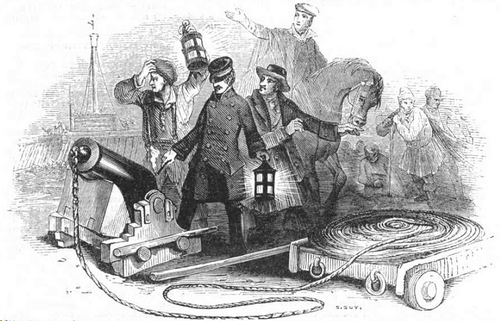
Manby (at one point he had been shot in the head and tended to behave oddly) went on to invent ways of catching people jumping from burning buildings or saving
those who had fallen through ice, as well as the first pressurized
portable fire extinguisher and a harpoon. This last he tried out when in 1821, he sailed to Greenland with William Scoresby, for the purpose of testing the new type of harpoon for whaling, based on the same principles as his mortar (see explosive harpoon). However, his device was sabotaged by the whalers.[11]
Around 1810 Manby took another of his bright ideas (how to assassinate
Napoleon) to an old political pal, the Honorable Charles Yorke. Who
turned down more government jobs than most: ambassador to Russia,
governor of Madras, governor of Jamaica, surveyor of forests, and member
of the board administering India. He accepted secretary of war, wrote a
book on Egyptian monuments in the British Museum, and generally made no
mark on parliamentary history. He did, however, support the launch of
the Royal Military College, Sandhurst.
Whose architect was James Wyatt. You loved or hated him. He had an
infuriating tendency to enthuse about a project till it started and then
lose interest. Nonetheless, at twenty-six he was architect of choice if
you had a falling-down country mansion to renovate. Wyatt traveled an
amazing four thousand miles a year in his coach complete with office and
drawing board (when it was rumoured that he was about to leave the country to become architect to Catherine II of Russia, a group of English noblemen is said to have offered him a retaining fee of £1,200 to remain in their service).
After sprucing up the abodes of royalty (Windsor Castle)
and various dukes, Wyatt turned to the restoration of Gothic cathedrals.
Wyatt's "restoration" meant ripping out anything later than medieval
(such as carved screens, chapels, and porches) as well as moving tombs
and other memorabilia into neat, orderly rows between the aisles. This
good work earned Wyatt his nickname: "the destroyer."
Not everybody hated Wyatt's stuff. One fan was a philandering German
dissolute, Prince Puckler-Muskau, a dashing ex-cavalry officer who dyed
his hair and was also an accomplished landscape gardener.
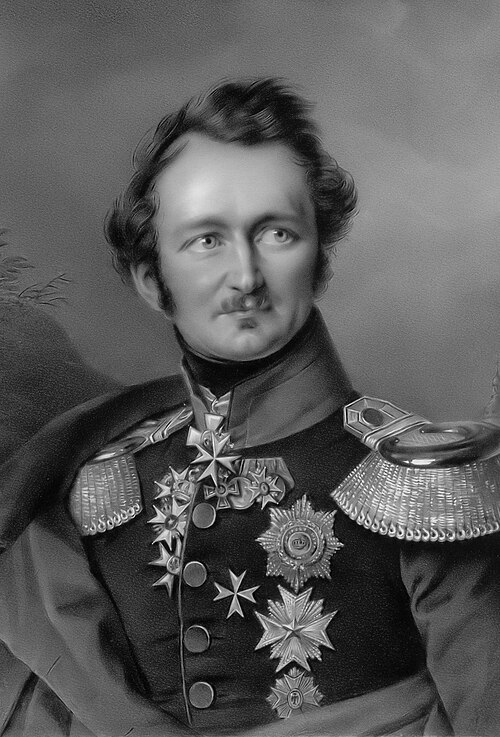
In 1827, having spent all his wife's money and then divorced her, he was in
England taking in the sights, meeting royalty and Sir Walter Scott, and
sleeping with every woman he could persuade. His predilection seems to
have been for vicars' daughters, sisters, and actresses.
After his England visit he published a selection of the letters he'd
written home. The book caught the attention of Sarah Austin. Just the
kind of woman Puckler-Muskau fancied. Sarah was beautiful, sensuous, and
married to a cold-fish professor of jurisprudence who had bad health and
hangups. Sarah spent a year in Bonn learning German and in 1832
translated Puckler-Muskau's work as: Travels of a German Prince in
England. She also began a correspondence with him that verged
on the pornographic. There was much talk of dreams. By 1835 after
Puckler-Muskau had offered to come and "visit" and she'd said no, the
prince headed for Africa.
Sarah turned to another translation job which she referred to as "dry."
Report on the State of Public Instruction in Prussia had been
compiled in 1832 by France's leading thinker and molder of public
opinion, Victor Cousin. It outlined the kind of educational system
Cousin wanted France to have: compulsory primary school attendence for
both boys and girls (and punishment of parents who failed to send them),
standardized curriculum, textbooks produced by the state, state control
over teacher training, and of course, state funding.
When Sarah's translation of Cousin arrived in America, the book was just
what Horace Mann was looking for.
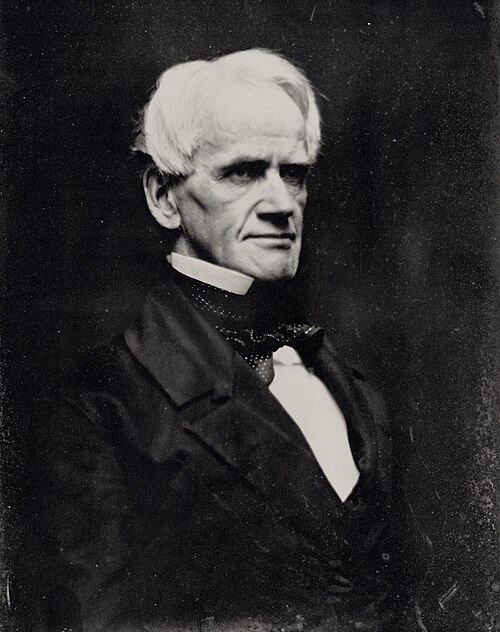
Mann was secretary to the Massachusetts Board of Education and he had already opened a couple of teacher-training schools. Mann also visited Germany during his honeymoon in 1844 and came home fired up for reform. Above all Mann wanted to take
religion out of schools. Over the next few years Mann increased
teachers' salaries by 50 percent, opened fifty new public high schools
that used standard textbooks published in Boston, and finagled more than
$2 million out of the state to pay for it all. The rest of America soon
followed Mann's inspiring example.
In the early 1850s Mann's sister-in-law and her short-of-cash husband
came to stay on their way to Liverpool, England, where the husband
(Nathaniel Hawthorne, by this time famous as the author of The Scarlet
Letter and The House of Seven Gables) was to be
U.S. consul. After Liverpool in 1857 the couple headed for Italy where
they met the expat community toughing it out in Florence. These
lotus-eaters included poets Robert Browning and Elizabeth Browning and Walter
Leader of the esthete Florentine layabouts was Seymour Kirkup, a Brit
painter with (it was said) too much money and not enough talent. And who
by this time had been in Florence for more than thirty-three years
complete with three mistresses and offspring. Kirkup had been a disciple
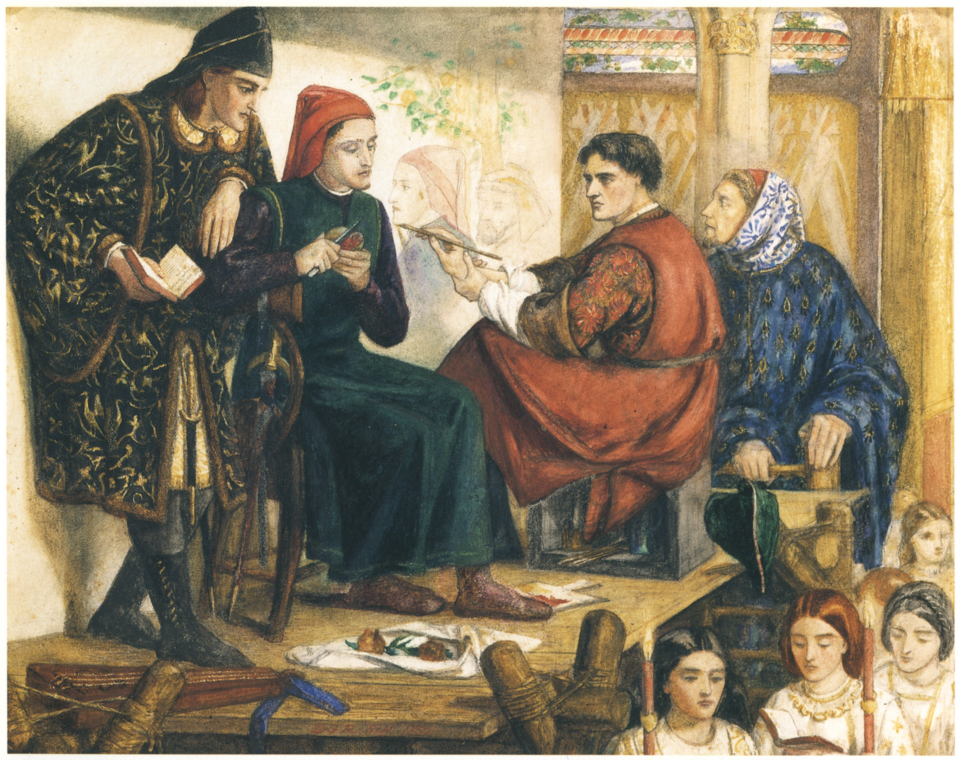
of the London-based Dante scholar Giuseppe Rossetti (Italian nobleman, poet, constitutionalist, scholar, and founder of the secret society Carbonari) and knew about the Lost Giotto Portrait of Dante Hidden Somewhere in Florence. On July 21,
1840, he found the fresco, covered over with whitewash, on a wall in the
Bargello. So he sent a tracing to Rossetti. Who showed it to his son
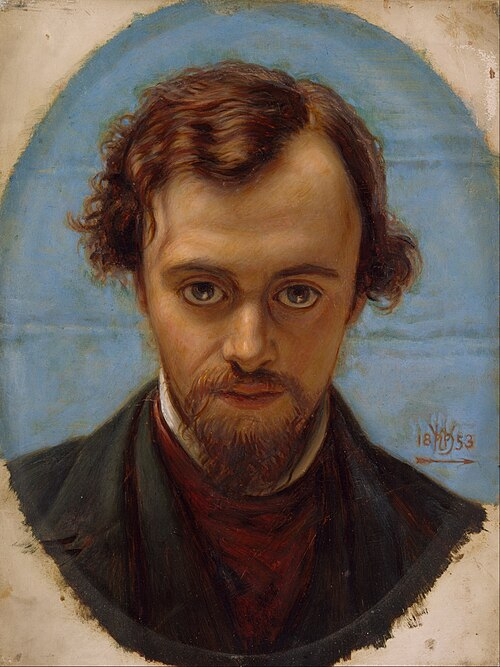
Who painted Giotto Painting Dante's Portrait.
D. G. Rossetti was part of the group of artists known as the Pre-Raphaelite Brotherhood
whose aim was to return to the medieval simplicites of art before
Raphael. Great if you liked spun sugar. Or woodsy wallpaper such as that
produced by fellow PRB member William Morris, designer to a middle class
now yearning to forget the industrial world outside their windows.
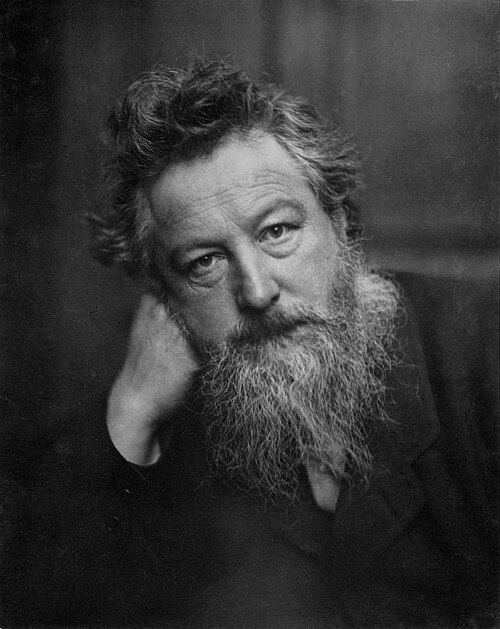
In 1870 Morris spent a year in Iceland (where the communitarian lifestyle
fired his socialist imagination) and then translated a medieval
Icelandic saga. He went on to do the same for the Anglo-Saxon epic
Beowulf.
This medievalist aspect of Morris's work (and indeed the entire
Pre-Raphaelite range of product) was, between 1936 and 1945, to inspire
Anglo-Saxon scholar J. R. R. Tolkien to write the great Lord of the
Rings trilogy (Tolkien considered much of his literary work to have been inspired by an early reading of Morris, even suggesting that he was unable to better Morris's work; the names of characters such as "Gandolf" and the horse Silverfax appear in The Well at the World's End ). At the time Tolkien was philology (James Burke studied this at Oxford) professor at Pembroke College, Oxford, where one of his colleagues was modern historian Ronald McCallum. Whose forte was political analysis (he coined the word
"psephology": the study of polls). While in Oxford, McCallum was an irregular attender of the Inklings, an informal literary discussion group associated with the University of Oxford and attended by C.S. Lewis and J.R.R. Tolkien, which met for nearly two decades between the early 1930s and late 1949.[7]^
Of all the students who attended McCallum's tutorials, perhaps the most
famous was William J. Fulbright, who spent from 1924 to 1928 in Oxford
as a Rhodes Scholar studying modern history.
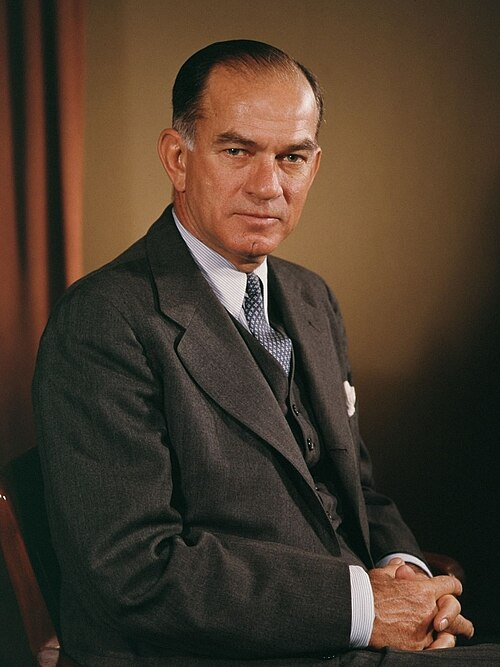
After which, a year in Europe with journalist Mikhail Fodor meeting major political figures. In 1942, back in the United States, Fulbright began a thirty-two-year
congressional career.
In September 1943 the House adopted the Fulbright Resolution, which supported international peacekeeping initiatives and encouraged the United States to participate in what became the United Nations in 1945.
Fulbright opposed the anti-Communist crusades of Joseph McCarthy and the similar investigations by the House Un-American Activities Committee.
Fulbright was prosegregation, anti-isolationist,
pro-peaceful coexistence with the U.S.S.R., and anti-Vietnam War. He
also believed in internationalism as a means of keeping the peace, so he
supported America's involvement in the U.N. To the same end in 1946 he
set up an international exchange program in graduate studies, which
became known as the Fulbright Scholarship.
Fulbright alumni have occupied key roles in government, academia, and industry. Of the more than 325,000 alumni:
- 93 have received the Pulitzer Prize.[6][7]^
- 80 have been MacArthur Fellows.[7]^
63 have received a Nobel Prize.[5][7] Linus Pauling, twice
- 42 have served as head of state or government.
- 1 (Boutros Boutros-Ghali) has served as secretary-general of the United Nations.
In 1968 Thomas Heck was a Fulbright Scholar in Vienna studying the
history of the classical guitar and in particular adding to his
collection of first-edition manuscripts of music by Giuliani (guitar
composer, 1781-1829). In 1973 Heck set up the Guitar Foundation of
America to act as a storehouse for his (and then others') guitar-music
collections. Since then the organization has acted to provide guitarists
with materials, a library, a society, a publisher, and educational
resources.
In 1985 the Guitar Foundation president was JAMES SMITH.