Witherspoon, John
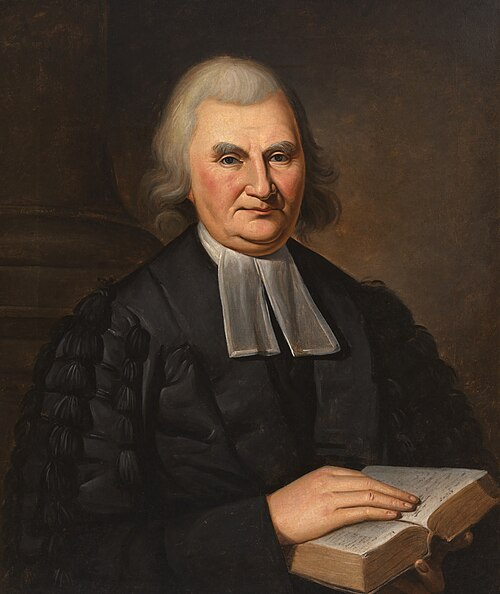
John Witherspoon (February 5, 1723 – November 15, 1794) was a Scottish-American Presbyterian minister, educator, farmer, and a Founding Father of the United States.[1] Witherspoon embraced the concepts of Scottish common sense realism, and while president of the College of New Jersey (1768–1794; now Princeton University) became an influential figure in the development of the United States' national character. Politically active, Witherspoon was a delegate from New Jersey to the Second Continental Congress and a signatory to the July 4, 1776, Declaration of Independence. b
He was the only active clergyman and the only college president to sign the Declaration.[2] Later, he signed the Articles of Confederation and supported ratification of the Constitution of the United States. In 1789 he was convening moderator of the First General Assembly of the Presbyterian Church in the United States of America. As one of the first national leaders of American Presbyterianism, he promoted theological and civic ideas adjacent to John Calvin, John Knox, and Samuel Rutherford, particularly the concept that resistance to tyranny is obedience to God.[3]
Early life and ministry in Scotland
[ ](https://en.wikipedia.org/wiki/File:The_grave_of_Rev_James_Alexander_Witherspoon,_Gifford.jpg)The grave of John Witherspoon's father, Rev. James Alexander Witherspoon.
John Witherspoon[4] was born in Yester, Scotland, documented in the Old Parish Register as the eldest child of the Reverend James Alexander Witherspoon and Anne Walker,[5][6] a descendant of John Welsh of Ayr and John Knox.[7][8] This latter claim of Knox descent though ancient in origin is long disputed and without primary documentation.[9] He attended the Haddington Grammar School and obtained a Master of Arts from the University of Edinburgh in 1739. He remained at the university to study divinity.[10] In 1764, he was awarded an honorary doctoral degree in divinity by the University of St Andrews.[11]
Witherspoon was a staunch Protestant, nationalist, and supporter of republicanism. Consequently, he was opposed to the Roman Catholic Legitimist Jacobite rising of 1745–46. Following the Jacobite victory at the Battle of Falkirk, he was briefly imprisoned at Doune Castle,[12] which had a long-term effect on his health.
He became a Church of Scotland (Presbyterian) minister at Beith, Ayrshire (1745–1758), where he married Elizabeth Montgomery of Craighouse. They had ten children, with five surviving to adulthood.
From 1758 to 1768, he was minister of the Laigh Kirk, Paisley (Low Kirk).[7] Witherspoon became prominent within the Church as an Evangelical opponent of the Moderate Party.[13] During his two pastorates he wrote three well-known works on theology, notably the satire "Ecclesiastical Characteristics" (1753)[14] about the Inverkeithing Case of 1752, which opposed the philosophical influence of Francis Hutcheson.[15]
Princeton
 The President's House in Princeton, New Jersey. Completed in 1756, Witherspoon lived here from 1768 to 1779; it is a U.S. National Historic Landmark.
At the urging of Benjamin Rush and Richard Stockton, whom he met in Paisley,[16] Witherspoon finally accepted their renewed invitation (having turned one down in 1766) to become president and head professor of the small Presbyterian College of New Jersey in Princeton.[17] Thus, Witherspoon and his family emigrated to New Jersey in 1768.
At the age of 45, he became the sixth president of the college, later known as Princeton University. Upon his arrival, Witherspoon found the school in debt, with weak instruction, and a library collection which clearly failed to meet student needs. He immediately began fund-raising—locally and back home in Scotland—added three hundred of his own books to the library, and began purchasing scientific equipment including the Rittenhouse orrery, many maps, and a terrestrial globe. Witherspoon instituted numerous reforms, including modeling the syllabus and university structure after that used at the University of Edinburgh and other Scottish universities. He also firmed up entrance requirements, which helped the school compete with Harvard and Yale for scholars.
Witherspoon personally taught courses in eloquence or belles lettres, chronology (history), and divinity. However, none was more important than moral philosophy (a required course). An advocate of natural law within a Christian and republican cosmology, Witherspoon considered moral philosophy vital for ministers, lawyers, and those holding positions in government (magistrates). Firm but good-humored in his leadership, Witherspoon was very popular among both faculty and students.
Witherspoon had been a prominent evangelical Presbyterian minister in Scotland before accepting the Princeton position. As the college's primary occupation at the time was training ministers, Witherspoon became a major leader of the early Presbyterian Church in America. He helped organize Nassau Presbyterian Church in Princeton, New Jersey.
Nonetheless, Witherspoon transformed a college designed predominantly to train clergymen into a school that would equip the leaders of a new country. Students who later played prominent roles in the new nation's development included James Madison, Aaron Burr, Philip Freneau, William Bradford, and Hugh Henry Brackenridge.[18] From among his students came 37 judges (three of whom became justices of the U.S. Supreme Court); 10 Cabinet officers; 12 members of the Continental Congress, 28 U.S. Senators, and 49 U.S. Congressmen.
Although Witherspoon can be heavily credited in the expansion and progression of the university, his ownership ties to the enslavement of Black people in America have caused for an internal Princeton petition to the CPUC Committee on Naming at Princeton University and President Eisgruber for the removal of his statue that currently stands in Firestone Plaza on campus. The statue was originally installed in 2001.[19][20] As of Fall 2022, the petition has garnered over 250 signatures in support of removing the statue on the basis that it is a distraction to the university's mission and makes community members uncomfortable because of Witherspoon's racist history. The petitions suggests replacing the statue with "an informational plaque which details both the positive and negative aspects of Witherspoon's legacy."[21][22]
Revolutionary War
[ ](https://en.wikipedia.org/wiki/File:Declaration_of_Independence_%281819%29,_by_John_Trumbull.jpg)In Declaration of Independence by John Trumbull (1818), Witherspoon is the second seated figure from the (viewer's) right among those shown in the background facing the large table.[23].
Long wary of the power of the British Crown, Witherspoon saw the growing centralization of government, progressive ideology of colonial authorities, and establishment of episcopacy authority as a threat to the liberties of the colonies. Of particular interest to Witherspoon was the Crown's growing interference in the local and colonial affairs which previously had been the prerogatives and rights of the American authorities. When the Crown began to give additional authority to its appointed episcopacy over church affairs, British authorities hit a nerve in the Presbyterian Scot, who saw such events in the same lens as his Scottish Covenanters.
Soon, Witherspoon came to support the American Revolution, joining the New Jersey Committee of Correspondence and Safety in early 1774. His 1776 sermon "The Dominion of Providence over the Passions of Men" was published in many editions, and he was elected to the Continental Congress as part of the New Jersey delegation.[24] In Congress, he was appointed congressional chaplain, and in July 1776, he voted to adopt the Virginia Resolution for Independence. In answer to an objection that the country was not yet ready for independence, according to tradition he replied that it "was not only ripe for the measure, but in danger of rotting for the want of it."[25][26]
Witherspoon served in Congress from June 1777 until November 1784 and became one of its most influential members and a workhorse of prodigious energy. He served on over 100 committees, most notably the sitting committees, the board of peace and the committee on public correspondence or common affairs. He spoke often in concurrence; helped draft the Articles of Confederation; helped organize the executive departments; played a major role in shaping public policy; and drew up the instructions for the peace commissioners. He fought against the flood of paper money and opposed the issuance of bonds without provision for their amortization. "No business can be done, some say, because money is scarce", he wrote. He also served twice in the New Jersey Legislature and strongly supported the adoption of the United States Constitution during the New Jersey ratification debates.
In November 1777, as British forces neared, Witherspoon closed and evacuated the College of New Jersey. The main building, Nassau Hall, was badly damaged, and his papers and personal notes were lost. Witherspoon was responsible for its reconstruction after the war, which caused him great personal and financial difficulty. In 1780 he was elected to a one-year term in the New Jersey Legislative Council representing Somerset County, and was a candidate for Congress in 1789 and 1791.[27][28] At age 68, he married a 24-year-old widow, with whom he had two more children.[29]
Death and burial
 Witherspoon's grave at Princeton Cemetery.
Witherspoon suffered eye injuries and was blind by 1792. He died in 1794 on his farm Tusculum, just outside Princeton, and is buried along Presidents Row in Princeton Cemetery.[30] An inventory of Witherspoon's possessions taken at his death included "two slaves ... valued at a hundred dollars each".[31]
Family
Witherspoon married Elizabeth Montgomery on 14 August 1748 documented in the old parish register in Beith, North Ayrshire. They were both from the parish.[5] They had a total of 10 children, only five of whom survived to accompany their parents to America. James, the eldest, graduated from Princeton in 1770 and joined the Continental Army as an aide to General Francis Nash, with the rank of major and was killed at the Battle of Germantown on October 4, 1777.[32]
The next oldest son, John, graduated from Princeton in 1779, practiced medicine in South Carolina, and was lost at sea in 1795. David, the youngest son, graduated the same year as his brother John, married the widow of Abner Nash, and practiced law in New Bern, North Carolina. Anna, the eldest daughter, married the Reverend Samuel Smith on June 28, 1775. The Reverend Samuel Smith succeeded Dr. Witherspoon as president of Princeton in 1795. Frances, the youngest daughter, married Dr. David Ramsay, a delegate from South Carolina to the Continental Congress, on March 18, 1763.
Philosophy
 John Witherspoon Statue, Paisley, Scotland by Alexander Stoddart.
According to Herbert Hovenkamp, Witherspoon's most lasting contribution was the initiation of the Scottish common sense realism, which he had learned by reading Thomas Reid and two of his expounders Dugald Stewart and James Beattie.[33]
...
Sandbox: TheBrain
===
AMERICAN CONNECTIONS
JOHN WITHERSPOON (NJ) was fifty-three. He'd
arrived in the United States from Scotland only eight years before and
worked his tail off in Congress (sat on over a hundred committees and
was a frequent speaker). Witherspoon had come to America to be president
of Princeton College, where things were going from dire to worse. The
year he arrived there were only eleven graduates. So Witherspoon hit the
road to raise money (he doubled the endowments) and to recruit students.
In the end he did pretty well: His pupils went on to become a U.S.
president, a vice-president, nine cabinet officers, twenty-one senators,
thirty-nine congressmen, three Supreme Court justices, and twelve state
governors.
In 1771 Witherspoon graduated Philip Freneau, who wasn't able to be at
commencement, so his schoolmate Breckenridge read Freneau's poem: "The
Rising Glory of America." Don't bother. Freneau's life was one long
struggling writer's attempt to make ends meet. He frequently disappeared
for years at a time to earn money on trading ships in the Caribbean. At
one point his ex-college roommate, James Madison (that one), persuaded
him to be editor and writer for a new journal, the National
Gazette (also Jefferson, partisan attacks on Hamilton and Washington).
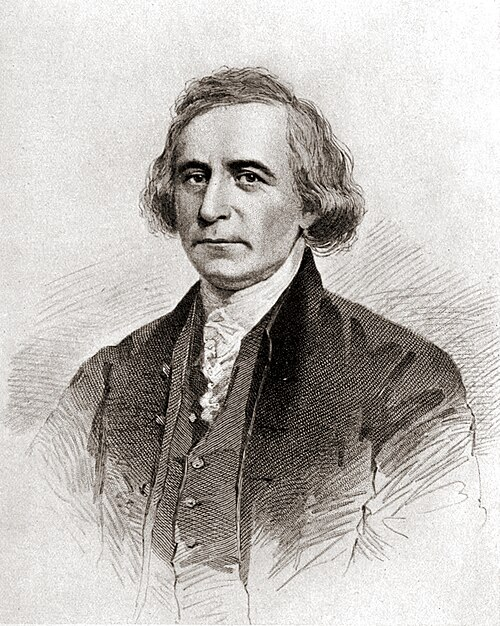
Freneau wrote pieces that rambled on about how Independence was supposed
to make life better for everybody and not just enrich the fatcat
merchant elite. As the only poet to flourish during the Revolution, he
became unimaginatively known as the "Poet of the Revolution." His work influenced EA Poe and Transcendentalists Emerson and Thoreau.
Much of the sharp edge to Freneau's work came from his healthy dislike of the
Brits after his wartime experience on a privateer in 1780 aboard the prison ship (aka
"hulk") Scorpion. After six weeks of appalling treatment he
was released, skin and bones.
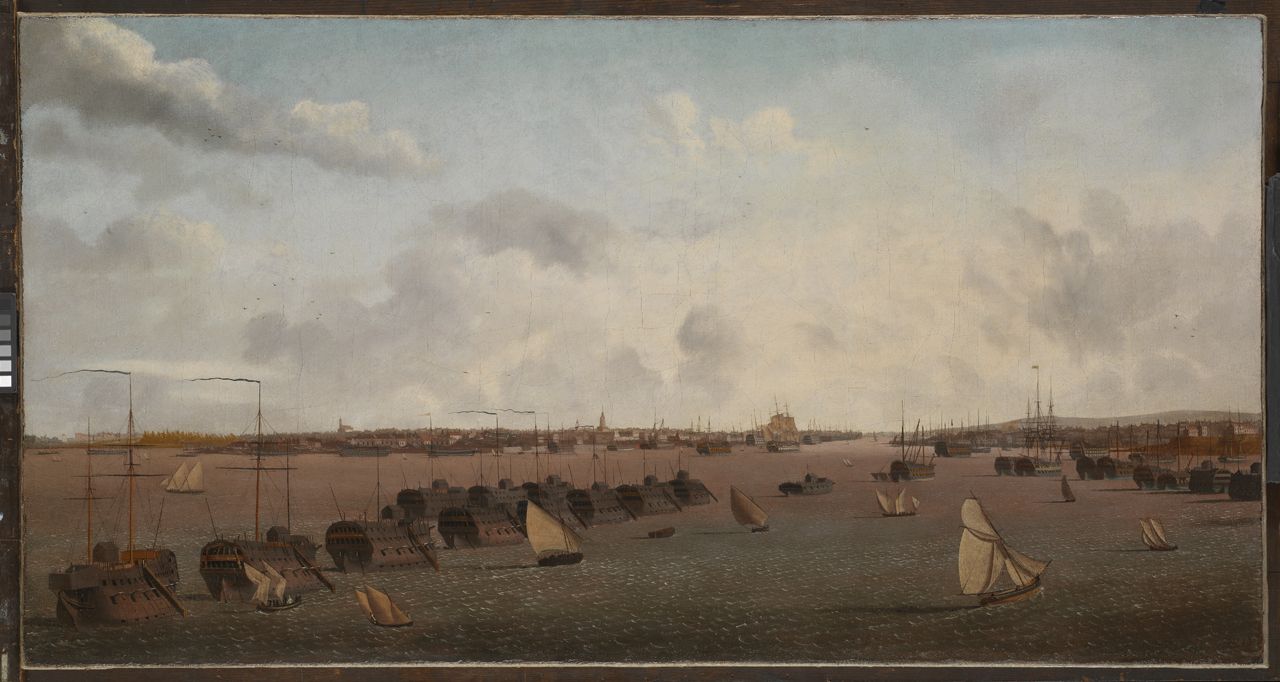
Portsmouth Harbour with Prison Hulks, Ambroise Louis Garneray
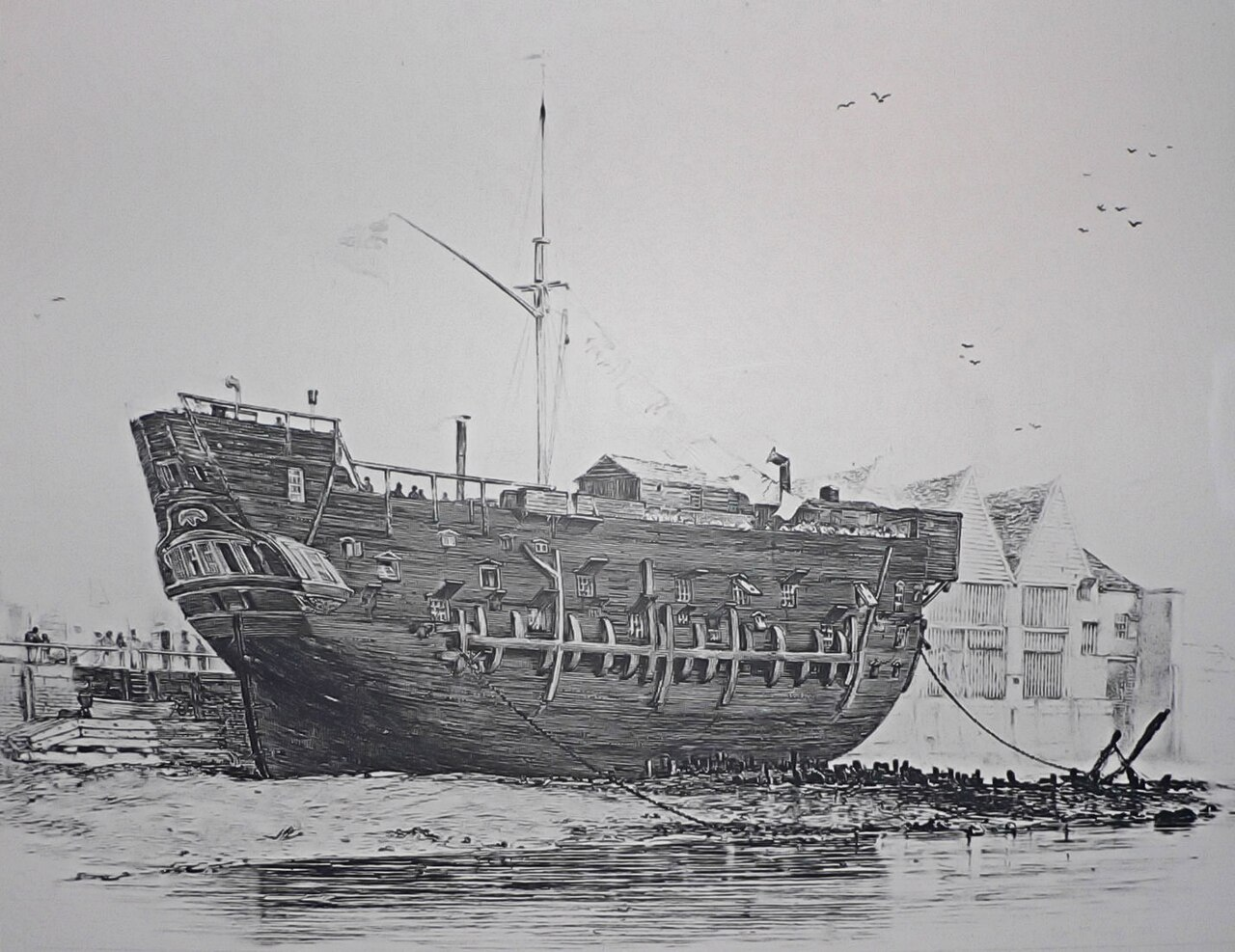
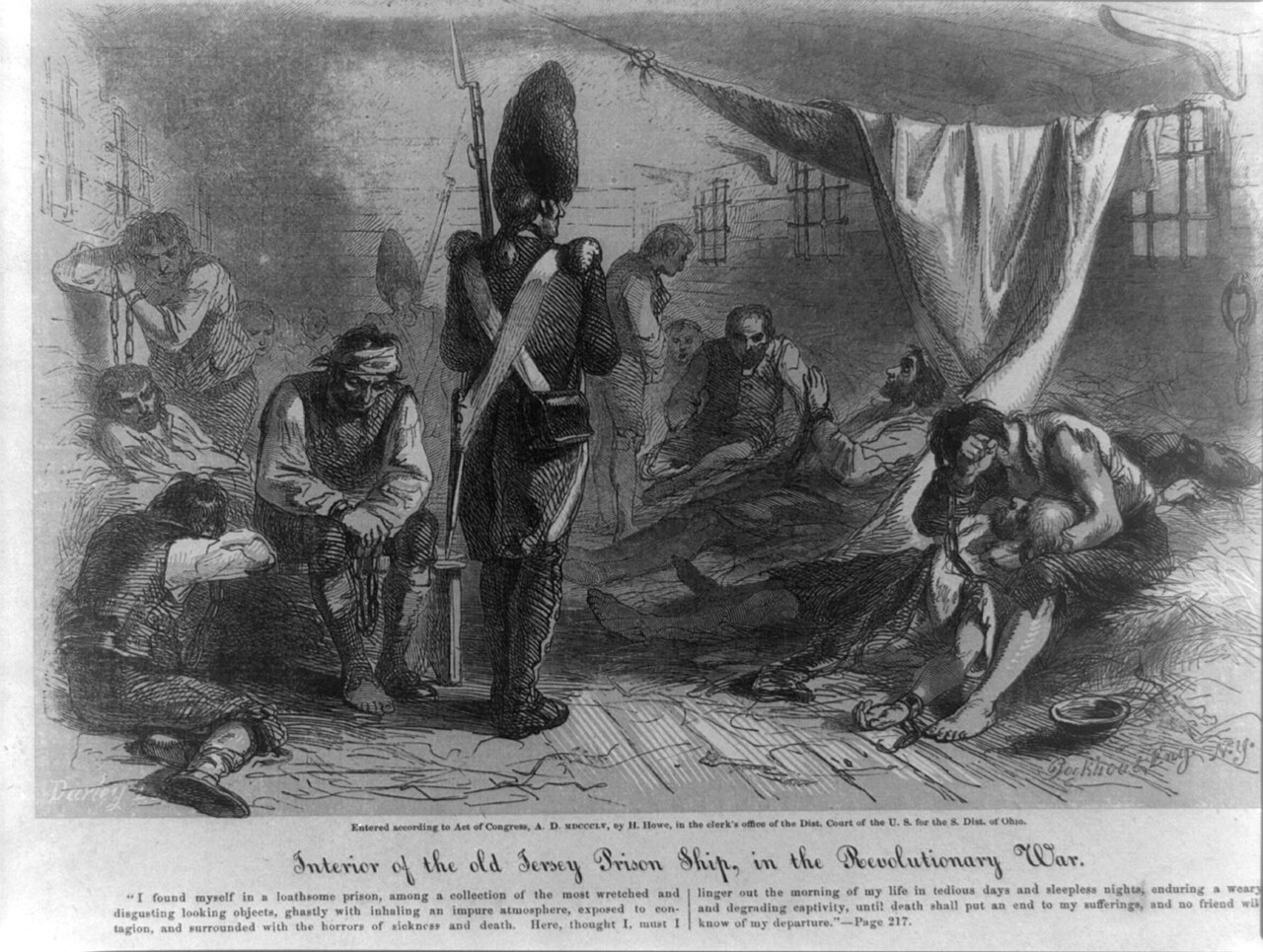
Prison hulks had first appeared in England because thanks to the
American War the judges could no longer transport criminals to the
American colonies. This created a humongous problem, because with two
hundred capital crimes and two hundred crimes-of-deportation on the
books there were more jailbirds than cells. Hence the hulks. Run by
contractors for profit and on which conditions were unspeakable:
dysentery, fever, floggings, filth and vermin, rotten food, and guards
with swords permanently drawn and palms permanently open.
In 1777 an opinionated, self-centered, devout, narrow-minded social
climber named John Howard published The State of the Prisons,
written after he'd visited 250 of them in the previous two years.
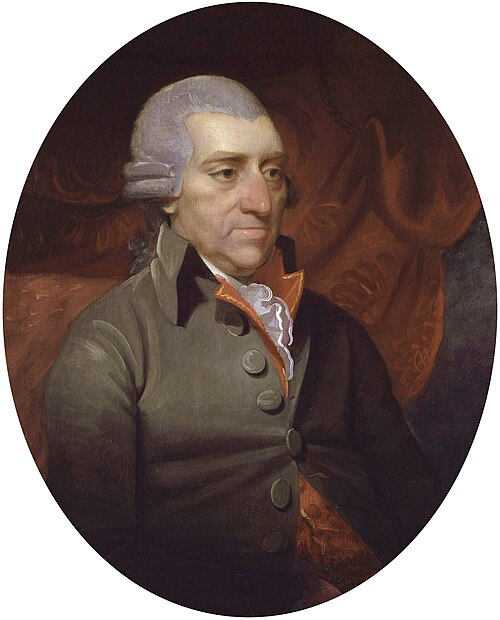
Howard was a country squire who dabbled in weather forecasting, then got
obsessed by incarceration and spent his life visiting prisons everywhere
from Holland to Russia to Portugal. In Britain he called for crazy
reforms such as clean cells, health care, purpose-built penitentiaries,
and (craziest of all) salaried jailers and prison clothing. Parliament
set up a committee, a parliamentary bill was introduced, and nothing was
done. By 1784, Howard calculated that he had travelled over 42,000 miles (68,000 km) visiting prisons. Whilst visiting a prison in Kherson, he contracted typhus and died, at the age of 63. Typhus was commonly known as "gaol fever" in England at the time, due to the frequent outbreaks in prisons caused by poor and crowded conditions.
Howard's bill's sponsor was his second cousin, millionaire high-tech
brewer Samuel Whitbread. Whitbread invested in all the latest technology to industrialize production,[6]^ storing the beer in large vats. The brewery was also one of the first to employ a steam engine (purchasing a sun and planet gear engine, the Whitbread Engine, from James Watt's company in 1785). Whitbread became the first to exploit Porter commercially on a large scale and this coincided with an increase in beer consumption in the UK, following regulations to limit the sale of gin owing to the excesses of the Gin Craze.[5]^
Whitbred's son Sam Jr. (Eton and Cambridge, rich,
ambitious) spent years in Parliament annoying aristos and being passed
over for government positions because he was only a brewer. He was also
a reformer: against the 1812 war with America, antislavery,
pro-Napoleon.
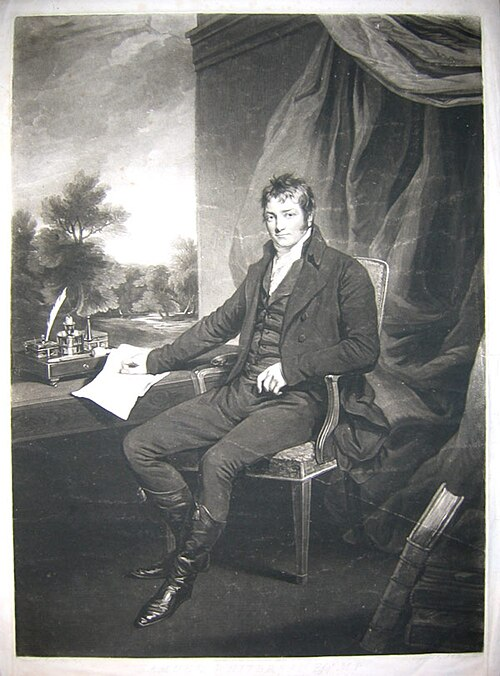
He married Elizabeth Grey, daughter and brother of Earl Grey (of tea fame).
Part of Sam's problem was that he became quite hysterical
over his pet peeves. The guess is that he suffered from a disease of the
endocrine system known as Cushing's Syndrome. This may also be why on
July 6, 1815, he slit his throat, after Napoleon's defeat at Waterloo by Wellington.
Three years later so did his pal Samuel Romilly (after the death of his wife).
A highly successful lawyer, Romilly was everything Sam wasn't. The higher he rose in the legal profession (he finally made attorney general), the more he hated
what the job required him to be (as he put it: "a near spectator of
selfish and degrading conduct").
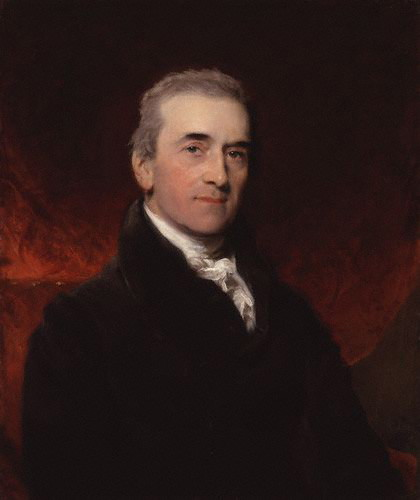
As a reformer he did his best to reduce
the number of death-penalty crimes (samples: picking pockets, stealing
property from a boat) and to increase the frequency with which cases
were argued in the presence of juries. In 1814, he succeeded in abolishing hanging, drawing and quartering.
Romilly was also keenly interested in Howard's penal reform and made much noise about corruption at the royal level.
In which regard, in 1804 Romilly was briefed to defend Mrs. Fitzherbert
in the three-year-long Minnie Seymour custody case. Minnie was three and
had been given to Fitzherbert by the girl's mother, who was dying from
TB. Now the relatives were claiming the child back. It helped
Fitzherbert that she was the illegal (because Catholic) wife of the heir
to the throne, the Prince Regent. Whose passion for Fitzherbert (Roman
nose, fat, curly blonde, card player, big bosom) had the prince rolling
on the floor, tearing out his hair, screaming, and stabbing himself to
get her attention. For twenty-six years the two of them lived together
on and off (he frequently left for various mistresses), the scandal of
Europe and a massive drain on public funds.
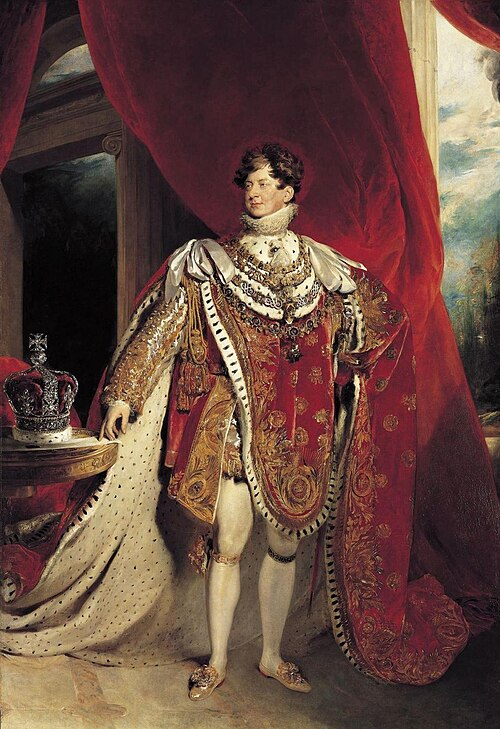
The prince was a really big spender. And a corpulent, lascivious,
boozing egomaniac, who knocked down large bits of London so that he
could see his new Regent's Park (designed by John Nash in Regency Style)
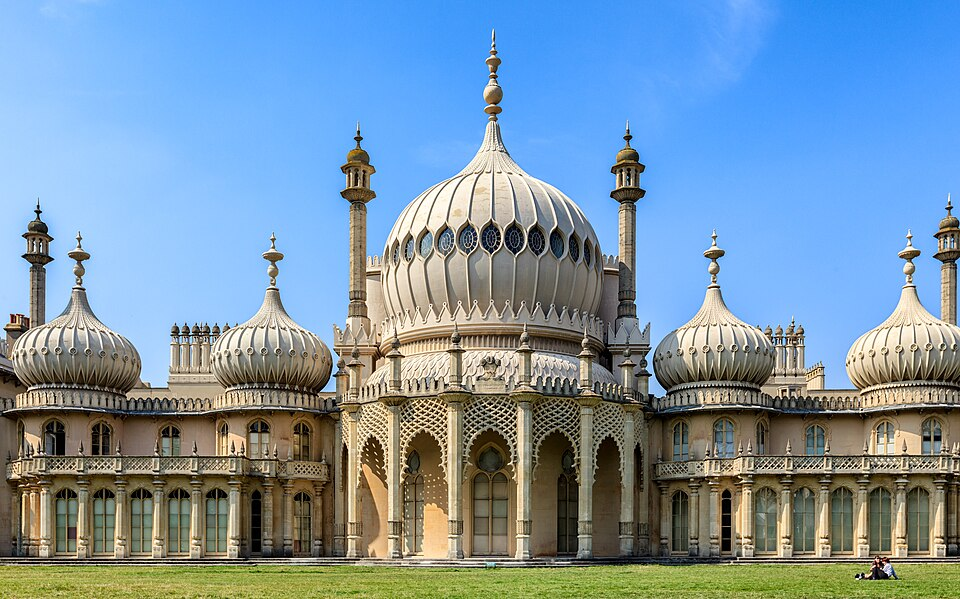
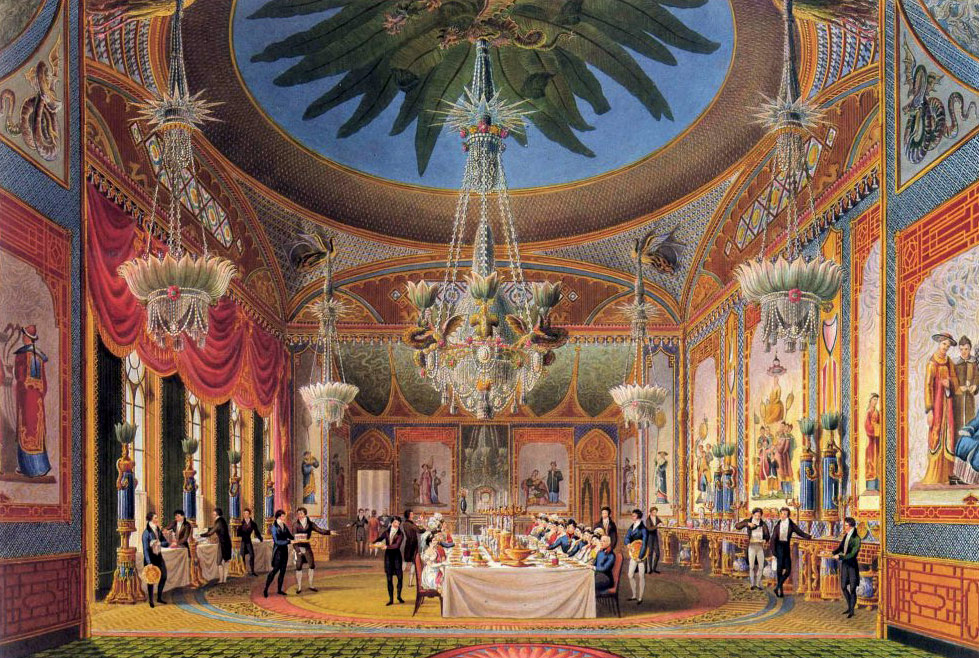
from his new home in Carlton House (by looking up the new Regent Street). His other great architectural overindulgence (also by Nash) was Brighton Pavilion, erected for him in the coastal city of Brighton. Moghul Indian on the outside, Chinese and Arabian
interiors. All in supremely dreadful taste but at the time the height of
fashion. About which the prince cared even more than sex, drink, or
gambling.
The prince's consultant in the essential matter of dress was one of the
dandies with whom he surrounded himself, Sir Lumley St. George
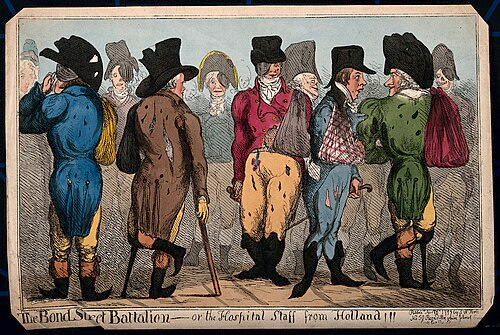
Skeffington, known as Skiffy, the fop's fop. Skeletal, with rouged
cheeks, he was famous for the wave of perfume that preceded him. His
clothing dictated the day's look and usually included knee-ribbons,
skin-tight breeches, striped vests, and absurdly large hats. He was satirized by Byron.
Skiffy's obsession was the theater, and he never missed a first night or
a debut, sometimes seeing four shows in the same evening. He wrote plays
that were instantly forgotten and sent poems to actors who never read
them. And he would hang around green rooms just to be near the players.
On Valentine's Day 1831 he penned one more vacuous piece of rhyming
drivel to Lucia Vestris, the toast of London, a contralto with great
legs. Who titillated the entire male population by playing "breeches"
parts (in men's clothing) to show off the great legs to great advantage.
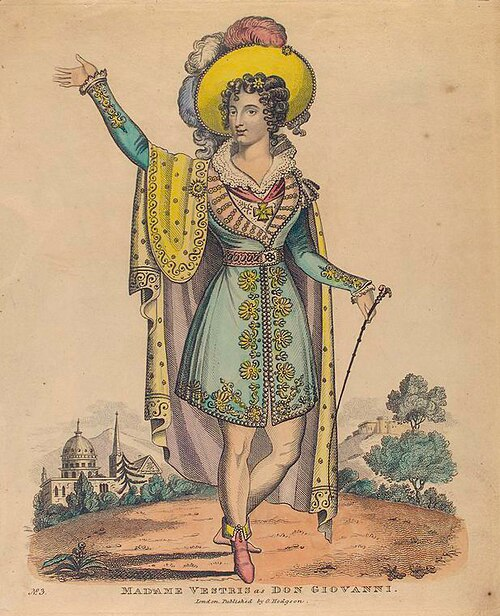
Madame Vestris as Don Giovanni in W.T. Moncrieff's Giovanni in London, Hand-coloured etching, c. 1820
The same year Vestris didn't read Skiffy's little poem, after fifteen
years of success acting in burlesques and extravaganzas she bought the
lease of the London Olympic Theater. As manager she remodeled the
theater, staged light comedies, and brought the curtain down by eleven
every night to cater to the new middle-class audience who had jobs to go
to in the morning.
Vestris also hired Laura Keane, a promising young
actress with management ambitions. In 1835 Keane left to pursue her
American dream. Like all actor-managers Keane followed the money. In her
case: to New York, San Francisco, Sydney, Australia, then back to New
York. In the 1860s she took her company on tour and in 1865 found
herself playing a role in Our American Cousin at Ford's
Theater in Washington, D.C. the same night actor John Wilkes Booth
opened the state box door and shot Lincoln in the back of the head.
Keane cradled the dying president's head in her arms.
After the assassination John Ford was jailed for a month, his theater
was closed down by the federal authorities, and he was paid one hundred
thousand dollars compensation. He remained faithful to Booth's family,
however, arranging for Booth's body to be reburied in the family plot.
Ford had a name for being astute and (unusual in the cutthroat theater
world) honorable. In 1878 he was the only theater manager to pay
royalties to Gilbert and Sullivan for a performance of their operetta:
HMS Pinafore. He was also on the board of the B&O Railroad.
The show's cast included a promising young singer, Lillie West, daughter
of an Iowa publisher. In 1889 she was on the verge of fame when her son
died of diphtheria. Devastated, she left the stage. In Chicago her
mother persuaded her to join the Daily News as a drama critic
and for forty years (as "Amy Leslie") Lillie wrote puff pieces to
encourage her readers to support the theater. She reviewed Annie Oakley, Lilly Langtry, Lillian Russell and Sarah Bernhardt.
After obtaining a divorce from Brown, Leslie was the mistress of Stephen Crane ( The Red Badge of Courage) and lived with him in New York.
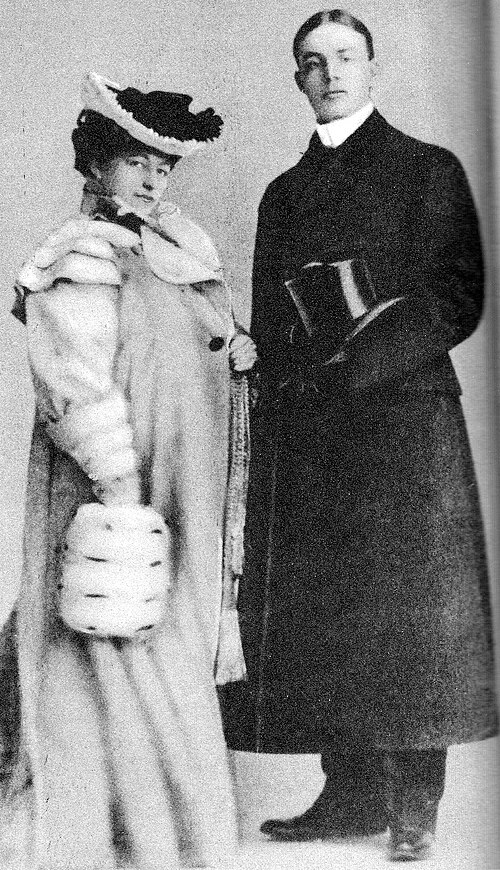
In 1910 one of Lillie's colleagues sent in a report about the French craze for aeronautics.
The piece was written by correspondent Octave Chanute, who was also an
American engineer and airplane buff. And who back in 1896 had developed
his own experimental flight station (on the Indiana shore of Lake
Michigan), where the pilots flew 359 feet in fourteen seconds on gliders
whose design became basic to all modern airframes.
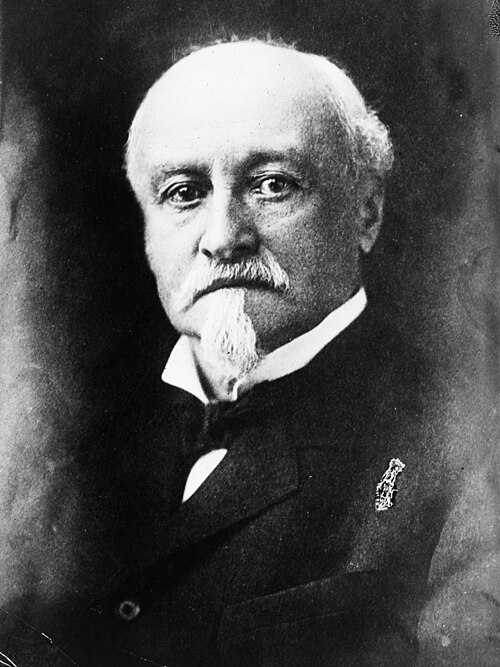
Chanute had a difficult relationship with the Wright brothers, who later denied using
his ideas in spite of the 435 letters and cables they exchanged with him
between 1901 and 1910, and the fact that Chanute had been organizing
conferences on powered flight since 1885.
In 1913 the French mag L'Aérophile published a (generous,
considering) Chanute article on the Wrights. The same edition carried
news of the new ramjet engine designed by Frenchman René Lorin.
He could not test this invention since there was no way at the time for an aircraft to go fast enough for a ramjet to function properly. It was supported in 1933 by Louis Charles Breguet, the grandson of Louis Clément François Breguet,(telegraphy) and great-great-grandson of the famous horologist Abraham-Louis Breguet.
L'Autre Monde: ou les États et Empires de la Lune (Comical History of the States and Empires of the Moon) (1657) was the first of three satirical novels written by Cyrano de Bergerac that are considered among the first science fiction stories. Arthur C Clarke credited this book with conceiving the ramjet,[3]^ and as the first fictional example of rocket-powered space flight.
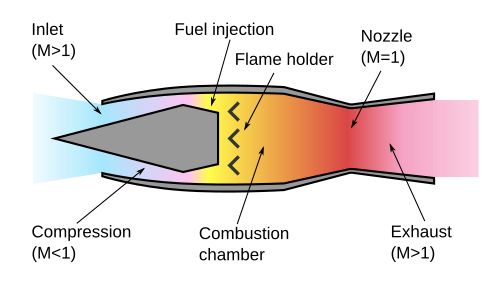
The engine was simplicity itself. Air entered a tube and was compressed by a
narrowed section of the tube. A fuel mist was sprayed into the
compressed airflow and then ignited. As the compressed air heated, it
expanded and with nowhere else to go accelerated out of the back end of
the tube, thrusting the tube (and anything attached to it) forward.
Starting the ramjet process involved only moving the tube to cause air
to enter.
In 1942 at Peenemunde on the Baltic Sea this was done with a
steam-catapult launching system, which sent the ramjets, attached to
wings and a bomb (an arrangement known as the "V-1") toward London.
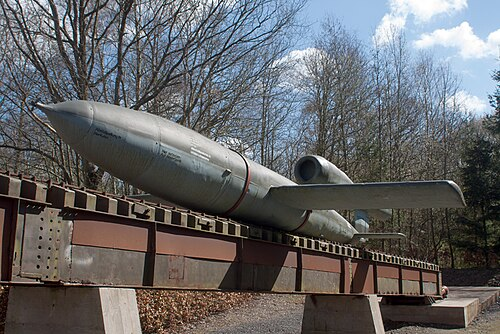
Shortly thereafter, in August 1943, more than thirteen hundred British
RAF bombers returned the favor by bombing the Peenemunde launch pads,
thanks in large measure to the espionage efforts of American Allen
Dulles. In his Swiss HQ, Dulles (ex-banker turned Office of Strategic
Services operative) ran an extraordinarily successful spy ring, whose
agents included the mistress of German Admiral Canaris (executed for sabotage). And a metallurgy expert, Edward Schulte. Who blew the whistle on the V-1 launch site (and the Holocaust via the Riegner Telegram).
In 1947, when Dulles was president of the Council on Foreign Affairs, he
was involved in discussions with another ex-OSS man, John Gardner (who
by this time was vice president of the Carnegie Foundation), at a time
when the foundation was considering the establishment of a Russian
Studies Center at Harvard. He also launched Medicare, which brought quality health care to senior citizens, and the civic watchdog Common Cause
Nearly twenty years later Gardner set up a Carnegie Commission on
Educational Television. The commission recommended the creation of a
Corporation for Public Broadcasting. In 1967 Congress took the
commission's advice and approved the formation of the Public
Broadcasting System (PBS) and National Public Radio (NPR).
These were gutted in the Trump DOGE coup, along with foreign aid.
CPB appropriation amounted to less than 0.01% (1/10,000) of the U.S. federal budget.[143]^ Polls conducted by YouGov from 2022 through 2025 showed PBS and NPR to be among the most trusted media institutions in the United States.
NPR's first board chairman was JOHN WITHERSPOON.
===