Hall, Lyman
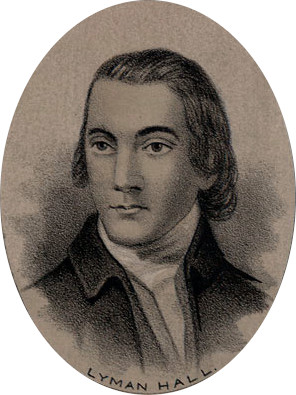
Lyman Hall (April 12, 1724 – October 19, 1790) was an American Founding Father, physician, clergyman, and statesman who signed the United States Declaration of Independence as a representative of Georgia.[1] Hall County is named after him. He was one of four physicians to sign the Declaration, along with Benjamin Rush, Josiah Bartlett, and Matthew Thornton.
Early life and family

Coat of Arms of Lyman Hall
Hall was born on April 12, 1724, in Wallingford, Connecticut. He was the son of John Hall, a minister,[2] and Mary (née Street) Hall.[3] He studied with his uncle Samuel Hall[4] and graduated from Yale College in 1747,[5] a tradition in his family. In 1749, he was called to the pulpit of Stratfield Parish (now Bridgeport, Connecticut). His pastorate was a stormy one: an outspoken group of parishioners opposed his ordination; in 1751, he was dismissed after charges against his moral character which, according to one biography, "Were supported by proof and also by his own confession." He continued to preach for two more years, filling vacant pulpits, while he studied medicine and taught school.
In 1752, he married Abigail Burr of Fairfield, Connecticut; she died the following year.[2][4] In 1757, he married Mary Osborne.[6] He migrated to South Carolina and established himself as a physician at Dorchester, South Carolina, near Charleston,[4] a community settled by Congregationalist migrants from Dorchester, Massachusetts, decades earlier. When these settlers moved to the Midway District – now Liberty County – in Georgia, Hall accompanied them. Hall soon became one of the leading citizens of the newly founded town of Sunbury.
Revolutionary War
On the eve of the American Revolution, St. John's Parish, in which Sunbury was located, was a hotbed of radical sentiment in a predominantly Loyalist colony. Though Georgia was not initially represented in the First Continental Congress, through Hall's influence the parish was persuaded to send a delegate to Philadelphia to the Second Continental Congress. Hall was delegated and was admitted to a seat in the Congress in 1775. He was one of the three Georgians and one of four doctors to sign the Declaration of Independence.[7]
In January 1779, Sunbury was burned by the British. Hall's family fled to the North, where they remained until the British evacuation in 1782. Hall then returned to Georgia, settling in Savannah. In January 1783, he was elected governor of the state – a position that he held for one year. While governor, Hall advocated the chartering of a state university, believing that education, particularly religious education, would result in a more virtuous citizenry. His efforts led to the chartering of the University of Georgia in 1785. At the expiration of his term as governor, he resumed his medical practice.
Death and legacy
In 1790, Hall moved to a plantation in Burke County, Georgia, on the South Carolina border, where he died on October 19 at the age of 66. Hall's widow died in November 1793.
Lyman Hall is memorialized in Georgia where Hall County, Georgia, bears his name; and in Connecticut, his native state, where the town of Wallingford honored him by naming a high school after its distinguished native son. Elementary schools in Liberty County, Georgia, and in Hall County, Georgia, are also named for him.
Signers Monument, a granite obelisk in front of the courthouse in Augusta, Georgia, memorializes Hall along with Button Gwinnett and George Walton as Georgians who signed the Declaration of Independence. His remains were re-interred there in 1848 after being exhumed from his original grave on his plantation in Burke County.
See also

AMERICAN CONNECTIONS
LYMAN HALL (GA) was fifty-two. Yale. Fired for
"moral" matters from his Connecticut church. Moved south and after an
attempt at rice-planting in Georgia went into local politics. Georgia
was so conservative that at one point the revolutionary Hall tried to
get his parish to secede to South Carolina (the state turned him down).
In 1783 as one-year state governor, Hall pushed through legislation for
a state university and then persuaded Abraham Baldwin to join the board
of trustees. Lawyer Baldwin (another Yalie) arrived the following year
and helped to write the charter for the University of Georgia (then
called Franklin College). It took twenty years for the school to open.
Baldwin's colleague John Milledge provided the campus acreage. In 1802,
when the federal government opened all western lands to settlement "once
a reasonable price had been peacefully agreed with the Indians,"
Milledge and Baldwin were asked to review Georgia's treaties with the
tribes. The review triggered one of the darkest episodes in American
history.
The Georgians wanted the land that in 1791 had been guaranteed to the
local Native Americans in perpetuity. The Cherokees, seeing which way
things were headed, began a policy (it lasted twenty years) of
acculturation to white customs, replacing hunting with agriculture,
setting up schools and a legislative assembly, a police force, a
newspaper, then writing a constitution and applying for U.S.
citizenship. In spite of all this, in 1838 they were to be forced at
gunpoint to leave for Oklahoma on the Trail of Tears. Four thousand of
them would die on the way.
Meanwhile, in 1803, Cherokee schooling was in the hands of Gideon
Blackburn, a fiery Tennessee Presbyterian preacher (and whiskey
distiller) who traveled the country raising money for education. By 1810
he was a reformed drunk and lecturing on the evils of booze. Spent the
War of 1812 as a chaplain. After which his revivalist meetings became so
famous his portrait was painted by second-rate painter Richard Street,
whose output was prolific and who usually specialized in portraits of
people already dead. In 1815 Street exhibited at the Philadelphia
Academy of Fine Arts, where he met the academy's founder, Charles W.
Peale.
Who was a first-rate painter. And \\\\\\\\\\\\\\\\\\\\\\\\\\\\\\\[really]{.italic} prolific. After
spending two years in London watching the by-then-famous American
Benjamin West at work, Peale took classes, met the painterly elite, and
in 1769 went back home to a life of art and science. Peale painted over
a thousand miniatures as well as landscapes, still lifes, and history
paintings. In 1785 he opened the first American Natural History Museum
(eventually renting Independence Hall for the purpose) where everything
was exhibited in its natural setting. Stars of the show in 1802 were two
mastodon skeletons from the Hudson Valley. About which Baron Cuvier got
very excited.
Cuvier (French science big cheese) founded the study of paleontology
with his idea that muscles made impressions on bones and that all animal
parts were exactly related to their function: e.g., a carnivore needed
intestines, powerful jaws, sharp teeth, claws on flexible toes, and
musculature to move fast enough to catch food. Putting all these
comparative anatomy clues together, Cuvier could reconstruct
long-vanished prehistoric animals from the evidence of a single bone.
Which he did with one of Peale's mastodons (and gave the animal its
name). He went on to run French education and write the definitive
textbook on zoology.
This was the heyday of French research, led by major noodlers such as
Arago, Biot, St. Hilaire, and Buffon. All of whom fell for the beauty
and intellectual charms of Mary Somerville, over from London in 1817
with her Royal Society husband (whom she outshone then and since).
Somerville (the Oxford College is named after her) was fluent in
geology, mineralogy, botany, Greek, and math. She made her name with a
series of books popularizing science. And the "read-this-first" preface
to her translation of Laplace's math-dense \\\\\\\\\\\\\\\\\\\\\\\\\\\\\\\[Celestial
Mechanics]{.italic} became a standard higher-math course paper. All this
done without a degree because women weren't allowed into university.
In Britain Mary hobnobbed with the intelligentsia, including (a
particular fan of hers) Great Historical Novelist Sir Walter Scott. Who
created the genre and helped to invent Disney Scotland replete with
kilts (invented by an Englishman), sword dances (taken from French
ballet), and baronial halls (fake). Scott spent so much money turning
himself into a Scottish nobleman with residence to match that it took
every penny of a fortune in royalties to pay off his debts. Between 1814
and 1832 Scott churned out twenty-three novels.
One of them, \\\\\\\\\\\\\\\\\\\\\\\\\\\\\\\[Quentin Durward]{.italic} (a tale set in 1465), was
reproduced with only the names changed by Alfred de Vigny, French
Romantic poet and big fan of Scott. De Vigny's plagiarized-Scott opus
was \\\\\\\\\\\\\\\\\\\\\\\\\\\\\\\[Cinq Mars,]{.italic} considered by the French to be the greatest
French historical novel. No comment. The impression you get is that De
Vigny was a bit of a sad sack. His poetic output was small-and-Romantic
just as Romanticism was going off the boil. Unhappily married to a
sickly Englishwoman and with a mistress (actress Marie Dorval) who gave
him nothing but grief, Vigny retired hurt to a country estate. His
friend Sainte-Beuve coined the phrase "ivory tower" to describe De
Vigny's situation there.
While the English wife was still ambulatory, on a trip to London De
Vigny made friends with one of the sharpest tongues in criticism, Henry
Fothergill Chorley. A measure of Chorley's acerbity was his description
of \\\\\\\\\\\\\\\\\\\\\\\\\\\\\\\[dernier cri]{.italic} Verdi as "noisy and vulgar." Between 1833 and
1868 Chorley wrote more than twenty-five hundred go-for-the-throat book
reviews, but saved his best work for musicians. Among whom he was a
power to be reckoned with. He introduced Gounod and Meyerbeer to the
Brits, loved Rossini and Mendelssohn unreservedly, and from 1862 onward
did all he could to promote the career of new composer ("so young an
artist, so full of promise") Arthur Sullivan.
Sullivan might have surfaced unnoticed in the sea of Victorian chorales
and songs-for-the-drawing-room had it not been for his partnership with
W. S. Gilbert and the operettas they wrote together: \\\\\\\\\\\\\\\\\\\\\\\\\\\\\\\[Trial by Jury,
H.M.S. Pinafore,]{.italic} and \\\\\\\\\\\\\\\\\\\\\\\\\\\\\\\[Mikado,]{.italic} to name but three of
the witty, satirical takes on British social customs. Gilbert did the
clever words and Sullivan the whistleable music. Audiences went wild.
Between 1875 and 1889 the pair made and squandered a fortune and
Sullivan was made Sir by Queen Victoria, who asked if he would please
return to serious music. In 1889, after a row with Gilbert, he did. And
never succeeded again.
The operettas had all been the idea of impresario Richard D'Oyly Carte,
who commissioned \\\\\\\\\\\\\\\\\\\\\\\\\\\\\\\[Jury.]{.italic} In 1888 he married his secretary Helen
who then turned into the greatest businesswoman of the age. Helen was a
workaholic. She criss-crossed the Atlantic fixing productions and tours
and organized the staging, finance, and management of everything. She
was also a big pal of American painter James Whistler, who painted her
London apartment yellow (his favorite color).
Whistler did experimental work that took a while to make its mark. His
insistence on titles such as \\\\\\\\\\\\\\\\\\\\\\\\\\\\\\\[Arrangement in Grey and Black]{.italic}
(portrait of his mother) and \\\\\\\\\\\\\\\\\\\\\\\\\\\\\\\[Arrangement in Grey and Black No
2]{.italic} (portrait of writer Thomas Carlyle) gave the critics a field
day. For years they razzed him. In a famous lecture in 1885 (organized
by Helen Carte) he razzed back, arguing that art had nothing to do with
politics or morals or social change or education or anything. Art was
for art's sake. The critics razzed the lecture. But in the end Whistler
won through and became an international art celeb. In 1898 he was made
president of the International Society (mission statement: "Art has
nothing to do with nationality").
After him came the man who carved Whistler's monument, French sculptor
Auguste Rodin. Whose work unnerved most critics and exhibition
organizers. Following twenty years on the fringe, in 1880 Rodin was
finally commissioned to do the monumental doors for the new Paris Museum
of Decorative Arts. He chose as a theme Dante's \\\\\\\\\\\\\\\\\\\\\\\\\\\\\\\[Inferno]{.italic}. The
museum never happened but his pieces lived on as single works, including
\\\\\\\\\\\\\\\\\\\\\\\\\\\\\\\[The Thinker]{.italic} (first named \\\\\\\\\\\\\\\\\\\\\\\\\\\\\\\[The Poet]{.italic} and representing
Dante) and \\\\\\\\\\\\\\\\\\\\\\\\\\\\\\\[The Kiss.]{.italic} Rodin worked with amateur sitters such
as street musicians, acrobats, or dancers and made "notes in clay" as
they moved around. His public commissions (Hugo sexually aroused and
Balzac naked with nymphs) shocked everybody. An exhibition of his many
erotic drawings caused a major scandal in Germany.
In 1890 Rodin taught Gutzon Borglum, the Danish-American
mountain-shaper. The first mountain happened in 1915 when Borglum was
commissioned to carve (out of Stone Mountain, Georgia) a view of Lee,
Jackson, and Davis with a troop of artillery "coming round the hill."
After arguments with the backers (who included the Ku Klux Klan),
Borglum destroyed the work and moved on to bigger things at Mount
Rushmore. Begun in 1927 and finished after his death in 1941, the piece
included sixty-foot-high faces of Washington, Jefferson, Lincoln, and
Teddy Roosevelt. It was said Borglum's dynamiters could work with
four-inch accuracy.
In 1922 Borglum told a young apprentice he'd never be a sculptor, so
Japanese-American Isamu Noguchi took up medicine. Then dropped it for a
brilliant life in sculpture: abstract pieces in New York, sculptural
gardens for UNESCO in Paris, and the National Museum in Jerusalem, as
well as portrait heads of inventor Buckminster Fuller and dancer Martha
Graham. Who introduced Noguchi to George Balanchine, one of the greatest
of twentieth-century choreographers. In 1948 Noguchi designed the set of
Balanchine's \\\\\\\\\\\\\\\\\\\\\\\\\\\\\\\[Orpheus.]{.italic}
Balanchine had defected from the U.S.S.R. in 1924, then choreographed
ten ballets for Diaghilev's Ballets Russes and in 1933 arrived in the
United States. Where he formed the American Ballet. \\\\\\\\\\\\\\\\\\\\\\\\\\\\\\\[Orpheus]{.italic}
earned his company a permanent home as the New York City Ballet and
Balanchine went on to change the art of dance with extraordinary
innovations in step, posture, and movement, working to music ranging
from Bach to Gershwin.
In 1954 Balanchine's \\\\\\\\\\\\\\\\\\\\\\\\\\\\\\\[Nutcracker Suite]{.italic} became a long-running
national phenomenon with a giant Christmas tree, an on-stage blizzard,
and dozens of children including (as the Nutcracker Prince)
twelve-year-old Eliot Feld. In 1974 (when he was already a major
choreographer), Feld set up the Eliot Feld Dance Company and recruited
as a principal dancer the son of Houston's Jazz Ballet director Patsy
Swayze.
Patrick Swayze, who made Hollywood stardom in 1987 with the hit movie
\\\\\\\\\\\\\\\\\\\\\\\\\\\\\\\[Dirty Dancing,]{.italic} had initially headed toward a dance career via
an athletic scholarship at San Jacinto College. Where, in 2004, the
College Dance Show was taped by Houston MediaSource.
The video producer was LYMAN HALL.