Nelson, Thomas
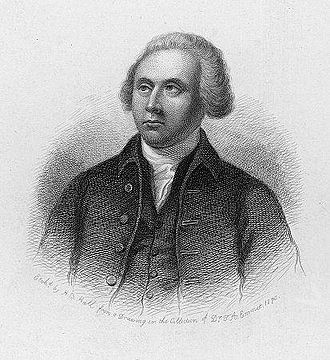
Thomas Nelson Jr. (December 26, 1738 – January 4, 1789) was a Founding Father of the United States, general in the Revolutionary War, member of the Continental Congress, and a Virginia planter and slave owner. In addition to serving many terms in the Virginia General Assembly, he twice represented Virginia in the Congress, where he signed the Declaration of Independence in 1776. Fellow Virginia legislators elected him to serve as the commonwealth's governor in 1781, the same year he fought as a brigadier general in the siege of Yorktown, the final battle of the war.
Early and family life
Nelson was the grandson of Thomas "Scotch Tom" Nelson"), an immigrant from [Cumberland, England, who was an early pioneer at Yorktown. Nelson Jr. was born in 1738 in Yorktown; his parents were Elizabeth Carter Burwell (daughter of Robert "King" Carter and widow of Nathaniel Burwell) and William Nelson, who was a leader of the colony and briefly served as governor.
Like many Virginians of the planter class, Nelson was sent to England for his education. He attended Newcome's School before entering Christ's College at Cambridge University in 1758.[1][2][3] He graduated in 1760 and returned to Virginia the following year. Nelson was an ancestor of Thomas Nelson Page and William Nelson Page.
Nelson married Lucy Grymes on July 29, 1762, and they had 13 children, 2 dying in infancy. Through her mother’s family, Mary Randolph, Lucy was the cousin of many of the founding fathers who served with her husband including Peyton Randolph, Benjamin Harrison, Carter Braxton, the Lee brothers and Thomas Jefferson.
Planter
Upon returning to Virginia, Nelson assisted his father in the operation of his several plantations, which depended on the labor of enslaved African Americans. Following his marriage to young widow Lucy Grymes Burwell, he also managed the estates left to her sons from her first marriage. These included Carter's Grove left to her son Nathaniel Burwell.
During the American Revolutionary War, Nelson bought 5,400 acres of land and 400 enslaved people in Prince William County from financially strapped Lewis Burwell (who died in 1779).[4]
Political career
York County voters elected Nelson to the Virginia House of Burgesses as a young man in 1761; he succeeded Robert Carter Nicholas in this part-time position. He served his first six terms alongside veteran delegate Dudley Digges.[5]
As Virginians became dissatisfied with colonial governance, Digges and Nelson were elected to represent York County during the five Virginia conventions that preceded statehood: the First Virginia Convention (which met in Williamsburg in 1774), the Second Virginia Convention (which met at St. John's Church in Richmond in March 1775), the Third Virginia Convention (which met in Richmond in the summer of 1775), the Fourth Virginia Convention (which met in the winter of 1775–1776 in Richmond and Williamsburg, which Nelson was unable to attend), and the Fifth Virginia Convention, which met in Williamsburg in the summer of 1776 (Nelson left this convention in May to attend the Continental Congress).[6]
William Digges (who had represented York County during the last Virginia Revolutionary Convention) also represented York County alongside Corbin Griffin at the first non-colonial session of the Virginia House of Delegates in the fall of 1776. But Nelson won the 1777 and 1778 elections to represent York County in the House of Delegates, where he served alongside Joseph Prentis. Prentis relinquished his seat in 1778 to serve on the Council of State and was replaced by Nelson on September 21, 1778.[7] In 1779, 1780, and 1781, Nelson served alongside William Reynolds and relinquished his legislative seat upon being elected governor of Virginia in June 1781.[8]
Nelson's first term in Congress continued until 1776 when a bout of illness forced his resignation for the 1778–1779 term. After his recovery, he was again elected and served another year.[9] During his first stint as a member of Congress, Nelson also returned to Virginia to play a key role in its Constitutional Convention in the spring of 1776. He returned to Congress to sign the Declaration of Independence that summer.
Thomas Nelson was one of the thirteen committee members appointed in the Continental Congress on June 12, 1776, to "prepare and digest the form of confederation" they drafted the Articles of Confederation.[10]
He was a brigadier general[11] of the Lower Virginia Militia and succeeded Thomas Jefferson as governor of Virginia (after William Fleming's nine days as acting governor). Nelson was engaged in the final siege of Yorktown.
According to legend,[12][13] he urged General George Washington (or, in some versions, Marquis de Lafayette) to fire on his own home, the Nelson House, where General Cornwallis had his headquarters, offering five guineas to the first man to hit his house.
Following his term as Virginia's governor, Nelson again won election to the Virginia House of Delegates. He represented York County alongside Joseph Prentis in the assemblies of 1782 and 1783 but was replaced by Nathaniel Nelson in the assembly of 1784–1785.[14] He and Prentis won the next election and again served in the sessions of 1786–1787 and 1787–1788. Robert Shield and William Nelson replaced them in the assembly of 1788.[15]
Death and remembrance
Nelson died at his son's home in Hanover County, Virginia, nine days after his fiftieth birthday. He is buried in the Grace Churchyard at Yorktown. Nelson was a member of Grace Church.
Colonel Innes made this tribute:
The illustrious General Thomas Nelson is no more! He paid the last great debt to nature, on Sunday, the fourth of the present month, at his estate in Hanover. He who undertakes barely to recite the exalted virtues which adorned the life of this great and good man, will unavoidably pronounce a panegyric on human nature. As a man, a citizen, a legislator, and a patriot, he exhibited a conduct untarnished and undebased by sordid or selfish interest, and strongly marked with the genuine characteristics of true religion, sound benevolence, and liberal policy.
Entertaining the most ardent love for civil and religious liberty, he was among the first of that glorious band of patriots whose exertions dashed and defeated the machinations of British tyranny, and gave United America freedom and independent empire. At a most important crisis, during the late struggle for American liberty, when this state appeared to be designated as the theatre of action for the contending armies, he was selected by the unanimous suffrage of the legislature to command the virtuous yeomanry of his country; in this honourable employment he remained until the end of the war; as a soldier, he was indefatigably active and coolly intrepid; resolute and undejected in misfortunes, he towered above distress, and struggled with the manifold difficulties to which his situation exposed him, with constancy and courage.
In the memorable year 1781, when the whole force of the southern British army was directed to the immediate subjugation of this state, he was called to the helm of government; this was a juncture which indeed 'tried men's souls.'
He did not avail himself of this opportunity to retire in the rear of danger; but on the contrary, took the field at the head of his countrymen; and at the hazard of his life, his fame, and individual fortune, by his decision and magnanimity, he saved not only his country, but all America, from disgrace, if not from total ruin. Of this truly patriotic and heroic conduct, the renowned commander in chief, with all the gallant officers of the combined armies employed at the siege of York, will bear ample testimony; this part of his conduct even contemporary jealousy, envy, and malignity were forced to approve, and this, more impartial posterity, if it can believe, will almost adore. If, after contemplating the splendid and heroic parts of his character, we shall inquire for the milder virtues of humanity, and seek for the man, we shall find the refined, beneficent, and social qualities of private life, through all its forms and combinations, so happily modified and united in him, that in the words of the darling poet of nature, it may be said: His life was gentle: and the elements so mixed in him, that nature might stand up And say to all the world—this was a man.[16]
Legacy and honors
"York Hall," Captain George Preston Blow House, 1914, the home of Thomas Nelson Jr., 1738–1739.
- Nelson County, Virginia, and Nelson County, Kentucky,[17] were named in his honor.
- The Virginia State Council for Higher Education named Thomas Nelson Community College in Thomas Nelson Jr's honor in 1967. The college was renamed in 2022, removing his name altogether.
- The Thomas Nelson High School was opened in 2012 in Nelson County, Kentucky.[18]
- The circa 1730 Nelson House built by "Scotch Tom" Nelson in Yorktown, Virginia, was occupied by Thomas Nelson Jr. during the Revolutionary War. It was designated as a National Historical Landmark. It is maintained as part of the Colonial National Historical Park by the U.S. National Park Service.
See also
Thomas Nelson Jr. | Descendants of the Signers of the Declaration of Independence
-=-=
AMERICAN CONNECTIONS
THOMAS NELSON (VA) was thirty-seven. The year
before, he and some pals had their own (York River) Tea Party. A plump,
red-haired businessman, plantation-owner, and reckless spender with a
lavish lifestyle, Nelson was land-rich and cash-poor. Like many of his
class he preferred a trade embargo to outright war, but gradually came to
see that there was only one way out of the mess.
During the war Nelson put up his estates as collateral for loans taken
out by the state. He was never reimbursed and died in poverty. As a
young man Nelson had been sent to England and educated at Cambridge
under Beilby Porteus, who in 1787 became bishop of London and then
chaplain to the king.
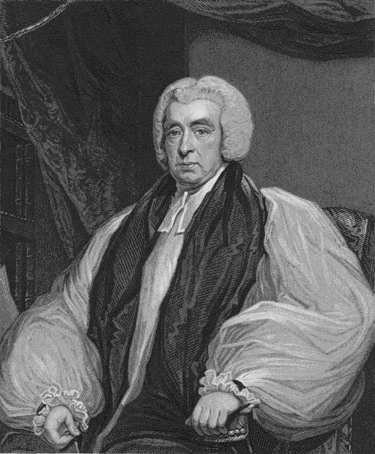
Beilby was born in Virginia and his family knew
the Nelsons well. He was a leading figure in the Society for Enforcing
the King's Proclamation against Immorality and Idleness and in the fight
against slavery ( Church of England reformer and a leading abolitionist in England. He was the first Anglican in a position of authority to seriously challenge the Church's position on slavery ). He also persuaded George III not to play cards on
Sunday. And worked hard to stop people Sunday-promenading (but failed).
When he heard that humble workers were selling their Bibles to buy
copies of Tom Paine's Age of Reason, Beilby indicted Thomas
Williams, a bookshop owner, for selling one of Paine's books. He hired
Thomas Erskine as prosecutor. Erskine visited the poverty-stricken
Williams (two kids had smallpox) and then urged mitigation. The judge
went easy on him: only three years. He also defended Thomas Paine himself.
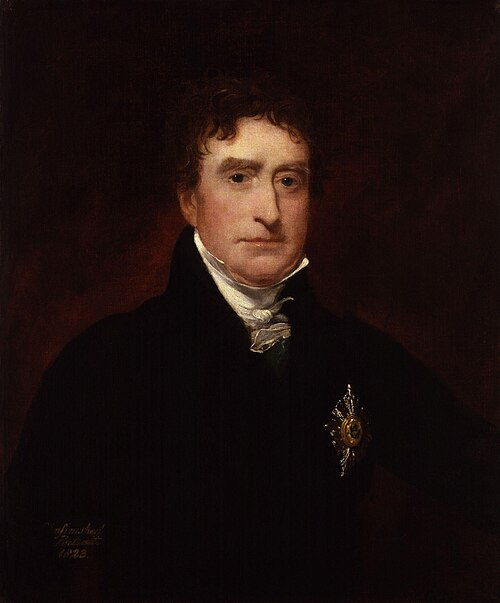
Erskine was a brilliant lawyer and specialized in military cases,
adultery, and radicals. In 1781 Erskine had his first opportunity to address a jury when he defended Lord George Gordon (Byron) who had been charged with high treason for instigating the anti-Catholic riots of 1780. Erskine's defence not only achieved Gordon's acquittal but also dealt a blow to the English legal doctrine of constructive treason.[19]^ The case established Erskine as the country's most successful barrister.[20]^
He defended many clients free (including a man
who had taken a shot at George III) and at age fifty-six was made lord
chancellor (head of the legal profession). Erskine was an animal lover
(he kept dogs, a goose, and a macaw) and introduced a "Prevention of
Cruelty to Animals" bill in Parliament. He also owned two pet leeches
named after the eminent surgeons Everhard Home and Henry Cline.
Henry Cline inclined to the political left, often appeared in the
witness box as a medical expert, and would have gone from history
unnoticed but for his major medical moment in 1777 when he identified
(and developed a surgical procedure to treat) a disease of the hand in
which fibrosis of the tissue of the palm pulls on the fingers causing
them to contract like hooks. For some strange reason, by 1833 Henry's
role in this had been forgotten when the entire matter was revisited by
a French surgeon who then got all the glory (the condition is now known,
after this French person, as "Dupuytren's contracture").
In 1794 Baron Guillaume Dupuytren was in the first class to graduate
from the new Paris Medical School, where he was taught the cutting-edge
stuff with which French medicine was leading the world: clinical
observation, progress charts, ward visits, and the rest. A military surgeon, he gained much esteem for treating Napoleon Bonaparte's hemorrhoids (which may have limited his mobility at the Battle of Waterloo), but he is best known today for his description of Dupuytren's contracture, which is named after him and on which he first operated in 1831 and published in The Lancet in 1834.[3]^
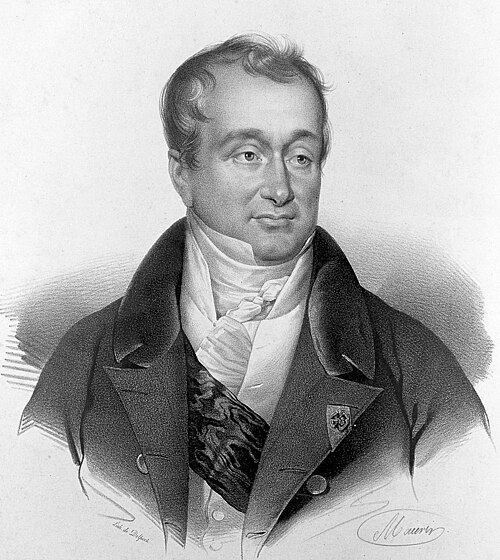
Dupuytren became known for great pathology, dissecting every death that occurred
in his wards. Dupuytren's other moment of glory came on the evening of
February 13, 1820, when he was called to the Théâtre Louvois in Paris
where the Duke de Berry (nephew of the French king Charles X) had been
stabbed in the chest by a deranged republican supporter of the
Bonapartes. Dupuytren tried the usual treatment for a stabbed man:
bleeding him. Unsurprisingly the duke expired.
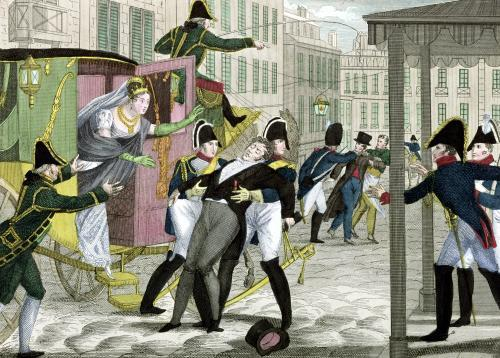
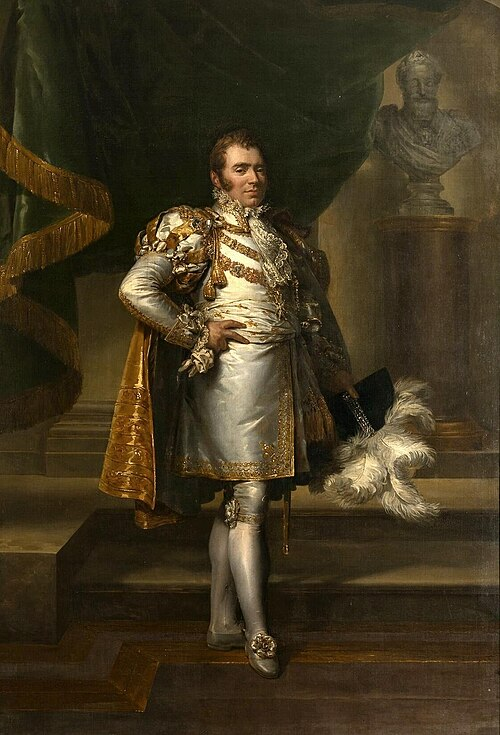
De Berry (and his pregnant duchess) had been enjoying the latest
chart-topper: Le Rossignol, a comic opera that played to
packed houses no fewer than 227 times (some said because there was
little else worth seeing). Composer Louis-Sebastien Lebrun was a tenor
turned composer who churned out many other comic operas (now thankfully
dusted off only for Ph.D. research work). Le Rossignol has
survived because of the virtuoso duet between the soprano and the flute,
whistled (as they say) in every Paris street.
A few years later a guitar arrangement of this amazingly popular piece
was done by guitarist and publisher Jean-Antoine Meissonnier. This was
the era of guitar mania in France, and Meissonnier even wrote an
arrangement of the overture to The Barber of Seville for
violin and guitar. Avoid it if you can. In 1814 just after he started
his Paris publishing business Meissonnier met a Catalan guitar virtuoso
who was to become a major client. Fernando Sor had left Spain for Paris
that year, then moved on to London the following year. In both places he
was an overnight rave. Nobody'd ever heard the instrument played so
brilliantly. In 1808, when Napoleon Bonaparte invaded Spain, Sor began to write nationalistic music for the guitar, often accompanied by patriotic lyrics. Sor was even part of traveling military bands that would play protest music on the streets.
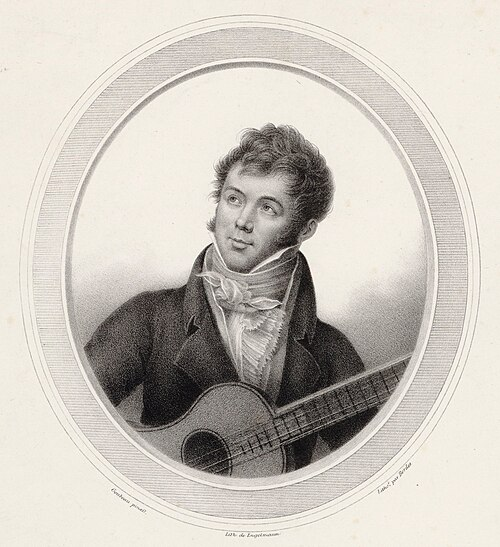
Sor developed the basic modern classical guitar technique
and by the 1820s he was an international star playing St. Petersburg,
Moscow, Berlin, and Warsaw before settling in Paris for the rest of his
life.
One of Sor's pupils was a young Irish actress, Fanny Kelly, who at age
seven had debuted at Drury Lane and after a brief tour in the provinces
returned to the theater for the next thirty-six years.
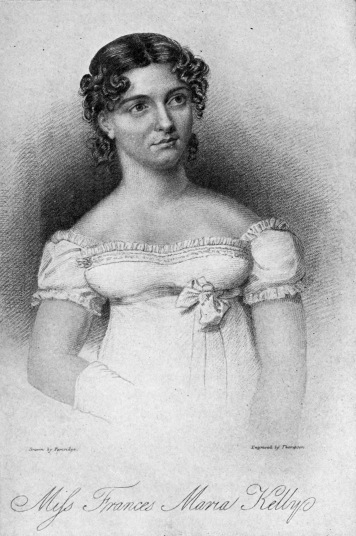
In 1816 she was shot at, onstage, by a lunatic who missed. In 1819 the drama reviewer
who habitually gave her good notices finally proposed marriage. She
turned him down primarily out of concern about the insanity that seemed
to run in his family. Back in 1795 he'd spent time in an asylum and a
year later his sister Mary Lamb had stabbed and killed her mother in the
kitchen. After a period in an asylum, she had been released into her
brother's care.
In spite of Fanny's marital no-thanks, she and the shy, stammering
boozer Charles Lamb remained good friends.
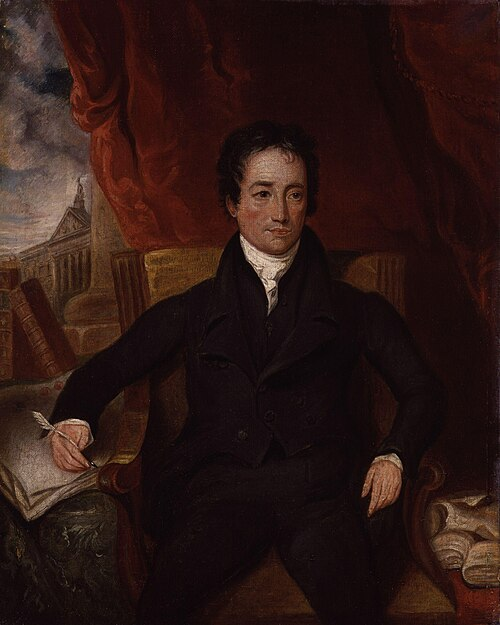
Already well known for his
children's book Lamb's Tales from Shakespeare, Lamb was by
now using his spare time (from an undemanding job as an accountancy
clerk) to write the Essays of Elia for which he would be
famous as the best English writer in the genre. Semi-autobiographical,
gentle in tone, full of whimsy and observation, the essays ran in the
London Magazine for thirteen years. And gained him the
friendship of Keats, Coleridge, and the Wordsworths.
One of Lamb's own favorite reads was the 1824 Our Village by
Mary Russell Mitford. Whose main reason for writing was a gambling,
high-living father who spent it faster than Mary could earn it. She
tried her hand at the kind of blood-and-guts historical tragedies
popular at time: Her Foscolo featured two deaths from joy,
two poisonings, two assassinations, and a hero killed. In spite of which
the play bombed. As did all her others except Rienzi, all
about the fourteenth-century governor of Rome assassinated for his
cruelty. In 1828 a smash hit at Drury Lane. Mary's one and only success.
Rienzi also did well at New York's Park Theater, where it
featured the rising American tragedy star Charlotte Cushman. An upscale establishment (though some were put off by constant spitting of tobacco juice); however, its elaborate facade designed by Marc Isambard Brunel, was not executed to save money). Later it was owned by JJ Astor.
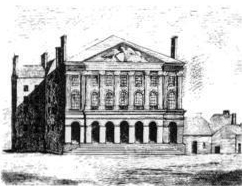
In 1844 Cushman (eighth generation descendent of an organizer of the Mayflower) arrived in London and was acclaimed as the Next Big Thing. After
five years of success she returned triumphant to the United States where
she earned so much money that by 1852 she decided to retire to Rome with
her English lover Matilda Hays.
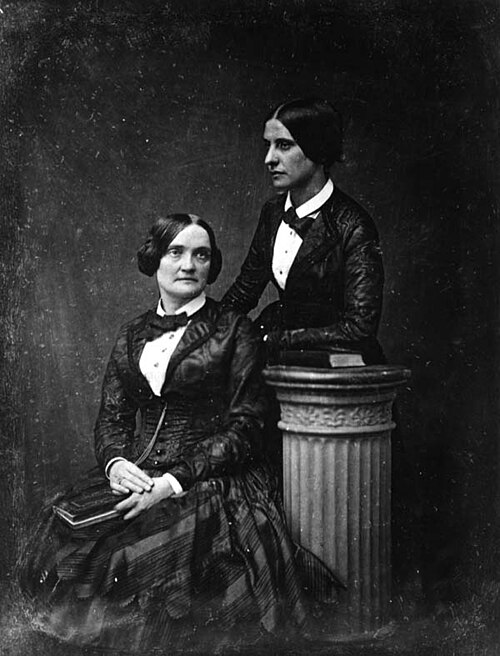
Charlotte Cushman (left) and Matilda Hays
Soon after, Cushman switched her affections to live-in American sculptor Emma Stubbs, with whom she would cohabit from then on.
Cushman was friends with artists, writers and politicians; when she came to Washington, D.C. in the 1860s, she often stayed at the home of Secretary of State William Seward, with whom she was very close friends. In July 1861, Seward introduced her to President Abraham Lincoln, who told her that Macbeth was his favorite Shakespearean play and that he hoped someday to see her in the role of Lady Macbeth. In 1863 she again returned to the United States, appearing on several occasions for the benefit of the US Sanitary Commission. Lincoln saw her perform in Macbeth in October at Grover's Theatre with his family. She reposed the role in one of several farewell performances at Booth's Theater.
During one of their frequent return journeys to London and America, in
1861 Cushman and Emma went to Fontainebleau, near Paris, to the château
of (another lesbian) painter Rosa Bonheur, famous for animal painting.
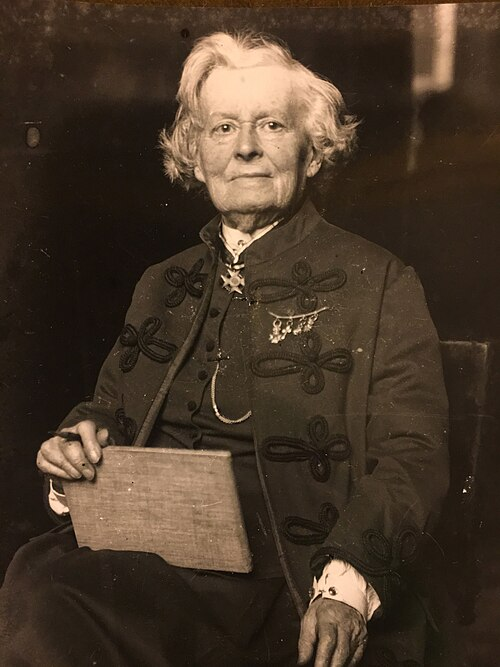
Her specialty was horses, and the château had been bought with the
proceeds from three equine paintings: Ploughing in the Nivernais, Horse
Fair, and Haymaking in the Auvergne.
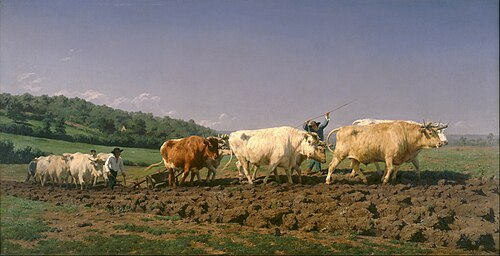
In the 1850s, Bonheur had to ask permission from the police to wear trousers, as this was her preferred attire to go to the sheep and cattle markets to study the animals she painted.[40]^
Bonheur's siblings included the animal painters Auguste Bonheur and Juliette Bonheur, as well as the animal sculptor Isidore Jules Bonheur. Francis Galton used the Bonheurs as an example of the eponymous "Hereditary Genius" in his 1869 essay.[10]^
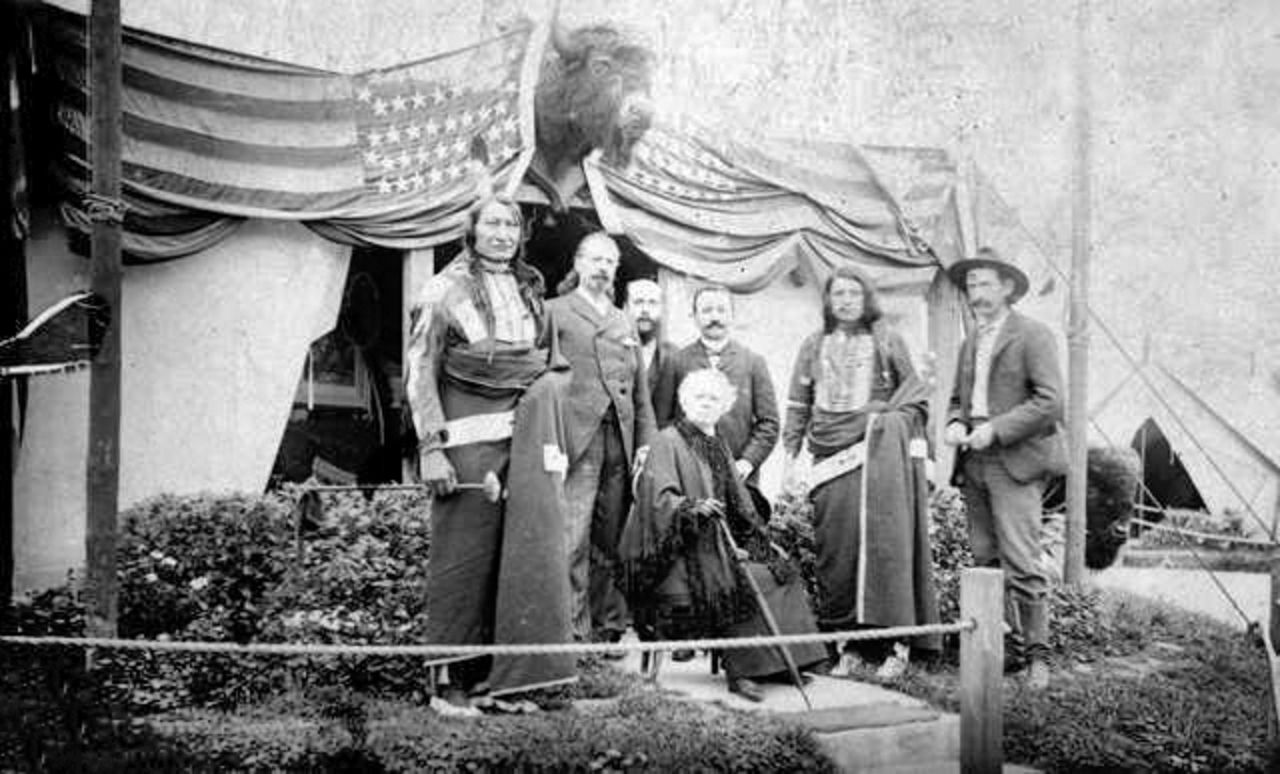
In the 1880s Bonheur became fascinated by Buffalo Bill Cody and after meeting him she
visited the Wild West Show in Paris in 1889 and produced several works
including The Buffalo Hunt, the image used from then on to
give Cody's publicity a distinctive look. And to differentiate the show
from its imitator.
Sam Cody, "King of Cowboys" (a Texan whose real name was Franklin
Cowdery), toured Britain with his own act, dressing and looking (long
hair, beard) just like Buffalo Bill.
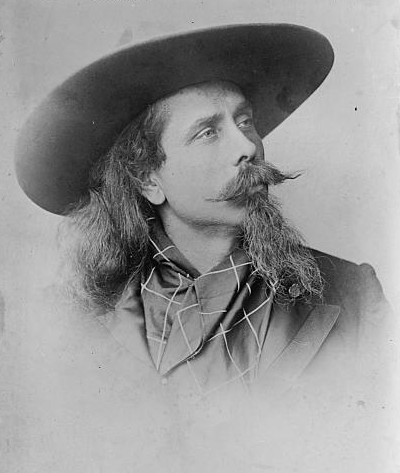
In 1900 Cody's theatrical show Klondike Nugget made him enough money to concentrate on his passion for kites.
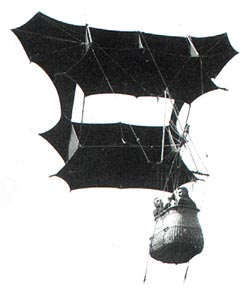
He is most famous for his work on the large kites known as Cody War-Kites, that were used by the British before World War I as a smaller alternative to balloons for artillery spotting. He was also the first man to fly an aeroplane built in Britain, on 17 October 1908.[1][2]^
By 1901 he had a man-carrying version. Small "lifting" kites set at intervals on a cable raised the main kite. Once it was flying, a man-carrying trolley, hung from a wheel running on the cable, could be hauled up to just below the kite. By 1906 Cody was
hoisting artillery observers as high as twenty-four hundred feet and had
become chief kite instructor to the British army.
On 7 August 1913, Cody was test flying his latest design, the Cody Floatplane, when it broke up at 200 feet (61 m) and he and his passenger, the cricketer William Evans, were killed at Ball Hill, Laffans Plain, Cove Common near Farnborough.[16]^ The two men, not strapped in, were thrown out of the aircraft.[17]^ The Royal Aero Club accident investigation concluded that the accident was due to "inherent structural weakness", and suggested that the two might have survived the crash if they had been strapped in.[17][18]^ Cody's body was buried with full military honours in the Aldershot Military Cemetery; the funeral procession drew an estimated crowd of 100,000.[19]^
In 1907 Cody's work excited the imagination of army engineer Ernest
Swinton, who included an essay ("The Kite") in a series on future
warfare he was writing for Blackwood's Magazine.
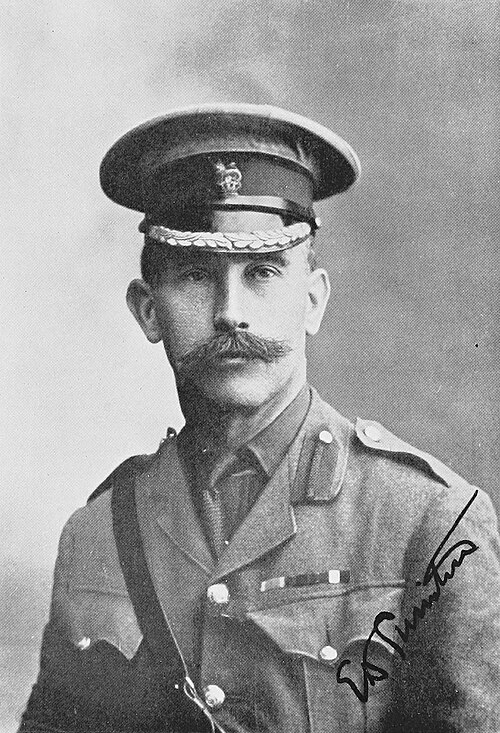
In 1914 Swinton was sent as a war correspondent to the trenches, where he saw
the murderous effect of machine-gun fire. This gave him the idea of an
armored vehicle capable of breaking down barbed wire and overrunning
machine-gun emplacements. By 1916 Swinton's idea (the tank) was in
action at the Battle of the Somme.
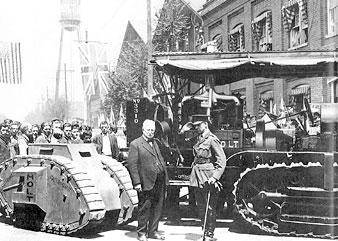
Swinton and Benjamin Holt in Stockton, California, on 22 April 1918, with a Holt caterpillar tractor (right) and a model of a British tank (left).
The new fighting vehicles had one minor problem: They were blind. No window and no periscope.
Unfortunately most optical glass was made in Germany. With that supply
cut off there was a desperate need to find other ways of making the
glass, now also needed for telescopes, binoculars, and rangefinders. In
America one of the scientists coopted to solve the problem was
University of Illinois chemist Edward Washburn, who specialized in
ceramic engineering. His other speciality was electrical conduction in
concentrated solutions. This esoteric discipline was to prove
earth-shatteringly important.
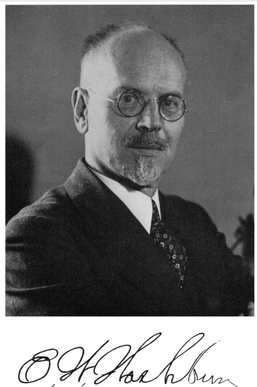
In due course Washburn became chief chemist at the National Bureau of
Standards in Washington, D.C. Meanwhile, in 1931, Harold Urey had
discovered deuterium (Nobel Prize 1934) , a hydrogen isotope (a different element with the same number of protons in its nucleus as hydrogen). Using electrolysis
Washburn succeeded in concentrating deuterium oxide in water. This
process drove off the hydrogen and left a concentrated solution of
deuterium known as "heavy" water. Which turned out to be part of the
process controlling atomic nuclear reactions.
Deuterium was also used to fission (split) atoms during the effort to
develop the atomic bomb. In 1940 Urey was put in charge of separating
out fissionable uranium-235 from nonfissionable uranium-238. He
succeeded and U-235 was exploded successfully over Hiroshima in 1945. Washburn recruited Robert Watson to come to Harvard after cracking DNA with Francis Crick.
Urey's Manhattan Project team included a young graduate student, Paul
Doty. Doty also served on the board of the Doty also served on the board of the Bulletin of the Atomic Scientists, linking his work to a broader public intellectual community concerned with atomic risk (famous for its Doomsday Clock; The main factors currently influencing the Clock are nuclear warfare, climate change, and artificial intelligence.[2][3]). Doty in 1973 founded the Belfer Center for Science and International Affairs at Harvard.
In 2005 one of the center's international council members was THOMAS
NELSON.