Morton, John
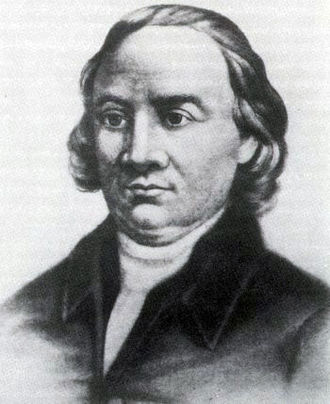
John Morton (1725 – April 1, 1777) was an American farmer, surveyor, and jurist from the Province of Pennsylvania and a Founding Father of the United States. As a delegate to the Continental Congress during the American Revolution, he was a signatory to the Continental Association and Declaration of Independence. Morton provided the swing vote that allowed Pennsylvania to vote in favor of the Declaration. Morton chaired the committee that wrote the Articles of Confederation, though he died before signing.
Early life
Morton was born in Ridley Township,[1] in Chester County, present-day Delaware County, Pennsylvania, in 1725, the exact month is unknown.[2] Morton's great-grandfather Martti Marttinen (Swedish: Mårten Mårtensson, or Morten Morteninpoika) was a Finn with roots in Rautalampi, Finland. In 1653, Marttinen emigrated from the Swedish land of Finland—then a constituent part of the Realm of Sweden—bringing son Martti Jr. to the Swedish colony of New Sweden.
The younger Marttinen's son Johan anglicized his name to become John Morton Sr., who died in 1724—shortly before the birth of his only son and namesake who would become the famed Finnish American statesman John Morton.[3][4][5][6][7] His mother, Mary Archer, was also of Finnish descent.[1][8] When Morton was about seven years old, his mother married John Sketchley, a farmer of English ancestry, who raised Morton.
Political career
Morton was elected to the Pennsylvania Provincial Assembly in 1756. The following year he was also appointed justice of the peace, an office he held until 1764. He served as a delegate to the Stamp Act Congress in 1765. He resigned from the Assembly in 1766 to serve as sheriff of Chester County. He returned to the Assembly in 1769 and was elected speaker in 1775. Meanwhile, his judicial career reached its pinnacle with his appointment as an associate justice of the Supreme Court of Pennsylvania in 1774.[9]
Morton was elected to the First Continental Congress in 1774 and the Second Continental Congress in 1775. He cautiously helped move Pennsylvania towards independence, though he opposed the radical Pennsylvania Constitution of 1776. When in June 1776 Congress began the debate on a resolution of independence, the Pennsylvania delegation was split, with Benjamin Franklin and James Wilson in favor of declaring independence, and John Dickinson and Robert Morris opposed.
Morton was uncommitted until July 1, when he sided with Franklin and Wilson. When the final vote was taken on July 2, Dickinson and Morris abstained, allowing the Pennsylvania delegation to support the resolution of independence. Morton signed the Declaration on August 2 with most of the other delegates.
Morton was chairman of the committee that wrote the Articles of Confederation, although he died, probably from tuberculosis, before the Articles were ratified.
Legacy
 John Morton's grave in the Old St. Paul's Church Burial Ground, Chester, Pennsylvania.
Morton was the first signer of the Declaration of Independence to die and was buried in Old St. Paul's Church Burial Ground (also known as the Old Swedish Burial Ground) in Chester, Pennsylvania. Morton's grave remained unmarked until October 1845, when the present-day 11-foot marble obelisk was erected by his descendants.[10]
The inscription on the west side of the memorial reads:
Dedicated to the memory of John Morton, A member of the First American Congress from the State of Pennsylvania, Assembled in New York in 1765, and of the next Congress, assembled in Philadelphia in 1774. Born A.D., 1724 - Died April 1777.[11]
The inscription of the east side of the memorial reads:
In voting by States upon the question of the Independence of the American Colonies, there was a tie until the vote of Pennsylvania was given, two members of which voted in the affirmative, and two in the negative. The tie continued until the vote of the last member, John Morton, decided the promulgation of the Glorious Diploma of American Freedom.[12]
The inscription on the south side of the memorial reads:
In 1775, while speaker of the Assembly of Pennsylvania, John Morton was elected a Member of Congress, and in the ever memorable session of 1776, he attended that august body for the last time, establishing his name in the grateful remembrance of the American People by signing the Declaration of Independence.[13]
The inscription on the north side of the memorial reads:
John Morton being censured by his friends for his boldness in giving his casting vote for the Declaration of Independence, his prophetic spirit dictated from his death bed the following message to them: 'Tell them they shall live to see the hour when they shall acknowledge it to have been the most glorious service I ever rendered to my country.[14]
John Morton's participation in the signing of the Declaration of Independence has been important in terms of the identity of Finnish Americans. In the early decades of the 20th century, Finnish immigrants had to face the question of who were "real Americans". They claimed to belong, through Delaware and Morton, to the "founding nationalities" of American history. An important role in the dissemination of information was played by amateur historian Reverend Salomon Ilmonen, who researched Delaware and John Morton for Delaware's 300th anniversary. Thanks to the Delaware colony and John Morton, American Finns' self-esteem rose and they celebrated the history of the Delaware colony spectacularly both in 1938 and in 1988.[7][15]
50 John Morton researchers from around the world arrived in Rautalampi in June 2010 to research Morton's family roots. They got to know, among other things, the Delaware monument in the town. According to DNA research, Morton has a 99.56% probability of Finnish descent. His family roots from Savonia have also been confirmed by research.[6] In July 2010, a restaurant Konttiravintola Morton, which was named after him, was opened in Rautalampi.[16]
In 2013 University of Turku established the John Morton Center for North American Studies, after it was concluded that the field of studies regarding North America was fragmented and a national institute was needed.[3][17]
Personal life
Morton married Ann Justis of Chester County, and together they had three sons and five daughters; Aaron, Sketchley, John, Mary, Sarah, Lydia, Ann and Elizabeth.[18] Morton's second son, Sketchley, was a major in the Pennsylvania Militia of the Continental Army during the American Revolutionary War.[19] Morton was an active member of the Anglican Church in Chester County.
See also
John Morton (American politician) - Wikipedia
It is said that Pennsylvania, because of John Morton’s deciding vote is nicknamed the “Keystone State”. For without Pennsylvania’s vote for independence the probability of it being adopted was doubtful.
Extra Connections:
In September 1777, after the Battle of Brandywine which the British won, Anne Morton, John Morton’s wife, fled across the Delaware River with what valuables she could take to Billingsport, New Jersey. It was during this time that many of the papers that belonged to John Morton, as well as household possessions were destroyed. On November 18, 1782, Anne Morton filed an accounting of the losses she suffered in compliance with an act of the General Assembly. This is unfortunate because this documentary evidence could have broadened our understanding of John Morton’s private and public life.
John Morton with his wife, Ann, had nine children: Aaron, the eldest child, Sketchley, a major in the Pennsylvania line of the Continental Line, Rebecca, John, who became a surgeon and died while a prisoner of war on the British ship, Falmouth in New York Harbor, Sarah, Lydia, Elizabeth, Mary, and Ann, whose husband, Captain John Davis fought in the Revolutionary War as an officer in the Pennsylvania line.
John Morton | Descendants of the Signers of the Declaration of Independence
AMERICAN CONNECTIONS
JOHN MORTON (PA) was about fifty-two. Up to then
he had been against independence, but at the last minute changed his
mind and cast the swing vote that brought Pennsylvania on the side of
revolt. In one sense Morton's was the single key vote for independence,
because without Pennsylvania the other states might not have decided to
go ahead with the fight. So let's hear it for Morton. A year after this
moment of glory in an otherwise dull, hardworking local-politics life
Morton died of tuberculosis.
One of Morton's friends in the Pennsylvania Provincial Assembly had been
"Mad" Anthony Wayne. Handsome and well-educated (some said rash and
drunk), Wayne's "fondness for the ladies" ruined his marriage. He had a
meteoric military rise to general and might have made it all the way
(some said to president). Wayne's lightning march to West Point when
Benedict Arnold was about to hand it over to the Brits earned him George
Washington's permanent support. Later Washington would make him general
of the American armies. "Mad" Anthony ended the war in debt (as did so
many) and headed for Georgia to run a rice plantation. It failed. In
1791 he aimed for Congress and got unwittingly embroiled in
ballot-stuffing.
The stuffer was lawyer Thomas Gibbon, who had a tendency to interpret
the law rather loosely.
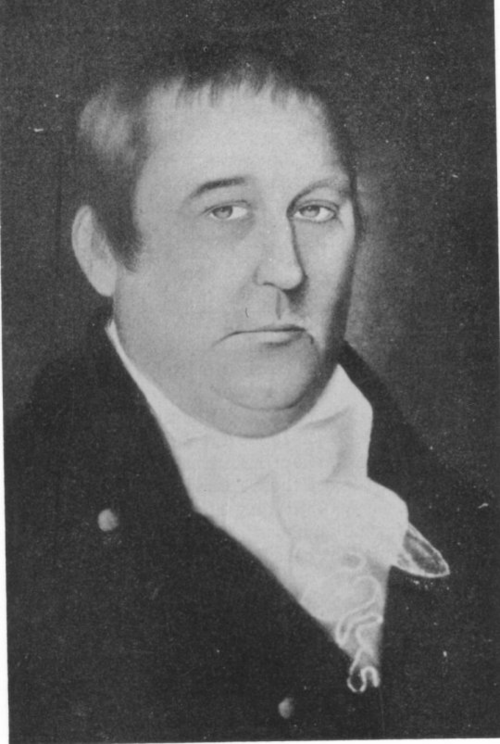
In December 1802 Gibbons wrote a letter to Johnathan Dayton, who then served as U.S. Senator from New Jersey, which in part asserted that the sexual liaison between Thomas Jefferson and Sally Hemings was a reality.[8]^ The letter revealed the names of all of Hemings’ three children, who were alive at the time, and some other information, that newspaper accounts of the day did not reveal.[9]^ The Gibbons letter had no known impact during Jefferson’s Presidency and was not known to participants in the controversy until the 1990s. Jefferson historians dropped their denial of the sexual liaison very soon after historian Joseph Ellis and others dumped a DNA report into national print and broadcast media without the foreknowledge of the DNA testing organizer, Dr. Eugene Foster.[10]^
Gibbon was a "high liver" and his pro-Brit sentiments (and rumors of less than loyal behavior) triggered attempts to sequester his property and a duel. Gibbon was also involved in the Great Yazoo Land Scam (see elsewhere). From which he emerged smelling like a rose. And rich. Then after his wife sued him for keeping
prostitutes in the house in 1817, he headed north and became involved in
a fight to break the monopoly (established by Signer Robert Livingston and inventor of the steamboat Robert Fulton)on steamboat routes between New York and
New Jersey. In the end he won, after a row with the U.S. Patent Office
about his own steamboat patent (in the Supreme Court with the help of Daniel Webster). Gibbons hired a young Cornelius Vanderbilt to captian his ferry).
The Patent Office had been set up (and then run on a shoestring) by
William Thornton. In 1802, President Jefferson appointed Thornton the first Superintendent of the Patent Office. When Washington was burned by the British in 1814, Thornton convinced them not to burn the Patent Office because of its importance to mankind. It is written[10]^ that a loaded cannon was aimed at the patent office to destroy it. Thornton "put himself before the gun, and in a frenzy of excitement exclaimed: 'Are you Englishmen or only Goths and Vandals? This is the Patent Office, a depository of the ingenuity of the American nation, in which the whole civilized world is interested. Would you destroy it? If so, fire away, and let the charge pass through my body.' The effect is said to have been magical upon the soldiers, and to have saved the Patent Office from destruction."
Thornton was also an amateur architect, despite his artistic ambitions not being supported by his Quaker family (he made his own camera obscura). He trained as a doctor at Edinburgh University)
In the 1820s, Thornton wrote of having been summoned to Mount Vernon in December 1799, in the hopes that he would be able to treat George Washington, but of having arrived after Washington's death; as a result, he devised a plan to resurrect Washington's frozen corpse by
(f)irst to thaw him in cold water, then to lay him in blankets, & by degrees & by friction to give him warmth, and to put into activity the minute blood vessels, at the same time to open a passage to the Lungs by the Trachaea, and to inflate them with air, to produce an artificial respiration, and to transfuse blood into him from a lamb.[15]^
Thornton's plan was rejected, however, despite "there (being) no doubt in (Thornton's) mind that (Washington's) restoration was possible."[15]^
Back in 1793, besides whipping up support for various South American revolutions, setting up a colony for ex-slaves in Sierra Leone, and
developing plans for a national university, Thornton had won George
Washington's approval for the "noble simplicity" of his design for the
proposed Capitol Building. Evidently too simple. And likely, some said,
to fall down. So shortly thereafter Frenchman Etienne Sulpice Hallet
(who'd come second in the contest) was called in to modify Thornton's
design.
In mysterious circumstances Hallet and his partner Joseph Cerneau were
then given a U.S. patent for an improved version of the Montgolfier
hydraulic ram. This used the power of trapped flowing water to force
more water up a tube. Known as "raising water," the technique was the
main method before electric pumps. Cerneau was a shadowy figure who had
spent time in Cuba before being asked to leave the island when his
fellow Freemasons made "representations" to the governor.
After he arrived in New York Cerneau set up an alternate Freemason organization
(the "Cerneau Grand Consistory") and proceeded to make Masonic waves by
inducting people and conferring ranks none of which he was empowered to
confer. In 1813 a group of Masons turned up from Cuba with proof of the
kind of nefarious activity Cerneau had been up to, down there, which
they said would be sufficient to blacken anybody's reputation.
The official Masonic organization in America asked Cerneau to cease and
desist but he didn't. His version of New York Freemasonry continued to
hold meetings and do whatever Masons did. In 1824, just before he
finally left for France in (no surprise) suspicious circumstances,
Cerneau managed to induct a new Masonic grand commander. None other than
the Marquis de Lafayette, who was at the beginning of his triumphal
farewell tour of the twenty-four states.
President Monroe's canny invitation to the lame old hero to come and say
good-bye achieved its purpose. The tour revived memories of the valiant
past and renewed America's sense of national pride. Everywhere he went
Lafayette was overwhelmed by crowds. He opened libraries, laid
foundation stones, dedicated public buildings, and had Masonic meetings.
And was accompanied for a while by Frances Wright, a strange
Englishwoman who wanted to be either his lover or adopted daughter, but
who got fed up with Lafayette's endless American groupies and dropped
out of the tour. Her father was a wealthy linen manufacturer and a political radical. He corresponded with Adam Smith and was sympathetic to the American patriots and French republicans,[5] including the Marquis de Lafayette, and Thomas Paine.
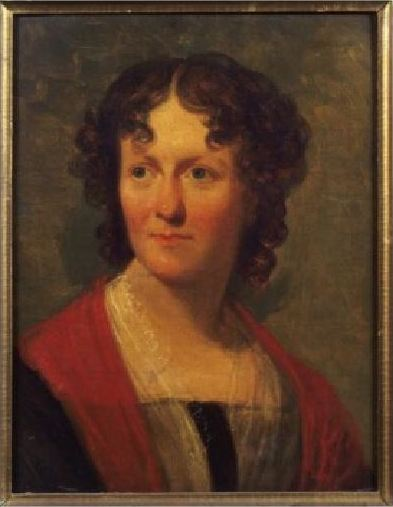
Wright then headed to the utopian community at New Harmony, Indiana, to
pick up some tips for her own similar venture planned at Nashoba, near
Memphis, Tennessee. Wright's idea was that slaves could be prepared for
freedom in an environment where they could mix as equals with whites.
Wright dressed in tunic and trousers, wore cropped hair, and addressed
"scandalous" (i.e., mixed male-female) audiences on such matters as
birth control. Naturally enough she became known as the "Great Red
Harlot."
Soon thereafter Nashoba went belly-up when the community overseer blew
the whistle on free-love practices and miscegenation. But not before
Frances had persuaded her friend Frances Trollope to come take a look.
Trollope (author Anthony's mother, whose novel influenced HB Stowe) looked, then headed for Cincinnati. Where she wrote Domestic Manners of the Americans (Brits
loved it, Americans didn't) and set up a money-making wax-museum project
titled "Infernal Regions," featuring dummies, mechanical figures, and
electrical shocks.
Most of the show's figure-modeling work was done by young sculptor Hiram
Powers. Who eventually made it to D.C., where he sculpted the president
and other luminaries, then headed for Florence, Italy. In 1843 he
produced his blockbuster (possibly the most influential American statue
ever) Greek Slave.
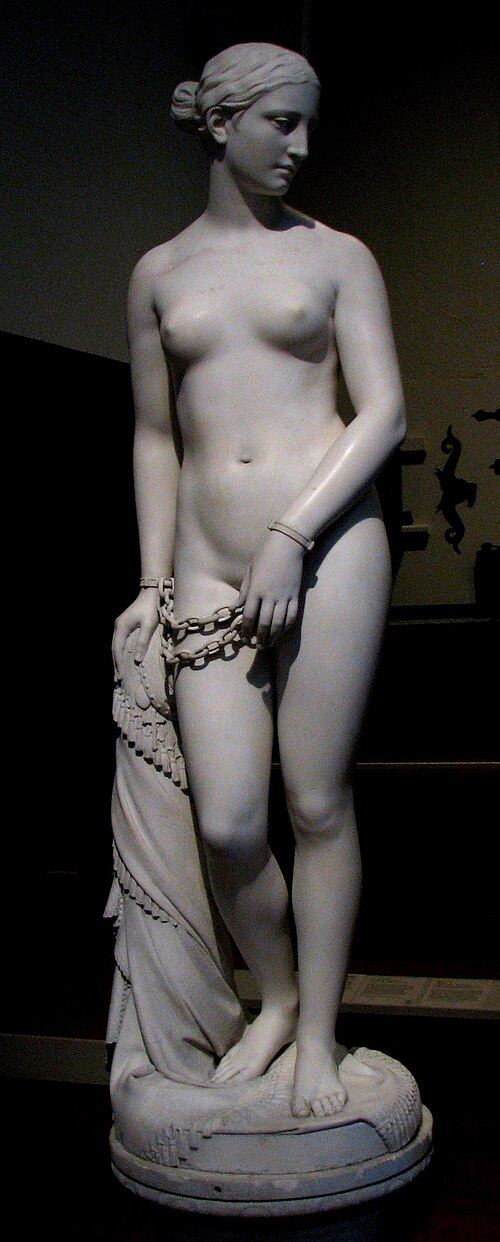
The statue of a nude, shackled slave girl,
her pose evoking the thought of terrible Turkish perversions, toured the
United States for two years to standing-room-only prurience. Not
everyone had the same reaction. At a preview in Florence, Elizabeth
Barrett Browning totally missed the hint of porn. It was also a hit at the Crystal Palace in 1851.
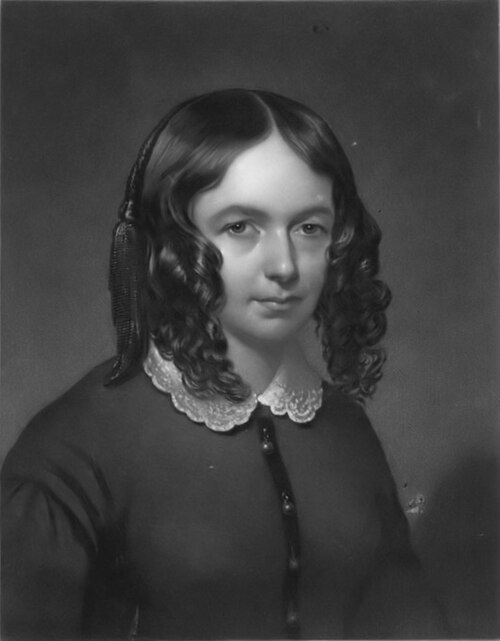
By this time Browning was a successful and admired poet, living a
blissfully happy life with her husband, Robert Browning, who had come
into her life from the outside world and saved her from hypochondria,
dimly lit bedrooms, and opium: Robert wrote saying he admired her
writing; she wrote back saying same to you; ninety-one visits and a year
later they eloped. Only one small cloud shaded their otherwise
saccharine existence: Elizabeth's interest in Daniel Dunglass Home, a
medium (or, as per Robert, a fake).
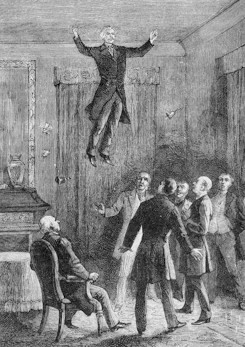
The levitation of Daniel Dunglas Home at Ward Cheney's house interpreted in a lithograph from Louis Figuier, Les Mystères de la science 1887
Things had started going bump around Home while he was growing up in the
United States. The poltergeist activity proved too much for the family
and Home was invited to leave home. He traveled from curtained séance to
curtained séance until in 1855 he fetched up in London where big names
including Ms. Browning held hands as tables tilted, levitated, and
rapped while instruments played, phantom figures appeared, and Mr. Home
extended himself.
In the era of credulity Home couldn't fail. There followed marriage to the tsar's goddaughter, a twenty-four-thousand-pound gift from a woman believer, and a U.S. tour. And meetings with the pope, the French emperor, and the king of Bavaria.
And the establishment of a posh spiritualist center in London.
In 1871 Home was given the ultimate cachet: Victorian England's leading
nerd fell for the mumbo-jumbo. William Crookes was president of
scientific everything and held forth on the same number of subjects. He
was Victoria's Victorian sage (and chemist, and physicist), who turned
his experiments into money (water treatment, sewage treatment, cow-pest
treatment), cultivated other science biggies like himself, and nearly
discovered X-rays.
Like many others at the time, Crookes was into sending electrical discharges through rarefied gases. During which procedure he produced a "stream" or "ray" that fluoresced whatever it hit, was warm to the touch, and cast shadows. In the 1890s Crookes was
able to do all this with his "Crookes Tube" (cathode ray tube), a
high-vacuum glass tube with two electrodes in it. The mystery rays went
from the cathode to the anode (i.e., from one end to the other).
In 1896 telephone billionaire Alexander Graham Bell had a Crookes tube
at his mansion in Nova Scotia and was forecasting the use of X-rays to
produce three-dimensional pictures of the inside of a body (a prediction
of the modern CT scan). In 1903 Bell also suggested using tiny pieces of
radium in tiny vacuum tubes placed inside a cancer to destroy it. By
this time the great man was enjoying well-earned retirement,
experimenting with electricity, radioactivity, and flight, while his
patents made him richer by the minute.
In the United Kingdom, Bell's patents were owned by the National
Telephone Company. In 1914, Mick Mannock, one of their clerks looking
for advancement, took off for Istanbul to work on an NTC subcontract,
rigging up a telephone network for the city. A few months later World
War I happened and Mannock and all other expat Brits were interned until
an exchange agreement in 1915 set them free.
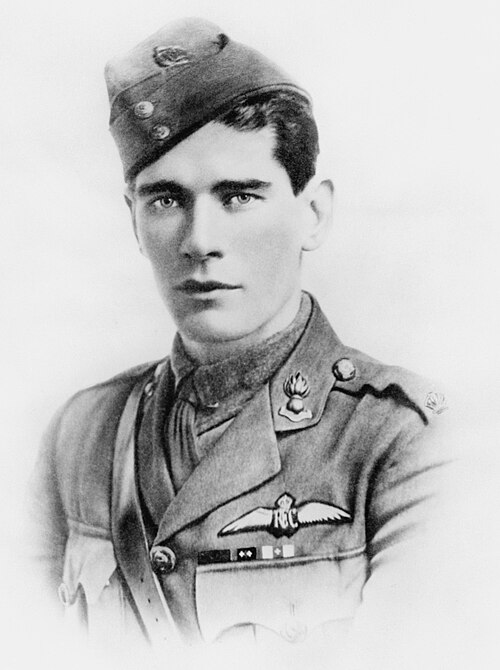
Mannock returned to Britain and by 1917 was a Royal Flying Corps fighter
ace in a squadron equipped with the latest Nieuport 17. The Nieuport was
a highly maneuverable French airframe built by designer Gustave Delage
and used by all the air forces in the war.
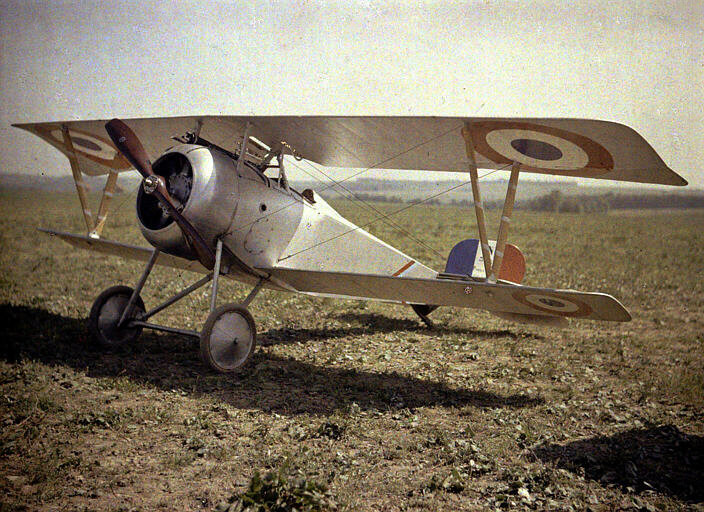
Carrying a synchronized machine gun that fired through the propeller, the plane had an unusual feature: The upper wings were twice the size of the lower wings. For
this reason the Nieuport was designated a "sesquiplane" (one-and-a-half
wing). Only one minor tendency detracted from its many good points: In a
steep dive the lower wing could sometimes come off.
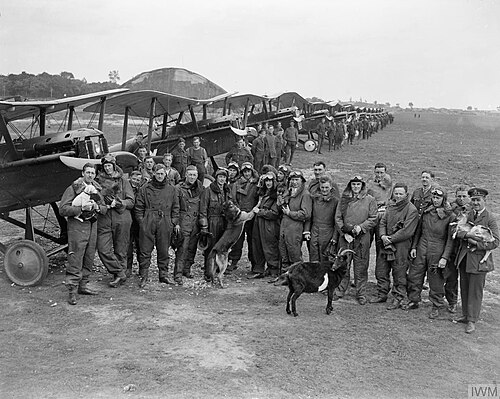
After the war, as private flying became fashionable, the same wing
design was taken up again by a New York company, which produced over two
hundred sesquiplane Brunner-Winkle "Birds" for such flying elites as
Lindbergh's wife. Another enthusiast was Russian-born aeroengineer Alec
Ulmann, who flew his Bird around Europe in the 1930s while working for
international companies such as Goodyear.
In 1950 Ulmann, who was also a high-performance car buff, set up a new
twelve-hour endurance race at Sebring, south of Orlando, Florida. In the
early years the race attracted all the great names: Stirling Moss
(who made several media appearances, including in the James Bond film Casino Royale (1967), Graham Hill, and Mario Andretti. Driving Porsches, Ferraris, Maseratis,
and Jaguars.
The race is still run today. In 1994 the winner was JOHN MORTON.